Investment-starved West Bengal will see the completion of two major industrial projects totalling an investment of nearly Rs 23,000 crores by this month end.
While one public sector project would be the largest dose of capital infusion in the state in recent times, the other would be the biggest dose of private sector investment under the present government.
One project is the Rs 17,000-crore greenfield steel plant of Steel Authority of India Ltd at Burnpur near Asansol and the other is the Rs 4600-crore power plant of the private sector RP Sanjiv Goenka group at Haldia in Purba Medinipur.
Both projects were conceived a few years ago with the steel project suffering a four-year delay due to a host of project-related factors as well as recent problems related to land acquisition.
The project generated massive employment during the construction phase and has already propelled regeneration of local economy around Burnpur where one of Asia’s oldest steel plant which started production in 1870 still stands. It is SAIL’s first greenfield plant since Bokaro Steel Plant
The first unit of the 600 MW Haldia Thermal Power Project of CESC is expected to be commissioned end of November and is among the biggest private sector investments since the All India Trinamool Congress government came to power in May 2011.
source: http://www.thehindu.com / The Hindu / Home> News> Cities> Kolkata / by Indrani Dutta / Kolkata – November 14th, 2014
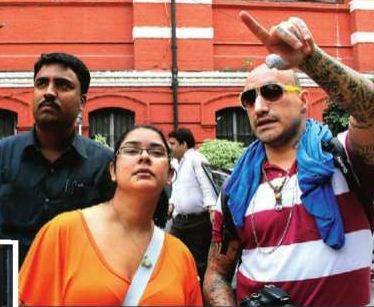
Aditi with Sidney Norling and Kolkata Police special branch cop in Kolkata. / www.newslocker.com / Times of India
Kolkata :
Thirty three years after she was adopted by Swedish parents and relocated to Stockholm, Rebecca Aditi Sandlert has returned to India for the first time in search of her roots. Born of a Nepali mother and a Bengali father on June 28, 1980, Aditi landed at an orphanage in Kolkata on November 4 when she was not even five months.
Her mother gave her up after she was left with no means to support the child after her husband left her following his family’s opposition to the marriage.
A few months later, in March 1981, Aditi was adopted by a Swedish couple.
She grew up in their care in Stockholm and married a Swedish, David, her childhood sweetheart and boy next-door.
Then late last year, Alva came to her life.
The birth of her daughter was the catalysis to embark on a journey in search of her birth mother that she has been postponing for years.
“Ever since I was a child, I have been confronted with questions about my ‘real’ parents and my ‘real’ country. The searching questions to which I had no answers initially came from classmates in school and continued through college and even when I started to work. Sweden was not a very mixed society in the 1980s and 1990s and I, with my brown skin and black hair, stood out among the predominant white people with blonde hair.
Though I always knew I was adopted as did my brother Fredrick aka Bijoy who was born in Kolkata, I didn’t want to be different from the rest of the kids. As I grew up, there would be phases when I would be very curious about my past and Indian culture and others when I would push the thoughts aside. I knew visiting India was crucial but kept pushing it back till Alva was born. She is Swedish like I am but she looks different as her parentage is half Indian, half Swedish.
She, too, will one day have questions and I want to have the answers,” explained Aditi, who is a qualified social worker at the Stockholm Public Service.
That family friend Sidney Norling, who has been making a documentary on the West’s perception of India and the reality, agreed to accompany her in the journey to the unknown helped. “Since I am adopted, too, I can relate to Aditi.Things crystallized when I discovered that my friend Pam who was also born in India had been adopted from the same orphanage as Aditi. I will be back again in December with Pam and her family as she wants to visit the city of her birth,” said Sidney , who has featured as a villain in two Swedish films and appeared on multiple music videos.
Any hesitation that Aditi may have had about the India trip disappeared when she connected with Bapan Das on Facebook. The Kolkata Police special branch cop hit the headlines after he helped a youth from Bihar who had been lost in Siliguri when he was a child reunited with his folks. “I do social work beyond duty hours and have contacts in Siliguri where I hail from.When Aditi contacted me after reading the news, I immediately agreed to help after work hours,” said Bapan.
Before Aditi arrived, Bapan contacted his friends in Siliguri to trace the nursing home where she was born. They have zeroed in on the facility at Hakimpara, Siliguri, owned by gynecologist KC Mitra. Now 84, the doctor has agreed to offer all help when Aditi reaches Siliguri.
Since reaching Kolkata, Aditi and Sidney have visited the orphanage on Elliot Road that finds mention in the adoption documents of 1981. They learned that the orphanage had moved from El liot Road in 1986 and had become Society for International Child Welfare on Col Biwas Road near Park Circus. The visit to the orphanage led to an interesting information. Aditi was due to be adopted by another Swedish couple. But when they failed to turn up within the requisite time, the current parents who were next in queue got her.
In a letter dated June 28, 1980, Aditi was praised by one Brinda Krishna from the orphanage. “She is a very happy baby and smiles a lot. She responds to us talking to her and wants to be held and cuddled a lot…,” the letter read.
Going ahead, Aditi knows she is following a blind lead and acknowledges that finding her mother will require more than a stroke of luck. “In all likelihood, I won’t find my mother. It is extremely unlikely. I knew it even before I boarded the plane to India. I came here because I didn’t want to one day regret for not trying. I will give my best shot.
Let’s see what happens. But this journey itself is an experience of self-discovery. I am not obsessed with the goal,” she said.
But what if that luck does smile on her and she meets her biological mother? “I want to give her a hug and say a big thank you. I can’t even imagine her trauma when she gave up her five-month-old baby to an orphanage. Having then grown up with doting parents in a country that is not burdened with over-population and poverty, I realize I have had a privileged life. And it was all due to the brave decision of my birth mother,” said Aditi.
source: http://www.timesofindia.indiatimes.com / The Times of India / Home> City> Kolkata / by Subhro Niyogi & Udit Prasanna Mukherji, TNN / November 20th, 2014
Innovation and creativity were the hallmarks of the third Times NIE Science Project Competition held on Saturday at NSHM Knowledge Campus, Kolkata. Presented by NSHM Knowledge Campus, the event saw students from over 50 schools impressing the distinguished panel of judges with their projects on Physical Science, Life Science or Social Science. The projects were evaluated on three primary parameters: innovation, application and presentation.
The projects made by the students ranged from nanotechnology, hydraulics, cardiology, hovercraft, Everest climber, USB fan to smart stick for the blind, virtual reality, solar car, windmill, gastro-entro system, bottle tornado, robotics, gyro boat, Kepler space telescope and solar sound radio receiver.
The judges were Dr. Abhijit Chakraborty, professor and head, Crystallography and Molecular Biology Division, Saha Institute of Nuclear Physics; Dr. Rajendra Nath Basu, chief scientist and head, Fuel Cell and Battery Division, CSIR-Central Glass & Ceramic Research Institute, Kolkata and Dr Manish C Bagchi, CSIR Emeritus Scientist, School of Bioscience & Engineering, Jadavpur University.
The first prize was won by La Martiniere School for Boys for their project ‘Auto control street light’ which showed how street lights can glow for one or two km only on detecting vehicular movement. In second place was Calcutta Girls High School for their project, ‘Flix’, a hydraulic robotic arm which was based on Pascal’s Law. The Heritage School came third for their project on the advantages of automatic irrigation system. Special Appreciation Awards were given to 10 schools.
“At NSHM, we believe in learning by doing. In fact, we give emphasis on experiential learning. The kind of curriculum we offer are not typical academic courses. We call them professional degree courses which are different from the run-of-the-mill or traditional academic courses,” said Cecil Antony, managing trustee, NSHM Knowledge Campus.
source: http://www.timesofindia.indiatimes.com / The Times of India / Home> City> Kolkata / by Althea Phillips & Monalisa Chakraborty, TNN / November 17th, 2014
A short film on a young girl’s fight to stave off marriage and help her family make ends meet drew appreciation at the film festival on Sunday.
Made by Oscar winning American short filmmaker Megan Mylan, the film is about a beneficiary of the state government’s Kanyashree and Sabala schemes that are aimed at empowering the women of rural Bengal. Mylan said she read about 16-year-old Monika Barman of Cooch Behar in an article and was stunned by her resolve.
Titled ‘After My Garden Grows’, the ten-minute film is more like a clip that conveys a strong message. It shows Monika working to develop her family’s own garden on a plot of land where she grows vegetables and helps her father earn by selling them at the local market. She is shown discussing the perils of an early marriage with peers and village elders and asking everyone around not to get their daughters married at an early age.
“I have just shot what was really happening. It was amazing to see Monika changing the lives of adolescents in her village and fighting a tradition. Through my film, I have tried to portray what adolescent girls in India are faced with,” said Mylan, while speaking to newspersons on Sunday.
She was accompanied by the state child and women’s development minister Shashi Panja, who felt the film showed that the government’s initiatives are bearing fruit. “Both Monika and her elder sister Kanika, who got married and had a child at the age of 17, are beneficiaries of our schemes. The Kanyashree and Sabala schemes have been helping hundreds like them. Girls have now been made aware that they shouldn’t be getting married before 18. I congratulate Megan for having handled this gender issue so sensitively,” said the minister.
Monika is now back in school and continues to tend to her garden which helps her family earn money. Monika, who was present at the event, said she would not get married in the near future. “Now, I have the courage and the support to refuse marriage proposals. My father has been very supportive and he wants me to be self-sufficient. I hope other girls of my village follows my example,” she said.
The film could be used by the state government to project its rural schemes, Panja said. “We are exploring the possibility. It is indeed a good advertisement for our schemes,” she said.
source: http://www.timesofindia.indiatimes.com / The Times of India / Home> City> Kolkata / TNN / November 17th, 2014
Building a bridge between two languages is not easy. But S Krishnamurthi (aka Calcutta Krishnamurthi), who died recently in the city, did exactly that by translating major works in Tamil into Bengali and vice versa in a career spanning more than five decades. He translated the works of veteran Bengali writers like Sarat Chandra Chattopadhyay, Mahasweta Devi, Sunil Gangopadhyay and Bibhutibhushan Bandyopadhyay into Tamil. Similarly, he translated classic Tamil Sangam literature ‘Tirukkural’ and many modern Tamil literary works into Bengali.
Krishnamurthi’s translation of Indira Parthasarathi’s novel “Kuruthippunal” into Bengali won him the Sahitya Akademi award in 1991. “He would invite visiting Tamil scholars and writers home for dinner after long conversations in the Bharathi Tamil Sangam in Calcutta. It would lead to a lot of discussions on literature in Tamil as well as in Bengali,” said Tirupur Krishnan, scholar and writer. Krishnamurthi died on September 7 in the city after suffering from illness. Speaking at a condolence meet organized by the Tamil Heritage Trust a couple of days ago, Krishnan said, “He should have been recognized in Chennai like the way he was in Bengal.”
Born in Pudukkottai in 1929, Krishnamurthi obtained his MA in English literature from Nagpur University. Even though he was fluent in his mother-tongue Tamil, he learnt other languages like Hindi, Bengali, Sanskrit, English and German. While he was working with the audit department of the Government of India in the then Madras state in 1955, he was transferred to Calcutta. He embraced Calcutta as his second home since then.
“After Subramanya Bharathi who translated Rabindranath Tagore’s works into Tamil, Krishnamurthi was the one who took up the challenge. He also translated English and Hindi books into Tamil, including “Nehru, Ideology and Practice”, written by veteran communist leader EMS Namboodiripad,” said R Gopu, a software engineer.
Krishnamurthi wrote biographies of Nazrul Islam, Sarat Chandra, Munshi Premchand and Ishwar Chandra Vidyasagar in Tamil. K Mohan, a retired school teacher, said, “Krishnamurthi translated a Tagore story studded with proverbs with great expertise. It was a great attempt as he did not want to lose the flavour in Tamil. This was the main reason why communist leader and former chief minister of West Bengal Jyoti Basu praised him for the beauty of his Bengali,” he said. Even though Krishnamurthi didn’t want to leave Kolkata, he had been living in Chennai for more than a year due to old-age related illness. He is survived by a daughter and a son.
source: http://www.timesofindia.indiatimes.com / The Times of India / Home> City> Chennai / by M. T. Saju, TNN / September 16th, 2014
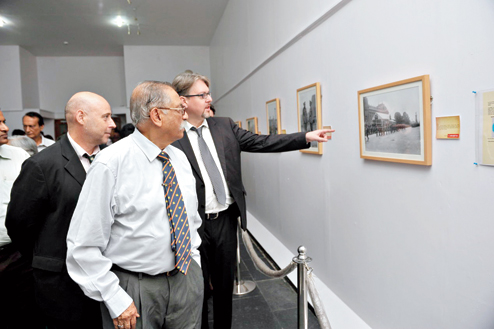
French consul-general Fabrice Etienne, director of Alliance Francaise du Bengale Stephane Amalir and General (retd) Shankar Roy Chowdhury at Victoria Memorial. (Anindya Shankar Ray)
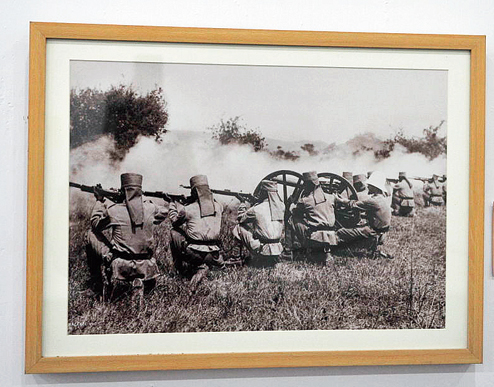
On a day when French President Francois Hollande was to pay a tribute to the 6,00,000 foreign soldiers who fell in World War I, Alliance Francaise du Bengale, in association with Victoria Memorial Hall, opened to the public a photography exhibition titled “War and the colonies”, presenting glimpses of soldiers at work on French soil from lands as varied as India, Ireland and Senegal, 100 years after the Great War.
“Around 28,500 Indian soldiers came to fight on French and Belgian soil as part of the British army by end-1914. They faced the severe winter of 1914-15 and the war in Neuve Chapelle in March, Ypres in April, Festubert in May and Los in September,” said French consul-general Fabrice Etienne at the inauguration of the exhibition at Victoria Memorial.
“From 1914 to 1918, around 90,000 soldiers in various capacities fought for the freedom of France and Belgium. Of them, 8,500 died and 50,000 were injured. France will never forget the suffering and the heroism of these men,” he added.
General (retd) Shankar Roy Chowdhury pointed out that WWI was no concern of India. “It was not their war. But the Indian army was a professional one and part of the assets of the British Empire. What choice did they have?”
Two factors loaded the situation against them. “They were meant for imperial policing and not equipped for a full-blown battle. Within a week of arrival in Marseille, they were put in the assault zone. Also, their efficiency relied heavily on their personal bond with their British officers. But the 10-12 officers there were in each battalion died within the first week. Young officers, fresh from Britain, were sent in haste to lead the Indian troops.
“No wonder Indians did not fare well in France and Flanders, and were moved out to Asia Minor. Still they got nine Victoria Crosses for gallantry,” Roy Chowdhury said.
Without the colonies, the Allies could not have won, said Kaushik Roy, a professor of history at Jadavpur University. “Of a population of 235 million, 1.2 million Indians were serving in WWI. This is a significant percentage. Raised voluntarily, mainly from Meerut and Lahore, they were mostly illiterate farmers who did not write much except for some letters home. The poorest were not taken as they were thought to be malnourished. Punjabi Muslims, Sikhs, Garhwalis and Gorkhas were the dominant segments while Bengalis and Madrasis were under-represented,” Roy said.
WWI resulted in fragmented identity-building of each race, rather than evoke any pan-Indianness, he added.
The evening concluded with Theophilus Benjamin playing works of French composers on the guitar.
The exhibition is on till November 23, except Monday.
source: http://www.telegraphindia.com / The Telegraph, Calcutta / Front Page> Calcutta> Story> Caleidoscope / by Sudeshna Banerjee / Sunday – November 16th, 2014
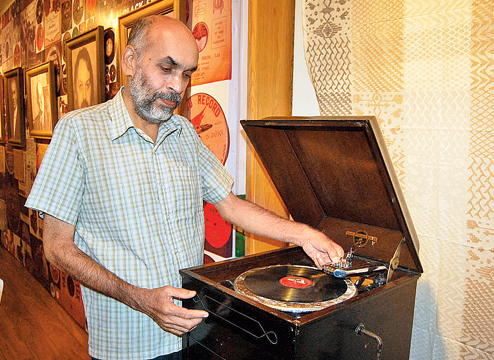
Suresh Chandvankar at the inauguration of the digitising centre at Weavers Studio. Picture by Bibhas Lodh
If you have inherited a collection of old gramophone records you have no idea how to preserve or perhaps even where to play, this is the address where to head. Weavers Studio Centre for the Arts has opened a digitising centre in its gallery space in Ballygunge Place where old and rare records are being digitised.
“We want collectors to come forward. We will digitise and archive their records and return the discs to them along with a CD of what we archived. We have started with 400 records and can digitise two records per day,” said founder Darshan Shah. Early 20th century single-sided cardboard Nicole, shellac Pathe, paper records and pre-World War I Beka-Grand records form part of their acquisition, sourced from flea markets. “We are working on a wide range of genres — Hindustani and Carnatic classical, folk, early film or theatre music, Bengali songs and speeches of leaders,” Shah added.
The centre wishes to disseminate the digitised content among music lovers and researchers through audio-visual exhibitions, listening kiosks and portals, guided listening sessions etc. It has set up a permanent listening facility for visitors to enjoy the digitised sound, on two computers with headphones and 10 Android phones gifted by Tata Docomo. On each phone, close to 150 audio clips have been uploaded, which are being changed depending on the theme of the exhibition organised most recently by the centre. “We can take the phones to schools or to other cities when we hold travelling exhibitions,” Shah said.
Schools are also being invited to send students over to experience India’s audio history. One can walk in and listen to any of the digitised material like the “Tryst with destiny” speech of Jawaharlal Nehru or Swami Vivekananda’s Chicago address, or voices of Subhas Chandra Bose and Mahatma Gandhi. There are also 70 versions of Vande Mataram. The listening facility is available on weekdays, 3pm to 7pm.
The centre was inaugurated by Suresh Chandvankar, the secretary of the Society of Indian Record Collectors in Mumbai. “In Calcutta, where India’s first commercial recording was done in 1902 by Gauhar Jaan for The Gramophone Company, there are people with knowledge in the field but not many are ready to come forward and share it. This is the first time that a digital archive is being set up and exhibitions on records being held by a private body unsupported by the government,” said Chandvankar, who has bought an apartment on the outskirts of Mumbai just to store his collection of records.
Even after a record has been digitised, Chandvankar argues for its preservation. “Digital can never replace the physical form. When a new technology comes, the physical recording will be needed again.”
The future of preservation, he believes, is a virtual archive. “Put all digital material on Cloud. And for outreach, the best channel is social media,” he advised. “But when it comes to sound quality, aficionados abroad are getting tired of the digital sound. So a revival of the disc is on the cards. In fact, many of my collector friends believe that the 78 rpm disc has the best sound quality.”
source: http://www.telegraphindia.com / The Telegraph, Calcutta / Front Page> Calcutta> Story / by Sudeshna Banerjee / Sunday – November 16th, 2014
They had originated and proliferated in India, possibly in Tanjore, in the late 16th or early 17th century under the patronage of the Mughal emperors. But, with the passage of time, Kalamkari paintings on textiles faded into oblivion.
Thousands of miles away, a museum in France on the Swiss border has preserved some of the oldest specimens of Kalamkari paintings on textiles. These are very rare to find even in museums within the country.
For a fortnight starting on Wednesday, the textile gallery of the Indian Museum will showcase the world famous ‘Tapis Moghol’ — some of the most elaborate designs replete with mysterious animals, birds, foliage and flowers — that hold the key to many stories of the times. The ‘Tapis Moghol’, that dates back to the late 16th or early 17th century, has been preserved for the world at the En Musea De L’Impression Sur Etoffes De Mulhouse or the Museum of Printed Textiles at Mulhouse, France.
Kalamkari paintings in its earliest form were motifs painted on large wall hangings that were used to decorate the altar behind the deity. Kalamkari, though, is not a lost art form in the sense that it is still practised in both the painted and block printed versions. But, we have lost most of the original designs that were popular when it was used as an altar backdrop in South Indian temples.
“A gentleman called Funffrock, who was an employee of the French East India Company, was posted in Tanjore. The Frenchman was immensely interested in the traditional art form and got a cotton cloth, measuring eight feet by eight feet, done up with rich intricate designs that showcased the best motifs of that time. With time, this became the focal exhibit, around which the other collections of the period grew. The exhibition will give the city a glimpse of the Funffrock collection,” explained Ruby Palchowdhury, spokesperson of the Crafts Council of West Bengal, which is a wing of the Crafts Council of India and is funded by the Centre.
Textile and culture ministries and the Alliance Francaise have funded the expo that will have 25 panels to show off design details and the stories underneath. The exhibition has been curated by ethnic historian Lotika Varadarajan.
source: http://www.timesofindia.indiatimes.com / The Times of India / Home> City> Kolkata / by Jhumli Mukherjee Pandey, TNN / November 16th, 2014
Once Okamoto Yoshiko starts speaking on the history of Bengal, jaws are bound to drop. Yoshiko, a history scholar of modern Japanese thought at Institute of Asian Cultural Studies of International Christian University, Tokyo, is tracing the untold history of Bengal and the city in connection with modern Japanese thought.
For last few days, she has been running from one house to another belonging to forgotten luminaries of Calcutta in search of documents, old photographs and books to track the vibrant bond Japan shared with Bengal more than 100 years ago.
Recently, Yoshiko was sifting through old books and documents at the house of Tapan Sen, great grandson of Narendranath Sen (1843-1911), the founder-editor of nationalist newspaper, Indian Mirror.
“He was a liberal Hindu, with a deep interest in other religions, particularly Buddhism. He was the founder of the Theosophical Society of Bengal,” Yoshiko said.
Yoshiko is working towards a book on an international religious conference that was to be held in Japan — a cancelled event at Kyoto in 1903. The key mover of the conference was Okakura Kakuzo (1863 -1913). This was after Kakuzo and art historian and Japanese monk Oda Tokuno came to Kolkata in 1902 and 1903 and met literary, cultural and spiritual luminaries like Rabindranath Tagore, Swami Vivekananda and Sister Nivedita. Narendranath Sen was elected chairman of the committee for the religious conference, Yoshiko said.
Why did the conference not shape up? “One of the reasons was the premature death of Swami Vivekananda. Without him the conference would have lost its sheen. There were other reasons as well. But the cancelled conference became a threshold of modern Japanese thought and forged an international intellectual network. With the idea of one-Asia, Kakuzo ceased to identify himself as Japanese but an Asian,” Yoshiko explained. The conference evoked world-wide response. Two Indian monks — Swami Rama Tirtha and Agamiya Parama Tattava — travelled to Tokyo for the conference.
Kakuzo had some wonderful intellectual exchanges with Narendranath Sen, who first interviewed Vivekananda after his return to India. In fact, Narendranath was the prime mover behind Vivekananda’s supposed participation at the Kyoto conference, the scholar explained. Yoshiko was sad that the original house of Narendranath Sen was razed.
Like Tagore, Kakuzo’s prophesy in his book, ‘The Ideas of the East’, proved true a century later, she said. “He noted that Japan’s rapid modernization was not universally applauded in Asia,” Yoshiko said.
source: http://www.timesofindia.indiatimes.com / The Times of India / Home> City> Kolkata / by Krishnendu Bandyopadhyay, TNN / November 13th, 2014
The Kathgola Palace, where the then chief of the British East India Company had met Mir Jafar after the Battle of Plassey in 1757, has regained some of its lost glory. The house of the Jagat Seth family, pre-eminent for its powerful moneylenders and bankers in the first half of the 18th century, has been restored, too.
Decrepit and prey to vandals till a couple of years back, both buildings are now popular tourist spots in Murshidabad, which was the capital of undivided Bengal during the Mughal era.
“They are now sustainable heritage properties and generate Rs 10 crore in tourism revenue,” said Pradip Chopra of the PS Group, who is also president of Murshidabad Heritage Development Society.
The Murshidabad model of conservation will be showcased along with other successful conservation projects in a seminar titled “Get the best out of your Heritage Property/Assets” at Palladian Lounge on November 22 and 23. The seminar will be part of “Resurgence — 3rd Murshidabad Heritage Festival 2014” to be held at Hazarduari palace and Kathgola palace in Murshidabad.
The Murshidabad Heritage Development Society is organising the festival, along with CREDAI Bengal, The Palladian-Asian Hotels North Limited, Hotels and Restaurants Association of Eastern India, The Calcutta Gastronomes, Intach and ASI.
“It will bring together stakeholders like property owners, developers, tour operators, hoteliers, restaurateurs and conservationists to develop a sustainable conservation effort,” said Anjan Mitra, architect and seminar coordinator.
The seminar will have an eclectic mix of speakers, including Debasish Nayak, the director of the Centre for Heritage Management, Ahmedabad University, civil engineer R.K. Anil, Aman Nath of Neemrana Fort Palace Hotel, Raj Basu of Help Tourism, Kasturi Gupta Menon, the chairperson of Crafts Council of India, and Sunil Rampuria, a heritage property owner in Bikaner.
Heritage is not just the building but also history, memories, lifestyles, craft, cuisine and a host of other things that need to be conserved holistically, said Mitra. So the inclusion of stakeholders like The Calcutta Gastronomes represented by chef Shaun Kenworthy.
The teaser launch of the seminar at Palladian Lounge on Tuesday showcased the royal vegetarian cuisine of Murshidabad, called Sheherwali cuisine.
source: http://www.telegraphindia.com / The Telegraph, Calcutta / Front Page> Calcutta> Story / Thursday – November 13th, 2014