All posts by wellnmed@gmail.com

One stop, three starts

ApolloKOLKATA04dec2014

The Apollo Hospitals group will set up a medical college in the city with 150 MBBS and 50 postgraduate seats and a 1,000-bed hospital.

The state government has given a 14-acre plot at Calcutta Riverside in Maheshtala, on the southern fringe, to the group for setting up the medical college. The institution will be the fourth private medical college in Bengal.

The township is coming up on 262 acres on the banks of the Hooghly, about 20km from the city. Apart from residential apartments, Calcutta Riverside includes a medical college, a film city and a sports academy.

“With the Apollo Institute of Medical Sciences and Research, Calcutta will become one of the health hubs. We’ll bring faculties and new technology,” Prathap C. Reddy, the chairman of the Apollo Hospitals group, said at a programme where chief minister Mamata Banerjee laid the foundation stone for three facilities at Calcutta Riverside.

He said the medical college would be part of a bigger project by the Apollo group, which will have 17 other colleges, including ones related to paramedics, nursing and allied health services.

Mamata said she had formed a group of ministers to get the project cleared. “In the coming days a lot of doctors will be produced from here,” the chief minister said in her speech at the programme.

Apollo officials said the Rs 300-crore project would be completed in five years and in two phases. In the first phase, there will be 100 MBBS seats and a 500-bed hospital.

“We are planning to bring faculty from abroad,” said Rupali Basu, the chief executive officer of Apollo Gleneagles Hospitals, Calcutta. Once the building that will house the medical college is ready, the group will apply for a no-objection certificate from the health department. After getting the certificate, the group can apply for an inspection by the Medical Council of India.

Bengal has 2,450 MBBS seats, nearly half of which were scrapped by the medical council earlier this year because of lack of adequate infrastructure at the colleges.

The council later restored the seats after the colleges promised to set up the required facilities.

Along with the medical project, the chief minister laid the foundation stone for Kolkata Studios and Sourav Ganguly’s school and sports academy. The former Team India skipper was present on the occasion.

source: http://www.telegraphindia.com / The Telegraph, Calcutta / Front Page> Calcutta> Story / by The Telegraph Special Correspondent / Tuesday – December 02nd, 2014

UK scholar on indigo trail

Kolkata :

UK museum officer Helen Bradley’s quest for truth has landed her not just in Kolkata, but given invaluable insight into the atrocities committed by her British forefathers on Indian peasants in the 18th century. What began as a causal interest in the founder of Bradley’s workplace and his birthplace could well turn out to be one of the most candid versions of the Indigo Revolt (1859-61).

Bradley is the development officer, Llandudno Museum, Wales. She is on a research assignment not only on early life of Francis Chardon, son of an indigo planter, or the momentous event in history but to especially explore the potential of the indigo dye. Bradley has got a British Council grant for coming to Kolkata, seeking collaborations between her museum and the Indian Museum and the Victoria Memorial Hall (VMH).

“We want to learn more about Francis Chardon and his family, and to understand our collections better with help from colleagues in India. We are carrying out some initial research into the Chardons in India and the plantations that they managed throughout Bengal,” Bradley said, ahead of her meeting with Jayanta Sengupta, curator, VMH, on bringing Welsh and Indian museums together. She has spent hours at the National Library, the Indian Museum, Neelhat House and the VMH, compiling records on the Indigo Revolt.

Llandudno Museum was established in 1926, and Chardon was born in (then) Calcutta in 1865, to Maria and Edouard. His father, Benjamin, cousins and uncles were all indigo planters in lower Bengal, Bihar and Bangladesh between 1830 and 1890.

Chardon was born at Gallis Hotel, Dharamtala, his mother, Maria, was born on Mangoe Lane, and his father, Eduoard, lived at 5 Dacres lane. Bradley, whose week-long trip (her first to India) ends on Thursday, has clicked photographs of all these places that will figure in an exhibition on indigo in 2016, as part of project “Indigo Trail”.

The exhibition will begin at Llandudno and travel to several locations. A landscape survey and research which will include the location and layout of indigo houses and plantations will complement the exhibition. “The idea is to tell the true story of indigo – with the tales of oppression and also its significance as a time when national consciousness was growing in Bengal. We want to examine the Indigo Revolt not just from the Chardon family’s perspective, but from the ryot’s point of view — to view the picture of exploitation,” Bradley said.

source: http://www.timesofindia.indiatimes.com / The Times of India / Home> City> Kolkata / by Ajanta Chakraborty, TNN / December 02nd, 2014

Tapan Raychaudhari, the renaissance man

Calcutta University V-C remembers the historian

Historians and students in Kolkata remembered Tapan Raychaudhari as a man who had all the qualities of a ‘Renaissance man’. The eminent economic and social historian Tapan Raychaudhari breathed his last on Wednesday in Oxford. He was 90 and had not fully recovered from a stroke he suffered last year.

Professor Raychaudhuri was a Reader in Modern South Asian History at St. Antony’s College, Oxford, from 1973 to 1992. An alumni of Presidency University, he completed his second D. Phil. in Oxford University in the late 1950s, and was the Emeritus Fellow of St. Antony’s College until his death. The winner of a Padma Bhushan in 2007 for his contribution to the study of history, Professor Raychaudhari authored several books on colonial India.

Among his many publications are Bengal Under Akbar and Jahangir, Jan Company in Coromandel, Europe Reconsidered: Perceptions of the West in Nineteenth Century Bengal, and The Cambridge Economic History of India (co-edited with Irfan Habib). He had also penned two autobiographies — Bangal Nama in Bengali and The World in Our Time in English.

Remembering his teacher at Oxford University, Vice-Chancellor of the Calcutta University Suranjan Das said Professor Raychaudhuri took equal interest in both academic as well as personal concerns of the student, a quality which is rarely found in a teacher.

Recalling an incident when his foodie professor personally accompanied him and another student to the dining hall to help shed their inhibitions in a new environment, Professor Das told The Hindu: “Professor Raychaudhuri never imposed his ideologies on us. Even if he differed with our arguments, he would think from our point of view and accordingly assist us to arrive at a logical decision. He treated criticism for his own work in an intellectual way.”

Although Professor Raychaudhuri migrated to the U.K. in 1970’s, he was passionate about research on Indian studies and helped establish the Centre for Indian Studies at Oxford University to encourage research on Indian studies to help dispel commonly-held stereotypes about India and Indian pluralism. Instead of focusing purely on research and analysis, the Centre would take a cultural approach on Indian studies to help understand Indian culture.

Professor Raychaudhuri was a strong critic of post-modernism and believed in empirical studies, the Vice-Chancellor said adding that his wife Pratima Raychaudhuri had played a critical role in supporting him in the domestic front.

source: http://www.thehindu.com / The Hindu / Home> News> Cities> Kolkata / by Staff Reporter / Kolkata – December 01st, 2014

Calcutta University confers Honoris Causa on President

Kolkata :

President Pranab Mukherjee was awarded Honoris Causa by Calcutta University on Friday.

After assuming office as the President of India, Mukherjee has received several offers of honorary doctorate from universities, all of which he has refused. He felt that as the President of India, he should not accept such offers. But, when it came from his own alma mater, his sentiments overwhelmed him, Mukherjee said.

“I thank the university for bestowing upon me the Asutosh Mookerjee Memorial Medal that was introduced a year ago to commemorate the 150th birth anniversary of the towering personality of Indian education,” he said at the CU convocation.

Recalling his ties with the varsity, Mukherjee said he studied at Suri Vidyasagar College. “I pursued law and two postgraduate degrees — modern history and political science — from CU. It is my good luck to have been associated with this esteemed institution,” he said. It might be mentioned that the President had also taught for sometime at Vidyanagar College in South 24-Parganas.

On the sidelines of the convocation, CU VC Suranjan Das shared an anecdote. “Much after he left the university as a student, a few years ago he requested us for duplicate copies of his registration card. I was amazed as he remembered his registration and roll numbers. We could immediately provide the copies,” Das said.

Governor Keshari Nath Tripathi, too, was present at the convocation where DSc was awarded to scientist Bikash Sinha and ENT surgeon L S Ojha. DLitt was awarded to former foreign secretary Muchkund Dubey. Among the eminent teachers awarded was historian Jayanta Kumar Roy for his substantial contribution to the university.

Later in the day, the President inaugurated the 150-bed facility of Institute of Neurosciences Kolkata at Mullickbazar — a PPP project in which the health department and KMC chipped in for the venture of three NRI doctors.

Mukherjee urged young doctors to embrace value-based principles while aspiring to be top professionals. “They have to remember that the nation invested in their education and they should never snap the sacred bond with the motherland while pursuing higher studies abroad.”

The President wanted a suitable rehab policy for patients with neurological problems, which is growing among the elderly populace with increased life span. “Elderly people are suffering from diseases like dementia, for which the need for medical aid and treatment cost are increasing. The dignity of patients is to be protected so that they are not isolated,” he said. He wanted campaigns highlighting treatment of neuro-psychiatric diseases.

source: http://www.timesofindia.indiatimes.com / The Times of India / Home> City> Kolkata / TNN / November 29th, 2014

‘Kolkata deserves Unesco tag’

Kolkata :

The word “Bengali” is most used in Penang, Malaysia, to refer to anyone of North Indian origin because the headquarters of Penang Presidency were located in Kolkata during the British Raj.

Such unknown facts about the heritage of Kolkata was up for discussion at the Indian Museum where the two-day annual conference of the Indian National Trust for Art and Cultural Heritage (Intach) ended on Saturday to discuss the impact of urbanization on heritage.

Many heritage conservationists and art historians converged at the Indian Museum to attend the event on Friday. Experts felt that Kolkata should find a place among the Unesco sites but unfortunately the fact that Kolkata was the centre from where the British Empire proliferated, hasn’t quite been marketed well.

“The city should make a consistent effort in getting its pivotal place in history registered in the world’s mindscape,” said historian and conservation architect from Delhi AGK Menon.

“There is a renewed interest in Malaysia in the contributions of this once capital of the British empire to the realm of art and architecture,” said Khoo Salma, a conservationist with the Penang Heritage Trust.

“Coming here almost feels like being where it all began, at least when it comes to colonial art and culture,” said Gwynn Jenkins, a cultural anthropologist working in Malaysia. Among others present were historian PT Nair, art historian Bhau Daji Lad Museum director Tasneem Mehta and art historian Saryu Doshi.

“There are heritage laws in place but they have no teeth. We are yet to see destroyers of heritage getting arrested. Promothesh Barua’s house got razed, the arch at the gateway of Bishop’s House was pulled down and nothing happened to the builder. This needs to be stopped,” said GM Kapur, Intach state convenor.

source: http://www.timesofindia.indiatimes.com / The Times of India / Home> City> Kolkata / TNN / November 23rd, 2014

French scientist wows students with ‘do-it-yourself’ science

Kolkata :

It’s a rare lecture that makes teachers feel like the taught and forces guardians to pull out chits of paper from their wallets to take down notes in a hurry. When renowned French scientist and author Nicole Ostrowsky speaks, the laws of magnetism take on a whole new meaning.

The acclaimed physicist was in Kolkata last week as the star attraction of the third edition of Apprentice Scientist competition at The Future Foundation School (TFFS). The contest, held in collaboration with its partner school Lycee Francais de Pondicherry, encourages some of the best young brains in the city to get out of their textbooks and test their scientific aptitude in creative ways.

The participating school teams get the same equipment — and questions that force them to think out of the box. This time, for instance, each team got two plastic glasses, a football, three bottles and other items that look like odds and ends. One of the questions was: can you transfer air using two cups and a container full of water?

The teams of Class VII students had to complete four experiments, at the end of which they came to realize, hands-on, that all sciences — physics, chemistry, biology — are linked.

The correlation between sciences was a key feature of Ostrowsky’s lecture. She added psychology to the group and pointed out how it would dominate research in the days to come.

Ostrowsky, author of ‘The Agenda of the Apprentice Scientist’, is on a worldwide mission to make science fun for children. A professor emeritus at University of Nice in France, she has taught at Harvard and founded the ‘Exploratoire’ in Paris, a hugely popular collection of interactive scientific experiments. This is her first visit to Kolkata. “I am fascinated by the colours here,” she said.

The packed hall at TFFS was completely under her spell as Ostrowsky put up one scientific riddle after another: If you put a pea and a banana in a bowl of water, which will sink? If all the icebergs in the world melted, would the sea level rise? She showed how the answer to these questions can be found in simple experiments at home. “Be curious. Ask questions. That is what a scientist does,” she advised students. Handing over her pointer stick to students, she asked if anyone could find its centre of gravity. One boy did, drawing applause.

The same spirit was seen in the contest where Cedric Le-Bescont, head of science teachers at Lycee Francais, was urging the competitors to “forget your books and write your own science”. “Forget what you learnt. Analyze what you see,” he kept telling students.

He wanted them to stop etting confined to any one branch of science and to allow them to look for down-the-lane answers. The winners were Heritage School, followed by South City International and Modern High for Girls.

source: http://www.timesofindia.indiatimes.com / The Times of India / Home> City> Kolkata / TNN / November 25th, 2014

Bengal honour for Baltic biker boy

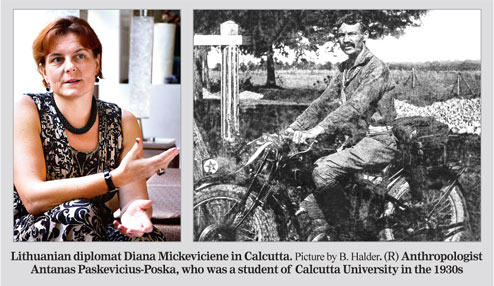
LithuanianKOLKATA23nov2014

In the autumn of 1929, 26-year-old Antanas Paskevicius-Poska set off on a rather long motorbike ride. The Lithuanian would travel down south to Egypt, through Central Asia, with India as his final destination. From Iran, he took a ship to Bombay. In early 1931 he joined the University of Bombay, where he received his Bachelor degree in 1933. Then he shifted to Calcutta to collect material for his Masters. The five years he spent in India, including three in Calcutta, resulted in an eight-volume travelogue titled From the Baltic Sea to Bengal, other than accounts in the Lithuanian press about India and sundry friendships he struck with the intellectual elite.

The story will come full circle on November 28, when President Pranab Mukherjee takes the stage at the convocation of Calcutta University, Poska’s alma mater, and a posthumous DLitt is handed over to Laimute Kisieliene, Poska’s daughter.

“The Lithuanian scholar was brought to our notice by Diana Mickeviciene, a diplomat who came to us on behalf of the country’s embassy in Delhi a year-and-a-half ago to look for material on Poska. We found that he had studied in our anthropology department and had even worked on his PhD. This made us think of recognising his contribution to Indological studies,” said the vice-chancellor of Calcutta University, Suranjan Das. Rimantas Vaitkus, Lithuania’s vice-minister of science and education, and ambassador Laimonas Talat-Kelpsa are flying down too.

Mickeviciene, who has just returned to Lithuania, had spoken to Metro when she was here. “Poska was Calcutta’s ambassador in Lithuania. It is because of him that Lithuanians know about the city. He also worked at the anthropology laboratory of the Indian Museum on racial anthropology and started translating the Gita. Lithuanian is the closest living sister language to Sanskrit,” she said.

Poska, she pointed out, had also spent some time in Santiniketan as a friend of Laxmiswar Sinha, who, like Poska, was a practitioner of Esperanto, a constructed international language. Here he came in touch with Tagore and translated some of his poems into Lithuanian.

Among his friends was the linguist Suniti Kumar Chatterji, who became interested in the Lithuanian and Baltic culture. The monograph of his comparative research of Indian Vedic and Baltic pagan rites, Balts and Aryans, was dedicated to Poska. Chatterji even travelled to Lithuania twice, Mickeviciene added.

Poska met Mahatma Gandhi twice, in Bombay and in Allahabad, and conveyed to him the support of the Lithuanian people for India’s Independence. “Gandhi had gifted him a tablecloth which he took with him even to Siberia, where he was sentenced in 1945 for refusing to comply with an order to destroy books published before the Soviet occupation,” she said. He was the head of the library department of the Lithuanian SSR commissariat then. Most of his archives were destroyed.

Poska’s doctoral research remains unfinished business, though. He did his PhD thesis in physical anthropology under professor Biraja Sankar Guha. It was sent to London for the measurements of skulls to be checked. Poska’s diary mentions that the paper was sent to the British Museum in 1936, and he was planning to go to London to defend his thesis but the delay in his return journey from India, financial difficulties and finally the outbreak of World War II came in the way.

When Chatterji visited Poska in Lithuania in 1966, he had volunteered to retrieve his dissertation from London and to accord the scientist a PhD from the university. However, though Poska’s diary mentions Chatterji’s letter informing him of granting him the degree, and Chatterji himself addressing him as “Dr. Antanas Poska” in the preface to Balts and Aryans, the university archive has no such record.

“Without the defence, his PhD could not have been completed. All we have is the title (‘Physical Affinities of Shina-speaking people of the Western Himalayas’). But we all agree that he deserves recognition,” said vice-chancellor Das.

source: http://www.telegraphindia.com / The Telegraph, Calcutta / Front Page> Calcutta> Story / by Sudeshna Banerjee / Sunday – November 23rd, 2014

The big fat biryani battle

AlooBiriyaniMPOs23nov2014

The A in the B

Shahanshah Mirza cannot imagine his biryani without the aloo. Fatima Mirza could not imagine her biryani with the aloo. Till the girl from Lucknow was married into the Mirza family of Park Circus. “I remember finding the aloo in the biryani quite funny at first,” says Fatima, who friends insist serves up some of the best biryani in town. And yes, with the aloo.

Why are we so bothered about the biryani being cooked in the Mirza kitchen? Simple, that’s where the great “to aloo or not to aloo” debate was born for the Calcutta biryani.

Yes, Shahanshah Mirza is the great-great-grandson of Wajid Ali Shah, the last nawab of Awadh. Foodlore has it that the nawab came to Calcutta after losing his throne and to cut costs, his cooks replaced the meat with the potato. And, foodlore number two: Wajid Ali Shah’s cooks added the aloo but only after falling on hard times following the death of the nawab. Either way, thus was born the Calcutta biryani the city now gorges on.

The nawab’s family line dismisses all this as, well, lore. “The nawab was a connoisseur of food and had given a free hand to his chefs to experiment with dishes. Once his chefs played around with the biryani and put potatoes in it. The nawab liked it so much that he ordered that the aloo be a constant in the biryani henceforth,” says Shahanshah.

And that is how it is cooked to this day in the Mirza kitchen — and in the kitchens of almost every biryani-serving restaurant around town.

With the royal exception of… Royal Indian Hotel.

What started as a humble rented shop in Chitpur to sell culinary creations by Ahmed Hussain, a migrant from Lucknow, is now a two-storeyed restaurant that seats 65 in its AC hall, 75 in the non-AC hall and 40 in the ground-floor dining hall and “remains full at meal times”.

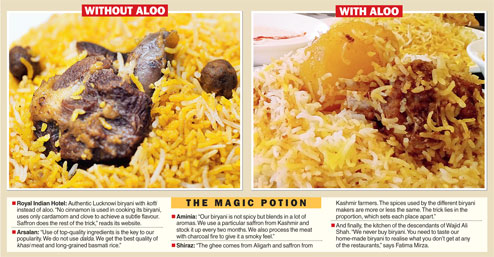
But don’t dare mention the A (aloo) word here. “We only make authentic Lucknowi biryani and our patrons love that. Our biryani does not have aloo, it has kofti (meat balls),” declares Md Irfan, one of the directors of Royal Indian Hotel, stirring up biryani since 1905, the year Lord Curzon divided Bengal.

More than a century on, Calcutta still stands divided. Along the thick potato line when it comes to the biryani.

How tough it is to serve biryani without the potato in a city weaned on that is evident from what Luknow, an Awadhi food restaurant that opened in Park Circus and Ballygunge this year, had to face. With diners insisting that “aloo chhara biryani hoy na (there can be no biryani without aloo)”, Shalini and Vinay Arora, the couple behind Luknow, were in a pickle. The cooks from Lucknow at the helm said: “Awadhi biryani cannot be cooked with potatoes.” But on popular demand aloo was introduced in one of the 11 biryanis on the menu.

No wonder the most popular biryani places in Calcutta just pile on the potato. Arsalan, Shiraz, Aminia, New Aliah — you name it and all of them have it. Aminia of New Market that has been running since August 15, 1947, has three more outlets in Calcutta — at Gol Park, Jessore Road (Nagerbazar) and Rajarhat (Chinar Park). They have been serving aloo with their biryani since inception.

Arsalan, a relatively recent dot on the biryani map of Calcutta (2002), has zoomed to the top of the bestseller chart and now runs five outlets — two in Park Circus, including the landmark one at 191 Park Street, and one each in Ripon Street, Taratala and Hatibagan. For them, there truly is no B (biryani) without A (aloo). “Some customers even look for a second piece of aloo on the plate!” says Arsalan director Akhtar Parwez.

The aloo is also an essential part of the biryani at Shiraz Golden Restaurant, which dates back to 1956. It has 10 outlets in the city stretching from Garia to Dum Dum.

A new kid on the biryani block, Oudh 1590, has tried to create a destination for Awadhi cuisine with the decor and menu at its Deshapriya Park address. But with one concession for the Calcutta palate: the option of the biryani with aloo. “Yes, the Awadhi Handi Biryani without aloo is less popular. People come and specifically ask for the aloo-wala biryani,” admits Debaditya Chaudhury, a partner of Oudh 1590.

Among foodies batting for the aloo in the biryani is musician-food writer Nondon Bagchi. “It is a part of our tradition. The aloo should not be taken out of the Calcutta biryani,” he says.

And slightly further away from home, we asked economist Abhijit Vinayak Banerjee, the celebrated co-author of Poor Economics and a fabled cook in his friends’ circle, where he stood on potatoes in biryani. “Potatoes can be very nice, especially if the biryani is sharp, like a Sindhi biryani,” said the man from MIT in the US. [Sindhi biryani is known to have mint, coriander and prunes in addition to the meat and rice. Originating from Sindh province in Pakistan, some of its variations have potatoes in it.]
BiriyaniFamilyMPOs23nov2014

The biryani boom

Enough of the potato, let’s get to the meat of the matter now.

To what lengths Calcutta can go for its fill of biryani is evident from the thousands who throng The Telegraph Biryani and Kebab festivals every year at City Centre (Salt Lake and New Town).

And it’s this passion for the rice-and-meat platter that has finally nudged Royal Indian Hotel to join the branching-out biryani brigade. Yes, Royal will have its first branch — “to be opened opposite Quest mall very soon”.

It took four generations and more than a century for this traditional biryani bastion to get a move on. So what prompted them to go south? “Our loyal customers from across Calcutta travel all the way to 147 Rabindra Sarani and often rue that we don’t have an outlet in their part of the city. We believe we are now ready to reach out and take our brand to all corners of Calcutta — north, south, east and west. We begin with south because it is a strategic location, where we can attract a wide clientele from the Ballygunge and Park Circus areas,” says Royal’s Irfan.

The restaurant that enjoys iconic status among loyalists says the popularity of the biryani here picked up after Independence. “Satyajit Ray to Uttam Kumar, Gunter Grass to Khushwant Singh, they all loved our biryani. Yesteryear actress Tabassum would get it packed and take it for Dilip Kumar. And now, Sourav Ganguly loves our Chicken Biryani,” smiles Irfan.

Royal may finally be stepping out of its crease, like Dada used to in his prime, but no one understands the biryani boom better than bestseller Arsalan. “If everything goes right, we intend to open three branches by June 2015,” says Arsalan director Akhtar Parwez. The locations on the radar are Barrackpore, Rajarhat and Jessore Road.

Simmering in the Arsalan handi is a target for “at least 50 outlets across Bengal” in the next 10 years. “If a Bengali loves and craves for Arsalan biryani, he should be able to get it near his home. That’s where we want to take our brand to,” says Parwez, reluctant to divulge the number of plates served per day in their blockbuster outlet at the Park Circus roundabout.

Multiplicity is the name of the game for Shiraz and Aminia as well. Aminia aims to open a branch in Behala, next to Ajanta cinema, and another near the Shyambazar tram depot. Shiraz has launched a chain of quick-service restaurants named Lazeez Express, which “does good business in Kasba”. For Zeeshan, which already has two outlets in the south (Deshapriya Park and Garia), another one near Lake Market is being planned. And then one in Kidderpore maybe.

Two new biryani players — Oudh 1590 and Luknow — are attracting a steady clientele in south Calcutta, enough for Oudh 1590 to eye a second serve near City Centre Salt Lake in January.

Multiplicity is married to makeover in the new-age biryani game, with words like decor and ambience coming into the dictionary. Take Oudh 1590. This Awadhi cuisine restaurant has created a “period dining experience” at its Deshapriya Park address.

The older players, too, are paying attention to the look and feel of their dining rooms. Aminia Rajarhat that opened earlier this year has been built on a Sufi theme.

“Today’s customers are hygiene-conscious and look for places that have a feel-good ambience. So we had to put in a lot of effort to make our Hatibagan address look chic and vibrant,” says Arsalan man Akhtar Parwez.

With the “need to reach out” becoming the mantra — from Royal to Lazeez — the biryani is taking the pizza route. Takeaways and home delivery are playing an important part. “You need to take special care as food items like biryani are best enjoyed fresh from the handi,” says Parwez.

“We depend largely on home-delivery orders, from domestic as well as corporate clients,” says Ishtiaque Ahmed of Shiraz’s Lazeez chain.

And then there’s Facebook, Zomato and Foodpanda for the smart(phone) set to book biryani on the go.

A foodnote: The great biryani debate doesn’t begin or end with the aloo. There’s a greater debate cooking, which questions the very standing of the biryani. But as with most things Calcutta, there is no place for the finer nuances or larger debates of life.

We turn the culinary pages to Abdul Halim Sharar (1860-1926), a courtier in nawab Wajid Ali Shah’s Lucknow durbar, who wrote in Lucknow: The Last Phase of an Oriental Culture that the real raeez of Lucknow preferred mutton pulao to biryani, which was bit of an aam aadmi food.

The last word is left, once again, to economist Abhijit Vinayak Banerjee from MIT. When asked to define the difference between pulao and biryani, he said: “Pulao is rice cooked in broth. Biryani is made with pre-cooked rice. Kachchi biryani is with marinated but not cooked meat. Normal biryani is with cooked meat. In both cases the meat cooks more and the vapours from that are used to flavour the rice.”

That, sadly, is too fine a flavour for the Calcuttan busy with a mouthful of biryani, aloo and all.

Do you like your biryani with or without the aloo? Tell ttmetro@abpmail.com

source: http://www.telegraphindia.com / The Telegraph, Calcutta / Front Page> Calcutta> Story / by Sibendu Das / Sunday – November 23rd, 2014
NBU to host science meet

Siliguri :

The North Bengal University has been chosen by the state department of science and technology to host the Bengali Science Congress for two days in February-end next year.

According to varsity sources, the authorities were informed by officials of the state science and technology department about hosting the two-day event from February 28.

“The trend of hosting the Bengali Science Congress was started by the erstwhile Left Front government. The main aim of holding such a meet is to encourage young students to take up science in their higher studies, pursue research or start careers in the field. Even research scholars benefit from the congress as they get to know about the recent findings in the field, new technologies and new areas which can be subject of future research,” a varsity source said.

The two-day event will be conducted mostly in Bengali and thus, it has been titled Bengali Science Congress.

“Most of the lectures, exhibitions and posters will be in Bengali. Students may not understand certain scientific terms in English and that is why Bengali has been kept as the medium of instruction. Such events will help clear their doubts and also give them direction as to which field of science they want to take up in future,” a source said.

The last time NBU had hosted the congress was in 1998. Topics in different fields of science like botany, zoology, chemistry, physics and environmental science will be dealt with at the event. Around 25 resource people like faculties of different varsities and scientists will be invited to the event.

“We are hosting the event after around 16 years. The host varsity as well as the state department will choose the resource persons for the event,” said the source.

source: http://www.telegraphindia.com / The Telegraph, Calcutta / Front Page> North Bengal & Sikkim> Story / by The Telegraph, Correspondent / November 20th, 2014

Purney tea launched – Sale money to go to family and garden hospital

Margaret’s Hope :

The Purney Subba limited edition tea was launched by the Goodricke Group today to mark Margaret’s Hope garden’s 150th year and the brew fetched a maximum of Rs 7,000 a kg.

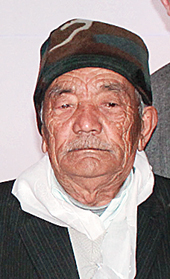
The management had decided to name a special edition autumn tea after the garden’s oldest surviving worker, Purney Subba, 98.

Today, Purney launched the tea in the presence of P.J. Field, chairman, Goodricke Group (UK), M.C. Perkins, chairman, Camellia PLC, UK (parent body of Goodricke) and A.N.Singh, managing director, Goodricke Group. “I wish all the luck to the garden,” Purney said after the launch.

The special edition tea is called FTGFOP1 PS Special. All Darjeeling tea is sold as FTGFOP (Fine Tippy Golden Flowery Orange Pekoe. PS stands for Purney Subba.

The packet has a photograph of Purney Subba and his year of birth, 1916.

Purney Subba at the tea launch. (Suman Tamang)

Of the 60kg tea launched today, 40kg was sold. “Marcus Wulf of Schroeder and Mamann from Germany and Leafull Corporation Limited from Tokyo, Japan, bought 20kg each,” said Vinod Gurung, manager (marketing), Goodricke.

The German buyer wanted to buy 20kg at Rs 6,500 a kg and later the Japanese buyer bought another 20kg for Rs 7,000.

Autumn tea is usually sold for less than Rs 500 a kg.

Jeevan Pande, the garden manager, said: “This is a small effort to recognise the hard work put in by the workers to make our tea world famous.”

Singh said the proceeds from the sale would go to Purney’s family and the 20-bed garden hospital. “Twenty percent will be given to Purney Subba and the rest of the money will be used to buy a ventilator for the hospital. If it is not enough, the company will chip in for the ventilator.”

He said the ventilator will cost around Rs 10 lakh.

Today, the management distributed school bags among 600 students and commemorative wall clocks among the 1,500 workers and gave five laptops to Margaret’s Hope High School and Rs 1.5 lakh to buy furniture for the school. “We will construct 150 toilets in the garden,” said Singh.

Margaret’s Hope spread over 586 hectare was established in 1864. Purney had worked in the garden for 40 years. Of his five sons and three daughters, one son and a daughter are garden workers. Deoraj, who is a chowkidar at Margaret’s Hope, said: “I am happy that a tea has been named after my family. This is an honour for the work force. I do not want my children to work in gardens. With a daily wage of Rs 90, it is difficult to survive.”

source: http://www.telegraphindia.com / The Telegraph, Calcutta / Front Page> North Bengal & Sikkim> Story / by Vivek Chhetri / Friday – November 21st, 2014