All posts by wellnmed@gmail.com

Researchers trace 57 addresses of Tagore

Kolkata :

“All our dwelling places contain varied partnerships of love…” Tagore wrote in 1935. What about is own spaces? Have they withstood the onslaught of time?

Not quite. One of the revered addresses that have been deleted forever is 49 Park Street where ‘Gitabitan’ and ‘Mayar Khela’ were composed. Researchers have recently recorded 57 places where the bard lived. Sixteen of them were in Kolkata, 14 in the Hills and 27 in south Bengal.

In a prelude to an ambitious heritage-tourism project of the government titled Tagore Circuit, history professors Shouvik Mukhopadhyay, Partha Sankha Majumdar and Ramanuj Mukherjee, at the behest of the West Bengal Heritage Commission (WBHRC), have come up with dates, anecdotes, addresses and several startling revelations about the poet.

Take Birjitalao where ‘Raja O Rani’ was staged and Tagore played Bikram in the 19th century. Wife Mrinalini played Narayani — her only stage appearance. The poet would frequent this house, rented by brother Satyendranath, next to the St Paul’s Cathedral.

“Indira Devi in her memoirs attests that the present day Calcutta Club was located on this land,” reads the study in its avatar as a coffee-table book. Chief minister Mamata Banerjee has a foreword: “Tagore has stayed in many different places which have earned for themselves the distinction of being temples of creativity, knowledge, literature, beyond any parallel.”

WBHRC chairman Shuvaprasanna writes: “The history of these abodes… testifies to the insight of a complete artist… throw light on the mental upheaval of a creative person who was never confided to a single place.”

Tagore would keep visiting the Hills; some of these structures continue to exist. The house that Scottish shipping magnate Daniel Hamilton built for the poet at Gosaba is one of the best maintained structures. But 16 such dwellings in Kolkata don’t exist any longer. The list includes 52/2 Park Street, 50 Park Street, 14 Lower Circular Road (now AJC Bose Road) and 237 Lower Circular Road. Soon after his marriage, the poet started living here and Mrinalini was admitted to Loreto House. Tagore wrote ‘Chhobi O Gaan’ here. Businessman Naliniranjan Sarkar later erected a building here. It’s now the Kolkata Police’s Foreigners Regional Registration Office.

“In a country like ours, it’s not possible to protect such buildings unless they are enlisted. The research on Tagoreean abodes is a significant beginning for such initiatives,” said Partha Ranjan Das, member, WBHR.

Places like 10 Sudder Street where Tagore lived with Jyotirindranath and his wife Kadambari Devi continue to exist. But the only trace of Tagore here is a plaque that reads that ‘Nirjharer Swapnobhango’ was composed here. After changing hands, the building is now Hotel Plaza.

The grand exception is the Art College, an enlisted heritage building. From 1928, the poet frequented the residential quarters of then principal Mukul Dey here and exhibited his paintings in February, 1932.

“His journey was external, physical as well as internal. The constraint of space often made him impatient and he continuously changed his locations, not only by moving outside but also relentlessly changing his dwelling places. Fluidity was integral to his creative genius,” write the researchers.

“The research is our labour of love, but there’s no stopping here. We are working on how the constant change of residences played a crucial role in Tagore’s creative genius,” said Mukhopadhyay. Both he and Majumdar have studied in Santiniketan.

source: http://www.timesofindia.indiatimes.com / The Times of India / Home> City> Kolkata / by Ajanta Chakraborty, TNN / December 28th, 2014
Rabindra Bharati University theatre repertory makes debut

Kolkata :

Rabindra Bharati University’s theatre repertory staged its debut production ‘Bandi Bihanga’ at Jorasanko on Friday.

Kolkata has professional theatre repertories like Minerva and Binodini, but this is the first time a university in eastern India has set up one of its own where former students of the department of drama can work and perform as professional artists, said university authorities.

“These former students will be paid for their work, unlike such productions by other universities. We aim at producing six plays,” said Haimanti Chattopadhyay, member-secretary of West Bengal State Akademi of Dance Drama Music and Visual Art.

‘Bandi Bihanga’, based on Tagore’s ‘Tota Kahini’, is an open-air play directed by Debashish Chakraborty, an RBU ex-student. The next production will be a Bengali adaptation of Shakespeare’s ‘A Midsummer Night’s Dream’.

source: http://www.timesofindia.indiatimes.com / The Times of India / Home> City> Kolkata / TNN / December 26th, 2014

Muktijoddha poet’s creations go unnoticed

Kolkata :

Lyricist Gobinda Halder, whom Bangladesh President Abdul Hamid met at a hospital on Monday, didn’t just write ‘Joy Banglar Gaan’, patriotic songs that inspired the Muktijoddhas during the Bangladesh Liberation War in 1971. He had also penned nearly 3,500 semi-classical, folk, baul, kirtan, Shyamasangeet and modern Bengali songs before glaucoma claimed his sight and ended his writing spree.

Some of his patriotic songs like ‘Mora Ekti Phulke Bachabo Bole Juddho Kori’, ‘Ek Sagor Rokter Binimoye Banglar Swadhinata Anlo Jara’, ‘Purbo Digonte Surjo Uthechhe Rokto Lal’ and ‘Padma Meghna Jamuna Tomar Amar Thikana’ are still popular in Bangladesh. Artistes from All India Radio and Doordarshan did sing some of his songs from other genre but Halder was never acknowledged. Most of his works, both songs and poetry, remain unpublished and unknown.

Halder’s first book on poetry had been a success. The 500-odd copies that the writer had managed to print in 1989 after depleting his meagre resources got sold out. Unfortunately, Halder did not have the means to reprint ‘Door Digante’, a collection of powerful poems.

His childhood friend Debkumar Mitra, who was chief librarian of Calcutta University till 1994-95, did publish the second edition five years later. But a combination of factors that ranged from poor production quality to lack of sales and a quantum change in reading habits post-Liberalisation ruined its prospects.

“I still have about 70 copies unsold. During my trips to Bangladesh, I had approached officials and offered to hand them over so that they could be distributed either in the country where he is loved or from the Bangladesh pavilion at the Kolkata Book Fair,” said Debkumar’s daughter Sangeeta.

Mitra would drop by at Halder’s tiny Ramakrishna Samadhi Road apartment in Kankurgachhi regularly till four years ago when his own failing health confined him indoors. He passed away this March, his dream of publishing his friend’s works unfulfilled.

Halder, who is unaware of his friend’s demise, is recuperating at JN Roy Hospital. B Hazra, the doctor treating him, said his condition was stable. “He was in a critical condition when he came on December 13, suffering from cerebral atrophy that affected his speech. He had also contracted bed sore. His speech has since improved,” the physician said. Halder is on Ryles tube and catheter.

Halder’s daughter Gopa said they were happy with the treatment and glad her father was responding to it.

source: http://www.timesofindia.indiatimes.com / The Times of India / Home> City>Kolkata / by Subhro Niyogi & Debasish Konar, TNN / December 24th, 2014

MUSIC – Fresh as ever

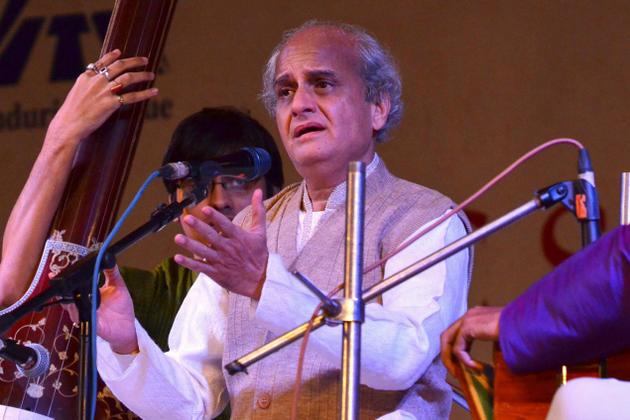
The recent ITC Sangeet Sammelan in Kolkata gave a platform to young musicians alongside the veterans.

Pandit Ulhas Kashalkar.

ITC was perhaps the pioneer in shouldering the corporate social responsibility when it took a resolve to preserve and promote Indian classical music. It organised the first ITC Sangeet Sammelan in 1971, at a time when the reputed musicians had lost royal patronage. Encouraged by the success of this initiative, the ITC decided to open a ‘gurukul’ of classical music, formalising the time-tested guru-shishya parampara, where topmost artistes would groom professional musicians living with them in the most congenial atmosphere to impart training and transmit their art. The idea crystallised in the year 1978 in the form of the Sangeet Research Academy (SRA), a residential gurukul, where the students lived and learned in close proximity of great gurus. The ITC-SRA thus, produced a number of distinguished musicians who in turn became gurus to carry forward the tradition.

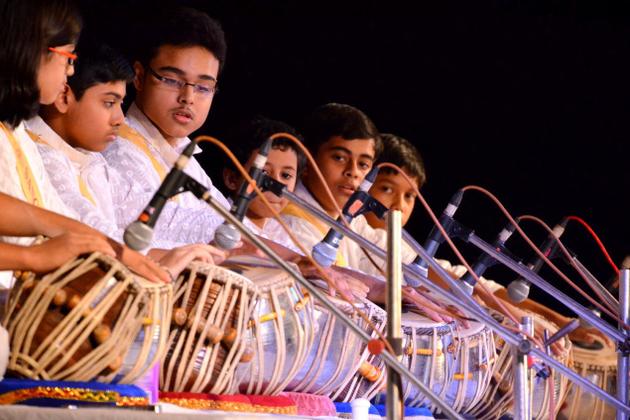
Children’s group tabla recital at the event.

It was a proud moment for the SRA when a galaxy of gurus adorned the stage on the inaugural evening of the recent ITC Sangeet Sammelan held in Kolkata, while this year’s ITC Sangeet Samman was conferred upon Taal Yogi Pandit Suresh Talwalkar. The three-day overnight festival offered a judicious blend of upcoming and well-established artistes presenting ragas of every hour from dusk to dawn. The Sammelan this year opened with a pleasant surprise when the children of Sangeet Piyase (5 to 12 years of age) gave a group tabla recital under the guidance of Guru Samar Saha, that sounded like a tabla-tarang, tuned to the swaras of raga Chandrakauns being played as the accompanying lehra in Teen tala.

Raga Chhayanat of Sanjukta Biswas, the gifted disciple of Guru Shubhra Guha, Jhinjhoti on the sarod by Malhaar Rakshit, disciple of Guru Pt. Buddhadeb Dasgupta or raga Puria Dhanaashree of Shatwisha Mukherjee, Yaman and Hameer of Shankhumay Debnath being trained under Pt. Ulhas Kashalkar, had the authentic stamp of their gurus. Saket Sahu’s melodious violin, Allahrakha Kalawant’s sarangi solo, Ratan Bharati’s guitar, Sandeep Bhattachrya’s Rageshree and Sucheta Ganguli’s raga Jog and a Thumri in Kaushikdwani were the other remarkable performances. Musician tutors of the SRA belonged to the next category of brilliant performers where Abir Hussain impressed with raga Bihaag on the sarod, Arshad Ali with his khayals in Malkauns, Omkar Dadarkar in Jogkauns, Wasim Ahmad Khan with Baageshree and Aniruddha Bhattacharya with his Lalit welcoming the dawn.

Among the invited artistes, Ashwini Bide Deshpande’s Kaafi Kanhada and Chandrakauns, Kala Ramnath’s Natnaraayana on the violin, Shashwati Mandal Pal’s gaga Malgunji, Sohini Bhathiyaar and Tappa, Manjusha Patil’s Multani and Purbaayan Chattaerjee’s Miyaan Ki Todi as a sitar jugalbandi with his Guru and father Pt. Partho Chatterjee were some of the memorable presentations. Pt. Hariprasad Chaurasia played raga Maru Bihaag and a couple of melodious folk tunes of Bengal. Kaushik Bhattacharya’s raga Jaijaiwanti and Kirwani Bhajan had more of decorative elements and less substance. Aliflaila had come from Bangladesh but her sitar could not match the high standards of this prestigious platform.

The real stars of the Sammelan were the Gurus of the SRA including Pt. Suresh Talwalkar who received the ITC Award this year and gave a brilliant performance on the inaugural evening. Vidushi Girija Devi’s Nayaki Kanhada and Thumri, Ustad Mashkoor Ali Khan’s Darbaari Kanhada, Uday Bhawalkar’s Dhrupad in Adbhut Kalyaan, Pt. Ulhas Kashalkar’s Vibhas and Khat and Pt. Ajay Chakravarti’s Bhairav welcoming the morning, were some of the memorable performances that transported the Kolkata music lovers to a state of bliss and fulfilment.

source: http://www.thehindu.com / The Hindu / Home> Features> Friday Review> Music / by Manjari Sinha / December 25th, 2014

Queen of thumri and much more

Kolkata :

She is Appaji to even those in this music loving city who don’t know how she got the name. To Ravi Shankar, she was a little sister, “chhoto bon”. Kishori Amonkor calls her Didi but thinks of her “like mother”. Kabir Chowk at Banaras adorned her with the sobriquet of thumri samragyi while the government showered on her the Padma Bhushan. To the world at large, she’s Dr Girija Devi.

However, more important than the many epithets is the fact that ‘Girija — a Lifetime in Music’ — distills her as both, a vocalist and a guru. For, it’s a tribute by her disciples Debapriya, Samanwaya and Sankalp to the Purab Ang maestro as she turns 86. The film, produced by daughter Sudha Datta and Madhuchandra, was launched at ICCR on Saturday in the presence of Governor KN Tripathi, Pt Vijay Kichlu, Krishna Neotia and Sanjay Budhia while H P Budhia presented her a purse of Rs 1 lakh.

To give one example: Girija Devi asks a disciple to stretch out her arm in the drizzle. “This is rim-jhim puhar, a few notes on your skin. If you sing two-three taans, it will become a shower or downpour. The words of the bandish don’t warrant that,” she imprints the experience on her student’s mind. On another occasion, she sings of a separated lover. “She’s like fish out of water, tarap tarap ke jee rahi. You must imagine the fish gasping for her life breath. Only when you see, feel, experience can you express emotions through your notes.” Clearly the memories of catching fish on the sandy banks of the now polluted Ganga inspires her to date.

Girija Devi, born to a Bhumihar Zamindar in Banaras of 1929, claims kinship with the traditions of Siddheswari Devi, Bismillah Khan, Ravi Shankar, Birju Maharaj, Rajan Saajan Mishra. Making her public debut at AIR Allahabad in 1949, she is an agraj (elder) showing the way to flautist Hari Prasad Chaurasia. As an upper class woman who promised her mother and grandmother she’d never perform mujra (private concerts), she became a faculty member of ITC Sangeet Research Academy – and made Kolkata her second home. Music, as Girija Devi has taught Anjana Nath, Manasi Majumdar, Sunanda Sharma, Malini Awasthi, Dalia Rahut — among so many others — “is more than a weaving together of notes. It is breathing lived life into the words.” Sometimes she does this with sparkling taans, unique embellishments, exquisite artistry.

Sometimes she displays her grasp of tappa and dadra, at other times bhajan and khayal gayaki. But, and always, people flock to listen to her thumri. If Omkarnath Thakur was synonymous with bhajan, Siddheswari was the empress of thumri, she believes. But not once will she disappoint even those who’re alien to the regional characteristics of Kajri, Chaiti, Hori…

Once they sit through her recital, they go home with a profound sense of happiness. As they do after watching Girija – despite its 140-minute duration. Isn’t that ‘ananda’ – aesthetic as much as spiritual – the lakshya of every high art?

source: http://www.timesofindia.indiatimes.com / The Times of India / Home> City> Kolkata / by Ratnottama Sengupta, TNN / December 21st, 2014

New Town to get country’s first floating solar plant on Jan 5

Kolkata :

The country will get its first floating solar power plant on January 5.

The unit, which will generate 10KW solar power every day, will be inaugurated at Rajarhat New Town. State power minister Manish Gupta will inaugurate the floating solar power plant installed on a waterbody near Eco Park in New Town.

The floating solar power plant has been jointly set up by the Arka-Ignou Community College of Renewable Energy, headed by solar power expert S P Gon Chaudhuri, and the New Town Kolkata Development Authority (NKDA).

The power that will be put into the grid through marine cables will light up several areas in Eco Park and its surroundings.

Gon Chaudhuri, who is a former managing director of West Bengal Renewable Energy Development Agency (WBREDA) and West Bengal Green Energy Development Corporation (WBGEDC), said the ministry of new and renewable energy (MNRE) had earlier sanctioned a grant of Rs 20 lakh to the authorities as a research component and another Rs 15 lakh for developing and installing the solar panels. The panels have already been installed and are now ready to generate power.

“Already, engineers from different parts of the country are coming to have a look. A team of experts is coming from Lakshadweep soon to take a look at the project as a similar project will be taken up there,” Gon Chaudhuri, who was also the former adviser to the state power department, said.

Gon Chaudhuri also said that that it was around one and a half years ago that he first thought about developing a floating solar panel.

“Land is required for setting up any power plant, but a floating solar panel doesn’t require any land, since it is set up on a waterbody. Only Japan and Australia have developed floating solar power plants so far,” he added. “I gave a proposal to the Centre that developing such floating solar panels has its own benefits since it will not only generate pollution-free solar power, but also help emit less carbon dioxide. Once this floating solar panel is inaugurated and starts generation, we will conduct further research on this,” Gon Chaudhuri said.

source: http://www.timesofindia.indiatimes.com / The Times of India / Home> City> Kolkata / by Suman Chakraborti, TNN / December 22nd, 2014

Four decades of a special cause

TaratalaKOLKATA22dec2014

From a two-room set-up in Ballygunge Military Camp with just a couple of students to a full-fledged campus in Taratala, Indian Institute of Cerebral Palsy has come a long way in 40 years.

The institute recently celebrated its journey with an exhibition that paid tribute to the city that has been home to it and all the people who have lent their support.

Samiran Nundy, gastro specialist from Delhi and guest of honour, remembered the special place IICP had in the life of his mother Shanti Nundy, the first qualified special educator at the institute.

For Raman Dhawan, GoC, Bengal, and the chief guest on the occasion, it was his first visit to IICP and he admitted to feeling “privileged” to be part of the 40th anniversary celebrations.

“It is this institute or institutes like this, the caregivers, the special children… the special adults who work for self-reliance… they are the actual heroes. We all need to applaud them,” said Dhawan. He also shared how the place once occupied by IICP at the Ballygunge Military Camp is now home to a special school. “They (IICP) were with us for a decade or so… I want to assure this institute, you may have left us to come to your new premises but you are very close to our heart. The place that you left, those two rooms… we made it into a slightly bigger establishment and there we run a small Asha school. A school for the special children of the armed forces,” Dhawan said.

Nundy took a trip down memory lane, remembering how his mother joined IICP at age 60 and how much she loved the institute. “At the age of 54 she enrolled herself in Brandon University in Canada and for three years she studied special education. When she returned to India in 1977, Sudha (Kaul) and Junie (Sethi) were very kind in employing someone who was nearing 60,” he said.

“My mother absolutely adored the school. She, I think, cooked, looked after the garden, looked after the children and she taught a little,” smiled Nundy. He also shared how even when her children were back home during holidays, she never used to miss out on work. “She would still be going out to work in the morning, saying ‘I can’t miss my job, I have to go to work whether my children are here or not’.”

Even after being diagnosed with cancer and undergoing treatment, she continued to work with IICP.

A short film, Beyond Barriers, by Jayabrato Chatterjee on IICP’s 40-year journey was screened on the occasion, followed by the release of the institute’s newsletter, Deepshikha, sponsored by ABP, where students, parents, teachers and people associated with the institute have shared their memories.

Jeeja Ghosh, an ex-student of IICP, gave a PowerPoint presentation on Ankur, an advocacy group she heads.

“Our parents and teachers have encouraged us. As we grew up we learnt to voice our rights and achieve our goals. We believe that people with disabilities have rights, the ability to shoulder responsibility and need to be recognised,” said Jeeja, who now works at IICP as head of advocacy and disability studies.

Madhuri Kapur, one of the first two students of IICP, was felicitated by vice-chairperson Sudha Kaul.

The exhibition titled Salaam Kolkata, which was on display at the Taratala campus, had students of the junior section put together Calcutta Canvas with vignettes of city life from phuchkawallah to animals from Alipore zoo.

source: http://www.telegraphindia.com / The Telegraph, Calcutta / Front Page> Calcutta> Story / by Shweta Keshri / Monday – December 22nd, 2014

Home hero leads ATK victory lap – ‘For a sports fan, this is the place to be’

As Atletico de Kolkata won the first edition of the Indian Super League with a last-gasp goal in Mumbai on Saturday evening, the 17-year-old sat transfixed in front of the television, grateful to be playing football at a time when the game has finally gone international in India.

The Class XII student at Frank Anthony Public School, who captains his team and wears the No. 10 jersey, writes for Metro what the ISL and Atletico de Kolkata’s victory meant to him.

LiamBainKOLKATA22dec2014

The nail-biting football that had the nation hooked for 90-odd minutes on Saturday night was not only a fitting finale to the first edition of the ISL but also a big triumph for Calcutta, which is the place to be for any sports fan like me.

Atletico de Kolkata’s victory completed a rare double for the city – 2014 IPL and ISL champions – while our home-grown forward Mohammed Rafique’s winning goal made me believe that perseverance and dedication matter the most in the quest for glory.

ATK’s never-say-die attitude in the final was inspiring too. I have won and lost many finals and I know how mentally draining it can be. But the ATK players were calm. Your instincts and talent matter but your mindset can make or break you. Big matches are nerve-wracking and brutal to lose.

Super-sub Rafique’s 95th-minute header reminded me of two occasions where I have been in a similar position. During my training at Club Atletico Boca Juniors, I had come on as a substitute in a friendly and scored a late goal that gave my side a 1-0 win. In the quarter-finals of the Keventer Cup 2014, my school team was awarded a last-minute penalty, which I calmly converted.

On the flip side, I have been in the boots of Kerala’s Michael Chopra, who thought he had scored the winner, only to discover that his shot had been saved by the brilliant Edel Bete.

Like Michael, my heartbreak moment had come in the dying moments of a final of the inter-Frank Anthony schools’ tournament, which cost us the match. That’s the harsh reality of sport.

Saturday’s final taught me how a strategy like keeping a defender at the first post (which Kerala goalkeeper David James should have done) or a brilliant save (like Edel’s) can be the fine line between triumph and misery.

Without Luis Garcia in the starting XI and Fikru out of the match, ATK had their backs to the wall from the beginning. They initially lacked creativity in the midfield and Kerala looked a much better team. But Kerala failed to convert chances and I was amazed how Arnab Mondal and Josemi, the defensive stalwarts, and goalkeeper Edel kept ATK alive in the game.

With missed chances at both ends, each side was almost resigned to 30 minutes of extra time until, astonishingly, ATK found a way out of it!

In the end, I think, India was the real winner of the ISL, opening up so many avenues for the growth of football in the country.

The ISL also gave young footballers like me the much-needed push to dream of making it big. It gave me new heroes like Sandesh Jhingan, who makes match-winning tackles; Elano Blumer, whose free kicks I would like to emulate; Luis Garcia, whose skills and leadership qualities I have tried to embrace; and Iain Hume and Steven Pearson, whose stamina and perseverance inspire me.

source: http://www.telegraphindia.com / The Telegraph, Calcutta / Front Page> Calcutta> Story / Monday – December 22nd, 2014

Park Mansion raises ‘French toast’

Kolkata :

Tuesday marked the end of a 15-year wait for all those who have a part of Alliance Francaise du Bengale. So as bottles of St Emilion 2011 were being uncorked atop the grand-old Park Mansion, a lot was being toasted for. It was a homecoming that arrived late, but each moment of wait has bolstered Kolkata’s French connection that has been going strong for the last 75 years.

Alliance Francaise lost its home of 60 years in a devastating fire in 1999. “Park Mansion not only used to be the hub of the French delegates in Kolkata post Independence, but it was also one of our treasured structures that fell prey to the April 1999 fire. It’s as if the building and its treasures like the Alliance Francaise has risen from the ashes,” gushed G M Kapoor, founder of Intach.

The inauguration brought together several of the city’s elite for whom it was much more than a soiree. For Nitin Kothari, one of the oldest tenants of Park Mansion and owner of Peter Cat and Mocambo, it was a momentous occasion. “It’s Alliance Francaise arrival and also the first party on our terrace,” said Kothari, pointing at the majestic dome that’s unique to the Park Mansion, which was developed by Armenian jute merchant T M Thaddeus in 1910 in a style that’s a blend of the Victorian and the Indo-Saracenic.

For Alliance Francaise director Stephan Amalir, it was a proud moment: “Being the prime organizer of the event, I have so many things to worry about, but I can’t let go of the feeling of euphoria that comes along with the shifting,” he said.

The honours were done by Francois Richier, ambassador of France in India, who came to confer the title of “Chevalier de l’Ordre des Arts et des Lettres” (Knighthood of the Order of Arts and Letters) to three Kolkatans for contributions to arts.

Alliance Francaise doesn’t look the same though as Amalir has risen new-age needs while keeping alive the old-world charm. Fire-proofing gadgets and new cabling system have been installed. There is an e-library (Culturetheque) for GenY.

AFB had been operating out of Khaleel Munzil and Bimal Villa on West Range, a few buildings behind it. The institute is retaining Bimal Villa but the library and the administrative offices have shifted to Park Mansion in its much smaller space (3,500 sq ft as opposed to the earlier 10,000 sq ft covering two apartments on the first and the third floor). The apartment is on a 10-year lease.

“The 1999 fire was a catastrophe, but today we proved that it did not deter us from reclaiming our old home,” said Gargi Bannerjee, Alliance Francaise president.

source: http://www.timesofindia.indiatimes.com / The Times of India / Home> City> Kolkata / TNN / December 16th, 2014

Film with Kolkata touch in Oscar race

Kolkata :

When Bickram Ghosh and Sonu Nigam hit it off as collaborators four years ago, little did they know that a moment of creative spark will land them in the race for Oscar. The soundtrack of ‘Jal’, a film based in the Rann of Kutch, scored by the duo with a horde of Kolkata musicians on board, has been shortlisted for Oscar.

The soundtrack has several Kolkata musicians behind the scenes — such as keyboardist Indrajit Dey who has done the melody programming, and folk singer Dipannita Acharya, among others. This is also a first for Ghosh, who has featured in a Grammy-nominated album so far.

“The producer is excited as the movie has been shortlisted in the best feature film category as well. We have featured an international artist like Greg Ellis and the soundtrack has several Kolkata fingerprints on it. Shamik Guha Roy is the recordist along with Pramod Chandorkar in Mumbai. The sound is a marriage of Gujarati folk and voice music,” said Ghosh.

“Sonu is overjoyed. We collaborated first in 2010 and our album will be launched this week,” he added. The race is against masters like A R Rahman, who has two film scores on the list, and the legendary Hans Zimmer.

Dey, who has programmed the score for the melody, said: “It’s a marriage of desert folk and symphony and even oral percussion.” When asked about his chances, he replied: “It’s all about taste. There is folk raga music… I am more used to classical fusion and I find desert fusion closer to the heart and the grassroots. This could be an advantage in the race to the Oscars. Dipannita, who excels in various folk forms, has a god-gifted Gujarati folk texture and the effect is amazing.

source: http://www.timesofindia.indiatimes.com / The Times of India / Home> City> Kolkata / by Shounak Ghosal, TNN / December 13th, 2014