All posts by wellnmed@gmail.com

Chinese community in Kolkata ready for a fresh start

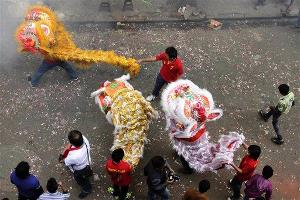
The Chinese community living in the city has always celebrated their New Year in their own unique style.

Kolkata :

The Chinese community living in the city has always celebrated their New Year in their own unique style. But this time, they have put their heads together and vowed to make a new beginning, in true sense of the term. To begin with, the community has already started renovating the Pei May School complex, which has remained abandoned for long. A cooperative has been formed to steer the community.

Pei May is the only Chinese-medium school in the city that was set up to teach kids of the migrating Chinese community. However, Chinese children started going to English-medium schools and Pei May lost its relevance with time. Gradually, people stopped visiting it. But finally, it dawned upon the community that wasting more than 2 lakh sq ft area was not a good idea.

Led by Liu Kuo Chao, the Chinese Welfare Association brought together 5,000 Chinese residents to form a co-operative that would run the trust governing the school and temple complex. The temple already stands spruced up. Interestingly, a statue of Sinthee, a man who is believed to have superhuman protective powers, stands outside the altar with his horse. Almost every Chinese home has prepared some offering for the deities and will visit the temple at least once during the weeklong festivities that start Wednesday.

The massive school building will be repaired after the New Year celebrations. The trust plans to start a Chinese language training school here for graduates and professionals. “Our kids are joining the hospitality, IT and teaching professions in China because they are proficient in English and they can also speak Chinese. The fact that they cannot read or write Chinese is not being counted as a dampener. The school will target those from outside the community who want to learn the language from Chinese trainers,” said Monica Liu, owner of several Chinese restaurants in Tangra.

“There are a large number of elderly people within the community who are extremely gifted as far as Chinese writing and even literature is concerned. We will rope them in to create easy speaking and writing modules for non-Chinese youth,” said Sze Shiyenyeh, a senior enthusiast of the Welfare Association.

The community has finally started feeling vindicated in Kolkata. “For years, Tangra has been neglected. A look at the streets outside the swanky restaurants will tell you how the Chinese have been relegated to one corner of the city. When the tanneries were ordered out, many of us shut our units and got into motley businesses, most of which did not work. But now we have found a cause to live once again,” said Liu Ka Keen, who might join as a part-time teacher in the school.

source: http://www.timesofindia.indiatimes.com / The Times of India / Home> City> Kolkata / by Jhimli Mukherjee, TNN / February 19th, 2015
Where cars go for a ‘workout’

Kolkata :

This nondescript automobile repair workshop on a narrow lane off the Hazra Bridge over the Adi Ganga wouldn’t be hard to miss… had it not been for a few unusual cars parked in and outside it.

Cars with scraped bumpers and dented bodies, but with many extra gadgets, special seats, reinforced interiors and, once you open the hood and look carefully, even modified and fortified engines.

Calcutta Motors, this 52-year-old workshop, is where car rallyists from all over Bengal send their automobiles for renovations, repairs, reinforcements and all other works.

And on most days, this is also where they drop in for a chat with the amiable and helpful Joydeb Ghosh, whose father Soumen had started this business in 1963.

Joydeb, 39, is an avid rallyist himself and winner of many awards in this adventure sport. And Calcutta Motors happens to be the most well-known name in Eastern India for converting ordinary vehicles into ones fit for all sorts of rallies across the country.

Converting an ordinary automobile into a “rally-worthy” vehicle is no easy or inexpensive task (see box).

“The first step is to fit a ‘sump guard’ (chamber guard) in the undercarriage of the vehicle and a fuel tank guard for added protection,” oydeb says. Special suspensions need to be installed and the suspensions’ lower arms and apron need to be strengthened. The entire body of the vehicle has to be reinforced through ‘tik’ (cold) welding. “‘Tik’ welding is a special and time-consuming process where all the joints need to be re-welded,” he adds.

Then comes the major task of ‘blue-printing’ the vehicle’s engine. “Engine components of a vehicle of the same make differ, and that affects their performance. We get the manufacturer’s blueprint with the exact specifications of all engine components and replace all the components that do not meet the specifications.

The purpose is to ensure optimum performance of the engine. We make all these new components ourselves,” Joydeb explains. Joydeb, who has participated in over 250 car rallies over the past 10 years, says that in order to save costs for rallyists, he does a lot of “jugaad”. “I and my mechanics go all over the country and observe how rally cars elsewhere are retrofitted and apply the same techniques at much lower costs here,” he says. This is because many automobile enthusiasts from Kolkata and Bengal are good rallyists, but hail from middle-class families and don’t have the very deep pockets required for upgrading their cars to the ‘rally-worthy’ category.

Special seats and seatbelts need to be installed, as well as probes for odometers, trip meters and sophisticated GPS equipment. And finally, a ‘roll cage’ needs to be installed inside the vehicle for protecting the driver and navigator. Joydeb, his team of mechanics and the drivers and navigators of the 20-odd automobiles — Maruti Gypsies, Esteems, Cedias, SX-4, and Maruti 800 — that have been retrofitted and undergo regular overhaul and servicing at Calcutta Motors, all form a large and happy family. Their passion for automobiles and participating in rallies is the bond that binds them together in a strong brotherhood. They call themselves the ‘CM Rally’ team.

Calcutta Motors also sends its service team, comprising its best mechanics, to rallies the ‘CM Rally’ team members participate in. “We go wherever our customers go as rallyists and give the best services to them,” said Sarbeshwar Dolui, a senior mechanic at the workshop.

Calcutta Motors’ service team has been awarded many trophies in various rallies across the country. Joydeb’s dream is to ensure that the ‘CM Rally’ team members win in every rally they participate in. And he’ll do all he can to make that happen.

source: http://www.timesofindia.indiatimes.com / The Times of India / Home> City> Kolkata / by Jaideep Mazumdar, TNN / February 21st, 2015

Former BCCL director no more

Kolkata :

Narendra Kumar, a former director of Bennett, Coleman & Co Ltd (BCCL) and chairman of Wearit Group, breathed his last in Kolkata on Saturday. He was 81 and is survived by wife Pramod Rani, son Manish and daughters Neerja and Nandita.

“As member of the board for many years, Narendra Kumar’s wise counsel was of great assistance to my husband Ashok Kumar Jain. The Times family remembers him with affection,” said chairman of the Times Group Indu Jain in a message. Vice chairman of the Times Group Samir Jain said, “Narendra Kumar’s long association with our company was cherished by my father.”

Kumar served as a director in the BCCL board for close to 50 years. Wearit Group has interests in the tea and textile businesses. Known as a visionary in the tea industry, Kumar held several important portfolios. He was the chairman of Indian Tea Association (ITA) from 1989 to 1991. He also headed Consultative Committee of Plantation Associations (CCPA) and was the chairman of Tea Research Association from 1993 to 1996.

According to Manish, Kumar leaves behind two tea companies and a robust textile business. The tea companies — Scottish Assam India and SPBP Tea India Ltd — have gardens in Assam. Wearit Group has textile plants in Madhya Pradesh and Rajasthan. The group has four plants in these two states. The Wearit Group is known for viscose, cotton and polyester yarns and polyester-viscose blends, polyester-cotton blends and polyester-linen blends. It has clients in Europe, the Middle East, the United States and the Far East.

A baithak to remember and pay homage to the departed soul was organized on Sunday at his Ballygunge Park home. Another baithak will be held on Monday at the same venue.

source: http://www.timesofindia.indiatimes.com / The Times of India / Home> City> Kolkata / TNN / February 16th, 2015

New start for grand lady – Descendants rededicate gravestone of botanist

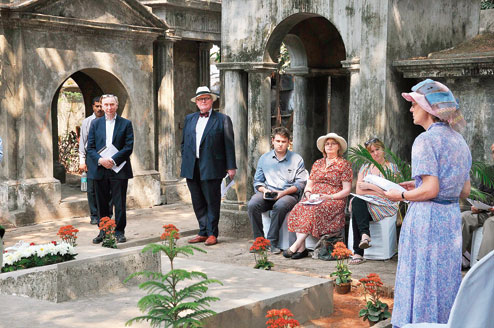
Lady Emma addresses the small gathering at the ceremony to dedicate the gravestone of her ancestor, Lady Anne Monson, at South Park Street Cemetery on Thursday morning. With her are Michael Dorrien Smith, Lady Emma Windsor-Clive, Isabella Monson (seated) and JM Robinson and James Miller (wearing panama).  Picture by Anup Bhattacharya
Lady Emma addresses the small gathering at the ceremony to dedicate the gravestone of her ancestor, Lady Anne Monson, at South Park Street Cemetery on Thursday morning. With her are Michael Dorrien Smith, Lady Emma Windsor-Clive, Isabella Monson (seated) and JM Robinson and James Miller (wearing panama).
Picture by Anup Bhattacharya

Calcutta :

Sleepy, leafy South Park Street Cemetery could have turned into a scene from the TV series Downton Abbey on Thursday morning as a small group of Englishmen and women gathered at the twin graves of Lady Anne Monson and her second husband, Colonel George Monson, for a quiet and solemn ceremony as a chorus of koels sang incessantly.

The frail, behatted Lady Emma Monson was with her granddaughter Isabella, her friend, the youthful Michael Dorrien Smith, a descendant of Lord Clive – Lady Emma Windsor-Clive – and two friends, architectural historian J.M. Robinson and art historian James Miller.

Lord Clive was a British officer who defeated Siraj-ud-Doula in the Battle of Plassey in 1757 and consolidated the East India Company’s rule.

Lady Emma was there to dedicate a tombstone inscription to her ancestor, Lady Anne Monson, who was a botanist, an exceptional figure in the 18th century, and great granddaughter of King Charles II.

Charles II, king of Great Britain and Ireland (1660-85), was restored to the throne after years of exile during the Puritan Commonwealth, according to Encyclopaedia Britannica. The years of his reign are known in English history as the Restoration period.

The genus Mansonia was named by Swedish botanist Carl Linnaeus in honour of Lady Anne. Colonel Monson was a member of the Supreme Council of Calcutta and an enemy of Warren Hastings. He died six months after his wife in September 1776. An inscription above his tomb was erected in 1908 by the Calcutta Historical Society. But Lady Anne’s tomb remained without an inscription. Both graves are quite nondescript by the monumental standards of this cemetery.

A wreath was laid on the spruced-up grave and newly inscribed tombstone by Ranajoy Bose, executive member, Christian Burial Board, with Ash Kapur, president of the Association for the Preservation of Historical Cemeteries in India, Bertie Da Silva, vice-principal of St. Xavier’s College, and Christina Mirza, who heads the English department of the college. Lady Emma said in her address that when she first visited Calcutta in 2012, both graves were in ruins and she wished to restore them. So she got in touch with the British Association for Cemeteries in South Asia (BACSA).

She thanked all concerned for refurbishing them. Both graves have been restored by an accredited architect and its surroundings have been cleared and neatly marked with brick dust. The service was conducted by Reverend Nigel Pope, vicar of St. Paul’s Cathedral.

source: http://www.telegraphindia.com / The Telegraph, Calcutta / Front Page> North Bengal> Story / A Staff Reporter / Saturday – February 14th, 2015

Grandniece continues Nivedita’s quest for truth

Kolkata :

When a 73-year-old woman stepped into Mayer Bari — Maa Sarada’s house at Bagbazar — everybody was busy with their daily chores. Sight of tourists is nothing unusual for them. But when they came to know that the lady was actually the grand-niece of Sister Nivedita, there was no leaving her alone. For rest of the day, a strong crowd milled around Selenda Margot Giardin, who came all the way from Newbury at Vermont in the US. By evening, it was a day well-spent for Saradha Math monks, students of Nivedita School and Selenda as well.

“I am fascinated. I feel like a celebrity,” beamed Selenda, who was the centre of attraction at Sarada Sarani on Monday. The pangs of Parkinson’s and acute arthritis could not dissuade Selenda from embarking upon the long journey in quest of “truth, love and God”.

Selenda didn’t know how to react when people touched her feet. Anushuya, a student at Nivedita School where Selenda led a prayer, said: “For us, it’s like being with Bhagini Nivedita herself.”

Some found the same eyes in Selenda, who shares her middle name (Margot) with her Irish grand-aunt Margaret Elizabeth Noble, whom Swami Vivekananda christened Nivedita. “My middle name is ‘curiosity’. From the age of seven, when I first read at the church that ‘God is Love’, I have been curious about God. The search continues…and now I am here, searching…” reminisced Selenda, who runs her choir at the United Church of Christ at Vermont.

The septuagenarian will be attending a host of programmes over the week. She will spend two days at Belur Math before flying back to the US on Saturday. Her son John Grow is accompanying her.

Selenda let out more about herself and the Nobles as she spoke to TOI: “Ever since I was a child, I remember my mother, Isabel Noble, telling me stories of her aunt who pursued her quest for truth and worked for the people living in this faraway land.”

She gifted the monks of Sarada Math the handwritten notes by Sister Nivedita circa 1909 and a replica of Michaelangelo’s Pieta, which Sister Nivedita had gifted Selenda’s mother Isabela. These items will be on display at the upcoming Nivedita Museum inside Nivedita House.

Mayer Bari head Swami Viswanathananda said: “Selenda’s amazing. We never imagined that a descendent of Sister Nivedita would come here after all these years.” Another monk Prabuddhaprana shared the euphoria: “We are glad to discover the Sister’s family at last.”

source: http://www.timesofindia.indiatimes.com / The Times of India / Home> City> Kolkata / by Ajanta Chakraborty, TNN / February 17th, 2015

ZSI plans digitisation of specimens

A view of the Alipore Zoo in Kolkata / The Hindu

Launching its centenary celebrations, the Zoological Survey of India (ZSI), India’s premier taxonomic research institute, is aspiring for an ambitious project of digitisation of its millions of specimens, besides identifying the gap areas in taxonomy.

Started in 1916 with four scientists and seven other employees, the ZSI, in the past 99 years, has identified 96,000 species in India, considered a mega-diversity country possessing seven-eight per cent species of the world.

Speaking to The Hindu, ZSI Director K. Venkataraman said on Saturday that one of the primary future initiatives was networking with taxonomist and taxonomical research institutes in the country and identifying the gaps in taxonomy.

Scientists at the ZSI pointed out that despite the identification of 96,000 species, only 10 per cent of the country’s biodiversity and 50 per cent of the ecosystem had been explored. They also faced the challenge of a large number of species in the wild becoming endangered and even facing the threats of local extinction.

Commenting on the rich repository of biological specimens in collection with the ZSI, Mr. Venkatraman said the ZSI was the largest repository of fauna in Asia. “Over four million zoological specimens, including 17,000 type specimens, are maintained in the national zoological collections of the ZSI. This will the first set to be digitised,” he said. This would be followed by preparation of a database of temporal and spatial distribution of specimens over 100 years of the ZSI, he added.

source: http://www.thehindu.com / The Hindu / Home> News> Cities> Kolkata / by Special Correspondent / Kolkata – February 15th, 2015

‘Bodhon’ bags double US prize

Kolkata :

Barshan Seal bagged the best actor’s prize end-January at North Carolina State’s Global Film Festival 2015 for his performance in ‘Nabalok’ (The Innocent). A couple of days ago, the production team of ‘Bodhon’ got an official notification that it has got the ‘best film’ and lead actor Arpita Chatterjee has bagged the ‘best actress’ award. With this, all three top awards at the American festival has come to Bengal.

“It was an official selection in Indian Panorama at IFFI, too, and that was prestigious as well. But this double award is a big boost too,” said debutant filmmaker Ayananshu Banerjee, who got top ranks in both Madhyamik and Higher Secondary before graduating from IIT-Kharagpur.

For Arpita, it’s welcome news. “An award doesn’t define an artist. It’s a nice feeling and it will help me strive for perfection. It will be a driving force,” she said. Asked if the limited number of films she works in is a conscious decision, she responded: “I don’t do films out of financial compulsion. So this acts as an elimination process. Also my priority is my son, so I keep my schedule tuned to him.” ‘Bodhon’ is a film about a woman on her journey to rediscovering motherhood.

Arpita said her long-term plans include returning to the theatre stage. “I’ll wait for a good film script. And, in the next five years, I will be able to devote a good portion of my time to theatre. There are several young theatre groups coming up which are doing good work. It’s a very good time to be in the theatre world and theatre has always been an integral part of Bengal. It’s where any actor gets the best ground to hone his or her skills. It is equivalent to what ‘riyaz’ is to a vocalist,” she told TOI.

Asked about the state of affairs in Tollywood, she exclaimed: “A large number of films are releasing now, but the market space hasn’t increased. Some halls have shut down. This is a terrifying situation. We have to increase the number of halls, be it single-screen or multiplex. Because of lack of space, there is no breathing space for films releasing in quick succession.”

source: http://www.timesofindia.indiatimes.com / The Times of India / Home> City> Kolkata / by Shounak Ghosal, TNN / February 12th, 2015

Sun never sets on Leander

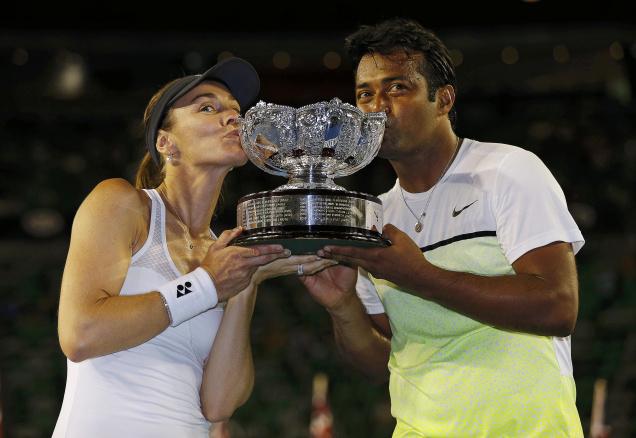
Leander Paes, Martina Hingis / Reuters

Leander Paes in his long and illustrious career has played with nearly 100 different partners in doubles and recently with Martina Hingis

There seems to be no expiry date on Leander Paes career. At 41, he is going as strong as ever, picking Grand Slam titles almost at will stunning the game’s pundits, few whom were willing to write him off as a potent force in the doubles. The Indian ace enthralled, legion of his supporters and proved his detractors wrong when he won his record 15th Grand Slam doubles title at the recent Australian Open, partnering game’s another great, Martina Hingis in the mixed doubles event.

It took all the persuasive charm of Leander to get the Swiss ace and former Women’s World No.1 Martina Hingis, who came out of retirement in 2013, to team up with him and as he says, “it took almost two years.” And when it happened, it was sheer magic. The two champions produced vintage tennis to win the mixed doubles crown.

Incidentally, Hingis had won a mixed doubles title at the Australian Open in 2006 pairing with Mahesh Bhupathi, Leander’s former men’s doubles partner. But winning with Leander Paes indeed has been a special moment for Martina Hingis, who had won three singles (from 1997 to 99), four doubles and two mixed doubles titles at the Melbourne Park. It was Leander Paes’ third Australian Open mixed doubles title and he had earlier won it in 2003 with Martina Navratilova of the United States and with Cara Black in 2010. In a career tally of seven mixed doubles titles, he has won three with Cara Black of Zimbabwe, two with Martina Navratilova one with Lisa Raymond of the US and now with Martina Hingis. In men’s doubles, he has won Grand Slam titles and maximum of three with Mahesh Bhupathi.

A delighted Martina Hingis, called him as a ‘perfect patner’ while Leander, acknowledged her role saying “we had a great chemistry and understanding”.

Leander Paes in his long and illustrious career has played with nearly 100 different partners in doubles, ranging from legend like Martina Navratilova (in mixed doubles) to a relatively unsung Vishnu Vardhan (men’s doubles). With whomsoever he plays, Leander has the ability to transfer his kinetic energy and positive attitude to his partner and that’s one of the main ingredient of his success in doubles. Leander also makes sure that his weakness, such as lack of a very powerful serve, is compensated by a strong partner, who serves strongly and a great hitter, such as Mahesh Bhupathi and Radek Stepanek

There is lot more to it in doubles, than finding a good partner. The well-known tennis coach, M. Krishna Kumar of Kinesis, who is a USPTR certified Professional and an avid admirer of Leander’s game, lists Leander’s lightning fast reflexes and good court craft as his big asset. Krishna Kumar also picks up Leander’s uncanny court craft as big plus point. “He has an exquisite court craft and Leander has the ability to pick the ball and find the right gap and angle to put it away for a winner. For that you need speed and timing and he has that ability to do that with an amazing ease,” says the coach.

Leander is a great team man, adds Krishna Kumar. “In doubles you need to complement each other well and communication is very important and Leander does that very effectively with all his partners.” Tennis fans in Bengaluru had a great time during the Davis Cup match against Serbia few months ago, watching Leander turn a losing doubles tie into a winning one with Rohan Bopanna. Two sets down, the Indians came back from cold to win that tie, with Leander taking charge of the show from the third set. Though Leander and Rohan won the doubles tie, India lost the rubber 2-3. But Leander made that doubles contest a memorable one. That never-say-die and taking charge in crunch situations makes Leander arguably the best doubles player in the World.

As years roll by, Leander’s magical show goes on and on.

source: http://www.thehindu.com / The Hindu / Home> Features> MetroPlus / by Kalyan Ashok / February 08th, 2015

In six decades, Santhals have turned away from agriculture

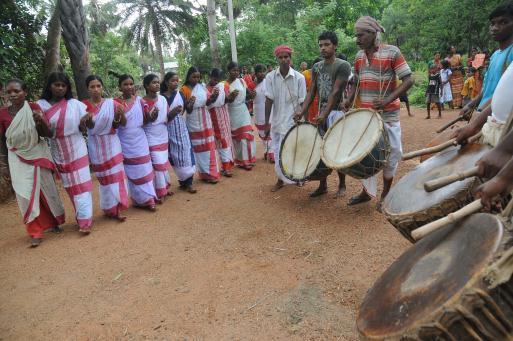
The Santhal community is celebrating a festival at Bhalukshole village in Paschim Medinipur district of West Bengal. Photo: Arunangsu Roy Chowdhury


Study conducted by Anthropological Survey of India.

Research undertaken by the Anthropological Survey of India (AnSI) has pointed to a shift in the socio-economic and cultural life of tribal communities like the Santhals over the past few decades.

A recent study conducted by the AnSI at Kuotala village in West Bengal’s Birbhum district, has revealed that in six decades the economy of the village has shifted from agriculture to one of menial work. Most of the men from the village now work as daily labourers, rickshaw pullers, gardeners and caretakers at private residences. The women are engaged as maids in the various households in the region.

Interestingly, a seminal work on the Santhals of the village by Nabendu Datta Majumdar titled ‘The Santhal — A study in cultural change,’ based on the research he carried out in the 1950s, clearly states that the tribal society was primarily agrarian.

“The principal economic activities of the Santhals of Kuotala and adjoining villages are agriculture, hunting, fishing, rearing of domestic animals and day labour. Agriculture is the chief source of livelihood…” the book published in 1956 stated.

“However, now, the village economy has transformed with the rise in demand for cash in hand at the end of the day. Menial work in various developmental activities run by government or non-government organisations is being sought after by the villagers of Kuotala,” Shyamal Kumar Nandy, Research Associate, AnSI, Kolkata told The Hindu.

Along with the economic activities a change has also come about in the cultural and religious practices of the tribals. While Mr. Majumdar’s book clearly referred to a strict hierarchical order in the society, headed by a chief known as Manjhi, the latest research points to a weakening of the social structure among the Santhals.

“Some members of the community are not willing to hold the post of the Manjhi as they feel that they will have to devote a lot of time to community activities and not be able to make sufficient money,” Mr. Nandy said.

The researchers have come across an instance where the Jaherthan or the sacred grove of the Santhal community had to be shifted because of construction work carried out by the Visva Bharati, Kakuli Chakraborty, head of office, Eastern Regional Centre of (AnSI) told The Hindu.

Jaherthan — a cluster of trees — is considered by the Santhals to be the abode of their principal deities.

According to the publication of Mr. Majumdar, Kuotala dates back to 1865, long before the central university was set up, when a few immigrant Santhal families from the Santhal Parganas had settled there.

According to the book, in 1938, the land in and around Kuotala and the adjoining Santhal villages were purchased by Visva Bharati from the local zamindar of Surul and the Santhals automatically became the tenants of Visva Bharati.

source: http://www.thehindu.com / The Hindu / Home> News> National> Other States / by Shiv Sahay Singh / Kolkata – February 05th, 2015

10 schools ‘Film It’ to national stage

Kolkata :

The ministry of culture has shortlisted 10 films made by students from as many city schools to create awareness about Kolkata’s heritage and promote tourism.

Three of these films will make it to the final list and find a place, along with shortlisted films from other cities, on the websites of ministries of culture and tourism. Posters from these films will also be used by the Centre in its ‘Incredible India’ campaign.

The films were screened on Tuesday at Birla High School as part of a nationwide screening of ‘Film It’, as the initiative has been christened.

Schools that made it to the top-10 list are Modern High School for Girls, Apeejay Park Street and Salt Lake, Birla High School, Lakshmipat Singhania, Loreto Sealdah, DPS Megacity, Heritage and South City International. “As many as 400 films were submitted from Kolkata. Choosing 10 best from the lot was a tough task. But I must say that Kolkata kids showed a lot of imagination while looking at heritage from a completely fresh angle,” said Purnima Dutt, who came from Intach-Delhi. The Indian National Trust for Art and Cultural Heritage (Intach) has been appointed the nodal agency for this countrywide project.

It is not built-heritage alone that the kids focused on. Even intangible heritage came in for filming. Take the case of Birla High School for Boys that made a film on fish markets of the city. “Visiting the fish market was an eye opener. It was a journey of sorts. Right from the catch, the sorting, the quality that goes into the different markets, the preservation, the sale and finally the preparations,” said Deepon Roy, a Class IX boy who was part of the film unit.

Similarly, Modern High School focused on the ancient game of Chaupar (dice) and how some ancient Marwari families still play it. Interesting mediums like animation and verse were also used to tell tales.

Schools from Mumbai, Delhi, Bangalore, Chandigarh and Ahmedabad have also been selected for the final round. Films screened by them showcase the heritage and culture of respective states.

“We have tied up with the Helen Hamlyn Trust in th UK that will also showcase the films in UK schools,” said Intach convenor GM Kapur.

source: http://www.timesofindia.indiatimes.com / The Times of India / Home> City> Kolkata / TNN / February 04th, 2015