He was born in Woodstock and became a raga exponent in Kolkata, his bansuri featuring in a Grammy-winning album and Oscar-winning film along the way.
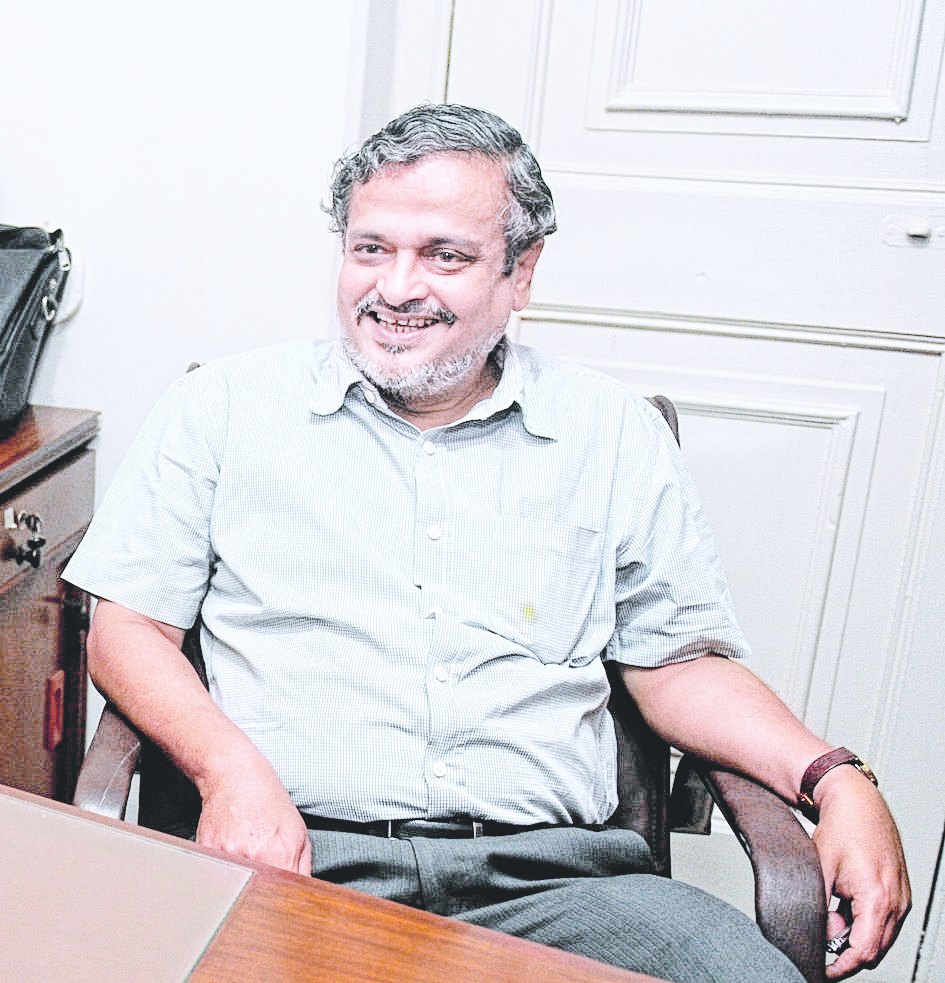
Flautist Steve Gorn is in town to perform at a concert presented by Calcutta Classical Guitar Society in association with Flute Lover’s Association on Wednesday.
Gorn had first come to India in 1970. He visited Kolkata a year later. “I had a Western music background. My father was a pianist and I played jazz saxophone and Western flute. During the late 1960s, though, many in our generation got influenced by Ustad Bismillah Khan’s shehnai. I came to Varanasi to explore Indian classical music and even tried the the shehnai. But since I was already playing the flute, I shifted to bansuri,” he said.
Gorn next travelled to Kolkata and began learning bansuri from Gaur Goswami, a disciple of the legendary Pandit Pannalal Ghosh. “I stayed around Gariahat and would take a tram to Shyambazar. That year, 1971, was a troubled time because of the Bangladesh war. Bombs were going off, curfews were imposed and thousands of refugees strea- med in. But I was young and couldn’t gauge the political situation. Now of course I know things better,” he told TOI.
“But back then, the music used to be a lot different from what it is now. Kolkata had an old-world charm and the music I love comes from that era — the music of stalwarts such as sitar maestro Pandit Nikhil Banerjee. For me, it is the ‘bhav’ or ‘ras’ of Indian classical music that is more important than anything else,” he said.
By 1972, Gorn and his wife had spent about 16 months in India. Then came a long gap and he returned again in 1986. “But Indian classical music continued to influence my compositions for films, dance shows and theaters,” he said. It also took him around the globe. Last year, he performed in China, Japan, Bulgaria, Czech Republic and Holland. “That’s why I speak only smattering of Hindi and Bengali,” he says apologetically.
Pandit Hariprasad Chaurasia heaps praises on Gorn. “He is a very good musician and a nice human being. We are very good friends and I have visited his home many times,” the flute maestro told TOI on Tuesday.
In 2004, Gorn played the flute for “Born Into Brothels” which was shot in Sonagachi and bagged an Oscar. “One scene is very close to my heart — a boy flies a kite and the flute melody also rises with its flight,” he said.
In 2011, he featured in the Grammy-winning album “Miho – Journey to the Mountain”. “Dhruba, the nephew of Pannalal Ghosh, played sarangi in the album. Miho is a museum in Japan and the music director was invited to visit and create music reflect the Asian artworks that were on display,” he told TOI.
Gorn has also been a part of several Grammy-nominated albums, including two this year.
source: http://www.timesofindia.indiatimes.com / The Times of India / Home> City> Kolkata / by Shounak Ghosal, TNN / March 11th, 2015
Saibal Das’s exhibition of black-and-white photographs (silver gelatin prints), Before the birth of Time, at The Harrington Street Arts Centre in collaboration with Tasveer lifts the veil over a world that once India was identified with, but is hardly visible anymore, now that the entire country has turned into a marketplace which has no connect with the more contemplative side of life.
Das, a veteran photojournalist, began his quest for a way of life where money and the principles it represents have little value, about four years ago when he visited Nabadwip, where the Vaishnavs have little use for material possessions. Over the next three years he travelled to Vrindaban, Puri and Manipur, which are regarded as the seats of Vaishnavism in India.
This world is sombre, pensive and at times sad, but it can also be charming and even quaint. A woman stands alone by the tulsimancha in Vishnupriya’s home in Nabadwip. The effigy of her beautiful, lotus-eyed husband, Chaitanya Mahaprabhu, is worshipped in a shrine in Puri. Whether by accident or design, behind him is a mural of Hanuman, the symbol of strength and prowess. A young woman, who has come to worship the sun during Chhat puja, is lost in thought. Behind her is a vast expanse of water from which sugarcane sprout like rushes. A smile plays on the lips of a buxom woman who has also come to the riverside along with other worshippers.
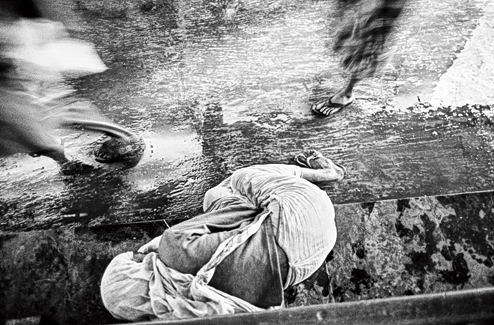
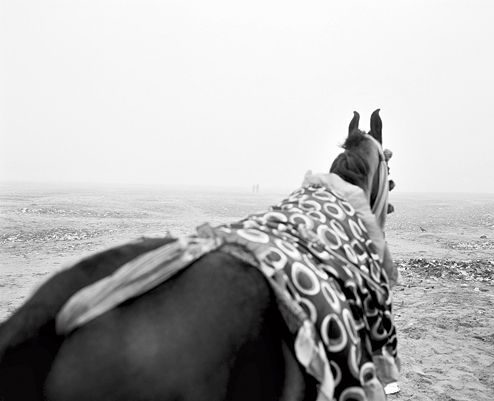
Two photographs from Saibal Das’s exhibition
An old woman with an unlined face in a white sari and folded hands sits alone in a huge hall. A pinpoint of light illumines her dark eyes. She is calm and no sorrow can touch her any longer. Another old woman lies beneath the staircase of a shrine as people pass by hurriedly, their feet blurred by speed. But not all women are so resigned. The old women who are being initiated into Nagahood look tough and strong, both physically and mentally. A royal lady is the very picture of dignity as she sits on her bed.
In this world one walks alone. This is perhaps symbolised by the stray pair of rubber slippers resting upright on a wall clawed and mutilated by the hands of time. There are also the ash-covered mendicants who are absorbed in their own world while playing the flute or telling their rosary. As solitary as these wandering figures is a horse standing in a dry riverbed. On the horizon are two human beings reduced to specks.
But it is not all sadness and gloom. An unwilling child dressed as Krishna holds on desperately to the waistband of a man as he is perhaps being led to a dais. The ceremonial guards of a temple in Manipur sit with their spears amidst a vast hall. The turbaned cooks with statuesque physique of the same temple have their mouths covered with cloth so as not to pollute the food for god.
Das’s most powerful photographs are those of the Manikarnika burning ghat where countless human beings are cremated. He never shows the grotesque half-burnt bodies floating in the river. Instead, his focus is on the mountains of logs used for the funeral pyres. They are piled up on the staircases and on the boats by the bank. The wood is being sold by the kilogram. An old woman is busy tying something in the pallu of her sari. She looks elsewhere. Her attention has been distracted. Behind her rises a wall of logs. In another photograph, smoke rises from a pyre in the distance, blurring the buildings behind it. In the foreground is the massive back of a man with a shaven head.
source: http://www.telegraphindia.com / The Telegraph, Calcutta / Front Page> Calcutta> Story / by Soumitra Das / Sunday – March 08th, 2015
WITH the retirement of Madhumita Bisht, a long and illustrious chapter in the history of Indian badminton has come to a close. In a career spanning nearly three decades, Madhumita grew from a small-town girl to a big-hearted champion. By stringing together will, courage and determination to succeed, Madhumita set an example for all those who followed.
Madhumita Bisht announcing her retirement in New Delhi. The queen of Indian badminton is an eight-time National singles champion, nine-time doubles winner and a 12-time mixed doubles winner
V.V. Krishnan
“If you believe you can do it, you will do it. After all, we human beings are blessed with amazing abilities. It is for us to make the most of these abilities.” These words from the 38-year-old Madhumita reflect the tremendous self-belief she developed over the years.
No wonder, Madhumita, who became the National sub-junior champion in 1977, went on to collect National titles at will. An eight-time National singles champion, nine-time doubles winner and a 12-time mixed doubles winner! That, in short, tells the tale of Madhumita’s all-round success at home.
Madhumita broke Meena Shah’s record of six successive National singles titles by winning seven between 1985 and 1991. She also had the unique distinction of emerging winner in all her eight appearances in the singles final of the National championship.
A fitness fanatic, fiercely competitive and a firm disciplinarian, Madhumita was greatly inspired by Ami Ghia, who won the Nationals seven times. She acknowledges the contribution made by Ami and says, “till date, we are best friends.”
Even before Madhumita arrived on the National scene, Ami was already a four-time National singles champion. “I remember watching her play for the first time. I thought she was just too good,” recalls Madhumita, now a Sports Officer with Northern Railway.
It was at Panjim in 1978 that Madhumita first saw Ami play and went on to lose to her. “I used to be very scared of the senior players like Ami and Kanwal Thakur Singh. Then I joined Railways and Ami was with me. I remember, we had a camp in Delhi’s Karnail Singh Stadium. We were roommates. Dipu Ghosh was our coach and he was of the opinion that I stood to gain a lot from Ami. He was right.”
Madhumita recalled a tournament in Bangalore, before joining the Railways, in 1978. “I was to play Ami in the final. But when I watched her warm-up, I forgot all about the fact that even I had to warm-up. Believe me, I did not warm up at all. Needless to say, I lost. But after watching her before the match, I realised the importance of warming up before every match. Perhaps, her meticulous ways rubbed off on me.”
It was not until 1980 that Madhumita began to believe that she could actually beat Ami. “I had beaten Kanwal Thakur Singh (who won two National titles by beating Ami in the finals) in the Lucknow International. So my confidence was growing.”
One Saturday afternoon, in the Uber Cup camp at Patiala, Madhumita lost 11-12 to Ami in the deciding game. “After the match I was wondering if I could run her so close, it was possible to beat her, too. Sunday was a day of rest. On Monday, the trials to select the team were to start. When the lots where drawn, I faced Ami in the first match of the round-robin trials. I beat her 11-7, 11-8,” recalls Madhumita with a glint of pride in her eyes.
“I beat her in August 1980 and again in January 1981. But around a fortnight later, in the Vijayawada Nationals, I lost to her in the semifinals. But thereafter, things became a little more comfortable for me. I beat her six times in the National finals. I’ve enjoyed playing with Ami. I played with her and many more opponents since then, but I can tell you, that in my opinion, Ami was the most difficult player to beat,” declares Madhumita, whose game revolved around her speed, fine anticipation, power and deception.
Hailing from Jalpaiguri and getting her early lessons in badminton from her father at Siliguri, young Madhumita worked hard to overcome the constraints. From playing on an outdoor mud-court to a make-shift indoor hall with the roof only 15 feet high, Madhumita progressed. “One could neither serve deep, nor go back since there was a danger of banging your racquet against the back-wall. But this helped my speed as I had to get adjusted to the shuttle travelling at such a quick pace,” says Madhumita on those challenging days.
An appearance in the National junior final and a sub-junior title kept her on the course. “In 1978, my dad (an artist with the Information and Cultural Affairs Department) shifted to Calcutta. This helped my badminton a lot. I must tell you that my dad was my biggest support. When I was 10, he accompanied me everywhere. He forgot everything else as he helped me pursue my dreams. He would give me an oil massage, tie my shoe-laces and even hand over the racquet to me before my match. Would you believe that? He would never scold me even when I lost. He would say, ‘unless you lose, you’ll not know what it takes to win.’ Till date, he is equally concerned,” says Madhumita about her “baba,” who used to personally repair the cemented floor of the badminton court at Siliguri to ensure that there was no break in his daughter’s practice-session.
Employed with the South Eastern Railways at the tender age of 13 years and seven months and married at 18 to Delhi-based shuttler Vikram Singh, Madhumita benefited a great deal from the environment which encouraged her to go on.
Madhumita went on to bag a bronze in the Asian Games in 1982 and received the Arjuna award in the same year. In 1992, Madhumita became the first lady to represent the country in the Olympic Games, in Barcelona. In fact, right through the 1980s and the 1990s, Madhumita was a regular feature of the Indian teams for the World Cup and Uber Cup competitions. Again in the 1998 Asian Games in Kuala Lumpur, Madhumita was part of the bronze-winning team.
Looking back on Madhumita career, success in the major international championships is absent. She won a triple-crown at Toulouse and finished runner-up in the USSR International in Moscow. But to see things in perspective, it must be remembered that during her best years as a singles player, lack of international exposure was the biggest hindrance facing the Indian players. Barring Prakash Padukone, no other player in the country could break these home-grown shackles. But surely, Madhumita deserved more in the international arena.
Among her big victories, the one against World number two Kusuma Sarwanta in 1992 stands out. Kusuma had won the Malaysian Open and the following week, Madhumita beat her in the second round in Indonesia.
Madhumita wanted to take a break from the game soon after the Nationals in 1991. “But Vikram and my in-laws asked me to concentrate on making it to the Olympic Games the following year. They said, ‘since you are playing well, you should give it a shot,'” recalls Madhumita.
Madhumita was ranked 29th in the world in 1992. For three months she looked for a sponsor to play abroad but in vain. Non-participation brought down her ranking to the 60s. “Since only the top-40 get a direct seeding in the Olympic Games, I had no option but to play and do well enough to raise my ranking. I reached the quarterfinals of the Korean Open and the ABC Championships before making the pre-quarterfinals of the All-England Championships that year,” says Madhumita.
On her return from Barcelona, Madhumita chose to stay off the game. She returned when her son was three months old but was firm on playing only in the country. “I was very happy to have a son after 10 years of marriage. I knew that I had played enough and my time was now for him. So I made up my mind not to travel overseas,” says Madhumita.
Later, Madhumita became Sindhu Gulati’s doubles partner after Nancy Keith gave up the sport following her marriage. Madhumita and Sindhu not only won their inter-Railways matches but also went on to win all three selection tournaments leading to the selection of the Indian team for the World championship in Switzerland. “Though Sindhu was aware of my priorities, all others waited for me to report for the World Cup camp at Patiala. At that time, I was away in Kolkata to attend my brother’s wedding. Citing domestic reasons, I stayed away from the camp.”
The turning point in Madhumita’s career came when she lost the doubles match with Sindhu in the 1996 Nationals at Bharauch. “I had put on a lot of weight due to thyroid problems. But I told myself that I had to become completely fit before the next Nationals. Thereafter, I began training very hard.”
A string of consistent showings, up to the Pune Nationals in 1997, saw Madhumita make the National team for the SAARC Cup at Colombo. “I was not very keen but Dipu Ghosh and Ami Ghia persuaded me to travel with the team.” She made all the three finals and won the doubles in the company of P. V. V. Laxmi.
Thereafter, in a major tournament in Chennai, where Aparna Popat and Manjusha Kanwar did not play, Madhumita beat Neelima Choudhary in the semifinals and Laxmi in the final. This was also Madhumita’s last singles title.
Her amazing success-rate in the doubles is something that has not received the kind of accolades it deserves. Madhumita’s first doubles title came in the company of Ami in 1981. She regained the crown in 1986 with Mallika Barua and went on to retain the title for the next three years with Ami. After Ami left the scene, Madhumita partnered Sudha Padmanabhan and won twice in succession till 1991. In 1998, Madhumita was back on top with Sindhu and regained the title for the last time in 2000 alongside P. V. V. Laxmi.
In mixed doubles, Madhumita’s consistency will be hard to match. She has played the National mixed doubles finals a whopping 20 times!
Madhumita first won the mixed event in 1982 in the company of Sanat Mishra. The duo came together in 1987 and recreated the magic over the next three years. For the following two years, it was with Harjeet Singh. After her comeback, beginning in 1995, Madhumita won four times in succession with Vinod Kumar. Last year, Vincent Lobo was Madhumita’s partner in prosperity, just as it was Markose Bristow this year. Interestingly, the only time Madhumita partnered Vikram, the duo ended as runner-up in 1986.
“I understand that doubles competition does not get its due. But that has not discouraged me from enjoying the doubles. I hope, with changing times, we’ll pay more attention to doubles. After all, in the World Team championship, you have three doubles. I’m glad the Badminton Association of India is working in this direction. Getting a specialist doubles coach like Rashid Sidek to India was a wonderful idea. We have talented doubles players and youngsters like Sanave Thomas and V. Diju are promising a lot. I am sure, it is a matter of time before we start getting results in doubles, too.”
Being involved in competitive badminton for 27 years, the only time an injury threatened to put an end to her career was in 1999. A leg-injury suffered in a camp in Bangalore necessitated an operation. And for once, Madhumita thought that it was not possible for her to resume playing. But help was at hand.
“Dr. Ashok Rajagopal told me that he’ll see to it that I’m back. He even told me that he cited my example to encourage others to fight their injuries and return to their respective discipline. It took eight months for me to get back. I again trained and found a place in the Uber Cup team in 2000,” recalls Madhumita.
Thereafter, she began contemplating retirement. Though there was no dearth of motivation, Madhumita thought it was time for her to spend more time with her growing son, Harshvardhan, besides fulfilling other family commitments.
“After the Cochin Nationals (in 2000), I decided to announce my retirement. But people around me prompted me to play on. The same happened even after the Jaipur Nationals, last year. But this time, before the Lucknow Nationals I had made up my mind that this would be it,” she says.
In fact, Madhumita all but made a formal announcement at Lucknow before changing her mind to do so on her return to Delhi. The mixed doubles title in the company of Markose Bristow was an indication of her form and this led to her selection in the Uber Cup team in Eindhoven.
And when Madhumita finally called it a day in New Delhi, it was in the presence of her employers, former Asian champion Dinesh Khanna and several badminton players.
“I am not feeling too sad since I had prepared myself mentally for this day long time back. May be, I’ll be attached to badminton and do everything that I can for the youngsters. Whatever I’ve learnt, I will try to give to the younger players,” said Madhumita who is also the chief coach for Railways.
“Whatever I am today, my job, name and fame, it is all due to badminton. There are several successful people in various professions and vocations but how many of them are well-known? So I’ll remain eternally grateful to the game and all those people who believed in me.”
Looking ahead, Madhumita is happy that a lot of foreign exposure is being given to today’s players. “It is good but not everyone is making the most of it. Since, they are getting it far more easily, they do not value it as much. I feel, there is not much accountability. The players should be made to feel that if they are being given the opportunity to represent the country, they should give their very best. I am not saying you win every time you go out and play, but try your best. I see that they lack dedication and discipline. This is where the role of parents comes in. Certain values need to be inculcated at home.”
Citing examples of her idol Prakash Padukone for his discipline and P. Gopi Chand for his commitment, Madhumita says, “I’ve watched Prakash work very hard. His discipline was simply amazing. Take a look at Gopi. He is so dedicated. Even after three knee operations, he is so committed on the court. If you don’t have the commitment, you cannot succeed,” says Madhumita. For years, Madhumita has carried on successfully mainly due her form and fitness. Her passion for the game and the appetite for success have kept her on the court. When looking at Madhumita’s glorious career, it is difficult to find a parallel. She is one of a kind.
“If you believe you can do it, you will do it. After all, we human beings are blessed with amazing abilities. It is for us to make the most of these abilities.” These words from the 38-year-old Madhumita reflect the tremendous self-belief she developed over the years.
No wonder, Madhumita, who became the National sub-junior champion in 1977, went on to collect National titles at will. An eight-time National singles champion, nine-time doubles winner and a 12-time mixed doubles winner! That, in short, tells the tale of Madhumita’s all-round success at home.
Madhumita broke Meena Shah’s record of six successive National singles titles by winning seven between 1985 and 1991. She also had the unique distinction of emerging winner in all her eight appearances in the singles final of the National championship.
A fitness fanatic, fiercely competitive and a firm disciplinarian, Madhumita was greatly inspired by Ami Ghia, who won the Nationals seven times. She acknowledges the contribution made by Ami and says, “till date, we are best friends.”
Even before Madhumita arrived on the National scene, Ami was already a four-time National singles champion. “I remember watching her play for the first time. I thought she was just too good,” recalls Madhumita, now a Sports Officer with Northern Railway.
It was at Panjim in 1978 that Madhumita first saw Ami play and went on to lose to her. “I used to be very scared of the senior players like Ami and Kanwal Thakur Singh. Then I joined Railways and Ami was with me. I remember, we had a camp in Delhi’s Karnail Singh Stadium. We were roommates. Dipu Ghosh was our coach and he was of the opinion that I stood to gain a lot from Ami. He was right.”
Madhumita recalled a tournament in Bangalore, before joining the Railways, in 1978. “I was to play Ami in the final. But when I watched her warm-up, I forgot all about the fact that even I had to warm-up. Believe me, I did not warm up at all. Needless to say, I lost. But after watching her before the match, I realised the importance of warming up before every match. Perhaps, her meticulous ways rubbed off on me.”
It was not until 1980 that Madhumita began to believe that she could actually beat Ami. “I had beaten Kanwal Thakur Singh (who won two National titles by beating Ami in the finals) in the Lucknow International. So my confidence was growing.”
One Saturday afternoon, in the Uber Cup camp at Patiala, Madhumita lost 11-12 to Ami in the deciding game. “After the match I was wondering if I could run her so close, it was possible to beat her, too. Sunday was a day of rest. On Monday, the trials to select the team were to start. When the lots where drawn, I faced Ami in the first match of the round-robin trials. I beat her 11-7, 11-8,” recalls Madhumita with a glint of pride in her eyes.
“I beat her in August 1980 and again in January 1981. But around a fortnight later, in the Vijayawada Nationals, I lost to her in the semifinals. But thereafter, things became a little more comfortable for me. I beat her six times in the National finals. I’ve enjoyed playing with Ami. I played with her and many more opponents since then, but I can tell you, that in my opinion, Ami was the most difficult player to beat,” declares Madhumita, whose game revolved around her speed, fine anticipation, power and deception.
Hailing from Jalpaiguri and getting her early lessons in badminton from her father at Siliguri, young Madhumita worked hard to overcome the constraints. From playing on an outdoor mud-court to a make-shift indoor hall with the roof only 15 feet high, Madhumita progressed. “One could neither serve deep, nor go back since there was a danger of banging your racquet against the back-wall. But this helped my speed as I had to get adjusted to the shuttle travelling at such a quick pace,” says Madhumita on those challenging days.
An appearance in the National junior final and a sub-junior title kept her on the course. “In 1978, my dad (an artist with the Information and Cultural Affairs Department) shifted to Calcutta. This helped my badminton a lot. I must tell you that my dad was my biggest support. When I was 10, he accompanied me everywhere. He forgot everything else as he helped me pursue my dreams. He would give me an oil massage, tie my shoe-laces and even hand over the racquet to me before my match. Would you believe that? He would never scold me even when I lost. He would say, ‘unless you lose, you’ll not know what it takes to win.’ Till date, he is equally concerned,” says Madhumita about her “baba,” who used to personally repair the cemented floor of the badminton court at Siliguri to ensure that there was no break in his daughter’s practice-session.
Employed with the South Eastern Railways at the tender age of 13 years and seven months and married at 18 to Delhi-based shuttler Vikram Singh, Madhumita benefited a great deal from the environment which encouraged her to go on.
Madhumita went on to bag a bronze in the Asian Games in 1982 and received the Arjuna award in the same year. In 1992, Madhumita became the first lady to represent the country in the Olympic Games, in Barcelona. In fact, right through the 1980s and the 1990s, Madhumita was a regular feature of the Indian teams for the World Cup and Uber Cup competitions. Again in the 1998 Asian Games in Kuala Lumpur, Madhumita was part of the bronze-winning team.
Looking back on Madhumita career, success in the major international championships is absent. She won a triple-crown at Toulouse and finished runner-up in the USSR International in Moscow. But to see things in perspective, it must be remembered that during her best years as a singles player, lack of international exposure was the biggest hindrance facing the Indian players. Barring Prakash Padukone, no other player in the country could break these home-grown shackles. But surely, Madhumita deserved more in the international arena.
Among her big victories, the one against World number two Kusuma Sarwanta in 1992 stands out. Kusuma had won the Malaysian Open and the following week, Madhumita beat her in the second round in Indonesia.
Madhumita wanted to take a break from the game soon after the Nationals in 1991. “But Vikram and my in-laws asked me to concentrate on making it to the Olympic Games the following year. They said, ‘since you are playing well, you should give it a shot,'” recalls Madhumita.
Madhumita was ranked 29th in the world in 1992. For three months she looked for a sponsor to play abroad but in vain. Non-participation brought down her ranking to the 60s. “Since only the top-40 get a direct seeding in the Olympic Games, I had no option but to play and do well enough to raise my ranking. I reached the quarterfinals of the Korean Open and the ABC Championships before making the pre-quarterfinals of the All-England Championships that year,” says Madhumita.
On her return from Barcelona, Madhumita chose to stay off the game. She returned when her son was three months old but was firm on playing only in the country. “I was very happy to have a son after 10 years of marriage. I knew that I had played enough and my time was now for him. So I made up my mind not to travel overseas,” says Madhumita.
Later, Madhumita became Sindhu Gulati’s doubles partner after Nancy Keith gave up the sport following her marriage. Madhumita and Sindhu not only won their inter-Railways matches but also went on to win all three selection tournaments leading to the selection of the Indian team for the World championship in Switzerland. “Though Sindhu was aware of my priorities, all others waited for me to report for the World Cup camp at Patiala. At that time, I was away in Kolkata to attend my brother’s wedding. Citing domestic reasons, I stayed away from the camp.”
The turning point in Madhumita’s career came when she lost the doubles match with Sindhu in the 1996 Nationals at Bharauch. “I had put on a lot of weight due to thyroid problems. But I told myself that I had to become completely fit before the next Nationals. Thereafter, I began training very hard.”
A string of consistent showings, up to the Pune Nationals in 1997, saw Madhumita make the National team for the SAARC Cup at Colombo. “I was not very keen but Dipu Ghosh and Ami Ghia persuaded me to travel with the team.” She made all the three finals and won the doubles in the company of P. V. V. Laxmi.
Thereafter, in a major tournament in Chennai, where Aparna Popat and Manjusha Kanwar did not play, Madhumita beat Neelima Choudhary in the semifinals and Laxmi in the final. This was also Madhumita’s last singles title.
Her amazing success-rate in the doubles is something that has not received the kind of accolades it deserves. Madhumita’s first doubles title came in the company of Ami in 1981. She regained the crown in 1986 with Mallika Barua and went on to retain the title for the next three years with Ami. After Ami left the scene, Madhumita partnered Sudha Padmanabhan and won twice in succession till 1991. In 1998, Madhumita was back on top with Sindhu and regained the title for the last time in 2000 alongside P. V. V. Laxmi.
In mixed doubles, Madhumita’s consistency will be hard to match. She has played the National mixed doubles finals a whopping 20 times!
Madhumita first won the mixed event in 1982 in the company of Sanat Mishra. The duo came together in 1987 and recreated the magic over the next three years. For the following two years, it was with Harjeet Singh. After her comeback, beginning in 1995, Madhumita won four times in succession with Vinod Kumar. Last year, Vincent Lobo was Madhumita’s partner in prosperity, just as it was Markose Bristow this year. Interestingly, the only time Madhumita partnered Vikram, the duo ended as runner-up in 1986.
“I understand that doubles competition does not get its due. But that has not discouraged me from enjoying the doubles. I hope, with changing times, we’ll pay more attention to doubles. After all, in the World Team championship, you have three doubles. I’m glad the Badminton Association of India is working in this direction. Getting a specialist doubles coach like Rashid Sidek to India was a wonderful idea. We have talented doubles players and youngsters like Sanave Thomas and V. Diju are promising a lot. I am sure, it is a matter of time before we start getting results in doubles, too.”
Being involved in competitive badminton for 27 years, the only time an injury threatened to put an end to her career was in 1999. A leg-injury suffered in a camp in Bangalore necessitated an operation. And for once, Madhumita thought that it was not possible for her to resume playing. But help was at hand.
“Dr. Ashok Rajagopal told me that he’ll see to it that I’m back. He even told me that he cited my example to encourage others to fight their injuries and return to their respective discipline. It took eight months for me to get back. I again trained and found a place in the Uber Cup team in 2000,” recalls Madhumita.
Thereafter, she began contemplating retirement. Though there was no dearth of motivation, Madhumita thought it was time for her to spend more time with her growing son, Harshvardhan, besides fulfilling other family commitments.
“After the Cochin Nationals (in 2000), I decided to announce my retirement. But people around me prompted me to play on. The same happened even after the Jaipur Nationals, last year. But this time, before the Lucknow Nationals I had made up my mind that this would be it,” she says.
In fact, Madhumita all but made a formal announcement at Lucknow before changing her mind to do so on her return to Delhi. The mixed doubles title in the company of Markose Bristow was an indication of her form and this led to her selection in the Uber Cup team in Eindhoven.
And when Madhumita finally called it a day in New Delhi, it was in the presence of her employers, former Asian champion Dinesh Khanna and several badminton players.
“I am not feeling too sad since I had prepared myself mentally for this day long time back. May be, I’ll be attached to badminton and do everything that I can for the youngsters. Whatever I’ve learnt, I will try to give to the younger players,” said Madhumita who is also the chief coach for Railways.
“Whatever I am today, my job, name and fame, it is all due to badminton. There are several successful people in various professions and vocations but how many of them are well-known? So I’ll remain eternally grateful to the game and all those people who believed in me.”
Looking ahead, Madhumita is happy that a lot of foreign exposure is being given to today’s players. “It is good but not everyone is making the most of it. Since, they are getting it far more easily, they do not value it as much. I feel, there is not much accountability. The players should be made to feel that if they are being given the opportunity to represent the country, they should give their very best. I am not saying you win every time you go out and play, but try your best. I see that they lack dedication and discipline. This is where the role of parents comes in. Certain values need to be inculcated at home.”
Citing examples of her idol Prakash Padukone for his discipline and P. Gopi Chand for his commitment, Madhumita says, “I’ve watched Prakash work very hard. His discipline was simply amazing. Take a look at Gopi. He is so dedicated. Even after three knee operations, he is so committed on the court. If you don’t have the commitment, you cannot succeed,” says Madhumita. For years, Madhumita has carried on successfully mainly due her form and fitness. Her passion for the game and the appetite for success have kept her on the court. When looking at Madhumita’s glorious career, it is difficult to find a parallel. She is one of a kind.
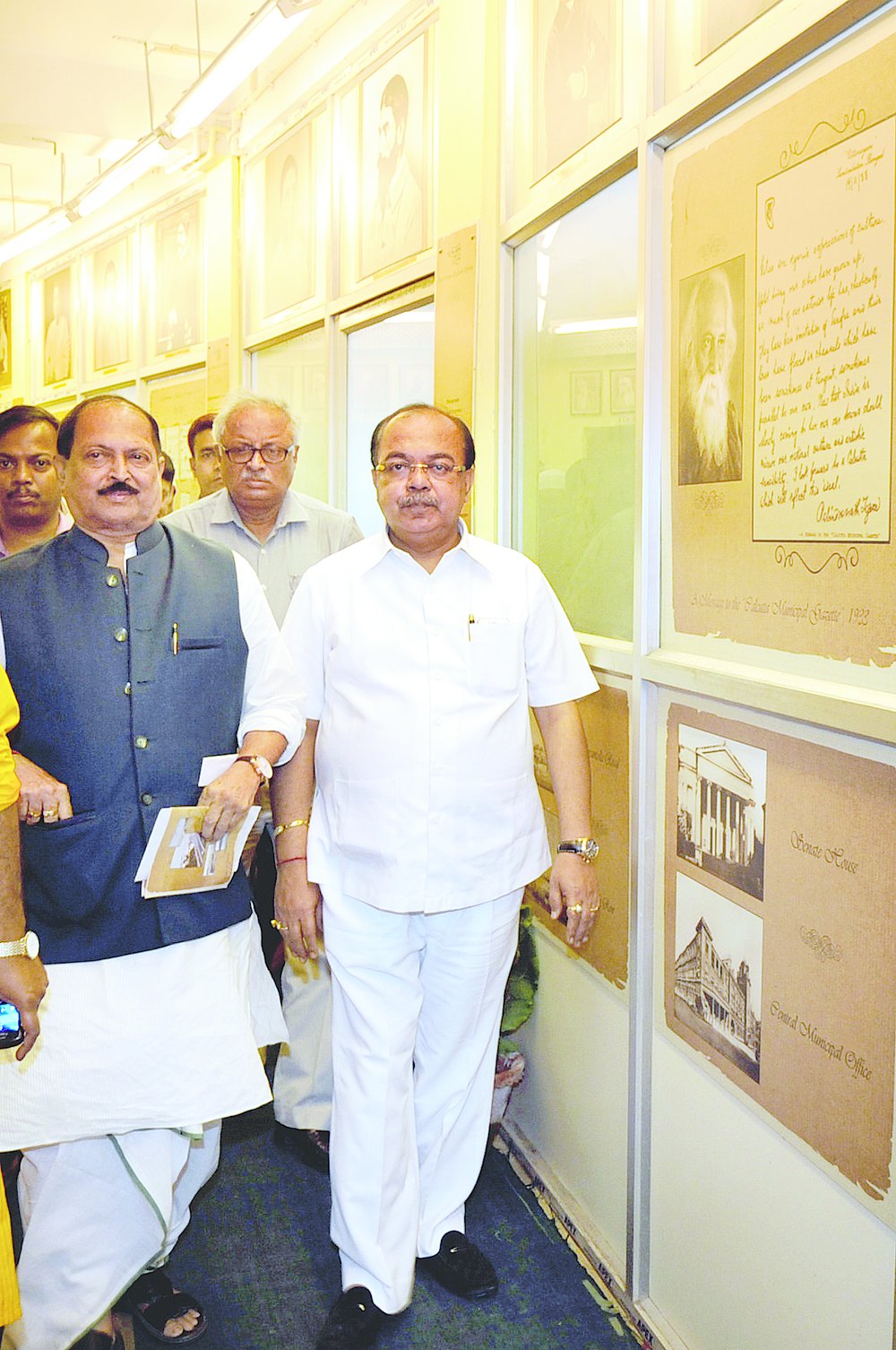
Mayor Sovan Chatterjee and former mayor Subrata Mukherjee at an exhibition in the Calcutta Municipal Corporation headquarters on the occasion of the inauguration of a digital archive.
The rare pictures on display are among the hundreds that will be stored, along with significant documents, in the Amol Home Digital Archive. The collections include a photograph of a pensive Gandhiji at Keoratala during Chittaranjan Das’s cremation.
The archive has been named after scholar Amal Home, who used to edit the Calcutta Municipal Gazette when its publication started in 1924.
source: http://www.telegraphindia.com / The Telegraph, Calcutta / Front Page> Calcutta> Story / Wednesday – March 04th, 2015
Presidency welcomed back an old boy on Monday as a distinguished professor four decades since he left to join arch-rival Jadavpur University, first as a student and then a teacher.
Swapan Chakravorty, adored and revered by generations of students who studied English at JU, is now a Rabindranath Tagore Distinguished University Professor in literature and cultural studies at Presidency University. Swapan Chakravorty
Chakravorty sees little significance in the shift, but to those well-versed in the dynamics of the Presidency-JU rivalry a tinge of delight here and the sense of loss there would be hard to miss. “I don’t think institutions miss any individual, and it’s silly of an individual to miss the institute,” Chakravorty told Metro on the first day of his new assignment.
Malabika Sarkar, former JU professor and Presidency’s first vice-chancellor, said Chakravorty joining his alma mater was “a gain” for his alma mater rather than a loss for the institution he served for three decades. “At least he will be working in the same city and probably will take time off to attend seminars and conferences at JU.”
While his brief is to provide Presidency University academic leadership and help achieve its goal of becoming a centre of excellence, Chakravorty is pragmatic about what needs to be done. “Even to be recognised nationally, our infrastructure has to be far better,” he said.
Chakravorty recalled that it was with “astounding infrastructure” that American universities had attracted “the best and brightest teachers post World War-II”.
And could Presidency realistically aim to create similar infrastructure to woo the best and brightest? “Presidency has a 10-acre plot in Rajarhat, but what will it do with the land if it doesn’t have enough money? Ahead of the institute’s bicentenary, one of the immediate requirements is money,” Chakravorty said.
The former JU professor had been a member of the Presidency mentor group that submitted a report in 2012 expressing disappointment over the lack of clarity on financial assistance from the state government.
“We are disappointed to note that no follow-up action was taken on a proposal from the vice-chancellor, specifically sought by the principal secretary, higher education, in January 2012 for an allocation in the range of Rs 200 crore for Presidency University. This needs to be clarified,” the report had stated.
On Monday, Chakravorty pleaded for an “out-of-budget allocation”, be it from the state coffers, the Centre or a private source. “Visva-Bharati University was once granted by the Centre a corpus of Rs 100 crore to commemorate the 150th birth anniversary of Rabindranath Tagore. If a similar amount could be tapped from some quarters, it would mean a lot for this fledgling university. Then we can say, ‘Oh! Yes, there is a future for Presidency’,” he said.
Sajal Nag, until recently professor of history at Assam Central University, too stressed the need for better infrastructure hours after joining Presidency on lien as Distinguished University Professor in history and political science. “It is a privilege for me to be part of Presidency…I believe that with the right infrastructure we can do wonders,” he said.
Crumbling infrastructure has been Presidency’s hurdle in the quest for old glory. Baker Building, where once strode stalwarts such as Acharya Jagadis Chandra Bose, Prasanta Chandra Mahalanobis, Satyendra Nath Bose and Meghnad Saha, wears a ceiling so fragile that teachers and students risk injury every day to teach and study there.
source:http://www.telegraphindia.com / The Telegraph, Calcutta / Front Page> Calcutta> Story / by Subhankar Chowdhury / Tuesday – March 03rd, 2015
A unique initiative involving the West Bengal Health Department and a non-government organisation here on Monday has brought hope to mentally ill patients of Kolkata’s Pavlov Hospital.
Ostracized by society and abandoned by their family members, patients of the biggest mental health facility in West Bengal can now dream of financial independence and a life beyond the confines of the hospital.
A memorandum of understanding for Dhobhi Ghar, a laundry project, was signed between the representative of State Health Department and Anjali, a mental health rights NGO, which at the outset will involve at least 12 patients who have recovered from their ailment but are unable to return home.
“Initially, we will be dry-cleaning clothes from hospitals and slowly we will take orders from hotels and restaurants. The 12 people who are involved in the project will be paid Rs 232 per day as per minimum wages laws,” said Ratnaboli Ray, who signed the MoU on behalf on Anjali.
While the machines for starting the project have been imported by the NGO, the Bengal government has provided necessary infrastructure and ensured water and electricity supply for the project.
“We thought that it was a good proposal to provide livelihood and rehabilitation to mental health patients. This is the first such initiative taken in Bengal involving mental health patients,” Moloy De, Principal Secretary of Bengal’s Health Department told The Hindu .
According to mental health activists like Ms Ray this is first such initiative tried anywhere in the country and it comes as good news from the mental health instruction of Bengal after many years.
In the past, the mental hospitals of Bengal particularly the Pavlov Hospital were in the news for unnatural deaths and human rights violations.
The death of 84 inmates in the mental health facility of Bengal in 2013 over the past three years had resulted in strong criticism by activists.
source: http://www.thehindu.com / The Hindu / Home> News> Cities> Kolkata / by Shiv Sahay Singh / Kolkata – March 03rd, 2015
Around 123 original works of Abanindranath Tagore, or Aban Thakur, as he is fondly called, will be on display at the Victoria Memorial from Tuesday onwards. The exhibition has been curated by art expert Ratan Parimu from Vadodara.
While Victoria Memorial is bringing out some of the never-seen paintings from its vaults, a large number of the creations on display will be from Rabindra Bharati Society’s collection, which had been gifted to Victoria authorities for conservation and safekeeping.
The mammoth display will offer glimpses of all the styles that Tagore toyed with and which gave birth to the Bengal school of art.
Though he was trained in Calcutta school of art under European masters like O Ghilardi, who taught him the use of pastels and Charles Palmer, who taught him oil painting, Aban Thakur did not let contemporary European styles influence him. Instead, he thought indigenous styles need to be showcased to the world, especially our own patachitra traditions, Mughal miniatures and Rajasthani styles of paintings. He imbibed these in his own drawing and painting patterns and developed a unique style.
Examples of all the best known innovations by Tagore will be on display like his landmark creations from Hindu mythology like the ‘Slaying of Putana by baby Krishna’ or Goddess Chandika from the attributes of the ‘Chandi Mangal’. Tagore was one of the earliest Indian artists to study wildlife in detail and his lifelike watercolour creations of the cheetah and rhinocerous have often been praised. His portrayal of the fasting Abhaya brings to light characteristics of rural life in Bengal. Some of the best examples of his adaptation from Mughal and Rajasthani miniatures, where the use of gold is striking, will also be on display.
It was not easy to get so many paintings ready. Victoria Memorial director Jayanta Sengupta said, “While the paintings were robust, they needed to be de-acidified and mounted on acid free mount boards for a better life. We have prepared a condition report for each painting, photo documented them and drawn up an accession history. We are calling it in situ conservation.”
source: http://www.timesofindia.indiatimes.com / The Times of India / Home> City> Kolkata / by Jhimli Mukherjee Pandey / March 03rd, 2015
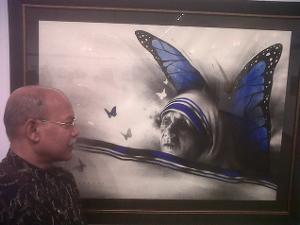
Even as the recent controversial statement of the RSS leader Mohan Bhagwat on Mother Teresa has received strong opinionated responses and also started an online war between opposing views on the issue, a Mumbai based artist has gently put forth his impression with charcoal and acrylic on canvas.
Artist Ajay De is currently holding an exhibition titled `Butterfly People’ at Jehangir Art Gallery where he has shown among other artworks two paintings in which Mother Teresa is a butterfly.
“I have correlated beautiful people as butterflies through art. In fact, I feel that everyone can be a butterfly, a creature that lives for just a few days but spreads beauty and happiness all around it,” explained De, whose exhibition is on till Monday (March 2).
When asked what he thinks of the latest controversy on whether Mother Teresa used to convert the people she rescued from the streets, De said: “I do not want to get into this political controversy, though I will say that it has not affected the reputation of Mother Teresa.”
The artist who had met Mother Teresa just once in the early ’80s in Kolkata, elaborated: “When a stone is thrown at a celebrity, his or her image is not tarnished, but someone else may get some publicity.”
His two artworks on Mother Teresa have already been sold, while the other paintings have also got a favorable response at the exhibition.
“From the time it breaks out of the chrysalis and transforms into a beautiful winged creature, the butterfly stuns the world with its beauty and soothes the world its spirit. In life, we humans come close to being the butterfly, yet only a few are able to embrace the life of a butterfly. That is the challenge we all have to think about,” he concluded.
source: http://www.timesofindia.indiatimes.com / The Times of India / Home> City> Mumbai / by Vijay Singh, TNN / March 01st, 2015
Sarod exponent Joydeep Ghosh tells Meena Banerjee his musical education allowed him to take uncommon ragas in his stride.
One discovered an intriguing fact from versatile musician Joydeep Ghosh, the concluding artiste of the annual soiree organised recently by Kolkata’s Ballygunge Maitreyee Music Circle, dedicated to the late Sangeetacharya Radhika Mohan Moitra (Radhubabu). On this occasion his sarod etched a rare raga, Kedari-Marwa, with admirable clarity. In this both Kedar and Marwa remained intertwined; like in a braid; without giving up their identity. Such an interpretation, replete with unexpected bends, does not allow complacency, either to the player or to his listeners. This was definitely a show by a maestro for initiated listeners only. The latter is a dwindling community even in Kolkata nowadays; but going by Ghosh’s usual selection of ragas, one was inspired to ask:
What encourages you to choose rare ragas for concerts?
I was only five when I started learning at the feet of great masters Anil Roychoudhury and Radhubabu; and later from Buddhadev Dasgupta. They all belong to the famous Senia Shahajahanpur sarod gharana and they are revered for their enviable melodic treasures. I also learnt tabla and vocal music from venerable gurus. Subsequently, I came under the wings of the erudite and versatile master Bimalendu Mukherjee, a doyen of the famous Imdadkhani gharana of sitar and surbahar. Under their priceless guidance I assimilated vocalism, instrumentalism and the style of rhythmic play along with raga elaboration.
The simple fact is that my gurus did not tell me what were common and what ‘rare’ ragas were. They all came naturally as sister ragas, with their key phrases loud and clear, during the learning process of one major raga; even the jod-ragas (blend of more than one) were taught to me without much ado; just as they did not categorise any instrument and made me learn to play sarod, surshringar and mohanveena.
Isn’t the mohanveena a newly invented instrument?
Radhubabu’s mohanveena.
Unfortunately, very few remember the history of the original mohanveena, conceived and invented by Radhubabu in early 1948! Once, around 1944, he played the surshringar in a jugalbandi (duet) with the famous beenkar (Rudra veena player) Ustad Sadiq Ali Khan in Lucknow. The concert inspired him to design a unique instrument in which the playable materials of both the sitar and the sarod could be appropriately exploited and the tonal quality of the Rudra veena could be equally maintained. Since he was proficient in both, having had his training from Ustad Mohammad Ameer Khan of the Shahajahanpur gharana and Ustad Inayat Khan of the Etawah gharana in the sarod and the sitar respectively, Radhubabu’s experiment succeeded.
The instrument’s majestic tonality impressed Thakur Jaidev Singh, the renowned musicologist who was then Chief Producer, All India Radio, Delhi. In 1950, Thakur Saheb named the instrument ‘mohanveena’ and also arranged an archival recording for AIR, followed by an extensive interview of Radhubabu, its inventor. Radhubabu was invited in several music festivals all over India to play the mohanveena. Some of his rare recordings for AIR archives are available in compact discs as precious documents.
So, despite the emergence of another, Hawaiian guitar-based instrument of the same name almost fifty years later, the original mohanveena exists along with its own unique excellence till date, through some of the devoted torchbearers of Radhubabu’s legacy. I am also a humble exponent of the mohanveena.
source:http://www.thehindu.com / The Hindu / Home> Features. Friday Review / by Meena Banerjee / February 27th, 2015
Yudhajeet and (right) Deeptyajeet De at the Welfare Society for the Blind tournament. (Arnab Mondal)
At 18, twins Yudhajeet and Deeptyajeet De have already won more accolades than their years put together. The Class XII students have not only beaten players on the other side of the chess board but also their greatest opponent – visual impairment.
Yudhajeet was introduced to the game by his mother when he was just six, while Deeptyajeet started picking up the moves from his brother a few years later. Both are FIDE-rated players and Yudhajeet added another feather to his already crowded cap when he won the first edition of the Rapid Blind Chess Tournament organised by the Welfare Society for the Blind last week. Deeptyajeet finished third at the same event.
“We eat, drink and sleep chess. We just love the game. We keep thinking about our moves all day,” said Yudhajeet, whose FIDE (Federation Internationale des Echecs) rating is 1554. The rating provided by the World Chess Federation denotes a player’s individual skill level. Viswanathan Anand, for instance, enjoys a FIDE standard rating of 2797 at present.
Yudhajeet has had no vision in both eyes since birth but that hasn’t stopped him from taking on sighted opponents. “We have to visualise the board in our mind and remember all the positions constantly. It is tougher when we play rapid chess as there is little time to make the moves,” said Yudhajeet, who finished runner-up in an all-Bengal under-14 sighted tournament in 2010.
The duo have been in the top 20 at the east zone chess meet quite a few times and qualified for Category B of the national championship for the visually impaired. Though Deeptyajeet, FIDE rating 1443, is yet to qualify for Category A of the national meet, Yudhajeet has played it twice.
“Both brothers are keen learners. Yudhajeet is quick to grasp the openings and remembers the moves I teach him. They have improved a lot in the past year. They have to compete more with sighted players now at the national level to gain confidence,” said chess player Laltu Chatterjee, who has been training the boys for more than a year.
The Uttarpara boys met their present coach at an all-Bengal open chess tournament in Rishra and requested him to train them. Before that it was their tutor, Madan Jana, who had taught Yudhajeet the basics of the game and got him interested.
When their mother, Ruma De, wanted Yudhajeet to engage in an indoor sport, she decided chess was the best option. “I thought he could excel in it as it’s more of a brain game and he has always been a good student in school,” Ruma said.
Yudhajeet’s first competitive event was an all-Bengal tournament for the visually impaired in 2008.
“It was held at St. Xavier’s College and I won the runner-up trophy. The taste of success in the very first tournament gave me a huge boost and made me dream,” he said. In 2012, he came third in the junior open national chess meet for visually impaired and in 2014, he found a place among the top 10 in the national A championship.
Last year was also good for Deeptyajeet, who started playing the game at age 10 and played his first tournament in 2011. In 2014, he won three all-Bengal tournaments.
A late entrant in the game, chess is now Deeptyajeet’s sole passion. It is brother Yudhajeet’s first love, too, but he also plays the sitar and is a big fan of Virat Kohli.
A dream they share is to become international masters, but their immediate goal is to make a mark in the ongoing open national chess meet in Nagercoil, Tamil Nadu.
What is your message for Yudhajeet and Deeptyajeet De? Tell ttmetro@abpmail.com
source: http://www.telegraphindia.com / The Telegraph, Calcutta / Front Page> Calcutta> Story / by Ayuan Paul / Saturday – February 28th, 2015