All posts by wellnmed@gmail.com

A beehive for a club

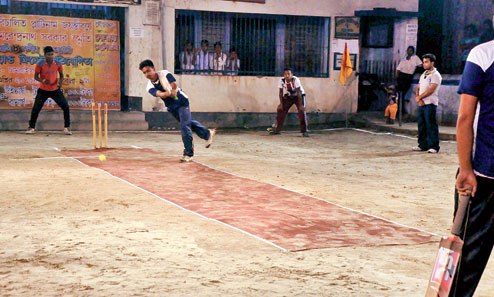
An inter-club underarm cricket tournament organised by Mouchak at  Chamrail High School ground. Picture by Gopal Senapati
An inter-club underarm cricket tournament organised by Mouchak at
Chamrail High School ground. Picture by Gopal Senapati

The name sounds unusual for a club, but the founders of Mouchak wanted the club to run exactly like a beehive, where the Queen bee orders around and the servants follow the orders. In this case, the secretary is the Queen Bee and all members are her workers. Mouchak has been functioning this way through its 75-year journey.

The club is one of the oldest among those around Kona, Chamrail and Jagadishpur. Senior members of the club remember seeing Martin Rail pass from the front of the club. Although established in the pre-Independence years, the members were not associated with the freedom struggle. “At that time, this was a remote village in Howrah with only a handful of residents, most of whom were farmers. Gradually, people from other places have come and settled in Chamrail,” said Sailendranath Mondal, the secretary of the club.

Those who liked to do physical training or were involved in music, did not have a place to practise. “They would go to local resident, Tarapada Mondal’s house which became a centre for physical exercise and cultural activities,” said Mondal. Later, the local zamindar, Panchkari Santra, donated land for a club. This was a low-lying pond which was filled to make the first club house. “Initially, the club house had a mud floor and bamboo walls and a tiled roof. Later, the building was made into a concrete structure,” said Mondal.

Mouchak was initially started with the purpose of providing space for gym and physical training. Later, however, the members took interest in social welfare of Chamrail, including literacy drives. The founders of the club were Sisir Kumar Ganguly, Rohini Kumar Mondal, Naresh Chandra Manna and Ashwini Kumar Mondal and they began several welfare activities. “Many institutions in Chamrail had started from this club. Chamrail High School was initiated at this club. When the school building was not there, classes were held at the club. Members were involved in welfare activities like clearing overgrowth in residential areas, cleaning drains and other activities,” said Sachin Das, a member of the club.

The children’s section of the club started 45 years ago. It started with bratachari sessions at the club and the children from this club would go to Sab Peyechir Asar. Much later, the club band was formed. The library was a part of the club at one time but became a government sponsored library in 1982. A blind school also ran from the club, till the school found its own building nearby. The new club house was built in 1998 and the first floor was extended in 2010.

At present the club is involved in cultural activities like holding classical dance and music, recitation and art and craft lessons. A handwritten magazine, Pora, was earlier published by the club members, but it stopped after a wall magazine started at the library. Yogasana is also practised at the club.

There are not too many sports activities, the reason being that the club does not have its own ground. “The club never had its own playground which is why we could never carry out regular coaching camps. We do have a volleyball team, but they practise at the barowari committee ground. We also organise an inter-club cricket tournament with underarm bowling,” said Mondal.

The platinum jubilee celebration started from January 4 with a colourful procession. More events are coming up later this year. “We will have cultural competitions at different times of the year and we also plan to organise an inter-district underarm bowling cricket tournament where 16 teams from Howrah, Hooghly and other districts will be participating,” said Mondal.

FACTFILE

Name: Mouchak
Estd: 1940
Address: PO and Village, Chamrail
Activities: Music, dance, recitation and yogasana

source: http://www.telegraphindia.com / The Telegraph, Calcutta,India / Front Page> Howrah> Story / by Daila Mukherjee / Friday – July 03rd, 2015
Kolkata engineer replicates Zurich model to address cerebral palsy

Kolkata :

Much like the campaign on polio, another one in right earnest will start soon. And this time Kolkata will be the city to anchor it. The audio visual campaign, that is presently getting designed will have voices of Babul Supriyo, Kumar Sanu, Abhijeet and Jolly Mukherjee to stress on the fact that cerebral palsy can largely be prevented through pre-natal and neo-natal care. The campaign is being spearheaded by a man, who is better known in the city for some of the iconic structures that he had created, but whose life is now governed by a tragedy – the death of his 27 year old son, Abhishek, a cerebral palsy patient.

Gautam Mitra, who now lives in Zurich on business, started by setting up an NGO for cerebral palsy patients in Switzerland, which attracted a lot of attention there. Enthused by that success, he has now come to Kolkata to start his Bishwa Bandhan, an NGO that will work to spread awareness and also provide supplementary support to children with cerebral palsy and their parents.

During his heydays as a structural engineer and consultant to Tata Steel, some of the structures that Mitra built were, Nazrul Mancha, the steel galleries of Mohammedan Sporting after the wooden ones got destroyed in a fire, the traffic diversions on Vidyasagar Setu, the mini bus shelter at BBD Bag and pedestrian over bridges at Ultadanga and Manicktala. But such accolades have stopped having any meaning for him anymore.

In Switzerland he continues to build tunnels, overbridges, pre-fabricated structures and other constructions using cutting edge precision technology, that is coming of age in Europe today, but only when he is not engaged in a dialogue with the WHO or state authorities in Zurich regarding his cerebral palsy awareness programme. Though he accedes that the level of awareness is very high in Europe, the fact that a large number of babies are born prematurely or with extremely low birth weight as a result of artificial insemination arising out of growing numbers of infertility cases, incidences of cerebral palsy are very high in Europe.

Bishwa Bandhan, which is headquartered in Zurich, has already partnered with WHO there and started its two pronged intervention – spreading awareness among pregnant women that cerebral palsy is preventable and supplementary therapy can make life bearable for children who are born with the problem. The NGO is making waves with its awareness campaigns that stresses on the fact that in most cases when sufficient volumes of oxygen do not reach the brain, babies develop cerebral palsy, so a great stress needs to be laid on administering oxygen on the mother during birthing. It has also started a unique music therapy on children with palsy to help rejuvenate them.

“We are trying to replicate the Zurich model here,” Mitra said. He is presently in the city to start up the the Kolkata chapter of Bishwa Bandhan. A teaser campaign on prevention of palsy will be up soon and the audio visual is getting readied now. Just like in Zurich, where the initiative is being partnered by WHO, Bishwa Bandhan here has tied up with the Institute of Child Health, the Indian Medical Association, leading gynaecologists and fertility experts. They are all enthisuastic about the impending campaign. “It is true that a large number of cerebral palsy patients would have been born normal had oxygen been administered on the mother well, this would not have happened. It is not a genetic disorder. Hence, a systematic campaign is a must. All stakeholders in the birthing process, right from the doctor to the nurses and even the mother should be made aware of this,” said Apurba Ghosh, director of the Institute of Child Health.

The Indian Medical Association has also thrown its weight around the campaign. “There are plenty of pre-natal routine procedures that are not followed in many cases. Again forcep birthing causes a lot of damage since it obstructs the flow of oxygen to the brain. When babies are born pre-mature or with low birth weight, oxygen deficiency is a related hazard. Inorder to maintain WHO standards, one has to eliminate negligence at every stage and that is possible only through an intensive campaign,” said Shantanu Sen, secretary of IMA Bengal chapter.

A 6000 square feet space at Red Cross Place off Raj Bhavan is being prepared as therapy space of Bishwa Bandhan for children with cerebral palsy. “We will experiment with different kinds of music and colour to excite and activate the slow moving brain of palsy kids. Physiotherapists will also work on their limp limbs and make them as active as possible,” Mitra promised.

source: http://www.timesofindia.indiatimes.com / The Times of India / Home> City> Kolkata / by Jhilmil Pandey, TNN / July 07th, 2015

All that jazz: Catch The Bodhisattwa Trio in Mumbai

Kolkata's experimental jazz rock outfit - The Bodhisattwa Trio.
Kolkata’s experimental jazz rock outfit – The Bodhisattwa Trio.

If you’re a fan of funky arrangements and odd time signatures, head to Blue Frog on Sunday to catch Kolkata experimental jazz rock outfit, The Bodhisattwa Trio, in concert. Led by Bodhisattwa Ghosh on the guitar, the band whips out mean progressions, backed by Premjit Dutta’s drumming and Bijit Bhattacharya’s bass lines.

This is the band’s second stint in Mumbai after having played with Ehsaan Noorani earlier this year. The trio has roped in Toronto-based jazz musician and saxophonist Andrew Key to improvise and collaborate on stage for the event, which is titled Phase Anomaly.

“Andrew had come to study Indian classical music earlier, when we did a show together. We have continued that collaboration,” says Ghosh.

“At this gig, we will play some new material that will make into our album, scheduled to release next year,” he adds.

The band has accrued some touring experience after playing at independent venues in London, Paris, Slovenia and Bangladesh, apart from performing at the Kolkata International Jazzfest.

From fiery progressive rock tracks like Annihilation to the downtempo melodies of 0305, the trio has been experimenting with soundscapes since they started in 2012.

Meanwhile, city gaming arena Smaaash will see some heavy duty metal acts from across the country, at the eighth edition of the popular crowd-funded gig series Control Alt Delete. The acts include Mumbai’s Bhayanak Maut, Zygnema and The Minerva Conduct, Aberrant from Shillong, Bengaluru/Chennai band Escher’s Knot and Delhi band Kraken. City band Cosmic Infusion and Pune-based Abraxas complete the line-up, which ranges from black metal to contemporary metal.

WHAT: Performance by The Bodhisattwa Trio (above)
WHERE: Blue Frog, Todi Mills Compound, Lower Parel
WHEN: Sunday, 9.30 pm
Call: 6158-6158
ENTRY: Rs 350 per head

WHAT: Control Alt Delete, featuring Bhayanak Maut, Zygnema and others
WHERE: Smaaash, Kamala Mills Compound, Lower Parel
WHEN: Saturday, 9 30 pm onwards
Call: 4914-3143;
ENTRY: Pay as you like

source: httpL.//www.hindustantimes.com / Hindustan Times / Home> Cities / by Mohan Kumar K / June 13th, 2015

Bandhan to start Banking Operations from Aug 23

Micro-finance institution Bandhan Financial Services, which got the final license from Reserve Bank of India to start universal banking, would formally start operations as a banker from August 23.

GhoshKOLKATA06jul2015
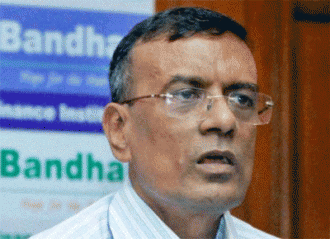
“We will start banking operations under Bandhan Bank from August 23 with the inauguration of 600 branches in 27 states across the country along with 250 on-site ATMs,” Bandhan chairman Chandra Sekhar Ghosh told PTI.

He said 247 branches would be opened in West Bengal, while Bihar, Orissa and Assam would also have a good share in terms of the number of branches.

Ghosh said 65 per cent of the branches would be rural, while the rest 35 per cent would be opened in urban areas.

The logo for Bandhan Bank has been designed by advertising agency O&M, Ghosh said adding that all the branches would be on core banking platform.

Bandhan is also in the process of obtaining separate RBI licenses for RTGS, NEFT, payments gateways and CTS, he said.

Ghosh said all the necessary hardware and software are in place to start the operations.

The MFI had got the in-principle license from RBI to start universal banking in April 2014 within 18 months time.

Along with Bandhan, IDFC had also got the same in-principle approval from RBI for starting universal banking operations.

With IFC, GIC Singapore and SIDBI as equity investors, Bandhan Bank would start operations with a capital base of Rs 2,616 crore.

source: http://www.dailypioneer.com / The Pioneer / Home> Banking & Finance / PTI / Kolkata – Sunday, June 05th, 2015

Shelter for cancer patients opens door – Premashraya will house 200 patients, 300 relatives

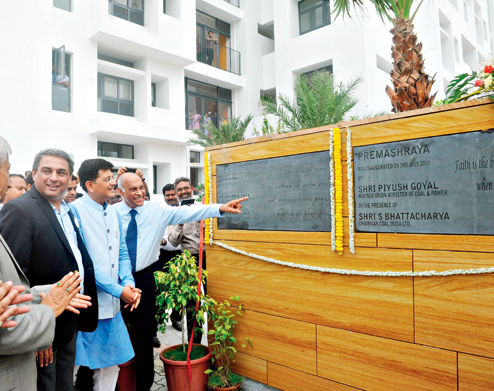
Kids with cancer (top) play at Premashraya in Rajarhat after it was inaugurated by Union minister Piyush Goyal, flanked by Tata Steel managing director TV Narendran and Tata Medical Center medical director Mammen Chandy, on Friday. Pictures by Amit Datta

A shelter for outstation cancer patients and their relatives visiting Tata Medical Center for treatment was inaugurated at New Town on Friday.

Premashraya, an 11-storeyed building less than a kilometre from the hospital in New Town Action Area III, can house 200 patients and 300 family members with separate wings for children and those needing palliative care.

“Relatives of cancer patients need to be with them. Poor patients can’t afford expensive hotels; but they need to stay in the vicinity of the hospital as they can’t travel for long,” Piyush Goyal, minister of state for power, coal and new and renewable energy, said after inaugurating the building.

Coal India Ltd has funded the Rs 41-crore project.

Goyal said his ministry would like to help out the hospital, run by the Tata group, with its annual operational expenses that have been calculated at around Rs 30 crore. He also urged the authorities to approach the people of Calcutta for funds.

“I would request Geeta Gopalakrishnan (director, donor relationships, Tata Medical Center, who raised funds for Premashraya) to approach every industrialist, businessman and Rotaries of Calcutta; connect with them and get a promise for Rs 30 crore. Then that’ll give them a satisfaction,” Goyal said.

Mammen Chandy, the medical director of Tata Medical Center, said many patients could not afford treatment for want of a place to stay. “Premashraya was planned when there was no money,” he said. “Then Coal India came forward. But maintaining and running it and keeping the place clean is a big challenge.” St. Jude’s Child Care Centre, a voluntary organisation, would look after the children’s wing.

The hospital authorities said they would hire agencies for housekeeping, cleaning and other daily jobs. Once the daily operational costs have been worked out, the charges for staying will be decided, an official said. The charges will be minimal though, he said.

“In some cases, cancer can’t be cured. But if we can’t cure cancer, we can allow a person to die with dignity. That is why we have two floors for palliative care,” Chandy said.

The third and fourth floors will house patients in need of palliative care. The hospital will counsel and train relatives of such patients in palliative care. The official said patients could return home after completion of the training.

Premashraya, spread over 100,000sq ft, has a library, prayer hall, cafeteria, physiotherapy centre, auditorium and a play area for children.

Four shops on the ground floor will sell vegetables, fruits, grocery and gift items. For every six-seven rooms, there’s a kitchen where family members of patients can cook.

The auditorium will be used for yoga classes, meditation and counselling. There will be vehicles to ferry passengers and their relatives from the building to the hospital. Vastu Shilpa Consultants has designed the building.

The hospital has expansion plans as well. A seven-storey building with 250 beds will come up on the same campus where the 183-bed hospital is now operating.

An official said Indian Oil Corporation had funded part of the Rs 200-crore project.

“It’ll have three radiotherapy machines. Currently, we have two machines and the average waiting time for a patient is two months despite both machines operating from 11am to midnight,” said V.R. Ramanan, the deputy director of the hospital. The target date for completing the building is 2017.

source: http://www.telegraphindia.com / The Telegraph, Calcutta, India / Front Page> Calcutta> Story / by Special Correspondent / Saturday – July 04th, 2015

HIT wins accolades

Kolkata :

It was a proud moment for Heritage Institute of Technology Kolkata when the students of the Rotaract Club of Heritage Institute received the Best Club Award in the Rotaract District out of 30 clubs on June 28, 2015 in the district award ceremony.

Rotaract Club of Heritage Institute won 16 awardsfor the term 2014-2015. Since 2009 the club has maintained the record of winning the Best Club award and this time it was no different from the previous years. The list of awards received included, best club, best president, secretary, best in community service, best in spreading community literacy and of course the best social media presence.

“It was a great moment for Heritage Institute as the students worked hard in organizing various projects for social welfare,” said P.K. Agarwal, CEO, Heritage Group of Institutions Kolkata. Both in Heritage School and its specialized higher education institutes, a great deal of stress is laid on social service. Children are taught to share their good fortunes with the underprivileged and spend time with them so that they realize that it is their responsibility to take up the cause of the less fortunate.

source: http://www.timesofindia.indiatimes.com / The Times of India / Home> City> Kolkata / by Jhimli Mukherjee Pandey, TNN / July 03rd, 2015

Zoological Survey of India discovers founder’s grave in 100th year

Kolkata :

RIP Thomas Nelson Annandale, at the Scottish Cemetery.

Not many people know that the first director-general of Zoological Survey of India (ZSI), Thomas Nelson Annandale was buried at the Scottish Cemetery when he breathed his last on April, 1924. Or who he actually was. When ZSI kick-starts its centenary celebrations on Wednesday (the organization was founded on 1 July 2016), a plaque will be erected to pay homage to its Scottish founder at recently-discovered tomb.

Tracing the grave was far from easy for the premier institution on animal taxonomy that is adept at identifying species around the country. According to some records at ZSI, Annandale was buried inside the South Park Street cemetery. It took ZSI a while to fish out documents to prove that his remains had been shifted to the Scottish Cemetery where he has since been left to rest.

ZSI director Krishnamoorthy Venkataraman told TOI on Monday: “Now that we have found the grave, a plaque will be erected to honour Annandale’s contribution to ZSI and science at large.” Dhriti Banerjee, deputy director and head of office, ZSI, said, “It took us some time to find out that the ZSI founder was buried at the Scottish Cemetery and not at the Park Street Cemetery. But when we initiated the mission, we realized that the inscriptions were barely visible. We had a difficult time finding out Annandale’s tombstone.”

Most of the tombstones at the cemetery lie broken, defaced and forgotten. Weeds have obscured the gorgeous carvings. Annandale’s tombstone was unclean and the lead filling on the inscription had corroded. Established in 1820, the six-acre Scottish Cemetery was in use till 1940. Currently, it has around 4,300 graves. Apart from Scots, a few Bengalis who were converted to Christianity by Scottish priests were buried there.

After discovering the grave, ZSI officials had the tombstone spruced up and the inscription re-painted. On the occasion of ZSI’s centenary, new slabs will be installed on the grave and landscaping done around it.

An array of programmes have been planned to mark ZSI centenary. The authorities are organizing a run on July 1 to kick-start its centenary celebrations. The Centenary Run will begin from the Asiatic Society in Park Street, the place of ZSI’s origin, and end at Prani Vigyan Bhawan, the present headquarters in New Alipore.

Venkataraman said Prime Minister Narendra Modi will participate in the centenary celebrations in the third week of July at the ZSI headquarters and dedicate the “Digital ZSI” – the e-access to ZSI’s documents – to the country on 100 years of faunal inventory of India.

Going back to the organisation’s first founder, the director said: “We have learnt from a publication published by ZSI that the first director-general travelled across the country and also to China, Japan, Malaya and Morocco looking for different species of fauna in the beginning of 20th century.” The publication had described Annandale as a person of “slight physique, with high strung temperament and restless energy.” He was born in Edinburgh in June 1876 and died in Kolkata on April 10, 1924. During his short life of 48 years, Annandale had 528 scientific reports published.

Venkataraman said conducting authentic research on the country’s rich faunal diversity, undertaking studies on alien fauna, collecting samples of the country’s zoological wealth and setting up zoological museums in different parts of the country are some of the objectives of ZSI.

Annandale had founded the ZSI, which later started functioned under the ministry of environment, forests and climate change, to promote survey, exploration, research and documentation on animal taxonomy. It has identified more than 96,000 species of animals.

source: http://www.timesofindia.indiatimes.com / The Times of India / Home> City> Kolkata / TNN / by Ajanta Chakraborty / June 30th, 2015

The god of death worshipped in a backyard

TEMPLE TRAIL

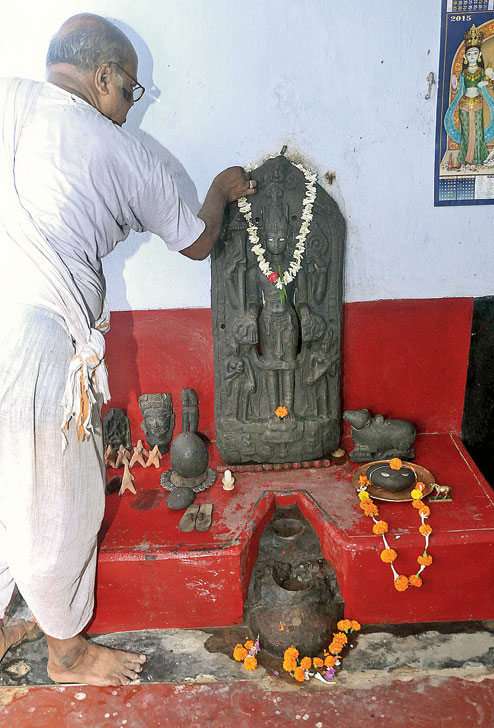
A purohit offers flowers to the deity at the Dharmaraj temple in Shibpur. Pictures by Gopal Senapati

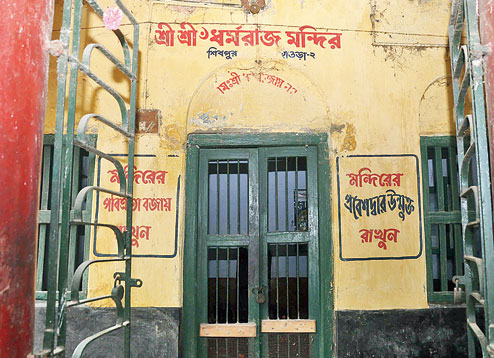
A nondescript house that stands dark and invisible behind the cramped row of flower and fruit stalls at Shibpur Dharmatala More houses the Dharmaraj temple. It is hard to imagine that a temple exists in the milieu of a marketplace. An old wooden door leads to the tiny temple inside where a black stone relief sculpture is the presiding deity, known as Dharmaraj to the common people of Shibpur. According to Howrah Itihas- Aitijhya, written by local historian Sibendu Manna, this sculpture is a figure of Vishnu, standing on a blooming lotus flower. Next to the Dharmaraj idol are other smaller black stone idols of Kali, Jarasur and Vishnu.

The inconspicuous temple at Shibpur Dharmatala

Shibpur’s Dharmatala gets its name from this Dharmaraj temple which is estimated to be more than 300 years old. Although there is little historical information available about the temple, it is said that the temple was built by one of the members of the Roychowdhury family, the zamindars of Shibpur. “We have seen this temple since childhood and always knew that our forefathers had built it. The first settler of our family, Rambrahma Roychowdhury, had come here in 1683. His son Sukdeb Roychowdhury came to power in 1707. We assume that the temple must have been built during his tenure,” said Samir Roychowdhury, a member of the family.

Dharmaraj is a form of Yama. The god of death is usually worshipped by members of lower caste Hindus. Inside the temple, one can find a number of earthen horses placed near the deity. Mothers who have ailing children or those whose infants cannot walk properly, usually pledge these horses to the deity.

Buddha Purnima is an auspicious day at the Shibpur temple. Special puja is offered to the god on this day and devotees come in droves to offer prayers at the temple. “We have been sevaits at the temple for several generations. This temple is revered by most people in Shibpur area. On Buddha Purnima, we have a special puja and many people come to offer puja to the deity,” said Madhusudhan Bhattacharya, the priest at the Dharmaraj temple.

source: http://www.telegraphindia.com / The Telegraph, Calcutta, India / Front Page> Howrah> Story / Friday – July 03rd, 2015

Medica Hospital launches Tele-ICU

Kolkata :

For Doctors Day on Wednesday, Medica Hospital, in association with Bengal Chamber of Commerce and Indian Medical Association, Bengal branch, launched Tele-ICU facilities. Designed by Philips India Ltd, the technology is a specialist-led ICU care to be monitored from a command centre.

Kolkata’s branch will serve as the command center, which will be connected to other Medica Hospital branches.

“Our specialists sometimes have to fly to other centers to monitor critical cases. This Tele-ICU facility will enable them to monitor patients from Kolkata itself,” said Dr Alok Roy, chairman of Medica Hospital.

“The command center will get all the data about the patient online. These are real time data. The experts in the command center can monitor and intervene whenever the need arises,” said Dr Arindam Kar, director of Medica Institute of Critical Care.

“I am sure this Tele-ICU service is going to help patients. We are also trying to upgrade technology-aided services in government hospitals,” said health minister Chandrima Bhattacharya. The hospital also organized a quiz contest on Wednesday.

source: http://www.timesofindia.indiatimes.com / The Times of India / Home> City> Kolkata / TNN / July 02nd, 2015

ZSI celebrates a century of magic finds

Kolkata :

Scientists at the Zoological Survey of India (ZSI) have discovered 176 new animal species in the run-up to their centenary year that kicked off on Wednesday.

Speaking to TOI, ZSI director K Venkataraman said 93 new species of insects were recorded by the team last year along with 24 species of amphibians, 23 species of fish and two species of reptiles. The other new finds were 12 species each of arachnida and crustacea, one type each of nematoda, trematoda and mollusca.

“It has been an exciting year with our scientists contributing to the inventory of animal species on the planet. Apart from the new finds, 61 species of animals that were found elsewhere in the world were also found and recorded in the country,” Venkataraman said.

Of the new insects discovered, several were found in Bengal. Agricnemis kalinga was found in Panchala, Howrah; Amemboa bifucrata in Kalikhola, Jalpaiguri; Amemboa mahananda in Mahananda Wildlife Sanctuary, Darjeeling; Onchotrechus dooarsicus in Buxa Tiger Reserve, Jalpaiguri; Pleciobates bengalensis in Alipurduar; Calvia explanata in Darjeeling and Forcipomyia parasecuris in Burdwan. In addition, several other species were found across the state.

ZSI deputy director Dhriti Banerjee said Bengal has one of the richest faunal diversities in the country due to its diverse climatic zones. “Of 96,000-odd recorded animal species in India, 11,042 species, or more than 10%, are found in the state. Different climate zones — alpine temperate forest in Darjeeling, tropical forest in north Bengal, desiduous forest in south Bengal, dry grassland in the middle and mangroves in Sunderbans — support the varied animal life,” she said.

In fact, north Bengal, particularly Darjeeling, is considered a animal diversity hotspot by zoologists as the Eastern Himalayas is the gateway for faunal elements coming to India. “Any experienced scientist can confidently set out on a trip to Darjeeling and find a new species. The insect and ambhibian population in Darjeeling is very high,” Banerjee said.

While new species are being discovered in the state, several species have become extinct, including Javan rhinoceros, Asiatic two-horned rhinoceros, musk deer, monal pheasant, mombin quail, pink headed duck, marbled cat, golden cat, three-banded palm civet, mock viper and gore’s bronze back viper.

While ZSI has traditionally focused on surveys, collection of specimens, identification, naming and preserving, it has now started working on a GIS platform so they can be spacially and temporally mapped for reference. An ambitious programme to digitize the specimens is underway.

“A databank of high resolution photographs of type specimens, along with their full profile — what it looks like, where it was discovered, where it is found now and its DNA bar code — will be created,” Banerjee said.

Banerjee is heading the Rs 3 crore project to digitize information on 7,286 species, most of which are 100-200 years old.

source: http://www.timesofindia.indiatimes.com / The Times of India / Home> City> Kolkata / TNN / July 02nd, 2015