All posts by wellnmed@gmail.com

In the groove for 50 years

Kolkata :

For more than 50 years now, his fingers have strummed the bass guitar, while his deep sonorous voice has kept pace with lead singers.

Noel Martin is 70 today and Park Street recognizes him as the senior most performing pop musician, who is hardly ever absent from his perch between 9pm and 11.30pm at Trincas, which remains a rare place where English pop music still rules the roost at dinner hour, a reminder of the heady Sixties.

Immediately after completing 56 years of existence in June, the Trincas management has now decided to felicitate Noel.

This is perhaps the first time that a senior musician will be publicly feted.

Naturally, hardcore Trincas fans and fellow musicians are thrilled. Music happened quite early to Noel. He started playing bass guitar at the Great Eastern Hotel, inspired by none less than Arthur Gracias. After being there for two years, Park Street beckoned. As the Flintstones rolled into Trincas, Noel joined them and rolled in with his bass guitar and unmistakable voice that jammed like a house on fire with Eddy Ranger, the lead singer. Bands have come and bands have gone, and Noel, too, has punctuated his stints with stops at Blue Fox (where he played with Carlton Kitto) and Mocambo (where he was a part of the electrifying psychedelics), but Trincas and its trademark ambience that the likes of Usha Uthup and Nondon Bagchi swear by has remained Noel’s most comforting shelter forever.

After the tea room of Mr Trincas got converted into a licensed nightclub in 1959, run jointly by Om Prakash Puri and Ellis Joshua, Trincas simply set Park Street on fire with sensations like Eve, Molly, Jenny, Linda, Brenda (who later went on to marry Jaideep Mukherjee), Usha Iyer (later Uthup), Vivian Hanson, Benny Rozario of the Elite Aces fame and crooner Flora.

Noel came to Trincas in the 60s and played with almost all of them. Usha Uthup, with whom he was a regular accompanist, remembers him as a person “who naturally had rhythm in his body and a way with his guitar that made the singer want to sing. As a new singer in a saree, completely foreign in the Trincas locale, Noel simply put me at ease, one of the finest humans I have come across… an institution.” Bagchi, too, had only praise for Noel. “Music is worship for him, you don’t see the likes of him any more. He plays with such harmony behind the lead singer, something that can be counted as a rare gift. I have jammed with Noel often and I am so happy that he will finally be recognized for the relentless work that he has put in.

Kolkata is gradually losing its original brand of musicians who practiced English pop music, and the likes of Noel are becoming rare. I can only say that the felicitation is very well deserved,” he said. ‘Black Magic Woman’, the Fleetwood Mac tune made popular by Carlos Santana, is perhaps the best loved of all the songs that Noel sings.

Sitting in his modest drawing room deep inside the Wellesley 2nd Bye Lane, Noel sings away, strumming his bass, by way of practice.

Today, as part of Sweet Agitation, he performs along with Cornel Bloud (singer), Candice Gray (singer) Gavin Keys (lead guitarist), Dibayan Banerjee (keyboard) and Nigel Gomes (drums). “I am lucky to have played and jammed with several generations of music-makers on Park Street. The scintillating 60s are no more, when so many corporate head offices were here and the place buzzed with young upwardly mobile professionals who looked only for Western pop. So we re-created Frank Sinatra, Cliff Richards, Elvis Presley, Tom Jones, Neil Diamond, Harry Belafonte and Bruce Springsteen. The patrons reciprocated with equal verve.

Today, tastes have changed and so Hindi and Bengali music are played in the evening tea time hours. It is only after 9pm that we come in to play for the dinner clientele that still comes here for Western pop alone,” Noel says.

Deepak and Shashi Puri, who run Trincas today, feel it is because of musicians like Noel that Trincas still remains a class apart. “As Trincas moves from strength to strength, it is a duty on our part to also felicitate its makers. Noel, being the seniormost, comes first on the list,” Deepak signs off.

source: http://www.timesofindia.indiatimes.com / The Times of India / Home> City> Kolkata / by Jhimli Mukherjee, TNN /July 11th, 2015
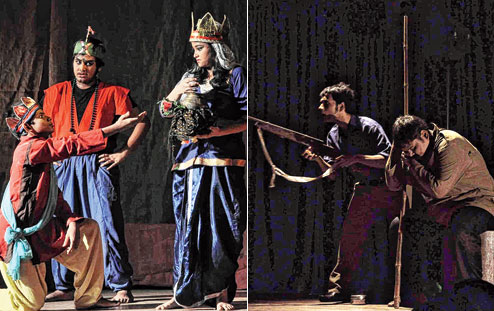
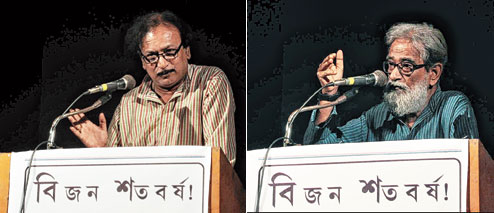
Legendary playwright remembered

Scenes from Nagchampa (left) and Aborodh. Pictures by Anup Bhattacharya

Bijon Bhattacharya has inspired a number of theatre personalities but in Howrah most have not had the temerity to work on his plays or do any research on his works. On the birth centenary of this revolutionary playwright-director-actor, Natadha decided to pay tribute to Bijon Bhattacharya through some of his well-known plays and through discussions by theatre personalities. The three-day programme started from July 17, Bijon’s birth anniversary and continued till July 19 at Ramgopal Mancha.

“It is indeed a great effort by Natadha to organise a workshop on Bijon Bhattacharya when no other theatre group has yet done that. However, Bijon Bhattacharya was a playwright with a different vision who few people understand,” said Ashok Mukhopadhyay, the director of Theatre Workshop, who was present to speak about Bhattacharya on the last day of the festival. He also read a poem and an excerpt from one of Bhattacharya’s plays.
Other speakers of the evening included directors Chandan Sen, Debasish Majumdar, Soumitra Basu and Goutam Mukhopadhyay. “Few directors understood the villages of Bengal the way Bijon Bhattacharya did. Also, he had seen and felt revolutions, riots and destruction closely. Which is why there were magnified expressions of emotions in most of his scripts,” said Basu.

Portions of Bhattacharya’s plays like Nabanna, Aborodh, Hans Khali Hans and Nagchampa were enacted during the three days of the festival by members of Natadha.

“On the first day, we had staged a portion of Nabanna and Aborodh, which we had to re-stage on the last day on audience request. Because of inclement weather on July 17, many people could not come to watch the plays,” said Shib Mukhopadhyay, the director of Natadha.

“While the members of Natadha acted in all the plays, we had included actors from other groups as well in Nabanna. Subir Goswami from Bally Bidushak, Badal De from Samipesu and Chandrasekhar Ghosh from Trisha had acted in the play,” said Mukhopadhyay.

Meghnad Bhattacharya (Left) and Bibhash Chakraborty speak on Bijon Bhattacharya

School students were also involved in the festival. Students of different schools of Howrah had prepared short speeches on Bijon Bhattacharya, based on whatever information was provided to them. Students of Howrah Vivekananda Institution had even prepared a skit on the playwright.

Speakers like Shyamal Chakraborty, Kamal Saha, Kaushik Chattopadhyay, Bibhash Chakraborty and Meghnad Bhattacharya were invited to speak on Bijon Bhattacharya as well. An exhibition on Bijon’s life and works was on display at the entrance to Ramgopal Mancha.

source: http://www.telegraphindia.com / The Telegraph, Calcutta,India / Front Page> Howrah> Story / by Dalia Mukherjee / Friday – July 24th, 2015

Fake or real? A royal riddle

A mighty fracas is raging between the descendants of Nawab Wajid Ali Shah in Calcutta and an Iranian woman who claims to be married to a scion of the Awadhi family. Hemchhaya De investigates the rumpus

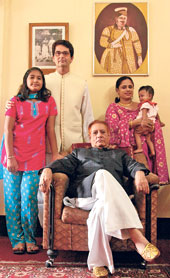
REGAL ROOTS: Shahebzade Wasif Mirza and his family pose before the portrait of Nawab Wajid Ali Shah;

A king-size portrait of Nawab Wajid Ali Shah will catch your eye the moment you step into the grand, old living room of Wasif Manzil on Talbagan Lane in Calcutta. “That’s my ancestor,” says Shahebzade Wasif Mirza, a dignified septuagenarian, pointing at the portrait — the pièce de resistance in a room bristling with Awadhi heirlooms.

“Satyajit Ray once asked me, ‘Why did the Nawab choose to move to Bengal after his kingdom was annexed?’ At that time, he had just made a film called Shatranj Ke Khiladi,” recalls the patriarch, a registered descendant of Wajid Ali Shah (1822-1887). “I told Ray that perhaps the Nawab felt he would get the respect he deserved only in Bengal.”

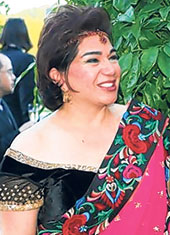
For Shahebzade Mirza, it’s a matter of family honour that he takes on what he calls “pretenders” to the Awadh legacy. In recent months, he has been fighting a fierce battle against Fay Ary, an Iranian woman who divides her time between Monaco, Paris and Dubai, and claims to have married a direct descendant of Nawab Wajid Ali Shah and his second wife Ronakara Begum.

Fay Ary
Fay Ary

But she refuses to disclose her late husband’s name for “fear of being drawn into family feuds.” Ary also wishes to do something for the underprivileged in India through her charity organisation, Royal Awadh Cultural and Heritage Foundation (RACH).

“All this sounds very nice. But she calls herself Her Royal Highness Princess Jehan Ara Fay Ary. I have the complete family tree and she figures nowhere. I’d like to know where her imaginary kingdom is located,” says Mirza. In a recent letter to the French ambassador to India, Jerome Bonnafont, he complained against Ary and RACH. “Our objection is to the use of our family’s name …for large monetary gains,” wrote Mirza.

Fay held a charity auction in Paris this May where her “personal collection of jewellery” went under the hammer. “We don’t know what she auctioned as her Awadhi legacy. And we don’t know where the proceeds are going,” says Ibrahim Ali Khan, a descendant of a 19th century Awadhi vizier, who heads the Royal Family of Awadh Foundation in Lucknow.

It all began a couple of years ago when Nawab Jafar Mir Abdullah — who reportedly claimed to be the Awadh rulers’ “direct descendant” — came under media glare. Abdullah, who’s on the RACH advisory committee, was accused of faking his nawabi heritage and arranging Awadhi banquets for foreign tourists in collusion with “unscrupulous” travel operators in Lucknow. It was also alleged that he charged tourists hundreds of dollars for banquets and mujras (dances) at his Lucknow home. His partner in this enterprise is said to be Prateek Hira, who heads a tour operating agency called Tornos India and is also associated with RACH.

Hira maintains that Khan and others have launched a malicious campaign to defame Ary, Abdullah and his agency. “Abdullah is well respected in Lucknow,” says Hira.
d in Lucknow,” says Hira.
_______________________________________________________________________
Dramatis personae

Shahebzade Wasif Mirza, descendant of Nawab Wajid Ali Shah (1822-1887) of Awadh (Oudh).

Fay Ary, an Iranian who claims to have married a direct descendant of Wajid Ali Shah and his second wife Ronakara Begum. Ary runs a charity, Royal Awadh Cultural and Heritage Foundation (RACH).

Ibrahim Ali Khan, a descendant of a 19th century Awadhi vizier, who heads the Awadh Royal Family Foundation in Lucknow. Does not support Ary.

Jafar Mir Abdullah, who is described as Wajid Ali Shah’s direct descendant and is on the RACH advisory committee.

Prateek Hira, who heads a tour operating agency called Tornos India and is associated with RACH.

_________________________________________________________________________

Fay Ary gained some publicity in Lucknow around this time after announcing her charity projects. “She wants to do something for the poor — like arranging cleanliness drives in various Indian cities and providing slum dwellers with clean drinking water. She sought my help to implement the projects,” says Hira.

Ibrahim Ali Khan and others tried to blow the lid off what they called a “nexus” between Abdullah, Hira and Ary last year. “The issue was almost dying down when a freelance journalist from Delhi wrote to Hira and threatened action against his activities. He wrote to me as well,” says Khan.

Fay didn’t take it lying down. In an email dated June 29 this year, she wrote to her friends in Lucknow, Dubai and Paris, “A very nasty activity is being undertaken …(by a journalist)… for want of some money to sustain himself …ignore this man who keeps changing his name to fool people.”

Speaking from Paris, Ary expresses her “anguish and disappointment” over the “concerted efforts to pull down RACH.” “I claim nothing from the Indian government or from the Awadh families. I auctioned my own jewellery in Paris. I am hankering after no title. All I wanted to say to these people was that I had the resources to do some good work in India,” says Ary.

She wants to start her “slum cleanliness drive projects” in early October. She will also host a gala event in Dubai this November to seek support for her charity work. “People who claim to be true nawabs in India should stop bickering and do something for their country.

There seems to be another point of clash between Ary and Shahebzade Mirza. Ary told the media last year that she would renovate Nawab Wajid Ali Shah’s mother’s grave in the Père Lachaise cemetery in Paris. The Nawab’s mother, Aliya Begum, went to England to plead with Queen Victoria for returning Awadh to her son. On her way back, she fell ill and died in Paris in 1856 and was buried in Père Lachaise. Ary wants to project her grave as a site of historical significance.

The Shahebzade Mirza family, on the other hand, wants to rectify an inscription near the grave which says that her son Wajid Ali Shah was killed by British forces in 1856. “The Nawab died of natural causes in 1887. We have written to the French consulate in Calcutta to do something about it,” says Mirza. A spokesperson from the French consulate, who prefers not to be identified, confirmed receiving the letter.

“I accompanied Fay to the Paris cemetery this year. She is planning a renovation,” says Abdullah, the controversial ‘nawab’ who refutes all allegations against himself. “She doesn’t lay any claim to the Awadh royalty. She is herself related to Farah Diba Pahalvi, the queen of the last Shah of Iran who ruled till 1979.”

Abdullah also goes on to say that he will go on hosting banquets for tourists in order to interact with people and entertain them. “I tour the world and get invited by top officials. I will also continue to be part of RACH and the commendable work it does,” says Abdullah. “I never claimed to be a descendant of Wajid Ali.”

Agrees Rosie Llewellyn-Jones, a British scholar who’s writing a biography of Wajid Ali Shah. “Abdullah does not really claim descent from Wajid Ali Shah, but from Nawab Mohammed Ali Shah, who ruled Awadh from 1837 to 1842,” she says. She adds that it’s important to remember that “Wajid Ali Shah’s descendants are not the only descendants of the royal family of Awadh.”

“Each Nawab, from the time of Asaf-ud-daula (1775 to 1797), had a number of wives, and inevitably, a large number of children and grandchildren. These people are also descendants of the Awadh royal family. On Wajid Ali Shah’s death he left about 45 sons, and a larger number of daughters, and the descendants of these sons and daughters can obviously claim direct descent from him.” On Ary, she says that unless she is prepared to reveal her husband’s name “we can’t really check out her claim.”

Indian historian Ravi Bhatt, who penned a book called The Life and Times of the Nawabs of Lucknow, begs to differ. “Just as Nagpur is famous for oranges and Benaras for silk, Lucknow is known for its nawabs,” says Bhatt. “Every Tom, Dick or Harry calls himself a nawab these days. But let me tell you there is no descendant of the Awadh royal family in Lucknow now,” says Bhatt.

Meanwhile, Shahebzade Mirza is gearing up for the next round of battle. “We hope the French government will act on our complaint against Ary. The war is far from over.”

source: http://www.telegraphindia.com / The Telegraph, Calcutta,India / Front Page> 7 Days> Story / Sunday – August 23rd, 2009

He who could feel, see and smell diseases

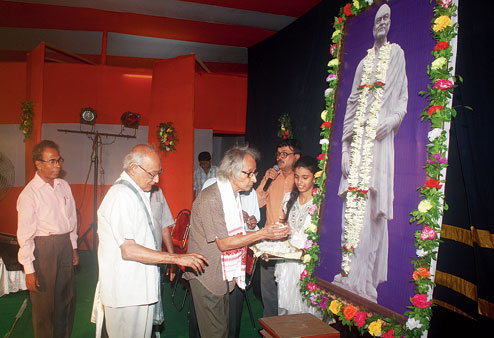
Author Sanjib Chattopadhyay offers floral tribute to a portrait of Dr Bidhan Chandra Roy at Bidhan Sishu Udyan as cartoonist Chandi Lahiri looks on

“Dr Roy was a rare combination of talent, personality and power. His upright gait and towering figure inspired awe in people. All officials were scared of him as he understood administrative matters inside out,” recalled author Sanjib Chattopadhyay, reminiscing about Bengal’s visionary chief minister. He was speaking at a programme organised on July 1 at Bidhan Sishu Udyan in Ultadanga.

Dr Roy was a friend of Chattopadhyay’s grandfather Swarup Bandyopadhyay who was a well-known doctor as well. Dr Roy did a lot of election work from his house while contesting from Barrackpore. “When I joined the cottage and small scale industries department as a 25-year-old, senior officials would send me to his house with the files, not daring to face him themselves. Dr Roy was a miracle worker as a doctor. He used to say that he could see, feel and smell a disease as the patient walked into his chamber.”

Chattopadhyay recalled his father’s colleague going to Dr Roy with a complaint of his head spinning every time he got off the bed. “Treatments for vertigo and spondylosis had failed. The man was about to lose his job due to continuing illness. Dr Roy saw him on my request and simply wrote ‘Reverse your head’ on the prescription. His family thought it was a rude joke. When I went back for an explanation, he said the man was surely sleeping with his head to the north and feet to the south and therefore was acting like a needle to the earth’s magnetic field. He changed his sleeping posture and in three days was fully fit!”

Educationist D.K. Sinha talked of Roy’s contribution as an administrator. “He used his proximity with Prime Minister Jawaharlal Nehru to expedite Bengal’s growth.”

Tagore’s Tasher Desh was staged in chhou dance style.

source: http://www.telegraphindia.com / The Telegraph, Calcutta, India / by A Staff Reporter / Friday – July 10th, 2015

Leander Paes wins 16th Grand Slam title at Wimbledon

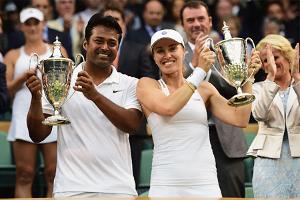
Leander Paes with his Swiss partner Martina Hingis won the mixed doubles title at Wimbledon. (Getty Image)

London :

A vintage Leander Paes clinched his 16th Grand Slam trophy, winning the mixed doubles event of the Wimbledon Championship with legendary Martina Hingis after a dominating win over Alexander Peya and Timea Babos, here today.

Seventh seed Indo-Swiss pair drubbed the fifth seed Austrian-Hungarian team 6-1 6-1 in the lop-sided summit clash which was over in just 40 minutes.

It was Paes’ eighth mixed doubles title and second with Hingis. They had won the Australian Open early this year.

42-year-old Paes has eight men’s doubles crowns in his Grand Slam collection.

Paes’ win capped an incredibly successful Wimbledon for India as the country took three titles this year. Sania Mirza won the women’s doubles and Saumit Nagal won the junior boys doubles trophy.

For Hingis, it was second title in as many days, having won the women’s doubles with Sania. Overall it was 18th Major title for the Swiss and third in mixed doubles.

Hingis was back on court less than 24 hours after that win with Sania but showed no sign of fatigue. She served well and was terrific at the net, complementing the Indian Pro.

Paes and Hingis literally toyed with Peya and Babos, who surprisingly failed to put any resistance.

In no time Paes and Hingis pocketed the first set as all they needed was 19 minutes to nose ahead. Two broke Babos in the fourth game and Peya in the sixth for a 5-1 cushion. Hingis served out the set when Paes smashed a volley winner.

Paes and Hingis kept the pressure on the Austrian- American combination right from the first game of the second set. Peya failed to negotiate a Paes return at deuce to hand the seventh seeds grabbed the opportunity to break them.

Babos’ could not handle a Hingis return and the Indo- Swiss pair got an early break. There was no stopping them from there as they raced to victory in less than one hour.

Babos failed to hold her serve even once and it was on her return that Paes hit a deft backhand volley winner to close the contest.

source: http://www.timesofindia.indiatimes.com / The Times of India / Home> Sports> Tennis> Wimbledon 2015 / by PTI / July 12th, 2015

Librarian lifeline for library

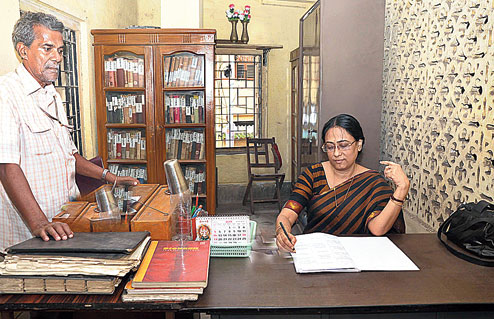
Gouri Sanyal has joined as librarian of Howrah Seva Sangha library from February this year. Picture by Gopal Senapati

After a seven-year fight, Howrah Seva Sangha Library finally got a librarian in February this year. The little room on the first floor of the clubhouse on Narasingha Dutta Road, has 9,500 books and since 2008, it was run by the club members themselves.

Howrah Seva Sangha, started as a social welfare group in 1923 and its members were involved in the freedom struggle. The library was established at around the same time, but later became a government-sponsored primary unit library. The club is popular for its sports, yogasana, gymnastics and multigym. The Durga Puja is also one of the oldest in the town. However, the library has been struggling to stay afloat for the past seven years. “Although this is a government sponsored library, we did not get a librarian after the previous one retired, even after repeated requests. The club members would open the library every evening,” said Amarnath Basumullick, the president of Howrah Seva Sangha Library.

Gouri Sanyal, who was earlier the librarian at Sahid Smriti Sangha Granthagar at Bakultala, was transferred to this library in February this year. “I visit this library three days a week. At present I am trying to bring some order to it, by making a fresh catalogue of books and arranging the shelves properly,” said Gouri. Funds had also stopped coming to the library in the past seven years but after the new librarian was appointed, a sum of Rs 30,000 was also sanctioned.

“The fund will be used for some basic furniture like a table, chairs and stationery for the librarian to work. This has been sanctioned from the library’s contingency fund. As the library starts coming back to the mainstream, we will sanction the regular annual grant as well,” said Tushar Kanti Chattopadhyay, the district library officer, who has taken an active interest in reviving this library. “We are trying to revive several such libraries in Howrah that are struggling to stay afloat. We have started with those in the Howrah Municipal Corporation (HMC) area and we are trying to help revive them,” added Chattopadhyay.

Although the library has started functioning, another huge task is to bring back readers to the library. “I think a career guidance section and a children’s section are necessary to attract young readers to the library. There are a number of schools in this area and we can try to get the students from the schools to come to the library regularly,” said Sanyal. Other interactive programmes and discussions like the one on the importance of books held at the club on July 4 on the 92nd annual programme of the club and library are being organised.

Barid Baran Ghosh, the president of Bangiya Sahitya Parishad, Arup Roy, agriculture marketing minister, Chaitali Dutta, professor at the library sciences and information department of Jadavpur University and Tushar Kanti Chattopadhyay, the district library officer were present at the July 4 programme and spoke about how books can be a person’s best friend.

source: http://www.telegraphindia.com / The Telegraph, Calcutta,India / Front Page> Howrah> Story / by Dalia Mukherjee / Friday – July 10th, 2015

Training to lift kettlebells

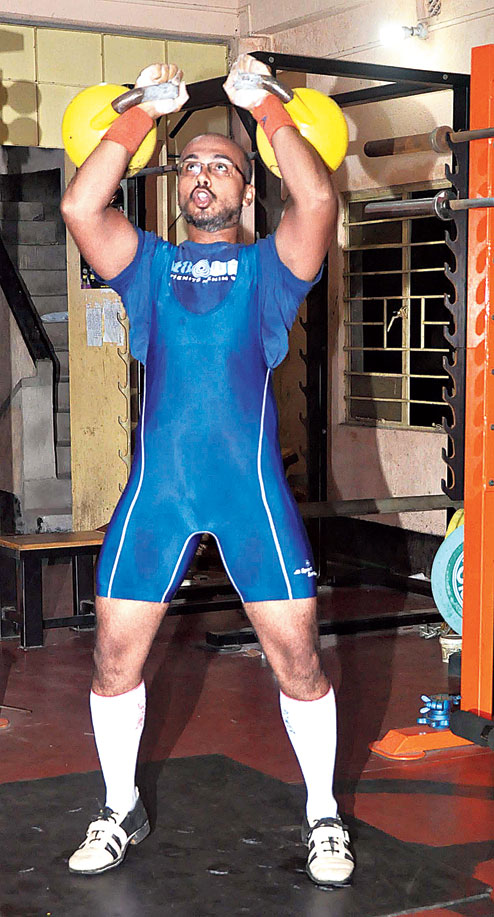
Kaushik Balial demonstrates kettlebell lifting at KB’s gym.  Picture by Gopal Senapati
Kaushik Balial demonstrates kettlebell lifting at KB’s gym.
Picture by Gopal Senapati

Kettlebell lifting has a long history in Russia and has been a competitive sport since the 1960s. Kettlebell sports, also known as Girevoy Sport, is a popular sport in Russia and Europe. It has started becoming popular in other countries around the world recently. A variation of weightlifting, the sport involves the same snatch and jerk techniques that are demonstrated in the former.

Along with the world, kettlebell sports have also made an entry into India and Calcutta. Health clubs and gyms where members are involved in regular kettlebell training, have introduced the sport as well. Kaushik Balial of KB’s Gym, introduced kettlebell training in his gym some months back and on July 4 and 5, he conducted a workshop on Level 2 kettlebell training. “In most gyms in Calcutta, kettlebells, which were treated as a fitness training equipment, have become a sports equipment. More people are trying this sport,” said Kaushik.

“Level 2 training includes training in the sport. Level 1 is all about strength and endurance and is usually done with one kettlebell. In Level 2, the trainees have to learn to lift two kettlebells together and gradually try to increase the weight limit,” he added.

Four members of KB’s Gym participated in the workshop. At this workshop, Kaushik demonstrated kettlebell lifting with two 4kg bells. “There are generally two events in competitive kettlebell events. One is the biathlon and the other is the long cycle. The biathlon is a classical event where the lifter has to perform a set of jerks followed by a set of snatches. In a long cycle, the lifter has to perform a set of long jerks,” said Kaushik.

At the workshop, Kaushik stressed on techniques – how to do the moves and how to develop a body for the sport. “Strength and endurance are the two most important things in kettlebell sports. This form of fitness training has become popular among the young generation because kettlebells are small equipment which require less space and also because training takes less time. The maximum time one should give to kettlebell training is 20 minutes,” said Kaushik. After this workshop, Kaushik hopes to be able to build a team of kettlebell lifters. “There is a kettlebell lifting competition next year in Calcutta and I hope to send a team there,” said Kaushik.

source: http://www.telegraphindia.com / The Telegraph, Calcutta,India / Front Page> Howrah> Story / by Dalia Mukherjee / Friday – July 10th, 2015

When 1,000 voices sang

The Choir paid tribute to Tagore and his ‘Gitanjali.’

CoirKOLKATA10JUL2015

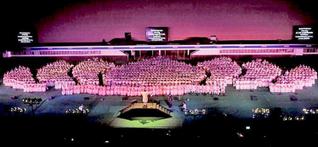
Thousand voices and one celebration… The Netaji Indoor Stadium in Kolkata, reverberated with poems of Nobel laureate Rabindranatha Tagore recently as Sangeet Bharati Muktadhara presented ‘Echoes of Gitanjali’ to commemorate 100 years of Rabindranath Tagore’s Nobel in Literature and Gitanjali.

For the 1000 singers from all over India – Chennai, Patna, Mumbai, Delhi, Gurgaon, Bengaluru, Baroda, IIT-Kanpur, Allahabad and Bhilai – the show, conceptualised, scripted and directed by Arundhati Deb, president, Sangeet Bharati Muktadhara, came after months of rigorous practice. The theme was the lotus, and sure enough, the singers on stage were positioned to represent the national flower.

For the group of 12 singers from Chennai group, it was a perfect opportunity to pay tribute to Gitanjali and its profoundly fresh beautiful verse.

Years ago, travelling abroad, Tagore witnessed western classical music concerts featuring musicians numbering 1000 to 2000. This left a lasting impression on him, observers had said. Nevertheless, Tagore had not voiced his latent desire – to give a similar treatment to his compositions.

“The programme titled ‘Echoes of Gitanjali’ commemorates 100 years of Tagore’s English Gitanjali,” said the 60-something-Arundhati Deb, who travelled from city to city to refine the performances of the different groups. She was in Chennai to help the team with singer Swati Bhattacharya taking the lead.

Hailing from a family deeply interested in music, Arundhati Deb grew up fascinated with Rabindra Sangeet. After a Master’s Degree in English and an editing stint, her desire to do some serious work with Tagore surfaced. The result? The first 1000 Voices Choir in 2007.

source: http://www.thehindu.com / The Hindu / Home> Friday Review / by Renuka Suryanarayan / July 10th, 2015

New bone cancer cure without amputation

Kolkata :

Osteosarcoma, or cancer of the bone, now has an easier and cheaper cure. While the most commonly used treatment is to replace the affected bone with a prosthetic one, a team of city doctors has now used bone scraped out of a patient’s left leg to reconstruct the bone above the right knee (autograft). This has not only cut out cost of the prosthetic replacement, but also made recovery faster and less complicated.

While a prosethetic bone replacement costs Rs 1.5-2 lakh, an autograft can be done for just Rs 50,000.

Amputation of the affected bone was the only cure for osteosarcoma till recently. The ailment is triggered by a cancerous tumour on the bone, which is usually an aggressive form of malignancy. It is more common among children and young adults.

In this case, 19-year-old Sabaqur Nahar Begum, a resident of Burdwan, was affected by osteosarcoma last March. She had a cancerous tumour on her femur and amputation seemed to be the only option. Looking for another way, her husband Syed Badshah Ali got in touch with doctors at the Netaji Subhas Chandra Bose Cancer Research Institute.

“I was told that her leg would not only be saved, but that she would not even require an artificial replacement to heal the affected bone,” he said.

Led by orthopaedic surgeon P Pujari of Ramakrishna Mission Seva Prathisthan, the surgery removed the cancerous part of her femur and used bone fragments from her tibia to fill the gap. The surgery was preceded by a series of three chemotherapy sessions.

A rod has been inserted into the area to support the implanted bone. It will be removed after three to six months depending on how quickly the area heals.

“The trend is now to saving limbs and body organs affected by cancer. While previously we would ampute the bone or limb, now it is possible to save them with modern and more accurate surgical procedures. In this case, the patient has responded well to the surgery and is on the path of recovery,” Pujari said.

Osteosarcoma patients usually do not suffer a relapse in the area of the operation. “But metastatis or a recurrence can’t be ruled out in another part of the body. This is true of any form of cancer, though,” added Pujari.

Oncologist Subir Ganguly felt that while the surgical technique has opened up the option of saving the limb, a recurrence of the cancerous tumour can’t be ruled out.

“Microscopic cancerous cells, that are hard to detect, might linger in the area. It often happens that the tumour forms again, a reason why surgeons earlier preferred to ampute the affected bone. But the new procedure is useful for it allows the surgeon to delay or rule out the amputation as far as possible,” said Ganguly.

source: http://www.timesofindia.indiatimes.com / The Times of India / Home> City> Kolkata / by Prithvijit Mitra, TNN / July 09th, 2015

Mamata Banerjee Flags Off Kolkata-Dhaka-Agartala Bus Service

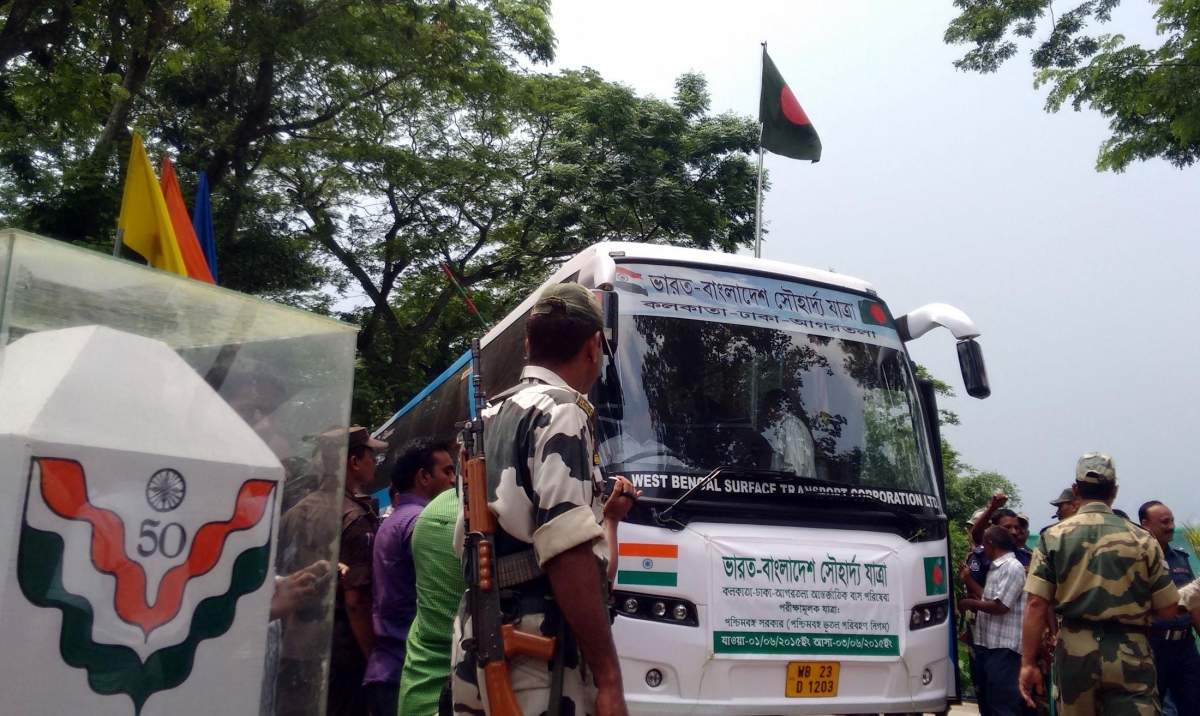
The first Kolkata-Dhaka-Agartala bus enters Agartala from Bangladesh through Akhaura integrated checkpost during a trial run on 2 June, 2015.IANS

Flagging off the Kolkata-Dhaka-Agartala bus service here on Thursday, West Bengal Chief Minister Mamata Banerjee said the initiative will turn the India-Bangladesh ties into an everlasting relationship.

“The launching of this service makes this day forever memorable and historically significant for both the countries,” Banerjee said at the flagging off event at the state secretariat, Nabanna, in Kolkata’s neighbouring Howrah district.

“This service will bring both India and Bangladesh closer and turn our cordial ties into an everlasting relationship,” she added.

The cross-border bus service was approved at a recent meeting between Bangladesh Road Transport Minister Obaidul Quader and his Indian counterpart Nitin Gadkari in New Delhi.

The bus service will facilitate visiting mainland Indian states for people of the mountainous northeastern region, reducing the distance by over 1,000 km.

Agartala via Guwahati is 1,650 km from Kolkata by road, but the distance between the tripura capital and the West Bengal capital via Bangladesh is only around 500 km.

Prime Minister Narendra Modi and his Bangladesh counterpart Sheikh Hasina are scheduled to flag off the Agartala-Kolkata direct bus service in Dhaka on June 6.

source: http://www.ibtimes.co.in / International Business Times / Home> News> Society / by IANS / June 04th, 2015