All posts by wellnmed@gmail.com

Diplomat seeks revival of French connection of Chandernagore

Kolkata :

Outgoing French Consul-General in Kolkata Fabrice Etienne, whose second innings in the city comes to an end this month, celebrates the cultural bond that links the city with Paris, but bemoans the fading French connection with Chandernagore.

Q. Your first posting was in this very city 20 monsoons ago. What was your first impression back then?

A. I was first impressed by the excessive sides of Calcutta — too many people, too many cars, too much noise, too much heat, too much rain. The old, and often decayed, colonial buildings of central Calcutta and what remained of the palaces of north Calcutta left its mark. I had the feeling I had been transported to a place rich with a thousand stories.

Q. Cut to 2015, how much has the city changed in your eyes?

When I first returned to Kolkata in 2004, I was pleasantly surprised — the streets were cleaner, some shopping malls had come up, some flyovers were built, some old buildings renovated and repainted that gave the city a more modern look. In 2012, this impression was confirmed and yet at the same time, I felt the very soul of Kolkata was still very much there, and the soul of Kolkata, is its people and the great culture they carry within them.

Q. Do you have any bitter memories during your stay here?

A. Road accidents that have struck my Bengali friends. Nothing really has been done to improve the road conditions in India—it is not only a Kolkata issue—and reduce the number of fatalities. This bothers me to no end, especially because the social and economic gains are directly related to a fluid traffic flow. It is true for environment protection. And of course, I do feel a little bitter about the lack of any concrete fruition of the projects earmarked in my tenure between France and Bengal.

Q. What has been your impression on the former French colonies of Chandernagare. Do you think the preservation work is satisfactory? If not, what are your suggestions?

A. As a Frenchman, I am of course much attached to the remnants of our past in this former trading outpost. The banks of the Hooghly are very nice and I feel something from the French “art de vivre” (art of living) each time I go there. I sadly do not see any serious preservation work done there, and it is even sadder when you think about the huge tourism potential of this area. Every 10 years or so, the government shows an intention to develop cultural tourism here by improving connectivity, renovating heritage building, promoting this unique destination. Nothing takes place afterwards. A few years ago, the French embassy commissioned an inventory of the French heritage building in Chandernagore to Indian architect Aishwarya Tipnis. Of the 100 building she listed, many have been destroyed. Tipnis, with the support of French NGO Vieilles Maisons Francaises is digitalizing the database.

Q. During a meeting with the CM, you expressed France’s interest in investing in Bengal. What’s the progress?

A. I cannot speak on behalf of the many French companies in India. It is true certain companies did not consider Bengal as the best possible place to invest in their fields. The ABG-LDA case in Haldia did not contribute towards sending the right signals back home. Fortunately, there are some success stories: The Accor group opened its first hotel, Novotel, a few months ago and plans to open other hotels in near future; Decathlon (sport equipment) will open stores here in the next few months.

Q. What in your opinion has been your greatest achievement as Consul-General?

As Consul General, that France is back in Kolkata and now active in a wide range of subjects of bilateral interests — culture thanks to Alliance Francaise du Bengale, students exchanges thanks to Campus France, tourism thanks to a very effective visa section that processes all applications for Indian tourists within 48 hours, science — and many others areas of mutual interests and cooperation building blocks laid down in the past few years.

Nothing really has been done to improve the road conditions in India… The same is true for environment protection. I do feel a little bitter about the lack of any concrete fruition of the projects earmarked during my tenure between France and Bengal

source: http://www.timesofindia.indiatimes.com / The Times of India / News Home> City> Kolkata / by Showmak Ghosal, TNN / August 20th, 2015
Dare to dream and dream big

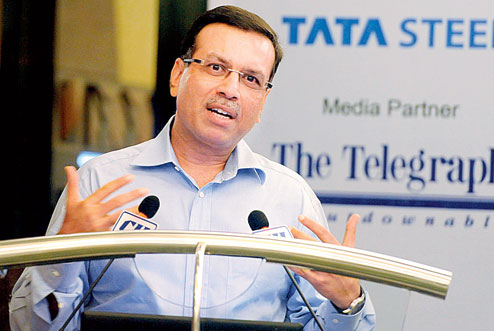
Sanjiv Goenka, chairman of RP-Sanjiv Goenka Group, speaks to youngsters at the Yi-India@75-CII Confab

Sanjiv Goenka, chairman of RP-Sanjiv Goenka Group and a former president of the Confederation of Indian Industry (CII), urged the youth to dare and dream big at an interactive session at Yi-India@75-CII Confab, The Importance of Youth Entrepreneurship in Shaping India’s Economy, in association with The Telegraph.

Edited excerpts from his speech.

Entrepreneurship

It is not the preserve of people who have capital. Today’s technology, today’s venture capital funding… just make sure if you have a good idea, if you are organised, you will get capital.

All you need to do is believe in yourself, believe in your idea, dare to dream and dream big, don’t dream small. And if you do that…. I think there’s no stopping you.

Entrepreneurship is about trying something interesting, innovative and succeeding in it. Whoever would have thought, 10 years ago, that Anjan Chatterjee (of Mainland China) would have a valuation of Rs 1,000 crore ….

Look at Anamika Khanna… today she does profits of Rs 50 crore…. Look at Sabyasachi Mukherjee, he does profits of Rs 50-60 crore…. But 10 years ago they didn’t have that much capital. So it’s possible.

The youth

I think the great difference between us and the next generation is impatience. You can call it speed. You can call it a very quick desire to succeed. There is a kind of confidence, which stems from knowledge that you all have, access to knowledge that you all have, which borders on arrogance. You have minds that challenge convention, that challenge routine. You are not scared of the unknown. You are not scared of an unpleasant answer. You have minds that dare to dream and that has the confidence to succeed.

When I interacted with students at IIT Kharagpur… when I interact with students at IMI (International Management Institute), I actually feel a sense of great pride, a sense of great optimism, because the minds are so sharp.

And I think we as elders have the responsibility to give you the freedom of operation, freedom to think, freedom to actually just go out and perform without being bound by convention, rules or regulation.

If you are scared of making wrong decisions, you will not land up making decisions. Out of 10, if you get 6 right, you’ve done very well. I mean 6:4… 6 right, 4 wrong is a fantastic ratio.

First day at CESC

When you are 27 you are somewhat stupid… not in this generation, but in our generation certainly. It was this whole thing of wanting to prove to myself that I can turn a city that is notorious for power cuts into a city that doesn’t have power cuts. I believed I could do it.

It took me longer than I thought… but I must tell you when I entered the CESC office the first day…. At the building’s entrance, the workers had built a funeral pyre. They had an effigy… they kept saying ‘Sanjiv Goenka murdabad’.

When I entered the office, they lit the funeral pyre. So that was my baptism…. It was horrific to say the least. I was viewed with suspicion. I was viewed as somebody who was a rich man’s son and therefore an upstart. I was greeted with hostility.

I must confess I got fazed; I didn’t let anyone realise it, excepting my wife…. The fact that today Calcutta is free of loadshedding gives me the greatest amount of satisfaction. And I think somewhere up there, my father must be pleased.

Renewable energy

When you look at solar or wind (energy), you are not dependent on anyone to supply you fuel. Today, coal is one of the most precious things and it’s an expensive thing and thereby it means that the power that you generate from coal will be expensive.

Technology is bringing down costs…. Give it another couple of years and costs will go down further. I think that’s the stage when solar and wind (energy) will take off in a big way….

The challenge there will be land…. With the new land acquisition bill, as it is proposed, it’s going to be difficult or almost impossible to get land; and if you don’t get land, solar (energy) will certainly become out of the question.

Music World was set up for a purpose and I can’t afford carrying on businesses that make losses. Nobody buys physical CDs, and cassettes and DVDs anymore…. It’s not what one can afford to do; it’s about what is sensible to be done.

source: http://www.telegraphindia.com / The Telegraph, Calcutta,India / Front Page> Calcutta> Story / by A Staff Reporter / Monday – August 17th, 2015

Bankim house heritage tagging begins

Kolkata :

Finally, the Mamata Banerjee government has initiated the process of bestowing heritage tag to the house where Vande Mataram creator Bankim Chandra Chattopadhyay lived during his stints as deputy magistrate and deputy collector. The house is in ruins and desperately needs restoration. Even as Howrah Municipal Corporation (HMC) has sanctioned Rs 5 crore for it, but work can’t be started unless the building is included in the heritage list.

Ten years ago, the house-owner, Pranab Mukherjee, sold the house to a developer. Just then, locals and an NGO, Howrah Citizen’s Forum, put up stiff resistance and stalled demolition of the property.

On Tuesday, at the behest of the chief minister, a Heritage Commission team visited the premises to start the tagging process. Basudeb Malik, OSD, heritage commission, told TOI, “Although the house doesn’t have much architectural significance, it is associated with a great man. It must be protected from falling apart, at any cost. We are looking for substantial records to prove that the creator of Anandamath had lived here.”

Chattopadhyay wrote the iconic novel became synonymous with the struggle for Independence and banned by the British. The song, Vande Mataram, originally a Sanskrit stotra personifying India as Mother Goddess, was first published in this novel. Bipin Chandra Pal named his patriotic journal after Vande Mataram in August 1906. Lala Lajpat Rai also published a journal of the same name. Chattopadhyay is also regarded as a proponent of Bengal’s literary renaissance for his versatile writing.

Efforts have been on to have Chattopadhyay’s stay in Howrah (between 1881 and 1886) officially recognized and commemorated. But confusion has been prevailing over his residences at 218 Panchnantala Road (about 2 km off Howrah Station) and 212 Panchanatala Road, in the same locality.

Pranab Mukherjee (63), who lives on the first floor of 218 Panchantala Road, that threatens to fall apart any day, said, “We had no idea that the building was associated with Bankim Chandra. If the state government wants to take it over, me and my brother and sister who co-own the house, should be compensated.” Chunks of concrete keep peeling off the house, forcing the other two Mukherjee siblings, Prodyut and Protima, to move out. In 1964, they had bought it from one Jaladhar Mitra, who, in turn, had bought it in 1936. Locals have turned the 17-cottah land in front of the house at 218 Panchanantala Road into a park and named after the litterateur. Mukherjee alleged, “The land was part of the same property, but the local club has encroached it.”

Howrah mayor Rathin Chakraborti said, “We have sanctioned Rs 5 crore for the restoration. Now we are waiting for the government to announce the heritage staus.”

Howrah Citizen’s Forum coordinator N Sarkar said, “During his first stint as an administrator in Howrah in 1881, Bankim Chandra would travel from Kolkata to his workplace. He later shifted to the rented house at 218 Panchanatala Road, and lived there during his second stint in Howrah in 1883. This tenure was his longest among the three.” For the third time, Bankim joined as first class deputy magistrate and deputy collector after being transferred from Bhadrak in Odisha on July 10, 1886. He travelled to Howrah every day but had not vacated the rented house at Panchanantala.

source: http://www.timesofindia.indiatimes.com / The Times of India / News Home> City> Kolkata / by Ajanta Chakraborty & Rupak Banerjee, TNN / August 15th, 2015

BSF women patrol border for first time

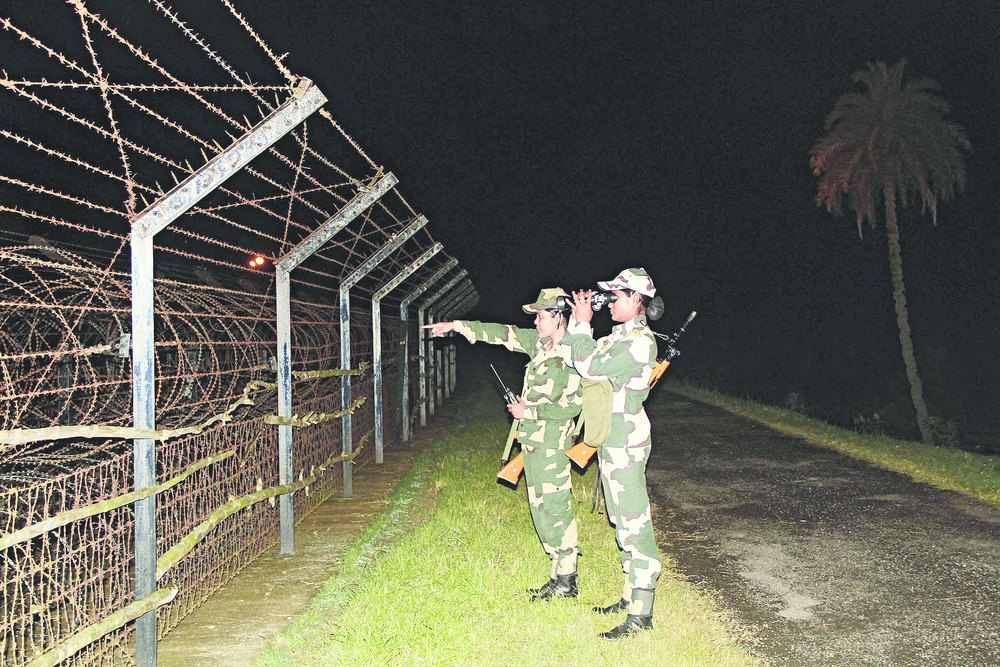
Women commandoes of the BSF at the India-Bangladesh border in Nadia. Picture by Pranab Debnath

Gede (Nadia) :

For the first time, women commandos of the Border Security Force (BSF) have been patrolling the south Bengal frontier on the India-Bangladesh border in Nadia’s Krishnagar sector.

The deployment of the women personnel in night patrolling comes in the wake of security alerts claiming terror outfits can use young women in possible attacks around Independence Day.

Women BSF personnel have done “camp duty” at night in Punjab, which meant guarding the gates. There have not been reports, however, of women personnel being used in anti-sabotage or active patrolling in the night.

It is certainly the first time women are patrolling the border in Bengal.

The BSF began to think differently following the blasts in Burdwan’s Khagragarh on October 2, 2014, in which women played a key role. Razia Biwi, a homemaker, had allegedly played a key role in the Burdwan blast and in weaving a terror network.

In addition, there were reports that Bangladeshi terror outfits were recruiting young homemakers and training them.

“Intelligence inputs indicate that women with terror links may try to sneak in in the guise of cattle smugglers. Bangladeshi terror outfits such as the Jamaat-ul-Mujahideen Bangladesh (JMB) are quite active in the border areas. They have recruited young homemakers and given them terror training. It is not easy for a male BSF officer to get into a combat with or frisk them. So women personnel were pressed into action,” said a BSF officer in Gede.

The BSF deployed the women in key stretches of the 235km sector in North 24-Parganas and Nadia.

For the past three days, women constables of the BSF’s 113th battalion posted in the Gede area of Nadia are on their toes round the clock along the India-Bangladesh border.

Three young women are in their camouflage uniform. They hold the sophisticated Insas and Beretta guns in their hands and night-vision cameras to their eyes. They are guarding the international rail tracks connecting Gede with Darshana in Bangladesh. The Indo-Bangla train, Maitree Express, uses these tracks.

“This is a challenging job. I have been enjoying it,” said a woman constable who was recruited in 2012.

A woman constable and a male constable share the same duties, BSF authorities said.

BSF South Bengal Frontier inspector-general Sandeep Salunke said: “A woman constable is supposed to perform all the duties of their male counterparts. Women have been trained to undertake any type of operation. So it is quite natural that they be engaged in night patrolling too.”

BSF started recruiting women constables in 2009 for the Punjab and Bengal borders. At present, it has over 2,000 women personnel, who have been given commando training. The force recently recruited 27 officers in the rank of assistant commandos through the UPSC.

Senior BSF officers said that even though there was no strict rule against engaging women commandos in night patrol, the force had nevertheless avoided deploying them frequently.

“In Bengal, they are being deployed the first time in patrolling and area dominance during night,” a senior BSF officer said.

The presence of women constables has already made a difference, officials here said.

“Many local villagers are involved in smuggling. They often try to smuggle small fertiliser bags, drugs, gold biscuits, silver and cattle. We were earlier unable to frisk the women involved. Villagers often raise allegations of molestation against our male jawans. But things have changed once women constables have been deployed along the border,” said the officer.

“Direct noticeable involvement of women involved in suspected criminal activities in border areas has also come down largely as women BSF personnel undertake random combing of villages along the border,” the officer added.

source: http://www.telegraphindia.com / The Telegraph, Calcutta, India / Front Page> Bengal> Story / by Subhasish Chaudhri / Sunday – August 16th, 2015

Food for friendship on freedom day

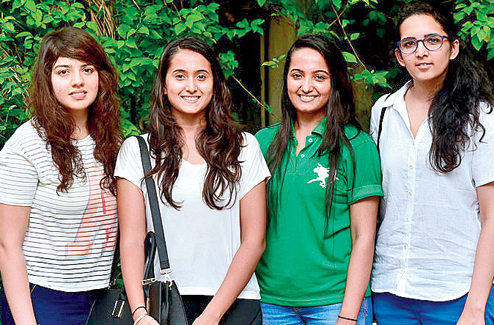
(From left) Isha Kapoor, Aishwarya Jena, Pragya Jena and Ankita Dokania. Picture by Anindya Shankar Ray

Two nations. Seven-hundred-and-fifty volunteers. One lakh food packets for the hungry and homeless.

An army of students and young professionals from across India, including 50 from Calcutta, will distribute food in slums of India and Pakistan on August 14-15 in a unique Independence Day initiative aimed at spreading a message of peace and friendship.

The city chapter of the Robin Hood Army, as they call themselves, is led by Ankita Dokania, a fashion designer, and Chitvan Jaipuria, a wedding and event planner. Also part of the group is Green Oscar winner Ashwika Kapur. “I have been part of the army since its inception. I always do my bit to spread the word when I am not in the jungles,” she said.

It all began in August 2014 with Neel Ghose, a city boy who works with Zomato in Delhi, teaming up with colleague Anand Sinha to form the Robin Hood Army in Delhi. “We procured excess food from restaurants to distribute among the poor. It’s been fulfilling,” said Neel over the phone from Delhi.

The army now operates in 12 cities, including Calcutta, Delhi, Hyderabad and Mumbai. The city chapter was born in October 2014 with five of Neel’s friends. Today, there are 50 members and several more volunteers.

In February this year, Neel got in touch with a Pakistani friend who helped form the Lahore and Karachi chapters of the army. Thus was born the idea of commemorating Independence Day. The Calcutta army plans to distribute over 4,000 food packets among slum dwellers in the Kidderpore, Gariahat, Southern Avenue, Park Circus and other areas.

Isha Kapoor, a third-year student of JD Birla College, joined the movement three months ago. “For I-Day I have mobilised my friends to distribute food in their neighbourhoods,” she said. Aishwarya Jena, a third-year student of microbiology at St. Xavier’s College, has been marshalling forces, too.

Pragya Jena, an entrepreneur, remembers a boy who refused to take a packet of khichdi because he wanted another one for his dog. “Such life’s lessons are precious,” she said.

The movement has garnered corporate support. “We hope to involve more people. But for now we want to make people smile on both sides of the border,” Ankita said.

source: http://www.telegraphindia.com / The Telegraph, Calcutta,India / Front Page> Calcutta> Story / by Chandreyee Ghose / Friday – August 14th, 2015

Enclave’s first baby after freedom named Azad

Kolkata :

Midnight on July 31 had ushered in a new freedom in Cooch Behar’s 51 Bangladeshi enclaves. It took the wail of a newborn 12 days later to underline what it actually meant. Named Azad, he is the first baby born in free territory -with his parents’ real names, and calling what was no-man’s land his home.

When TOI had met the pregnant 18-year-old Jharna Biwi a fortnight ago, the Bangladeshi enclave of Poator Kuthi in Cooch Behar was excited because this baby would be special. At 6.30am on Wednesday , Azad was born at Bamonhat primary health centre. Never has the birth of a newborn -to a teenage mother -been the cause of such joy in any enclave.

Gone are the days when even quacks, what to speak of doctors, would refuse to deliver babies of enclave residents.Would-be-mothers would suffer the ignominy of lying about their husbands’ name.Azad’s elder brother, born four years ago, was named Saheed (martyr). Grandfather Mujibur Ali is ecstatic but cannot forget the shame and agony of half a century .”When Saheed was born in 2011, we had to send Jharna to her maternal home in Dinhata’s Picnicdhora, evading BSF patrols. We had to lie about her husband’s name and give a fake Indian address just to get her into hospital. Not any more,” Ali said. “Azad signals the new dawn,” he said, before hurrying off to offer sweets to visitors flocking to his home.

When Jharna felt pre-mature labour pains in the predawn hours, her brother-inlaw Meharul and mother-inlaw Jamina Biwi took her in a van rickshaw to the primary health care centre, half-anhour away . This in itself would be a huge task a fortnight ago. Being Bangladeshis, they couldn’t step out of their villages for fear of being hounded by BSF or police.And getting admission in a state-run health facility was out of the question.

As Poator Kuthi savoured the sweets of Azad’s birth, 70year-old Mansoor Ali recalled how Asima Biwi was denied treatment in 2010.

“Nearly 3,500 enclave residents braved a nine-hour stand-off with police and BSF to get her treated at Dinhata sub-divisional hospital. The administration relented only when they realized the protest could snowball into a huge agitation. Her baby was born that day and we named him Jehad (struggle),” said Mansoor, president of Poator Kuthi enclave exchange committee. Mansoor said, “Jehad’s birth may have brought our plight before the people but it didn’t change our way of life. Expectant mothers had to fudge their husbands’ name (give an Indian’s name) and address to get admitted to hospitals. Nothing can be a bigger insult to a married woman than to lie about the father of her child.” He added, “But this morning, I held Jharna’s hand and told her to go with her head held high and tell them that she belongs to Poator Kuthi, India, and her husband’s name is Jamidul Ali. She did.”

source: http://www.timesofindia.indiatimes.com / The Times of India / News Home> India / by Kamalendu Bhadra, TNN / August 13th, 2015

Glimpse of rare coins in Kolkata

Kolkata :

Time is money but some particular currency is timeless. On the eve of Independence Day, Kolkatans will get see some of the most ancient coins of Bengal at an exhibition by the Numismatic Society of Calcutta. On display will be 2nd Century BC coins from Chandraketugarh, along with those from Sasanka and Samudragupta era, among others.

“This is the first time we will hold an exhibition at any college in Kolkata. Elsewhere we had held shows at IITs, NITs,” said Samarjit Ghosal, the society’s secretary. The exhibition will be held at Jogesh Chandra Chaudhuri College on Friday.

“The Chandraketugarh coin is identified by some specific symbols like the sun and boat. A telltale symbol is that of a conch on the reverse side,” said Anup Mitra, the society’s president.

Explaining how collectors get hold of such ancient coins, he said: “In old times, the practice of storing valuables underground was quite common. In case they are abandoned, they are discovered long after, mostly by accident. Those who find them take them to jewellers. In England, museums buy back such coins. But here there is no such system here. Across the country, small teams of traders keep a track on movement of coins at jewellery shops. Once they acquired, they are sold to museums or collectors.”

“Till recently, it was believed ‘kouri’ was the medium of exchange in early Bengal. But after discoveries of the last few decades, it is now proved that ‘kouri’ was a parallel currency till early 19th century,” said Shankar Bose, an authority on coins who has penned 10 numismatic books.

Bose will present a powerpoint presentation on ancient Bengali coins at the exhibition.

source: http://www.timesofindia.indiatimes.com / The Times of India / News Home> City> Kolkata / by Shounak Ghosal, TNN / August 10th, 2015

Artist Sunil Das, one of the greats, dies

Kolkata :

Painter Sunil Das died of a massive heart attack on Monday morning. He was 76.

Rabin Mondale, whose exhibition Das was scheduled to inaugurate on Wednesday, recalled how his friend had earned the moniker of ‘Ghora Das’ because of his passion for horses. “Though he was more than 10 years younger to me, we addressed each other by our first names. When I was a clerk with the railways, I would often go over to Sunil’s office adda. I can’t believe he won’t be there to inaugurate my show,” said Mondal, recalling the days when Das was the youngest recipient of the National Award from Lalit Kala Akademi. He was still a student of Government College of Arts then.

Artist Manu Parekh said: “I first heard about his horses when he was only in his third year. But his sketches had qualities of great masters.”

Painter Sanat Kar, who was founder secretary of Society of Contemporary Artists, remembers the day when he got a young Das to join the society. “While on a French Government Scholarship to study at the Ecole des Beaux-Arts in Paris, Sunil went to Spain and watched bullfights. That inspired him to sketch bulls too,” Kar said.

According to art historian Pranabranjan Ray, what set Das’ horses apart from those drawn by MF Husain and Nikhil Biswas was their dynamic energy. In a yet-unreleased documentary titled ‘Sunil: The Lyrical Artist’, director Arun Kumar Chakraborty has interviewed Das about how he developed his fascination for horses. The documentary has footage of Das saying: “I would spend days and nights at the stable of Mounted Police to understand the details and body contours of horses.”

At Keoratala crematorium, an emotional Chakraborty said, “During his discussions in front of poet Alokranjan Dasgupta and painter Tapan Mitra, Sunil-da had told us that he had wanted his body to kept sitting in a chair before his cremation. He was so full of energy that he never wanted to lie down even during his last journey,” Chakraborty said.

Mitra said, “He had even told us that he had kept Rs 5 lakh aside so that he is cremated with sandalwood. Unfortunately, his wishes were left unfulfilled.”

On Sunday evening, Das had called up Mitra to say he also wanted to build a Sunil Das Artist Guest House. From being someone whose father had warned him that he would go hungry to bed if he took up painting as a career, Das used a large part of his savings to support financially weak artists. “His last call to me at 6.39pm on Sunday was to inquire about the progress of the guest house,” Mitra said.

source: http://www.timesofindia.indiatimes.com / The Times of India / News Home> City> Kolkata / TNN / August 11th, 2015

TOI gets 3 honours at scribe awards

Kolkata :

Journalist Uday Banerjee received the Lifetime Achievement Award at the 6th edition of the Journalism Awards on Sunday. Banerjee, who covered government and administration for four decades, is known for his honesty and is revered in the fraternity. Tripura governor Tathagata Roy presented him with the trophy and citation.

Consumer affairs minister Sadhan Pande presented the ‘Hall of Fame Award’ to sports journalist Debashish Dutta at the same ceremony.

Of the 18 other categories of awards, the Times of India group bagged five. Out of the total 10 journalists from TOI and 12 from Ei Samay shortlisted as finalists, three each from TOI and Ei Samay won the honours. Two TOI scribes shared the Best Journalist News (English) award while another won the Best Journalist Lifestyle & Cinema (English) award. Ei Samay picked up Best Journalist Lifestyle & Cinema (Bengali), Best Journalist Sports (Bengali) and Best Journalist Features (Bengali).

Judges included Abhijit Dasgupta, retired station director of Doordarshan and secretary of Kolkata Sukriti Foundation, Dilip Banerjee, former photo editor of Mail Today, Tapas Ganguly, former chief of bureau of The Week, Manik Banerjee, former chief of bureau of UNI, Pradipta Sankar Sen, vice-president of Calcutta Film Society and ex-resident editor of Hindustan Times, Shyam Afif Siddiqui, visiting faculty at Management Development Institute, Murshidabad.

source: http://www.timesofindia.indiatimes.com / The Times of India / News Home> City> Kolkata / TNN / August 11th, 2015

Joynagarer Moya wins G I tag

Kolkata :

Here’s a first from the world of Bengali sweets. Our very indigenous Joynagarer Moya, sweet roundels made of a special kind of puffed rice and bound with jaggery, has won the coveted G I (geographical indication) tag.

While the decision was firming up since April, the state government, which has been championing the cause of the moya, has just been intimated about the crown. Naturally, the moya makers of South 24 Parganas Joynagar, are rejoicing. This authentication tag attaches great prestige to the special sweet with a very short life that makes its annual appearance only in winter.

Joynagarer Moya had to go through a stringent test and documentation process for two and a half years before finally wresting the crown from the G I scientists in Chennai, who work as a wing of the ministry of commerce and industries. The state department of science and technology, which had applied for the G I tag is now enthused about winning the tag for its other two applications – Mihidana and Sitabhog of Burdwan, which are presently being evaluated for a final declaration towards the later part of the month. A GI tag is a name or sign used on certain products which corresponds to a specific geographical location or origin.

India as a member of the WTO enacted the GI Act in 1999, which came into effect in September 2003. The GI tag ensures that none other than those registered as authorised users (or at least those residing inside the geographic territory) are allowed to use the popular product name. Darjeeling tea became the first GI tagged product in India. The Joynagarer moya was invented in 1929 by two confectioners of Bahura and Charan near Joynagar – Purna Chandra Ghosh and Nitya Gopal Sarkar who sold their creation at their Sri Krishna Mistanna Bhandar. The secret lay in the use of kanakchur rice, which is a special variety of winter rice grown locally.

This rice has a distinct aroma that is heightened when this rice is puffed up. Special gawa ghee and nolen gur, also collected fresh locally, are then used to bind the khoi (puffed rice) into a moya. Kanakchur rice cannot withstand chemical fertilizers. “Initially the Joynagar moya makers, threatened by the plethora of fake and cheaper varieties that flood the market in winter, tried to apply for the G I status on their own but faced several hurdles. So they approached the state government for help.We documented the regional history, lore, ingredients, authentic recipe, the formulae used by the inventors and the list of makers at Joynagar who still follow the original process. The G I scientists inquired and tested random samples for consecutive years before agreeing to give the Joynagar er moya the coveted GI tag,””said Mahua Hom Chowdhury, scientist of the Patent Information Centre of the WB State Council of Science and Technology, which is a wing of the state’s department of science and technology.

A total of 150 moya shops have been included in the G I tag as the only authentic makers. It implies that the rest of the shops across the state who will still sell the moya are selling fake stuff. It was after submitting the application for Joynagarer Moya that the state government received appeals from the makers of sitabhog and mihidana of Burdwan too. “Our scientists actually camped in Burdwan for months and along with officials of the district administration, prepared separate dossiers for both mihidana and sitabhog. We were stunned by the details,” said an excited state minister for science and technology, Rabiranjan Chatterjee. He was found basking in the glory of the Joynagarer Moya. “This is our first sweet GI. We have also received GI for three Bengal varieties of mangoes – fazli, himsagar and lakshman bhog,” he said.

The document prepared for mihidana and Sitabhog and submitted to the GI office says that On February 10, 1904, Viceroy Lord Curzon visited Burdwan to confer the title of maharaja on then king of Burdwan Vijaychanda. Bhairav Chandra Nag, a local sweet-maker, had made the sitabhog and mihidana to mark the occasion. Mihidana is made from Kaminibhog, Gobindabhog or Basmati rice.

The rice is mixed with besan and saffron and blended. The mix is poured into hot ghee through a brass ladle with holes. The deep-fried saffron grains are then dunked in sugar syrup. Sitabhog on the other hand is, cottage cheese or chhana and powdered rice rolled into a dough. It is broken into tiny bits and fried in ghee, then soaked in sugar syrup.

source: http://www.timesofindia.indiatimes.com / The Times of India / News Home> City> Kolkata / by Jhimli Mukherjee Pandey, TNN / August 11th, 2015