All posts by wellnmed@gmail.com

Indo-Bangla project on Partition

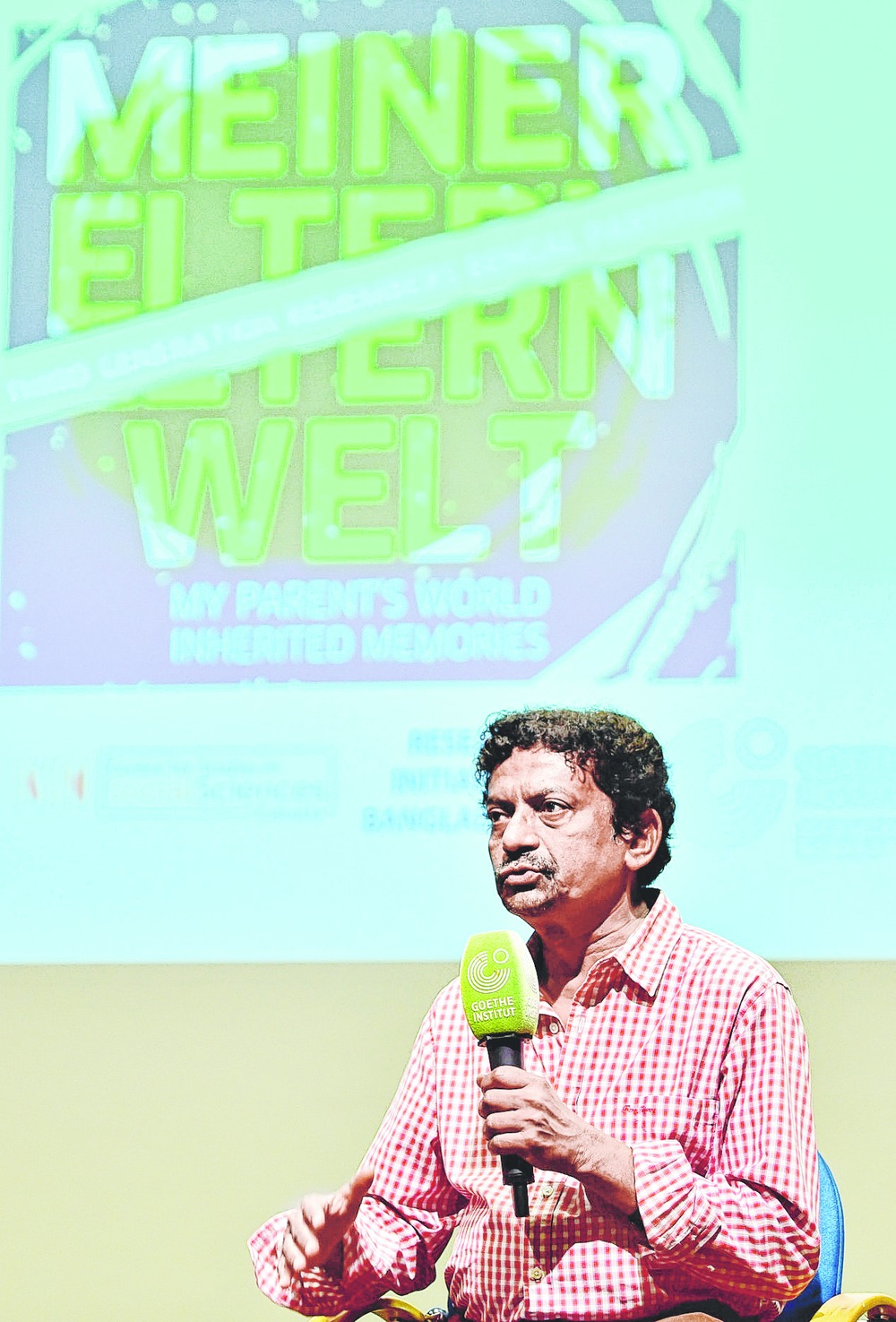
Goutam Ghose at the conference in Max Mueller Bhavan. (Anindya Shankar Ray)

Director Goutam Ghose often wondered as a 10-year-old why his friends could visit their desher bari during vacations while he could not.

“I remember asking my mother if we have a gramer bari. She would say, ‘achhe, but it is in East Pakistan and we don’t have easy access’,” Ghose said during a recent conference at Max Mueller Bhavan.

The conference kicked off a five-month Indo-Bangladesh project titled My Parent’s World – Inherited Memories, organised by Calcutta and Dhaka’s Goethe Institut.

Ghose narrated how he used to accompany his grandmother to refugee colonies in the Jadavpur and Bijoygarh areas to meet relatives. “I remember my grandmother telling me stories…. When I became a filmmaker, I thought let’s connect. Two races had been divided for a wrong reason. I wanted to go back to my ancestral home and make a film. So I made Padma Nadir Majhi and my father was really happy. He said he was happy that I had chosen the subject as I could go and shoot near the Padma.”

The conference saw speakers like Andrea Zemskov-Zuge from the Berghoff Foundation, Berlin; Manas Ray of the Centre for Studies in Social Sciences, Calcutta; Meghna Guhathakurta, executive director, Research Initiatives, Bangladesh, which works with the marginalised community; and former BBC journalist Nazes Afroz.

Ghose spoke about a village (Chakpanital) where he shot for his upcoming Indo-Bangla film – Shonkhochil. It is a village where there are houses of both sides and people live together.

“I find this two-nation theory absurd… that too on the basis of religion. While making the film, I was studying the Radcliffe Line. It is so strange… how on a huge water body you find a zigzag line separating two nations. Same people, same language, same culture divided by an absurd border. Why did Gandhi not launch a ‘Stop Partition Movement’ like the Quit India Movement?”

As part of the project, eight students from Calcutta travelled to Goethe Institut, Bangladesh, to meet eight students there. Together they will attend conferences and workshops on commemorative culture. “Once both sets of students are trained in interviewing techniques, they will interview third generation families of Partition on both sides of the border. People would be selected to travel to the country of their ancestors,” said Judith Mirschberger, director, Goethe Institut, Bangladesh. “So, someone living in Calcutta would travel to Bangladesh and vice versa to trace his/her family roots with these students.”

The project will end with the launch of a web platform where all interviews and background information will be put up.

From Shahid Minar in Dhaka to a memorial in Bhopal by a Dutch sculptor for victims of the Bhopal gas tragedy, Nazes Afroz, who is also the coordinator of the project, presented a slide show of pictures, while talking on the topic “Visual tool is very important in culture of memory”.

It was after a visit to Dhaka in February 2014 for an exhibition that Friso Maecker, the director of Goethe-Institut, Calcutta, started thinking about the possibility of working together. “I remember we were shooting a documentary film, which was about moving from one place to another…. There’s not been much research on the influence of Partition on third generation people in India as well as in Bangladesh…. Also from the viewpoint of an outsider… it is quite astounding that there is no memorial or place to remember the migration of more than eight million people… Which is why we started the project.”

source: http://www.telegraphindia.com / The Telegraph, Calcutta,India / Front Page> Calcutta> Story / by Malancha Dasgupta / Tuesday – September 15th, 2015
Cousins in arms for cause close to heart

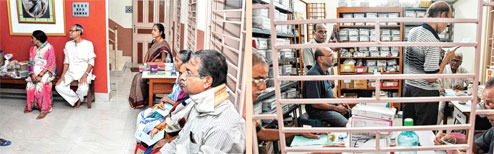
Patients wait for their turn inside the clinic; (right) the medicine counter. Pictures by Anup Bhattacharya

Two do-gooder Calcutta cousins have helped set up a clinic in Chandernagore that offers treatment to those who cannot afford it.

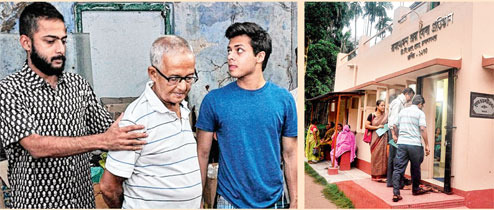
Cousins Rishabh Badoni, 19, a former student of La Martiniere for Boys now studying at Bard College in New York, and Siddharth Sengupta, 23, a Calcutta-based architect, have organised fund-raising exhibitions for three years to develop NGO Ram Mohan Roy Seva Pratisthan’s clinic by the same name – a lifeline for those who cannot avail themselves of costly medical services.

Despite the presence of government medical centres and a sub-divisional hospital in Chandernagore, the common belief is that no other place can provide the same service with care as the doctors and social workers at this clinic can.

Take for instance, Kakoli Singha from Burdwan’s Memari, a widow with two children. She travels for more than an hour by train every morning carrying fresh paneer, which she sells in Chandernagore.

Three years ago she had a skin allergy and got herself treated at Ram Mohan Roy Seva Pratisthan for a nominal fee. Since then, Kakoli has been visiting this clinic for her or her children’s medical needs.

“I used to live with my husband in Chandernagore. After his death, I moved to Memari to live with my in-laws,” Singha said. “But I prefer this clinic as I can consult a doctor and get medicines for a nominal charge. This NGO has been providing good service for so many years… I have faith in them.”

Like Singha, many underprivileged patients from various parts of Hooghly, Burdwan and Bankura get themselves treated at the clinic for a fee of Rs 10.

Every week, from Tuesday to Thursday, the 1,200sq ft clinic is chock-a-block with patients. Three doctors are available for consultation from 4pm. Fifty patients, on average, turn up every day.

“Apart from general physicians, we have a gynaecologist, cardiologist, paediatrician, dermatologist, orthopaedist, psychiatrist and psychologist visiting the clinic throughout the three days,” said Ranjit Kumar Ghosh, the treasurer of Ram Mohan Roy Seva Pratisthan. “We can refer serious cases to doctors who run private chambers in Chandernagore. They see patients for free.”

Medicines are collected from various sources. “We collect free samples from medical representatives as well as from doctors,” said skin specialist Dr Sunil Chandra Dutt, who’s been associated with the clinic for seven years.

Homemaker Surupa Chakraborty visits the clinic in the evenings to take stock of and distribute medicines.

Sunil Chandra Dutt flanked by his grandsons Rishabh Badoni (right) and Siddharth Sengupta; patients outside Ram Mohan Roy Seva Pratisthan

“What we need are nutritional supplements for babies and mothers. I see a several patients with anaemia and gynaecological problems and children suffering from malnutrition,” said gynaecologist Dr Roma Sengupta, who visits the clinic once a week.

A member of the NGO sponsors tests for those who cannot afford it. “We avoid expensive tests, but if there are serious cases where specialist doctors would want more investigation, we request for a discount from diagnostic centres,” said Dutt. “We have several volunteers at the clinic. An executive body runs the NGO… but now we are thinking of setting up a trustee board so that, after us, no one tries to sell or rent the property for other purposes.”

The NGO has been working for the welfare of the underprivileged for the past 42 years.

“The clinic was started by Renuka Betaille, nee Mukherjee, in 1973 in the old post office building. Later, it shifted to the building of the primary school, of which I was the headmaster,” said Ghosh. It was not until 2014 that the clinic got its own building at Goabagan in Chandernagore’s Lalbagan. “Most of what you see here is donated. We collected funds from local people. A resident donated the land.”

Dutt found support in his grandsons, Rishabh and Siddharth, and their friends. A corpus of Rs 1.5 lakh was collected towards constructing the building through an art and photography exhibition and donations from close friends.

The dedication of those working at the clinic motivated Rishabh and Siddharth to do something more for the NGO.

“We have started a new design collective called 145 East, where we design products with traditional Indian handicrafts,” said Rishabh, a student of engineering and literature at New York’s Bard College. “Our first exhibition at Weavers Studio had a theme of gamchha. We designed skirts, tops, tablemats and a whole lot of things using the gamchha.”

Metro had reported in July 2013 how Rishabh, along with Siddharth and friends, had turned his Jodhpur Park home into an art gallery with photographs, paintings and artefacts collected from friends and acquaintances to raise money for the Chandernagore NGO.

The French Consulate and Alliance Francaise, Calcutta, had extended their support to the exhibition-cum-sale that fetched Rs 56,000.

In December 2011, Rishabh with his friend had rushed to AMRI Hospitals in Dhakuria to help in the rescue operation following the fire in Annexe I that took 90 lives.

“Social work runs in our blood and Rishabh and Siddharth have got it from there,” said Dutt.

Rishabh said it was important to support people who were devoted to social work.

Siddharth, who studied architecture at Sardar Vallabhbhai Patel Institute of Technology in Gujarat’s Vasad, is helping with design and production at 145 East. “The last exhibition helped create an awareness about the NGO and we managed to collect Rs 12,000 through it,” said the architect who has just completed a year’s teaching in Gujarat.

source: http://www.telegraphindia.com / The Telegraph, Calcutta,India / Front Page> Calcutta> Story / by Dalia Mukherjee / Monday – September 14th, 2015

Fashion week finale

ShraddaDasKOLK14sept2015

The second edition of the three-day Bengal Fashion Week, partnered by t2, was brought to a close by city boy Abhishek Dutta.

The showstopper? Shraddha Das (in picture), who has earned her spurs in Telugu, Malayalam and Kannada films, dabbled in Tollywood and is now poised to make it big in Bollywood.

Abhishek presented Anno Domini, a neo-chic fall/winter 2015 line marked by graphic prints, ombre shading, structured silhouettes and layering.

Picture by Rashbehari Das

source: http://www.telegraphindia.com / The Telegraph, Calcutta,India / Front Page> Calcutta> Story / Monday – September 14th, 2015

British-era vault still operating in Kolkata

Kolkata :

Inside the underground chambers of a non-descript office building on BBD Bag’s Netaji Subhas Road, lies a piece of Kolkata’s banking history. Here, in the basement of the four-storeyed structure, constructed by a Gujarati entrepreneur in 1940, Kolkata had one of its first private vaults — The Calcutta Safe Deposit Vault.

In the absence of locker facilities in banks then, it was a huge success with British citizens and business families. Seventy-five years later, the vault — probably the only privately owned one in Kolkata now — still survives.

Spread across 5,000 sqft, the vault has an astounding 8,600 lockers and three strongrooms. Dozens of safes, chests and almirahs, some of which are nearly a century-old, take up space in the strongrooms. Several lockers are still in the name of foreigners who rented them three generations ago. Around 2,000 of these lockers are now ‘dead’ and their holders are untraceable.

But the rest are active, says Sriram Ojha, a member of the board of management that runs the vault.

“We still have clients in USA, UK, Singapore and Canada, apart from all corners of the country. While many have stopped getting in touch with us, the rest are active users of the vault. They have been using it over generations and are keen to carry on. We are delighted to serve them because they are helping to keep this vault alive. It is part of our city’s great history,” Ojha said.

It was his father Amritlal Ojha, a successful industrialist from Kutch in Gujarat who started the vault in a building constructed by him. People like industrialists Badridas Goenka and Nalini Ranjan Sarkar attended the inauguration in January, 1940. It charged clients just Rs 8 every three months for a locker.

Four years later, on October 18, 1944, Amritlal passed away.

“My father had travelled to England to secure permission for the vault and building, which had been denied initially. He was on the board of more than a dozen companies and also president of the Indian Chamber of Commerce and FICCI at New Delhi, apart from numerous other business organizations. He enjoyed a tremendous goodwill in the elite circles of Kolkata, which made it easy for Calcutta Safe Deposit Vault to continue even after his death. Our clients never left us,” Ojha said.

Among those who stored valuables at the vault were the Dalai Lama and the Maharaja of Burdwan. Members of the royal family of Sikkim and the Tata and Birla families still hold some, apart from numerous other rich, aristocratic families in the city. Many of them still visit the vault regularly.

Fresh applications for lockers are still received, though there is hardly any available now. Recently, a client opened a locker that had not been operated for nearly 30 years — a Bengali woman from Texas claimed her husband’s trunk from a strongroom at the vault.

Reminders are sent to old clients to come and check their belongings. “Many respond enthusiastically while others are returned to us for the recipients are either dead or have shifted residence,” Ojha explained.

It is more to carry on his father’s legacy, than anything else, that the vault has been kept running with a workforce of only 20, said the 71-year-old Ojha. “None of his other businesses survive so I am keen that this one exists at least till I am alive. It is a hand-to-mouth existence for the vault since we have hundreds of defaulters. Charges have been revised but the earnings are still not enough to result in a decent profit. But we can still survive,” Ojha said.

There is a set of Reserve Bank of India guidelines for nationalized Bank lockers. But Ojha is not aware of them and he has not been questioned either.

“When my father started it, there was no RBI. But a demand for lockers must have existed as this vault was a runaway success. Our vault is not the only one in the country, there are several others in other cities. But ours was a huge hit,” he argues.

The vault now charges between Rs 800 and Rs 3,000 annually for a loc-ker, depending on its size. The char-ges for renting an almirah, a safe or a trunk are Rs 12,000, Rs 15,000 and Rs 5,000 respectively.

What worries Ojha now is the future. “Rent from the building sustains the company but the major tenant has been defaulting. Unless we can generate more revenue, the vault will pass into history. It sustains nearly a hundred people, which makes it important for me to ensure that it goes on,” Ojha explains.

source: http://www.timesofindia.indiatimes.com / The Times of India / News Home> City> Kolkata / by Prithvijit Mitra, TNN / September 13th, 2015

Paes-Hingis win US Open mixed doubles title

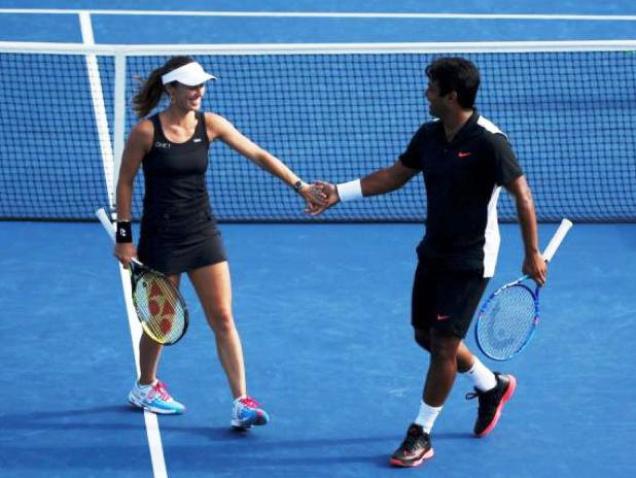
Martina Hingis celebrates a point with mixed doubles partner Leander Paes during their finals match against Bethanie Mattek-Sands and Sam Querrey at the U.S. Open tennis tournament in New York on Friday / Reuters / The Hindu

Paes now has nine Grand Slam mixed doubles titles, surpassing compatriot and former partner Mahesh Bhupathi’s record of eight.

Leander Paes created history by winning the U.S. Open mixed doubles title with Swiss partner Martina Hingis and surpassed compatriot and former partner Mahesh Bhupathi’s record.

The 42-year-old Paes now has won nine Grand Slam mixed doubles titles, against Bhupathi’s eight.

The fourth seeded India-Swiss pair, edged past unseeded Americans Bethanie Mattek-Sands and Sam Querrey 6-4 3-6 10-7 in a tricky final to win their third Major title together this season.

Paes is now only behind legendary Martina Navratilova, who won 10 mixed doubles trophies. Of those 10, two came with Paes, when they won Australian Open and Wimbledon in 2003.

With this win, Paes and Hingis, who also won Australian Open and Wimbledon titles early this season, have become the first mixed doubles team since 1969 to win three Grand Slam mixed doubles titles in the same year.

It was Paes’ 17th Grand Slam title overall and Hingis’ 19th. Hingis has won four Grand Slam titles and all of them have come with Indians. She won her first mixed doubles trophy with Bhupathi when they won 2006 Australian Open.

Hingis is also in the contention in the Women’s Doubles with Sania Mirza with whom she won the Wimbledon this year. They are up against Yaroslava Shvedova of Kazakhstan and Casey Dellacqua of Australia.

Paes and Hingis broke Mattek-Sands at love to take a 2-1 lead in the opening set as the Swiss miss hit a forehand passing shot to secure the break. That bit of momentum was all they needed, as Paes easily closed the set out at 5-4 when Hingis hit a volley winner.

A lone break of serve also decided the second set, as Mattek-Sands hit two straight winners to break Hingis’ serve as the Americans led 3-1. Hingis saved three set points on her serve at 2-5, but Querrey easily held in the next game to send the contest into a deciding super tiebreak.

The unseeded Americans were cruising as they created a 4-1 cushion when they won both points on Hingis’ serve to grab the first mini-break. But Hingis and Paes took the mini-break back on Mattek-Sands’ serve at the next opportunity.

The crucial point of the match came at 7-7, when Paes blocked Querrey’s serve for a clean passing-shot winner. He then won both points on his serve to close out the match, hitting an overhead winner on their first match point and then lifting Hingis in celebration.

source: http://www.thehindu.com / The Hindu / Home> Sport> Tennis / PTI / New York – September 12th, 2015

Valiant village boys’ goal rush – Young heroes battle odds To turn football into a life force

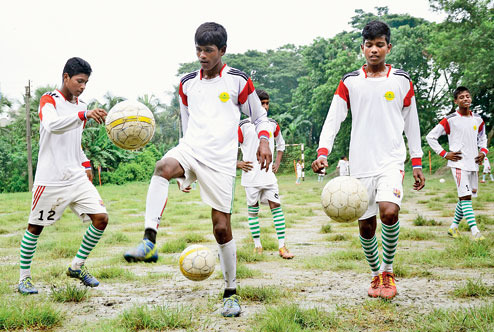
The Deeksha boys train at Dihi village in Sonarpu

Tapas Khan is his team’s star striker but often sleeps hungry. Sanu Manna is greased lightning in the midfield but the struggles of life sometimes sap his spirit. Bijay Mondal’s long-range shooting would do a pro proud but the one goal he is eyeing is a livelihood.

The three 14-year-olds turning out for Deeksha Education Trust scored a stunning goal each in the final of the Calcutta leg of the STAR Sports Young Heroes tournament last month against a stellar school team that was expected to dominate them.

Those who watched the Young Heroes final say St. Lawrence High School didn’t lose the match, the Deeksha boys won it with their natural brilliance.

“We have been playing football together for just the past two years and this was our first inter-school tournament. Before the campaign started, we couldn’t have imagined winning the Calcutta leg over so many top schools,” Dipankar Pramanik, the captain of the winning team, told Metro.

Dipankar, a student of Class VIII at the NGO-run school in Dihi village of Sonarpur, South 24-Parganas, was one of the stars of the tournament with four goals.

Like Tapas, Sanu and Bijay, his is a story of fighting poverty to play football. Dipankar’s family is so poor that he often stays in his coach Jhoton Manna’s house to ease the burden on his elder brother, who is the breadwinner.

“We are six, including my parents, elder brother, sister-in-law and niece. We live in a mud hut. My father is ailing and unable to work. My brother earns around Rs 4,000 a month working in a local hospital. I dream of ending my family’s misery by playing for a big club,” Dipankar said.

The Deeksha captain takes pride in the fact that his team’s success in the STAR Sports Young Heroes tournament came against the top school teams of Calcutta, including La Martiniere for Boys, St. James’ School and St. Xavier’s Collegiate School.

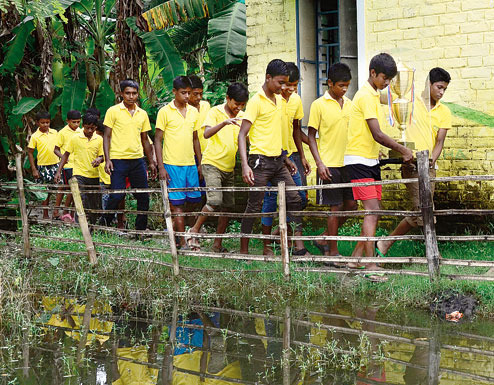
The team carries the STAR Sports Young Heroes trophy to their school building. Pictures by B. Halder

STAR Sports Young Heroes is an under-15 national inter-school football tournament-cum-talent scouting programme that involves over 650 schools. As many as 64 school teams from across Bengal had competed in the Calcutta leg, culminating in Deeksha’s 3-0 victory over St. Lawrence at the Howrah Municipal Corporation Stadium.

For Class VIII student Tapas, the second highest scorer for his team in the tournament with three goals, football is the lone bright spot in a life beset with problems. His father has been battling tuberculosis for seven years and his elder brother, a masonry apprentice, doesn’t earn enough to feed the five-member family.

Sanu, a student of Class IX and the midfield general of the Deeksha squad, isn’t sure he will be able to continue playing football. His father, a barber, struggles to support the family of five and Sanu is bracing for the day he will have to give up playing to earn a living.

Classmate Bijay, who too comes from a poverty-stricken family, lost his mother to snakebite a few months ago and he wakes up every morning worrying about where the next meal will come from. “My coach tells me that I am doing well but I wonder whether football will earn me a living,” he said.

Debdas Munda, a student of Class IX who defended so well that Deeksha didn’t concede a single goal in the tournament, is the son of a vegetable vendor. His next challenge is to prove he is good enough to be a professional footballer before his father asks him to work for a living.

Debdas has at least one reason to be optimistic. Former Iran footballer and Maidan hero Jamshid Nassiri, who is the head mentor of the talent scouting programme, picked him among the three most talented footballers in the Calcutta leg of the tournament.

The other two boys who made the cut are Kiyan Nassiri, a Class VIII student at St. James’ School, and Saaron Bhattacharya, a Class IX boy from Julien Day School, Kalyani.

“I will pick the 45 most talented under-15 players from 15 cities to undergo training under professional Spanish coaches, who would then choose the top 16 players. These 16 players would be flown to Spain for an international exposure trip. After they return, we will help them compete for selection to the under-17 squads of big clubs and academies, provided their parents agree to cooperate,” Nassiri said.

Debasish Sarkar of Deeksha, who along with his wife and three friends had started the school in 2012, said the STAR Sports Young Heroes campaign was much more than a tournament for his institute. “The football team has changed the culture and atmosphere of the village. They have shown what they can do and everyone is proud of them.”

Sarkar first took note of the Deeksha boys’ potential when his son Dion, an alumnus of South Point, visited the village with his school football team to play a friendly. The visitors conceded seven goals. “I was amazed by their game and requested (coach) Jhoton to take special care of them and build the team,” he recounted.

Jhoton, 20, used to be the best football player in Dihi until a spinal cord injury two years ago dashed his dream of turning professional. “I will be happy if I can help some of these boys grow as players. But I feel we also need a professional coach to groom them properly,” Jhoton said.

Sarkar has approached some Calcutta-based coaches to help take the team to the next level but nobody has agreed yet. “The distance from Calcutta to Dihi village (around 35km) is a huge constraint,” he said.

Under Jhoton’s tutelage, Dipankar and his teammates are preparing for their next challenge: the national final of the Young Heroes tournament, where they will be up against 14 champion teams from as many cities.

Besides concentrating on bettering their game, the boys are eager to hone their conversational English. “Since returning victorious from the Calcutta leg, they have been requesting me to teach them how to communicate in English with teammates on the field. They heard the city boys doing that during the tournament!” smiled Sarkar, who teaches science and English at the school.

If learning to converse in English is a skill the boys aim to acquire over time, the national leg of the Young Heroes tournament is a mission. They believe a better future is just a goal away.

source: http://www.telegraphindia.com / The Telegraph, Calcutta,India / Front Page> Calcutta> Story / by Ayan Paul / Thursday – September 10th, 2015

BSF organises exhibitions at schools in Kolkata as part of Golden Jubilee celebrations

BSFkolkata11sept2015

Kolkata :

As part of the Border Security Force’s Golden Jubilee celebrations, the South Bengal Frontier is organizing exhibitions at schools across Kolkata and neighbouring districts to raise awareness on the activities of the border guarding force among students and teachers.

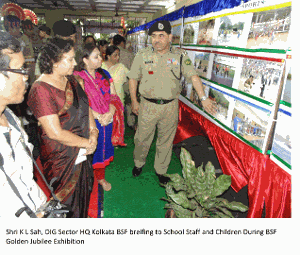
On Thursday, an exhibition was held at the St Joan’s School in Salt Lake where weapons and surveillance equipment were displayed. A photo exhibition also highlighted the force’s achievements over the last 50 years.

“The BSF’s history, participation in the Republic Day parades, training activities and roles played by the air, water and artillery wings were explained to hundreds of students at the school during the day. High-tech communications equipment systems were also displayed. BSF soliders and mahila constables briefed students about the functions of various weapons and equipment used by the BSF during war and peace. The exhibition was inaugurated by K L Sah, DIG, Sector HQ Kolkata, in the presence of Devyani Ghosh, principal and Lucia Ghosh, vice principal and over a thousand students,” a senior officer said.

Sah and S P Tiwari, DIG, Frontier HQ South Bengal briefed students about the genesis of the force, its role and task, duties and how effectively BSF sentinels guard the border from Kashmir to Kutch and Sundarbans to Mizoram with utmost professionalism. A short film on the role and task of the BSF, its functioning and parade at the Joint Retreat Ceremony of Indo-Bangladesh Border at Petrapole and Indo-Pakistan Border at Attari was also screened for students.

“The initiative has been taken to inculcate patriotic spirit in young school children and to make them aware about India’s borders and duties performed by the BSF. The patriotic tunes played by the BSF brass band were highly appreciated by the young children. The next programme will be organized by BSF on September 16 at The Heritage School,” the officer added.

source: http://www.timesofindia.indiatimes.com / The Times of India / News Home> City> Kolkata / by Jayanta Gupta, TNN / September 10th, 2015

Neglected Coolie Darwaza turns into pile of rubble

Kolkata :

St George’s Gate, once a prominent structure of the city after which even a road was named, was long lost. And now, even its remains are sinking into oblivion.

The southern gateway to Fort William near the northern slope of Kidderpore bridge, the gate, also known as Coolie Darwaza, was abandoned by military authorities when the passageway was converted into a civilian road — St George’s Gate Road. The new St George’s Gate of Fort William was built a little west, near Prinsep Ghat.

TOI on Thursday found only the pillar on the side of southern flank partly intact, overgrown weeds covering most part of it. The other part on the northern side has vanished. Only its broken pieces are strewn all over the place. Who razed it? When was it razed? No one ever bothered to know. It is not known whether it was razed when the elevated approach road of Vidyasagar Setu was constructed.

The pathetic condition of the gate was brought to the notice of Archaeological Survey of India (ASI) by Anthony Khatchaturian, a passionate heritage activist. ASI regional director (east) Dr P K Mishra immediately took note of it and inquired about it. He also wrote to GoC Bengal Area, requesting him to look into how this important heritage gate got destroyed.

“Historically, it is a very important architecture. It would be great if we could restore the structure,” said Mishra. There is a detailed reference of St George’s Gate in M L Augustine’s book ‘Fort William: Calcutta’s Crowning Glory’.

“I was surprised how such a beautiful structure is being damaged systematically. I was surprised to find the signs of destruction still intact across the road. There must be some serious attempt to restore the structure and rebuild the destroyed one,” said Anthony, a passionate save heritage campaigner with an Armenian origin.

source: http://www.timesofindia.indiatimes.com / The Times of India / News Home> City> Kolkata / by Krishnendu Bandyopahyay, TNN / September 11th, 2015

The Bengal paradox – Why the population growth rate in the state is low despite few noticeable advances on the economic and social fronts and what Mamata can learn from it

Sept. 6: Bengal has turned conventional economic wisdom on its head.

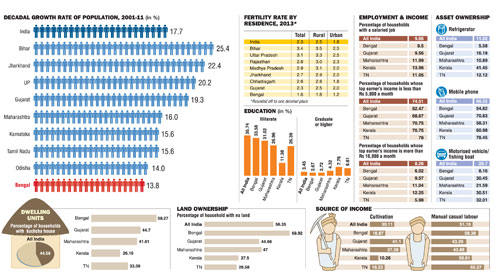
Data released by the Centre last month revealed that Bengal had one of the lowest population growth rates, 13.8 per cent, in the country for the 2001-11 decade. This is of a piece with the number thrown up earlier in 2013 for Bengal’s total fertility rate, which placed the state at the bottom of the table.

This development has taken place without being accompanied by the level of economic and social progress that has so far been seen to create conditions for low population growth.

Saswata Ghosh, economist and mathematical demographer at the Institute of Development Studies, Calcutta, said: “The basics in economics tell us that population growth rates tend to stabilise with rise in income and social well-being. We have seen such trends in the advanced economies of Europe around the 1960s and 1970s.”

Japan’s experience has been the same.

Bengal bucks that trend. The provisional socio-economic caste census (SECC) data of 2011 paints a dismal picture of rural Bengal: one-third of the population are illiterate and nearly three-fifths live in kuchcha houses and three-fifths earn their livelihood through manual labour. The breadwinner in 82 per cent of the households makes less than Rs 5,000 a month.

The situation of Odisha is somewhat similar. The state has witnessed a decadal population growth rate of 14 per cent but the socio-economic conditions of the rural population cannot be regarded as favourable for such a dip in the population growth rates.

“This is a demographic puzzle and I think it calls for more research,” said Anup Sinha, professor of economics at IIM Calcutta.

According to him, a proper social safety net can push down fertility rates – as it has been witnessed in various European countries – because people think that the government will take care of them in their old age. India is far from a situation like that.

Given the uncertainty about the future and the widespread misery, conventional wisdom expects the poor to have more children in the hope of augmenting future income. Besides, the lower probability of survival of all the kids also encourage the poor to procreate more.

But the finding from Bengal is different, as the total fertility rate has dipped. This rate is defined as the average number of children a woman would have over her reproductive life. Bengal’s fertility rate of 1.6 is not only below the national average but also lower than the replacement rate of 2.1 children per woman. This rate is taken to be 2.1 with the notion that a couple will be replaced by two children; 0.1 is added to factor in infertility among some women.

“The dip in the fertility rate in urban areas in Bengal is more to do with aspirations for their children, where parents are reducing fertility in search of social uplift. But in rural areas, the decline is distress-driven, as there are fears that the next child may starve to death,” said Ghosh, who has been tracking the trend for some time.

This sense of insecurity can be understood in the context of results from the census. Some 70 per cent of the rural households are landless, around 47 per cent of the rural population do not have primary education (national average of 50 per cent) and the percentage of graduates in the state is less than the national average and all the western and southern states.

The low decadal population growth might make Bengal’s current administrators happy as it means less strain on scarce public and private resources. As for the state’s poor social and economic scores, Mamata Banerjee can well blame her predecessor, the Left Front, as the survey related to the years to 2011, the year she took charge.

Several economists, however, said the trend of deprivation seen during Left rule doesn’t seem to have changed.

“Had there been a significant improvement in the situation after 2011, it would have been discernible to even non-expert eyes…. At least I haven’t seen any major changes in terms of job opportunities or education,” said Sinha.

Economists may wait for numbers, but till the next such survey results are out, Mamata can keep claiming that the Left destroyed both industry and agriculture, but the tables tucked in the voluminous report have several lessons for the chief minister.

Governments in Bengal have boasted about rapid industrialisation, never producing the numbers to support their claims. The provisional SECC data show that only 8.5 per cent of the rural population have salaried jobs -evidence of the lack of industrialisation. Agriculture offers a picture that is as gloomy: only 19 per cent of the rural population – against a national average of 30 per cent – earn their main livelihood from cultivation.

If more than 58 per cent of a state’s rural population earn their primary living through manual casual labour – which means they do not use skills and employment is irregular – there is little doubt that the state needs industrialisation for which availability of land is a precondition. But Mamata’s stated stand is against government acquisition of land.

“If the present government sticks to its stand on land, the next census will produce a more dismal picture of the state,” said an city-based economist who did not wish to be named.

Over the past few years, the Mamata government has been claiming that Bengal is ahead of the national average in terms of all the major indicators like the growth rate of the economy and the rate of growth in industry, agriculture and services.

“From a small base, one can achieve higher growth numbers. Besides, the national average includes other laggard states. So, clocking a higher than national average is no big deal. Instead of patting herself on the back for what she has achieved, she should take a lesson from these numbers and change her approach,” said the economist.

source: http://www.telegraphindia.com / The Telegraph, Calcutta,India / Front Page> Story / by Devadeep Purohit / Monday – September 07th, 2015

Mecca of rare books

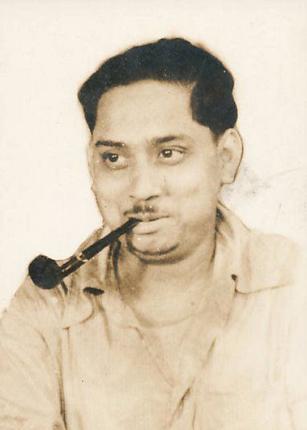
Nirmal Chandra Kumar / Special Arrangement / The Hindu

Nirmal Kumar was probably the first Indian bookseller to publish a rare books catalogue in the best tradition of bespoke antiquarians around the world.

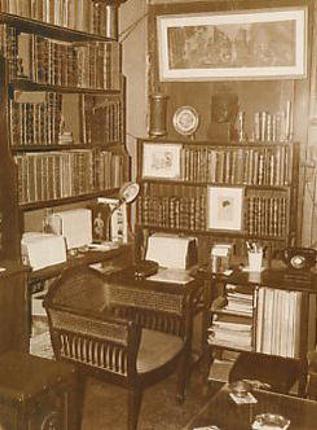
One can only imagine it today: a set of cosy rooms in an ancestral home on a busy street in Calcutta in the 1950s resembling a finely appointed private library with a complex of bookcases and furniture that was actually an antiquarian bookshop one could walk into for a browse and for long conversations with its bohemian-bibliophile owner. His name was Nirmal Chandra Kumar, and his bookshop was called, simply, Kumars. From 1945 until his death in 76, Kumar ran a rare bookshop from his home. It took up several rooms and the stock ranged widely, from fine bindings to prints to maps.

Kumar's bookshop / Special arrangement / The Hindu
Kumar’s bookshop / Special arrangement / The Hindu

I first learnt about Kumar and his bookshop when I stumbled upon a blog by his son, Aloke Kumar, on his father’s bookshop and its influence on the life and work of many Bengali artists and intellectuals of that time who were all regulars at Kumars. I was delighted to discover there had once been such a marvellous bookshop in India — a genuine antiquarian bookshop in a country where antiquarian bookselling and buying is not an ingrained tradition. In this sense, Kumar was no doubt a maverick and thank God for that. Eager to know more, I managed to contact his son, Professor Aloke Kumar, for a brief chat on the phone.

In one of his writings, Kumar describes his father: “a stocky Bengali… he wore a white collared shirt, half-sleeved, and a lungi; his formal dress was a dhoti and kurta with pump shoes. Can you imagine somebody wearing this dress and smoking a pipe or a Davidus cigar sitting in his library surrounded by books?” Kumar was probably the first Indian bookseller to publish a rare books catalogue in the long tradition of all bespoke antiquarian booksellers around the world, especially the legends Kumar had done business with, Quaritch and Maggs. The city’s bibliophiles, artists, luminaries, antiquarians and bohemians all frequented Kumars. Satyajit Ray, a regular browser here, consulted Kumar when he was making The Chess Players: in a London book auction, Kumar had bid for and won a priceless scrapbook on the Mutiny.

Ray went on to pay his own little tribute to Kumar in the character of the encyclopaedic Sidhujata in the Feluda stories. Well-known antiquarian Sir Ashutosh Mukherjee was also a customer. When he donated thousands of rare books to the National Library, several books in the collection had once come from Kumars. “In the early 1940s,” writes Aloke Kumar, “rare book collection was in a dismal, class-bound rut. The famous rare book shop Cambray… was already fading, Thacker and Spink was alive, but there were hardly any rare books… Kumar helped to change all that. His enthusiasms included the then unheralded British painters, Thomas and William Daniel, to be re-introduced to Calcutta once more. He bought the rare elephantine folio of 144 Views of T&W Daniell from Sotheby’s to ship it to Calcutta.”

What was just as remarkable about Kumar — reading his son’s reflections — was how generously and freely he gave to his customers, friends and family even though the bookshop wasn’t a profitable business and . It just broke even most of the time, but Kumar, right in the middle of his struggles to keep the bookshop afloat and provide care for the needs of his own family, invited his parents (who had faced a financial loss) to come live with him. He was also apparently a gourmet and “organized the very best of fine cooking to be presented to his friends. Sometimes such delicacies that you would only find in the pages of some rare Mughal document.”

Aloke recalls a regular errand for his father: being sent off with books in hand to be delivered to Satyajit Ray; he also remembers how cautious everyone in the house was about handling the books, tiptoeing around the shelves, careful not to disturb them. One of the things that broke Kumar’s heart was the sharp practice in the antiquarian trade in the late 1970s of breaking up rare books, atlases and maps to make a bigger profit. Some of his fellow booksellers had begun to buy books with rare prints and maps and tear them up in order to sell each print or map individually. You made more money this way than when you sold the set or the atlas as a whole.

“Kumar did not want to be a part of this and lost out,” says Aloke. “And it was with a sense of bowing to the inevitable that Kumars mentally gave up. Nirmal Kumar died in 1976 and with his death, the literary world lost a sweet and genuinely unselfish man who freely gave of his vast knowledge and delighted in the achievements of those he influenced so profoundly.”

My interest in this impassioned, unsung bookman and his cherished antiquarian bookshop is not so much for the luminaries who once buzzed around it as much as for imagining the regular traffic of ordinary bibliophiles, scholars, and collectors for whom Kumars must have been a Mecca of fine and rare books.

Pradeep Sebastian is a bibliophile, columnist and critic.

source: http://www.thehindu.com / The Hindu / Home> Opinion> Columns> Pradeep Sebastian / September 05th, 2015