All posts by wellnmed@gmail.com
24
With a perfect eye
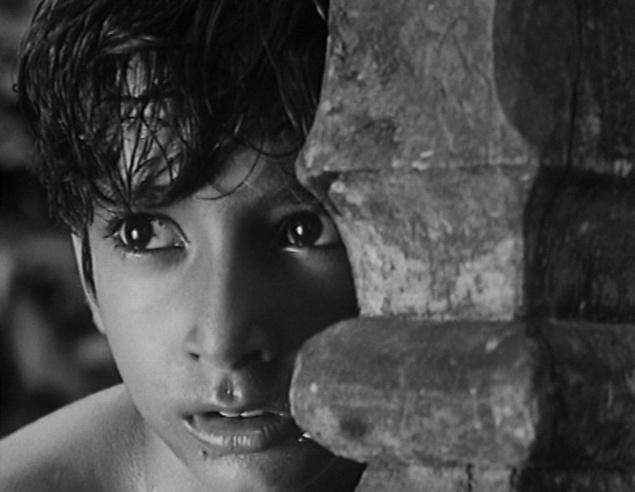
The man responsible for the distinct visual vocabulary of “Pather Panchali”, has unfortunately been forgotten.
Subrata Mitra was an observer of Jean Renoir when he was shooting The River at Kolkata in the late 40s. It was at this juncture he came across Satyajit Ray who was also a keen Renoir observer. Both struck a creative chord and agreed to work together.
No wonder when Satyajit Ray made his debut as a writer-director with Pather Panchali, he had Mitra as his cinematographer. The teaming of Ray, Mitra Ravi Shankar, Dulal Dutta and Banshi Chandra Gupta was perhaps the greatest combination in Indian cinema. With a Michele camera, Mitra created wonders in Pather Panchali. The incomparable use of natural light during the monsoon rains, shots of the kash flowers and a running train in the distance created cinematographic magic. Mitra won a National Award for his camera work in Pather Panchali.
By the time Aparajito went on floors, the Arriflex camera had arrived in the cinematic world. Mitra made superb usage of bounce lighting during the indoor shots in Aparajito. Prior to Aparajito, bounce lighting was unknown to Indian cinema. Even the iconic Ingmar Bergman made use of this technique years later in Through A Glass Darkly.
Mitra can best be described as the perfect cinematic eye of Satyajit Ray. So well did he understand Ray’s thoughts, imagination and visualisation that his camera interpretation of them was sans any flaws. Apur Sansar, Jalshaghar, Devi, Teen Kanya and all Ray films bore the masterly Mitra stamp of cinematography. When Ray decided to shoot Kanchenjungha in colour, it was a challenge for Mitra. Without opting for too many special effects or cinematographic jugglery, he used close-ups to capture the panorama of the Himalayas. The montages were lyrical. The first ever freeze shot in Indian cinema was used to perfection by Subrata Mitra in Charulata.
After Nayak in 1966, Ray and Mitra parted ways. It was mainly due to creative and not egoistic differences. Mitra believed in certain visions which did not gel with Ray’s.
They drifted apart with dignity never criticising each other in public. Ray’s films after Nayak lacked the genius of Mitra’s cinematography. Mitra sans Ray was also not at his altruistic best. One of Indian cinema’s greatest tragedies.
James Ivory and Ismail Merchant worked with Mitra very well in Householder, Shakespearewala, Bombay Talkies and The Guru. In Householder, Mitra used tight close-ups of Shashi Kapoor and Leela Naidu, five in quick successions creating visual poetry. Raj Kapoor made sure Mitra cinematographed Teesri Kasam for Basu Bhattacharya. The shot of the train through a hole in Hiraman’s (Raj Kapoor) cart shot without a tilt still haunts.
The genius took a sabbatical from cinematography in mid 70s. He returned in 1986 to shoot Ramesh Sharma’s New Delhi Times. The shot of Shashi Kapoor running in a dream sequence as his newspaper office burns remains a lesson in cinematography.
Mitra spent his last years teaching cinematography at SRFTII, Kolkata. He was an expert of monochrome and favoured soft colours compared to stark ones. He considered Saath Pake Bandha, Dakhal and Drishti truly well-lit films.
As Pather Panchali is completing 60 years Pather Panchali it is sad that the camera architect of the classic has been forgotten. Mitra still is an idol for any aspiring cinematographers.
source: http://www.thehindu.com / The Hindu / Home> Features> Friday Review / by Ranjan DasGupta / October 22nd, 2015
This is how Calcutta will become London?
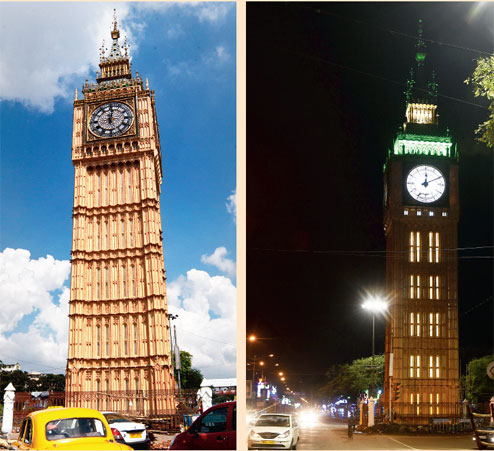
A replica of Big Ben, the famous clock tower of London, has come up at the Lake Town crossing on VIP Road. The 135ft-tall structure, however, falls far short of the original, which towers at 314ft.
The replica, designed by artist Sunil Chandra Pal, is made of concrete and has a fibre casing. Work on the structure had started in December.
Big Ben is the nickname of the Great Bell of the clock at the north end of the Palace of Westminster in London. Like the original, the replica will ring every hour, but the sound will not be produced by a bell like that in the London tower. Instead, a recorded sound will play from a speaker.
South Dum Dum Municipality spent over Rs 1 crore to build the clock tower.
Architect Partha Ranjan Das said the replica looked good but the money should have been spent on building something original.
“If they were so interested in making a tower’s replica, they could have chosen from Gour-Pandua (in Malda). There are many towers there,” he said.
source: http://www.telegraphindia.com / The Telegraph, Calcutta,India / Front Page> Calcutta> Story / picture by Amit Datta / Monday – October 19th, 2015
21
20
Nadia royal family bears Puja torch since Akbar era
Krishnanagar :
Illuminated by earthen lamps and torches (mashals), the idol of Ma Raj Rajeshwari looks resplendent in the Akbar-era Natmandir at the Krishnagar Maharaja’s palace.
The serenity is suddenly shattered by the town crier’s shrill call: “Attention! Agnihotri Bajpeyi Raj Rajendro Maharajadhiraj Nabadwipadhipati Mahashaya Krishno Chandro Roy Bahadur is arriving.”
On cue, 108 dhakis beat drums to frenzy.
The Maharaj arrives in an elaborately carved silver palanquin that was gifted to one of his forefathers by Emperor Jahangir. He approaches the pulpit. Shortly thereafter, the palace cannon booms, a signal for the beginning of sandhi puja. A hundred and eight buffaloes are assembled before the Goddess. At shandhikshan, the heads are severed and placed before the Goddess as offering to cleanse the human spirit of its evils. “As a child, I grew up watching these rituals being performed while sitting on my grandmother Maharani Jyotirmoyee Debi’s lap. Growing up, I always held a grudge against Ma Raj Rajeshwari. How could the divine mother, the supreme protector of good and the destroyer of evil, devour so many harmless, helpless lives? I would often bring this up with my father. Being a God-fearing man, he would stick to tradition till the resistance melted away when he saw my infant son Manish crying on witnessing the sacrifice.The practice was stopped in 1987,” said Saumish Chandra Roy , the 39th descendant of Nadia royal family .
Nadia Rajbari’s Durga Puja remains the oldest puja in what was then Anga-Banga-Kalinga or undivided eastern India region. Started in 1603 by Maharaj Rudra Rai, the great grandfather of Krishno Chandro, it has continued uninterrupted till date. “The puja began two years before the death of Emperor Akbar. Since it all happened at the height of the Mughal era, the influence is very strong in the architecture of the natmandir,” said Saumish’s son Manish. However, though the gran deur of celebrations have shrunk over the centuries, the rituals have remained intact.
Ma Raj Rajeshwari has seen Nadia during the most tumultuous of times.In medieval India, persecution and heinous tyranny on the grounds of religion was common.
Blood was spilt for the protection and defense of Nadia’s “honour”, for the protection of the freedom to choose and profess the religion of our choice.”Jato dharma Stato jayo” (Stay in the path of good dharma and victory will be yours) is embedded in the Krishna gar royal family’s coat of arms.
Ma Raj Rajeshwari’s power was tested during Partition. Nadia had initially been ceded to what was then East Pakistan on grounds of religion. “For three nightmarish days, we were Pakistanis. My father Saurish Chandra Roy , the last officially recognized maharaja, had told Sir Cyril Radcliffe (the chairman of the Boundary Commission in British India) that if Nabadwip was lost to Pakistan, then what would remain of the great Hindu faith in the Anga-Banga-Kalinga region?
After three days of rioting, rape and arson, a significant portion of Nadia was returned back to India. The entire population went wild with joy when the news was broadcast over All India Radio. People arrived in trucks from far and wide and assembled in front of the palace gates, shouting ecstatically “Ma Raj Rajeshwari’r Jai!” Though the princely order was abolished by former Prime Minister Indira Gandhi, some royal customs are still followed. The Maharaj was believed to be the protector of his people.Accordingly a clay model of a “shatru”, symbolizing evil, is created which is slain by the Maharaj every year during the Durga Puja. Saumish does the slaying now.
source: http://www.timesofindia.indiatimes.com / The Times of India / News Home> City> Kolkata / by Subhro Niyogi, TNN / October 19th, 2015