All posts by wellnmed@gmail.com
16
Faculty of Heritage Institute of Technology receives Gandhian Young Technological Award 2016
It was a proud moment for Heritage Institute of Technology Kolkata when one of its faculty members, Debjyoti Chowdhury, received the Gandhian Young Technological Innovations Award 2016 from the President of India on March 12, 2016.
Chowdhury was previously a student of the Department of Applied Electronics and Instrumentation, of the institute and was guided by Madhurima Chattopadhyay, head of the department of Applied Electronics and Instrumentation of the institute under whom he completed the project for which he received the award.
Chowdhury had created a “Cost effective self-stabilizing smart hand held platform (spoon/pen) for the elderly or Parkinson’s disease patients” under the guidance of Chattopadhyay. The project introduces an easy to adopt hand mount device that can be used to support the tremors in hands of old people with the disease for day to day normal activities like writing with a pen,having food with a spoon and also holding crockery/knifes.
More than 500 Institutions competed for the award and a total of 1,80,000 projects were submitted for the award.
source: http://www.timesofindia.indiatimes.com / The Times of India / News Home> City> Kolkata / by Jhimli Mukherjee Pandey / TNN / March 15th, 2016
Old boys get together to give back to their alma mater
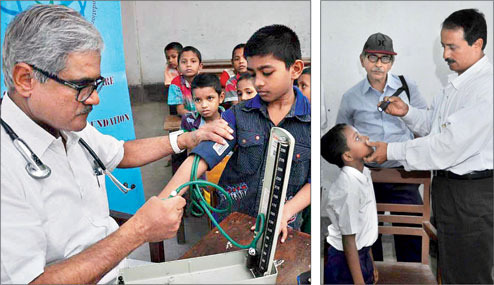
The 1972 batch of Uttarpara Government High School, which calls itself UGHS72 Soulmates, has got together to give back its due to its alma mater. On a Sunday morning, the classrooms are abuzz with children and their parents. Aritra Ghosh of Class IV cannot read small letterings and so Bablu Ghosh his father, a BSNL employee, has brought him to the free eye camp organised by Soulmates with the help of a medical trust, the Salt Lake City Global Health Welfare and Social Research Foundation.
“The doctor said he is myopic and will have to be given glasses,” said Bablu, who also got his eye power checked for free. Aritra’s classmate Arka Pramanick, probably wanted to spend the Sunday morning with his friend. “He came and complained that he cannot read properly and told me that the school was going to have an eye camp. So I brought him here to get his eyes checked,” said Narendra Pramanick, a tailor at Bally, Howrah. But Arka’s eyes are just fine, assured the ophthalmologist at the camp.
Not just eye camp, a general health camp was also held at the school by the Soulmates earlier. Leading cardiologist Rabin Chakraborty, psychiatrist Moloy Ghoshal, both of who belong to the ’72 batch, and oncologist Arundhati Chakraborty participated in the camp to assess the physical and mental wellbeing of the children and their parents in the school. “I was shocked to find young children and their young mothers suffering from hypertension and stress,” said Chakraborty.
“I found a Class III child had blood pressure that measured 124/86. It is dangerous. On top of that he was obese. I found out that he hardly does any physical activity. He watches cartoon shows on television most of the time,” said Chakraborty. And his mother, a 41-year-old, suffers from hypertension with her blood pressure reading 164/96. “I found out from her that there was a lot of tension at her home. Though they live in a joint family, the kitchens are separate. The husband works at the race course. She knows that she has hypertension and is undergoing homeopathy treatment but she is not regular with her medicines. I prescribed medicines for her and counselled her on how to cope with stress,” said the cardiologist.
The camps are aimed to increase health awareness. “I always tell them to avoid the four Fs, Fast Fried Fatty Food,” said Chakraborty. Oncologist Arundhati Chakraborty does family history screenings and symptom screenings at the health camps. “I try to make them aware about breast and cervical cancer,” she said. Psychiatrist Moloy Ghoshal has also held a stess management programme, all under the aegis of Soulmates.
It was in 2013, prior to the WhatsApp boom, that the batch of 1972 of Uttarpara Government High School got together. “It was Jhantu Banerjee, based in Delhi, who got us together. Out of a class of 78, a total of 65 got together. Unfortunately, eight of us are no more. So without wasting time, we met with the motto of giving back to the school what it gave to us. We want to help the teachers, help the present students and also improve the infrastructure of the school,” said Dipankar Roy, member of Soulmates.
A cycle stand for the school children funded by the alumnus is just the beginning of this journey.
source: http://www.telegraphindia.com / The Telegraph,Calcutta,India / Front Page> Calcutta> Story / by Special Correspondent / Monday – March 14th, 2016
13
Gold crown dug up at Moghalmari in West Bengal
Kolkata:
Excitement and expectation over the Moghalmari excavation site near Dantan in West Midnapore peaked on Monday as the state archeology department, which is digging up the ancient Buddhist vihara ruin, confirmed that it has found a portion of a gold crown over the weekend.
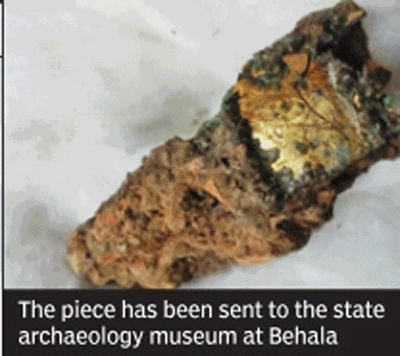
Archaeologists say the find is extremely rare since gold and silver ornaments have almost never been dug up at Buddhist excavation sites. The recovered piece, 7.5x4cm in size, looks like the tip of a crown set in a chunk of terracotta, probably part of a Buddha statue. It has been sent to the state archeology museum at Behala for further examination.
The Moghalmari vihara is gradually emerging as one of the oldest in the country, dating back to at least 6th century if not older. A large number of statuettes, pottery fragments and bronze items have been recovered from the mound since excavation re-started in January. Recently, gold coins bearing the name of Samachar Deva, a king of the pre-Pala dynasty, were dug up.
“We were stunned to find the portion of the gold crown.We feel it was part of the main Buddha statue of the vihara. Gold ornaments were normally not part of Buddha statues. But the Vajrayana sect of Buddhism worshipped what was known as the Crown Buddha. It seems this gold crown was worn by a Crown Buddha,” said Prakash Maity , the chief archaeologist at the site.
“It is possible that the Moghalmari vihara received royal patronage during the pre-Pala times from Samachar Deva, a local satrap who came into prominence in south Bengal after the fall of the Guptas in 550 AD. Notably, king Shashanka had not emerged on the scene yet.Again, while this crown might be indicative of religious harmony , Shashanka was a Shaiva and might not have been too kind towards other religions. Naturally , these matrices have to be studied while establishing the antiquity of the vihara,” Maity said.
He went on to suggest that since Moghalmari was part of an important trade route, the gold ornaments might have been gifted by traders. Two important seals have already been discovered that suggest the name of the vihara was `Sribandaka vihara’.
source: http://www.timesofindia.indiatimes.com / The Times of India / News Home> City> Kolkata / TNN / March 08th, 2016
11
10
09
An indigo planters’ journals
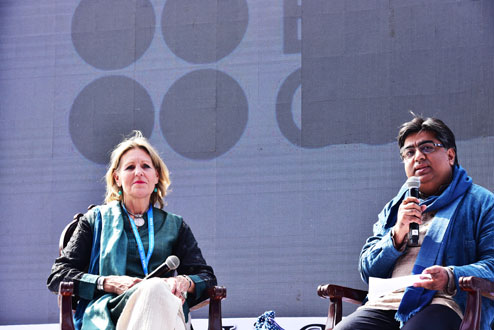
“It was serendipity,” said Jenny Balfour-Paul about how he chanced upon Thomas Machell’s journals in the British Library. She was speaking at the Tata Steel Kolkata Literary Meet, in association with the Victoria Memorial and The Telegraph on January 24.
Balfour-Paul’s book, Deeper than Indigo, based on these journals, seemed to her like a natural progression from her earlier works. For, it was indigo that lured her to Machell and shaped the 15 years of her life that she spent pursuing his trail.
Machell was a midshipman in the merchant navy and an indigo planter. He had travelled on an Arab ship dressed as an Arab and read the Bible to strict Muslims. He was taken aback at how much they had in common. Machell’s plea for religious tolerance is much more relevant now than it was in his times, said Balfour-Paul.
Balfour-Paul objects to her obsession with Machell being called a love affair across time. Yet, she seemed quite taken when it was pointed out that the Bengali translation of her book’s title, Ghana Shyam, not only means the darkest blue but is also another name for Krishna, bringing to mind an image of Radha and the themes of separation and union.
“It was a compulsion to know more about Machell and his spiritual search” that led Balfour-Paul to follow his path. Machell would love the way the world is connected at present, said Balfour-Paul, adding that had he been around he would probably have been quite active on Twitter.
Machell was ahead of his time in his empathy for the “natives” and his “criticism of colonialism”. His journals bear witness to him repeatedly “grappling with his conscience”. Machell, when he wrote the journals, only wanted to be heard. Balfour-Paul recalled how when she came across the first draft of the book, she shouted to the sea: “I’ve got you out there now.”
source: http://www.telegraphindia.com / The Telegraph,Calcutta,India / Front Page> Calcutta> Story / by Srimoyee Bogchi / Tuesday – March 08th, 2016