All posts by wellnmed@gmail.com

Where ideas turn into experiences

It’s a rare congregation where designers, techies, tinkerers, hobbyists and artists get together to toy with their ideas, exchange notes and give shape to them. MakersLoft, eastern India’s first makerspace, lets children give flight to their imagination with the help of tools and tips from professionals.

Purav Manot is passionate about robotics and has been following YouTube videos to build a bot. MakersLoft gave this student of Lakshmipat Singhania Academy a platform to develop professional skills and collaborate with fellow robotic enthusiasts. Manot now helps other kids create custom robots.

“I used to watch videos and design programmes with sensors and motors but never got a chance to showcase my models. Then MakersLoft happened. Now, I get to exchange and share interesting robotic experiences with professionals and hone my technical abilities,” Purav said.

Come with an idea and leave with a product is the invitation from Meghna Bhutoria, the founder and CEO of MakersLoft. “From 3-D painting, robotics, app development to photography, herbal painting, woodwork and fashion designing, MakersLoft is a one-stop shop for thinkers and innovators, no matter what their age,” she said.

The concept is widely prevalent in the US, France and Germany and has finally found a niche for itself in Calcutta. Stationed in a flat on Ballygunge Road, MakersLoft offers an enticing blend of lab-based learning, hands-on training and even offers chances of entrepreneurship.

“There are plenty of such never-seen-before experiences dished at MakersLoft. We have also introduced some unique and fun activities for tots and teens. Making ‘glow-in-the-dark’ objects, setting up structures and models using PVC pipes and phone film-making are some of the interesting options that can break the monotony of routine life at home or school,” Bhutoria said.

For Kushagra Kanoi, a student of Calcutta International School, the Lego classes on Saturdays are something he looks forward to all week. His Lego blocks were only lifeless pieces of plastic before he joined MakersLoft. Now, he knows how to get the blocks moving. “I used to make Lego cars but couldn’t do much to get them going. But with Lego technique set here, I know how to put lever and battery to use,” Kushagra said.

Namrata Manot, a Lego instructor at MakersLoft, said: “The kids’ imagination knows no boundaries. We give them an idea and watch them add their own creativity to it.”

source: http://www.telegraphindia.com / The Telegraph,Calcutta,India / Front Page> Calcutta> Story / by Rumela Sinha / Tuesday – July 05th, 2016
City wins teen chef crown – Calcutta Girls student tops it

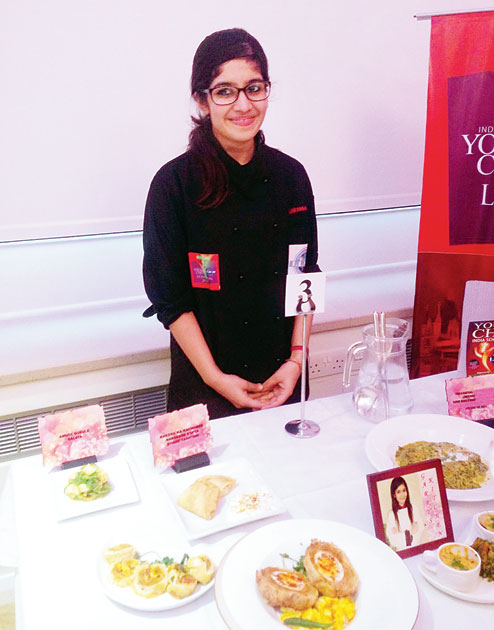
Garima Poddar plates her dishes at IIHM Young Chef India Schools 2014 at the University of West London

Garima Poddar likes her friends calling her Garry after Gary Mehigan, her favourite judge on Masterchef Australia.

And true to the Masterchef nickname, the Calcutta Girls High School Class XII student won the IIHM Young Chef India Schools 2014 contest at the University of West London on Saturday and retained the crown that Simran Kapur had won for Calcutta last year.

The finals of the inter-school cooking competition — held by the International Institute of Hotel Management (IIHM), in association with t2 — saw six finalists from six Indian cities (Calcutta, Delhi, Hyderabad, Bangalore, Pune and Ahmedabad) battle it out with their plates and pans to serve up meals to some of the best-known Indian chefs in London.

Wearing the judges’ hat at the London finale were Andy Verma, who owns restaurants Vama and Chakra in the UK, Dipna Anand whose family owns and runs Brilliant restaurant in London’s Southall area largely inhabited by Indians, Romy Gill of Romy’s Kitchen in South Gloucestershire, and closer home t2 columnist Shaun Kenworthy and Sector V IIHM’s chef Sanjay Kak.

How apt it was for the IIHM Young Chef India Schools contest to culminate in London was underlined by Virendra Sharma, MP, Ealing Southall, the chief guest at the evening prize distribution, who pegged the number of Indian restaurants in the UK at 60,000.

10dishesKOLKATA05jul2016

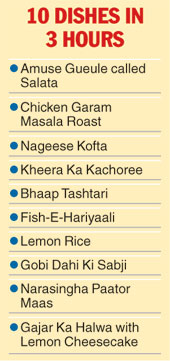
But what did Calcutta girl Garima do that the others didn’t? For one, she churned out 10 dishes in a three-hour-long cookout, a number unmatched by any other contestant. “Her biggest challenge was getting all her dishes right because she made so many,” agreed the judges, all of who gave Garima the highest score.

The Southern Avenue resident pinned her win down to two factors — confidence and practice. “I know it sounds cliched but practice does make perfect. I strived to make at least three dishes a day to prepare for the finals. One day, I did a 100 roti challenge just to get that perfect roti shape and all the rotis were given to the needy,” said Garima.

Like Garima, her other five competitors made it past 8,000 students who participated in the Young Chef competition over six months. Two got their visas in the nick of time and reached two hours before the contest kicked off while the Jaipur girl had to give it a miss, cutting down the number of finalists to six from seven.

In the two days they all spent in London before the finals, food was the only thing on Garima’s mind. Ask the Lebanese hairdresser at Eli’s Hair & Beauty on Kew Bridge Road who was unexpectedly pulled into a casual conversation on tahini, babaganoush and shawarma as she settled down for a wash-and-blow dry! Or the Kadai Chicken that was sampled at a local restaurant down the road from the hotel.

“In fact, it was for this competition that I started having non-veg,” said the spunky Marwari girl. “Non-veg is not cooked at home but we eat it outside. Initially, I would nibble on chicken; now I can eat a whole chicken meal!”

Which is why chicken featured on what the judges called her “buffet”. There was Chicken Garam Masala Roast, Nageese Kofta (egg wrapped in chicken keema) “learnt from my mom’s friend”, Kheera Ka Kachoree “learnt from dadi”, Bhaap Tashtari, Fish-E-Hariyaali, Lemon Rice, Gobi Dahi Ki Sabji and a fusion dessert Gajar Ka Halwa with Lemon Cheesecake. She also made an Amuse Gueule called Salata (frozen salad) and an Assamese dish called Narasingha Paator Maas “inspired by a YouTube video of Gordon Ramsay cooking Assamese food in Assam”.

The commerce student who loves economics also made all the right calculations and moves. Like when she used micro-greens to garnish her dishes, an idea picked up from Shaun’s cooking demonstration the previous day. Or when “I decided not to make rotis because they would have to be made last and would eat into my plating time”, she said.

Her future plans? “It’s either economics or cooking and after this contest, the scales are tilting more in favour of the latter,” she signed off, clutching in her hands the winning trophy, a cheque for Rs 5 lakh and a placard that read ‘Garry’s Kitchen’, which she had proudly displayed on her table.

What is your message for Garima? Tell ttmetro@abpmail.com

source: http://www.telegraphindia.com / The Telegraph,Calcutta,India / Front Page> Calcutta> Story / by Karo Christine Kumar in London / Monday – October 20th, 2014

WRITER’S BLOCK – Inside India’s oldest hotel

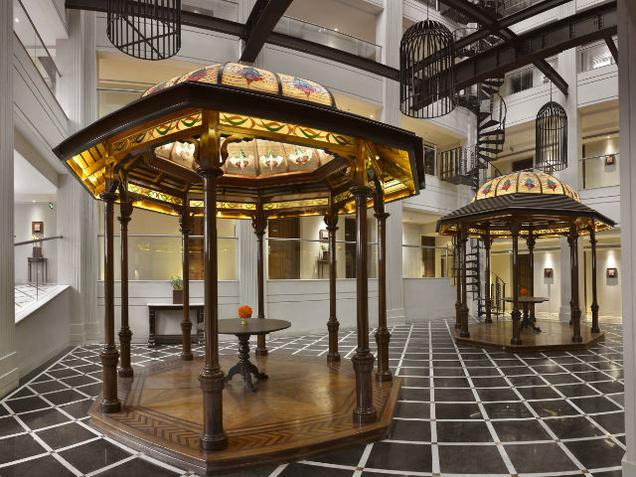
Past meets present: The atrium of the Lalit Great Eastern. /  by Special Arrangement
Past meets present: The atrium of the Lalit Great Eastern.
/ by Special Arrangement

In 1836 — when Bahadur Shah Zafar was yet to ascend the throne in Delhi to become the last Mughal — a man called David Wilson opened a bakery in Calcutta, which was fast growing into a second London. The bakery, a great source of comfort for homesick sahibs, did so well that Wilson soon acquired adjoining properties and in 1840 opened a hotel, cleverly naming it after Lord Auckland, the Governor-General of India who lived right across the road.

Until then, Calcutta boasted of only one hotel, Spence’s, also located a stone’s throw from Wilson’s bakery. Spence’s, which opened in 1830, had its share of admirers, who included Jules Verne. While scanning the archives of The New York Times, which I subscribe to online, I found only one mention of Spence’s, in an 1888 dispatch that was datelined ‘Spence’s Hotel, Calcutta’. Thereafter, for nearly a century, no Calcutta hotel merited mention in the paper other than Wilson’s, by then rechristened the Great Eastern Hotel. If you came to Calcutta, you had to stay at the Great Eastern, whether you were Mark Twain or Rudyard Kipling or Queen Elizabeth.

While no one seems to be sure when exactly Spence’s Hotel shut down, one knows for certain when exactly the Great Eastern was rescued from closure — in 2005, when the property, by now dilapidated and rat-infested, was bought over from the West Bengal Government by The Lalit group. Reopened to the public in 2013 as The Lalit Great Eastern, it is today the oldest existing hotel in India — a 176-year-old brassware restored and polished, its lifespan extended by another century or two.

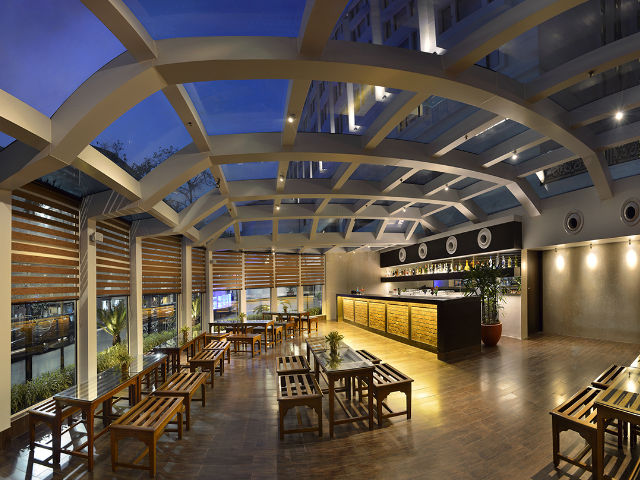
Resurrecting history: The Wilson, which serves as the pub and backery.

At the hotel, where I checked in last weekend, it is hard to miss the advertisement placed in the October 1840 issue of The Englishman and Military Chronicle: “D. Wilson and Co. beg respectfully to announce having taken those splendid and spacious Four-storied Premises, No. 1, Old Court House Street, formerly occupied by Messrs. Thacker and Co. and the Sans Souci Theatre, opposite Government House, and are sparing no expense in the alterations, and fitting it up in a manner that will render it one of the most comfortable family hotels in India.”

Nearly two centuries later, the new owners are doing precisely the same thing — sparing no expense in the alterations — as they blend the Victorian, Edwardian and modern eras to give something unique to Kolkata, which has been notorious for neglecting its handsome colonial-era buildings. The Victorian block, comprising 49 suites, is still under renovation, and will open in February next year.

The three nights I stayed there, I skipped dinner, simply because I overate during lunch, gorging on Bengali food that was prepared in its sanitised kitchens, but tasted very home-cooked. On the third day, lunch was actually home-cooked: I had happened to mention to the resident manager that I had never had litti-chokha, the quintessential Bihari dish, during my decade-long association with Kolkata, and so he had got me litti-chokha from home.

To burn calories, I walked — outside the hotel and inside. I walked around Dalhousie Square, Kolkata’s Westminster, where the hotel is located; I walked the streets of Kumartuli, watching Durga idols being made; I took a ferry across the Hooghly and walked on the Howrah Bridge. Walking in the corridors of the hotel was also as good as walking back in time. From time to time, one came across glass wine decanters, silver napkin-holders, silver water jugs, ancient teapots — all belonging to the time when the Great Eastern was known as the Jewel of the East.

It is one thing to recreate the past with the help of imagination, quite another to recreate it with actual pieces from the past — The Lalit Great Eastern has achieved the latter. When you hold an old wine decanter, you are forced to wonder whether it bears the fingerprints of Rudyard Kipling. It just might — who knows?

source: http://www.thehindu.com / The Hindu / Home> Features> Metroplus> Society / by Bishwanath Ghosh / Chennai – July 01st, 2016