All posts by wellnmed@gmail.com

Alpana decision taken at Kala Bhavan

Each district has its own 'brotos' with corresponding  alpanas
Each district has its own ‘brotos’ with corresponding alpanas

Kolkata :

It was at Kala Bhavan that the idea of including alpana as part of the fine arts syllabus germinated, through a series of workshops that Rabi Biswas was called in to conduct. Biswas, in fact, has been crusading to revive folk alpana, with foundations like Daricha and Intach playing a key role.

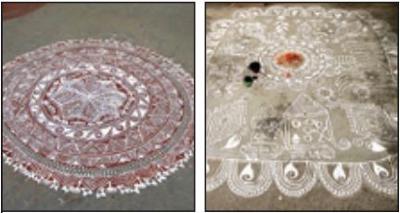
To most of us, the word alpana means patterns drawn with rice paste on auspicious occasions. In today’s age, when one has very little time to soak and grind rice to make the paste and then take time out to draw the patterns, stickers make for easy use. The result is that one of the most vibrant folk traditions of Bengal is gradually becoming extinct.

However, two of the country’s premier art schools have taken it upon themselves to make alpana a part of their teaching-learning process, to help start a revival of sorts.

The one-year foundation course at Kala Bhavan – compulsory for all students taking up fine arts at the undergraduate level – has been revised to include alpana, both in the Santiniketan gharana that was perfected by Nandalal Bose’s daughters Jamuna Devi and Gauri Bhanja, and also the genre inspired by folk traditions. “All students of painting, sculpture, graphics, design and art history have to first go through the foundation course, get their grades and then be given a chance to choose their specializations,” said principal Dilip Mitra. ” Alpana now features in the foundation course because we want every student to be aware of both the Santiniketan and the folk traditions. This will save it from extinction.”

The most popular among these are the six different kinds of ‘Lakshmi brotos’, coupled with specific corresponding alpanas. There are brotos in the monsoon for sowing paddy seeds popular in Birbhum, Burdwan, Bankura and Purulia, where the paddy sheaf is the central alpana motif, brotos for the Nabanna festival, for a custom called Punyipukur, where the pond and the lotus are the central motifs, for Dasputul, where the alpana is inspired by the ‘Ramayana’, the Senjuti broto that characterizes evenings in the month of Agrahayana, with a 52-motif elaborate alpana, the Jampukur broto where the god of death is appeased through rituals and alpanas, and the Hyachra broto to ward off seasonal diseases like chicken pox.

Though unrelated to the Visva-Bharati initiative, similar alpana workshops by Biswas were a routine affair at Rabindra Bharati University at its state academy of dance, drama, music and visual art. “We are toying with the idea of expanding a portion of the painting syllabus to include folk traditions from Bengal, including alpana of the different districts,” said head of the painting department at RBU, Nikhil Pal.

source: http://www.timesofindia.indiatimes.com / The Times of India / News Home> City> Kolkata / TNN / August 15th, 2016
Where history is set to fade into oblivion

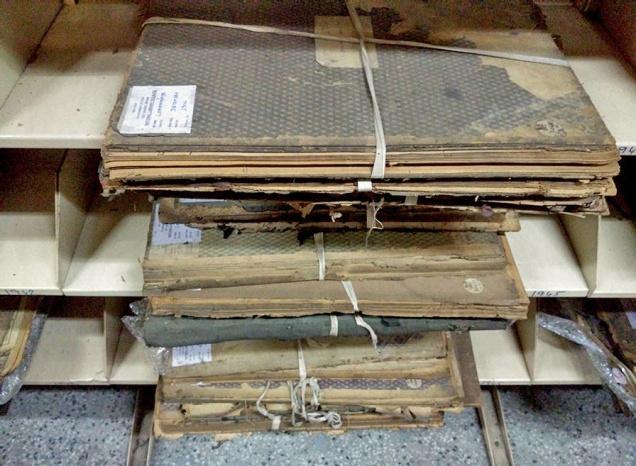
Historic documents lie in neglect in National Library. / Special Arrangement

Newspapers announcing Independence and other events lie in ruins at Kolkata library

“India Independent Today,” announced the August 15, 1947 edition of Amrita Bazar Patrika, one of the highest selling newspapers of India in 1947. The headline is placed above the masthead. But, 69 years later, the August 15 edition is so brittle that it is impossible to open it. It is not only the August 15 edition of Amrita Bazar Patrika that is frangible — 20,000 newspapers stacked up in the reading room are either soiled or so fragile that they will all turn to dust soon.

The rare editions are stored in a dusty and dark section on the second floor of Bhasha Bhavan, located in the western part of the 30-acre campus of the National Library at Alipore. The dark room resembles a mortuary where some of the papers are kept in plastic sheets coated with a thick layer of dust. Water leaks out of the air-condition ducts and during monsoon, buckets are placed to catch the droplets.

“About two weeks ago, the room was filled with ankle-deep water,” an employee of the library said. Some of the volumes were “partially drenched.” “Look at this,” a staff member said, “the August 9, 1942 edition of The Statesman with the news of the All India Congress Committee’s endorsement of Mahatma Gandhi’s call for Quit India Movement… The pages crumble even as you try to remove the dust.” The Statesman’s October 17, 1905 edition with a graphic description of Banga Bhanga, or the first Partition of Bengal, was lying next to The Statesman or Amrita Bazar Patrika. Both announced on Page One that Rabindranath Tagore returned his Knighthood on May 30, 1919, in protest against the Jalianwalla Bagh massacre. Both have nearly disappeared.

The employees said the volumes dating back to 1889 were brought to the Alipore campus in south Kolkata three years ago, for microfilming, from the original building of the Library in central Kolkata. Secretary of the National Library Employee’s Association, Santanu Bhowmick, said there had been “no progress” in the microfilming work.

The Director-General (Additional Charge) of the National Library, Arun Kumar Chakraborty, denied the allegations.

“Perhaps, it [the project] is held up because of the complications in the tendering process,” he said.

source: http://www.thehindu.com / The Hindu / Home> News> Cities> Kolkata / by Soumya Das / Kolkata – August 14th, 2016

Afghan tribe star of Museum show

Kolkata :

On International Day of World Indigenous People, observed on August 9, Indian Museum brought to the fore an anthropological treasure it has had in its store since 1929. Physical anthropologist Biraja Shankar Guha, former director of Anthropological Survey of India, had brought in a model of the Khalash community of Afghanistan after his study on them. Khalash community. It’s accession no is 11813.

In Afghanistan, at the extremities of Hindukush are some isolated mountain valleys of Khyber-Pakhtunkhwa, known to rest of Afghanistan and Pakistan as Kafiristan.

The word ‘Kafiristan’ underlines that the Khalash community follows its own religion. They have liberal customs, rituals and beliefs – for instance, elopement is as common as married women choosing their new husbands, said Indian Museum education officer Sayan Bhattacharyya.

The Khalash religion is similar to the religion that was practised by Rigvedic Aryans and the community has retained most of the Indo-Iranian traits as well.

A wooden statue put on display shows the pagan origin of the community. Some of the Khalash people claimed to be descendants of Alexander the Great and a recent genetic analysis has substantiated this belief.

During the 1970s, local Muslims and militants tormented the Khalash because of the difference in their religions and multiple Taliban attacks on the tribe lead to its numbers shrinking to just 2,000.

However, protection from the government has ensured decrease in violence by locals and Taliban. It has also brought about a great reduction in the child mortality rate. The last two decades has seen a rise in their numbers.

source: http://www.timesofindia.indiatimes.com / The Times of India / News Home> City> Kolkata / TNN / August 11th, 2016

Future of banking decoded

CalcuttaManagementSummitKOLKATA12aug2016

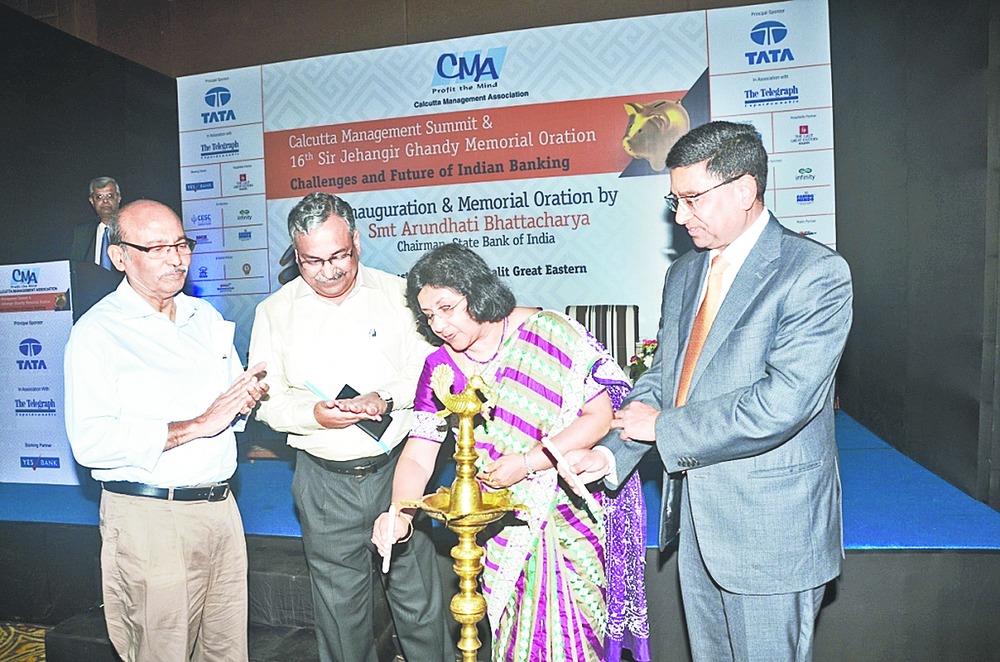
Calcutta Management Summit 2016, the annual signature event of Calcutta Management Association, was held at The Lalit Great Eastern on August 3. The theme? Challenges and Future of Indian Banking. It was inaugurated by the chairman of the State Bank of India, Arundhati Bhattacharya – seen here with Achintan Bhattacharya, director, National Institute of Bank Management (Pune), Gautam Ray, president (CMA), and industrialist Sanjay Budhia.

Bhattacharya delivered the 16th Sir Jehangir Ghandy Memorial Oration on “Challenges and Future of Indian Banking”. The summit had two technical sessions on “Changing Contours of Risks and Positioning Indian Banks” and “Digital Banking and Redefining of Efficiency Paradigm in Banking”.

The other speakers at the summit were Achintan Bhattacharya, A.S. Ramasastri, director, Institute for Development and Research in Banking Technology(IDRBT), Hyderabad, C.S. Ghosh, MD & CEO, Bandhan Bank, Anup Sinha, professor of economics, IIM, Calcutta, Pavan Trivedi, COO, Srei Equipment Finance, Shubhada Rao, group president & chief economist, YES Bank; Saugata Bhattacharya, senior vice president & chief economist, Axis Bank, Deshbandhu Kataria, deputy general manager, Anytime Channel, State Bank of India, and Rajarshi Sengupta, partnerchief innovation officer, Deloitte, Touche, Tohmatsu India LLP

source: http://www.telegraphindia.com / The Telegraph,Calcutta,India / Front Page> Calcutta> Story / Thursday – August 11th, 2016

Indian weaves meet Italian exuberance

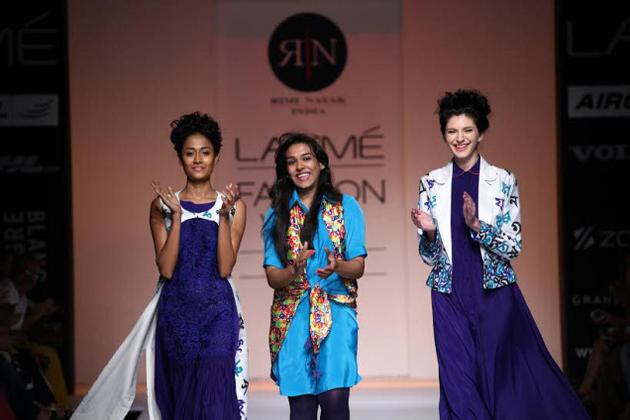
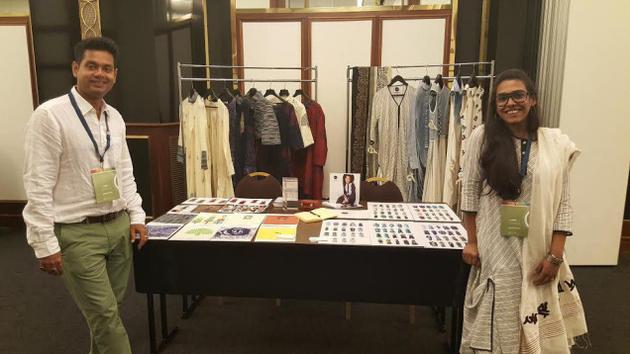
Designers Sayantan Sarkar and Rimi Nayak in Italy.

Two Kolkata designers represent the country in Italy

Last month, designers Sayantan Sarkar and Rimi Nayak — both Lakme Fashion Week veterans — were among a group of 18 delegates from various industries who represented India at a four-day trade conference, courtesy the Bengal Chamber of Commerce. The meet was organised in association with the Indian Embassy as a part of the government’s ‘Make in India’ project. Staged across three Italian cities — Milan, San Marino and Rome — the meet was graced by Italian fashion houses, buyers and industry experts, who were duly impressed by Indian craftsmanship, textile heritage and attention to detail.

Saying it in Bengali
Nayak has been working with prints inspired by Bengali fonts since 2013. Her signature Bengali typography prints have earned her rave reviews at the Lakme Fashion Week and celebrity clients such as Vidya Balan, Amrita Rao, Esha Gupta, Sayani Gupta and Yami Gautam. Nayak. The curvaceous look of the Bengali font piqued the curiosity in Italian buyers. “Bengali fonts are visually appealing and have been hugely appreciated in the past.” says the designer.

Nayak’s collection inspired by Bengali typography.

“I had iconic lines from Tagore’s literature printed on beautiful dresses with my signature drapes. Also, every line in Bengali also had its corresponding English translation. For instance, ‘Pothik tumi ki poth haraiyacho?’ was accompanied by ‘Wayfarer have you lost your way?’ printed beside it.” The ‘world map’ items from her 10-piece capsule collection were also a huge hit with buyers in Milan. “The entire world map was printed on the ensemble in a graphical manner, with names of the countries and oceans written in Bengali and English.”

Nayak, who works extensively with khadi, said that Europeans acknowledged and appreciate the rich heritage of the handloom fabric.

As for the typographical print, she said, “When it comes to typography prints in fashion, you mostly see English, Chinese and Arabic scripts. I am born and brought up in Bengal, although I am Oriya by birth. So I wanted to popularise the Bengali typography as it never got the kind of exposure it deserved.”

Nayak is now expecting potential collaborations through Milan Fashion Week with those who are keen to work with her label. She is looking forward to working on commissions for developing indigenous fabrics for them.

Europeran sensibilities, Indian fabric
Sarkar feels Indian designers ought to harness the craze Europeans have for our fabrics. “You can expect to sell a simple Khadi ensemble for 3000 Euros. That’s the kind of price they are willing to pay.” He has also been approached to develop weaves by ‘mesmerised buyers’ from Italy.

He is amongst the handful of Indian designers who develop their own textiles. He works with craftsmen in the Phulia district of Bengal to create fabrics for his western outfits. “The Chamber of Commerce was seeking someone who would cater to European sensibilities promoting Indian fabric. That’s how they zeroed in on me.”

Sarkar travelled with two collections, featuring trousers, shirts and jackets for women. The former used the khesh technie (a technique which recycles fabric) on the denim. “We have applied it on denim strips, washed them and developed fabric out of them. These fabrics were manufactured in Shantiniketan.” His Mayuraka collection. “had dancing peacock motifs used on shift dresses, tunics and shirts.” The other, more bohemian collection, called Vagabondage, was inspired by “the nomadic gypsy lifestyle” and used the Jamdani weave. The feathers of a dream catcher were used as a recurring motif. It featured shibori with kantha stitchwork and South American Aztec motifs inspired by the traditional Bengali Jamdani textile.

Sarkar concedes that the European market is of the opinion that our silhouettes are not trendy or global yet. “They think we are still very conservative. They demanded a new silhouette range, which we have taken up as our most recent project.” Sarkar is optimistic that his designs will display soon at multi-designer outlets in Rome.

The author is a freelance writer

source: http://www.thehindu.com / The Hindu / Home> News> Cities> Mumbai / by Piali Dasgupta / August 09th, 2016

City boy zeroes in on Rio bullseye

Atanu Das in action at the Rio Olympics on Tuesday

Atanu Das, the Baranagar boy who made the round of 16 in Rio on Tuesday, had taken his first aim with a bamboo bow. “It was made of Manipuri bamboo and cost Rs 1,200,” mother Aditi recalled.

When the Olympian-in-waiting started falling short of desired results in sub-junior contests, Atanu wept his eyes out, pleading with his parents for a fibreglass bow. “We are middle-class people. There was no way we could afford one. But seeing his determination, I closed some of my monthly income scheme accounts at the post office though the interest used to form a necessary part of our earnings,” said Aditi, a homemaker.

They then bought him a second-hand fibreglass bow for Rs 45,000. “It was so full of scratches that it looked more like a third- or fourth-hand one,” she said.

And on Tuesday evening, 24-year-old Atanu made good his parents’ sacrifices by scoring one perfect 10 after another – he got full points in seven of his nine shots in the first match – on the world’s biggest stage.

The bow with which Atanu shot down Nepal’s Jitbahadur Muktan and staved off Cuba’s Adrian Andres Puentes Perez costs close to Rs 2 lakh. “He has two-three top-class bows now,” father Amit said.

Late on Tuesday, the proud parents received a call from their Olympian son. “The wind, he said, was bothering him in the second match,” said Amit, who could not follow his dream of a career in football.

Atanu, now an assistant manager with Bharat Petroleum Corporation, was exposed to sports early. “I wanted him to take a different path. It could have been any sport. The Kolkata Archery Club in Sinthee happened to be near our home,” said Amit, who has taken VRS from the private company he worked for.

Atanu’s first coach Santanu Nandy remembers him well. “He was so serious that he would come straight from school for practice. When he won the sub-junior national championship on debut I knew he was special,” he said.

Baranagar Narendranath Vidyamandir used to let him off early and Aditi would take the 14-year-old straight to the archery club. “The school even excused him from appearing for his Madhyamik selection test.” He travelled to Jabalpur for the junior national meet instead, but only after his mother made him promise that he would do well in Madhyamik.

The call from Tata Archery Academy had come by then. But the boy did keep his word, getting a first division in his Board finals. Atanu is a boy of few words, said his parents who now live with him in the office flat in Bansdroni. Apart from the bullesye, he has his sights set on stamps. “He brings back stamps from wherever he goes,” said Amit.

And on Friday, Atanu has the chance to leave a permanent stamp on Indian sport with bow in hand in Rio.

source: http://www.telegraphindia.com / The Telegraph,Calcutta,India / Front Page> Calcutta> Story / Sudeshna Banerjee / Wednesday – August 10th, 2016

Tea tool for planters

Jalpaiguri :

The Tea Board of India today gave plucking machines to 150-odd small growers in the district.

Officials said the machines had been given away with a 50 per cent subsidy to be borne by the board. The remaining amount will be paid by the beneficiaries in three-four installments.

“Getting workers in the tea sector has become a major problem.The small tea sector here is also facing this shortage. That is why the tea board has decided to offer the machines to small growers,” Ramesh Kujur, deputy director of the tea board, said.

The tools that cost between Rs 40,000 and Rs 72,000 were given to planters from Rajganj, Sadar and Mainaguri who had applied for them.

“It can help growers in tackling manpower crisis and also increase the amount of leaves plucked,” Kujur said.

Jalpaiguri has 10,000-odd small planters.

ADDITIONAL REPORTING BY OUR SILIGURI CORRESPONDENT

source: http://www.telegraphindia.com / The Telegraph,Calcutta,Indai / Front Page> North Bengal> Story / Wednesday – August 10th, 2016

Anjan Dutta reinvents Hamlet

Kolkata :

Shakespeare’s Hamlet has inspired award-winning director Anjan Dutta to recreate the intense drama on celluloid, though with a contemporary spin.

Anjan’s ‘Hamlet’, which is the second adaptation of the age-defying drama in recent times after ‘Haider’ by Vishal Bhardwaj, deals with socio-political crisis and violence against humanity.

“Shakespeare’s Hamlet suffered from a basic crisis and I wanted to define and interpret that crisis in my own way,” the director told .

Actor Parambrata Chatterjee will portray Hamlet’s character ‘Hemanta’. Anjan said he himself would play the character if he were a little younger.

“Had I been a little younger, I would have done the role and my wish to portray Hamlet got shape through Param,” he said.

Anjan said that his Hemanta couldn’t care less about the situation around him, unlike his contemporaries who were largely insouciant about violence next door and busy with personal affairs.

“I had long been thinking I should not confine myself to Byomkesh exploits and urban relationship and musicals. I thought there is an imperative need to have a hard look at the present time through my protagonist’s eyes,” he said.

“Hamlet’s character has many layers. Some put his crisis at sexual level, some talk about his anguish and hatred towards the stinking political situation in Denmark about 500 years back. But for me it is more of his angst towards the situation prevailing all over the world,” Anjan said.

Parambrata said he had to cut himself off all other projects for one and a half months to study the character over and over again.

“Though I had read Hamlet during college days as a student of English literature, I needed time to grasp the contemporariness of his character,” the ace actor said adding “it is an actor’s dream to work in projects inspired by Chekov, Tagore and Shakespeare”.

Jisshu Sengupta is playing Horatio’s role while Saswata Chatterjee plays Cladius.

Hemanta after graduating from New York Film School returns to his home in Kolkata and gets the news that his film producer father has commited suicide because his mother Gayatri is set to marry uncle Kalyan (Cladius), which triggers a series of murders and mysterious deaths.
SUS MD MM JCH

source: http://www.timesofindia.indiatimes.com / The Times of India / News Home> City> Kolkata / PTI / August 08th, 2016