All posts by wellnmed@gmail.com
24th
23rd
Channel to boost Indo-Bangla ties
In 1971, Swadhin Bangla Betar Kendra was opened on Circus Avenue by freedom fighters from the erstwhile East Pakistan.
The transmissions from the radio station inspired people on both sides of the border to fight the oppressive Pakistani rule. The station folded up on December 16 after the birth of Bangladesh but All India Radio (AIR) continued broadcasting – albeit intermittently – on Special Bangla Service till a transmitter broke down in 2010.
Six years on, Akashvani Maitree is being launched to remind Bangladesh and India of their similarities. The growing presence of Radio China and Radio Iran in Bangladesh might have played a part in prompting the authorities to open the channel.
Akashvani Maitree – which will air at 594 kilohertz – will crackle into life at 11am on August 23. President Pranab Mukherjee is set to inaugurate the channel and its multimedia website from the Yellow Room of Raj Bhavan.
“Maitree was originally planned for a launch with much fanfare in June but the President’s schedule didn’t match. We will have a short programme in the evening at Nazrul Mancha, which will be broadcast live,” an AIR official said.
The programme will include performances by folk troops of Bengal, a reading of Jibanananda Das’s Banglar Mukh and other poems by actor Soumitra Chattopadhyay and recitation by Bratati Bandyopadhyay.
Akashvani Maitree will offer Bangladesh-specific news and entertainment and will also address the student community through programmes highlighting secular, anti-fundamentalist views.
The programmes will be designed in a way that Bangladeshis are encouraged to choose India as a medical destination and opt for Indian universities instead of those in the UK or the US.
Some of the programmes to be aired are Sambad Prabhaha (an exchange of news and views), Campus-ey Adda, Boiparar Khobor (about books and periodicals published in India and Bangladesh), Sholoanna Bangali (about people who have contributed to Bangladesh in some ways) and Ek mati Ek Sur (about similar cultural events like baul melas in Jadavpur and Kushtia).
“This is an outreach program which will bring people closer. There is a desire in people on both sides of the border to know how similar traditions thrive on different soils. Never before have we been able to frame a channel that invites artistes from neighbouring countries to perform in our studios,” said Prasar Bharati CEO Jawhar Sircar.
The popular stage and screen personality of Bangladesh, Mamunur Rashid, hasn’t heard of Maitree yet. “It must be the train you are talking about,” he told Metro over the phone from Dhaka.
On being told about the channel, he recounted the days of the liberation war when he would make radio plays with Mustafa Monwar, Aly Zakher, and others.
“If the radio connection is revived it will be a good thing. To connect more should be our motto. The more we meet the less we hate, the less we will be taken in by blind beliefs and threats by mischief makers,” Monwar said over the phone from Dhaka.
source: http://www.telegraphindia.com / The Telegraph, Calcutta,India / Front Page> Calcutta> Story / by Sebanti Sarkar / Monday – August 22nd, 2016
Century-old silent film boosts NFAI heritage plan
Footage from Bilwamangal, a 1919 film acquired from Cinematheque Francaise
The National Film Archive of India(NFAI) has acquired surviving footage of the Indian silent film Bilwamangal (1919) from the Cinematheque Francaise, France. This acquisition is considered an important for NFAI at a juncture when they are in the process of implementing prestigious National Film Heritage Mission to safeguard Country’s cinematic heritage.
The film produced by the Elphinstone Bioscope in Calcutta later renamed as Madan Theatres Ltd, was directed by Rustomji Dotiwala. NFAI has acquired 594 metres. (28 minutes footage at 18 fps) of this film. The film was originally 12,000 feet long.
NFAI will be returning this gesture by providing a digital copy of Indian silent film Jamai Babu (1931) directed by Kalipada Das from our collection as per mutual exchange policy under FIAF framework”, Press Information Bureau press release here on Friday quoted Mr. Prakash Magdum, Director NFAI as saying.
Bilwamangal is a landmark acquisition for NFAI, as there was no trace of work of studio of JF Madan, available in India till date. With this the NFAI now possesses in its collection films representing three important Indian studios of the silent era – Madan, Kohinoor and Hindustan. Each of these studios had a prolific output making nearly a hundred films each in the silent era.
The last silent films NFAI acquired were from Kolhapur during 1996, titled ‘Murliwala’, ‘Sati Savitri’ and ‘Maya Bazar’ directed by Baburao Painter. India has produced nearly 1300 silent films between 1913 and 1932, most of which were lost due to its Nitrate base.
Nearly 28 silent films though incomplete, have been preserved in NFAI’s storage facilities since then.
source: http://www.thehindu.com / The Hindu / Home> National / Prakash Kamat / Panaji – August 19th, 2016
Kolkata body wants to bring Rammohun Roy’s treasures, manuscripts back home
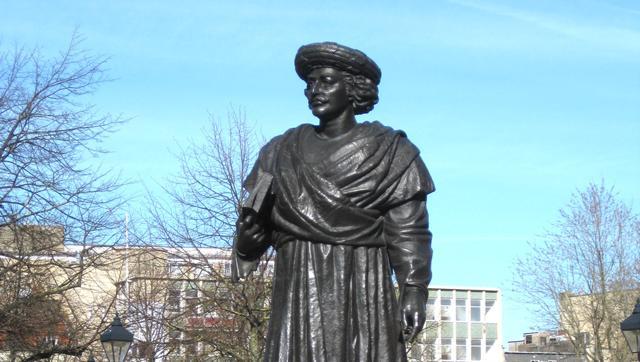
Tagore called him the man who inaugurated the modern age in India. Of all the personalities who ushered in Bengal renaissance, Rammohun Roy (1772-1833) was one of the tallest. A hunt is about to begin for bringing back the priceless historical documents related to the father of Bengal renaissance Raja Rammohun Roy including manuscripts and personal belongings much of which are lost, fell into the hands of treasure looters while a few remain scattered in various parts of the country and abroad.
Sachindra Nath Bhattacharya, the director of Raja Rammohun Roy Memorial Museum set up in 2000 to conserve his works told HT, the move to recover original documents was triggered by the discovery that many fake documents are stored in some archives in the country.
The museum is run by a trust.
“There is an urgent need to preserve the documents and rare manuscripts of Rammohun Roy that are lying in various universities and archives across Benares, Patna, New Delhi and the UK. We want to bring back all his original documents, including complete written works, documents related to the Sati movement, his dress, head gear and store in our museum for posterity,” Bhattacharya told HT.
“We’re in a hurry as many documents are already missing. We want to recover the remaining ones before they fall into the hands of treasure thieves. We’ll also approach the British Library which stores many documents of Rammohun Roy,” He added.
Bhattacharya has approached the union culture ministry for the project.
A research team would scout through schools registries in Patna, Sanskrit University in Benares and President’s House in New Delhi once the process gets a green signal from the government.
The Treasure Trove Act, 1878 and Antiquity Registration Act, 1972 empower the Centre to initiate legal processes to collect these documents from anywhere.
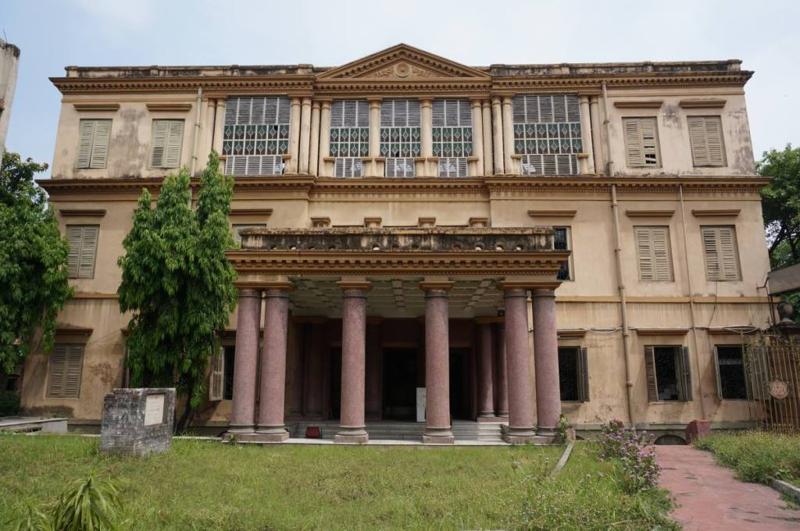
The museum authorities have sought President Pranab Mukherjee and chief minister Mamata Banerjee’s help so that a ‘territorial policy’ is framed under which documents related to a particular museum must be kept in its custody.
The authorities will attempt to unravel many unknown facts regarding his sudden voyage from Midnapore’s Khejuri port in a Albanian ship to Britain, his vital interactions with Dwarakanath Thakur (1794-1846) and other Atmiya Sabha and Brahmo Samaj members, close door discussion with Lord William Bentinck, David Hare and debate with William Carey through the collection of original documents spread across several places.
“We’ll visit all the places across the country where Sati was prevalent in Punjab, Rajasthan to West Bengal. We have already gathered vital information regarding exact numbers of women, including Muslim women, who became sati.
Soon, a drive will begin to collect all legal documents related to the Sati custom and its abolition.
We’ll also try to scout for details of his correspondence regarding introduction of allopathic medicine to the country,” said Bhattacharya.
An attempt will be made to collect documents regarding his pioneering works of Indian journalism such as publication of Sambad Kaumudi (Bengali weekly newspaper), Mirat-ul-Akbar (Persian journal) and Tuhfat al-Muwahhiddīn (Persian book on monotheism).
In 1828, Roy set up Brahmo Sabha that was the precursor to Brahmo Samaj, one of the most prominent socio-religious reform movements of Bengal.
source: http://www.hindustantimes.com/ Hindustan Times / Home / by Atonyu Choudhurri, Hindustan Times,Kolkata / August 20th, 2016
IIT Kharagpur introduced Staff Excellence Award on 66th Foundation Day
Kolkata :
Indian Institute of Technology Kharagpur celebrated its 66th Foundation Day on August 18.
“With the history of a political detention camp where freedom fighters, of the age of first year IIT students, gave their lives, the IIT system has become one of the finest brands that independent India offered to the world”, said Partha Pratim Chakrabarty, Director of IIT Kharagpur. He also remembered his school teacher on this occasion who was incarcerated in the Hijli Detention Camp for 15 years. “Building leaders is the aim that is fostered at the Institute now” added Chakrabarty.
Surajit Kar Purkayastha, Director General of West Bengal Police and an alumnus of IIT Kharagpur who was the Chief Guest of the programme said, the standard of IIT Kharagpur is such that any student can become high ranking civil service officers. He explained how the scenario of recruitment in civil services changed in late 70s’ with encouraging more engineers to join the services and enrich the country with their analytical skills and technical expertise. Shri Purkayastha also appreciated the serene atmosphere of the IIT Kharagpur campus separated from the chaos of the world outside and helping students to concentrate more on their career development. He urged the students to lay foundation of strong character on the occasion of the Foundation Day which will take them and the country forward.
On this day, the Institute announced life-long email service for its 55000+ alumni community. The Institute presented the Nina Saxena Excellence in Technology Award to Jeen Britto.M, ISRO Scientist, for his exemplary innovation in the field of Cryogenics Instrumentation and Automation. Krishnendu Chakrabarty, distinguished professor and Director of Graduate Studies at Duke University, was handed over the Distinguished Alumnus Award to which he was a recipient in 2014. IIT Kharagpur also introduced the Staff Excellence Award this year and honored three staff members in various categories.
The programme also saw participation from high school students of three schools – South Point, DAV Model School and Kendriya Vidyalaya. An interactive session was organized with the school students with the faculty and students from IIT Kharagpur. The students were given brief introduction of the interdisciplinary domains of technology education which they can pursue. While the faculty emphasized on the following the passion of the young mind instead of 7-digit pay packages, the 1st year students from IIT Kharagpur suggested their juniors to balance the hours of study and recess.
source: http://www.timesofindia.indiatimes.com / The Times of India / News Home> City> Kolkata / Somdatta Basu / TNN / August 19th, 2016
Former umpire Subrata Banerjee passes away in Kolkata
The former umpire was one of the youngest in the country to officiate in a Ranji match.
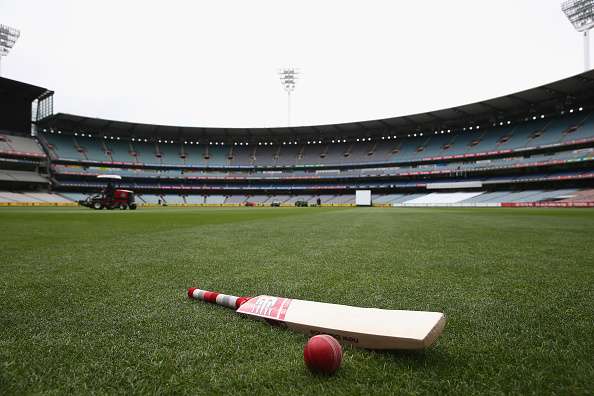
Subrata Banerjee, the former international umpire passed away in Kolkata today. Banerjee, 71 officiated in 13 One Day Internationals. The veteran umpire stood in his maiden first-class match in December 1967 during a Ranji Trophy game. He thus became one of the youngest umpires in the country to stand in a Ranji Trophy match, as he was only 22-years old.
He made his International debut in November 1983, when he stood as an umpire in the game between India and West Indies in Baroda.
In a career which spanned for 15 years, Banerjee’s final game was the match between India and Kenya in Gwalior in May 1998. However, his umpiring career spanned for 39 years wherein he officiated in 64 first-class matches.The 50-overs limited overs International between India and Pakistan Women teams was his final match as an umpire in any format. This match was held at the Sawai Mansingh Stadium in Jaipur in December 2006. He was also a television umpire during the India-England Test held in Mohali in 2001.
Off the field, Banerjee was closely associated with the Board of Control for Cricket in India (BCCI), as an umpire coach as well as an umpire’s educator. Apart from this, he also served as the chairman of Umpires Committee with the Cricket Association of Bengal and was also a member of the Cricket Committee.
source: http://www.sportskeeda.com / Sports Keeda / Homepage> Cricket> News / by Manish Pathak @manishpathak187 / August 19th, 2016
Horse carts get life… and a burden
Kulti :
A 50-year-old tanga (horse-drawn carriage) operator in Burdwan’s Kulti had been planning to sell his two horses and look for some other source of income as the business, in which his family has been involved for four generations, had fallen on hard times.
The same was the fate of around 30-odd tanga operators in Kulti town on the Bengal-Jharkhand border.
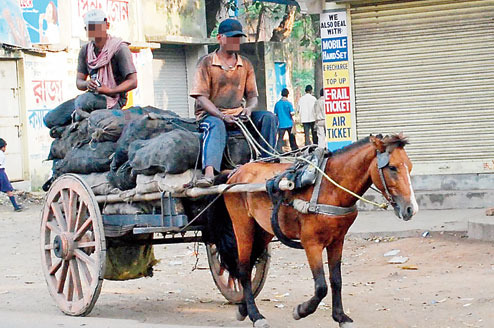
However, the tangas have now got a new lease of life and the horses are back on their feet, ironically though, because they are being used to carry the burden of an illegal trade. Local coal pilferers have chosen the nearly forgotten mode of transport to ferry their booty to brick kilns and depots as tangas are much faster than bullock carts.
The horse-drawn carriage was introduced in Kulti by the British after James Erskine founded Bengal Iron Works.
The journey of the tanga since then has been chequered. From a symbol of glory during British rule, it became a popular mode of public transport. However, with the advent of modern means of transport such as buses, autorickshaws and totos, the tanga lost out.
Earlier, pilferers used to transport coal in trucks. However, because of a crackdown by police, they had chosen bullock carts and bicycles. However, bullock carts are slow and ferrying huge amounts of coal on cycles is a labourious and time-consuming task, prompting the pilferers to choose the tangas.
The owners of at least 30 horse-drawn carts in Kulti town have modified the vehicles so that they can be used to ferry coal. The hoods and seats have been removed to make space for coal sacks. Sources said the tanga owners charge between Rs 200 and Rs 250 for each trip.
Some residents alleged a section of policemen took bribes from tanga owners and pilferers.
Asansol-Durgapur police commissioner L.N. Meena said he did not know that tangas were being used to ferry pilfered coal and dismissed as “baseless” the allegation of bribe.
source: http://www.telegraphindia.com / The Telegraph,Calcutta,India / Front Page> Bengal> Story / by Abhijeet Chatterjee / Wednesday – August 17th, 2016
Kolkata shipyard develops new vessel for Coast Guard
Kolkata :
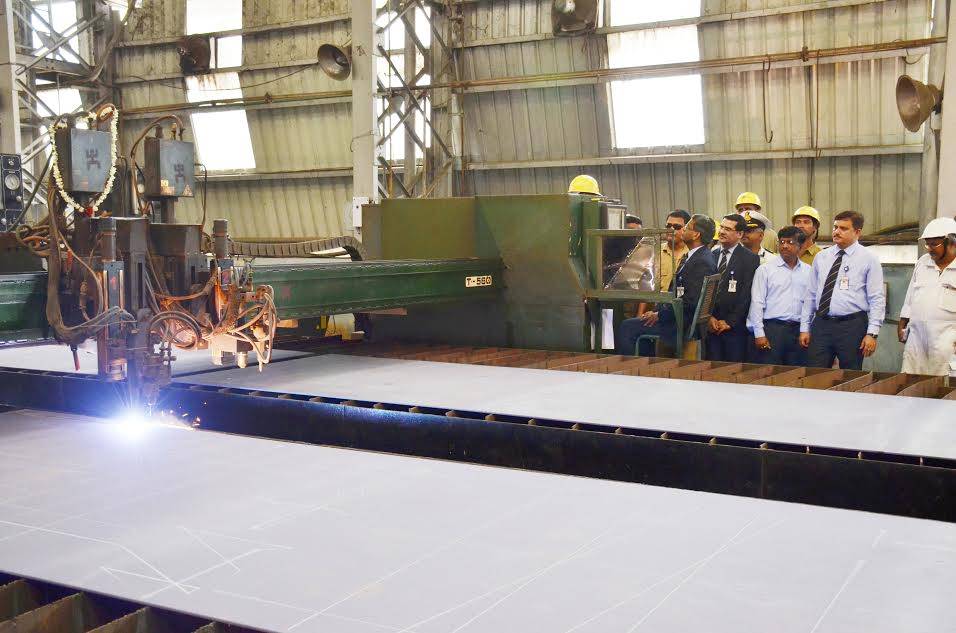
Garden Reach Shipbuilders and Engineers (GRSE), on Saturday, commenced work on the first in a series of Fast Patrol Vessels (FPVs) it has developed and will be building for the Coast Guard. Among those present during the ‘Plate Cutting Ceremony,’ the first step towards construction of a ship, were Rear Admiral (retd) AK Verma, chairman-cum-managing director, GRSE and other senior officials.
The order for the FBVs was placed in March, 2016 and the first ship will be delivered in February, 2018, Verma said. “The design of these ships is unique. They are cost-effective, fuel-efficient and ideally suited for patrolling, anti-smuggling, anti-poaching and rescue operations. They are an improved version of Inshore Patrol Vessel (IPVs) built earlier by GRSE for the Coast Guard. The FPVs are designed and developed by the in-house design centre of GRSE. Thanks to active support and participation of internal workforce and business partners in various shipbuilding activities, GRSE’s capabilities are constantly increasing. These ships will add punch to the Coast Guard’s capabilities in maintaining maritime security,” the CMD added.
The FPV is 48.9 metres long, 7.5 metres wide and has a displacement of nearly 300 tonnes. It is capable of attaining a maximum speed of 34 knots. At 12-16 knots, these ships have endurance of 1,500 nautical miles. They are fitted with three water jet propulsion systems powered by marine diesel engines, each developing 2720 KW of power and will be fitted with CRN-91 indigenous 30 mm gun. The ship has modern habitability conditions with accommodation for 35 personnel.
source: http://www.timesofindia.indiatimes.com / The Times of India / News Home> India / by Jayanta Gupta / TNN / August 14th, 2016