All posts by wellnmed@gmail.com

Policing feather in city girl cap

Millie Banerjee

London:

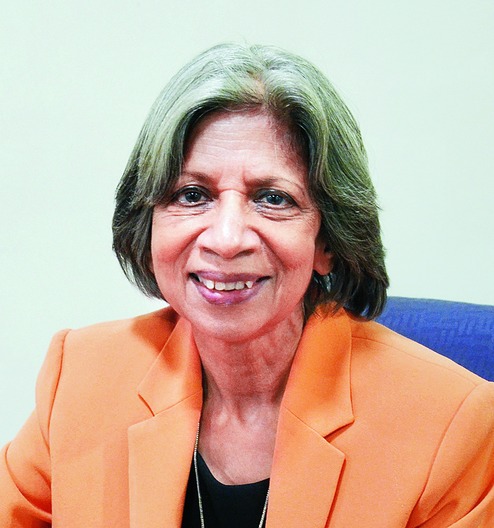
Calcutta-born Millie Banerjee has been appointed the new chairman of the UK’s College of Policing.

Actually, she has been interim chairman since November last year so her appointment was today made permanent by the home secretary, Amber Rudd.

“Working with Millie over the last year I have been impressed by the insight she brings from her time leading other public and commercial organisations, including the British Transport Police,” Rudd said on Thursday.

Millie’s responsibilities are highly sensitive – keep an eye on “standards in policing” across the 43 police forces in England and Wales; developing knowledge and “what works”; and assisting with education and career development.

It is possible she will want to exchange notes on policing in Calcutta.

“Millie” is really her nickname but it has come to stay as she has become part of the great and good in Britain. She was born Urmila Ray-Chaudhuri in Calcutta on June 30, 1946, and is friendly with a number of prominent figures in the city, among them the physicist Bikash Sinha.

Millie, who was honoured with a CBE on the Queen’s Birthday Honours list in 2002 and was High Sheriff of Greater London in 2012-13, was chairman of the British Transport Police Authority for seven years and spent 30 years in the telecommunications and satellite industries. This included 25 years with BT in senior positions.

She is currently the chairman of NHS Blood and Transplant and a board member of East London NHS Foundation Trust.

Reacting to her confirmation, Millie said: “I have spent many years in policing and it has been a privilege to witness the dedication and compassion of officers and staff to protect the public. This is evident when I see that public approval for police has remained high despite officers and staff being faced with ever more complex crime, a reduced workforce and greater demand.

“We are dedicated to providing access to the best knowledge and skills which sits behind the bravery, dedication and compassion shown by police on a daily basis. We have ambitious plans ahead and I intend on working with people across policing to continue building a professional body that supports all officers and staff.”

source: http://www.telegraphindia.com / The Telegraph, Calcutta,India / Home> Calcuttu / by Amit Roy / November 17th, 2017

Alumni Mentor IIT Kharagpur Students for Social Entrepreneurship

Kolkata :

Alumni of IIT Kharagpur have come forward to mentor students of the esteemed Institute to encourage them pursue career in the area of Social Entrepreneurship. The activity is part of the Students-Alumni Meet organized by the Students’ Alumni Cell (SAC) of IIT Kharagpur.

The event was organized in collaboration with the alumni association at the Kolkata campus of IIT Kharagpur. The alumni shared their experience in the domain of Social Entrepreneurship.

“Few young people are aware of the opportunities in this area which is actually blooming keeping in mind the government schemes such as Standup India and Startup India in place,” said Vishal Singh, General Secretary of Students’ Alumni Cell.

The students organized a competition where alumni and students were grouped together into teams of 5 each and were given a problem statement related to Social Entrepreneurship to discuss and debate amongst them and come up with an implementable business model.

Under the guidance of the knowledgeable and experienced alumni in each team, the students came up with innovative ideas and talked about the necessity, economic stability and sustainability of their solutions. This also led to a healthy debate among the crowd about the pros and cons of the model and how it could be improvised.

Students in consultation with Alumni presented on various Social Entrepreneurship models on areas like Eco Tourism, Resource sustainability, Growth and development of villages using natural resources etc.

The group leaders have been asked to further work on the subject and send an executive summary of the proposed social Entrepreneurship model for circulation among Alumni so that they can suitably contribute for execution / sustainability of the model.

“We will review the projects and approach alumni who are experts in these domains to mentor the students on the project proposals to develop business models. Some of the domain experts were present during the event and several of the other alumni we will help the students connect with,” said Siddharth Roychowdhury, Secretary of IIT Kharagpur Alumni Association Kolkata Chapter.

The guest speaker of the event was IIT Kharagpur alumnus Shri Amitava Bhattacharya who is also an alumnus of IIT Kharagpur and the founder of banglanatak.com, a social enterprise in the socio-cultural domain. He mesmerized the audience with a talk on his life journey and how it led him to found his successful venture banglanatak.com. His conceptualization and perception gave a new insight on the idea and notion of Social Entrepreneurship to the audience. Through banglanatak.com, Bhattacharya fosters inclusive and sustainable development using culture based approache for protection of rights of women, children and indigenous people.

“We have several other well-known social entrepreneurs from IIT Kharagpur like Dr. Harish Hande of SELCO, a Magsaysay Awardee, Shri Vinayak Lohani, Founder of Parivaar, a humanitarian institution, National Awardee for Child Welfare, Shri Dipak Basu, founder of Anudip Foundation, a nonprofit company dedicated to improving livelihoods of rural poor in developing countries through training in information technology and entrepreneurship.

These people have achieved more than personal success. Through their ventures they have brought significant changes in the world around. Through this initiative we are striving to inspire the students to explore opportunities in the domain of social entrepreneurship,” added Vishal.

SAC held similar events at Mumbai on ‘Make in India’ and Bangalore on career guidance. Similar events have been planned at Delhi and Hyderabad during the winter recess. “The Students Alumni Meet serves as a platform to encourage students from IIT Kharagpur look beyond the narrow idea of career for a livelihood and find a passion which they can use to impact the world.

The talent which the students of the Institute foster in the 4-5 years of study is much more than internships and placements and the alumni serve as just the perfect guide to open the realms of their passion which they can pursue as successful career” said Bharat Chandra, another student lead of the Cell.

source: http://www.timesofindia.indiatimes.com / The Times of India / News> City News> Kolkata News> Schools & Colleges / November 16th, 2017

Sweet victory: Bengal wins bitter battle over rasogolla

Kolkata :

It was a bitter battle but, in the end, victory was sweet. Bengal has won the Geographical Indication (GI) tag for Banglar Rasogolla, a sweet the state has almost been synonymous with, beating Odisha in a hard-fought war. The win came on Tuesday which was, ironically, World Diabetes Day.

The verdict comes after a two-year-two-month-old battle that the two states fought in the intellectual property wing of the ministry of commerce, which confers the tag. The war over the ubiquitous sweet was, by no means, simple: each state submitted reams of theses supporting their respective claims, drafted by historians, food technologists and even bure-aucrats. In the end, the first use of chhana (curdled milk) in making Bengal’s best-known sweet clinched victory.

The GI website mentions Banglar Rasogolla as “registered” for the coveted GI tag. The item was applicant number 533, and was registered as the 308th item to win the tag.

Chief minister Mamata Banerjee, who is in the UK now, expressed her joy in a tweet. “Sweet news for us all. We are very happy and proud that #Bengal has been granted GI ( Geographical Indication) status for Rosogolla,” she wrote. State higher education minister Partha Chatterjee, too, was ecstatic.

“We had applied for the GI tag in 2015,” said food processing secretary Nandini Chakraborty. “Rasogolla — under the name Banglar Rasogolla — will be registered under the Food Processing and Horticulture Development Corporation Ltd.”

Bengal perhaps never imagined that it would one day have to stake a claim on the rasogolla, but a claim made by the Odisha government, on the day of Ulta Ratha, 2015, saying the day should be declared as Odisha’s Rasogolla Day, made it sit up and take note.

Soon, Odisha applied for a GI tag on the rasogolla and Bengal’s science and technology department, prodded by thousands of rasogolla fans, lodged a counter-claim. In September 2015, the state prepared a dossier containing all sorts of proof — documents, historical texts and analogies — in support of its claim that the rasogolla was native to Bengal, and had been invented in two stages in two completely different historical time zones. The claim was registered by the GI registrations office and separate investigations were launched to authenticate the respective claims.

The Bengal government consulted sweets researcher Haripada Bhowmick for the historicity of the rasogolla, while the Odisha government got Jagannath cult researcher Asit Mohanty to look into its claim. Bhowmick’s book ‘Rasogolla — Banglar Jagat Matano Abishkar’, has been used as part of the material that was submitted to the GI office. Odisha evoked its gods and temples while staking its claim, replete with references of how Lord Jagannath used the kheermohan, the precursor of the rasogolla, to appease his consort goddess Lakshmi. And why mythology alone, even ancient history — from the time of the Dandi Ramayana, an adaptation of the epic by Balaram Das of the 16th century — has been used as reference. Bengal, too, has argued that it can trace the roots of the rasogolla to the times of the Bhakti movement of the 15th century and how Mahaprabhu Sri Chaitanya might have taken the sweet, in its formative stage, from Bengal to Odisha, when he started residing in Puri. Food writers who have been watching this space said the two states agreed on the antiquity of the sweet, if not its place of origin.

“We stand vindicated today,” said Mohua Hom Chowdhury, representative of the state science and technology department, who had coordinated the process with the GI registration office. “There should not have been any debate in the first place. We were rooting for our Banglar Rasogolla, which should not be confused with their kheermohan or their pahala rasogolla, which might be later variations, but are completely different sweets.”

Bengal has explained that the art of rasogolla-making lies in the use of chhana (Bengal-style cottage cheese). “Bengal is the only state that uses chhana, which is curdled milk, to make sweets. The process of curdling is considered ‘unholy’ by most communities including Odiyas, who never offered any sweet to Lord Jagannath made of chhana. The temple records that contain details of the food that can be served to the Jagannath does not mention rasagolla anywhere. To prove its point, the Bengal dossier quotes liberally from historical texts, records and literature like ‘Nadia Kahini’ by Kumudnath Mullick, proceedings of the Bangiya Sahitya Parishad, translations from the ‘Chaitanya Charitamrita’, ‘Chandimangal’ by Kabikankan Mukunda, etc. Kheermohan is made of kheer or concentrated milk and pahala rossogolla, a variant of Bengal’s original sweet, is yellowish in colour, less soft and much more sweet.

“Odisha should apply for kheermohan and pahala rasogolla separately,” Hom Chowdhury added.BoxGI tag : What does it mean?It is a name or sign used on certain products which corresponds to a specific geographical location or origin (town, region, or country)

Use of GI may act as certification that the product has certain qualities, is made according to traditional methods, or enjoys a certain reputation, due to its geographical originWhat will happen now?Any sweet maker can apply to the state science and technology department for the Banglar Rasogolla GI tag. There will be an investigation as to whether he is using the right ingredients, in the right quantity and following the specified manufacting process to be worthy of the tag.What are the advantages ?The tag is a proof of authenticity and someone who has been awarded the tag is definitely superior to one who is still selling rasogolla but doesn’t have the tag.Other Bengal items with GI tagThere are 15 items from Bengal with the GI tag now, some of them are :

Darjeeling tea (drink), Lakshman bhog, fazli, himsagar, baluchari sarees, dhaniakhali sarees, Joynagar moya, Bardhaman Sitabhog, Bardhaman Mihidana, Gobindobhog rice, Tulaipanji rice, Banglar RasogollaGI tag awaited Sarpuria and Sarbhaja.

source: http://www.timesofindia.indiatimes.com / The Times of India / News> City News> Kolkata News / by Jhimli Mukherjee Pandey / November 15th, 2017
How World War II cramped Kolkata airport runway

HIGHLIGHTS

Kolkata airport currently has a runway capacity of only 30 flights per hour

Airports Authority of India is considering a second airport for Kolkata.
________________________________________________________________________

Kolkata :

A decision taken during World War II has now come to haunt Kolkata airport’s growth prospects. The airport which currently has a runway capacity of only 30 flights per hour, could have handled twice the number of flights had there been a proper second runway at its disposal. But the plan to create a second cross runway in the east-west direction was junked and instead a parallel runway was built that cannot be used for simultaneous operations now because they do not meet safety parameters.

It is this runway constraint, coupled with lack of space for additional parking bays that is forcing Airports Authority of India to consider a second airport for Kolkata.

It was the Allied Forces’ fear of the airport at Dum Dum being bombed by Axis powers during World War II that led to the British opting for parallel runways instead of ones that cross each other. With Japanese bombers a constant threat, the Allied Forces felt that if a bomb was dropped at the point where the runways intersect, it would take out both runways. Instead, having them parallel would give them an opportunity to use the alternative runway if one was destroyed.

“Kolkata airport’s first landing strip dates back to the 1920s. It was later strengthened for use as taxiway and is still in use to taxi aircraft. Around 1932-33, a proper runway was constructed in the north-south direction. This is now the secondary runway at Kolkata airport. To cater to the increased requirement during WW II, it was decided to construct another runway around 1942-43. That is when the cross runway proposal was mooted and then dropped in favour of the parallel runway,” the source said.

While airports around the world have parallel runways in which flights take off and land simultaneously, it is not possible at Kolkata airport because the two runways are too close to each other. “When they were built, there were Dakota and Fokker planes with small wing span. The separation between the two runways at Kolkata airport at 213 metres was sufficient then. But as aircraft dimension changed, the minimum distance criteria was revised. Today’s Boeing and Airbus with large wing spans require a minimum distance of 760 metre between parallel runways. There is no space at Kolkata airport to create that separation as the terminal building is located to the west and boundary wall to the east,” an official said.

At present, the primary runway is used for flight operations with the secondary runway coming into play when the primary runway is shut down for maintenance or other exigencies.

source: http://www.timesofindia.indiatimes.com / The Times of India / News> City News> Kolkata News / by Subhro Niyogi / TNN / November 14th, 2017

‘Longest’ sari in making

– Art work with colours of national flag

Krishnagar:

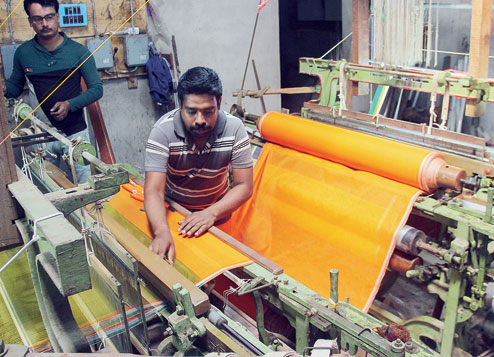
An award-winning weaver from Nadia’s Phulia is leading a team to make a 3.85km long sari, which he claims is the longest in the country.

The sari will be displayed at a Phulia school ground on January 1. The sari, being built at a cost of Rs 2.9 lakh, will have colours of the national flag – saffron, white and green.

Biren Kumar Basak, 72, who took the Sant Kabir award from Prime Minister Narendra Modi last year, said he would dedicate the sari to the nation on New Year’s Day as a tribute to his country.

Basak, who designed the sari and is financing the weaving, said: “This work of art will be longer than the 3.05km long sari made at Bharuch in Gujarat in March this year. I will dedicate the sari to the nation. I will then cut the polyester sari into 700 normal saris and distribute the same among the poor women of Phulia.”

Weavers busy making the sari at Phulia. Picture by Abhi Ghosh

The sari made in Gujarat earned a Guinness book entry.

Basak and five other weavers have been working almost round-the-clock at a power loom in Krishnagar using 316kg of yarn of saffron, green and white color brought from Surat to meet the target of January 1.

“My dream was to make the longest national flag. I then changed my mind and decided to make the longest sari using the colours of the Tricolour. My workers also supported the idea and I started working on it from September,” Basak said.

Raju Basak, a weaver who is monitoring the progress of the sari, said: “We have already completed around 3.2km and hope the target will be met.”

source: http://www.telegraphindia.com / The Telegraph,Calcutta,India / Home> West Bengal / by Subhasish Chaudhuri / November 13th, 2017

KIFF goes behind the lens of Ray and Ghatak

Kolkata :

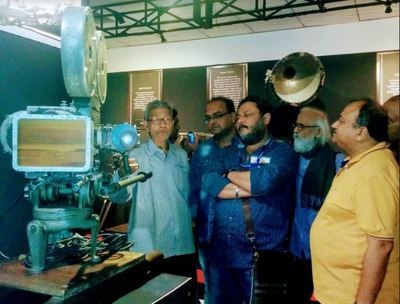
The camera which Subrata Mitra used for shooting ‘Pather Panchali’ triggered many memories for cinematographers – both veteran and young – when they dropped by at the ‘Looking Thru’ exhibition organised on the sidelines of the 23rd Kolkata International Film Festival. Inaugurated by director Prakash Jha, the exhibition is a priceless archive for global cinema.

“The exhibits include camera equipment used by directors like Lumiere Brothers, Satyajit Ray and Ritwik Ghatak and film students and the enthusiasts can learn a lot about our glorious history and how cinema evolved through its medium in the past century,” said principal secretary, Information and Cultural Affairs department Vivek Kumar.

Paying rich compliments to KIFF organisers for hosting such an exhibition, Jha said, “Truly, there was great passion in collecting all these and putting up such an exhibition. All film lovers of the city will be looking with eagerness at this. This adds a new chapter and will go a long way in understanding cinema,” Jha said.

One of the first exhibits on display – that was given by Anjan Bose of Aurora Film Corporation Pvt. Ltd – is a Bell & Howell 35 mm motion picture camera that was used in the silent era. US based Bell & Howell was founded in 1907 and was a manufacturer of motion picture machinery. Since 1909, this company used to make 35 mm motion-picture cameras. However, they stopped making motion-picture cameras from 1970s.

The next exhibit was the immensely popular camera in Europe. Called Super Parve, this camera was extensively used by Sergei Eisenstein and could record both sound and picture simultaneously in sound negative and picture negative formats. Director Abhijit Guha, who had come to watch this exhibition, mentioned that this camera was used for shooting Sukumar Dasgupta’s ‘Ora Thake Odhare’ and ‘Sadanander Mela’. “Both films had featured Uttam Kumar and Suchitra Sen,” Guha said.

The 35 mm Arriflex Blimp, which was capable of enclosing a 1000 ft magazine, also drew many visitors. The camera on display was used to shoot ‘Bhagini Nivedita’ and ‘Raja Rammohan’. Next on display was a Bell & Howells 1925 era Eyemo. Manufactured by the Bell & Howell Company of Chicago in 1925, it was the most popular, compact 35 mm camera that had a 100 ft capacity. Its small size made it a popular camera while filming during World War II and the Vietnam War. “During those days, it was difficult to film with heavy cameras. Hence, this camera became popular.

The 35 mm film size also was brought down to 16 mm and subsequently to 8 mm because of the needs during wartime filming. The 16 mm Maurer is another priceless camera in this collection. It was used for optical effects like dissolve, fade-in and fade-out. The Panavision is a later version of this camera,” said cinematographer Premendra Bikash Chaki.

Incidentally, this camera was so popular that the Appolo 11 spacecraft was equipped with a Maurer. History has it that the crew used this kind of camera to record lunar features from the lunar surfaces.

The Arriflex camera also had a special place in the exhibition. Based in Germany, the Arri group was founded in 1917. In 1937, Arri introduced the world’s first reflex mirror shutter in the Arriflex 35 camera. It has the ability to focus the image by eye through the viewfinder. Pointing at this camera, Chaki said, “This was used to shoot films like ‘Jalsaghar’ and ‘Jukti Tokko Aar Goppo’.”

The Bolex camera made by a Switzerland-based company also drew a lot of attention. Their 16 mm spring-wound is a popular introductory camera in film schools. In 1950s during the golden era of 3D film, Bolex offered a 3D stereo kit for their H-16 camera. Bolex 16 Pro and H-16 was technically very advanced. “This camera was used by Goutam Ghose. He had shot his award-winning documentary titled ‘Hungry Autumn’ with this,” Chaki said.

In 1952, Arri introduced the first professional 16 mm camera with a reflex-viewing system. In 1965, a self-blimped 16 mm camera was marketed: The Arriflex 16BL. “This camera was used by Goutam Ghose to shoot ‘Silk Route’,” Chaki added.

Even a Red digital camera donated by Swarup Biswas has also been on display. However, it was the Mitchell 35 mm camera that drew the maximum attention. That was not surprising since along with this camera was on display two working stills of Ray and Subrata Mitra shooting ‘Pather Panchali’. Gaur Karmakar, who had worked as an assistant cameraman in some of Ghatak’s films, explained: “We have shot ‘Komol Gandhar’ and ‘Subarnarekha’ with this very camera too.”

With many more stories unfolding behind the lens, it’s needless to say that viewers of KIFF will have a lot beyond movies as their takeaway from the cine-fest.

source: http://www.timesofindia.indiatimes.com / The Times of India / News> City News> Kolkata News / by Priyanka Dasgupta / TNN / November 11th, 2017

Indigo researcher digs out nuggets from past

Jenny Balfour-Paul at The Bengal Club. Picture by Sanat Kr Sinha

• A famous tea company in Calcutta traded in indigo in British India. That’s how its office on RN Mukherjee Road, Nilhat House, got its name.

•Opium and indigo growers were locked in constant rivalry before 1859

• Evidence of indigo dye has been even found in the remains of the Indus Valley civilisation

Calcutta:

Such nuggets from history made up writer Jenny Balfour-Paul’s hour-long Bengal Club Library Talk, organised in association with The Telegraph, on November 8.

Balfour-Paul, who has researched indigo for decades, traced its history right from the early evidence to the exploitation faced by farmers in pre-Independence Bengal.

The session was peppered with anecdotes, humour and photographs of travel that she undertook since 2000 to bring together the indigo story.

The highlight of the evening was shots of a handwritten journal by 19th century British explorer Thomas Machell, who got the author inspired in the first place.

Machell had lived in Calcutta and worked in several indigo plantations in the 19th century. His journal traced his experience and the culture of the time, in the form of correspondence to his father in England.

Balfour-Paul shared with the audience how she found Machell’s journals by accident. “I was in the British Library surfing through old books and records when I found this valuable piece of history. It was the word indigo that made me reach out for it,” she said.

One line in the handwritten diary had particularly caught her eye. “I wonder if anybody will find these journals in the 20th century in a dirty library…” Machell had written. “I thought I was meant to find it,” added Balfour-Paul.

The author decided to travel to all those places where Machell had visited more than 100 years ago. She juxtaposed snaps taken during her visits to Calcutta, Bangladesh and also the Marquesas Island in French Polynesia with the British explorer’s illustrations.

Visits to Calcutta brought out some lesser-known facts. “Tea company J Thomas & Co would auction indigo. No wonder their office was called Nilhat House,” Balfour Paul said.

Another story was about her hunt for Machell’s grave. “Two of his journals are missing and I am still putting together the last six years of his life. I was not sure where he had spent his final years,” Balfour-Paul added.

India made Machell ill. He had left its shores for his native Yorkshire only to come back again. “My daughter and I went places in search of his grave, till we realised he had died near Jabalpur. One rainy day in Jabalpur we almost got ourselves arrested as we went grave hunting,” laughed the author.

She has documented many of her tales in her book, Deeper than Indigo: Tracing Thomas Machell, Forgotten Explorer.

source: http://www.telegraphindia.com / The Telegraph, Calcutta,India / A Staff Reporter / Saturday – November 11th, 2017

Phulia creates 3km-long alpana in 10 hours

– Hundreds wield brush and paint to draw on road with four colours

Anit Thapa addresses the meeting in Kurseong on Sunday. Picture by Passang Yolmo

Phulia:

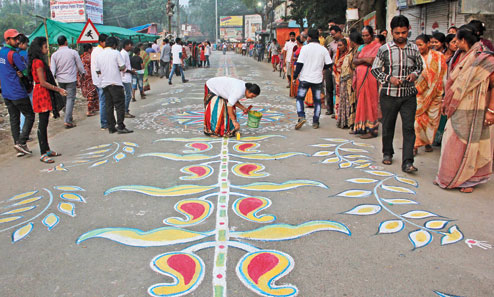
Over 800 people wielded brushes and paints of four hues and drew for around 10 hours to create a 3km-long alpana, which the organisers claim is the longest in the world.

The residents of Nadia’s Phulia woke up on Sunday morning to a splendid view of the alpana, which is a traditional motif drawn on the floor in Bengal and elsewhere in the country.

From 9pm on Saturday, 25 groups with 35 members each started drawing the alpana from Phulia bus stand and completed the entire 3km stretch of a road at Sabujpally around 7am on Sunday. To draw the alpana, 2,800 litres of acrylic paints of four different hues were used.

The artists were responding to a request by Junior 100 Foundation, a social organisation.

“Phulia’s 3km alpana is the longest in the world so far and we are planning to approach the Guinness Book of World Record for its inclusion on the list of extraordinary achievements,” said Abhinaba Basak, the cultural secretary of Junior 100 Foundation.

Debabrata Pal, 28, a graduate in fine arts from a government art college, who took part in the alpana drawing, said: “With such an initiative, people will experience the pleasant look of traditional motifs synonymous with our culture”.

In September, Before Durga Puja, Samaj Sebi Sangha Sarbojanin Durgotsav Committee in south Calcutta drew a 1.2km alpana. Over 320 government art college students took less than 24 hours to draw it.

Basak said: “Our aim is not to go for any competition rather to revive a passion to learn Bengal’s traditional art among the young generation. With this objective, we tried to make it as long as possible, which eventually became the longest one.”

Enthusiasts like Mousumi Biswas, 22, an MA second-year student and Arijit Debnath, 11, of Class V also took up the brush to draw the alpana. The initiative received cooperation from police who diverted traffic to facilitate the drawing.

source: http://www.telegraphindia.com / The Telegraph, Calcutta,India / Home> West Bengal / by Subhasish Chaudhuri / October 29th, 2017

Kolkata to Chandannagar: The French life

In Chandannagar, time flows as languorously as the Ganga beside it

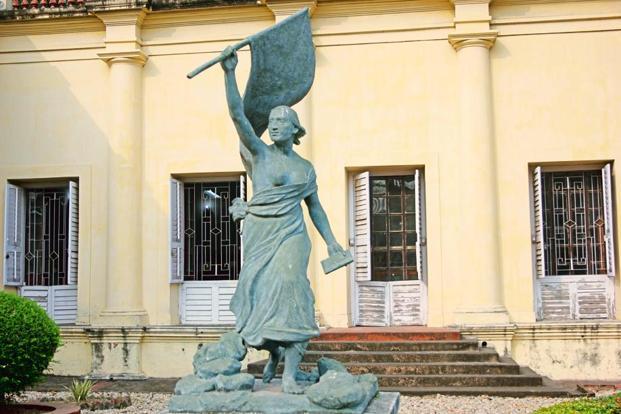
The statue of Marianne, a national symbol of France, outside the Dupleix mansion. Photos: Ganesh Vancheeswaran

The rains had left the fields lush green, a vivid contrast to the dark brown soil at the base. This dual-colour canvas kept a tight grip on the sides of the road through most of the trip. Bustling villages and near skirmishes with traffic ensured there was never a dull moment on the drive from Kolkata to Chandannagar.

My decision to go to Chandannagar for the weekend had been an impromptu one, taken the night before. The fact that it was the only French colony in Bengal in the 17th century, at a time when the British were making determined inroads into the region, made me curious. And so, late one Saturday morning, I hopped into a taxi for the 53km ride. It was a swift and mildly disorienting transition from the crush of humanity in Kolkata. As we entered Chandannagar, my driver pointed to two pillars topped with urns. He said these were all that remained of the grand gate built by the French in 1937.

I asked him to take me to the Dupleix Museum, located in a large yellow mansion. It is one of the few in India that houses a collection of artefacts from French rule, which lasted more than 250 years. Chandannagar was a major trading and military hub for the French during the 18th and 19th centuries. And this mansion used to be the official residence of French governor generals. Apart from French memorabilia, the museum houses rare collections of statues, letters exchanged between freedom fighters, and news clips on the freedom movement in Bengal. With its colonnaded courtyard, broad slatted windows and high ceilings, it is a throwback to period architecture. Even today, French is taught at an institute that operates from the same premises.

Leaving the museum, I headed to a stall nearby for a leisurely mutka (earthen cup) of tea. I was in no mood to rush from place to place. Already, I could feel my heartbeat settling into a slower rhythm. Chandannagar has that effect on you.

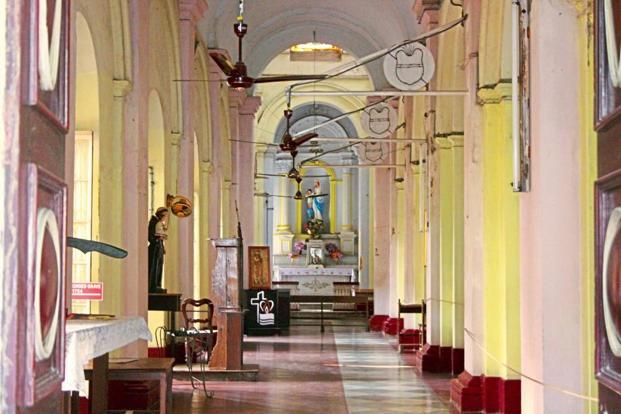
The interior of the Sacred Heart Church.

Continuing my journey into the past, I walked up to the lovely Sacred Heart Church, close to the Dupleix Museum. This church, designed by French architect Jacques Duchatz, was inaugurated in 1884. Stepping into its cool portals, I was transported back to the 19th century. The stained glass, old furniture and colourful murals along the nave are largely intact. Later, I walked through the restored graves and tombstones in the cemetery adjoining the church. Buried here along with other nobles is the long-forgotten French commander Duplessis, one of the town’s founding fathers.

Exploring the streets that evening, I saw a number of rambling bungalows from the French period. The structures, still intact, exuded an air of genteel neglect. There was an abundance of greenery. Traffic was sparse and slow-moving. Passing through the local market, I was struck by the absence of the hoarse cries one normally finds in Indian markets. Even the haggling was absent. It seemed as if the entire town loathed anything loud or frenetic.

Wending my way to the strand, I sat on a bench. A few others had colonized benches to read the newspaper or chat. In front of me, the Ganga, known in these parts as the Hooghly, flowed gently, with barely a murmur. Boats ferrying locals were the only traffic. And quiet descended as soon as the day’s activity wound up with the setting sun.

Fortified by some luchi-aloo dum the next morning, I sallied forth again. This time, to the stunning Nanda Dulal temple with its cream-and-vermillion exterior. This temple is built in the do chala (double sloping roof) style native to Bengal, but is, surprisingly, devoid of the terracotta work that is typical of buildings in this district. I learnt from the priest that this temple, which houses a deity of Lord Krishna as a child, was first built in 1740, destroyed and then rebuilt.

I was tempted to join the boys playing volleyball in front of the temple. In keeping with the mood, however, I decided to return to my room to curl up and read.

Weekend Vacations offers suggestions on getaways that allow for short breaks from metros. The author tweets from @theholehog.

source: http://www.livemint.com / Live Mint / Home> Leisure / Ganesh Vancheeswaran / November 09th, 2017

A north Bengal forest ranger people love to call ‘Singham’

In 2016, Sanjay Dutta and his team seized 14 leopard skins, 500 pieces of leopard and tiger bones, two rhino horns, live geckos, seven skins of clouded leopard and 11 jars of snake venom.

Ranger Sanjay Dutta (in black T-shirt) holding a baby crocodile seized from wildlife smugglers. (HT Photo)

In the forests of North Bengal, timber smugglers and poachers are in trouble. A 39-year-old forest ranger has come to be known as the ‘Forest Singham’ (lion of the forest) after having arrested hundreds of wildlife and timber smugglers.

As a ranger, Sanjay Dutta is in charge of 3,304 hectares of forest in the Belacoba range of Jalpaiguri district. The Chicken Neck area, a narrow strip of land lying adjacent to the international borders with Nepal, Bangladesh and Bhutan is especially known as a haven for poachers and smugglers. But with 15-20 seizures and 70-80 arrests a year, this has also become a happy hunting ground for the law enforcers.

In 2016, Dutta and his team seized 14 leopard skins, 500 pieces of leopard and tiger bones, two rhino horns, live geckos, seven skins of clouded leopard, 11 jars of snake venom and a cache of arms and ammunition.

In April this year, Dutta was made the head of a special task force set up to check wildlife smuggling in the forests of all the eight districts of north Bengal.

“Dutta has made numerous seizures and nabbed many offenders. He must have set a record by now. He is hardworking and brave and he has developed a network. Also, he maintains a very cordial relation with local people,” said M R Baloach, additional principal chief conservator of forest, West Bengal.

Sanjay Dutta receiving an award from chief minister Mamata Banerjee. (HT Photo)

A resident of Jalpaiguri, Dutta had to abandon his dream of becoming a police officer when his father, also a forest ranger, died at the age of 48. Dutta joined the department when he was only 18.

Ten years ago he was shot by timber smugglers while he was chasing a gang along the Teesta canal. One of the guards accompanying him was killed.

In 2016 Dutta became the only Indian recipient of the Clark R Bavin Wildlife Law Enforcement Award given by Animal Welfare Institute of Johannesburg. But Dutta missed the ceremony because he could not afford the trip to South Africa.

In view of the threat to his life, Dutta, a father of two, is provided with security personnel but that has not deterred him from staying in touch with people. He has set up a primary school in the Lodhabari forest area. He partly funded it with the Rs 25,000 cash award he got from the state government. Dutta arranged for another Rs 1.2 lakh from the joint forest management committee and started the school.

Over the years, Dutta, has helped many poor people, cancer patients and school children. Local people try to return the favour and love. Jyotshna Roy, head of a self-help group for women in Lodhabari said, “We have never seen a forest officer like him. He does not mind taking loan to help people in need. On Bhaiduj he was given ‘bhaiphota’ by 50 women.”

“With Dutta around, we know the forests are safe,” said Tula Mohammed, president of Hiramari Joint Forest Management Committee.

Visitors to the forest are frisked by state armed police (SAP) personnel. Fifteen of them work with Dutta. Shiv Sambu Som, an assistant sub inspector of SAP, said, “Working with Dutta is a new experience. He takes care of the staff and other employees. We don’t mind putting in extra hours to assist Dutta in nabbing offenders.”

“Dutta always leads an operation from the front,” added Lalit Tiwari, a forest department beat officer.

The Forest Singham however remains grounded. “I am no hero or celebrity. I love to work for the people and that’s what I do,” he told HT.

source: http://www.hindustantimes.com / Hindustan Times / Home> Cities> Kolkata / by Pramod Giri, Hindustan Times / November 07th, 2017