All posts by wellnmed@gmail.com

IIM reunion kicks off

Joka:

The IIM Calcutta’s 1992 alumni returned to the campus on Saturday to relive their student days with batchmates Sonya Dutta Chowdhury and Swati Kaushal who chucked corporate careers to turn authors.

Each year, winter marks the homecoming of the batch that graduated from Joka 25 years ago. And the occasion is called “Reminiscence”.

The reunion started with a two-day carnival that would include a guided tour of the campus, a discussion with the director and dean, interaction with former professors and current students among others.

“I cannot imagine being a writer without my stint in the management school,” Kaushal told her batchmates. “Because I went to management school, worked with Nestle, interacted with advertising agencies, I was subjected to a lot of communication… that’s what brand management is about.”

Dutta Chowdhury said: “MBA teaches you a lot of communication, writing, analysis and storytelling.”

Instances of IIM graduates shunning corporate careers to turn authors is not new, though. Amish Tripathi, who was at IIM Calcutta to collect the distinguished alumnus award on November 14, is perhaps the most successful example with his Shiva trilogy.

source: http://www.telegraphindia.com / The Telegraph, Calcutta,India / Home> Calcutta / by Special Correspondent / December 24th, 2017

Docspeak on Hepatitis cure 12 weeks for treatment

Calcutta:

Hepatitis C is now curable with 12 weeks of treatment and the chances of developing liver cancer from Hepatitis B has gone down, a professor of medicine from Weill Cornell Medicine said here on Saturday.

The most common liver disease in the world now is non-alcoholic fatty liver disease that can develop because of obesity, excess fat and genetic factors, Patrick Basu said.

“There are medicines that can cure Hepatitis C in 12 weeks. Vaccines can reduce the chances of development of cancer from Hepatitis B. There is a lot of advancement in treatment of hepatitis,” Basu told Metro.

Basu was in Calcutta to speak at a seminar for doctors at the Belle Vue Clinic.

Both Hepatitis C and Hepatitis B are viral infections.

Hepatitis C is a blood-borne virus and modes of infection include unsafe injection practices, unsafe health care, and the transfusion of unscreened blood and blood products, according to the World Health Organisation.

Hepatitis B is a potentially life-threatening liver infection. The Hepatitis B virus is transmitted through contact with the blood or other body fluids of an infected person.

When non-alcoholic fatty liver disease worsens, it can cause cirrhosis, a doctor said. It is possible to reduce the amount of fat in liver if detected early. Ideally, the liver should have no or little fat, he said.

Arun Sen, a professor in the Texas A&M University, spoke of the benefits of telemedicine in Bengal where doctors are few in rural areas.

Saurabh Kole, in-charge of Belle Vue’s intensive care unit, said the hospital was trying to create an organised platform of doctors for telemedicine in the state.

source: http://www.telegraphindia.com / The Telegraph, Calcutta,India / Home> Calcutta / by Staff Reporter / December 24th, 2017

Diagnosing early-stage cervical cancer using artificial intelligence

New approach: “The change in tissue morphology as the disease progresses can be picked up by light scattering,” say Prof. Prasanta K. Panigrahi (right) and Sabyasachi Mukhopadhyay

The AI identifies precancerous tissue, and also the stage of progression in minutes

The morphology of healthy and precancerous cervical tissue sites are quite different, and light that gets scattered from these tissues varies accordingly. Yet, it is difficult to discern with naked eyes the subtle differences in the scattered light characteristics of normal and precancerous tissue. Now, an artificial intelligence-based algorithm developed by a team of researchers from Indian Institute of Science Education and Research (IISER) Kolkata and Indian Institute of Technology Kanpur makes this possible.

The algorithm developed by the team not only differentiates normal and precancerous tissue but also makes it possible to tell different stages of progression of the disease within a few minutes and with accuracy exceeding 95%. This becomes possible as the refractive index of the tissue is different in the case of healthy and precancerous cells, and this keeps varying as the disease progresses.

“The microstructure of normal tissue is uniform but as disease progresses the tissue microstructure becomes complex and different. Based on this correlation, we created a novel light scattering-based method to identify these unique microstructures for detecting cancer progression,” says Sabyasachi Mukhopadhyay from IISER Kolkata and first author of a paper published in the Journal of Biomedical Optics.

Elaborating on this further, Prof. Prasanta K. Panigrahi from IISER Kolkata and corresponding author of the paper says: “The collagen network is more ordered in normal tissues but breaks down progressively as cancer progresses. This kind of change in tissue morphology can be picked up by light scattering.” White light spectroscopy (340-800nm) was used for the study.

Statistical biomarker

The change in scattered light as disease progresses is marked by a change in tissue refractive index. The team has quantified the changes in tissue refractive index using a statistical biomarker — multifractal detrended fluctuation analysis (MFDFA). The statistical biomarker has two parameters (Hurst exponent and width of singularity spectrum) that help in quantifying the spectroscopy dataset.

While MFDFA provides quantification of light scattered from the tissues, artificial intelligence-based algorithms such as hidden Markov model (HMM) and support vector machine (SVM) help in discriminating the data and classifying healthy and different grades of cancer tissues.

“The classification of healthy and precancerous cells becomes robust by converting the information obtained from the scattered light into characteristic tissue-specific signature. The signature captures the variations in tissue morphology,” says Prof. Panigrahi.

“The MFDFA-HMM integrated algorithm performed better than the MFDFA-SVM algorithm for detection of early-stage cancer,” says Mukhopadhyay. “The algorithms were tested on in vitro cancer samples.”

In vivo samples

The team is expanding the investigations to study in vivo samples for precancer detection. While the accuracy achieved using in vitro samples was over 95%, based on a study of a few in vivo samples the accuracy is over 90%.

“In the case of in vitro samples we were able to discriminate between grade 1 and grade 2 cancer,” says Prof. Nirmalya Ghosh from IISER Kolkata and one of the authors of the paper. “More testing is needed using in vivo samples.”

“Superficial cancers such as oral and cervical cancers can be studied using this technique. And by integrating it with an endoscopic probe that uses optical fibre to deliver white light and surrounding fibres to collect the scattered light we can study cancers inside the body,” says Prof. Ghosh.

source: http://www.thehindu.com / The Hindu / Home> Sci-Tech> Science / by R. Prasad / December 23rd, 2017

IACS develops hydrogel to remove toxic dyes and metal ions

Useful tool: “The hydrogel can be used by the industries for effective treatment before wastewater disposal,” says Prof. Arindam Banerjee (Centre)

It could begin absorbing dyes within 15 minutes, metals in about 6 hours

Scientists from Indian Association for Cultivation of Sciences (IACS), Kolkata, have developed a new gel that can remove toxic organic dyes and metal ions from waste water. They found the hydrogel began absorbing various commonly used dyes within 15 minutes. The dyes tested were malachite green, congo red, brilliant blue and rhodomine B. In the case of metals, the hydrogel was able to considerably remove commonly found ones such as cobalt and nickel from industrial effluents in about six hours.

Basic amino acids like leucine and phenylalanine were used to make the gel; the gel is biodegradable. It was stable at room temperature and remained as a gel for several months.

Effective treatment

The current methods used for treating wastewater — adsorption using activated carbon, chemical precipitation or electrochemical techniques — are largely ineffective due to incomplete removal or high energy requirements. In comparison, the new hydrogel-based material is able to remove the hazardous waste effectively as it has high water permeability, large surface area for adsorption and is also simple to use.

“We monitored the uptake capacity of the hydrogel using UV spectroscopy and found that within a few hours the gel absorbed the dyes and the waste water turned almost colourless. The hydrogel can absorb the wastes for up to 60 hours before reaching a saturation point. The gel was able to remove 78-92% of the dyes and more than 80% metals ions,” explains Nibedita Nandi, research scholar at IACS and first author of the paper published in Peptide Science.

Reusable resource

“The hydrogel can be washed with sodium bicarbonate and ethyl acetate and reused. As the dyes and metal ions are soluble in water they get washed out from the gel and the hydrogel can be used for up to four cycles. It can be used by the industries for effective treatment before wastewater disposal,” says Prof. Arindam Banerjee, senior professor at the Department of Biological Chemistry, IACS, and corresponding author of the paper.

The researchers say that the production of the gel can be scaled up to the desired volume for use in water treatment at industries.

source: http://www.thehindu.com / The Hindu / Home> Sci-Tech> Science / by Aswathi Pacha / December 23rd, 2017

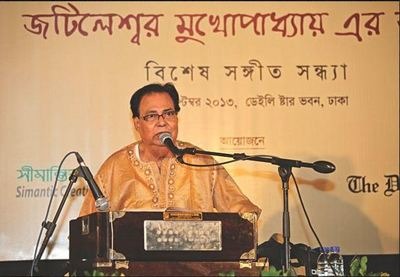
Bengal mourns the demise of veteran singer-composer-songwriter Jatileshwar Mukhopadhyay

Kolkata :

With the demise of Jatileshwar Mukhopadhyay, Bengal lost one of the most eminent personalities from the golden era of music who had the rare distinction of being a singer-composer-songwriter. Eighty three-year-old Mukhopadhyay succumbed to multi-organ dysfunction at a city nursing home on Thursday. He is survived by wife Sabita, daughter Subha and son Raja.

Born on December 13, 1934, at Chandernagore, Mukhopadhyay received his training under Satinath Mukhopadhay and Chinmoy Lahiri. Once he started working from the 60s, he created a niche for himself by writing the lyrics of 2000 songs and setting 1500 of them to music. Few know that he found inspiration in Mehndi Hassan’s ghazals.

While his own songs became popular, he churned out a number of hits when composing songs for Sandhya Mukherjee, Arati Mukhopadhyay, Haimanti Shukla, Banasree Sengupta, Pintu Bhattacharya, Sreeradha Bandopadhay and Pt Ajoy Chakraborty. Connoisseurs of modern Bengali songs remember his compositions like ‘E kon sokal rater cheyeo ondhokar’, ‘Keu bole falgun, keu bole polasher’, ‘Aamar swapan kinte pare’, ‘Aaami phoolke jedin dhore’, ‘Tomar songe dekha na hole’, ‘O sojon haay’ and ‘Amar onge jole’. His ‘Bodhua amar chokhe jol enechhe hai bina karone’ was a cult song and years later when Srikanto Acharya recorded it again, it generated equal interest among a new generation of listeners. Mukherjee had scored the music for Raja Sen’s ‘Damu’.

Tapan Basu, his disciple for over two decades, also highlighted his contribution as an author. “He has written Bengali essays and plays. ‘Krishnakumari Katha’ was a popular musical written by him. A lot of his research-based articles have been published as books. He also wrote in-depth articles on Begum Akhtar, Pankaj Mullick, Sudhin Dasgupta, Nachiketa Ghosh, among others,” Basu said.

Mukhopadhyay’s demise was deeply mourned by his music lovers. Composer Joy Sarkar described him as a most “underrated” talent who never got his due during his lifetime. Poet-and lyricist Srijato described Mukhopadhyay as a “smart” composer. “His compositions were smart, his lyrics had depth. He knew the art of expressing a lot while using few words. He is a perfect example of how to use knowledge with restraint,” Srijato said. Borrowing his own lyrics, noted elocutionist Urmimala Bose said: “Tomar songe dyakha na hole, bhalobashar deshta amar dyakha hoto na”.

His mortal remains will be kept at Rabindra Sadan on Friday to allow the people to pay their last respects before his final journey.

source: http://www.timesofindia.indiatimes.com / The Times of India / News> City News> Kolkata News / by Priyanka Dasgupta / TNN / December 22nd, 2017

Smash hit with paddle, Naihati boy two-time state champ

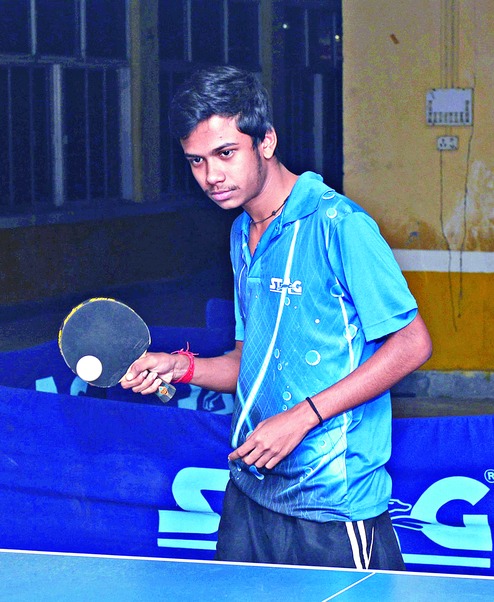
Anirban Ghosh during a practise session

Cossipore:

A 19-year-old whose mother sold her harmonium to buy his first table tennis kit has been the state champion in the game for two years in a row.

Anirban Ghosh spends more than four hours travelling from his Naihati home to a Cossipore club for practice everyday. The journey home in a crowded local train is particularly taxing after a long day’s practice.

The teenager’s father played para cricket to run the family before setting up a mini-recharge shop near Naihati station five years ago. The financial worries of Abhijit, 54, and wife Kakali, 46, have somewhat abated because of a sports stipend of Rs 18,000 that their son has been getting from the Airports Authority of India since last year.

Anirban won the state championships in both the youth (U-21) and men’s categories in 2016 and did an encore this year.

source: http://www.telegraphindia.com / The Telegraph, Calcutta,India / Home> Calcutta / by Debraj Mitra / December 21st, 2017

Playing T20 of classical music in Kolkata

Anubrata with father Pt. Anindo Chaterjee

Kolkata :

In order to draw the attention of a young crowd not initiated to Indian classical music, tabla player Anubrata Chatterjee has come up with a unique concept. In an innovative fashion, Chatterjee has conceived a new show that will cater to the tastes of those who have a short-attention span.

On January 11, Chatterjee is bringing a unique concert to the city called Beats & Pieces. Chatterjee describes this as “T20 of classical music” and is being presented by Pt Anindo Chatterjee’s Music Academy for Tabla Research (MATRA). This concert will feature 20-minute individual solo acts of Mayookh Bhowmik on percussions, Pratik Shrivastav on sarod, Rageshri Das on thumri, Allarakha Kalavant on sarengi and Chatterjee on tabla. All the artistes will finally jam at the end for a 20-minute session.

“The usual audience for classical concerts is fast ageing. If classical artists can’t connect to the youngsters, we shall find the numbers of art connoisseurs fast declining. That’s how Beats & Pieces came to my mind. It has a young vibe with its roots in tradition.

I hope, a packed performance, full of fireworks of Indian music, shall catch the attention of youth just like T20 cricket did,” said Chatterjee, who is also looking forward to the Sur Festival on February 4 where he will be playing a duet with Pt Kishan Maharaj’s grandson Shub Maharaj.

source: http://www.timesofindia.indiatimes.com / The Times of India / News> City News> Kolkata News / by Priyanka Dasgupta / TNN / December 18th, 2017

Big CAT is ready to land

Dum Dum:

Precision landing in dense winter fog with a visibility limit of 50 metres will become possible at Calcutta airport from January 4, when the Category III-B instrument landing system makes it debut on the primary runway.

An official of the Airports Authority of India said on Monday that pilots trained to land aircraft in low visibility were practising assisted touchdown during non-peak hours. “Visibility is fine as of now but pilots are having drills in preparation for the launch.”

He said air traffic control personnel were also acquainting themselves with the new system.

CAT III-B, the answer to fog-induced flight delays almost every January, was sanctioned for the city airport in early 2014 and cost Rs 130 crore to install. Metro had reported on November 30 about the instrument landing system awaiting a final clearance by the directorate-general of civil aviation.

“All inspections have been completed and we are ready for operations. We will be providing the facility by the cut-off date and it is up to the airlines to use it,” the official said.

To be able to use the CAT III-B system, airlines need compatible aircraft and pilots trained to operate in low-visibility conditions.

Captain Sarvesh Gupta, the chairman of the airline operators’ committee in Calcutta, said most pilots flying in India were trained in CAT III-B operations. It pays for airlines to have pilots compliant with CAT III-B procedures because fog delays translate into loss of revenue.

Between late December and mid-February, flights are often disrupted because of dense fog in the morning and night. According to officials, such disruptions usually happen between 3am and 9am, when the maximum number of flights operate.

The CAT II instrument landing system currently in operation enables aircraft to land till visibility of 350m. This is inadequate for a city where visibility often dips much lower in winter.

Whenever flights have to be diverted, not only do passengers suffer but affected airlines also take a financial hit. Apart from burning additional fuel, an airline has to pay landing and parking charges at the alternative airport. If the delay is long, arranging accommodation for passengers entails more expenditure.

“When hundreds of passengers are stranded at an airport, infrastructure is tested as well. The washrooms are used by more people than they can handle and there is sometimes no place for passengers to even sit,” Gupta said.

Airport officials expect CAT III-B to almost eliminate fog-induced disruptions because visibility hardly, if ever, drops below 50m in Calcutta.

The number of lights along the centreline of the primary runway have been doubled as part of the upgrade from CAT-II to III-B.

The new instrument landing system has been installed on the southern side of the primary runway because the wind blows from north to south during winter in these parts. A tailwind would increase the possibility of an aircraft overshooting the runway while landing.

The new system also includes an advanced signalling mechanism.

source: http://www.telegraphindia.com / The Telegraph, Calcutta,India / Home> Calutta / by Sanjay Mandal / December 19th, 2017
Kolkata boy defeats asthma, scales nine peaks in five years

Kolkata :

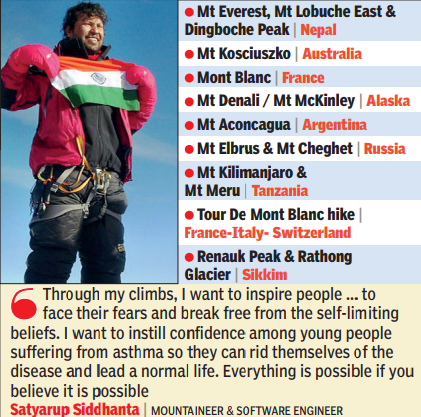
A mountaineer from Kolkata completed the rare feat of scaling nine peaks, including the Seven Summits (the highest peaks of each of the seven continents), on Saturday. Software engineer Satyarup Siddhanta, 34, climbed Mt Vinson in Antarctica shortly after 9am (local time) – his ninth summit since 2012.

An asthma patient who has never had any formal training in mountaineering, Siddhanta climbed the Everest in 2016. He has also scaled Mt Albrus, Mt Aconcagua, Mt Kilimanjaro, Puncak Jaya and Mt Denali. These apart, Siddhanta has also climbed Mont Blanc and Carsten’s Pyramid in Pappua New Guinea – the highest point in the Australian continent.

A resident of Kalitala Housing in Thakurpukur, Siddhanta is now based in Bangalore. According to his fellow climber Rudraprasad Haldar, Siddhanta once went to the Everest Base Camp and was inspired to begin his mountaineering journey, though he had no training. “It changed him forever and he decided to climb the Seven Summits,” said Haldar. Siddhanta’s website, however, mentions that he is a certified mountaineer from the Himalayan Mountaineering Institute in Darjeeling.

He overcame asthma which could have been a major barrier. “I realized I needed to reduce my dependency on inhalers when I was in college. I was also allergic to food items which triggered asthma. I struggled for years, continuously challenging myself by avoiding inhalers and consuming the food I was allergic to, without taking anti-allergic medicines,” Siddhanta wrote on his website.

But he didn’t give up. “I wanted to push limits to see how far I could go. Finally, with exercises, discipline, diet and some considerable will power and determination, I got rid of asthma,” he wrote.

His mother Gayatri, a homemaker, stayed up all night on Friday, following his march to the peak of Vinson.

“I couldn’t sleep a wink. I was more relieved than happy when he finally reached the summit,” she said. Siddhanta’s father Subhamoy is a doctor.

Gayatri said Siddhanta received funds from a few corporates for the climb. “He also auctioned some of his belongings and took a loan of Rs 30 lakh,” she added.

source: http://www.timesofindia.inditimes.com / The Times of India / News> City News> Kolkata News / by Monotosh Chakraborty / TNN / December 17th, 2017