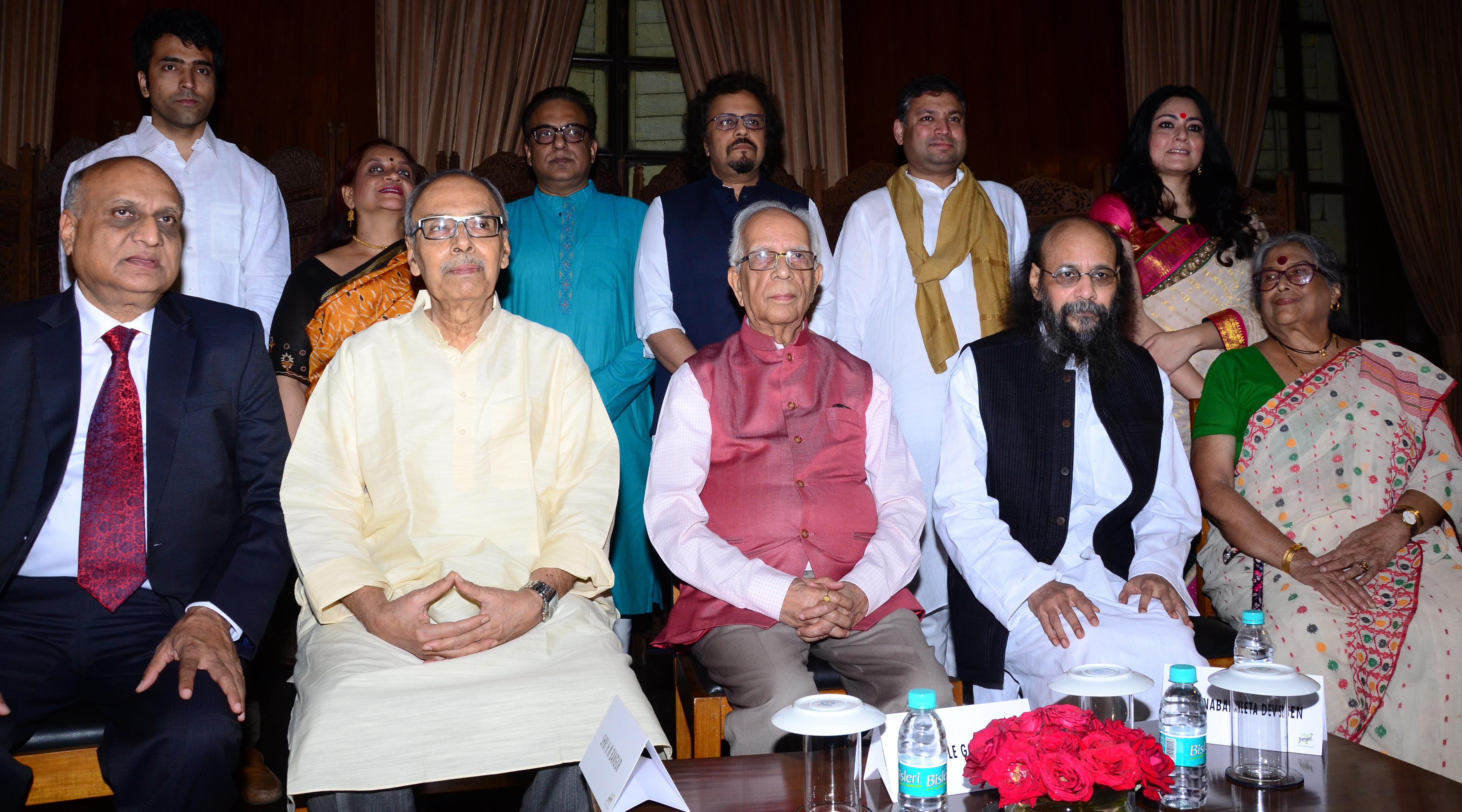
The Governor of West Bengal, Keshari Nath Tripathi, will honour litterateur Prafulla Roy with the Sunil Gangopadhyay Memorial Award for the year 2017 at a function in Raj Bhavan today.
The award ceremony is organised by The Bengal, an NGO represented by prominent individuals of the state from different walks of life.
The Governor, along with author Nabaneeta Dev Sen, president of The Bengal, and HM Bangur, chairman of the NGO, will confer the award on Prafulla Roy.
Agnimitra Paul will host the event, and members of the NGO like Goutam Ghose, Arindam Sil, Jogen Choudhury, Dona Ganguly, June, Bickram Ghosh, Aniruddha Roy Chowdhary and Usha Uthup, among others are expected to attend the event. A few celebs will also perform at the do.
“The Sunil Gangopadhyay Memorial Award was instituted in 2012 by The Bengal, a city-based NGO, following the demise of its immediate past president late Sunil Gangopadhyay. The award, which includes a citation and a cash amount of `2 lakh, is for outstanding work and contribution to Bengali literature,” said culturist Sundeep Bhutoria, honorary general secretary of the NGO.
The award for the years 2012-13 and 2013-14 were conferred on eminent poets Nirendranath Chakraborty and Sankha Ghosh respectively by the then President of India, Pranab Mukherjee. Other recipients of the award were Sirshendu Mukhopadhyay (2014-15) and Joy Goswami (2015-16).
source: http://www.timesofindia.indiatimes.com / The Times of India / News> City News> Kolkata News / by Srishti Dasgupta / TNN / April 19th, 2018
Conservation experts from the United Kingdom are voicing concern over the loss of Calcutta’s architectural heritage.
Conservation architect Philip Davies, who campaigns for the “shared heritage of Calcutta and Britain” and James Simpson, OBE, architect and vice-president of ICOMOS, UK, a heritage and cultural organisation, have lent their support to the protest march that Calcutta Architectural Legacies (CAL) is organising on April 18, the World Conservation Day.
Simpson believes Calcutta is facing a situation that Edinburgh faced 50 years ago. when development had threatened to rob the Scottish capital of its architectural heritage.
“Calcutta is… eminently worthy of recognition by Unesco as a World Heritage City. When chief minister Mamata Banerjee came to the Scottish capital last November, she saw in Edinburgh a beautiful city, whose heritage has made it one of the best places in the world in which to live and to do business, and to whose economy tourism makes a significant contribution,” Simpson wrote in an email sent to Metro on Sunday.
The Calcutta Municipal Corporation had last year downgraded the heritage status of the building that housed the old Kenilworth Hotel near the Middleton Street-Little Russel Street crossing, enabling its demolition by the present owners. Conservation activists have alleged that a builder-authorities nexus was behind the downgrading and the subsequent demolition.
The civic body had said the heritage downgrade of the building happened in accordance with law.
Amar Nath Shroff, the chairman of Alcove Realty, has said his company has not done anything outside the law. Alcove Realty is part of the consortium that owns the plot where the hotel stood and is promoting The 42, Calcutta’s tallest building.
Simpson said Calcutta’s heritage is its greatest asset, on which its future should be built. “Amit Chaudhuri and his supporters in CAL and PUBLIC are fighting for the very survival of the city. Without the architecture and the culture which makes it uniquely special, Calcutta will, in global terms, sink into mediocrity,” said Simpson.
London-based architect Philip Davies, who believes citizen’s movement is important to force governments into action, said: “Amit Chaudhuri, CAL and PUBLIC are to be applauded for taking to the streets to protest against the de-listing of buildings and the refusal of repeated administrations to designate conservation areas to protect its historic centres. Kolkata is one of the world’s great historic cities. Its remarkable heritage is enshrined in the very fabric of its buildings, neighbourhoods and public places. They desperately need strong statutory protection.”
Lamenting the loss of many such buildings, like the Strand Road warehouses, Davies said: “What is happening is a scandal. The Strand Road warehouses have stood vacant and decaying on a prime central riverside site for over 50 years losing crores and crores of potential revenue. The Botanic Gardens are of world significance and the oldest in Asia, but they are appallingly neglected with no coherent strategy for their future.”
He also lists the Silver Mint and Mint Master’s House, among the finest neoclassical buildings in India, that have been lying dilapidated for decades. The buildings that made Calcutta “a city of palaces” are threatened with development, he said.
Historic buildings and neighbourhoods are a huge economic and cultural asset, feels Davies. “A successful city can, and must, have both. Conservation is not an optional extra luxury, but crucial for sustainable urban regeneration and change. Heritage-led regeneration works,” he said.
Experience across the world – from London to Cape Town – demonstrates that waterfront cities can, and do, reinvent themselves. Calcutta can do the same and reap huge economic benefits for all, but it needs vision and leadership, felt the architects.
Grateful for the support from the UK, Chaudhuri said: “They have long been interested and invested in conservation in Calcutta.”
Talking of the UK experience in conservation, he said: “We can learn from Edinburgh, which never lost any of its architectural heritage, unlike Glasgow. We can learn from Scotland and London. But we can also learn from our own Mumbai, which has its own heritage precincts like the Churchgate and Oval Maidan, and the art deco of Marine Drive.
All these places are not museum-like but lived spaces shared by the affluent and the ordinary people. Calcutta too has the same mix of livelihoods and buildings that would form an attractive part of the city.”
source: http://www.telegraphindia.com / The Telegraph,Calcutta,India / Home> Calcutta / by Anasuya Basu / April 16th, 2018
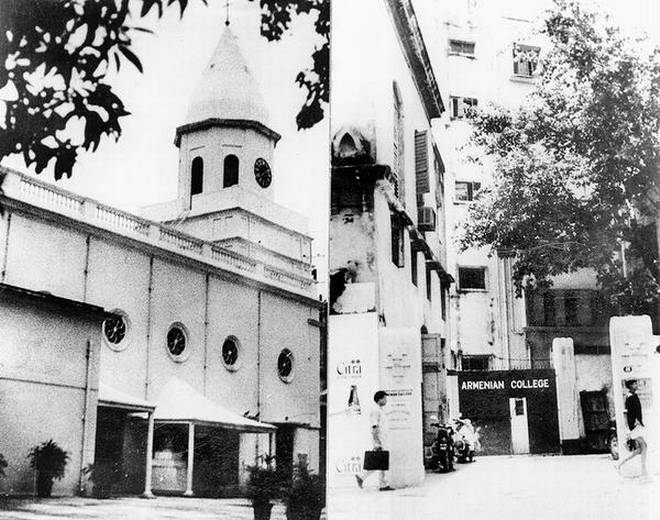
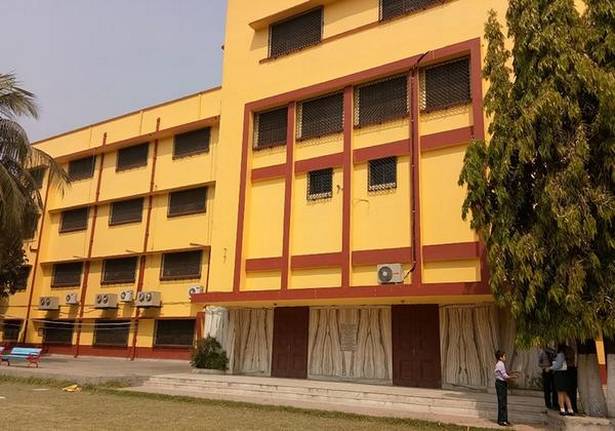
The Armenian Church of Nazareth, the oldest church in Kolkata; and (right) The Armenian College. | Photo Credit: PTI
For 197 years, the Armenian College and Philanthropic Academy has offered not just education but a sanctuary for children torn by conflict.
It was a birthday party of a different kind.
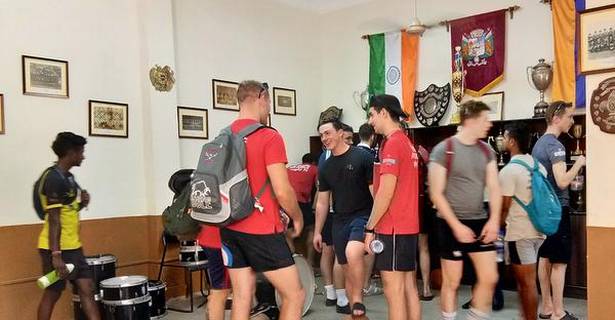
Brought together often by conflict and exile and nurtured in a regime of tough love, the dozen alumni and 70 present students of the Armenian College and Philanthropic Academy (ACPA) of Kolkata were celebrating 197 years of the institution on April 2.
Amid the animated discussions on the crisis in West Asia, Razmik Hakobyan, a 24-year-old Iraqi, an alumnus of the school, said he was dispatched to the ACPA in 2007 for “safety and education,” after a bomb exploded close to his house in Baghdad’s upmarket Kembel Gilani area. Mr. Hakobyan’s father, a retired soldier, decided distant Kolkata was safer.
“A friend who studied in Kolkata told us about the school and my parents got interested,” said Mr. Hakobyan, who left Baghdad when he was just 13. He would like to visit Baghdad, he said, but only on vacations.
“Baghdad is not getting better and nor is its education,” said the young man, whose family has since shifted to Kurdistan. Close to completing his graduation at the city’s St. Xavier’s college, Mr. Hakobyan says he is indebted to the Armenian College and its teachers.
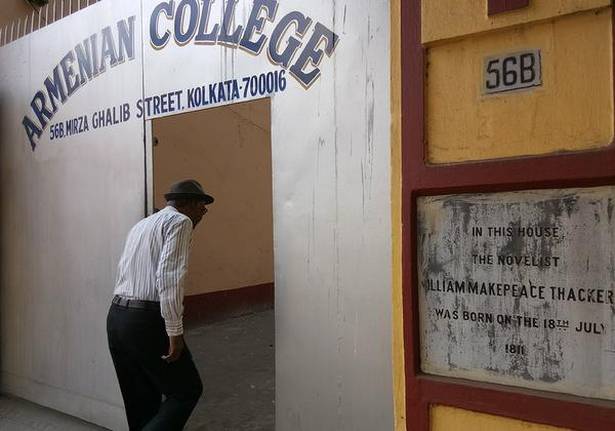
Set about 500 metres north of Park Street in the heart of the city, a plaque at the entrance of the imposing yellow building announces that “the novelist William Makepeace Thackeray was born on the 18th July, 1811” in the premises. Since 1821, it has housed the Armenian College and Philanthropic Academy — a school for Armenian students from all over the world up to Class X.
India as home
The Armenians adopted Christianity in 301 AD and were invited “to come and settle in his dominions” by emperor Akbar in the 17th century.
They arrived in Bengal in 1645 and settled along the Hooghly’s fertile western bank like most traders of the time. Anne Basil in her seminal book Armenian settlements in India writes that the community grew in size and influence and felt the need to have its own school. An informal school was set up in 1798, which was replaced by the present Armenian College and Philanthropic Academy on April 2, 1821, at 358, Old China Bazar Street near the Armenian Holy Church of Nazareth, Calcutta.
Following the genocide of more than a million Armenians in eastern Anatolia by Turkish forces in 1915, “hundreds of children of uprooted families…found shelter and a roof and received sufficient education…” at the Kolkata school, notes Basil.
Open to all Armenians
Armen Makarian, a former student and school’s coordinator, said the institution is the only Armenian school of its kind in the world.
According to Very Reverend Father Movses Sargsyan, head of the Davidian Girls’ School (DGS) — the girls’ wing — and Armenian College, the school is globally known among Armenians. “Internet, website and social pages informed the guardians,” Father Sargsyan said. While a majority of the students are from Armenia, the rest are from the Armenian disapora in Iran, Iraq and Russia and a handful of Indian-Armenians.
“We would like to have Armenian students from across the world — from Germany, Italy or France and even Syria,” Father Sargsyan said.
Like most boarding schools, the Armenian College has an intensely packed, exacting schedule. Mobile phones and laptops are a strict no-no, with the students allowed two hours out of the premises for shopping.
“But we like it,” said Vladimir Grigoryan, a ninth standard student, who was born in Russia but now stays in the Armenian capital, Yerevan.
“My parents were paying $2,500 annually for my education in Armenia. But the teachers never cared if we were learning — unlike here where teachers are constantly demanding,” said Vladimir, whose father runs a chain of hotels in Russia.
For Sevak Azarian Namagardi from Iran, who just appeared for his ICSE examinations, life is a “little boring” at times. Being a trained singer and a regular at choirs, he looks forward to weekly chats with his family over Skype.
“As the summer vacation approaches, I’m making arrangements to leave for Tehran,” he said. He has more reasons to cheer. “This time the family and I will visit Armenia, our motherland,” said Sevak. He, however, is equally keen to get back to friends at the school.
Academic challenge
Imparting education to students from such diverse backgrounds, however, is not easy. Soumitra Mallik, Principal at the Academy said the key problem was to match various levels of education.
“We do not know if the student who has studied up to Class V in her or his country is on par with what is taught here under the ICSE syllabus. So, this content mapping and matching is a problem,” he explained.
The other problem is communication as the students usually come from non-English speaking backgrounds. While Armenian teachers teach Armenian language, history, and culture, most of the around 25 faculty members at the Academy are Indian.
“So, we have six-month preparatory courses where we intensely teach English, some Mathematics and a bit of the Sciences to provide an outline of what the student will study and to hone their English language skills,” Mr. Mallik said. So far, it has worked well as many of the students are quickly able to leapfrog to reading Shakespeare’s Merchant of Venice within a few years!
Arindrajit Saha, the English teacher, said, “Studying Shakespeare within a brief period of time can be considered an important marker.”
Though the students indeed are grateful for the free and quality education they receive, there are regrets of a lost childhood back home.
“Saddam Hussein may have been a dictator but Iraq was not doing too badly and there was peace. With his departure, the country permanently collapsed and I had to leave my incomplete childhood behind,” said Mr. Hakobyan.
The different countries that the students hail from may not share friendly diplomatic ties, but the bond that Mr. Hakobyan or Sevak develop at the Kolkata school go beyond political compulsions or geographical boundaries.
“We are from the same tree, with same roots. The branches move in different directions, but the root remains,” says Arian Makarian of Iran, an alumnus.
source: http://www.thehindu.com / The Hindu / Home> News> Cities> Kolkata / by Suvojit Bagchi / Kolkata – April 14th, 2018
Residents of Raiganj have pinned hopes on Sonia Baishya, a local girl, to achieve medals at the Commonwealth Games on Saturday.
On Saturday, Sonia will participate at the finals of the 4 X 400 relay race at the international sports event. She is the sole member in the Indian squad from north Bengal.
“I have spoken with her over phone and have mentioned about the high hopes of Raiganj residents. We will organise a puja at home ahead of her event. But I will not join others to watch the live telecast. All of us are eagerly waiting for her success,” Baren, her father, a resident of Netajipally in the town, said.
In 2017, Sonia had bagged gold at the same event in the Open National Athletics Championship that was held in Chennai. Then she participated at 18th Asian Games Invitation Tournament held on February this year at Jakarta in Indonesia. There, she had also won the gold medal.
“Sonia’s consistent performance has helped her to secure a berth in the Indian squad that was sent for Commonwealth Games. India has already won a number of gold medals in the event but Saturday’s event is most important to us. We want to see her succeed,” said a sports enthusiast of the town.
Ahead of the event, residents, social organisations and even the North Dinajpur district administration have drawn up plans to pray for us as well as put giant screens to show the live telecast of Sonia’s event.
“A giant screen would be put at the stadium here where people can watch the event. Sonia Baishya has made North Dinajpur district proud and to encourage more children and youths to join the sports arena, we have made the arrangement,” said Ayesha Rani A, DM, North Dinajpur.
Sonia’s friends have planned a prayer meeting for her success. Also, organisers of Quiz Premiere League, a which will be held in the town from Saturday, have said that they would pray for her ahead of their programme.
“All eyes would be on Sonia on Saturday. People are planning celebrations if she succeeds,” said a representative of the District Sports Association.
source: http://www.telegraphindia.com / The Telegraph,Calcutta,India / Home> West Bengal / by Kousik Sen / April 14th, 2018
Thailand silver teaches chess teen how to finish first
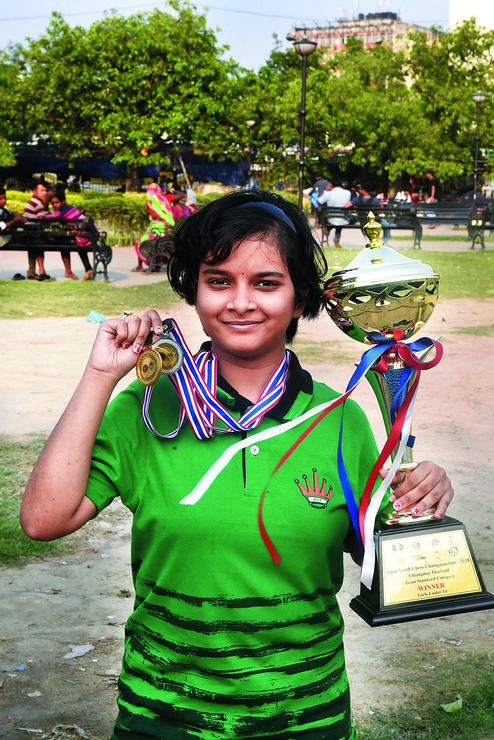
Bristy Mukherjee outside the Maidan club. Picture by Sanjoy Chattopadhyaya
Calcutta:
If Bristy Mukherjee misses her 8.45pm train from Howrah after training at a Minto Park academy, she has to wait another 90 minutes to catch the next one and reach home past midnight.
The 14-year-old from Memari in East Burdwan has become used to the consequence of missing trains, but is having a hard time consoling herself about the gold medal she narrowly missed in Thailand this month.
Half a point was all that forced Bristy to settle for silver in the under-14 girls’ category of the Asian Youth Chess Championship at Chiang Mai between April 1 and 10.
Bristy had outplayed higher-ranked players in four consecutive rounds, but drew her last match against China’s Wan Quian to score 6.5 points in nine rounds. This was just half a point less than what Kazakhstan’s Kamalidenova Meruert had totalled to win the gold.
The visit to Thailand was the first time Bristy had travelled abroad. She has had to skip a couple of other international tournaments because her parents could not afford the expenditure.
Bristy’s mother had mortgaged her jewellery to arrange just over Rs 70,000 so that she could compete in the Asian Youth Chess Championship. Her father used to run a grocery shop that shut down two years ago because accompanying his daughter to tournaments left him with little time for business.
“I have to travel with Bristy within and outside the state. There is nobody else to sit at the shop,” Debasish Mukherjee told Metro at a Maidan club where Bristy and other players from Bengal were felicitated by the state chess association.
Mukherjee rents out a portion of his ancestral two-storey house for private ceremonies. The prize money that Bristy wins is kept aside to cover travel costs, although that is hardly enough.
Bristy trains at the Alekhine Chess Club at Gorky Sadan, near Minto Park, and spends six hours a day travelling. “The journey is especially taxing during the summer months,” she said.
Chess became Bristy’s life in 2010 when she was visiting a nursing home near Minto Park with her parents. “I noticed an advertisement for admission to Alekhine Chess Club. Nobody in our family was associated with chess but I liked the game,” she recalled.
That was July. In October the same year, Bristy won the first tournament she participated in – at the Khudiram Anushilan Kendra in the under-6 category. At the Asian School Championship in 2011, she won a bronze medal in the under-7 event.
Bristy, who studies at Memari Rasiklal Smriti Balika Vidyalaya, idolises Grandmaster Koneru Humpy and aspires to win laurels for the country. “She is from a place where there is hardly any chess infrastructure. She is promising but the pressure to perform sometimes hampers her game. Her performance in Thailand is encouraging. This is the break she needed,” said Atanu Lahiri, the general secretary of the Bengal Chess Association.
source: http://www.telegraphindia.com / The Telegraph,Calcutta,India / Home> Calcutta / by Debraj Mitra / April 15th, 2018
Satyen Das was busy picking up passengers on his rickshaw at Geetanjali Metro station in Naktala when he got to know a documentary film—‘Ladakh Chale Rickshawala’ — on his rickshaw journey from Kolkata to Ladakh had won the Best Exploration/Adventure Film at the 65th National Film Awards announced in New Delhi on Friday.
By afternoon, when he got the news, the 44-year-old had already earned Rs 150, but he was more excited about the award. It’s his love for adventure that gave him the courage to fight all odds to complete the treacherous journey, says Das.
It turned out to be a life-changing moment for Das, when Indrani Chakraborty, a television producer from Naktala, hailed his rickshaw in 2014. During the short journey, she learnt that Das was planning to leave for Ladakh soon. He fished out old pictures of him visiting Puri and some places in north India on his rickshaw and showed it to her. At that moment, Indrani decided to shoot his journey to Ladakh and turn it into a film.
“I didn’t have the money to follow Satyen Das on his entire journey to Ladakh, so taught him to shoot on a handycam. It was tough when the handycam stopped working after he crossed Benaras and someone from my team had to rush to where he was and get it repaired. Two of my associates and I met him on the final leg of his trip in Ladakh,” says Indrani.
Das credits Indrani for helping him in completing the journey and doesn’t forget to thank some of his regular passengers and members of Naktala Agrani Sangha, a club in his neighbourhood.
“I drove my wife and daughter to Puri and north India and was inspired to take my rickshaw to Khardung La mountain pass, the world’s highest motorable road, 39 km Leh. I got help from Indranidi, a few of my passengers and members of Naktala Agrani Sangha. There were many challenges; every day, someone or the other would ask me to return to Kolkata. ‘You can go till Srinagar, not beyond,’ they told me. But I didn’t budge,” recalls Das.
For Das, food was as big an issue as the lack of oxygen and the inclement weather. “I carried basic ingredients like rice and potatoes. I would either have aloo chokha-bhaat or instant noodles; it was more of a fight for survival,” he says.
But the toughest part of his journey came when he reached Zoji La pass. “The roads were rough and there was no way that I could carry my belongings on the rickshaw and cover the 8-km stretch. I would offload everything on the road drive the rickshaw for a few metres and return to carry the things on my shoulder. It took an entire day to cross that stretch, but I didn’t stop. I wanted to create a record of sorts by reaching Khardung La.”
Das, who shot his journey on a handycam, was joined by a three-member camera team in Ladakh. “From thereon, there was no looking back. I returned to Ladakh again in 2017, this time with the message of fighting global warming. I sprinkled 5,000 date seeds along the way.”
His rickshaw has been put on display at the university campus set up by Sonam Wangchuk in Ladakh. Indrani, who helmed the documentary film, said even though the journey took two-and-a-half years to complete, it took her three years to finish this 64-minute film. She approached Films Division, which has taken the project under its wing.
source: http://www.timesofindia.indiatimes.com / The Times of India / Home> News> City News> Kolkata News / by Zinia Sen / April 04th, 2018
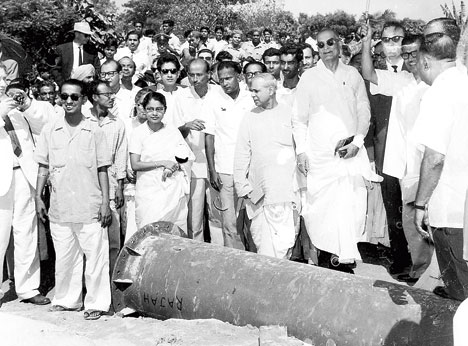
Chief minister Bidhan Chandra Roy and Ajay Mukherjee inaugurating the Salt Lake reclamation scheme on April 16, 1962. A Telegraph file picture
It has been 22 years since he retired as administrator of Salt Lake Reclamation and Development Project, having handed over the reins of the township to the newly formed Bidhannagar Municipality the year before, but Pran Kishore Chatterjee still has data related to the formative years of Salt Lake at his fingertips.
Seated in his AD Block home, the 80-year-old reminisces about the time when chief minister Bidhan Chandra Roy visualised founding the Calcutta Eastern Garden Suburb. “The city was bound on the west by the river, the southern fringes were becoming refugee colonies which would have been tough to dislodge. So the east was the only direction to expand. He had once travelled by launch till the house of Hem Chandra Naskar (former Calcutta mayor) near Mahisbathan and I have heard it was during that voyage that the idea came to him.”
The idea was to reclaim about 6 sq miles of the marshland by dredging the bed of river Hooghly and pumping in the slush. An estimated 124 crore cubic feet of earth would be needed to raise the area to +12. This was a unit followed by the public works department to determine how much higher the land level of a place would be compared to the Hooghly water level. “Salt Lake was originally a low-lying saucer-shaped area, where the waste of Dum Dum Park and Bangur would be drained. That also helped pisciculture practised here. The area was now to be raised to a level high enough to ensure that it would never suffer inundation. That is why Sector I and most parts of Sector II have no need for drainage pumping. Water naturally gravitates to Kestopur Canal. A drainage pumping station was built much later for Sector III opposite Nicco Park when the area was found to be too far from Kestopur Canal. The Eastern Drainage Canal was excavated for the purpose.”
The dredging started on April 16, 1962 and 11 floating units (two dredgers, two tug pusher boats, two bergs and two survey launches and three boosting stations) were deployed.
A survey had earlier been done on the Hooghly to check where the riverbed level was highest. A shoal at Ghushuri, near Chitpore Lockgate, was deemed the closest. That is where the dredging started. Using a booster pump, the slush was sent to Ultadanga, near Golaghata. The soil would be dumped at the site while the water would be drained into Kestopur Canal.
By 1967, about 90-95 per cent dredging was done. By then, the young engineer had participated in the government’s Re 1 lottery for distribution of plots in 1965 and got three cottahs at Rs 2,750 per cottah. “We used to stay in Jodhpur Park then. Since there was no transport, the Salt Lake Project ran a bus from Ultadanga crossing just to show prospective buyers how the area was developing. Still there was little interest as people thought houses built on a bed of sand would sink.”
One day, he brought his wife and father-in-law to show the plot. “A few houses dotted the expanse amid dense overgrowths of bulrushes. There was not a single tree in sight. The wind blew sand into the eyes and nostrils. I still remember my father-in-law’s sombre face when he set foot here.”
The Chatterjees did move into their newly built house in 1979 and stayed for two-three years before he was transferred. They settled permanently in 1988. He took over as administrator the year after. The Bidhannagar Notified Area Authority came into being in 1990.
Pran Kishore Chatterjee at his AD Block residence on Wednesday. (Sudeshna Banerjee)
“Initially when we were planting trees, we avoided fruit-bearing trees so that there would be no disputes over the fruits. But that kept the birds away. So we changed our decision and planted mango, wood-apple, jamun later.” Another lesson learnt along the way was keeping space for cooperatives and not just individual plots. “That is why you see all the cooperative complexes in Sector III which was the last to come up.”
Three types of roads were planned — arterial, spinal and local i.e. inside blocks varying in width from 48.46m to 9.14m. Interestingly, First Avenue is not the widest because it was never meant to be the primary gateway it has become.
“Second Avenue was supposed to be the arterial road. But when dredging started the familes that stayed in the area relocated to the highland which later became Duttabad slum. We never bothered about them then as we could carry out our work. But later when their presence blocked the exit from Second Avenue to the Bypass, an alternative exit had to be found in CA Block.”
He takes a lot of pride in pointing out that 23 per cent space was kept for roads. “At that time, the figure was barely 7 per cent for Calcutta.”
And though New Town was born long after his retirement, he likes to believe he made a contribution there too. “Gautam Deb (then the chairman of Hidco and the housing minister) had sought my advice. I told him not to repeat the mistake made with Salt Lake where no one from outside could make out how the township was developing. I asked him to first curve out a road to the airport through the project area so that people could see the development being undertaken,” he smiles.
DID YOU KNOW?
Originally 15sq km of marshy land was supposed to be reclaimed. But there was hue and cry about drainage getting clogged so Nalban and Chinta Singh Bheri were left out and the remaining 12.35sq km was reclaimed.
source: http://www.telegraphindia.com / The Telegraph,Calcutta,India / Home> Calcutta / by Sudeshna Banerjee / April 13th, 2018
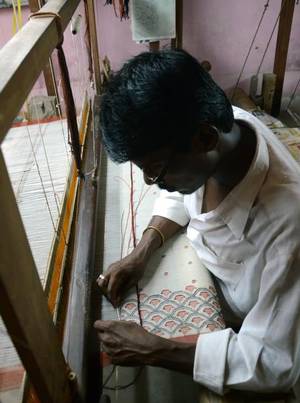
The Bengali Jamdani does not have a GI tag yet. Here, a weaver at the pit loom works on a Jamdani print at a factory in Kana, West Bengal. File photo. | Photo Credit: Sushanta Patronobish
So far, only three types of sarees from West Bengal — Baluchari, Santipur and Dhaniakhali have obtained the GI tags.
The textiles committee of the Union Ministry of Textiles has asked the various weaving communities of West Bengal to apply for the Geographical Indication (GI) tag for Intellectual Property Rights (IPR) protection.
So far, only three types of sarees from West Bengal — Baluchari, Santipur and Dhaniakhali have obtained the GI tags.
“We are asking the different weaving communities of West Bengal to go for GI registration. Some of them are the weavers of Bengali Jamdani, Begumpuri and Bengali Tangail sarees which have huge export markets,” deputy director of the Textiles Committee of the textiles ministry T.K. Rout told PTI.
The weavers of scarves and stoles of Fulia should also apply for GI registration, he said.
Mr. Rout said that once these weaving communities get the GI tag, their IPR would be protected and legal action could be initiated against those who were not bonafide claimaints of these textile products. “Even the export markets of these products would be protected,” he said.
“GI is IPR which provides protection to the products which have origins in a particular geographical location and different from patents and trademarks,” Mr. Rout added
It also gives protection to those weaving communities from counterfeit claims by others, he said adding that the ministry was working to facilitate this process.
As of date, 270 products of the country had been registered under the GI Act, out of which 151 of those belong to the textiles and handicrafts segment.
source: http://www.thehindu.com / The Hindu / Home> News> Cities> Kolkata / by PTI / Kolkata – March 16th, 2018
Forefather’s legacy reinvented with honesty of heritage
Golpark:
A Calcuttan whose forefathers had migrated to the city from Rajasthan more than 150 years ago has returned to his roots to turn an ancestral haveli into a boutique hotel.
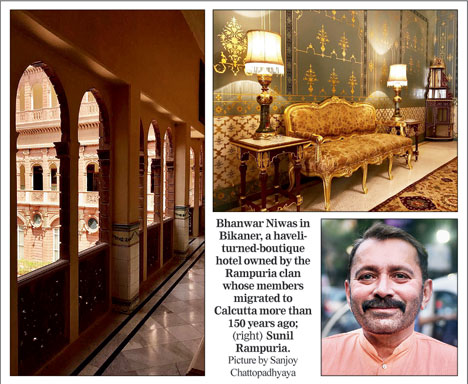
Bhanwar Niwas, one of the famous mansions owned by the Rampuria clan, stands in the old walled city of Bikaner. The haveli had been built in the late 1920s by Seth Bhanwarlal Rampuria, heir to a textile and real estate fortune in Calcutta. It became a boutique hotel in 1993 at the initiative of Bhanwarlal’s grandson, 61-year-old Sunil Rampuria.
Sunil, an alumnus of La Martiniere for Boys and St Xavier’s College, is now based in Bikaner but keeps visiting Calcutta, which he calls “home” and where his parents and in-laws remain.
“The Calcutta I grew up in has made me the person I am. The city is steeped in tradition but that has not stopped it from being liberal. Calcutta moulds you,” Sunil said.
He remembers going to a kindergarten school on Royd Street that used to be run by a Spanish woman and an Iraqi man. “I always wondered why their surnames were different. Back then, living in was not a common thing,” he quipped.
Sunil had sold a house in Vizag, where he had worked in a construction company for several years, to fund the facelift of Bhanwar Niwas.
Although the property is more than 90 years old, it did not need much renovation. The architecture of the three-storey mansion is a mix of Indian and European styles with a majestic facade and a sprawling courtyard in the middle. Multiple staircases and large rooms complete the heritage look.
“People from my native place came to work in Calcutta and eventually settled down. But there were relatives back home. They built large houses because they were a status symbol,” Sunil told Metro before returning to Bikaner last weekend.
Several bhujia makers in the city trace their roots to Bikaner. The Rampurias are one of the oldest among these clans with several havelis spread among Sunil’s distant relatives.
His great grandmother lived there until 1988. Sunil left Calcutta in 1992 when he was 27 and started the project the same year. He was married with three children and his parents were apprehensive about the decision because of the risks.
In Bikaner, people were surprised that Sunil was reversing a trend. While his forefathers had migrated from a provincial town to a booming business centre, he was returning from Calcutta.
Before the hotel opened, Sunil made changes like carving attached bathrooms out of the large rooms. He did the stencil-painted wallpapers himself.
The hotel has done well over the years. “I don’t have go to Delhi to solicit business,” Sunil said.
Bhanwar Niwas offers a wholesome period experience in its own way. It is located in the middle of a locality and guests can see people celebrate local festivals. There are no TVs in the rooms because Sunil wanted to be “faithful to the period when the mansion was built”.
It is hard to miss the connection with the Best Exotic Marigold Hotel, the 2012 film about a young Sonny Kapoor (played by Dev Patel) who wants to realise his father’s dream of restoring a grand hotel in Jaipur.
Sunil downplays the comparison, but is proud that his eldest son Prashant now looks after Bhanwar Niwas.
Calcutta is dotted with centuries-old buildings that are caught in the conservation conundrum.
A little over a month ago, the Calcutta Municipal Corporation allowed the building that housed the old Kenilworth Hotel to be demolished by its present owners after downgrading its heritage status. Heritage conservationists alleged a builder-official nexus.
Metro reported last week that Tripura House, the stately Ballygunge Circular Road mansion, will have a residential highrise share a portion of its 100-cottah compound after the West Bengal Heritage Commission gave its nod to a project rejected by the civic body.
Heritage has to be relevant to make conservation viable, Aishwarya Tipnis, an architect working on French heritage structures in Chandernagore, said in a lecture at the Indian Museum last Wednesday. “Conservation is no rocket science. It is far from a NASA code that can’t be cracked,” she said.
Sunil seems to have cracked the code.
source: http://www.telegraphindia.com / The Telegraph,Calcutta,India / Home> Calcutta / by Debraj Mitra / April 12th, 2018
Coach relives olympic medal miss in ward’s Commonwealth shoot-off
Mehuli Ghosh after shooting a bullseye to tie with the eventual winner, Martina Lindsay Veloso of Singapore. (Reuters)
Calcutta:
The shot at gold in the women’s 10m air rifle event at the Commonwealth Games was down to two competitors. Martina Lindsay Veloso of Singapore had just scored 10.4 in her final shot and nothing less than a bullseye would give her rival a chance. Mehuli Ghosh hit exactly that: a 10.9.
The crowd erupted as Mehuli pumped a fist, kept her rifle down, took off her blinder and stepped back from her position. Thousands of miles away, in New Town, her coach Joydeep Karmakar yelled at the TV: ” Hoyni (It’s not over)!”
Martina and Mehuli were tied at 247.2, a new Games record, and the gold was to be decided by a shoot-off.
Joydeep, who himself missed an Olympic medal at the London Games by a whisker, knew it would be tough for his ward. “It’s not easy to quickly regain position. The body has to be aligned with the target and weight distributed between outstretched legs for perfect balance. This is achieved over several shots,” he told Metro within minutes of Mehuli finishing second.
When she called, the first word Mehuli uttered to her coach was “sorry”.
“She told me, ‘ Jani tumi rege gyachho (I know you are upset)’. I told her I was about to break the TV,” Joydeep said.
Mehuli had been misled by her name overtaking Martina’s on the scoreboard. “She missed the rank ‘1’ against both names and the term ‘s-off’ to the right,” Joydeep said.
Mehuli scored 9.9 to Martina’s 10.3 in the shoot-off. “If only I were there, I would have shouted out to her about the tie,” the disappointed coach said.
But he had regained his composure quickly enough not to make his ward feel any more miserable about missing the gold. “What happened was because of inexperience. She is just 17. Girls her age chat and have fun after school while she is hard at practice,” he said. “Mehuli has promised me she will make up for the loss.”
As the nation woke up to the Baidyabati girl’s feat, mother Mitali spoke of the two-hour journey, with four changes of transport, she makes almost daily to reach Joydeep’s academy at The Newtown School.
“This has been her routine since she was 14,” she said.
To let her focus on shooting, Mitali had even allowed her daughter to skip the board exam this year.
source: http://www.telegraphindia.com / The Telegraph,Calcutta,India / Home> Calcutta / by Sudeshna Banerjee / April 10th, 2018