All posts by wellnmed@gmail.com
07
Kolkata youth now a London councillor
Kolkata :
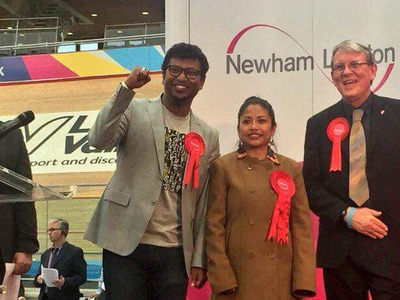
Rohit K Dasgupta, 30, has become the first Bengali from India to be elected as councillor in the London Borough of Newham. An alumnus of St James’ School and Jadavpur University, Dasgupta had joined UK politics in 2009, when he shifted to London to pursue his masters in English.
Last year, Dasgupta had unsuccessfully contested as the Labour Party’s parliamentary candidate for East Hampshire against the Theresa May government. This year, he won with 70% votes.
His parents — Mukut and Joyasree — are ecstatic. “My mother said my hard work paid off. My parents were up all night waiting for the results. They will have a celebration dinner,” Dasgupta said. After results, Dasgupta partied with all the Labour activists who contributed to his win.
Though he comes from a Left political tradition, none of Dasgupta’s parents have been involved in active politics. “I joined the Labour Party as I thought Gordon Brown was a fantastic leader and deserved to remain UK’s PM,” he explained. As for contemporary Indian politics, Dasgupta is against the “kind of Hindutva nationalism being espoused by the BJP”. “I was born in a secular country and to see that secularism being eroded makes me angry. I’m glad Bengal is one of the few states that has remained immune to Hindutva politics,” he said.
However, the recent Metro incident at Dum Dum — where his parents live — has left him ashamed. “Kolkata has been a bastion of liberal values compared to many other Indian cities. Moral policing is unacceptable. Showing affection should not be something we should be ashamed of or be censured for,” he said.
He will now he busy balancing his academic job at the Loughborough University and responsibilities as a councillor. Both jobs, he said, complement each other. As an elected representative, his priority is to expand “the equalities agenda of the council, repair and maintain all council homes and increase crime prevention”. Housing, he pointed out, is a big issue in Newham. “I’d like to see our council build more affordable homes for everyone,” he said.
Looking forward to strengthening the connection between Kolkata and London, he said, “Newham also has a sizeable number of Indian and Bangladeshi communities. There is opportunity for all kinds of cultural exchange with Kolkata and also learning good practices from each other.”
source: http://www.timesofindia.indiatimes.com / The Times of India / Home> City News> Kolkata News / by Priyanka Dasgupta / TNN / May 06th, 2018
05th
BL Block resident new India disabled cricket team coach
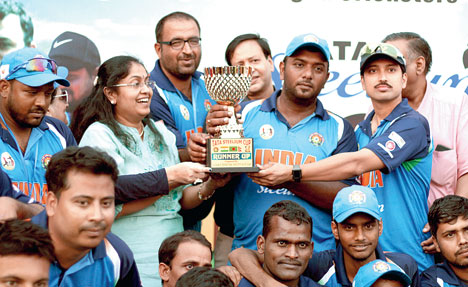
A Salt Lake resident has been appointed coach of the Indian cricket team. No, he is not replacing Ravi Shastri. Aparup Chakraborty of BL Block is now the coach of the physically challenged national squad.
“I have taken over from the second week of April,” says the former captain of the national indoor cricket team.
The team played the first tournament under his guidance in the Tata Steelium Cup, a T-20 tri-series held in the Eastern Railway Sports Complex, Behala.
“The cricket rules are the same as what you are used to seeing. The only exception is runners are allowed for up to three players per team,” explains Aparup.
Even then, he received a jolt when he first walked into the players dressing room. “We are used to seeing bats and pads strewn about on the floor. Here there were artificial legs too. Before taking the field, the leg amputees take that one step extra — putting the leg on before padding up. That sight was testimony to the challenges they overcme just to reach the cricket field.”
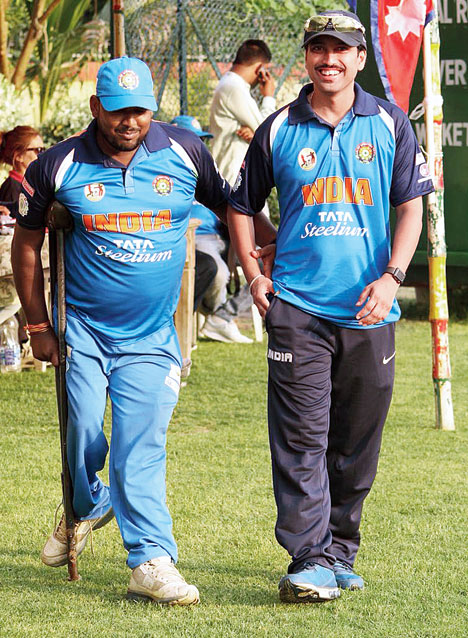
The 35-year-old coach is full of admiration for the level of competitiveness he witnessed on the field in his maiden assignment. “We have a 6ft tall bowler called Mandeep Singh who has a hand missing from the left wrist. But he bowls right-handed at 130 kmph. The Bangladesh skipper fields with a crutch. Yet when a ball was speeding past him he threw his crutch aside and dived to save the boundary. As it would have taken him time to get up, another fielder who was able of feet came running to pick up the ball.”
India lost the final to Bangladesh but Aparup is counting the positives from the tournament.
“Unlike in India, disabled cricket in Bangladesh gets infrastructural support from their cricket board and financial aid from their government. Their openers are among the top five players internationally. Here we function under Disabled Sporting Society but there is talk of the Board of Cricket Control in India taking over as the Lodha Commission report recommends that. But there is good talent in the team which we can harvest.”
He is looking forward to scouting for more talent across the country through tournaments. “India and England have bid for the right to host the disabled cricket World Cup in 2019. I hope to have a strong contingent by then.”
source: http://www.telegraphindia.com / The Telegraph,Calcutta,India / by Sudehsna Banerjee / May 04th, 2018
The communist who was not a bhadralok
Kolkata:
Veteran Marxist thinker and former state finance minister in the Jyoti Basu government (1977-86) Ashok Mitra died at a private nursing home on Tuesday morning. He was 90.
A man of letters, Mitra represented the rare breed of Marxists who left his cushy job as the chief economic adviser (CEA) to the government of India in 1972 and cut his teeth on Left politics as the finance minister of the first Left Front government in 1977. He was the pioneer of the alternative development model in Bengal. The senior economist leaves behind a rich legacy of debates and discourse over Centre-state relations that have come in handy for states now to expand federalism in terms of economic and political powers. Mitra, unlike his successor Asim Dasgupta, was not very keen on adopting uniform tax rates across the country. He believed it was an infringement of the state’s domain.
Uncompromising as he was with the dirt and filth of running the administration, quite evident from his famous “I-am-not-a-bhadralok-I-am-a-communist” remark over removing senior bureaucrat and Basu-loyalist S M Murshed from the post of power commissioner, the economist was slowly getting bitter with his own government till he put in his papers as the minister in January 1986, following differences with Basu. He also resigned from the CPM at the same time — just a month after he was inducted into the party state committee.
However, the separation couldn’t make a dent on Mitra’s unflinching commitment to Left ideology. All his life, the scholar kept writing against the “anti-poor policies” of the successive Congress governments at the Centre and was one of the fierce critics of globalization. A few years later, in 1993, CPM nominated Mitra to the Rajya Sabha where he made significant contribution, particularly on economic issues. He was the first to take note of the rightward shift in India’s economy following the appointment of Manmohan Singh in the Narasimha Rao government in 2007.
A brilliant author and regular contributor to magazines and newspapers, Mitra had a great command over both in Bengali and English. Apart from books like “Calcutta Diary” or “From the Ramparts”, Mitra wrote quite a few books in Bengali, including “Kabita Theke Michhile”, “Nastikatar Baire”, “Akatha Kukatha” and the much-acclaimed memoir “Apila Chapila” that deals with issue ranging from politics to literature. His collection of essays, “Taal Betaal”, won the Sahitya Akademi award in 1996.
The veteran Marxist was getting upset with the Left Front government over its tryst with private capital in Singur and couldn’t come to terms with the ways of CPM, particularly in Bengal, even after the government was voted out of power in 2011.
Former Lok Sabha Speaker Somnath Chatterjee offered glowing tributes to Mitra. “He was not only a brilliant economist, but a person who upheld the cause of the downtrodden till his last. I admired his erudition, his writing skills and his superb literary sense. I recall the days when I was a member of the State Administrative Reforms Committee formed by the Jyoti Basu government of which Ashok Mitra was the chairman. The committee had several meetings where members gave their opinions. Mitra didn’t depend on anyone in compiling the views and wrote the entire report on his own within a short time,” Chatterjee said.
Chief minister Mamata Banerjee condoled the passing away of the veteran Marxist.
source: http://www.timesofindia.indiatimes.com / The Times of India / Home> News> City News> Kolkata News / TNN / May 03rd, 2018
Landmark nuggets in 75th year
Desi steel for Howrah Bridge
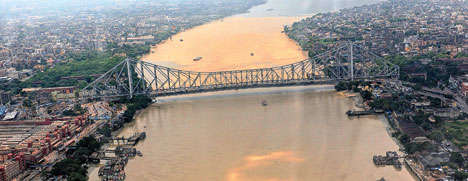
• When Howrah bridge was built in the late 1930s, nearly 90 per cent of its steel was made in India.
• When Vidyasagar Setu was built in the 1980s, all the steel was imported.
• The 705m-long Howrah bridge was built in 41 months. The 823m-long Vidyasagar Setu took 14 years to be built.
Calcutta:
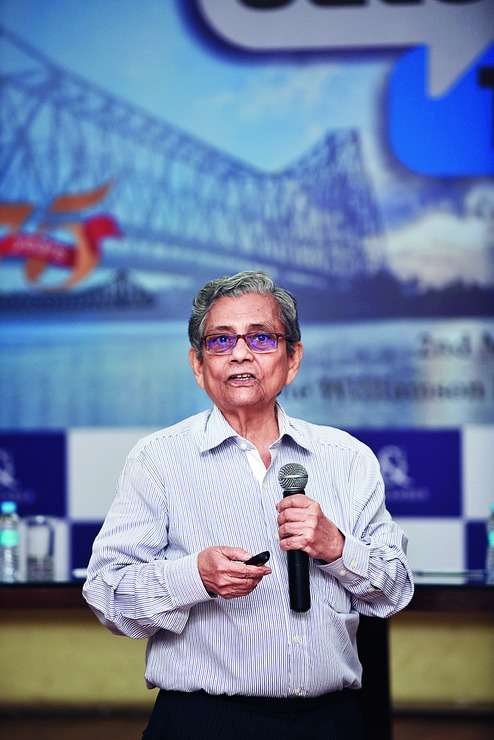
These and more such nuggets of information about the two bridges across the Hooghly were shared at the Bengal Chamber of Commerce and Industry on Wednesday during a lecture on the completion of the Howrah bridge’s 75 years.
Amitabha Ghosal, an engineer who was part of the team that built Vidyasagar Setu, spoke about the history of the Howrah bridge and its engineering.
Ghosal began by saying why the Howrah bridge was built. Traffic to and from Howrah station had been slowly but gradually on the rise. A pontoon bridge that stood over the Hooghly and connected Calcutta and Howrah had to be lifted whenever a large ship came under it.
“River traffic was then more important than road traffic, which was however increasing. So a need was felt to build a bridge,” said Ghosal, who studied the design, construction and tendering of the Howrah bridge while working on Vidyasagar Setu.
There had been talk about building a bridge since 1900 but the actual planning didn’t begin till 1921. World War I was one of the reasons for the delay.
(Sanjoy Chattopadhyaya)
The pontoon bridge was commissioned in 1874 for 25 years, but remained in use till 1943, when the Howrah bridge was commissioned. Construction began in November 1938 and carried on till March 1942.
Four companies from England, Scotland, Germany and India had placed bids in a global tender floated for the construction of the Howrah bridge. The German company was rejected because World War II was brewing.
Cleveland Bridge of England won the bid but British-owned Indian company opposed it. “It was a tiff between the British in India and the British in England. The British in India managed to convince the authorities that the entire work cannot be given to an England-based company,” said Ghosal.
A compromise was worked out. The Indian company – BBJ Construction Company Limited, a consortium of Braithwaite, Burn and Jessop – was asked to make the steel. Most of the steel – 23,500 tonnes out of 26,500 tonnes – was manufactured and supplied by Tata Iron and Steel Company (Tisco), now Tata Steel.
The foundation of the bridge was built by the Indian-owned Hindustan Construction Company, which is now building the Parama flyover in Calcutta.
source: http://www.telegraphindia.com / The Telegraph,Calcutta,India / Home> Calcutta / by Subhajoy Roy / May 03rd, 2018
‘Logged out’ of school at 10, boy turns IITian at 19
New Town:
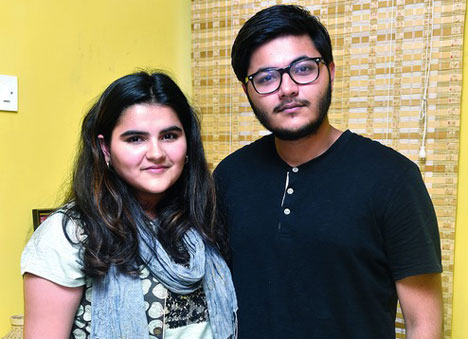
A 19-year-old Calcutta boy who had been pulled out of school by his father when in Class V has made it to IIT Kharagpur without a conventional education in between.
Nirmaan J. Sarkar, a second-year student of agriculture and food engineering, believes that being homeschooled since the age of 10 suited his later goal of cracking IIT-JEE to study in his father’s alma mater. He revelled in the freedom of learning at home and focusing on what he liked even as his sister Sohana pined for the structure and company that school provided.
The siblings’ father, Sourabh J. Sarkar, had had a normal schooling and taken the usual long, hard route to IIT. But he was disillusioned with the education his children were getting and wanted to free them from what Nirmaan now calls “the cage”. The decision to “log out of the system” came after much disagreement at home.
Sohana, for one, did not take kindly to being told she would not go to school again. For some time, she was even ashamed of it.
Nirmaan showed no such withdrawal symptoms. “After I quit school, I started learning programming in my father’s office from his technology team…I also learnt things from the Internet,” he recounted.
It wasn’t always homeschooling and no play. Nirmaan would visit the Sports Authority of India complex every day for basketball, was part of the orchestra at the Calcutta School of Music and also learnt to play the tabla.
Realising his son’s proficiency in mathematics, Sourabh hired a tutor in the subject who would come home to teach Nirmaan for 10 hours on some days. At the age of 15, Nirmaan was sent to a coaching institute started by three IITians.
“By then, I wasn’t interested in going to any other college. I was fascinated by IIT Kharagpur, having heard from my father and tutors about the campus culture there. I wanted to experience that,” he said.
While Nirmaan’s progress through homeschooling and private coaching was an affirmation that the method was working, his parents grappled with the thought that he and his sister still needed a group environment.
According to Sourabh, who lives in New Town, the challenge was to provide his children with peers representing a certain diversity “because life is not made up of a group of people of your age only”.
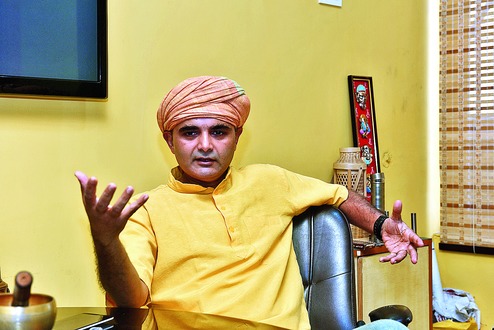
He and his wife Reena conducted a talent hunt to identify children from remote villages with different talents so that they could come and stay with them. The group was required to follow a routine, which included making breakfast and wearing uniform.
“We selected 30 underprivileged children with different talents like theatre, music, yoga and dance. We told their parents that their children could stay with us and we would help them get better at what they do,” Reena said.
Sohana, who will appear for the Class X examination through the National Institute of Open Schooling next year, appeared to miss school less after that. She started learning dance and is now also pursuing art.
After Nirmaan went to IIT Kharagpur, the thought of putting Sohana in a formal school did cross Reena’s mind but she ultimately decided against it. “Schooling would take away a lot of the things my daughter is doing,” she said.
Like her brother, Sohana has a clear goal. She wants to study fashion, albeit without going to college. “I don’t need to go to college to do what I want to do. I can do internships…. They teach circles and squares and I don’t want to do that. Now, I don’t lie to anyone that I go to school,” she said.
Sourabh refuses to label the education his children has had as homeschooling. “I think the term homeschooling is misleading for this set of children. The decision was to log out of the system. And when we decided that, I had no clue what the alternate system would be,” he said.
For Nirmaan, graduating from IIT won’t be the end of the road in terms of learning. “I don’t think just getting into IIT labels me as a success story. A real measure of the success will be what I learnt in the seven years I was out of school and studying at home. IIT isn’t the one big success in my life,” he said.
Father Sourabh gives himself “only 20 out of 100” for doing what he has for his children. “Till this day, I don’t think we have been successful in giving them the ideal option that I would have wanted,” he said.
source: http://www.telegraphindia.com / The Telegraph,Calcutta,India / Home> Calcutta / by Jhinuk Mazumdar / May 01st, 2018
1.5-million-year-old tools found in Museum vault
Kolkata :
Indian Museum is pushing back the history it has been narrating thus far. It has ‘excavated’ Paleolithic stone age tools, some of which are up to 1.5-million year old, from its own sub-terranian store and will put them on display at a new pre-historic gallery that will open next month.
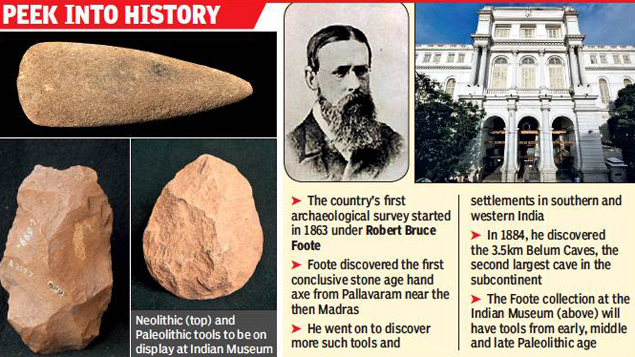
The collection, handed over to the museum in the 19th century by geologist-cum-archeologist Robert Bruce Foote, had been gathering dust in the underground store till they was re-discovered recently. Foote is considered the father of Indian pre-history and was the director general of Geological Survey of India.
Museum officials stumbled upon the collection of 100-plus tools that were discovered by Foote in south India. The oldest among them were unearthed in Atiram Pakkam, an area in Pallavaram, Chennai. These finds were named Atiram Pakkam tools.
“The Bruce Foote Collection is indeed the oldest collection of human tools anywhere in India. This treasure trove has never been viewed since it was brought to the museum. The inventory has swelled for 200 years without proper cataloguing. We are now sorting and classifying the collections scientifically,” said Indian Museum director Rajesh Purohit.
About 40 stone tools comprising of hand axes, scrappers, cleavers and arrow heads, mostly made of quartzite, will be brought out from that collection and displayed in the new gallery that will replace the Harappa gallery which had been till now the starting point of history at Indian Museum. The Harappa gallery has remained shut to public for nearly 15 years. Handpicked items from the Indus Valley Civilisation will also be exhibited at the new gallery.
The focus though will no longer be on Harappa and Mohenjo Daro, because these are both in Pakistan today and a large number of excavations on the Indian side around a circumference of 1.22 lakh sq km have revealed footprints of contemporary civilisations. “We can build our own history around these sites that have been unearthed in Haryana, Gujarat and Rajasthan. While in the earlier case, the civilisation developed along the Indus, on the Indian side the civilisations sprung up along Ravi, Chenab, Beas, Sutlej, Jhelum, Saraswati, Hakra and Ghaggar,” Purohit explained.
While Lothal (Gujarat) and Kalibangan (Rajasthan) excavations are well-known, other explorations in Rakhigarhi, Krunal, Birhana, Banawali and Firmana that have happened later and have led to discovery of thousands of archaeological remains like pottery, figurines and seals will now be part of the new gallery.
source: http://www.timesofindia.indiatimes.com / The Times of India / Home> News> City News> Kolkata News / by Jhimli Mukherjee Pandey / TNN / April 15th, 2018
Gate-way to a new Calcutta
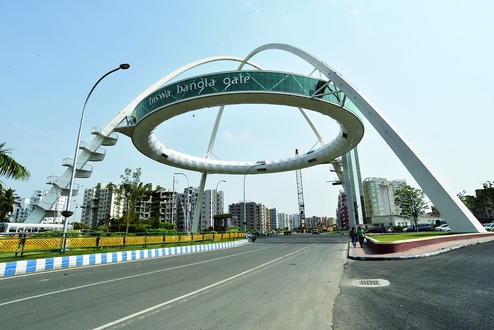
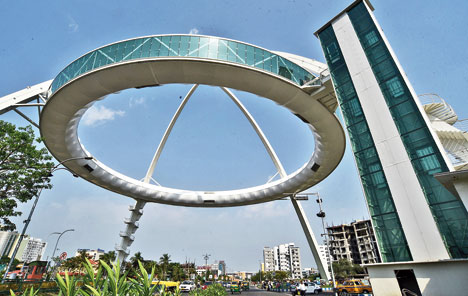
Kolkata Gate, a steel-and-glass structure with giant arches at the Rabindra Tirtha crossing of New Town, is almost ready. The two steel arches that criss-cross each other 55m above the ground can be spotted from several kilometres away.
A circular viewing gallery made of steel and toughened glass has been set up at 25m above the ground level. The 10ft-wide and 60m-long gallery has been constructed by interlinking four prefabricated structures that resemble aerobridges. These structures in turn are welded and attached to the steel arches at designated points. The facade is made of toughened glass with laminated silicone sheets that can withstand gale-force winds, hailstorms and extreme heat.
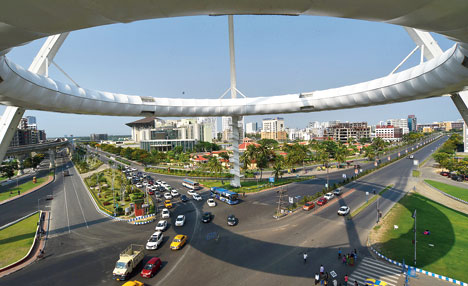
Programmable LED lights and flashers have been placed along the length of the steel arches to give it a snazzy look at night. The viewing gallery will have a snacks counter during the day and a fine-dining restaurant after 7pm. At night, only diners will be allowed inside the gallery that will offer a panoramic view of the township. The walls of the gallery have been painted with murals with an entire wall dedicated to the schemes and achievements of the state government.
“The restaurant will offer a one-of-a-kind experience. It will be unlike any other in the city and will offer cuisines from across the world,” said Debashis Sen, the chairman of Hidco. It is likely to open doors in June, officials said.
source: http://www.telegraphindia.com / The Telegraph,Calcutta,India / Home> Calcutta / by Snehal Sengupta / Photos by Sanjoy Chattopadhyaya / April 30th, 2018