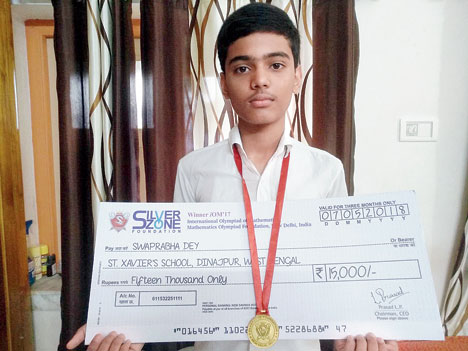
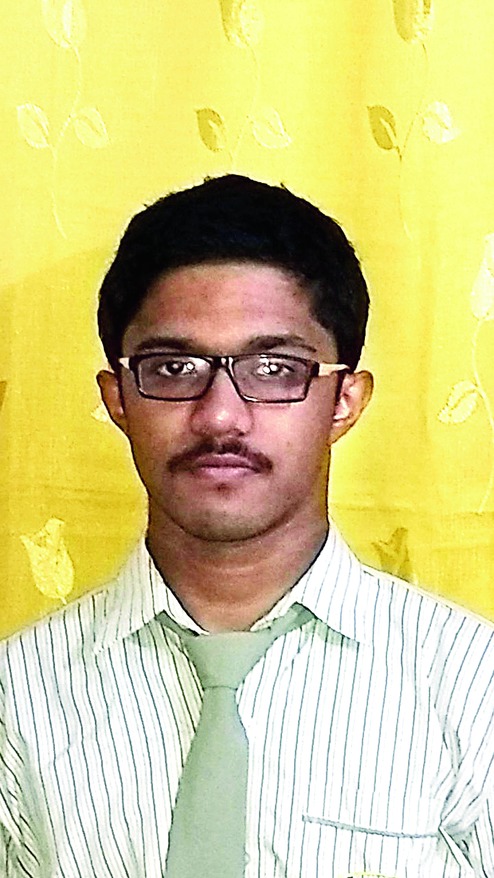
A Class IX student of Raiganj who topped a math Olympiad has won an educational trip to Nasa.
Swaprabha Dey, a student of St Xaviers School of the town, had stood first in the International Olympiad for Mathematics, 2017 conducted by the Delhi-based Silver Zone Foundation. He will visit Nasa on a week-long trip to the US in August this year.
“After the (Olympiad) results were announced, we were informed that he will be rewarded in cash and be taken to Nasa,” said Swaprabha’s father Sanjib Dey, a central government employee.
The boy, his parents said, is an ardent reader of science fictions. Professor Shanku, a character penned by Satyajit Ray, is one of his favourites.
“It is a matter of pride for the school,” Fr. David Raj, the school principal said.Ayesha Rani A, the DM, said the administration will “felicitate” Swaprabha for his success. “His performance has brought laurels,” said the DM.
source: http://www.telegraphindia.com / The Telegraph,Calcutta,India / Home> West Bengal / by Kousik Sen / May 20th, 2018
ICSE and ISC exam results throw up stories of success in the face of extreme adversity
Neelangshu Saha
Calcutta:
The weekend before his ISC mathematics paper, Neelangshu Saha was in hospital for chemotherapy. When the examination results were declared at 3pm on Monday, he was undergoing a PET scan in a Mumbai hospital.
Neelangshu scored 84 in mathematics, each mark bearing testimony to his effort in writing a paper for three hours after having been discharged from hospital just the night before.
The student of Adamas International School in Belghoria did even better in terms of aggregate – 86.75 per cent – after battling a relapse in the middle of the examination. His individual scores are 78 in English, 88 in physics, 82 in chemistry and 97 in computer science.
The 18-year-old had been diagnosed with alveolar rhabdomyosarcoma, a cancer originating in the muscles, in 2016. He seemed to be in remission after treatment, but the cancer returned in two years.
Doctors had told Neelangshu that he wouldn’t be able to write an examination immediately after chemotherapy, but he wasn’t ready to give up.
“I had already lost a year during the first spell of illness (with 33 cycles of chemotherapy and 51 rounds of radiation) and could not write the examination along with batchmates I had studied with for 10 years. That was a major push for me. My mother encouraged me to do so,” Neelangshu said from Mumbai.
The relapse was diagnosed two days after the teenager wrote his physics paper. His mother went to Mumbai to consult doctors on postponing treatment till the ISC examination was over.
“Doctors at the Tata Memorial Centre in Mumbai said treatment was more important than writing the examination. We then decided to get chemotherapy done in a Calcutta hospital,” said mother Aditi Roy, an economics teacher.
“It was a Monday, the day of his mathematics paper. He was so weak that he could barely open his eyes. But he showed tremendous mental strength and went to school,” Aditi recounted.
Despite the side effects of chemotherapy like nausea and not being able to sit for long hours, Neelangshu wanted to write the examination with his classmates.
“Chemotherapy would leave me feeling very hot and I could not continue in the examination hall. My school then arranged for me to write the examination in an air-conditioned room. Had it not been for my school’s support and that of my teachers, I would not have been able to write the exam,” Neelangshu said.
Before being diagnosed with cancer, Neelangshu had been an athlete with two gold medals in sprinting events in his last school sports meet in 2015. “The way he has fought illness is amazing, especially to write an exam between chemotherapy sessions,” said Mittra Sinha Roy, principal of Adamas International School.
A swelling in his left leg last January was the first sign of a relapse. “It (alveolar rhabdomyosarcoma) is a rare cancer with an unpredictable outcome. If it has not spread to the lungs and liver and is limited to the local area and site of origin, there are chances of the cancer being cured. The boy’s willpower is inspirational,” said oncologist Gautam Mukhopadhyay, although he hasn’t treated Neelangshu.
source: http://www.telegraphindia.com / The Telegraph,Calcutta,India / Home> Calcutta / by Jhinuk Mazumdar / May 15th, 2018
Briton married to Bengali finds new calling after living in village
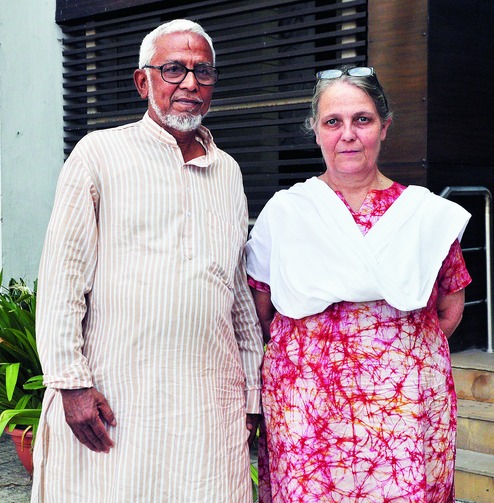
Ranjan Ghosh and Lindsay Barnes. Picture by Anup Bhattacharya
Calcutta:
She is from Lancashire in north-west England, he is from Bally in Howrah. Lindsay Barnes and Ranjan Ghoshhad met in the Eighties as students at Jawaharlal Nehru University and, fired by a shared idealism and sense of adventure, set up home in a village near Bokaro.
Sometime in 1993, Lindsay was forced by circumstance to help a village woman deliver a baby. She had no medical degree, only a book to help her. Since then, Lindsay has played midwife to scores of mothers and set up a 12-bed health centre with her husband Ranjan Ghosh to provide hundreds of others a safe place to give birth.
The couple have also brought together more than 7,000 women from 120 villages under various self-help groups, with Ranjan using his expertise to induct them into microfinance.
Lindsay and Ranjan, who were in Calcutta to attend a Mother’s Day programme organised by an infertility clinic in Kasba, said they planned to train junior doctors and nurses to deliver babies under limiting circumstances in rural areas.
Health care was, of course, not a choice Lindsay had made when she started living in Chambrabad village, 25km from Bokaro. A student of sociology, she was there primarily for research on life in the coal belt when a call for help changed her calling.
“Some neighbours approached me to help a mother-to-be,” she recounted. “I was astounded. I had no clue what to do. I was trying to put them off with excuses. It was my husband who goaded me to go,” 58-year-old Lindsay told Metro.
Armed with a book titled Where there is no doctor: A village healthcare handbook, Lindsay left home to help deliver the baby. “The local women who gathered around me knew I had no knowledge of midwifery, yet they were relieved to see me. They knew I would find a way out. That’s when it hit me that I must do something to help them,” she said.
Lindsay, now a mother of two, soon started receiving similar requests from other villages. “After a few home deliveries, I decided to educate myself in hospitals and nursing homes. I learnt a little and read a lot more to perfect my job,” she said.
After almost 100 home deliveries, Lindsaybegan hiring rooms for deliveries. She set up the 12-bed health centre in 2001. “The village girls now run the health centre with minimal support from qualified doctors. I am still called to handle critical cases. Ninety-five per cent of women have normal delivery. We refer critical cases to nearby hospitals,” she said.
According to gynaecologist and infertility specialist Sudip Basu, what sets Lindsay apart is her “practical knowledge”.
“It will be good if she can train our junior doctors and nurses how to treat patients under limiting circumstances. My team, in turn, can volunteer at her health centre. We plan to replicate the model in other villages.”
source: http://www.telegraphindia.com / The Telegraph,Calcutta,India / Home> Calcutta / by Chandreyee Ghose / May 14th, 2018
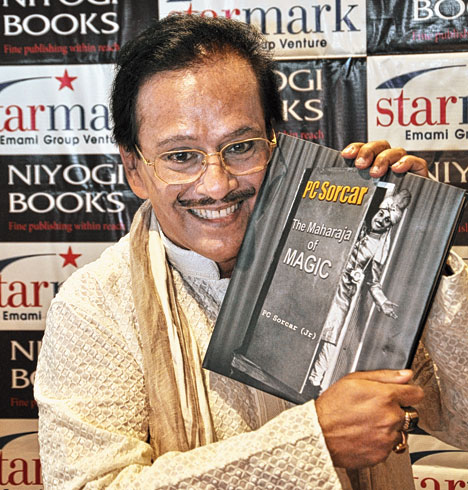
P.C. Sorcar (Jr) at the launch of a memoir of his father on Friday. (Anup Bhattacharya)
Calcutta:
On April 9, 1956, a live telecast of a magic show in London seemed to have gone awfully wrong. The scheduled 15-minute slot on BBC was almost over but the assistant cut in half by the turbaned Indian magician was not coming back to life.
As the channel switched to the news bulletin, viewers jammed the studio lines with calls, convinced that the woman had been murdered. Such was the furore that the event made the next day’s headlines, with interviews of the assistant, alive and well.
“It had all been part of a grand plan. He had deliberately instructed the lady assistant to lie unresponsive… at the critical moment… This man was Protul Chandra Sorcar. He was also my father,” the writer of a book titled PC Sorcar: The Maharaja of Magic describes the incident.
A memoir of the illustrious father Protul Chandra Sorcar penned by his torch-bearer and son Prodip Chandra Sorcar or P.C. Sorcar (Jr) was launched on Friday at Starmark. It is replete with anecdotes that demonstrate how the senior Sorcar single-handedly revived a dying Indian art and went on to be hailed by the International Brotherhood of Magicians in 1948 as “The World’s Greatest Magician”.
The book is also a storehouse of photographs, publicity material, newspaper clippings and cartoons on the phenomenon that was P.C. Sorcar. His reception in the 35 nations where he performed is nothing short of spectacular. If The Sunday Times carried a photo of him reading the newspaper blindfolded, one of Japan’s top newspapers The Yomiuri Shimbun ran the headline on an article on him “Invaluable Living Asset From India Brings Black Art” while The Australian Women’s Weekly did a full page feature on him when he was touring the continent in 1958.
“The book was five years in the making,” said Bikash D. Niyogi, the managing director of the publisher Niyogi Books.
At the launch of the book on Friday, Sorcar (Jr) revealed that his grandfather was bitterly against his son taking up magic as a profession. “‘Do not do public shows. Society is not ready. You will be taken as a dabbler in hocus pocus,’ he kept telling his son. He wanted him to become an engineer instead,” said Sorcar (Jr).
In a way, he was right. “Even after my father’s body was flown in from Japan where he suddenly passed away in January 1971, people gathered outside our house at night expecting him to return, much like he would at the end of his disappearing tricks, appearing from a distant corner with the shout ‘I am here’. People were so gullible that they could not distinguish between his stage persona and the person he was in real life.”
Sorcar, as a child, had an opposite problem. He took the sombre man keeping a strict eye over his son and the smiling magician on stage as different people. The book is a testimony as to how the two avatars of PC Sorcar come together in the eyes of a fellow magician who is also his son.
source: http://www.telegraphindia.com / The Telegraph,Calcutta,India / Home> Calcutta / by Sudeshna Banerjee / May 12th, 2018
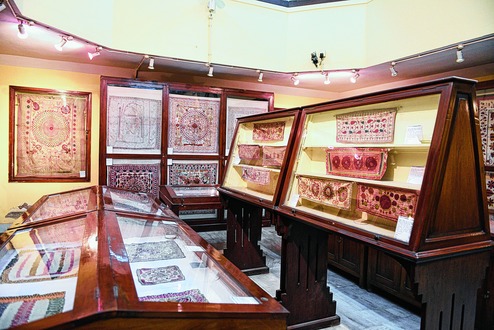
Free entry from 10am to 7pm, selfies with exhibits, mementoes inspired by artefacts and more kept Gurusaday Museum abuzz with activity on Thursday, the private collector’s 136th birth anniversary.
The museum in Joka, a treasure trove of kanthawork, patachitra, dokra and other artefacts, fell on hard times after the central government stopped funding it in December last year.
A sustained social media campaign by two research scholars, an archaeologist and an anthropologist has given the museum a fresh lease of life. The campaign to Save Bengal’s Folk History is aimed at reviving the cash-strapped museum and attracting more visitors.
The efforts bore fruit as hundreds of visitors, including schoolchildren, dropped in at the museum on Thursday.
Banners with the slogan Love the Museum welcomed all visitors. Food stalls, cultural programmes and merchandise on sale kept the visitors happy. They were also invited to take selfies with any exhibit of their choice.
“We are just trying to jazz up the birth anniversary celebrations and make the museum more attractive. People should be aware of the rich treasure it houses,” said Malavika Banerjee, the director of Kolkata Literary Meet and Byloom and one of the players in the museum’s revival.
Banerjee first visited the museum 15 years ago and was taken aback by all the folk art lying in oblivion. Some of the artefacts at the museum date back to the 10th century.
Research scholars Shrutakriti Dutta and Sujaan Mukherjee, archaeologist Tathagata Neogi and anthropologist Chelsea McGill, along with Banerjee, ran an online campaign and uploaded a campaign video on YouTube to spread the word.
“We want to start a crowdfunding effort to save the museum and help it sustain itself. We want to work in tandem with the staff and authorities here,” Dutta said.
The museum’s 13-member staff have not received their salaries for over seven months, said the museum’s executive secretary and curator, Bijan Mondal. “Today we have seen many firsts, including the selfie fest. A celebration of this scale till 7pm would have been unthinkable before,” he said.
The celebrations culminated in a discussion on The Life of Our Heritage that had panellists – Jayanta Sengupta, the secretary-curator of Victoria Memorial Hall; Bappaditya Biswas, the creative partner of Byloom; and Snehangshu Sekhar Das, designer at the Regional Design and Technical Development Centre, office of the development commissioner (handicrafts), ministry of textiles – offering suggestions on how to make the museum attractive.
Sengupta spoke about how a museum must be more than just a silent custodian of the past. “It has to reach out to people through smart storytelling,” he said. His advice: Organise workshops, reach out through the social media, engage the audience through proactive and interactive smart thinking, improve display and hook kids with the help of audio-visual clips.
The Victoria Memorial curator offered to hold an exhibition of items from Gurusaday Museum on the Victoria grounds. “We can help restore some collectibles,” he said.
Devsaday Dutt, grandson of Gurusaday Dutt, welcomed the idea. “The museum should be of a seat of knowledge. There are 275 paintings of Abanindranath Tagore and several Jamini Roys here. The storytelling in kantha artworks here will entice anybody,” he said.
source: http://www.telegraphindia.com / The Telegraph,Calcutta,India / Home> Calcutta / by Chandreyee Ghose / May 11th, 2018
The rhythmic hum became clearer the deeper I ventured into the forest. The man, wearing a saffron kurta over a white dhoti, seemed to be the least bothered by the visitors that his music was drawing. Seated on a mat spread over the red earth of the forest clearing, he carefully plucked the strings of the ektara and filled the air with his soulful voice. The movement of the beaded malas dangling from his neck complimented his head movement whenever he caught a high-pitched note.
It was hard to imagine, that in just a few hours, the imperturbable forest clearing would be buzzing with exuberance. The spirit of the weekly market held every Saturday, popularly known as Shonibarer Haat, would permeate through the meshwork of the sonajhuri or acacia trees. Sonajhuri, the place in the Khoai region of Bengal, lovingly named after the trees, would come alive.
During lunch at the resort, authentic Bengali food — shukto, alu posto, maacher kalia and chutney — kept piling on my plate, the way food accumulates during religious rituals.
As the afternoon progressed, the bauls arrived with their own entourage and took over the concourse with furious musical fervour. The harmonium, tabla and flutes accompanied the primary musical instrument used by the bauls — the ektara. Plucking the solitary string of an ektara, the bards continued reciting melodious folklore in Bengali. With hands thrown up in the air, the visitors danced — men and women, young and old alike. The pounding footsteps of the tourists stormed up red dust clouds. The performers don’t demand any monetary compensation in return; visitors are free to leave on the baul’s mat whatever they wish.
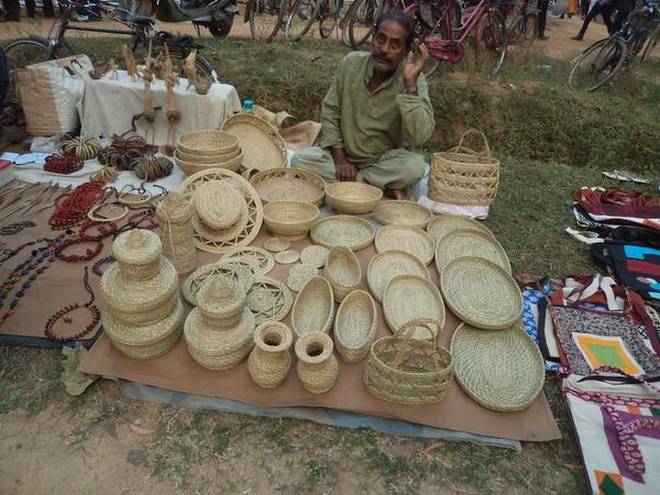
The weekly market was an exhibit of authentic craftsmanship, which belongs to the State of Bengal. Junk jewellery, saris and other clothing, bags, footwear, paintings, wood products, bamboo, cane, jute and terracotta products for kitchen use and home decor, were on display over rugs under the shade of trees. The handicrafts found in this part of the world are iconic to the region of Bolpur. Most of the sellers here are the artisans themselves. Unfortunately, many still struggle to make ends meet. I got a miniature ektara for myself.
Next morning, I walked through the maze of sonajhuri trees to Bonerpukur Adivasi Gram. Little mud huts with drooping ceilings of hay lined the dirt path. A few had relief work mimicking their own village life engraved on their hut walls. When plush bungalows peeked through the foliage of the trees, I knew the rustic village had ended to make space for farmhouses of the rich.
‘Fun on one bank, Fun-eral on the other.’
The greatest irony of life was scribbled on a board on the Kopai riverside. A battery-operated rickshaw, known in this part of the world as ‘toto’, brought me here. A timid silence prevailed all around, only to be broken by the voice of the solo mystic minstrel. On the other bank, village women were fetching pails of water. The baul started playing as I was exploring the riverside. He struck a chord on his ektara, with lyrics describing the beauty of life and the importance of living in the moment. As he was doing so, I stepped on some consumed pyre material.
That day on the river bank, something changed in me as I encountered the transient nature of life. The solitary string of the ektara holds it together. When the string breaks, the instrument dies. Just like the ektara, we have just one chance at life.
source: http://www.thehindu.com / The Hindu / Home> Life & Style> Travel / by Tania Banerjee / May 09th, 2018