All posts by wellnmed@gmail.com

Mathematics prof finds Hemanta’s rare recordings in Bangladesh

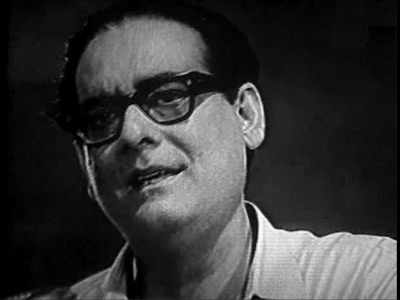
Singer-composer Hemanta Mukherjee

Kolkata :

Ahead of his 98th birth anniversary on Saturday, rare recordings of legendary singer-composer Hemanta Mukherjee from Bangladesh have been unearthed by a mathematics professor in the city. The recordings – one which dates back to 1971 and the other being the last ‘basic song’ recorded before his death in 1989 – have perhaps never been seen or heard in India.

Joydeep Chakraborty, the former guest lecturer at Rabindra Bharati Univerity (RBU) who now teaches in Murshidabad’s Nagar College, had earlier collected Mukherjee’s first recording of a Rabindra Sangeet in Pakistan. “The 45 rpm record of ‘Ami jalbona mor’ was made by the Gramophone Company of Pakistan in 1961. It was recorded in cooperation with the Visva-Bharati Music Board. I collected this from a Muslim family in Murshidabad,” Chakraborty said.

Two months back, he chanced upon the rare 1971 video recording from a friend. “After the liberation war of 1971, Bangabandhu Sheikh Mujibur Rahman had invited Mukherjee over to Dhaka. During that visit, he had performed a Rabindra Sangeet – ‘Tui phele eshechhis kare, mon, monre amar’ – for the state-owned television network in Bangladesh. My friend in Rajshahi sourced the recording for me,” Chakraborty said.

When Chakraborty was teaching at RBU, he came across a student from Bangladesh who wanted his help to covert some recordings in her family’s possession to the digital format. “While doing the work, I chanced upon a cassette that had a recording of a person composing a song. The voice seemed like that of Mukherjee,” Chakraborty said. His guess was confirmed by the student’s grandfather in Dhaka. “The recording was done in 1989 when Mukherjee was in Bangladesh and trying to set to tune the song ‘Lokhi jokhon ashbe ghore’. Nobody apart from that family has ever heard this recording,” he insisted.

During that same time, Chakraborty also chanced upon another rare recording of Mukherjee. “The song was ‘Bhalo kore mele dyakho drishti/Bujhbe Bangladesh bidhatar koto boro srishti’. The song was penned by Abdus Sattar and set to tune by Golam Mustafa. This was the last recorded ‘basic song’ of his,” Chakraborty informed.

However, it isn’t just these recordings from Bangladesh that make his Mukherjee archive interesting. In his kitty are some rare jingles that Mukherjee had recorded for Colgate toothpaste, PC Chandra jewellers and Lipton tea. “I sourced his jingle for Eveready torch from a roadside seller. An old employee helped me get hold of his Bata jingle. I also have a 1958-recorded jingle for Pundinhara that he had sung for Salil Chowdhury. I sourced his 1979-London recording of Ramayana in Hindi from an Anglo-Indian lady from Park Street,” he said.

That apart, Chakraborty also has 200 letters of the legend in his possession, a postcard record of Mukherjee singing for the coronation of the king of Nepal in 1964, recording of a 1973-programme in Rabindra Sadan which had Mukherjee singing live for all the characters in ‘Chandalika’, a harmonium used by Mukherjee during the late 1930s and Mukherjee’s personal collection of books.

Keen to exhibit his collection, Chakraborty will be happy to help if the government plans to host such a show.

source: http://www.timesofindia.indiatimes.com / The Times of India / Home> News> City News> Kolkata / by Priyanka Dasgupta / TNN / June 16th, 2018
The art of cooking, colours & conversation

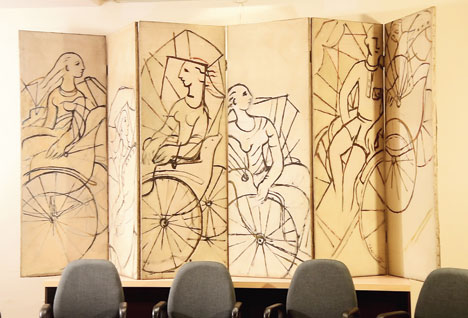
A painting by Shanu Lahiri from a series on rickshaws, a Calcutta phenomenon loved by the artist, formed the backdrop to the discussion

Calcutta:

One of the recipes that she had created was named Chicken Beparwah.

Shanu Lahiri, painter and sculptor, cooked with as much passion as she brought to her art. Wherever she was, laughter and conversation would flow. So would food cooked by her, as unusual and robust as her.

She would often name them with care.

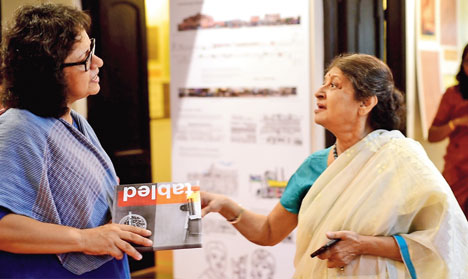
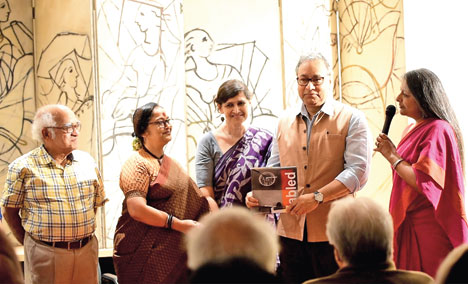
(From left) Samik Bandyopadhyay, Chaitali Dasgupta, Tapati Guha Thakurta,
Jawhar Sircar and Nandita Palchaudhuri at the launch of Tabled

The warmth and generosity of those afternoons and evenings that she presided over at her Lake Town home seemed to flow directly into the auditorium at Jadunath Bhavan in the city last Friday, at the launch of Tabled, a compilation of Shanu Lahiri’s recipes, anecdotes and art.

Shanu Lahiri, a member of The Group, a women’s artists’ collective in the city, was the sculptor of Paroma, a Calcutta landmark that had been installed in 1987 on what came to be known as the Science City island. The city woke up on a November morning in 2014 to find the statue, a woman’s form with children, vanished and replaced by the multi-colour globe of the Bengal government’s Biswa Bangla brand.

Damayanti Lahiri and (right) Damayanti Basu Singh

The book, launched by Jawhar Sircar, chairperson, Centre for Studies in Social Sciences, is the labour of love of Damayanti Lahiri, Shanu’s daughter. Damayanti, however, pointed at her namesake, Damayanti Basu Singh of Vikalp publishers, as having played a more important role in the project.

Tabled has been designed and structured by artist Chittrovanu Mazumdar, who happens to be Shanu Lahiri’s nephew, and who refused to show up on the stage despite several calls, remaining doggedly in the background.

The black and white cover of Tabled does not quite prepare one for what lies within: an explosion of colours, forms and recipes. But that was Shanu Lahiri. Close friends and loved ones remembered her lovingly.

Historian Tapati Guha Thakurta, who grew up in the south Calcutta house where the artist first lived with her family before moving to Lake Town, chose to speak in Bengali. “The language of “Shanu mashi’s” art was international, but the language she wrote in, or that of her inner self, was Bengali,” said Guha Thakurta. All those conversations that Shanu Lahiri seemed to be always having were conducted in Bengali. Guha Thakurta spoke about Shanu Lahiri’s food-loving husband, without whose large and benign influence the artist would not have grown; neither would the eccentric cook have been born.

TV personality Chaitali Dasgupta, who had interviewed Shanu Lahiri for a cooking programme on Doordarshan, said the sculptor had refused to put on the slightest make-up for the shoot. “Let the sweat show. It will look like garjan tel, garjan tel,” remembered Dasgupta. The Durga idol’s face is painted with this oil.

When social entrepreneur Nandita Palchoudhuri, who was conducting the conversation, asked scholar Samik Bandyopadhyay about the correspondences between cooking and painting, Bandyopadhyay spoke about “Shanudi’s passion for work as activity”. “Her lines move madly,” he said. She painted as if without a desire to control. “There was a kind of continuum in the ways she lived, worked and cooked.”

It is probably not a coincidence that when he received Shanu Lahiri’s book, Bandyopadhyay chanced upon a newspaper article on an exhibition in Barcelona on works by Picasso that are about cooking and utensils.

The evening evoked memories of a time that is difficult to imagine now: a flow of spirit over conversation and food, without the interruption, or aid, of mobile phones, ordering food from outside, and in the Bengali language. The previous city has disappeared, as the missing statue of Paroma proves.

source: http://www.telegraphindia.com / The Telegraph,Calcutta,India / Home> Calcutta / by Chandrima S Bhattacharya / June 15th, 2018

Story of a Messi Fan: Tea stall owner paints entire house in Argentina colours

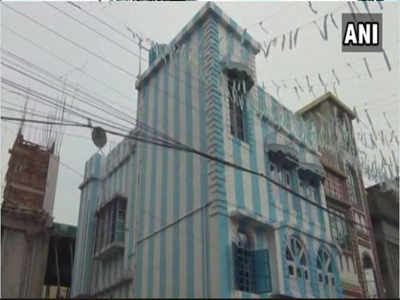
Shib Shankar Patra’s house (Photo: ANI)

Kolkata :

Shib Shankar Patra is one among thousands of die-hard Argentina fans in Kolkata and there’s nothing unusual about it.

But then die-hard fans at times can be weird too and the 53-year-old Patra has that weird streak in him.

Trying to garner enough savings from his modest earnings through a tea stall, Patra harboured a dream — to watch ‘The Albiceleste’ live from the stands in Russia.

But when a Kolkata-based travel agent informed him that his savings — a princely amount of Rs 60,000 (USD 900) is not enough to fund his World Cup trip (travel agent gave him a budget of Rs 1.5 lakh), he decided the next best thing –paint his entire three-storied building in Argentina colours.

“I don’t smoke or drink. I have only one addiction and that is Lionel Messi and Argentina. I don’t earn much but ensure that bulk of my earnings is kept aside for these indulgences when World Cup comes calling,” Patra, owner of a tea and snack stall in North 24 Parganas’ Nawabganj township, told PTI.

You don’t need a GPS to track Patra’s house once you get down to Ichhapore Railway Station. Ask any cocky teenager or elderly uncle about “Argentina Chaayer Dokan” (Argentina Tea Stall), they will be more than happy to oblige.

The street leading up to his tea stall cum house is dotted with Argentina flags while a giant one flutters high making its presence felt.

Every four years coinciding with the World Cup, Patra, who runs his tea stall from the ground floor of his three-storied building, gives his building a fresh coat of light blue and white shade.

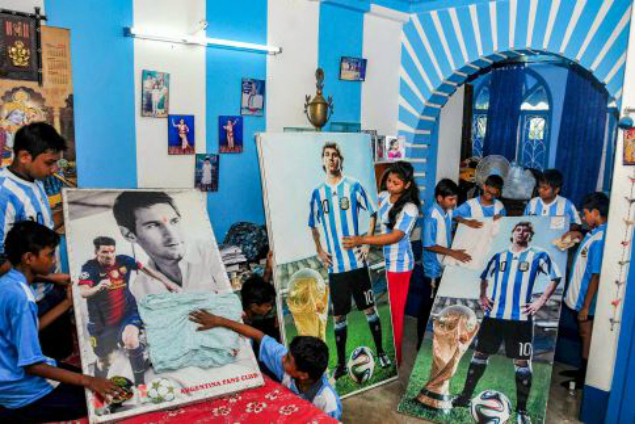
Enter his three-room apartment and the craziness hits you instantly. All the walls are painted in Argentina colour, even the small ‘puja sthal’ (where the idols of Gods and Goddesses are placed). The walls of each room adorns a life-size vinyl flex print poster of Messi.

Addiction can be contagious but if its ‘Messi mania’, Patra doesn’t mind that his wife Swapna along with his children — 20 year-old daughter Neha and 10-year -old son Shubham are equally mad about the fleet footed genius.

“My kids know everything about Messi. The food he likes, the car he drives, everything,” Patra says with a glint of pride in his eyes.

“They don’t miss a single match of Messi. If there’s a late night match during the exams, they will pretend to sleep early but will watch live streaming on their cell phones,” wife Sapna said.

There is one common thread of all Argentina fans in Bengal. The 1986 World Cup, which was aired live on Doordarshan turned Kolkatans into ‘Maradona devotees’. Messi is an extension of Maradona.

“I have watched the Argnetina friendly at the Salt Lake Stadium. I lived a dream that day,” Patra recollected.

It was the first time, he painted his house in Argentina colours, something he repeated in the 2014 edition of the World Cup as well.

Since 2012, the Patra family celebrates every Messi birthday with fanfare like cutting cake to organsing blood donation camp.

And it goes without saying that tea and samosas (staple diet for Bongs during their football adda sessions) is complimentary on all Argentina match days.

With Messi’s birthday coinciding with the World Cup, they have cancelled the blood donation camp, which is held every year.

Instead a 30-pound cake will be cut and 100 Argentina jerseys will be distributed amonmg local kids with Messi’s photograph embossed.

In attendance would be the local MLA and India U-17 World Cupper Rahim Ali.

By his own admission, he has never taken any loans for his personal indulgences.

“I’ve never sought money from anyone but we never fell short, and somehow everything falls in place in time,” Patra said.

“People here also happily come forward. Someone sponsors the food, someone gets the cake and we make it a mini-Argentina here,” Patra says.

Even there will be prayers for Messi with the priest of the local Hanuman temple — his regular client — offering special prayers for the Argentine wizard.

“He gets me the ‘sindoor’ from Hanuman’s left leg (the connection is Messi being a left-footed player) and the vermilion is applied on Messi’s poster during every match. We hope he lift the Cup this time,” Patra signed off.

source: http://www.timesofindia.indiatimes.com / The Times of India / Home> News> City News> Kolkata News / PTI / June 13th, 2018

West Bengal bags allocation of world’s 2nd largest coal mine

The announcement regarding the coal mine allocation was made by CM Mamata Banerjee on Facebook.

Kolkata :

West Bengal has finally received allocation of the Deocha Pachami Harinsingha Dewanganj coal mines in Birbhum district. Deocha Pachami Harinsingha Dewanganj is the world’s second largest coal mine. The project is likely to bring investment worth Rs 12,000 for the state.

Making the announcement on Facebook, chief minister Mamata Banerjee wrote, “I am very happy to share with all of you that after a long wait of 3 years, West Bengal has got the allocation of the Deocha Pachami Harinsingha Dewanganj Coal Mines in Birbhum district.”

The chief minister added, “With an estimated reserve of 2102 million tonnes, it is the 2nd largest coal mine in the world. The mining project has huge potential of generating nearly a lakh of direct and indirect employment opportunities in Birbhum and neighbouring districts.”

Referring to the coal mine, Mamata added, “It will also involve investments worth Rs 12000 crores in the intermediate run. There will be huge socio economic development of Birbhum, the neighbouring districts and the entire state.”

Necessary administrative infrastructure has already been set up to start the project immediately.

source: http://www.timesofindia.indiatimes.com / The Times of India / Home> News> City News> Kolkata News / by Ajanta Chakraborty / TNN / June 09th, 2018

India’s 1st woman Land Rover coach keeps family legacy alive

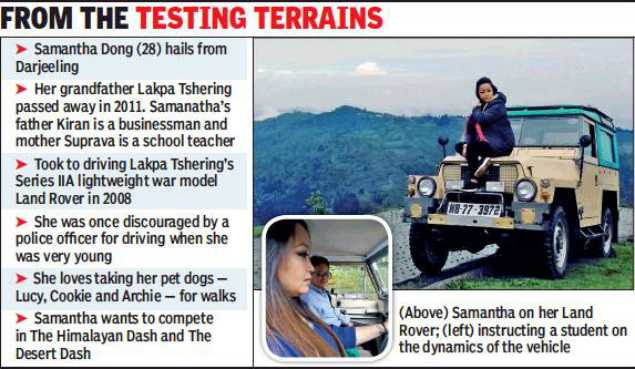
Samantha on her Land Rover

Darjeeling :

For India’s first woman Land Rover trainer Samantha Dong (28), it’s all about keeping the family legacy alive. Samantha had assured her grandfather Lakpa Tshering Dong that she would one day drive his lightweight Land Rover on the treacherous Sandakphu route. She has done that umpteen times since 2008.

She will head to Noida next month for the challenging Land Rover Experience Above and Beyond Tour. “The LRE tour event is held every month in different states. In Chandigarh, I instructed 10-12 Land rover enthusiasts. It is a nice feeling to share my experience with others,” she said.

Lakpa Tshering had purchased the lightweight series II-A war model Land Rover in the 1970s from Nepal. He used to ferry passengers and rations from Ghoom to Sandakphu to make a living.

But it was her father Kiran who trained her to drive the vehicle. Of the nine siblings, Samantha is the only one who drives the Land Rover, a passion that she now has developed into a career. “I was around 11-12 years when I first held the wheel of a car. It was our family’s Maruti Omni. I used to sit on my father’s lap who taught me to operate it,” she said.

Samantha has a master’s degree in public administration in 2016.

Life changed for Samantha when she participated in the Teesta Rangeet Tourism Festival in Darjeeling in December, 2017. She was the only female participant. Samantha was spotted by Asish Gupta, director of Cougar Motor Sport, during the event. Impressed by her capabilities, he had her inducted as a Land Rover instructor.

Samantha was, again, the only female driver in the seventieth anniversary celebration organized by Land Rover from Maneybhajyang to Sandakphu on April 30. She has been featured in leading auto magazines such as Top Gear, Overdrive and Autocar. As instructor Samantha is required to provide information about and knowledge about how the land rover runs and its features as she sits next to the learners.

source: http://www.timesofindia.indiatimes.com / The Times of India / Home> News> City News> Kolkata News / by Deep Gazmer / TNN / June 11th, 2018

Kolkata’s first Durga Puja-themed restaurant encapsulates city’s most celebrated event

Dashabhuja, the new restaurant, connects Bengal’s most delightful celebration with its inhabitants’ most delightful indulgence—Durga Puja and the festive Bengali cuisine.

With food stalls lining the streets, devotees queuing up outside eateries and plates full of food passed among families and friends, the whole of Kolkata turns into a giant food court during Durga Puja.

While the five-day festivities get over in the wink of an eye, the city now has its maiden Durga Puja-themed restaurant ready to serve gastronomes round the year.

Dashabhuja, near the city police headquarters at Lalbazar, connects Bengal’s most delightful celebration with its inhabitants’ most delightful indulgence—Durga Puja and the festive Bengali cuisine.

The elegantly-lit eatery, decorated with colourful overhead canopies and various forms of the goddess Durga, simulates the feeling of sitting in a marquee while pampering the taste buds. The sound track of rhythmic dhak beats, an inseparable part of the Puja rituals, and several Puja-themed hangings and artefacts add to the festive ambience.

The menu, comprising authentic Bengali platters, gives prominence to Puja dishes starting from bhog (community feast of food items offered to the Goddess first) of khichdi, bhuni khichdi and labda (mixed vegetables) to the lavish spread of mutton curry, luchis (a type of puri), chanar paturi, rice, and payesh or the Bengali version of kheer.Along with the Puja-specific main course, the mouth watering variety of “Pujor Misti” or the sweets offered to the goddess Durga, such as chandrapuli, narkel naru, balushai, etc., are also served in the eatery round the year.

According to the restaurant owner, an artist associated with designing prominent community puja pandals or marquees for the last three years, the eatery is a perfect amalgamation of his dream and the family business.

“My dream is to design the themes for Durga Pujas while we have been running restaurants as part of our family business.

So in my new project, I thought of connecting the two. This is the first of its kind project that would let you soak in the carnival spirit of the puja in Bengal—throughout the year,” said Sayak Raj, the owner, who also designed three prominent community pujas last year.

Raj also revealed he was in conversation with a number of city artisans and sculptors, who would be making the Durga idols for some of the most popular pujas this year, and plans to install artefacts designed by them in his eatery.

“I wish this restaurant to be an archive of the Durga Puja celebrations in Bengal so that visitors from other states and countries can get a glimpse of our heritage and culture surrounding this festival. We are planning to decorate the interior with the miniatures of Durga idols to be installed in some of the prominent pujas in the city this year,” he said.

The restaurant, inaugurated by veteran Bengali actor Barun Chanda and legendary Indian classical dancer Uday Shankar’s daughter and actress Mamata Shankar barely a month ago, has created a buzz among food enthusiasts in the city and received significant celebrity presence.

“We have also requested some popular committees to provide us with their Puja theme songs so that we can play them in our restaurant all year long — along with our signature theme music,” the owner added.

source:http://www.nationalheraldindia.com / National Herald / Home> Food / IANS / June 12th, 2018

1st-time tribal students at Jhargram school pass HS with flying colours

The students and teachers at Ekalavya Model Residential School

Jhargram:

All 22 first-generation students at Ramakrishna Mission Vidya Mandir (Ekalavya Model Residential School) in Jhargram have come passed the Higher Secondary examinations with flying colours.

The students, 13 boys and nine girls, belong to tribal families and none of their parents has ever studied till the highersecondary level.

Barring one, who wrote his exam from hospital and secured second division marks, the rest got first division, with eight of them securing star marks. School topper Budhor Mahali scored 84.2%. Three students got letter marks in English, nine in Santhali, two each in philosophy and political science and one in science.

Commending all students and teachers for the results, school secretary Swami Shuvokarananda Maharaj said, “Two years ago, Ramakrishna Mission was given responsibility to run the school. We have 374 students, all of whom are tribals. We have 48 teachers here. Parents of none of the 22 Higher Secondary examinees this year have studied till the plus-II level. The results show how children from the tribal community are making a headway in studies.”

source: http://www.timesofindia.indiatimes.com / The Times of India / News> City News> Kolkata News> Schools & Colleges / by Sujay Khanra / TNN / June 10th, 2018

IIT robot goes the distance

Robot-driven vehicle, Eklavya

Kharagpur:

A robot-driven vehicle called Eklavya won IIT Kharagpur the runner-up position in the Intelligent Ground Vehicle Competition at Oakland University in Rochester, Michigan, recently.

The robots were ranked according to the distance they covered in the designated arena while keeping to the lanes given by GPS coordinates, all the while avoiding obstacles on the way.

Eklavya, designed by the Kharagpur institute’s autonomous ground vehicle (AGV) team, covered 260 feet, said an official of the institute.

The AGV team is a multidisciplinary research group.

The team that won (left to right) Rahul Krantikiran, Indu Kan Deo, Sanskar Agarwal, Poojan Shah and Harsh Maheshwari

“For prototype purposes, we work on Eklavya which is a three-wheeled, front-driven and front-steered electric vehicle fitted with cluster wheels,” an official of the institute said.

Work for building the robot started in December last year under the supervision of Debasish Chakravarty, a professor of mining engineering at IIT Kharagpur.

“Students were required to work on image perception, simultaneous localisation and mapping, path planning algorithm, mechanical design and electronic design to come up with the robot-driven vehicle,” Chakravarty said.

Rahul Krantikiran, one of the five members of the participating team, said they were asked to cover a distance of 600 feet.

“We covered a distance of 260 feet. Though the time was not specified, I think we took around 2.5 minutes to 3.2 minutes to cover the distance. The only team that could outperform us was the team from CART (Center for Applied Research and Technology), Inc. from Bluefield State College, US,” said the student of computer science and engineering.

The team is exploring whether Eklavya can be fitted to an existing fuel-run vehicle.

“It requires advanced research. If it can be fitted to fuel-driven car, it will gain popularity,” Chakravarty said.

Seven teams from India, including ones from IIT Kanpur and IIT Madras, took part in the competition held from June 1 to 4.

source: http://www.telegraphindia.com / The Telegraph,Calcutta,India / Home> Calcutta / by Subhankar Chowdhury / June 09th, 2018

Sunity flaunts 4 toppers

Sanjibani Debnath with headmistress Manideepa Nandi Biswas at Sunity Academy on Wednesday. Picture by Main Uddin Chisti

Cooch Behar:

Had Maharani Sunity Devi lived now, she would have been happy.

Four girls of Sunity Academy, set up by her husband and Cooch Behar king Nripendra Narayan in 1881, have made it to the state-wide list of top 10 Madhyamik examinees this year.

A few among the Indian woman to be awarded a CIE (Companions of the Order of the Indian Empire) by the British, Sunity was the daughter of Brahma Samaj reformist Keshab Chandra Sen.

“Her initiatives to impart education to girls and women are well known in Cooch Behar. Not only that Sunity Academy was set up in her name (it was initially Suniti College), but she was also instrumental in setting up the Maharani Girls’ High School in Delhi. During her days as the queen of Cooch Behar, she had helped girls ensure that they get education. She would have been definitely happy to see girls of her school performing so well,” said Shaukat Ali, a senior academician based in Cooch Behar.

In the Madhyamik this year, Sanjibani Debnath of the school has topped in the state with 689, followed by Mayurakhi Sarkar (687, third in the state), Ankita Das (685, fifth in the state) and Aitihya Saha (681, ninth in the state).

“It is great day for us. Back in 2013, a student from our school had topped in the state in Madhyamik. In our school, there is a close relation among teachers and students. Though many take private tuitions but all the students are always dependant on the school to improve their performances,” said Manideepa Nandi Biswas, the proud headmistress.

Pankaj Kumar Debnath, the father of Sanjibani and a college principal, has appreciated the school.

“My daughter has been studying here since Class III and I have always found that each teacher is caring and giving individual attention to students. They keep on encouraging students and do not relent unless a student understands a subject,” said Debnath.

Along with the performance of the girls of Sunity Academy, Cooch Behar residents have another reason to cheer. In the Madhyamik this year, the district has come up with nine students in total – the highest in any district of Bengal – who have secured positions in the top 10 slot.

They are Sumit Bagchi of Dinhata High School (684, sixth in state), Mahasweta Home Roy of Manindra Nath High School (683, seventh), Debosmith Roy of Rambhola High School (682, eighth), Suman Saha (680, tenth) and Baidurjya Biswas (680, tenth), both of Mathabhanga High School.

“All these students have made our district proud. We will felicitate them for their success,” said NB development minister Rabindranath Ghosh, who also hails from Cooch Behar.

source: http://www.telegraphindia.com / The Telegraph,Calcutta,India / Home> West Bengal / by Main Uddin Chisti / June 07th, 2018