Alipore resident feels no-plastic is matter of practice
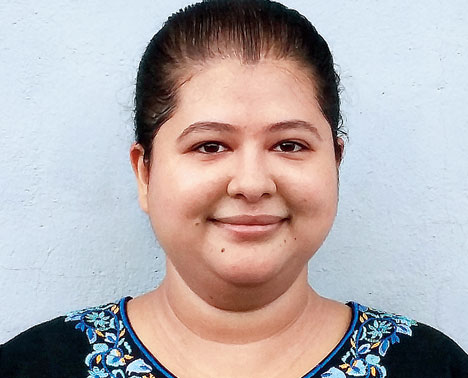
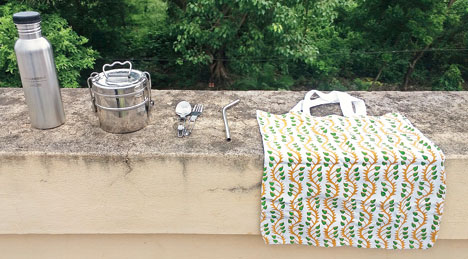
Alipore resident Rakhi Chakraborty suggests the use of (in picture below) cloth bags, metal water bottles, straws and spoons instead of plastic goods and steel tiffin carriers instead of plastic containers
Calcutta:
She is a zero waster – she doesn’t generate any garbage.
In her blog, zerowasteindian.com, she introduces herself as “a zero waster in progress” who “forayed into sustainable living” in 2017 and today pretty much generates zero to little waste.
Rakhi Chakraborty, an online journalist, is on a journey to a zero-waste life and is trying to spread awareness about the environment.
Rakhi was as alarmed as any other millennial about rising temperatures, plastic preponderance and all that’s associated with global warming.
She found in a recent study that humans have generated 8.3 billion tonnes of plastic since the 1950s. And a majority of that is dumped in landfills and oceans, contaminating water sources.
So, she decided to do her bit to undo the damage, one step at a time, believing in “the cumulative power of small positive change”.
In late 2016 she came across Lauren Singer’s blog, trashisfortossers.com, and found it “extremely empowering”. “Generally, as a citizen public policy is out of your control. Singer’s blog taught me to tackle my environment anxiety,” Rakhi, an Alipore Road resident, said.
She follows Bea Johnson and her prescription to lead a garbage-free life.
Apart from Singer’s blog, what spurred her towards a zero-garbage life was her polycystic ovary syndrome and an alarming bisphenol A (BPA) level.
Bisphenol A is an industrial chemical found in common plastic household items.
“It was then that the idea of zero waste made a personal connection with me because it would not only benefit the planet but also me,” she said.
An urban middle-class Indian generates 400-800g of trash every day on average.
“Plastic use has increased drastically over the past two decades. But it is entirely possible to live a life without plastic,” she said.
A zero waste guru, Bea Johnson has inspired thousands of people, including Lauren Singer, author of the zero waste blog Trash is for Tossers, to adopt a zero-waste lifestyle. The New York Times has hailed her as “the priestess of waste-free living”
“I started slowly… I banned plastic bags, water bottles… replaced them with cloth bags and glass bottles.”
Rakhi used to order takeaways that came in plastic boxes, along with plastic cutlery. “I started ordering food a lot less and even if I did I used my own container.”
But the more pervasive toxins came from detergents, dishwashers, beauty products, and even toothpastes.
Harmful toxins pass through clothes and directly into the body as well because of the presence of chemicals like parabens, sodium lauryl sulphate and triclosan in these products.
So, Rakhi has started using reetha (soapnuts), an all-purpose cleaner. “You can use reetha to wash your clothes, clean your utensils… to shampoo your hair. I use organic soap and tooth powder.”
One day she googled the composition of her toothpaste and it “blew” her mind, she said. It is not possible to find substitutes for all industrial product in India, but she follows the thumb rule in Ayurveda – if you can’t eat it, you can’t put it on your body, she said.
The journey to zero plastic hasn’t been easy but it is “pretty doable”, Rakhi, who writes it all in her blog, said. “It’s just a matter of practice and habit. Of course, there is a learning curve to everything.”
source: http://www.telegraphindia.com / The Telegraph,Calcutta,India / Home> Calcutta / by Anasuya Basu / July 03rd, 2018
A wheelchair that can climb stairs, a medicine dispenser that sends out reminders to users, and a walking stick that helps people with visual impairment mavigate with the help of audio messages. These were among 30 innovations that students at 24 institutions in eastern India demonstrated at a CII meet on innovation and startups in the city.
Conscious of the difficulty that the elderly and infirm experience in climbing stairs, students at JIS College of Engineering presented a wheelchair designed to climb stairs, with the help of three sets of wheels that work in tandem. Another innovation was Urja, a multi-purpose electric source, presented by Anish Kumar Sarangi from Silicon Institute of Technology, Bhubaneswar. The device can be used as a portable power source, a high-frequency mosquito repellent, a passive water filter, an LED light and a USB port, from which mobiles can be charged or USB fans can be operated. “Nearly two out of every 10 people in Asia and almost 300 million people in India do not have access to electricity. The challenge is to bring power to them.” Sarangi said.
“CII has formed innovation clubs at different colleges. Commercially viable projects are selected by the jury. Those projects, along with their prototypes, are displayed and some of them adapted in industries. We focus on four main fields: agriculture, education, finance and health,” said Dipankar Chakrabarti, co-chairman, CII Eastern Region Startup & Innovation Taskforce.
Students at Sudhir Chandra Sur Degree Engineering College have created an automatic medicine dispenser for which an app has been developed. Once the medicine schedules are fed into the dispenser the machine can deliver tablets or syrup at the correct time.
Among the other innovations was a solar AC proposed by Narula Institute of Technology. Its students have also proposed smart gloves that can translate gestures into speech to facilitate easier communication by people with speech impairment.
Jadavpur University students have proposed a light, portable, durable and fire-proof cabin that can be used by armed forces at the border.
MCKV Institute of Engineering presented a walking stick and a safety app that gets triggered when a ring worn by the user comes in contact with the mobile. The stick is fitted with GPS and guides the user —a visually impaired person—with audio directions.
Software Technology Parks of India additional director and officer in-charge Manjit Nayak felt most proposals had the potential to be developed into products. “A Class XII student from Bihar came up with a wireless device with which one can remotely control a tractor,” he said.
source: http://www.timesofindia.indiatimes.com / The Times of India / Home> News> City News> Kolkata News> Schools & Colleges / TNN / July 03rd, 2018
If there was no Chinese community in Calcutta, there would have been no rickshaw, no Darjeeling tea and no noodles for us.
But the Chinese – missionaries, migrants, journalists and government emissaries – also left their written impressions of the city.
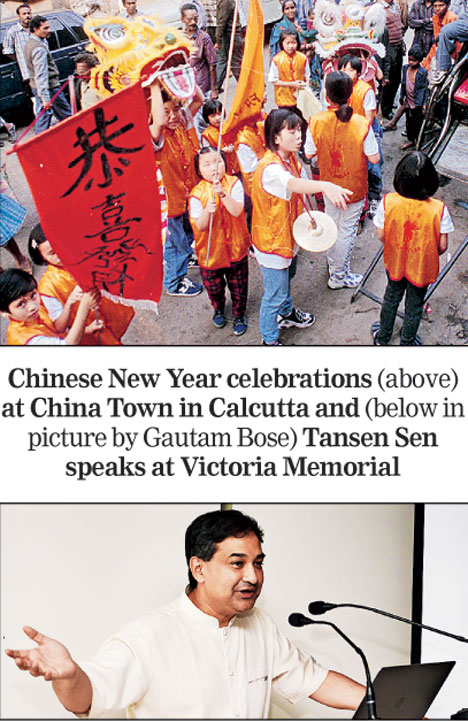
“The Chinese formed the largest migrant group from outside South Asia in the city. There were those who came to look for jobs and those who got smuggled in,” Tansen Sen said.
“It was the site of opium export and of financial transactions in the late 19th and early 20th century. The Mahabodhi Society here was a transit point between Sri Lanka and Thailand, China and Tibet. Many walked from Kalimpong to Lhasa, carrying necessary commodities. All this shows how important Calcutta was to the Chinese.” The professor of history and director, Center for Global Asia of New York University, Shanghai, was speaking on Chinese encounters with colonial and post-colonial Calcutta at Victoria Memorial on Thursday.
Governor General Warren Hastings initiated exchanges with China in the Qing dynasty. He sent a diplomatic mission to Tibet in 1774-75 and granted land near Budge Budge to Tong Atchew, the first Chinese trader to Calcutta, to set up a sugar mill in exchange of tea. British records show how Chinese labourers, especially carpenters, began to grow in popularity.
If Atchew did not document his impressions, Huang Maocai, sent by the governor of Sichuan in 1879, did. “His job was to check if the British planned to attack China and he created maps of the entire region from Sichuan to Bengal. He was fascinated with the railways and the telegraph as well as streetlights and tap water.”
But Kang Youwei, who visited Calcutta twice in the first decade of the 20th centure and stayed at the Grand Hotel, found the streets “filthy like those in Beijing”.
By the time Kang comes, there were three Chinese settlements in Calcutta – Bowbazar, Tangra and Budge Budge. Sen stressed that it would be wrong to lump the community together. “Bowbazar, housing the Cantonese, was a relatively open community. Tangra, housing the Hakkas, was gated. They did not like each other.”
The next major visitor, Tan Yunshan, the founder-director of Cheena Bhavana, Visva-Bharati, described China Town as an unhygienic place of criminal activities, opium dens and “where Chinese women showcase their small feet”, an euphemism for prostitution.
“But those who lived here regarded the place differently, like Kwai-Yun Li. Daughter of Hakka parents who migrated here in the 1920s and owned three shoe stores, she grew up in Chhatawala Gali and then Tangra, and was friendly with Bengali and other communities.”
But the political changes in 1949, when the Kuomintang lost the civil war in China and India recognised the People’s Republic of China (PRC) government, impacted the local Chinese populace.
The rise of communism or the “godless regime” impacted David and Mary Lamb, Chinese Christian missionaries who not only had to quit Shanghai but were also precariously placed in Calcutta as the Bengal government was supportive of PRC. The Lambs founded the Ling Liang Chinese Church and Grace Ling Liang English School in Tangra.
But worse was to come in 1962 with the war. As Kwai-Yun Li, who migrated to Canada and wrote of her Chinatown experience, told this correspondent during her Calcutta visit in 2008: “Fear was in the air…fear of being deported or put into Deoli.”
Deoli, in Rajasthan, is where a British detention camp for World War II Japanese prisoners had been reopened “to lodge Chinese-Indians”. Sen says those who had opted for PRC passports in 1949 were the first to be targeted. Many who were deported to China were settled in villages in Guanxi, Guangdong and Yunnan. “They still maintain Indian traditions like wearing sari and celebrating Diwali.”
The Chinese writings, Sen pointed out, present a perspective different from British writings and deserve to be read to understand the cosmopolitan nature of Calcutta.
source: http://www.telegraphindia.com / The Telegraph,Calcutta,India / Home> Calcutta / by Sudeshna Banerjee / July 01st, 2018
Swachchhasila Basu visits Michael Madhusudan Dutt’s Bengali debut stage on the poet-playwright’s 145th death anniversary
DUTT ADDRESS: Belgachia Rajbari
A two-storey structure off north Calcutta’s Belgachia Road nudges curiosity. The portico cuts though the building like a tunnel. Trees grow on the walls, their aerial roots weaving a veil over it. The pink ground floor walls are peeling like scabs, the upper floor is unpainted. The bricks that seal the arched spaces to the right of the portico talk of secrets buried. The red doors to the left are not welcoming either. And yet, once, the doors of this very house had been thrown open to Bengal’s cultural elite.
The Belgachia Rajbari hosted, among other things, the first performance of Michael Madhusudan Dutt’s Sarmistha, the first original play in Bengali.
According to the Mahabharata, Sarmistha is the second consort of prince Yayati. Says 83-year-old Nityapriya Ghosh, “It was 1859. While translating Ramnarayan Tarakanath’s Sanskrit play Ratnavali into English, Dutt realised there were no original plays in Bengali. Encouraged by friends and patrons, among them the rajas of Paikpara and Jyotindramohan Tagore, he wrote this five-act play.”
This was supposed to be the most productive phase of Dutt’s literary life. In a letter from 1859, written to a friend whom he refers to “as one of the best dogs in creation” he writes, ” Sermista [the English translation by Dutt himself is spelt thus] has turned out to be a most delightful girl… Jyotindra says it is the best drama in the language.”
Ghosh, who used to live in Belgachia Villa – a government housing that came up in a portion of the Rajbari estate – says that around 1836, Prince Dwarkanath, entrepreneur and grandfather of Rabindranath Tagore, bought the estate and a single-storey house and converted it into this palace. In Bonedi Kolkatar Gharbari, Debasish Bandyopadhyay writes that Dwar-kanath had spent over Rs 2 lakh on the estate makeover.
“The who’s who of society would look forward to an invitation to the innumerable parties he threw here,” says 88-year-old Deboprosad Majumdar, who has done much research on the region.
Later, Dwarkanath’s son, Debendranath, auctioned the property. Its new owners, the Singhas of Kandi in Murshidabad, who were the rajas of Paikpara, got it for Rs 54,000.
Paikpara is adjacent to Belgachia.
In Calcutta – The Living City, writer Tapati Guha Thakurta talks about the drawing room of the palace being full of European style furniture, art and sculptures.
Ghosh’s daughter, Sahana, recalls playing with her friends in the palace gardens till the early 1970s, while attending mothers would sit around on marble chairs fixed to the ground, around a marble table, chatting, knitting and soaking up the winter sun.
At that time, the then owners lived in a second house further down, across a large water body known as the Motijheel. Sahana says, “It extended quite a bit across the estate even in the 1970s. An uncle used to take us bird-watching there.” The jheel has vanished in places today and what remains of it are unrelated ponds and garbage dumps.
Theatre artiste Ditipriya Bandopadhyay, who got a chance to enter the palace building recently – she was shooting for a TV serial – says, “I saw some black-and-white photographs. They were captioned but the writing was so blurred that there was no telling what was what.”
Sarmistha opens in the Himalayas. Dutt writes in yet another letter: “Everyone says it is superior to that [Ratnavali] book; as for the Bengali original, the only fault found with it is that the language is a little too high… This I need scarcely tell you, is nothing; for if the book is destined to occupy a permanent place in the literature of the country, it will not be condemned on this head.”
source: http://www.telegraphindia.com / The Telegraph,Calcutta,India / Home> Calcutta / by Swachchhasila Basu / July 01st, 2018
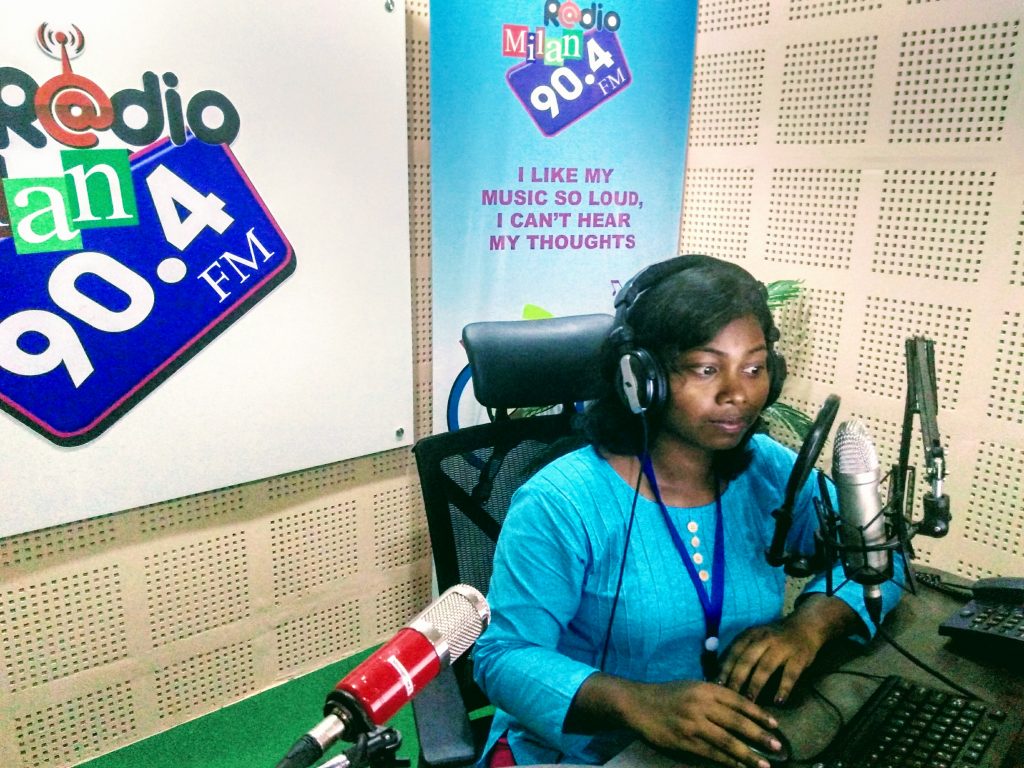
Shikha Mandi, who hosts a show about the coming-of-age of tribals in India in fluent Santhali, also wants more indigenous voices to be heard in the public domain.
Shikha Mandi. Credit: Priyadarshini Sen
Perched on the hot seat, her fingers manoeuvring the keys of a mixer console like an artist wielding her brush, 24-year-old Shikha Mandi cuts an arresting frame. The radio jockey punctuates her chat show, Johar Jhargram – about the coming-of-age of tribals in India in fluent Santhali (the language spoken by over six million indigenous people across South Asia) – with mellifluous strains of village songs.
Her story is even more interesting. The daughter of a small farmer from West Midnapore, Mandi worked her way up from the paddy fields of Jhargram’s Belpahari village where she was born, to the coveted mechanical engineering school at Kolkata’s Industrial Training Institute. And now, as one of India’s first tribal radio jockeys, she’s quite the talk of the town.
RJ Shikha commands the attention of hundreds of listeners through Radio Milan – a small community radio station in West Bengal’s Jhargram district – about 170 km west of Kolkata. The radio waves bearing her unusual Santhal imprint ripple through the Jhargram and Kharagpur districts. More fans across India and abroad tune in to her programme online. Her followers on social media are also growing. Not only does Mandi want tribal culture to be understood across India, she also wants to pioneer its representation through popular media. “There’s almost no knowledge of tribal life and its idiosyncrasies. I want more indigenous voices to be heard in the public domain,” she says.
To forefront tribal culture and ethos, Mandi holds her own at Radio Milan – her “working playground,” as she calls it. Here, she writes her own script, mashes up tunes, readies playlists and rustles up ideas for shows on socially relevant issues. “There’s a lot of independence at work, and I’m encouraged by my colleagues to think out of the box,” she says.
Her colleagues at Radio Milan, which was set up last November by Milan Chakraborty, a Kolkata-based entrepreneur, are supportive of her work. “Shikha impressed us with her determination, diligence and language proficiency,” says Tanmay Dutta, a well-heeled radio jockey from Siliguri, who trains young talent. “There are few people in India who understand the Santhali Ol Chiki script and can translate it. Not too many books or academic resources are available, either. So Shikha works hard on her research.”
But the journey to the hot seat hasn’t been an easy one for Mandi. At the age of three, she was sent to live with her uncle in Kolkata so she could receive a quality education. There were reported incidents of Maoist activity in the Jhargram region, which added to their insecurity. “My parents thought it wasn’t safe for me to live in our village. But in Kolkata, despite having a loving family, I felt a sense of uprootedness,” says Mandi.
At school, the young girl would get taunted for her Santhal leanings and demeanour. But that made her more determined to stay true to her roots. “The older I got, the more connected I felt to my tribal mores,” she says. So, Mandi would tune in to Santhal shows on Doordarshan; sing indigenous songs and recite Santhali poetry at social gatherings. Instead of settling into city life completely, she held on to her tribal identity and nursed the dream of going back to Jhargram.
The move back to Jhargram was in some ways fated. Just as Mandi was preparing to take an apprenticeship test at a Kolkata-based shipbuilding and engineering company, she got an interview call from Radio Milan last November. After scouring several resumes, the hiring team cast its eye on Mandi. “We felt Shikha is deeply embedded in the tribal culture. Her ability to identify issues facing indigenous people, and making them accessible through popular media set her apart from other applicants,” says Chakraborty.
Even though Mandi had no formal training in radio or anchoring, she won the hiring team over with her persuasion skills. Soon after getting selected, the 24-year-old moved back to her beloved hometown.
But the transition wasn’t easy. Years of living in Kolkata had taken the sheen off Mandi’s proficiency in Santhali. She had to make herself acquainted with tribal customs, rituals and devotional songs for her show Johar Jhargram. She also spent nights poring over books given to her by four Midnapore-based professors who knew the Ol Chiki script well, including the bi-monthly magazine Sagen Saota. “Going on air was a nerve-wracking experience, and I would have my script open in front of me every day,” says Mandi.
The content-mastering challenge aside, Mandi also had technical challenges to overcome. The 24-year-old was made to undergo training in script-writing, voice tone and modulation, studio sound and audience engagement. “I had no idea about the technical side of radio production, and was literally thrown into the deep end in order to figure things out,” she says.
But Mandi’s love for all things Santhal made these challenges surmountable. Today, she’s a purist in her approach to showmanship. “There’s not a speck of Hindi or Bengali in my show, and I can rustle up and rehearse a script, three hours prior to my programme,” she says with a wry smile.
The young RJ’s command of Santhali and understanding of tribal culture has also made her more experimental. Nowadays, she goes to different villages in Bengal to identify new trends, and ways to build a support-base in indigenous communities. “Instead of just sitting in my studio and doing my research, I like to be in touch with real people and real issues,” she says.
Mandi’s innovative approach has struck a chord with the Santhal people. Priyanka Hembrom, a 17-year-old ardent fan from the Jaigeria village in Jhargram district, says she too wants to be a radio jockey, and entertain and inform an audience. “Shikha brings important issues such as underage marriages in tribal communities to the fore. She adds a touch of humour to all her shows, which makes her stand apart from others,” says Hembrom.
Mandi’s out-of-the-box thinking also gets reflected in her special shows ahead of tribal festivals. Her programme – the ‘Wonders of Waiting’ was a big success, says one of her colleagues. “The act of waiting is pregnant with hope. Those who work on the borders, wait to be united with their families; children living abroad wait to go back home. Shikha wanted to underline the value of time in the act of waiting. Isn’t that an interesting idea?”
Perhaps for Mandi, too, patient waiting has given her career an impetus, and her life meaning. More advertisers are now buying slots during her show. The Santhali programme has been extended by a couple of hours, and there are plans to bring in more tribal artistes to improve people’s understanding of indigenous communities.
“The fact that I’m doing what I love, for the people I love, in the place I love the most is my biggest success. I’m not looking back,” says Mandi.
Priyadarshini Sen is an independent journalist based in New Delhi. She writes for various India and US-based media outlets.
source: http://www.thewire.in / The Wire / Home> Culture / by Priyadarshini Sen / June 13th, 2018
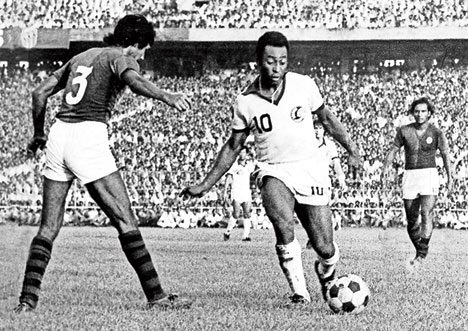
Compton Dutta tries to defend against Pele at Eden Gardens in 1977. A Telegraph file picture
September 24, 1977. New York Cosmos was to face Mohun Bagan. But the ground at Eden Gardens was slippery after a shower. Pele was in two minds about taking the field. But the galleries were roaring his name in chorus. That warmed his heart. He decided to play. “And he played the entire match,” recalls Compton Dutta, who was a part of the Bagan XI.
Seated in the drawing room on the first floor of his FD Block house, Dutta proudly revisits the match. “They went ahead by a goal scored by Alberto, who was Brazil’s captain in the 1970 World Cup. Then (Mohd) Habib and Shyam (Thapa) scored for us and we were up 2-1. But the referee gave a penalty in the dying moments amid an uproar. We asked Pele if it was a penalty. When he nodded in negation, we requested him to tell so to the referee. In broken English, he said the referee was the supreme authority. Thus the match ended in a draw.”
But what he saw of Pele later left a lasting impression. “There was a party in the evening at Grand Hotel where many had gatecrashed. When Pele got on the dais Dhiren-da (Dey, the Mohun Bagan secretary) placed a silver crown on his head.” In a short speech, Pele said to be a good player one has to be good human being first. So unruly was the crowd that when he went to have dinner, he was being pushed around from all sides and sweating, yet never did the smile waver from his lips. That showed that he really walked the talk.” That is why, in Dutta’s eyes, Pele will always be greater than Maradona.
The Cosmos match motivated the Mariners so much that they won the triple crown that year — ILA Shield, Rovers Cup and Durand Cup. “Ours was a star-studded team then — with Prasun (Banerjee), Gautam Sarkar, Ulaganathan, Habib, Akbar, Shyam and (Subhas) Bhowmik.”
It was time for Mohun Bagan to turn around after a period of humiliation. The club had lost almost every time to arch-rivals East Bengal between 1970 and 1975. Dutta rose up the ranks at Southern Sports Association and then Kalighat Club, marking his entry in first division football. He also debuted for Bengal in Santosh Trophy in 1974. He joined Mohun Bagan in 1975.
“Dhiren-da and (Sailen) Manna-da reared me with parental care. Subrata (Bhattacharya) and Prasun had joined the year before. Ulganathan was also there.” But it was East Bengal that had all the reigning stars. In 1975, in the IFA Shield final, the red-and-gold brigade rubbed it in with a crushing 5-0 scoreline on Mohun Bagan’s own turf. “I was fielded in the second half of that match,” Dutta says.
The turnaround started the next year with a 1-0 victory over East Bengal in the league. By then, the club had managed to wean away P.K. Banerjee as coach and then, Bhowmik and Samaresh Chowdhury from the red-and-gold ranks. Club transfers in those days were the stuff of thrillers. Footballers were sometimes made to sign on the dotted line at gunpoint.
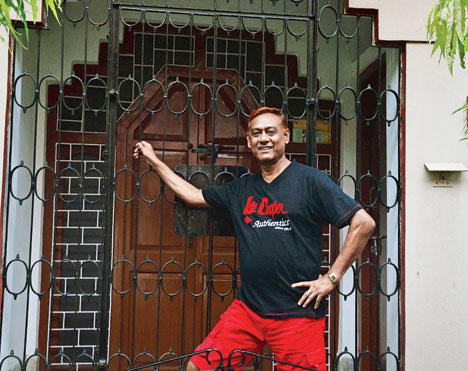
Compton Dutta at the entrance of his FD Block house. (Saradindu Chaudhury)
Transfer tales
Dutta recalls Shyam Thapa’s entry to Mohun Bagan. “Shyam was playing the nationals in Patna. The final was over and the team was staying at a guest house with East Bengal musclemen on guard outside the gate. Late at night, they fell in a stupor after a few drinks. Mohun Bagan recruiters flashed burning match sticks at a distance in the dark as signal to Shyam. He collected his kit and climbed down through the window of the bathroom. A car was waiting for him and he was whisked away to Dehradun and then Delhi. News spread like wildfire that Shyam had escaped. But when his flight was landing at Dum Dum, Manna-da was ready on the tarmac with a police contingent. So there was no way East Bengal could snatch him back.”
A loyal Mariner all his life, Dutta faced the strong arm of the club only once. “Hemen Mondol and Omar worked for Mohun Bagan and Mohammedan Sporting respectively while Jiban and Paltu were the musclemen for East Bengal.” Once he came home to hear a fair and well-built man wanted to see him. “I realised who he was when he gave his name. He said word was doing the rounds that Bidesh (Bose) and I were considering a shift to East Bengal and Dhirenda wanted to meet us. Despite protests, he made us get into his car and reach the tent. Dhirenda was surprised to see us and told him not to worry about our loyalty.”
Football passion in those days ran high. Waiting in queue for a ticket overnight was common. “I have known people to sleep in the open for two nights also,” he says. “When we won, there were celebrations in Mohun Bagan localities. Sweets would be distributed, flags would be hung and songs would be played on the loudspeaker.” But if the team lost crunch matches or even drew against small teams, there would be hell to pay. “Irate supporters badmouthed us and torched vehicles on Red Road.”
Dutta had the misfortune of staying in an East Bengal para — Jadavpur. “Sometimes I would be called names as I would pass by on my bike. I always stopped and protested. Once I returned home after a derby win to find the ambience tense. A local boy had come up to our second floor place and abused my mother. Ignoring her plea, I stormed out to see who it was. The boy was not home but I told his mother that his behaviour was unacceptable and I wanted to meet him. Of course, he never came but others dragged him to our house to seek an apology. Years later, the same boy would be among neighbours coming to me for tickets.”
Tragedy strikes
He became Mohun Bagan captain in 1980. The same year on July 16, Indian football witnessed a black day with 16 spectators dying during a derby at Eden Gardens. “The common belief is the violence was sparked by the on-field altercation between Bidesh and Dilip Palit.”
But Dutta offers a different account. “The violence erupted before the match started. We saw people being carried out by the police as we walked out of the dressing room. We did not realise they were dead.” He blames the thoughtless distribution of tickets that allowed supporters of both teams to sit together. “And when police appeared at the top of the tier to lathicharge the crowd in D1 — the only block in the stadium then to have an upper tier — spectators tried to jump down 20 feet to the lower tier or were already crushed in the stampede.”
His senior international career took off with the 1978 trip to Bangkok for Asian Games. He would go on to play two Nehru Gold Cups, two Merdeka Tournaments, President’s Cup, King’s Cup and pre-Olympics. But it is the 1982 Asiad in Delhi that is at the top of his mind. “A preparatory camp was held for two years at the site where Salt Lake stadium was being built. We were put up in under-construction flats in Karunamoyee,” recalls the right-back who would move into Salt Lake much later, in 1995.
But the sore point was the payment on national duty — a paltry Rs 2000 per month for two years — in place of the club pay cheques ranging from Rs 70,000 to a lakh a year. Sensing the discontent, an option was given and 21 players opted out. “Ours was a valid point. But the media portrayed us as traitors to the country. We started getting heckled everywhere. Finally Priyada (Priyaranjan Dasmunshi) called a meeting and mediated a truce. The AIFF agreed to take back six players, including me.”
Fighting with fever
During the trials, Dutta was down with malaria yet he was kept in the team. “We drew against China and won against Malaysia and Bangladesh. After every match, I would need saline injection at the medical unit. In the quarter-final, Pradip-da (P.K. Banerjee, coach) asked if I was up for it. I said yes. He promised to substitute me whenever I would raise my hand as signal of exhaustion. I fell frothing at the mouth after half time but there was no substitution despite my repeated signals. After I was finally taken off, I was just changing into a track suit when Sudeep Chatterjee, my substitute, blundered at the top of the box resulting in a last minute goal. Pradipda was weeping bitterly.” Only then did he realise that there were just two minutes left. “Had I known, I would have carried on.”
He did get to play at Salt Lake Stadium at the fag end of his career. “It was such an improvement from the sticky mud of the Eden surface which stuck to our studs in the monsoon.”
Another count on which he considers the present generation lucky is the live telecast of matches. Communication was nil when they went abroad. “Once on Puja-eve, we were returning from a match in Pyongyang, North Korea via Moscow. We had to take a roundabout route as India were denied access to China airspace in those days. But word spread that our flight had crashed. It was only after we reached that we found the reason for the grim atmosphere at the local Puja pandals.”
Watching the Asian teams assert themselves at the on-going Fifa World Cup, he laments the decline of India’s standard. “We don’t even play the top teams in the continent now. The Indian Super League (ISL) may be a well-marketed event but will it help Indian football?” he wonders.
source: http://www.telegraphindia.com / The Telegraph,Calcutta,India / Home> Calcutta / by Sudeshna Banerjee / June 29th, 2018
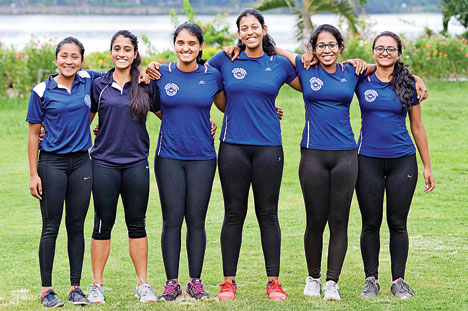
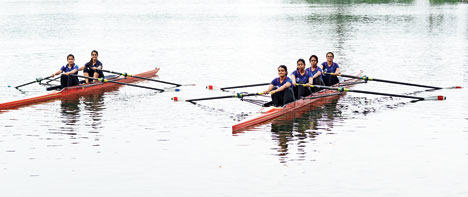
(From left to right) Aishwarya, Shreya, Shramana, Shweta, Shreyaa and Semanti at the Bengal Rowing Club. Pictures by Bishwarup Dutta
Calcutta:
Six girls from Calcutta will be part of the 10-member Indian women’s team for the World University Rowing Championship to be held in Shanghai from August 10 to 13.
Some 500 participants from 25 countries, including the US, the UK, Germany and Australia, will compete at the Shanghai Water Sports Centre in Qingpu district.
The finalists were selected at a trial camp in Chandigarh on June 18.
The top rowers from Indian universities attended the camp. The Calcutta contingent comprised four girls from Jadavpur University and two from Calcutta University.
Team JU
Semanti Choudhury, Shramana Saha and sisters Shreyaa and Shweta Brahmachari had won gold in the 2000m women’s fours in the national university championships at Chandigarh earlier this month.
The win was special because the team edged out Punjab University, the hot favourites, by 1.5 seconds.
“It is going to be a huge challenge in China,” Semanti, who has just completed her MSc in economics at Jadavpur University, said.
The senior-most in the group, she’s been rowing for more than a decade. Painting is her other passion.
Shreyaa, the older of the Brahmachari sisters, is doing her MSc in Chemistry from JU. “For me, it is labs and lakes,” Shreyaa, who lives in Southern Avenue, said. She got introduced to the lakes while taking swimming lessons at Anderson Club.
She shifted to rowing in 2009 at the Lake Club. Early morning trainings made her leave the bed at 5am. The two sisters slept together and it was their mother who prodded the younger daughter, Shweta, to follow suit.
“You, too, should get up early. Why don’t you join her for rowing,” Shweta remembered her mother telling her.
Shreyaa won her first medal (bronze) in 2010, the first time she took part in the sub-junior nationals in Roorkee. Shweta started rowing in the winter of 2010 and within six months, won gold in the sub-junior nationals in Calcutta.
Shramana, a first-year English honours student at JU, loves playing the double bass guitar. “I hardly have a social life. For me, the strings and the oars complement each other,” she said.
Team CU
Aishwarya Krishnan and Shreya Iyer, childhood buddies turned rowing partners, together won Bengal’s lone gold medal in the Senior National Championships in Pune last December.
The duo defeated Chandigarh and Odisha in the 500m women’s double sculls.
Shreya has just completed her graduation in psychology from Loreto College. Aishwarya studies commerce in St Xavier’s College. Both started rowing when they were in school, one after the other. The turning point in their careers came in 2015 when they became partners in double sculls. The two have since won several medals.
“We are super excited. Our strength is our chemistry,” Shreya said.
Rowing apart, Aishwarya is a trained Bharatanatyam dancer. Shreya’s other passion is violin.
The training
Shweta and Shramana are members of the Bengal Rowing Club. The rest are Lake Club members.
All six will leave for the training camp in Chandigarh in a few days.
But they are already into full throttle practice mode at the Rabindra Sarobar lake.
Shreya and Aishwarya are focusing on double sculls while the four from Jadavpur are training for women’s fours.
They are training in two shifts at the moment – early morning and evening.
Apart from boat sessions, long-distance running, ergometers and gymmimg are part of their schedule.
All four are on a junk-free and high-protein diet.
“We have not competed with so many formidable teams on an international level earlier. But we will give everything we have got,” Aishwarya said.
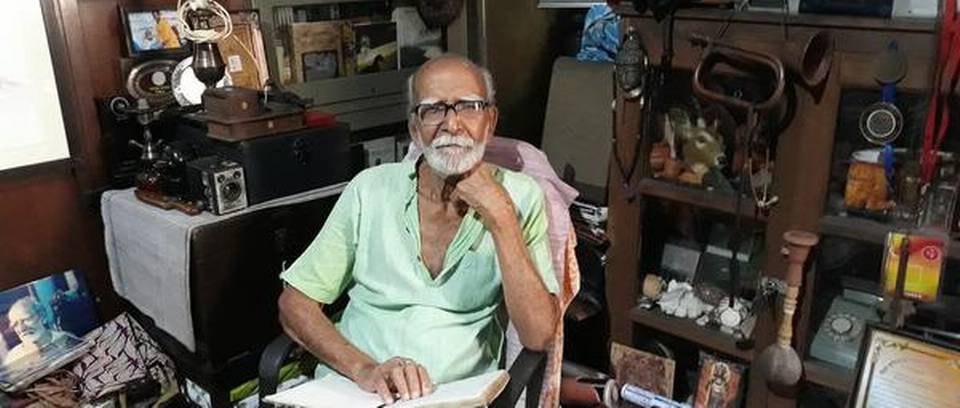
Custodian of memories: Nonagenarian Sushil Kumar Chattopadhyay aka Nakubabu has been collecting since boyhood and his one-room museum has everything from wooden ship binoculars to a World War I sundial clock – SANDIP ROY
A museum for boats, for a brilliant scientist’s workspace, for poignant records of indentured labour at the Port Trust and more — whether these museums are dusty sarkariaffairs or individual works of love, they brave many odds to preserve centuries-old lived history.
As I climb up the narrow stairway of the old house in north Kolkata, I hear the hiss of a pressure cooker and the strains of Rabindrasangeet, the deep baritone of Debabrata Biswas. There are clothes drying on the landing, the clutter of middle-class domesticity. In a room off the landing sits Nakubabu, a lean white-haired man in a lungi, almost hidden by piles of old movie projectors, wooden speakers and hanging lanterns.
“You don’t need my address,” Sushil Kumar Chattopadhyay aka Nakubabu had said over the phone. “Just ask anyone on my street.”
He is famous here as the man with the one-room museum. Every morning, he gets up at 4.30 am, has his cup of tea, which he shares with two tuntuni birds, does his yoga, washes his clothes, then dusts his “museum”.
Nakubabu is 93. He has been collecting his entire life. As a boy roaming the jungles of tribal provinces at night, he collected leaves and stones. Somehow that passion for collection became a private museum of sorts. He has paperweights from the days of indigo sahibs, old microscopes that doctors carried with them, wooden ship binoculars, a World War I sundial clock and so on.
“I don’t collect them. They call to me,” he says. “Look at this lamp. Someone just came and gave it yesterday.” He has no catalogue, only a memory map of what is kept where. He’s never held a real job, making amplifiers, acting in jatra theatre, roaming the country on his motorbike from 1948 till 2000.
This is a museum like no other, where facts take second place to stories. I grew up thinking of museums as homework, antiseptic fluorescent-lit rooms, neat captions about dead dynasties and 10th-century sandstone, a box for everything and everything in a box.
But Kolkata is filled with little museums few know about, some as intimate as Nakubabu’s, others run perfunctorily by dusty government agencies, or as labours of love.
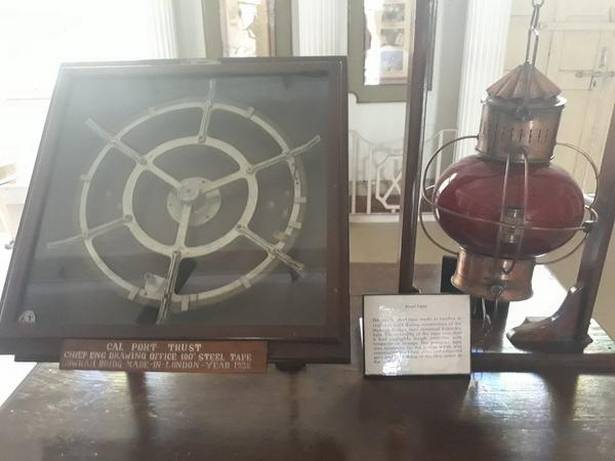
There is a Boat Museum with 46 wooden replicas of boats whose names we have forgotten — feal chhara, patia, bhidi. At the Ethnographic Museum, someone has collected dried milk from the Bhutia community and Santhal violins. The Kolkata Port Trust museum has a steel tape once used to measure the Howrah bridge, its speciality being that its length varied negligibly with temperature change. At the forlorn Government Industrial and Commercial Museum, constantly facing shutdown, there’s a grey muslin sari so fine it could pass through a ring, and a display of Bengal’s pharmaceutical heritage — green boxes of the bitter Kalmegh herbal tonic, blue-and-white Milk of Magnesia and “rational cough cure” Kasabin. Raja Ram Mohan Roy’s ancestral mansion, once stripped bare by squatters, and now restored, has a replica of his death mask and a “suttee gallery”. There was a pond and a swing, both gone now. The 19th-century social reformer, often called the Father of the Indian Renaissance, who campaigned to abolish sati, used to swing there facing the water, practising for seasickness while dreaming of going overseas.
They all form a jigsaw puzzle of the city, its idiosyncrasies, narrating the footnotes of a lived history that textbooks forget.
***
Once, Kolkata was a British city. The police were the good guys and the freedom fighters were the ones on the run. But at the Calcutta Police Museum, in the room with the declassified Netaji files, a sign proudly proclaims “Kolkata Police Salutes Netaji” right above files neatly numbered 1-54 of the police spying on Subhas Chandra Bose. In the gallery below, there is a book bomb sent to a magistrate, as well as bullets extracted from the body of Inspector NN Ghosh, and a revolver with which Bina Das tried to shoot the governor of Bengal.
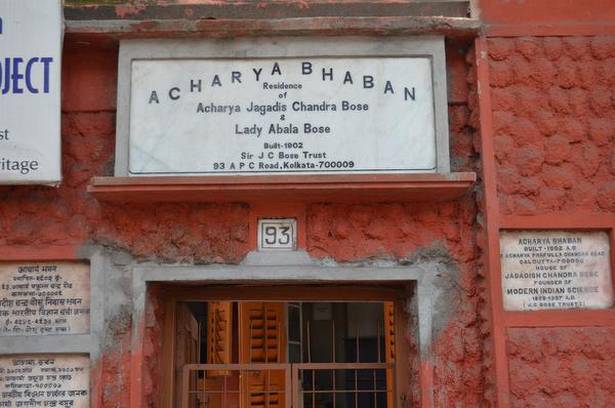
The Indian Museum and Victoria Memorial are grand but these are different kinds of museums, often homes where people lived, people like the philosopher-reformer Ishwar Chandra Vidyasagar, Subhas Bose and, of course, Rabindranath Tagore. They still bear the ghostly stamp of their personalities. “Look at those two chairs,” says Ankita Ghosh as she shows me around the bedroom in Acharya Bhaban, the grand red mansion that belonged to scientist Jagadish Chandra Bose. That’s where Bose would chat with Tagore. “I think the chair with the greater indentation is Bose’s,” she smiles. “He was the heavier man.” In the bedroom, there’s Lady Abala Bose’s purse and gloves, as if the Boses had just stepped out and their food was chilling in the state-of-the-art wooden refrigerator. The laboratory has the scientist’s instruments with names like crescograph, oscillating plate phytograph, stymphograph. The vine Bose brought back from California still bears purple flowers.
But museums cannot live on love and memory alone. Acharya Bhaban only opens twice a week, for two hours. “Manpower and security problems,” laments Parul Chakrabarti, a retired scientist who has made this her passion. “Even Tagore’s Nobel prize got stolen. And they have so much staff.” Acharya Bhaban was a decrepit mess filled with cobwebs when they began restoration work with the help of INTACH. It took three months just to get rid of termites. Now Nandalal Bose’s Mahabharata murals can be seen once again on the ceiling. There’s a wooden elephant stand with ivory teeth gifted by the Maharaja of Kashmir, the giant Bharat Mata painting by Abanindranath Tagore inspired by Sister Nivedita.
But Chakrabarti frets about the future. The museum has been promised ₹5 crore by the government of India if it can raise ₹1 crore on its own. “Corporate houses were interested but now their big priority is Swachh Bharat,” she says. They have just painstakingly fumigated and restored books gifted by the likes of George Bernard Shaw and Romain Rolland. “Restoring each page costs ₹1,000,” she says. They want to restore his brittle doctoral gown but it’s too expensive. GM Kapur of INTACH says, “You need resourceful movers and shakers on a trustee board to reach out to the corporate world. Shouldn’t Vodafone or Jio be supporting Jagadish Bose?”
Across town, the Gurusaday Museum, with one of the richest collections of folk art is facing a similar existential crisis. Old kanthas with pictures of sahibs and phaetons, and scroll paintings of Manasamangal are facing an uncertain future as funds have dried up.
Sometimes this feels very Kolkata-ish, wistfully clinging to a threadbare glory of bygone days. Yet this is not simply nostalgia for a fraying bhadralok past. There’s a more variegated story at stake beyond the Boses and Tagores.
Mind space: Acharya Bhaban offers rare glimpses into the life and work of scientist Jagadish Chandra Bose – SANDIP ROY
***
At the Port Trust museum, there are discoloured deeds for indentured labourers who passed through these ports. Each man was worth ₹6, each woman ₹8, zero for those under 10, “Punjabis are altogether refused”. They were given 14 chittacks rice daily, two chittacks dal, half chittack of ghee and salt. Once a year they got one blanket, two dhoties, one lascar cap and a lotah shared by four people.
These stories form the true marrow of the city, not its mythology. Popular myth has it that Job Charnock founded this city on August 24, 1690. Devarshi Roy Choudhury, scion of 35 generations of the Sabarna Roy Choudhurys, has been fighting to upturn this history for years. This is a much older settlement, he argues, and he has old documents to prove it.
Spanning time: The steel tape once used to measure Howrah Bridge, now in Kolkata Port Trust Museum – SANDIP ROY
He went to court to challenge August 24 being celebrated as Kolkata’s birthday and won. Since then he has been collecting everything he can find from attics and locked trunks of the many settlements the family called home. Some are precious — a diamond ring given by Jehangir in 1608. Some are priceless — the ashes of Sarada Maa, the spouse of Sri Ramakrishna. Some are curios — tweezers to pluck white hairs, a pot from 1840 that could store 240 kg of rice, a grinding wheel from 1812. “We want to show that we don’t have to look to the government for everything. We are privately organised, privately financed. But, of course, you have to sacrifice something. You need tenacity.” There are 22,000 members in the sprawling family tree but precious few to help run the Sabarna Sangrahashala, he admits. “But young students come. I tell them to create a drawer at home with their grandfather’s glasses, their family tree. It’s a beginning.”
***
At a time when so much competes for our attention, INTACH’s Kapur says it’s not enough to have a collection and expect support. “A museum must constantly reinvent itself, attract people with different activities. You have to think about how to get the museum out to the people.”
Old ties: A Sabarna Roy Choudhury family heirloom – SANDIP ROY
The Smaranika Tram Museum offers an air-conditioned bogey for coffee amidst old diodes, rusty ammeters, and models of horse-drawn trams. But its real attraction is the little café with cosy tables for two, admits Jalaluddin Sheikh, who presides over it all. The museum is empty when I walk in. The café is full, the romance of the tram very much alive for a ₹10 ticket. Sheikh came to the city as a wide-eyed boy from Burdwan in 1988, riding tram No. 25 from Howrah. The ticket cost 35 paisa. He still lives at a mess in the Tollygunge tram depot and rides a tram to work every day. And he supervises over both the museum and the lives of its regulars. As a young couple have a tiff, the girl complains angrily to Sheikh. The boy fiddles with his phone.
As they leave, Sheikh smiles indulgently. “It’s a deep relationship. There’s been a misunderstanding. But it won’t break. I am there toh.” And as simply as that, a museum meant to save a city’s past watches over its future. In the end, it’s always about the passion.
“Aakoolota,” says Nakubabu, an almost untranslatable word akin to desperate ardour. “If you are aakool, you can do anything, I actually have nothing. These things came to me. They were uncared for. I care for them. Those who originally bought them must have loved them. That love remains. As I clean them, I feel it. Perhaps, one day, someone will love them more. Then they will leave me.”
Has that ever happened, I ask.
Nakubabu leans back on his easy chair. “No,” he says softly. “They have not left yet.”
Site of progress: Social reformer and sati abolitionist Raja Ram Mohan Roy’s mansion has a ‘suttee gallery’ – SANDIP ROY
Sandip Roy is the author of Don’t Let Him Know
source: http://www.thehindubusinessline.com / Business Line / Home> Specials / by Sandip Roy / June 29th, 2018
Nearly one in five “Bengalis” — or people who have listed Bengali as their mother tongue in the 2011 census — now lives outside Bengal. India has 9.6 crore Bengalis, of whom 1.8 crore (or 19%) stay outside Bengal, data from the 2011 census on mother tongues has revealed.
Maharashtra has the maximum number of Bengalis in India if you discount Bengal and its neighbouring states like Orissa, Bihar and Jharkhand, and states and union territories like Tripura and Andaman and Nicobar Islands, which have always had a large Bengali population.
Maharashtra has 4.4 lakh people who count Bengali as their mother tongue, which is way more than the number of Bengalis in Uttar Pradesh, the National Capital Region of Delhi, Karnataka (which has Bengaluru, home to a large number of Bengalis), erstwhile Andhra Pradesh and Tamil Nadu.
Maharashtra topping the list of these states has come as a surprise to many. Of these states and union territories, Delhi is traditionally supposed to have a high concentration of Bengalis. “But Maharashtra has a high growth rate with a quite a few cities that are very well off,” social theorist Ashis Nandy felt. “Bengal, incidentally, is one of the biggest suppliers of labour to Maharashtra,” he added.
Linguist Pabitra Sarkar attributed the lure of the film industry in Mumbai as a reason for the high Bengali-speaking population there. “The education sector in Pune and the diamond industry based in Maharashtra are big draws among migrants who speak Bengali,” Sarkar said.
Also, Nagpur — the headquarters of erstwhile Bengal Nagpur Railway — has a large Bengali population of settlers who migrated to take up employment in BNR. Besides, Delhi is geographically much smaller than Maharashtra — a huge state — though the concentration of Bengalis there may be more.
Social theorists Ashis Nandy also pointed out that Bengalis were “assertive” about their language. “Even when Bengalis shift to Maharashtra, they continue to speak their language,” Nandy said.
Chhattisgarh is second to Maharashtra among states that do not share a border with Bengal (and states and UTs other than Tripura and Andaman and Nicobar Islands) to have a large Bengali population; it has 2.4 lakh Bengalis. Madhya Pradesh, from which Chhattisgarh was carved out in 2000, has a much lower figure of a little more than 1 lakh.
Andaman and Nicobar Islands has a similar number of people who count Bengali as their mother tongue. Sarkar attributes this to the migrant Bengali population. “They were refugees from erstwhile East Pakistan. Their children and grandchildren speak Bengali as their mother tongue,” Sarkar explained.
Among the five southern states, Karnataka — because of the large Bengali population settled in Bengaluru — tops the chart; it is followed by Andhra Pradesh, Kerala, Tamil Nadu and Goa.
The percentage of people in India who have listed Bengali as their mother tongue has gone up to 8.3% of the total population (from 8.1% in the last census of 2001). Sarkar says he would not want to ignore the influx of the migrant population from Bangladesh to various parts of India.
source: http://www.timesofindia.indiatimes.com / The Times of India / Home> News> City News> Kolkata News / by Priyanka Dasgupta / TNN / June 28th, 2018