All posts by wellnmed@gmail.com
29
28
Medical care for a low, flat fee of Rs 10
A Calcutta doctor who spends his Sundays running a clinic in a remote village asks why others don’t do so too.
Samantak Das
On the first Sunday of every month, Dr Santanu Banerjee, MD, gets up at 4:30 in the morning and sets off for a small village some 300 kilometres from Calcutta. I’ve known Santanu for some years now, as a neighbour who is also my physician, and as a keen participant in our para’s various activities, especially during the festive season. A few months ago, after he had completed my check-up, we got to chatting about healthcare issues and he told me how surprised he had been to discover the high prevalence of so-called ‘diseases of affluence’, associated with sedentary urban lifestyles, among the labouring poor in rural Bengal. When I asked, somewhat sceptically, where he got this information from, he invited me to visit the health centre that he runs in his ancestral village and take a look for myself. So, on the first Sunday of this October, I did.
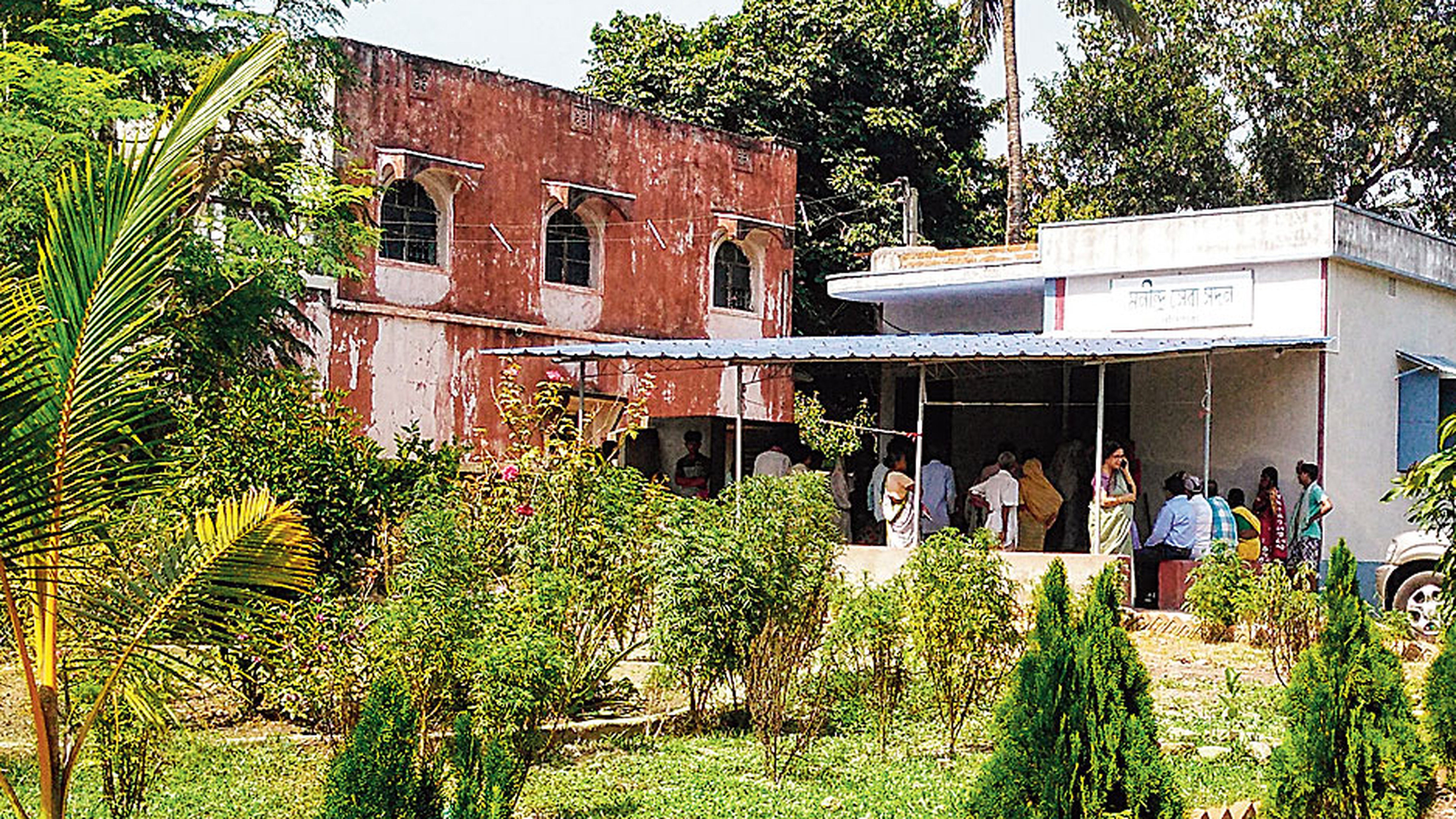
We reached Manihara village, just beyond the Bankura-Purulia border, a little before noon, and went straight to the Manindra Seva Sadan, named after one of Santanu’s ancestors. The spacious three-room centre is located on a largish plot of land, with a beautiful garden and immaculate lawns — Santanu tells me that it belongs jointly to several members of his extended family, but had been lying unused until he decided to set up the centre. He took a loan from his mother, cleared and cleaned the land, and constructed the neat, single-storey structure that stands there now.
Outside the building, under a large permanent awning, villagers wait, patiently, for the daktarbabu to come. On arrival, Santanu’s team swings into smooth, practiced action. Of the three rooms, the first — which runs the length of the building — is where patients have their names, blood pressure and pulse rates noted, and are given a number (depending on their place in the queue) on a slip of paper; as they pass through the long room, they can get a battery of tests done, if needed, on a device that Santanu calls his “lab in a box”. Once all this is completed, they line up to enter the doctor’s chamber in the next room, where one of Santanu’s assistants notes down their details on a laptop. After Santanu examines them and writes out his prescriptions, they move to the adjoining room, where medicines are distributed. On the day of my visit, Santanu’s wife, Kokila, a doctor with an MD in microbiology, was assisting Santanu’s father, a retired engineer, in the medicine room. Patients leave only after collecting a month’s worth of medicines. Some will come back to the centre in a week’s time, and report their condition to Santanu via video-conferencing — he is available online between 9:00 and 11:00 am every Sunday — and some of them will return on the first Sunday of the following month. The cost for all this is the ten rupees patients pay when they register; there are no other charges.
The day I was there, over 200 people had registered to be examined. There was a low buzz around the centre, interspersed with the occasional shout, as a patient’s name was called out, or someone asked someone else not to shove others in the queue. The noise level went up several-fold as patients jostled in line, assistants shouted to patients to register their names, have their pressure noted, and so on and so forth. In the midst of all this, Santanu sat like the calm eye in the centre of a mild storm, radiating cheerful good humour as he spoke to patients in his soft, measured tones and wrote down their prescriptions. Santanu has a mild, friendly manner, and is unfailingly polite even to the most vociferous of his patients. When his assistants raise their voices, mostly in order to ask patients to maintain quiet (“Have you come to a doctor, or to a fish market?”), he remains composed. He also has a sly sense of humour and a ready smile that puts even the most grim-faced individual instantly at ease. He tells a patient, with a broad grin, that he will kill himself if she can prove she actually did take the medicines he’d prescribed last month. After much hemming and hawing, she admits that she “might have missed” a couple of doses.
Of course, many of his patients have seen him before, and he seems (at least to my untutored self) to recall every detail of their various ailments. Interspersed with talk of symptoms, diagnostic tests, medicines and so on, he exchanges pleasantries with his patients — telling someone she’s fine, reassuring another that he needn’t worry, the usual doctor’s prattle: but, sometimes, he turns to me and says, half in jest and half in despair, “Tell me, how on earth do these people get these diseases, here, of all places?” He seems to be especially puzzled by the high incidence of diabetes among his patients, including in some who are in their early thirties, as well as other diseases of the leisured, particularly hypertension. “Look at her. Not an extra ounce on her and yet she has a blood sugar reading of 210! How do you explain this?” There is speculation in the medical community that undernutrition in infancy could be a likely cause even though official statistics do not seem to bear this out. This is something that needs to be investigated thoroughly because the health of thousands is at stake. Over 33 per cent of his patients have diabetes and 40 per cent suffer from high blood pressure. He has the details of all the patients he has treated since he set up the clinic three years ago but wants to know more about the prevalence of illness in the area. “I would like to make a database of every individual and their ailments in the 30-odd adjoining villages. Once I know this, we can do more to alleviate or, best of all, prevent them.” He would also like to bring every woman, child, and man in the area under a health insurance scheme.
When I leave the centre, it is past 4:00 pm, but Santanu is still inside, talking, smiling, examining, prescribing. He will stay back tonight, along with his wife and two kids, for tomorrow they will distribute saris among the women of Manihara for the festive season. His parents will help him, as will his paternal uncle and aunt, who still live in the village.
As I speed towards the bright lights and loud noise of the city, I glance back at the endless expanse of undulating green, dotted with clumps of kaash flowers, harbingers of the season of festive joy, and I wonder: what makes a man like Santanu Banerjee do this month after month, year after year, almost single-handedly, with scarce resources and at considerable cost to himself in terms of time, effort and energy? By my reckoning, it costs Santanu some thirty to forty thousand rupees every time he visits the health centre, but when I put this to him later he only smiles at me. Does he receive any money from funding agencies? No. Do many other doctors go with him to the centre? Again that smile. Yes, he agrees, he couldn’t have done it without strong family support. But why does he do this, I persist. He looks up, quizzically, “Shouldn’t you be asking me why others don’t do it as well?” I have no answer. Santanu says he can’t really explain why he started doing this work and refuses to accept the usual explanations about giving back to society, extending a helping hand to people, and so on. Instead, he tells me a story. “One night, as I was peeling open sealed boxes of medicines and arranging the strips into smaller bundles, my fingers started to bleed. And instead of feeling upset or angry, I felt this joy radiating through me. That was my epiphany. That’s when I knew this was the right thing to do.”
Samantak Das is professor of Comparative Literature, Jadavpur University, and has been working as a volunteer for a rural development NGO for the last 30 years.
source: http://www.telegraphindia.com / The Telegraph,Calcutta, India / Home> Opinion / by Samantak Das / October 26th, 2018
26
25
24
Balaichandi Durga Puja: In this Bengal village, Durga Puja starts on Dashami
Khadimpur village has celebrated Balaichandi Durga Puja for the last 500 years. The Durga idol here has four hands instead of 10, and you cannot find demon Mahisasur and his buffalo with Goddess Durga
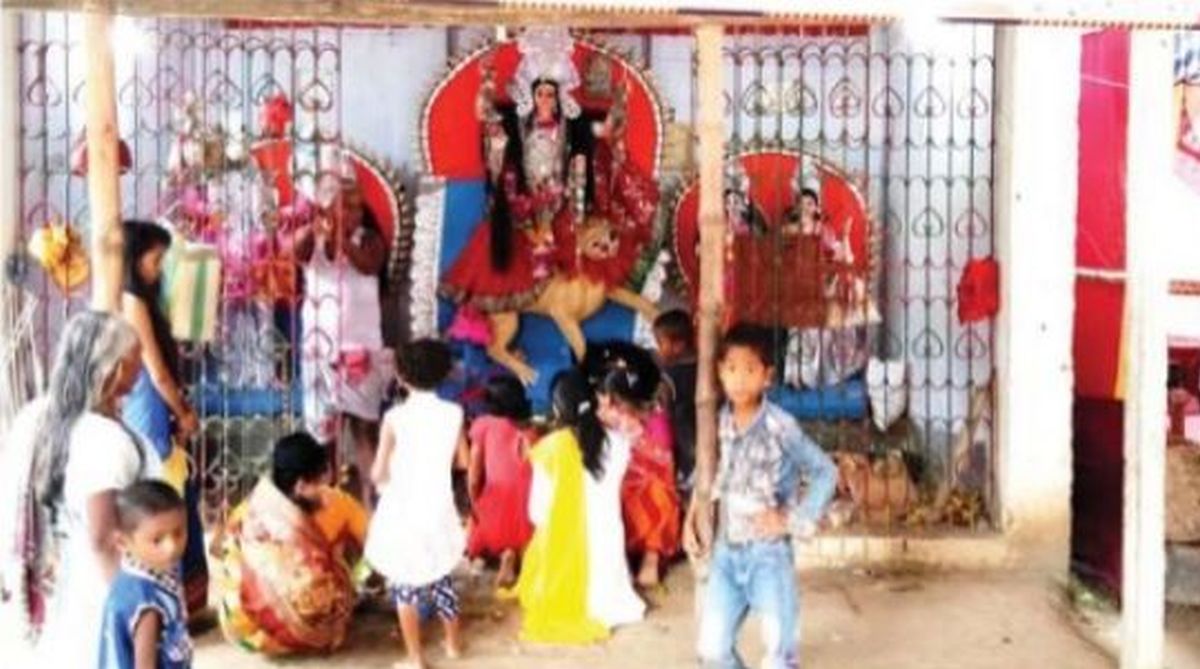
Durga Puja may be over for all of us now, but things are different for the residents of Khadimpur village in Kamlabari-2 gram panchayat, 12 km away from Raiganj town in North Dinajpur district. The villagers here are still in a festive mood. As every year, Khadimpur is engrossed in observing the traditional Balaichandi Durga Puja that started on the night of Vijaya Dashami.
Around 7,500 members of 1,500 families living in the village began celebrating the Durga Puja with all pomp and grandeur on the day.
According to Puja organisers, the village has celebrated Balaichandi Durga Puja for the last 500 years. The Durga idol here has four hands instead of the usual 10. All the deities, including Goddesses Lakshmi and Saraswati, and Lord Kartik and Ganesh are present with the Goddess Balaichandi. However, the demon king Mahisasur and his buffalo are not worshipped here.
Numerous visitors even from outside the district visit the Puja pandals in Khadimpur in huge numbers every year.
“The Balaichandi Puja is being observed in our village since the past 500 years for the well-being of the village. According to rituals, the Puja starts on the night of Dashami and continues for the next five days. All wear new clothes during the Puja and eat vegetarian food in their houses till the Puja is over. An animal sacrifice is also a part of the Puja observed here,” the Secretary of the Khadimpur Balaichandi Puja Committee, Sreekanta Barman, said.
The priest of the Puja committee, Basudev Chakraborty, said, “Our forefathers used to worship Ma Blaichandi here and the Puja is observed here even after 500 years of its commencement.
“Once upon a time, on the day of Dashami during the regular Durga Puja, our crops got damaged due to drought which led to the death of several villagers due to starvation. Since then, on the day of Dashami, villagers here started the Balaichandi Puja. As predecessors, we will have to keep the tradition going. People from nearby villages and from outside the district turn up here to witness our Puja. We will be organizing different cultural programmes with participation of students of our village for the next five days. Villagers enjoy it with great enthusiasm,” added Mr Chakraborty.
source: http://www.thestatesman.com / The Statesman / Home> India / by Statesman News Service, Raiganj / October 23rd, 2018
The Downton Abbeys of Dhanyakuria
Wandering in the Bengal countryside could bring you to these accidental Indo-English castles
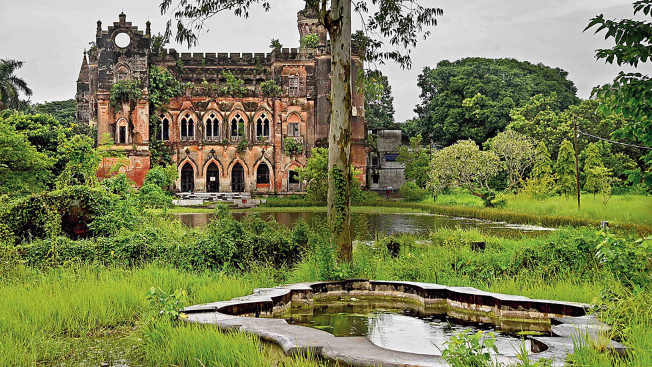
Image: Ankit Datta
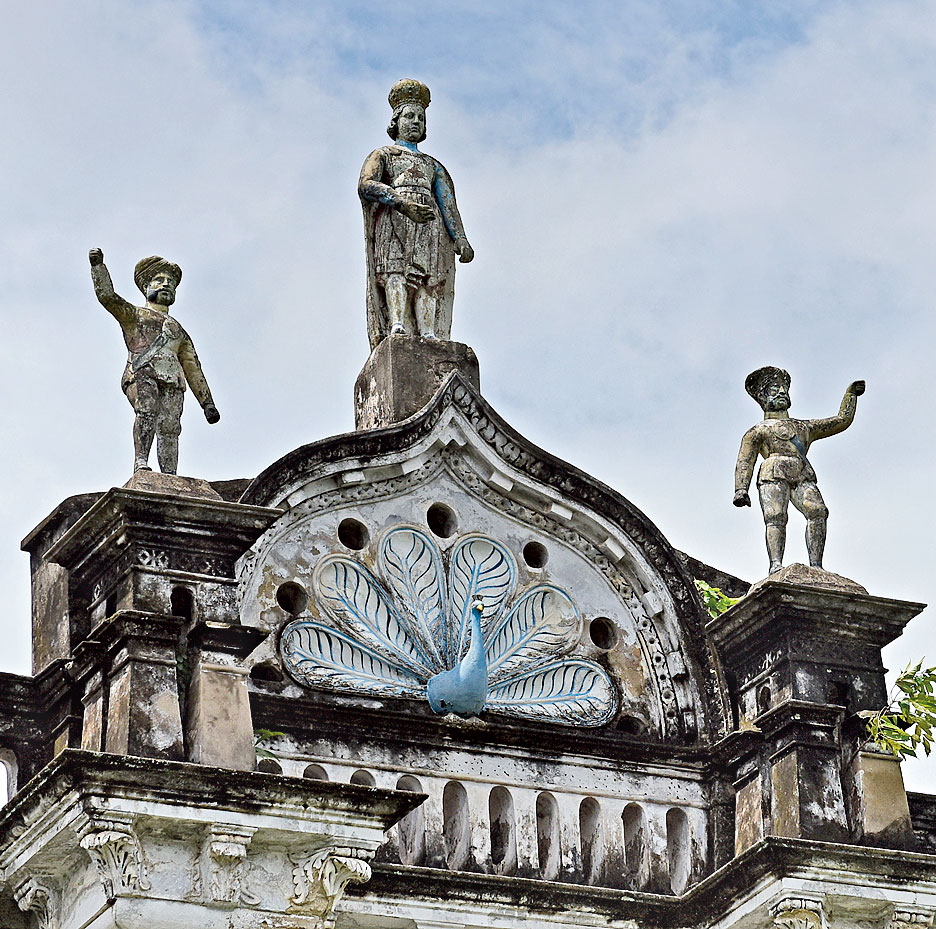
Anyone who has travelled along the Barasat-Taki road — northwards from Calcutta, towards Basirhat — would have noticed the picture-postcard castle. Visitors are not allowed inside the gated compound, but you can stop and admire the turrets, spires, the uneven roofline broken by stepped gables.
But that afternoon, when we reach the place, the gates are wide open. A truck is downloading bricks — we learn they are for the construction of a government office building. It is a 30-acre campus and we are eager to explore it. We sneak in and manage some quick clicks, when some security guards spring into action. We are chased out with a stern — “You need permission from the [social welfare] department.”
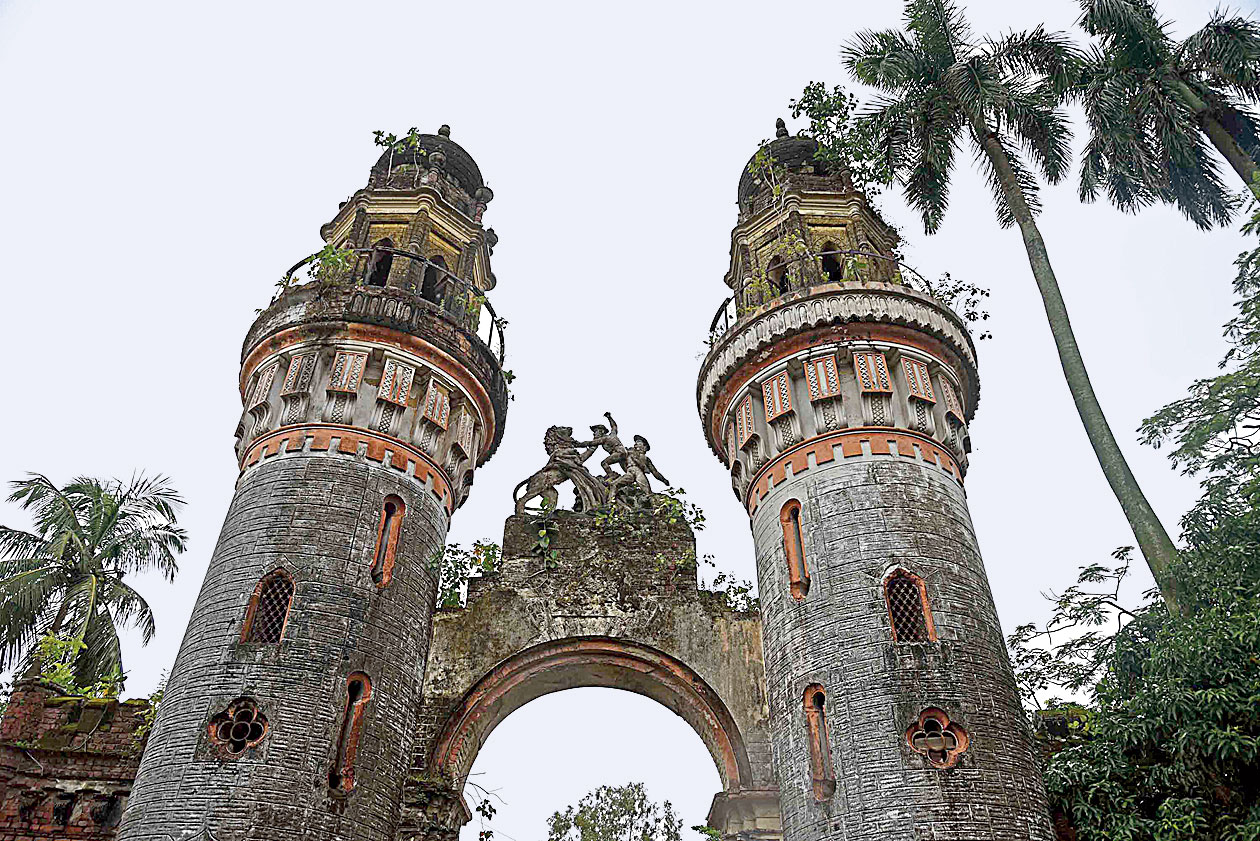
Image: Ankit Datta
Out on the road, we ask a passerby what this grand structure is called and what it’s meant to be. “This used to be called Gaine Garden, property of the Gaines,” he informs us, and for details redirects us to the Gaine progeny living in Dhanyakuria village in North 24-Parganas.
Teacher and writer Monjit Gaine lives with his elderly father, Kanchan Gaine, and his family in a portion of yet another grand structure of long, open corridors and many wings called the Gaine Rajbari. Monjit ushers us into the majestic thakurdalan or collonaded altar for Durga worship. He says, “Every other month some tele-serial or movie is shot here. Villagers call this ‘shooting bari’.” According to him, it is the rent from film production companies that aids the upkeep and maintenance of the huge mansion.
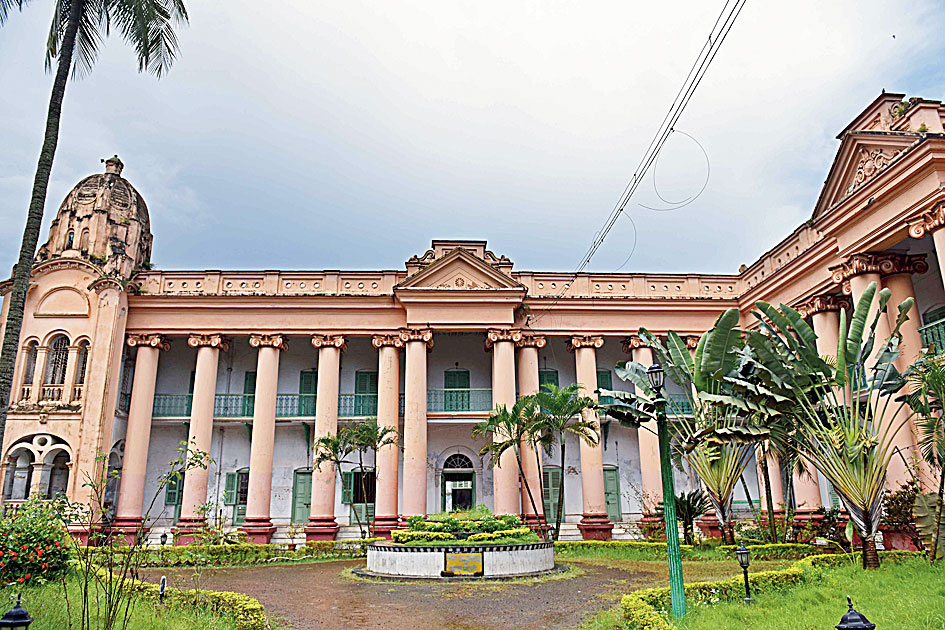
Image: Ankit Datta
The Gaines made a fortune trading in jute, jaggery and other agricultural products. They worked in partnership with two other families of Dhanyakuria — the Sawoos and the Ballavs. All of them enjoyed the patronage of the British. “Huge tracts of agricultural fields and land ownership turned them into zamindars,” says Monjit. “Family lore goes that our ancestral properties extended to Satkhira in present-day Bangladesh, and in north, central and south Calcutta,” he adds.
Gaine Mansion was built in parts, primarily by Gobinda Chandra Gaine and his son, Mahendranath Gaine, mid-19th century onwards. Mahendranath was a prominent member of the Bengal Chamber of Commerce and owned quite a few jute mills too. He was the one who built Gaine Garden by the main road. Post Independence, the state government acquired the property. Says Monjit, “A few years ago we heard it had acquired the heritage tag. [Once a property gets this tag, it cannot be defaced, its basic structure cannot be changed either.]” He has no clue about the ongoing construction.
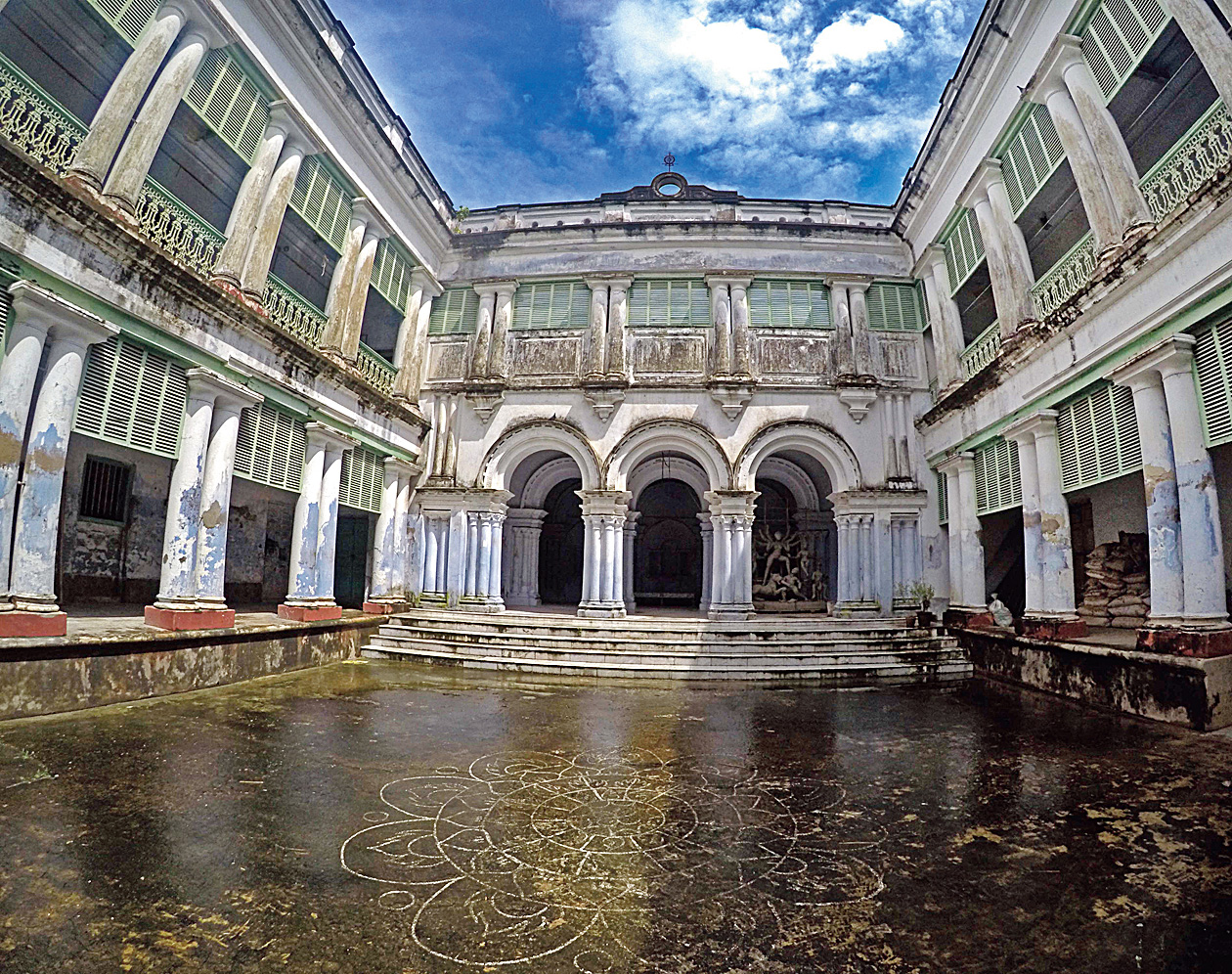
Image: Ankit Datta
According to Monjit, the three leading families worked for the development of the area. They built hospitals, roads and schools. We cross the Sanskrit primary school-turned-private English medium prep-school founded by the Gaines. Beyond it, a little ahead of the trisection is the mansion of the Sawoos. The gate is locked, a neighbour says the caretaker has gone to the market and the owners don’t live here.
We peep through the collapsible gate and spy a thakurdalan almost as majestic as the Gaines’. Here too, there is a solitary and stark frame of an under-construction Durga idol. Later, we call Ashok Sawoo, who lives in north Calcutta. The house was built by his forefather, Patit Chandra Sawoo, 200 years ago.
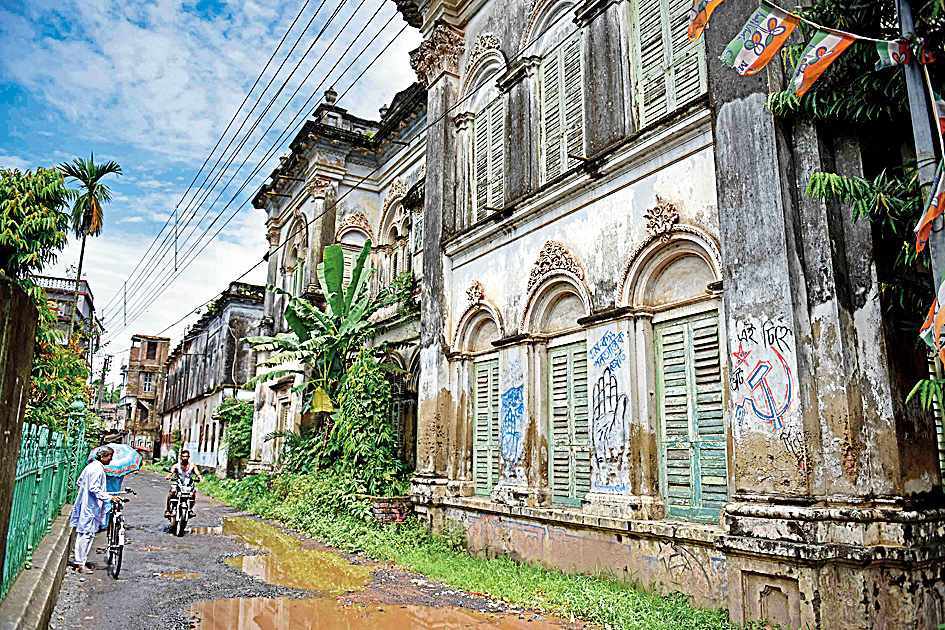
Image: Ankit Datta
We walk down to Ballav Mansion next. Painted in green and white, the mansion has ornate cast iron gates and fencing. The Corinthian pillars, stucco work in the verandah and the grand thakurdalan reflect the wealth of the family. There is a well-kept garden too. Says family member Uma Ballav Biswas, “The house was built by my great-grandfather, Shyamacharan Ballav, 150 years ago. He made his fortune mainly in jute trade.”
At the time of filing this piece, Uma is looking forward to the annual family reunion on the occasion of Durga Puja. It seems the same artisans make the Durga idols for the Gaines, the Sawoos and the Ballavs. The same family of priests presides over the festivities. Says Monjit, “If anyone wishes to see our houses in full grandeur, this is the time. There’s no restriction on entries at this time. Just like our ancestors, we welcome villagers and visitors.”
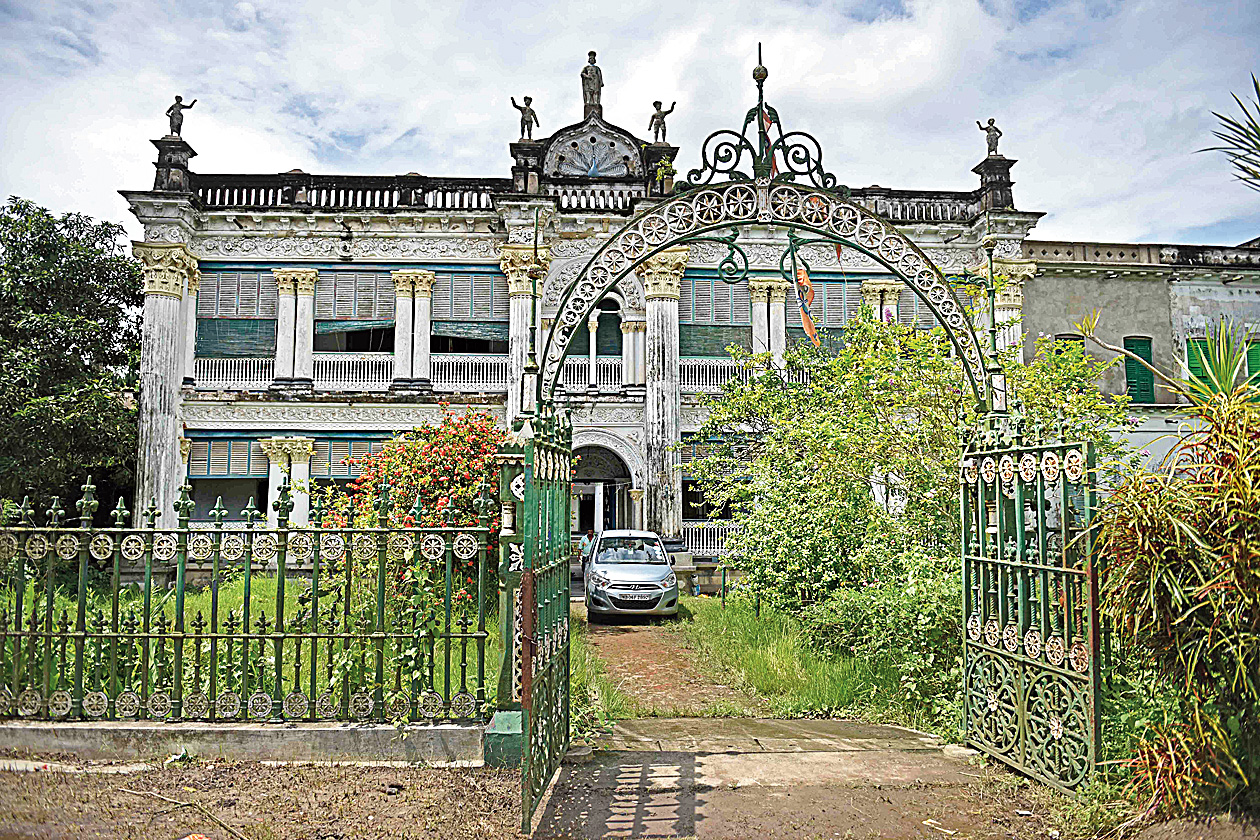
Image: Ankit Datta
Ankit Datta
source: http://www.telegraphindia.com / The Telegraph,Calcutta,India – Online edition / Home> Heritage / by Prasun Chaudhuri / October 21st, 2018