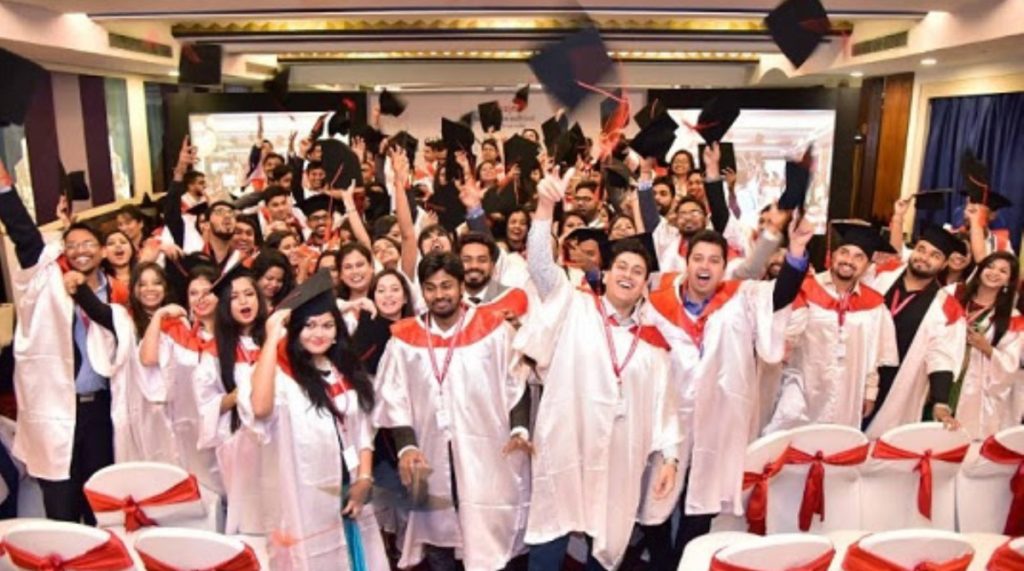
The 15th Annual Convocation of Globsyn Business School was conducted on February 17 at The Park, Kolkata. Over 120 students from Globsyn Business School’s postgraduate management programmes were felicitated at the event. The Convocation included the parents of the students graduating from GBS and the alumni.
Shri (Dr.) M.V. Rao, I.A.S., Addl. Chief Secretary, Panchayat and Rural Development, Govt. of West Bengal addressed the gathering and was the Chief Guest of the event. Shri Arun K. Chandra, Managing Director, PC Chandra Group also graced the occasion and addressed the Convocation as the Guest-in-Chief.
Shri Bikram Dasgupta, Founder & Executive Chairman, Globsyn Group, conferred diplomas to the students. While addressing the gathering, he said, “With a journey of over 20 years encompassing education, technology, skill development and infrastructure, Globsyn Group is now focused at evolving GBS into a global B-School with an education edifice that promotes Innovation, Research and Technology. Exciting times are awaiting the students, alumni, corporates and other stakeholders of GBS with the Group now focusing on emerging technologies as a way of life. I congratulate the students graduating today and wish them all the best for their ambitious career.”
Globsyn Business School recognised the contributions of several of their student-volunteers who are a part of the Kalyani Youth Leadership Forum. Their members undertake the B-School’s ‘care for society’ initiatives implemented under the aegis of Kalyani – a Bikram Dasgupta Foundation.
The 15th Annual Convocation also marked Globsyn Business School as the first AICTE approved B-School in India to use Blockchain technology to issue diplomas. The rollout of the diplomas on Blockchain will allow the students and their prospective employers to access the diploma credentials from any geographical location, without any need to send or present physical certificates.
Enhancing on the technology-connect of the B-School, Rahul Dasgupta, Director, Globsyn Business School said, “Globsyn Business School was started in 2002 with a vision to create industry-ready managers for the technology-driven knowledge economy. Having been promoted by Globsyn with deep roots in IT hardware, training and fulfilment, GBS uses technology-enabled platforms and systems in all its operations and processes. With Globsyn now looking at Blockchain, Artificial Intelligence, Machine Learning, Data Analytics and Internet of Things as an area of focus, the students of our B-School can only expect greater dependence on these emerging technologies to further improve the academic delivery process.”
source: http://www.thestatesman.com / The Statesman / Home> Books & Education / by SNS Website / New Delhi / February 18th, 2019
This retired professor in West Bengal is the reason many children of his region have an education and career
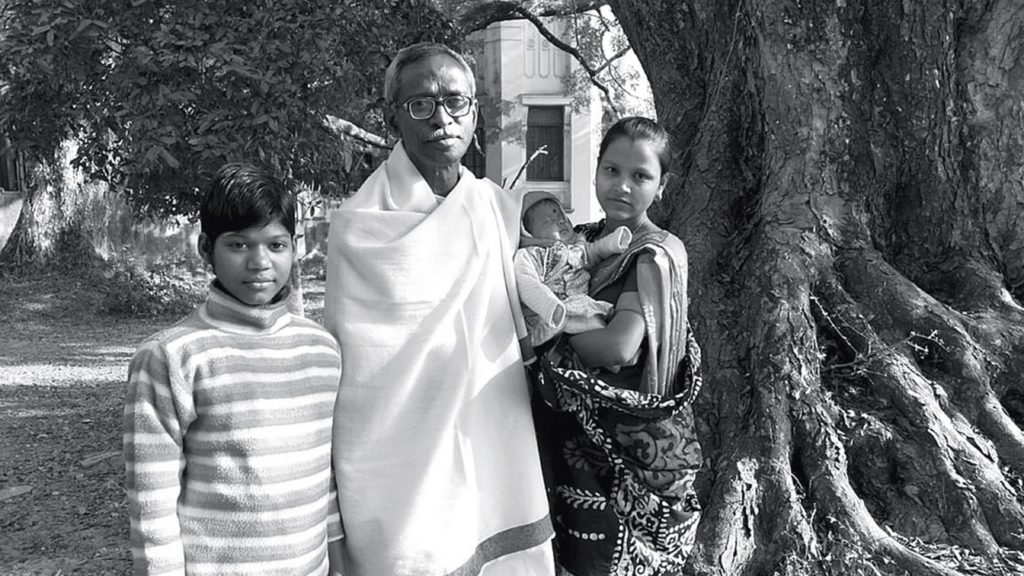
Lifeline: Professor Dilip Roy with Belaboti (left) and Uma / Image: Rabindranath Bera
Where is Dadu? Why haven’t you brought him along,” demands the petulant eight-year-old with closely cropped hair and a beige jacket over a pink frock. Her name is Bela, short for Belaboti, often referred to as Belu too. Just now she is standing akimbo, blocking the entrance to our lodgings adjacent to a two-storey mud house in Naradari, a village in Nandakumar block of East Midnapore district, five kilometres from Tamluk. The object of her query, or Dadu, meaning grandfather, is Dilip Roy, a retired professor of History and man of the house.
Bela knows that the septuagenarian had accompanied this gaggle of strangers from Calcutta to the flower show — an annual affair organised by the Tamluk Flower Lovers’ Association, founded by the good professor over 40 years ago. She is the youngest member of the Roy household, which includes Biswaranjan Pal or Bisha, Bishnupada Maity or Dipu and Joyinandan Maity or Joyi. While Bisha and Dipu are preparing for their higher secondary exams this year, Joyi is in the first year of college. There is Uma, too, whom Roy calls Kochi. She got married to Rabindranath Bera or Robi two years ago and is currently in Naradari with their newborn.
Roy is actually no kin of Bisha, Dipu, Bela, Joyi, Kochi or even Uma; at least not in the accepted sense. But each of these lives has got so entangled with his own that it is difficult to tell his story without straightening out a reference, giving an explanation or two to their lives’ stories and experiences. Also, these are lives that refract his own story, one that he himself is loath to tell.
Bisha, Dipu, Joyi were inmates of an ashram on the banks of the serene Roopnarayan river in the adjacent village, Betalbasan. When it closed down, Roy took them in. Uma is the daughter of farm labourers from Narghat village some 17 kilometres from Naradari. She had heard about Roy and his extended family from an uncle. She says, “I was not interested in studies and my parents would often beat me up for that. I literally ran away from home to escape studying and came here to work as a domestic help.”
But as it turned out, she had walked, rather run, straight into the tiger’s den. First, she was home-schooled, then at 14 she was enrolled in Class V of a local school. When the neighbours smirked, Roy — whom she and many others call Jethu, or uncle — told her, “Clear the Class X boards, that will shut them up.” Uma cleared her Class XII boards last year and is raring to resume college once her daughter is six months old.
Unlike Uma, Robi had wanted to study. He was a good student too, but his father was a hawker and couldn’t afford to support his son’s dreams. Once, while visiting his maternal grandmother in Talpukur village adjoining Tamluk, he approached Roy for help. Actually it was his grandmother who spoke to Roy as the boy explored the estate. The professor visited the boy’s school, paid for Robi’s textbooks, even arranged for free tuitions for the Class X student. And then, he supported him right through high school and graduation in every possible way. Today, Robi is team leader, back office operations, with Tata Consultancy Services, and posted in Calcutta.
Roy was born in Naradari in the late 1940s, but had left for Calcutta for his postgraduation. His father was an advocate while his mother, a housewife. When he returned home at 24, it was to teach at Moyna College, about 20 kilometres away. The youngest of three brothers, he had always been reclusive. And when he came back he chose to stay, not in the family home, but in the other two-storey mud house on the estate jointly owned by his father and uncles. He says, “The house was lying uncared for. The main house was too crowded. My parents, uncles, aunts, cousins, my Didi, her family…,” and his voice trails off as he looks at the manicured garden between the two houses.
Roy turned the ground floor into his living quarters and the upper floor he dedicated to Rabindranath Tagore. That became his library-cum-temple. He would sit there singing and listening to Tagore’s songs and reading his works. He would organise, and still does, cultural dos on Tagore’s birth and death anniversaries. “Even today, I begin my day reading sections of Tagore’s lectures, just like people read the Gita. Of course, of late, I have begun reading the Gita too,” laughs the lean, greying philanthropist.
A few years into teaching, he decided to remain a bachelor. He began to spend more and more time on his two passions — gardening and travelling. His closest friend, a doctor who died in an accident a couple of decades ago, was his travel companion. Together, they have traversed the length and breadth of the country. Somewhere along the way he began helping students from impoverished backgrounds in their pursuit of education and learning. And the more he got involved in the lives of his students, the more acutely aware he became of their hardships.
Around the beginning of the 1980s, he started providing food and lodging too to poor and meritorious young men. Today, so many years later, Roy cannot remember the first time he brought a student home. I point out that it is most odd, this date slip, of someone who teaches History, but he is distracted by Bela, who has given lunch a miss and is sulking. “She is angry with me for having my lunch without her,” he explains.
What happened was that one by one many students came to live with him. Not everyone stayed the course though. Many were taken away by their parents or guardians. But there were exceptions like Bela — the little girl from a cobbler’s family in Uttar Pradesh’s Saharanpur. She and her older sister were brought to Roy by their maternal grandmother but a few years later taken away by their parents. Her sister notwithstanding her pleas to return to Naradari was married off, but her parents eventually let Bela go back to Roy. She is being home-schooled currently.
When his college teacher’s salary could no longer sustain the expenses, Roy started to scout around for financial help. Over time he has developed a network of connections — civil servants, engineers, doctors, authors, teachers, businessmen, artists. Some pay the fee for these students, some buy the books. And while he is dogged in his pursuit of funds, Roy is careless about his own money.
To date, Naradari and its surrounding villages have produced six doctors, all of whom have flourished under Roy’s munificent shade. He paid for their admissions, entrance tests and connected them with foundations that bore their expenses at the medical colleges. And despite Roy’s advancing years, the effort to help students continues. Says Uma, “At the beginning of the new school session villagers line up for help. Every year, Jethu buys textbooks worth Rs 25,000-30,000 himself.”
During his student days in Calcutta, Roy would spend time at the city libraries. The National Library was his home on holidays. He says, “I’d go to there, borrow a book and spend hours on the veranda. I’d hardly read though. Most of the time I would look at the lawns and trees on campus.” And that’s how another interest took shoot. Roy started frequenting the neighbouring horticultural society.
His time at the horticultural society made him aware of environmental issues. In time, he launched a movement to educate villagers and schoolchildren on the need to plant trees, especially flowering ones. The movement gradually spread to neighbouring villages. Today, there are legions of gardeners working under Roy’s supervision, planting, landscaping. “Even the nurseries here seek his advice,” says Robi, the pride in his voice pronounced.
source: http://www.telegraphindia.com / The Telegraph – online edition / Home> People / by Swachchhasila Basu / February 17th, 2019
A market cum food court is being planned in New Town
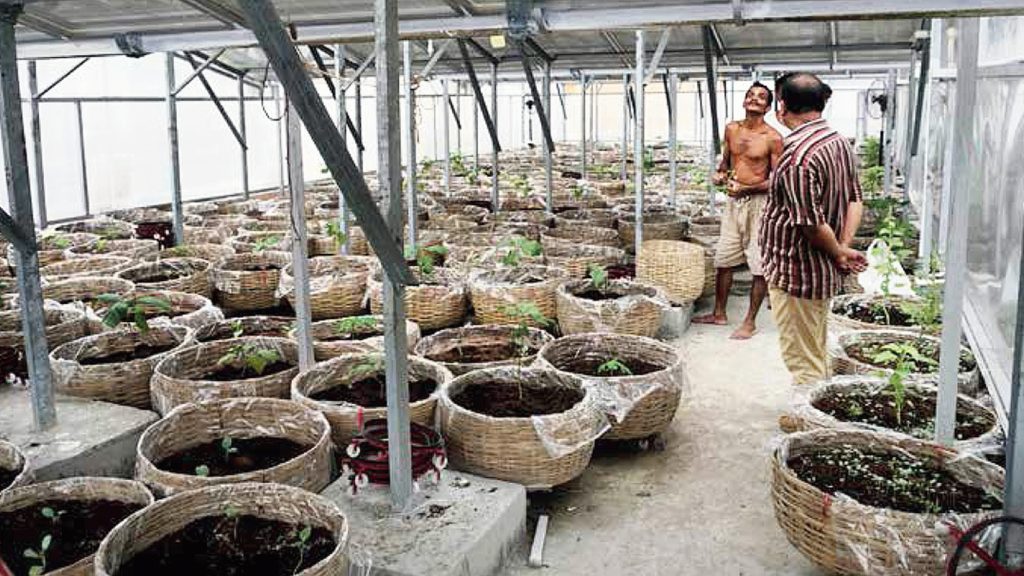
Baskets of organic vegetables on NKDA’s CB Market terrace. / The Telegraph picture
The West Bengal State Agricultural Marketing Board has tied up with the New Town Kolkata Development Authority (NKDA) to start an organic market between the Harley Davidson showroom and Eco Park. The name of the market will called Joibo Haat meaning organic market in Bengali.
Minister of the agricultural marketing department, Tapan Dasgupta, laid the foundation stone on January 17 in presence of ministers Sujit Bose and Purnendu Basu.
The plot, that has been leased from NKDA, measures around 14.77 cottahs, the building will be a G+6 one and the project should take two years to complete. The estimated cost is Rs 11.40 crore and funds are being raised from the Rashtriya Krishi Vikas Yojana.
“People are falling sick these days due to chemicals in fertilisers. Going organic is a much safer option,” Dasgupta told The Telegraph Salt Lake. “Also, we wanted to give a platform to those involved in organic farming.”
According to an official of the state agricultural marketing board, they have already called for a tender to build the market. “We expect construction to start within the next few weeks,” said the official.
Organic supermarket
The market will have separate floors for a variety of organically grown fruits, vegetables, rice, pulses, flowers and even honey. The idea is to create an organic hub in New Town. According to the officer, the organic produce will not only taste better but will also be healthier.
“We want to give a super market-like experience to shoppers who come here. Everything stocked will be organically produced with zero use of chemical fertilisers or pesticides. All racks will be properly labelled,” the official said.
Organic produce growers and self help groups from all over the state will be welcome to showcase and sell their produce too.
“The farmers’ markets organised in Calcutta get good response from both buyers and sellers so we believe there is a ready market for organic products. “Organic farming is being undertaken in large scale in North and South 24-Parganas and we’ve observed that people of New Town are ready to pay higher prices for quality products. So setting shop in New Town would guarantee more buyers,” the officer said.
The ground, first and second floors will house the organic market. The third floor will house an organic food court. The fourth floor will have training centre for skill development. The fifth floor will house an advanced laboratory and office. The sixth floor will have a guesthouse.
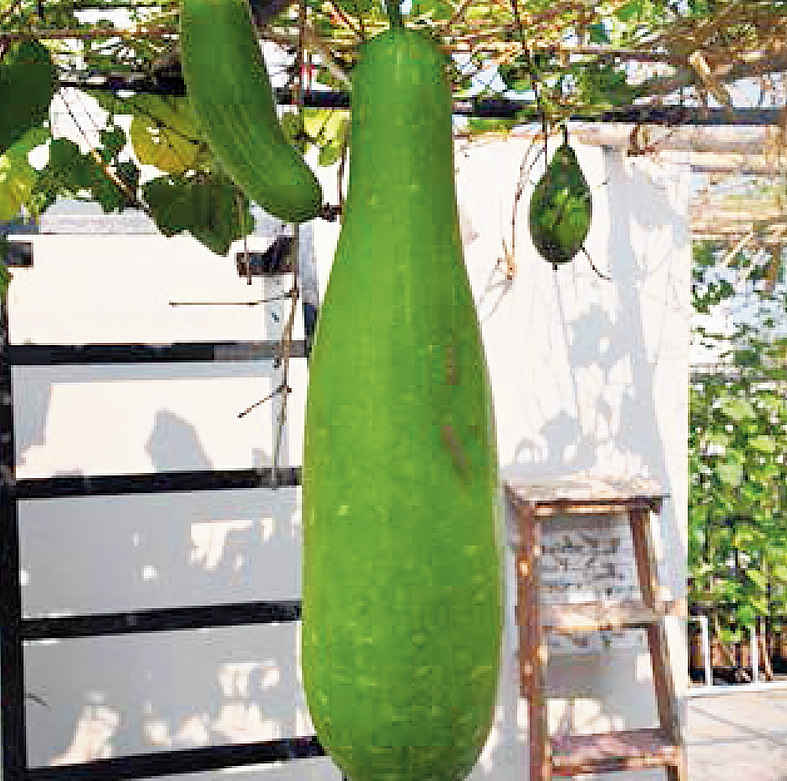
Gourds hanging from the overhead structures. / The Telegraph picture
The laboratory will not only conduct research on organic farming but also verify whether a vegetable is organic or not.
This will be the first laboratory in the state to conduct such tests. Currently, to conduct such tests samples are sent to other states. This adds to expenses.
The laboratory will also work to develop organic fertilisers and the facility will have regular workshops to encourage farmers from the villages to shift to organic methods.
Sikkim has managed to become India’s first fully organic state by implementing organic practices of farming on around 75,000 hectares of agricultural land. It had taken Sikkim around 12 years to achieve this feat and Bengal is now taking baby steps towards organic methods.
Farm on your rooftop
Debashis Sen, the chairman of NKDA, said such a market in New Town would give plenty of opportunities for residents to buy fresh produce and also motivate them to have roof-top gardens where vegetables can be grown.
“We are already in talks with agencies to develop rooftop farms on individual plots and buildings. Farming and gardening on the roof of a building will enhance the look of the terrace and provide quality food to residents. It will also keep the building cooler in summer,” said Sen.
NKDA runs a farm on the terrace of CB Market near Novotel and Sen says hydroponics and other alternative methods for container gardening are being used there extensively. This farm was started by Owl Spirit, a company formed by the NGO Uthnau, in 2017. They grew gourds, spinach, beans, cucumbers, carrots, brinjals etc in baskets up there.
At present, they are working on tower planters at Karigori Bhavan opposite Uniworld City. These are containers stacked one above the other and they are growing brinjals, chillies, gourds and spinach on trial basis there.
“We have been approached by the NKDA to help residents grow organic food in their balconies and terrace,” says director of Owl Spirit, Kunal Deb. “Chemical use in commercial crops has spread to such an extent that even if you have money today you can’t buy healthy food. It’s best if you can grow your own food then.”
Hari Mitti is another agency that has been approached. This Sector V-based company prepares crates of fruit, vegetable and herbs to sell to residents. “The nascent stages of plants are the most delicate. We shall look after the plant at this stage and hand them over when they are older and hardy. We also provide lifelong maintenance of the plants,” says Suhrid Chandra, the founder.
That there is a demand for organic farming is clear from the fact that Hari Mitti has started managing 82 rooftops over the past two years. “If a family takes in 30-35 crates, it won’t need to buy any vegetables from the market besides potatoes and onions.”
Both the agencies try to avoid using soil. Instead they use coco peat, vermin compost, hydroponics etc. “These options are lighter than soil and also, if we use soil, no matter where we source it from, it will be contaminated with chemicals,” says Chandra.
But the agencies are wary of practical problems. In 2014, Owl Spirit had started an urban farm on the terrace of Siddha Town in Rajarhat. They had to discontinue after nine months after residents refused to pay for its maintenance. “Residents can also complain about insects, those living on the top floor may complain of disturbance,” says Deb. “So we have requested minister Firhad Hakim to allow us to carry out urban farming atop government buildings.”
Residents are keen to give organic farming a shot. “I shall be retiring in six months and thereafter would love to indulge in gardening. When I moved to New Town I had about 25 pots but most of them didn’t survive. With help from these experts I would love to grow lemons, chillies and other fruits and vegetables,” says Chaita Mukherjee, a resident of Sree apartments.
Inputs from Sudeshna Banerjee
source: http://www.telegraphindia.com / The Telegraph, Online edition / Home> West Bengal / by Snehal Sengupta and Brinda Sarkar in Calcutta / February 15th, 2019
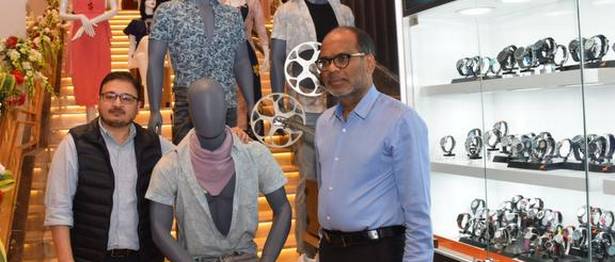
Future Lifestyle Fashions CEO Vishnu Prasad (right) and Future Retail CEO-East Zone Manish Agarwal – Debasish Bhaduri
It was in 1934 that American film production company Metro-Goldwyn-Mayer decided to set up a cinema hall in Calcutta to promote its films. The hall was inaugurated in 1935. Famous as an elite British city, the then Calcutta was a large market for Hollywood films.
Eighty-five years later, the iconic cinema hall on Chowringhee Road has made way for Future Group’s first ever movie themed ‘Central’ store.
The fashion and lifestyle retail store will play old Hollywood, Hindi and Bengali hits. These classics were big draws at the ‘Metro cinema’. The screenings are likely to start in April.
According to Vishnu Prasad, CEO, Future Lifestyle Fashions (which owns Central), the company is preparing a list of classics that have been screened. Plans are afoot to bring in the yesteryear stars who featured in these films. Over each week, a film will be played.
First thematic store
“This will be our first thematic store. In fact, Metro Central will be a filmi store. Going forward we may look to host theme-based movie screenings at the store. The idea is to bring alive a lost heritage of the city,” Prasad told BusinessLine.
Metro Central, as it is called, is expected to rake in ₹100 crore by FY20 with apparel sales accounting for nearly 70 per cent of it.
Down memory lane
Metro Cinema’s distinctive art deco structure has, over the years, defined the culture of the city. Initially, it screened only films produced by MGM. Gradually, Hollywood films made way for Hindi cinema and an occasional Bengali film.
The two-storied structure was designed by Thomas Lamb, a Scottish architect settled in the US who built several movie theatres around the world. MGM commissioned him to build two theatres in India. Metro Calcutta’s famous cousin in Mumbai was built in 1938.
Prasad points out that “special care” was taken at the time of renovation so that the art-deco façade, waterfall-style columns and grand staircase within were retained. The company has spent ₹22-25 crore on renovating the heritage structure that will have 55,000 sq ft of space.
Sources say the group had held talks for the renovation and reuse of Grace cinema, too, but issues such as structural stability of the building put things on the backburner.
source: http://www.thehindubusinessline.com / Business Line / Home> Variety / by Abhishek Law / Kolkata / February 15th, 2019
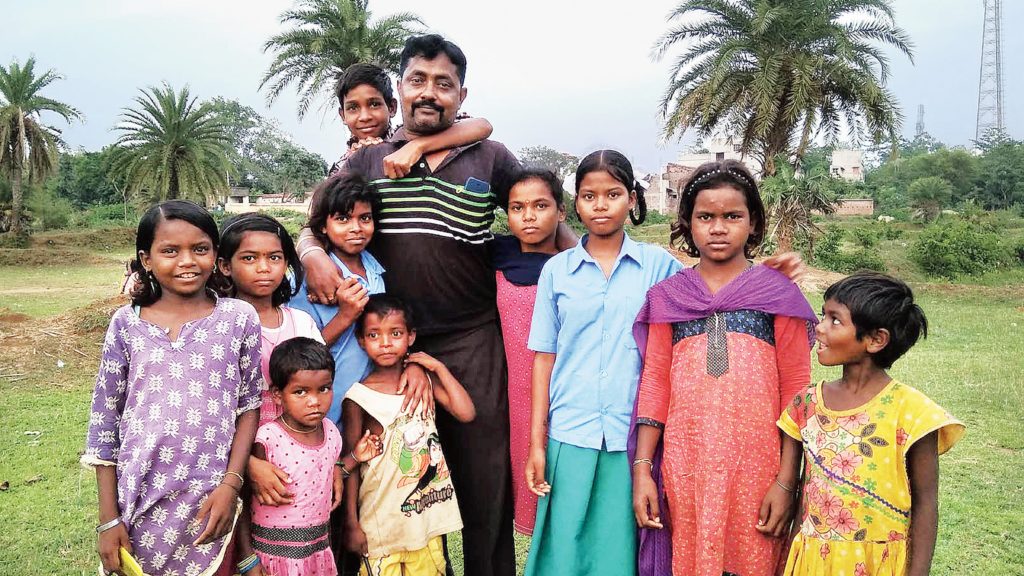
Arup Mukherjee, a constable of the South Traffic Guard, with some of the students of the school that he started with his savings in 2011 at Puncha village of Purulia district. / The Telegraph
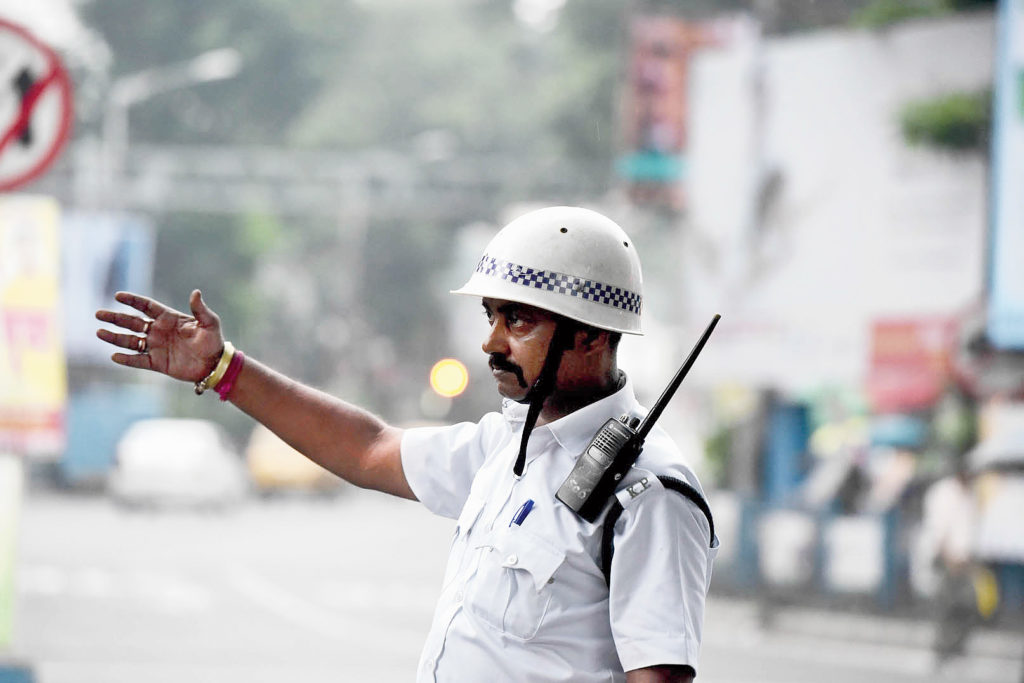
A Calcutta police constable who as a child had made a promise to himself to help the poor now sets aside Rs 20,000 from his salary of Rs 37,000 each month to run a school for abandoned and underprivileged children.
When 43-year-old Arup Mukherjee is not managing traffic at a busy intersection, he is busy pursuing his mission to rescue and rehabilitate abandoned children and convince impoverished and unlettered parents to send their daughters and sons to school.
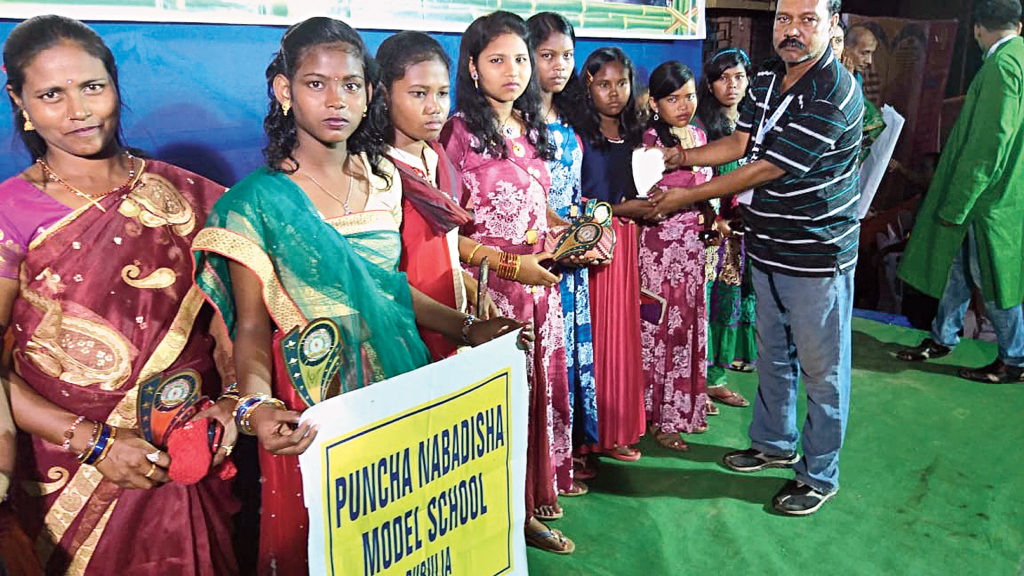
Some of these children were in New Alipore on Monday to inaugurate a Kali Puja, escorted by the Samaritan who works tirelessly to dispel the darkness in their lives.
Mukherjee’s zeal to rescue and educate children from the Sabar tribe of Purulia originated from a childhood curiosity about the persecution faced by a community counted among the poorest of the poor.
“I have witnessed since childhood people belonging to the Sabar tribe being blamed for theft or any other crime in the areas they inhabit. I have seen them being mistreated and ostracised and not given jobs, resulting in some resorting to crime. When I asked my grandfather about it, he told me this was because they were not educated and hence unable to find employment,” he told Metro.
Some students of the school after inaugurating a Kali Puja in New Alipore on Monday. / The Telegraph
Mukherjee, who was six years old at the time, never forgot what his grandfather told him or the promise he had made to himself. In 1999, he joined Calcutta police and started saving immediately for what would go on to become the fuel for his existence.
Puncha Nabadisha Model School became a reality in 2011, putting this unassuming constable of the South Traffic Guard on a path few like him would dare to tread. “I remember what my grandfather told me when I had spoken to him about what I wanted to do. He asked me to grow up, start earning a living and then think of doing something for the Sabar children,” Mukherjee recalled.
The initial corpus of Rs 2.5 lakh for the school in Puncha village of Purulia district, around 280km from Calcutta, came entirely from Mukherjee’s savings. He also took a bank loan of Rs 1 lakh and another Rs 50,000 from his mother to build five rooms with an asbestos roof on a plot donated by a friend of his father.
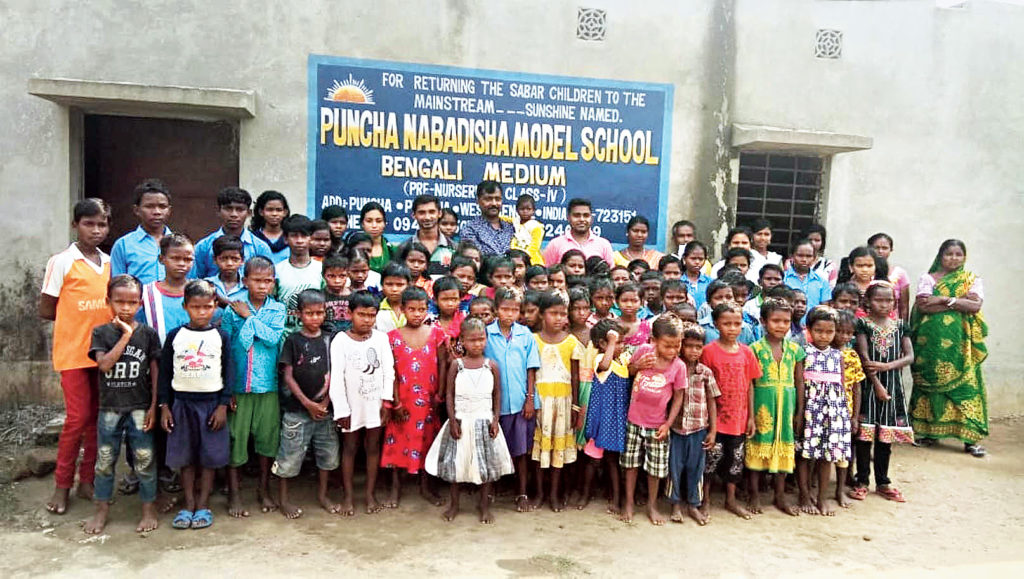
Starting with 15 children, Puncha Nabadisha Model School has grown into an institution that provides education to 112 children aged between 4 and 15.
It wasn’t easy in the beginning for Mukherjee to convince the Sabar tribe that he wanted their good. “They started trusting me after realising I did not have any motive. I would tell them, “Send your children to study if you do not want your plight to be like yours’. That struck a chord,” he said.
An incident three years ago highlights the despair and desperation that Mukherjee occasionally encounters. “I was visiting this village in Purulia when the strong smell of kerosene hit my nose outside a tribal house. A mother had wrapped three of her children, the youngest barely a year old, in a blanket and sprinkled kerosene on them to do the unthinkable. I went into the hut and held the mother by her hand. She said her children were asking for food and she didn’t have any to feed them,” he said.
Mukherjee took the three children under his care and their mother hasn’t met them since. The eldest of the siblings is now in Class III and the second one in Class II.
According to Mukherjee, who received a special honour at The Telegraph School Awards for Excellence 2018 in August, the courage to accomplish what he does comes from being a policeman.
Many among the Sabar community depend on him not only to give their children an education but also bail them out whenever they are unfairly accused of a crime. “Someone might be innocent but how to prove it when you can’t comprehend the law? They now have the confidence to speak up because they know that if they are right, I will help them,” Mukherjee said. “Most of them no longer resort to crime to feed their families.”
Around 20,000 members of the Sabar tribe are spread across five blocks of Purulia district. The children who go to Mukherjee’s school are provided food and a place to stay in. After Class IV, schooling continues in the secondary and high schools in that area.
Students and staff of Puncha Nabadisha Model School outside the school building. / The Telegraph
Puncha Nabadisha Model School needs Rs 45,000-50,000 a month to function, but Mukherjee does not believe in going around with a begging bowl. He accepts only voluntary donations. “I do not want to force people to help my children, neither do I want them to think that I am collecting funds for my own needs. People see the work that is done and offer help, which I accept,” he said.
Constable Arup Mukherjee manages traffic at an intersection in the city. / The Telegraph
Mukherjee is the father of twins, both students of Class XI, but it is the responsibility of being “Baba” to his extended family of 112 children that keeps him going. “My family does not make any demands of me. They are not upset that I don’t spend my entire income on them. They are rather proud of me,” he said.
source: http://www.telegraphindia.com / The Telegraph, online edition / Home> West Bengal / by Jhinuk Mazumdar and Pranab Mondal in Calcutta / November 07th, 2018
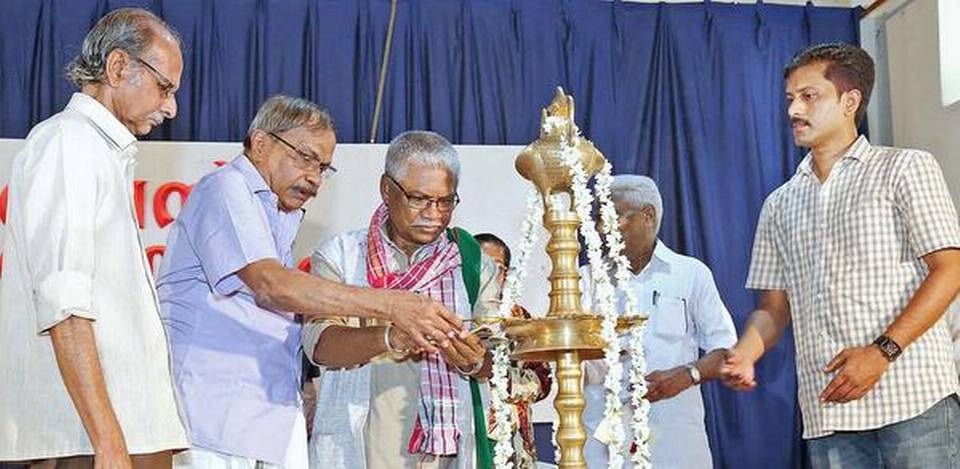
Bengali writer Manoranjan Byapari inaugurating the Thunchan Literary Festival at Thunchan Paramba, Tirur, on Friday.
This year’s Thunchan Literary Festival began at Thunchan Paramba, Tirur, on Friday. Inaugurating the festival, well-known Bengali writer Manoranjan Byapari described his life’s journey from being a shepherd to accidentally meeting Jnanpith laureate Mahasweta Devi while riding an autorickshaw.
He said that he had entered into writing much later in life. It was his incarceration that helped him find an interest in reading books. His writings in Bengali are considered one of the strongest in Indian Dalit literature.
Thunchan Memorial Trust chairman and Jnanpith laureate M.T. Vasudevan Nair presided over the function.
Arts festival
Mr. Nair released the Thunchan history penned by K. Sreekumar by giving a copy to Artist Namboothiri. Mr. Namboothiri inaugurated a book festival being held as part of the literary festival.
Poet V. Madhusoodanan Nair delivered the Thunchan Memorial Lecture on poetry and tradition. Writers Chathanath Achuthanunni, Manambur Rajanbabu, and V. Appu Master spoke.
Actor V.K. Sreeraman inaugurated the Thunchan Arts Festival.
Poet Alankode Leelakrishnan spoke.
source: http://www.thehindu.com / The Hindu / Home> News> States> Kerala / by Staff Reporter / Malappuram – February 15th, 2019