All posts by wellnmed@gmail.com

Au Revoir, Calcutta

On a Sunday with barely half a day left for him to bid adieu to the city he had called home for the past three years, French consul-general Fabrice Etienne criss-crossed north Calcutta with t2

Jorasanko Thakurbari: The house of Tagore made it to Etienne’s list of favourite spots as a mark of tribute to Rabindranath. “You have no idea of the influence that he has unless you reach Bengal. He is here on the streets, (our car had stopped at a traffic light and sure enough, there was Rabindrasangeet playing on the speaker), there is the university named after him, there is Santiniketan… there is so much respect. Everyone knows his work, not just the songs. This is unique. Of course, Calcutta is having trouble thinking beyond Tagore but that is a different issue. Only a small part of his work is available in French, like Andre Gide’s translation of Gitanjali and some novels like La Maison et Le Monde (Ghare Baire) and Charulata. But few in the West know that Tagore is more than a novelist. In French literature, we may compare him to Victor Hugo who was an educationist, a poet and a novelist. But his legacy is not as alive as Tagore’s is.”
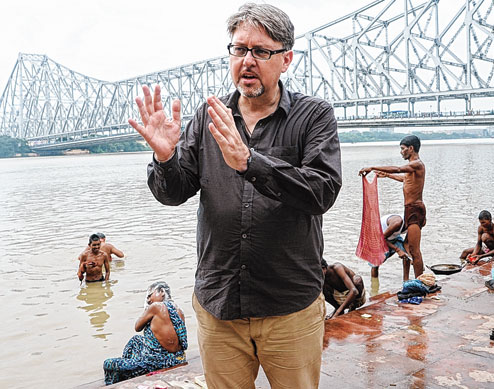
The riverside: Tip-toeing through the monsoon slush at the Mullickbazar flower market and pausing at a few stalls to negotiate prices for marigold strands, we reached Jagannath Ghat. “This is my favourite ghat as this is where you get the best view of the Howrah bridge and the rail station.” The gigantic warehouses on the Strand made him wistful. “How I wish I could live in a building like this, overlooking the river! Living in Calcutta you forget about the existence of the river which is largely hidden from view unlike in Paris which is split by the Seine. There, the city expanded on both sides of the river across which there are about 20 bridges connecting the northern and the southern sides. All the attractions are along the Seine — Eiffel Tower, the Louvre, Musee d’Orsay…. The Hooghly is much wider and the city has grown on its eastern side.”
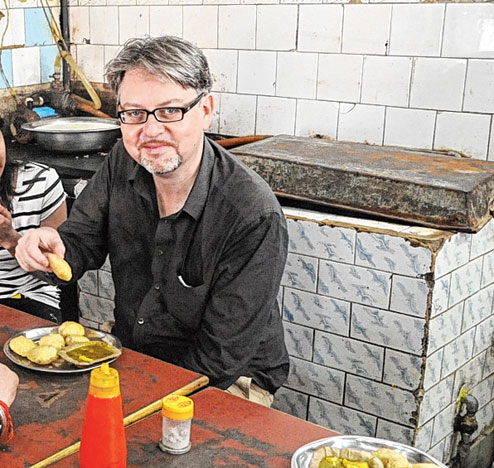
Street-side tea shop: “I have put on 10 kilos in these three years! A paunch is accepted in Calcutta but in Paris it is frowned upon. I have to start cycling and walking like a Parisian once I am back,” Etienne had confessed after getting off the weighing scale at Calcutta Club from where our trip had started. A couple of hours later, he was happily digging into club kachauri and alur torkari, followed by a handsome helping of rabri at Sharma Sweets on Kalikrishna Tagore Street, run by his friend Shyam Barua. “Nothing breathes the Orient more than the streets of north Calcutta. Wherever you look, there is something happening. These small tea shops remind me of our street-side cafes, which are integral to the French way of life. Here you can get away from the chaos on the street while keeping a watch on a slice of outdoor life. They are cheap and no one asks you to leave even if you spend hours with a cup of coffee.” 

College Street: Etienne could not find a single book in French on College Street but was startled to find some lesser-known titles of Alexandre Dumas in translation at several stalls. “This is the intellectual street of Calcutta with all the universities and bookstores. The Indian Coffee House here was a place for adda of Bengali intellectuals. It reminds me of the quartier Latin on the  left  bank of Paris which has bookstores of all sizes. This is for me one of the bridges between Paris and Calcutta…. For a kilometre on the promenade along the Seine, there are hundreds of small stores — some are just a box full of books. I used to go look for first editions of French or world literature titles as the area was close to our office.” On his last trip to College Street (“I used to come here often”), he picked up a Sunil Gangopadhyay translation. 
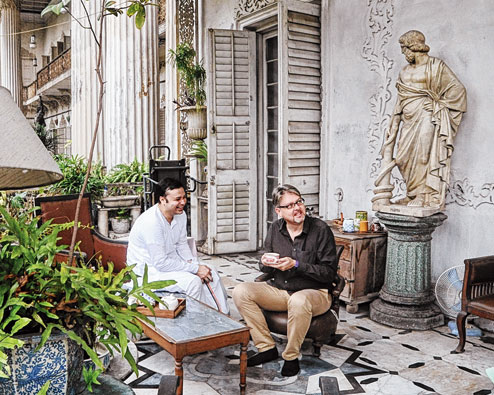
Marble Palace: A last-minute call to Sourendro Mullick secured an entry into Marble Palace, the palatial Mullick residence on Muktaram Babu Street. Photography being prohibited in the rest of the property, we settled down on the verandah adjoining Sourendro’s piano room, where a marble statue of Pluto, the lord of the Underworld, stood reclining against his staff around which a snake was coiled. “Calcutta is in many ways a baroque city and nowhere else does it express that trait more lavishly. This place is a Calcutta of one man’s fantasy. Rajendro Mullick had found so many things that caught his fancy from across the world. It reminds me of the Palace of Versailles where too the idea was to add chandeliers and marble works to express wealth. It is a unique mix of kitsch but it is kitsch with a soul. This place also has the first private zoo of India. The building has been extremely well-preserved,” Etienne remarked. 

source: http://www.telegraphindia.com / The Telegraph, online edition / Home> Entertainment / Text by: Sudeshna Banerjee , Pictures by: Sanytan Ghosh / September 17th, 2015
Kolkata Book Fair: A look at over 4-decade history of Boi Mela

The first Boi Mela was organised in 1976, after two years of planning and a year after forming the Publishers & Booksellers Guild, which continues to organise the event


The Kolkata International Book 2019 fair begins on 31 January and ends on 11 February. (Photo: KIBF)

In the early years of 1970s, during their regular adda at the iconic Coffee House on College Street, a group of literature enthusiasts, mostly publishers,  often discussed the Frankfurt Book Fair. The commercial trade fair of books was something they wanted to replicate in Kolkata, partly to give book lovers a place to exchange thoughts and ideas and get all their favourite writers’ works at one place, and partly to further the publishing business. Boi Mela or Calcutta Book Fair, which later became Kolkata Book fair, was thus conceptualised.

The idea was discussed, debated and finally given a shape in 1975, and the Publishers & Booksellers Guild came into being, with Sushil Mukherjea as its first president and Jayant Manaktala as general secretary.

The next year, in 1976, as many as 34 publishers got together and put up 56 stalls on the ground opposite Academy of Fine Arts, next to Kolkata’s landmark Victoria Memorial. Inaugurated by the then Education Minister Mrityunjay Bandyopadhyay on 5 March 1976, the ‘boi mela’ came to be known as the first Calcutta Book Fair. The 10-day affair culminated on 14 February. The book loving people of Kolkata welcomed the idea of Boi Mela and paid a 50 paisa per head entry fee to be part of the event.

The World Book Fair organised in New Delhi in 1972 and the 1974 National Book Fair organised by the National Book Trust in Kolkata were also the inspiration behind the big 1976 literary milestone for Kolkata.

The Publishers & Booksellers Guild went on to participate in the World Book Fair and the Frankfurt Book Fair also that year. Started on an experimental basis, the Kolkata Book Fair became an annual affair and the Publishers & Booksellers Guild has remained its organiser to this date.

With the 1977 edition too witnessing an equally enthusiastic participation and response, the Kolkata Book Fair required a bigger stage now. The 1978 event opposite the Rabindra Sadan ground reportedly saw participation of 112 publishers. In 1982, Peter Withers, the then director of Frankfurt Book Fair, visited the Kolkata do.

By now, the number of participating publishers had increased manifolds, and the Guild had started publishing names and details of all titles in print at the fair, besides a fair directory. Seminars and symposia also became permanent features. In 1983, then secretary general of International Publishers Association (IPA), Geneva, attended the inauguration ceremony. And it was the year the Kolkata Book Fair got its international accreditation. The IPA started mentioning the dates of the fair in its calendar every year.

In 1988, the book fair venue shifted to an even bigger ground, the Maidan nearer Esplanade, to accommodate the ever growing number of publishers and visitors. The vacant green area adjoining Park Street and Outram Road was developed by the Guild, which hosted the book fair there until 2007.

In 1991, a focal theme was introduced, on the lines of the Frankfurt Book Fair. The fair started to have one Indian state as its theme every year, aiming to highlight the literature and culture of the particular state. Assam emerged as the first focal theme.

From 1997, the focal theme has been a foreign country, starting with France.

Starting as a 10-day event, the Kolkata Book Fair gradually became a 12-day affair, usually starting in last week of January. The dates are fixed factoring in the pay day.

The Kolkata Book Fair has not been without its share of mishaps and controversies.

In 1997, six days into the fair, a massive fire broke out at the venue, reducing 1,00,000 books to ashes. A huge loss was reported. Reports said one person lost his life after suffering a heart attack at the venue following the fire. At the initiative of the then culture and home minister Buddhadeb Bhattacharjee, stalls and other structures were re-constructed within three days, the Guild says in the official website of the Kolkata International Book Fair.

If fire destroyed the 1997 Boi Mela, it was heavy rain that played havoc the next year. A lot of books were damaged. However, publishers were covered by insurance this time around.

The year 1999 was special. The fair had Bangladesh as the focal theme, and Sheikh Hasina, the then Prime Minister of Bangladesh, visited the fair. She was visiting this part of Bengal after 27 long years.

For seven more years, Maidan remained the fair venue. By then environment activists had started raising voice against holding the mega event at the green space. In 2007, the organisers had gone ahead with Maidan as the venue for the 32nd Kolkata Book Fair. Some environmentalists had filed a public interest litigation against Maidan as the venue. A day before the inauguration, the Calcutta High Court gave its ruling in favour of the petitioners.

Forced to dismantle the structures raised at the venue, the Guild shifted the Boi Mela venue to the Salt Lake stadium. From 23 acres available to them at Maidan, the Kolkata Book Fair was shrunk to a 10-acre space, and could be started only int he second week of February.

According to a study done after the event, the footfall dropped to 8 lakh from 25 lakh the previous year.

In 2008, Park Circus was decided as the venue but that too invited a PIL on similar grounds, forcing the organisers to postpone the 33rd International Kolkata Book Fair.

A different group organised the fair, calling it Boimela 2008, at Salt Lake Stadium but failed to evoke similar response.

The Guilt filed a special leave petition in the Supreme Court against the HC judgment. The then chief minister, Buddhadeb Bhattacharjee, intervened too, writing to the then Union home minister to get the fair back to Maidan.

The 33rd International Kolkata Book Fair was finally held at Milan Mela ground opposite Science City on an 18-acre land in 2009. Milan Mela is now the official venue for Kolkata Boi Mela. However, since 2018, the event has been taking place at the Central Park in Salt Lake due to ongoing restoration work at the Milan Mela ground.

Several efforts were made to increase the footfall. In 2010, it was first decided that the entry fee would be refunded if a visitor bought books worth Rs 200. Later, the entry fee was completely done away with. In 2011, the Publishers & Booksellers Guild got the NGO status. It can now use the Milan Mela ground at the rate that the state government pays for organising its fairs.

The year 2014 saw new event getting added to the Kolkata International Book Fair — Kolkata Literature Festival, on the lines of the famous Jaipur Literature Festival and Edinburgh Literature festival.

On 31 January 2019, the 43rd Kolkata International Book Fair is beginning. The Boi Mela this year pays tribute to the literary figures who passed away recently. The three halls mainly displaying English publications have been named after Nirendranath Chakraborty, Dibyendu Palit and Atin Bndyopadhyay, while the Little Magazine Pavilion will be named after Pinaki Thakur.

Guatemala is the theme country this year, and Ambassador of Guatemala Prof Euda Morales will be present when Chief Minister Mamata Banerjee inaugurates the fair on Thursday.

For the residents of Kolkata, the Boi Mela is however not just about books. Like its Durga Puja, the Kolkata Book Fair is a festival that the City of Joy waits for the entire year and celebrates as a way of life. It’s an amalgamation of words, emotions, feelings, memories and nostalgia, with the stories passed down from generation to generation.

Apart from English, the Kolkata Book Fair has stalls selling Hindi, Urdu and other books too. It’s considered a good business time for publishers as each stall manages to sell around 500-10,000 books every day.

Food stalls also prove to be a big draw, besides the different activity corners.

Kolkata is all ready for a lot of adda, food, discussion on books and some public display of love for books and reading habit.

source: http://www.thestatesman.com / The Statesman / Home> Cities> Kolkata / by SNS Web / January 31st, 2019

Metro rake on way to Calcutta from China

The train manufactured by CNR Dalian Locomotive & Rolling Stock Co. is the first of 14 rakes to be shipped to Calcutta


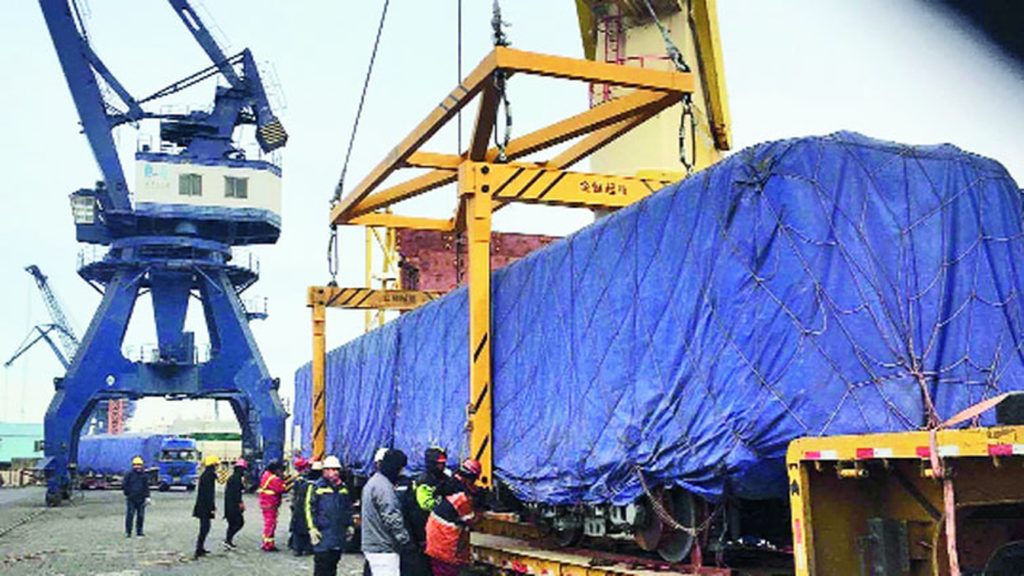
The China-made coaches being loaded on a vessel at the Dalian port / Sourced by the Correspondent

Consignment: Calcutta Metro’s first foreign-made rake

Origin: Dalian, China

Status: In transit

Calcutta Metro’s first foreign-made rake is sailing towards Chittagong on its way to the city from China.

The rake is scheduled to arrive at the Calcutta port on March 1. From there, it will be taken to Metro Railway’s Noapara maintenance base for trial runs, Metro officials said on Thursday.

The train manufactured by CNR Dalian Locomotive & Rolling Stock Co. of China is the first of 14 rakes to be shipped to Calcutta.

The prototype rake was loaded onto cargo vessel Han Zhang at Dalian port.

The vessel, which had set sail from Dalian on February 1, is now sailing towards Chittagong in Bangladesh after touching Singapore. It is scheduled to reach the Sandheads on February 28 and wait for the high tides.

At noon on March 1, when the high tide sets in and the water level rises, the vessel will enter Netaji Subhas Dock at Garden Reach.

The rake, like the existing Metro rail fleet, will have eight coaches.

“The train is being carried in two tiers of the vessel’s deck. Each tier has four coaches,” Metro spokesperson Indrani Banerjee said.

Once the cargo ship anchors at Calcutta port, special cranes will be used to lift the coaches and load them on to a container. “The coaches will be assembled in the port area to form the rake before a diesel engine pulls it to Noapara,” Banerjee said.

Metro will use Eastern Railway’s tracks to roll the new rake into its Noapara facility. The rake will be taken to Majerhat and from there to Chitpore, Belghoria and Dum Dum, before entering Noapara.

Calcutta Metro’s rakes, unlike other Metro trains, run on broad gauge tracks used by passenger and long-distance trains. “So, it’s easier to bring the rake into Noapara from the port using Eastern Railway’s tracks,” a Metro official said.

Engineers from China and Japan would be present when the coaches are unpacked and assembled into a train. Although CNS Dalian has manufactured the train, the components have been made by Toshiba of Japan.

“Once inside the maintenance base, the trials will begin,” Banerjee said.

Metro officials could not say when the first train would start commercial runs.

The 14 Chinese rakes will replace the snag-prone old non-AC Metro rakes and reduce the burden on the existing AC rakes.

The new rakes will also be used in the expanded network of Metro. The Noapara-Airport and Noapara-Baranagar-Dakshineswar lines are scheduled to be commissioned by next year.

The Chinese company is manufacturing 14 low-maintenance rakes for Calcutta Metro, breaking the monopoly of the Integral Coach Factory in Perambur, near Chennai, where the current snag-prone AC trains were built.

The trains will run at an average speed of 65kmph, 10kmph faster than the rakes in use. The aerodynamic design of the rakes will help them hit peak speed faster than the existing ones and reduce energy consumption too, the Metro spokesperson said. The doors will be 20cm wider than that of the existing AC rakes.

source: http://www.telegraphindia.com / The Telegraph, online edition / Home> West Bengal / by Sanjay Mandal in Calcutta / February 22nd, 2019

Calcutta’s Brush with War

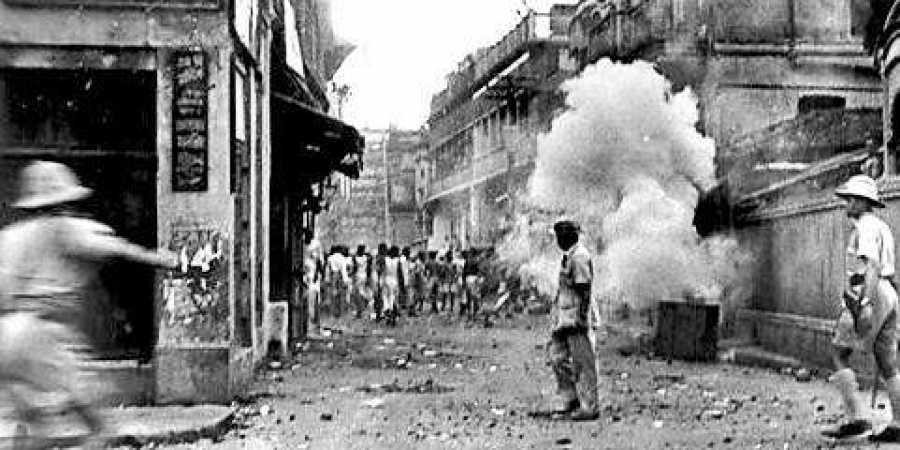
The year 1942 was a landmark year in terms of political and military changes, especially in East Asia.


Calcutta in post-World War II days

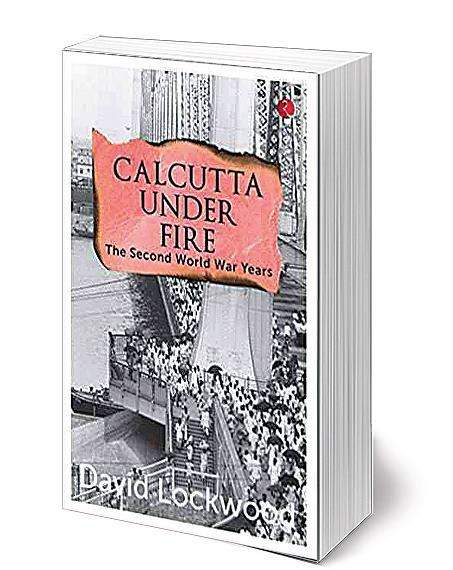
Calcutta Under Fire: The Second World War Years
By: David Lockwood
Publisher: Rupa 
Pages: 294
Price: `295

The year 1942 was a landmark year in terms of political and military changes, especially in East Asia. Japan, which had entered World War II spectacularly by bombing Pearl Harbour in December 1941, had—within less than a year—successfully invaded Malaya, Hong Kong, Singapore and Burma. In each of these territories, the defending (and now defeated) forces had been the British.

With the Japanese occupying Burma, sitting literally on the doorstep of India, it was unsurprising that by late 1942, fears of a Japanese invasion of India, or at least of its eastern and coastal stretches, should be widespread. 

Yet, there were other factors to be considered. Political, social, and military factors, and factors regarding less tangible ideas, such as the need to save face, or to put up a brave front. There was the Indian national movement, there was the growing doubt among many Britishers themselves regarding the future of India as part of the Empire. There was the (natural, given what had happened in Burma and elsewhere) fear among Indians that the British would be incapable of defending India against the Japanese. 

David Lockwood examines all of these and more in an attempt to explain the circumstances and events that shaped India during  World War II, especially around the tumultuous year of 1942, when the Japanese bombed Calcutta and sent thousands fleeing the city in panic. 

But merely looking at the Japanese bombing of Calcutta in isolation would not make a complete book, so Lockwood instead spreads his net wide to encompass events, ideologies, movements, policies and more. He examines the theory of hegemony as an intrinsic part of British imperialism, and from there goes on to discuss how the Congress’s policies were tailored towards a counter-hegemony.

There is a detailed discussion of how the Congress’s policies underwent changes; of the work the Congress did to mobilise the general populace in what was essentially a counter-hegemonistic movement; of the role played by radio (including the Congress’s illegal, underground radio broadcasts as well as Subhas Chandra Bose’s broadcasts from Berlin); and of rising discontent and nationalism among the Indians in the British Indian military and civil services.

The final picture is a complex but intriguing one of the different forces that not only shaped India in 1942, but which eventually led to independence. Lockwood manages to present interesting insights into the considerations that made the British, the Congress, and the general Indian public (both urban as well as rural) act as they did. 

Lockwood’s research is extensive (he even manages to present the Japanese side of it: did they really intend to invade India and make it part of a Japanese Empire?). There are some delightful bits of trivia, too (the thought of an impending Japanese invasion seems to have encouraged some Indians, who looked on the approaching Japanese armies more as liberators than conquerors, to take some very surprising steps, such as learning Japanese). While Lockwood’s style of writing may at times seem more geared towards an academic audience than a layperson, the book is an invaluable resource for understanding India during World War II.

source: http://www.newindianexpress.com / The New Indian Express / Home> Lifestyle> Books / by Madhulika Liddle / Express News Service / February 24th, 2019

Railway heritage by Hooghly

The highlight of a railway heritage walk was the residence of the GM of South Eastern Railway that was once occupied by Wajid Ali Shah, the last ruler of Awadh


The headquarters of South Eastern Railway.

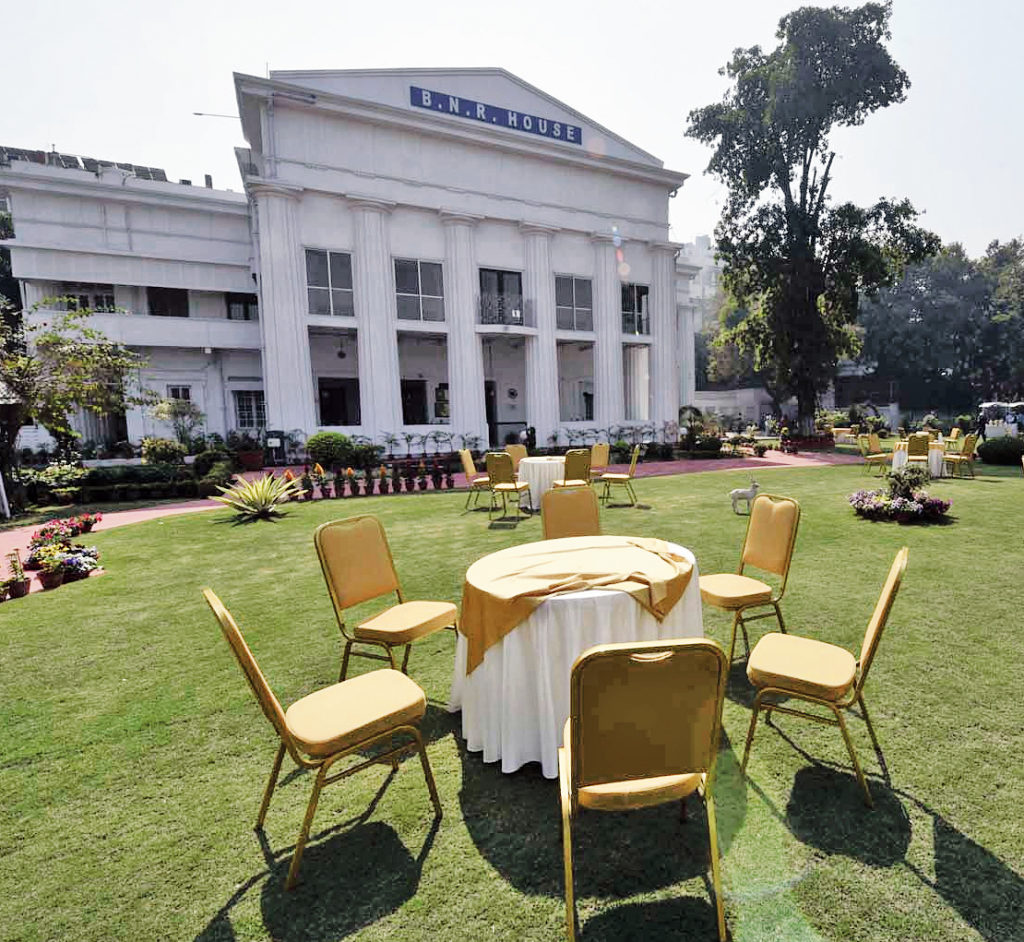
A white edifice overlooking the Hooghly in Garden Reach was built by the British in 1846, the architecture inspired by the Tower of the Winds in Athens.

The building, the highlight of a heritage walk on Saturday morning, was for a few years the home of Wajid Ali Shah, the last ruler of Awadh who was exiled to Calcutta.

But the first occupant of the home was Lawrence Peel, the chief justice of British India. He was the cousin of Robert Peel, two-time Prime Minister of England and one of the founding fathers of the Conservative Party.

The walk began at the South Eastern Railway headquarters in Garden Reach and culminated at the BNR (Bengal Nagpur Railway) House, the official name of the white bungalow that now serves as the residence of the general manager of South Eastern Railway.

“Fascinating titbits of colonial history is nested in every corner of the buildings in this area,” said Samrat Chowdhury, chief mentor of BAUL (Bespoken Architectural and Unique Legacies of Bengal), which organised the walk in association with the external affairs ministry and the railways.


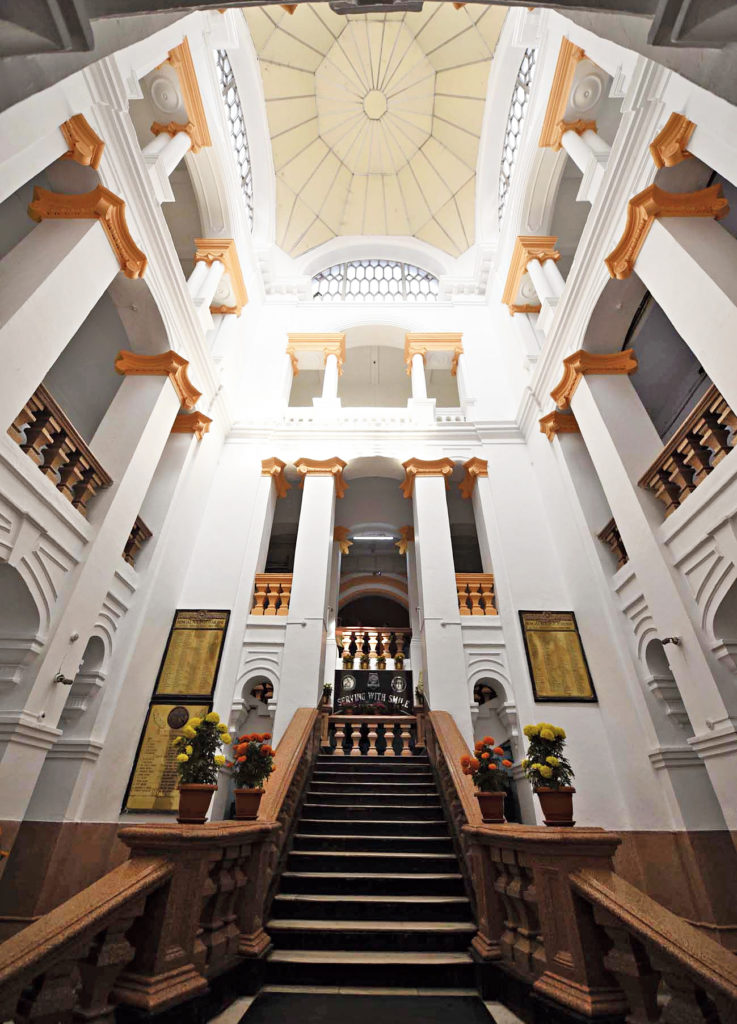
The inside of the building. The dome on top conceals water tanks

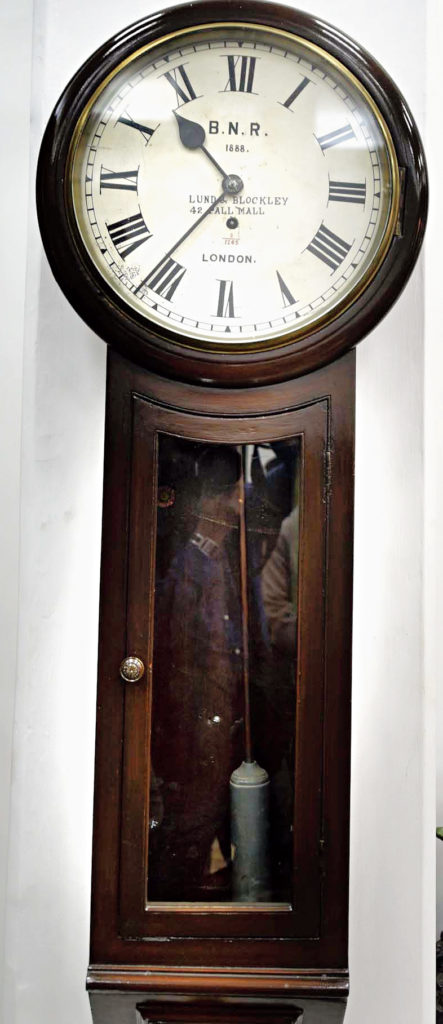
A clock made in London in 1888 inside the general manager’s office

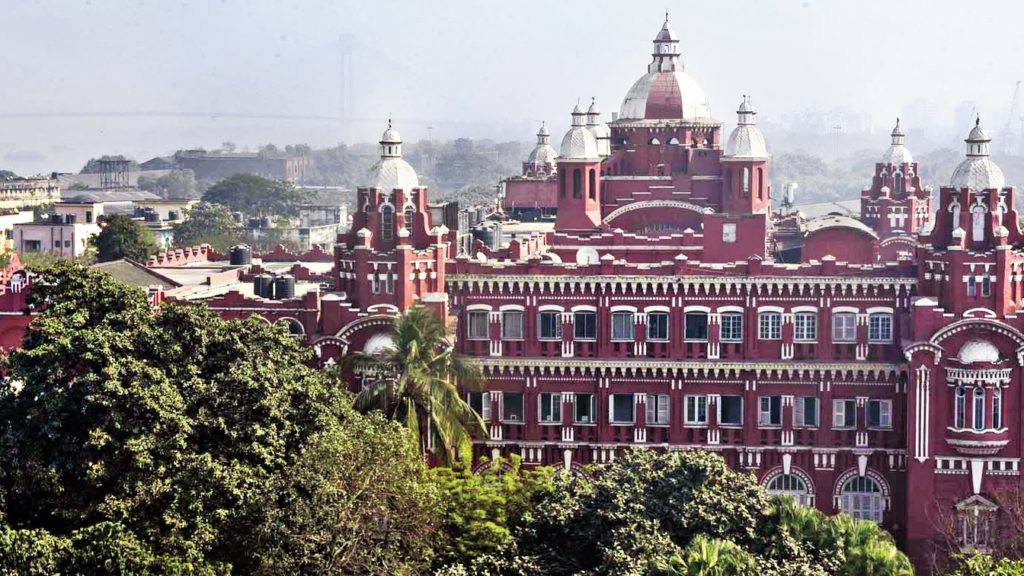
The headquarters of South Eastern Railway (erstwhile Bengal Nagpur Railway) is a majestic red brick building with domes.

“The architecture is Indo Saracenic, also found in Madras High Court and Lucknow railway station. The red brick structure is occasionally relieved by stone terracotta. The western design is embedded with Indian features such as domes,” said J.K. Saha, chief heritage officer of South Eastern Railway, who guided the participants in the walk.

The construction of the building — spanning over 53,000sq ft — started in April 1906 and was completed in May 1907, a pointer to British engineering efficiency.

Several things have been left unchanged for over a 100 years, including the cast iron-Burma teak staircase to the glass door that leads to the general manager’s cabin. “The building has not needed any structural alterations,” said Saha.

Apart from railway officials and heritage enthusiasts, people from various walks of life took part in the walk on Saturday. Janavi Sanon, a 24-year-old architect, was one of them.

“This is my second railway heritage walk. As a student of design, this is an exciting journey. The history behind all these buildings makes it doubly interesting,” she said.

The deputy high commissioner of Bangladesh, Toufique Hasan, was a participant.

One of the main attractions was a newly opened heritage gallery at the railway office. A 119-year-old Schiedmayer piano was a key draw in the gallery.

Made in Stuttgart, the instrument was shipped to India in 1900. “It is difficult to say who brought it and who played it in Calcutta but it is vintage stuff and would fetch at least a crore in the antique market,” said Saibal Bose, senior railway engineer who has done extensive research on railway history.


The BNR House that was home to Wajid Ali Shah for a few years / Pictures by Sanjoy Chattopadhyaya

A feedback from Netaji Subhas Chandra Bose in a complaint book of a railway refreshment stall at Muri station, now in Jharkhand, is there on one of the shelves.

A cabinet is dedicated to shells made by the Kharagpur railway workshop of BNR during World War I and II. Resting beside the shells is a large splinter that was inside a bomb dropped by the Japanese in Garden Reach during World War II.

“People of the country need to know about this heritage. I want more and more schoolchildren and youngsters visiting these areas,” said Kajari Biswas, head of the external affairs ministry’s branch secretariat in the city.

Saha also explained why the area was called Garden Reach.

A reach is a length of a stream or river, usually suggesting a level, uninterrupted stretch. There is one such reach in the backyard of the headquarters. The botanical garden sits on the opposite bank.

“The reach and the garden gave this name,” Saha said.

In December, BAUL had organised a similar heritage walk around Howrah station. “We want to bring the railway heritage sites within the ambit of tourism. Ideally, there should be a single-window system that takes care of a guided tour of all these places. There is tremendous tourism potential here,” said Chowdhury.

source: http://www.telegraphindia.com / The Telegraph, Online edition / Home> Heritage / by Debraj Mitra in Calcutta / February 03rd, 2019