All posts by wellnmed@gmail.com
25
British officer with Calcutta ties raises £15m
‘You’ve all got to remember that we will get through it in the end’
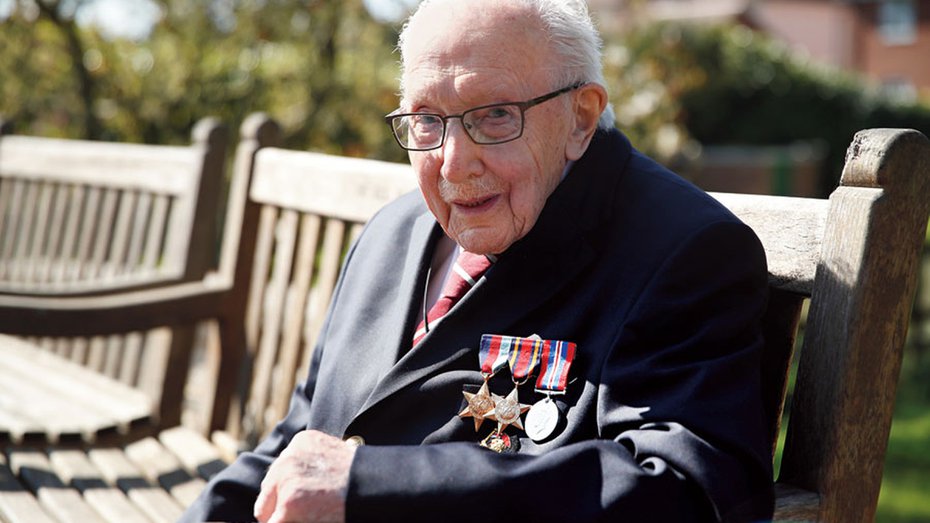
Captain Tom Moore, a former British army officer who served in Calcutta during World War II, had intended to raise £1,000 for the NHS by marking his 100th birthday on April 30 by doing 100 laps of the 25-metre loop in the garden of his home in Marston Moretaine, Bedfordshire, in 10-lap segments.
But by the time Moore, aided by his walking frame, had completed his mission on Thursday morning, donations from 620,000 people in 53 countries had taken the total on his fundraising page to over £15m — a record for a single campaign on “JustGiving”.
It is all a long time since his days in India. Moore was conscripted into the British Army in June 1940 when he was 20, and began his military career in Otley, West Yorkshire, where he joined the 8th Battalion, the Duke of Wellington’s Regiment under Lieutenant Lord George Saville.
This might explain why, when donations hit £10 million late on Wednesday night, Moore tweeted “Virtutis Fortuna Comes” — the Latin motto of the Duke of Wellington which means “fortune is the companion of virtue”.
In October 1941, his unit was posted to Bombay, with the sea voyage, via Cape Town, taking six weeks. He took a train to Poona and joined the 50th Indian Tank Brigade, where he was asked by his commander to start a motorcycling course for the Brigade because of his expertise in the sport.
He was next ordered to move to his base in Calcutta — the journey during the monsoons took three weeks — and later took part in two exercises in the Arakan before moving to Rangoon.
After all in his background, he probably thought his walk in England, even at 99, was a bit of a doddle.
Still, among those who applauded his fundraising achievement was Ben Stokes, Wisden’s cricketer of the year, who said: “The funds you have raised for the real heroes (in the NHS) are just sensational.”
Chancellor Rishi Sunak said Moore’s “extraordinary” efforts “goes to show the British spirit is as strong as it’s ever been”, while the health secretary Matt Hancock remarked, “This is an awful crisis, but there are some little shafts of light…. He’s served his country in the past and he’s serving his country now, both raising that money for the NHS, but also cheering us all up.”
From his home, Michael Ball, a well-known singer, offered a rousing rendition of You’ll Never Walk Alone.
As the sprightly dressed 99-year-old, with his medals gleaming in the spring sunshine, finished his mission, there were TV cameras and journalists to record the occasion plus four soldiers from the Yorkshire Regiment to give him a ceremonial salute.
An emotional Captain Moore, then revealed that he had postponed his 100th birthday party and that after a short rest he would resume his walk.
He added an uplifting message to people in Britain and beyond: “You’ve all got to remember that we will get through it in the end, it will all be right but it might take time. All the people are finding it difficult at the moment, but the sun will shine again and the clouds will go away.”
He said that NHS workers on the frontline “deserve everything we can give them”, and that “I’ve always been one for having a future, I always think things will be good. We’ve fought so many battles and we’ve always won and we’re going to win again.”
www.telegraphindia.com / The Telegraph, online edition / Home> World / by Amit Roy in London / April 17th, 2020
Forgotten hero of a forgotten battle
A 36-year old schoolmaster and his disciples, challenged the tyranny of the British Raj, and for a few glorious days, threw off the yoke of imperial servitude.
Chennai :
A 36-year old schoolmaster and his disciples, challenged the tyranny of the British Raj, and for a few glorious days, threw off the yoke of imperial servitude. They paid a heavy price. But a tinder had been struck, and a group of young Bengali men and women had briefly managed to attack and capture British strongholds. I am referring to the little-known saga of the Chittagong Armoury Raid and the ensuing Battle of Jalalabad Hills, led by ‘Masterda’ Surya Kumar Sen, former president of the Indian National Congress’ Chittagong branch.
My grandfather Suresh Chandra Dey was one of the 65 members of the Chittangong branch of the Indian Republic Army, who raided the local armoury and cut off the communication systems to isolate the important port city. A few days later, a regiment of more than 20,000 British troops struck back. During this fierce battle, my grandfather was shot. He managed to survive the injury and was helped by his comrade Shanti Nag, who carried him down the hill to safety.
Dey was eventually arrested and jailed without a trial, incarcerated as a political prisoner. When his tormentors could not extract information from him through coercion and torture, they tried bribing him, offering to send him to England and fund his higher studies as a barrister.
He did not give in and was eventually released and placed under house arrest. So much so, when my grandfather wed my grandmother Kironmoyee Dey, it was in the presence of British soldiers. He then made his way westward, and eventually founded a the first Sreeleathers store in Jamshedpur in 1952.
My grandfather had chosen to dedicate his life to the idea of an independent India. But the pocket of earth on which he and his comrades bled into was cleaved away at partition, first as East Pakistan and then as Bangladesh.
It falls upon all of us to remember our forebears, and cherish the country that was founded on the blood sacrifice of so many forgotten heroes.
source: http://www.newindianexpress.com / The New Indian Express / Home> Cities> Chennai / by Rijuta Dey Bera / Express News Service / April 23rd, 2020
IIT Kharagpur builds disinfection tunnel for campus visitors in coronavirus time
While passing through the tunnel, a visitor is sprayed with a disinfectant solution coming out of a high-pressure air compressor.

The Indian Institute of Technology Kharagpur has set up a disinfection tunnel for sanitizing visitors to the campus during the ongoing lockdown triggered by the coronavirus outbreak, an official said on Saturday.
The tunnel has been installed at the sole entry point of the campus for essential services staff such those involved in cleaning operations and once the lockdown is lifted, it can be of use to screen visitors until the threat of COVID-19 is gone, he said.
While passing through the tunnel, a visitor is sprayed with a disinfectant solution coming out of a high-pressure air compressor.
The system to automate the process of disinfecting visitors was developed by Prof Mihir Sarangi, Associate Professor Mechanical Engineering, along with faculty and staff members from various departments.
“The output material is like mist and highly effective as it covers a larger surface area unlike liquid disinfectant.
Also, it does not need any drainage,” Sarangi said, This mechanism is, however, a supplement for hand washing or the need to wear face masks in public. Hand wash stations have been placed just outside the disinfection tunnel, he said.
The product prototype has been built indigenously at the IIT Kharagpur in less than a week while the campus is under lockdown.
The prototype is now fully operational at IIT Kharagpur and is used for all people entering the campus.
The commercial model for the product has been estimated to be available for Rs 4 Lakh.
IIT KGP Director Prof Virendra K Tewari said such technologies can be quickly built and employed at any location which has a daily influx of essential service providers.
“Our campus is like a mini township which, in the current situation, requires automation of hygiene and safety protocols for essential service providers who are coming out of their homes every day to serve at the campus and also the campus community who are interacting with these visitors,” he said.
Tewari said more such innovations to assist Indias fight against COVID-19 are underway. PTI SUS NN NN
source: http://www.hindustantimes.com / Hindustan Times / Home> Education / by Press Trust of India, Kolkata / April 18th, 2020
Feed the Need: This group of friends in Kolkata has fed over 1000 families amid lockdown
In Kolkata, a group of six friends have come together to feed villagers in the state.
Kolkata :
The unprecedented lockdown in a bid to prevent the spread of coronavirus in India, has given rise to a humanitarian crisis, where thousands are going to sleep every night without a morsel of food in their stomach. Amidst the crisis, several good samaritans have come forward to do their bit to help the starving souls.
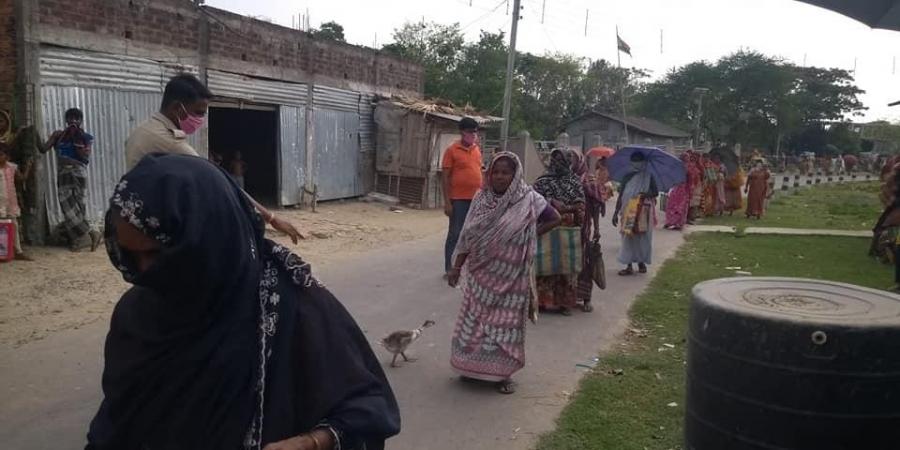
In Kolkata, a group of six friends have come together to feed villagers in the state. The group has so far raised more than Rs 4,000,00 through donations from their friends and colleagues and fed 1200 families in West Bengal.
Ritambar Das, Arijit Roy Chowdhury, Preetom Bhattacharya, Abhijit Sarkar, Sukanya Dutta and Rovers Chatterjee with the help of their friends from other cities in India, US and UK have been delivering ration to families in four villages which are completely cut off from the cities amid lockdown.
Three kilograms of rice, one kilogram of potato and some lentils go into a bag that is then distributed among the villagers. So far the group has managed to help people in Mallickpur, Joytola, Piyali and Betberia. From procuring the ration to distribution, these six people have been doing it all on their own with the help of local police.
“We decided to take this initiative after one of Rritambar’s employees asked for financial support for the people of his village. But for him, it was not possible to take the responsibility of the entire village. So he pitched the idea to some of us and we decided pool money and help them,” said one of the members of the team.
This group of young professionals have also started a Facebook page ‘Feed the Need- by willing souls’ to spread the word and collect funds. The members of the group added that it’s a close circuit network but they are deliberating the option of crowdfunding.
“We initially had a target to collect Rs 15,000 so that we could feed at least 150 families.Our friends passed on the information to their friends who started donating. We coordinate everything through a WhatsApp group. We add every donor to the group to keep them updated,” he added.
The group recently held a ‘thanksgiving’ event in South Kolkata for the essential service providers(police, delivery agents, et al) where they were given snacks and energy drinks.
“We have been distributing these rations on our own with the support from the local police. However, we have decided to engage daily wage labourers in distributing work so that we can pay them a fee to sustain themselves,” a member added.
We are not doing any religion-based distribution, the group maintains adding that it is imperative to look beyond such petty issues and help everyone who is less fortunate.
The group is scheduled to distribute more rations among the families of three more villages in South 24 Parganas district.
source: http://www.newindianexpress.com / The New Indian Express / Home> Good News / by Alisha Rahman Sarkar / Online Desk / April 19th, 2020
Boston Ice Party
Two hundred years ago, after 20 failed attempts, the first consignment of ice arrived in Calcutta from Massachusetts
This was not very long ago, but a period that may well now be time stamped as BC or Before Corona. The exhibits at the Jadunath Bhavan Museum and Resource Centre in south Calcutta were arranged in a certain way to present the history of ice in the city — yes, it wasn’t such a taken-for-granted item as it came to be.
The photographs on display were pickings from Fulbright-Nehru Scholar Christine Rogers’s research. Exhibit 1, a black-and-white-photo of a young man driving a rickshaw laden with blocks of ice through the streets of Calcutta. “The boy is carrying the ice to the fish market. It is a photo from present-day Calcutta,” said Rogers. The second exhibit, a photograph of commercial projects of snow parks that are now being created for entertainment. The third, people sitting on the banks of the Hooghly where the ice used to be downloaded after it arrived all the way from the US.
Once upon a time, ice was a rare commodity, procured all the way from America. The exhibition, in consonance with Rogers’ talk, is a detailed history of ice trade in India. The now, followed by the then.
In the 19th century, the British army in India and people in the administration found it difficult to cope with the intense tropical summer. In a letter dated May 1833, Daniel Wilson, the fifth Bishop of Calcutta and the man who built St. Paul’s Church, writes to his family in England: “The weather is perfectly suffocating. None can pity us but those who know our suffering.”
Wilson’s immediate predecessor had not been able to endure the extreme temperatures and had died in office. Thus, to ease things for their own, the East India Company set about arranging for a regular supply of ice for all seasons.
Those days, what was available in the market was “Hooghly ice”. It used to come from Chinsurah in the winter months and was so named because it was made from the river’s waters. Said Rogers, “This ice was filthy and more like slush. It was made by freezing water in shallow pits and was dirty and unfit for drinking. This was not the kind of ice that the British were looking for.”
In 1833, a businessman in Boston, Frederic Tudor, arrived in Calcutta in a large vessel stacked with ice. Bringing ice to India was no easy task, not even for as enterprising a fellow as Tudor. According to Rogers, he failed 20 times before he met with any success. The challenge was to keep the ice from melting the entire length of the two-month journey to Calcutta and thereafter.
Tudor was not in this project alone; he partnered with Nathaniel J. Wyeth, a supplier of ice and a businessman. Together, the two cracked issues such as the technology of cutting ice, thereby making large-scale ice exports from Massachusetts possible. The two evolved the technique of harnessing horses to a two-blade ice cutter to cut more ice in less time.
David G. Dickason writes in his book, The Nineteenth-Century Indo-American Ice Trade, how Tudor took up this project only because he was in dire need of money after failing to dominate the global coffee market. Dickason writes: “He inaugurated his India venture only after experiencing a desperate need for adequate cash flows and profits in order to repay enormous debts incurred through his misadventures in coffee.”
With ice, Tudor got lucky. He was based in Massachusetts that had the requisite climate for producing natural ice in excess. Ice was cut from the Walden Pond, a lake there, where pure ice was easily found. Also, the Boston port was close by.
In 1847, when American essayist, poet and philosopher, Henry David Thoreau, was staying near the Walden Pond, he witnessed the cutting of ice. In one of his essays titled “The Pond In Winter”, he writes: “Thus it appears that the sweltering inhabitants of Charleston and New Orleans, of Madras and Bombay and Calcutta, drink at my well.”
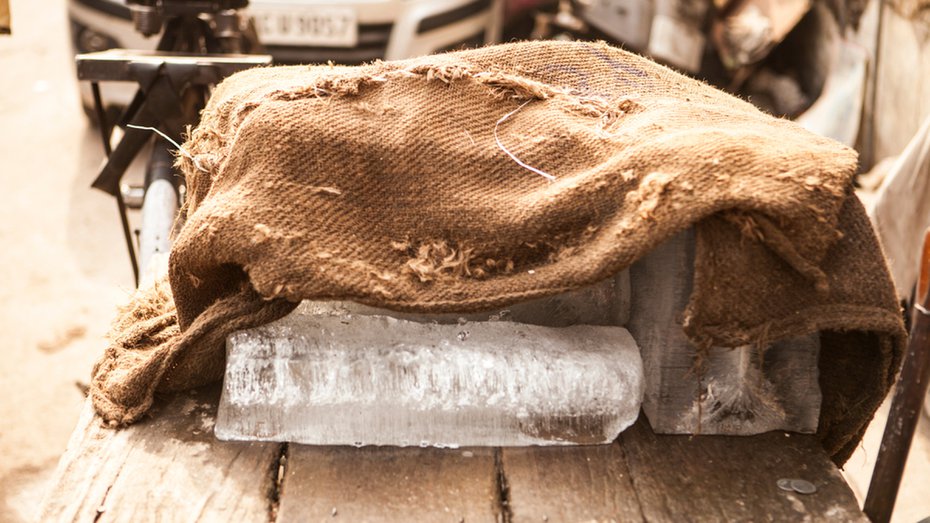
The route was a long one. The ice, according to records, would be covered with fly ash and salt and then packed in jute to keep it from melting. Tudor earned such grand profits from Calcutta the next two decades that he came to be known as the Ice King.
The trade continued for almost 50 years. The price of the ice was only 4 annas per pound (one pound equals half a kilo), much cheaper than Chinsurah ice. It later came down to 2 annas per pound.
Records show that the ice was hugely in demand during that period and it had to be rationed at times as the ships were delayed and there would be a crunch. In fact, people had to produce a doctor’s certificate to get the ice. The British living in Calcutta even raised funds to set up an icehouse to preserve the cargo. Around this time, many Bengali businessman also got involved in the trade.
Rajinder Dutta was one of the pioneers of ice trade in Calcutta. His progeny, living in central Calcutta today, however, has no related documentation. Sanat Kumar Ghosh, who is one of the eighth generation Duttas, rattles off names of some others who eventually joined the trade — the Debs of DarjiPara in north Calcutta, Chhatu Babu and Latu Babu, and the Mitters.
“Rajinder Dutta was more famous as a homeopath. He had treated Ishwarchandra Vidyasagar, the Maharaja of Jaipur and also Raja Naba Krishna Deb of Calcutta,” says Ghosh as he hands over a book titled History of Homeopathy in India in the 19th Century. The book has a few lines on ice trade too. It reads: “In 1836, 12,000 tonnes of ice was shipped to Calcutta and 10 years later, the figure spiralled to 65,000 tonnes.”
That day at the Jadunath Bhavan Museum, Rogers spoke at length about how ice was transported to Madras and Bombay from Calcutta. Dickason also notes how eventually ice came to be used by Indians too. It was used to preserve food, for refrigeration, in drinks. Rounding up he wrote: “Even Hindoos, otherwise so scrupulous, do not hesitate to mix the frozen waters of America with the sacred stream of Gunga, whilst the stricktest Mohummudans use it with unlimited freedom (sic).”
source: http://www.telegraphindia.com / The Telegraph, online edition / Home> Heritage / by Moumita Chaudhari / March 29th, 2020
Microbiologists in Bengal emerge unlikely heroes in COVID-19 time
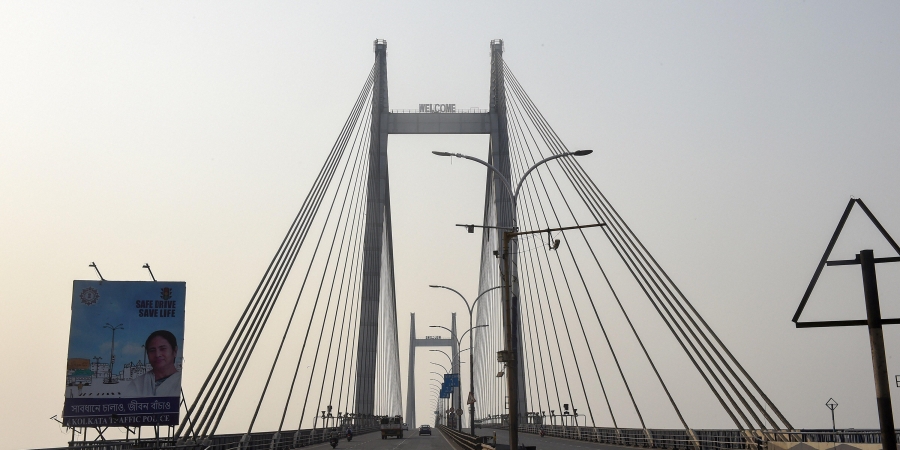
Welcome to the world of NICED, where samples taken from suspected coronavirus cases are re-examined for confirmation.
Kolkata :
They are working for an average of 13 to14 hours a day.
One of them left his newly married wife home, while another faced ostracism from his hostel authorities.
Welcome to the world of NICED, where samples taken from suspected coronavirus cases are re-examined for confirmation.
An 18-member team of virologists, microbiologists and consultants are working 24/7 at the National Institute of Cholera and Enteric Diseases (NICED) in Kolkata — testing samples, filing reports, and attending hundreds of phone calls from hospitals and even from common people.
Samples examined by one hospital are sent for confirmatory test to this institute, which functions under the department of health research, Union ministry of health and family welfare.
“Earlier we used to get one or two samples a day. Now the workload has increased to a large extent in the last four weeks. Now we get more than 70 samples per day,” said Agniva Majumdar, a microbiologist working at NICED.
From receiving a sample to delivering the test report – the entire process takes around 4-5 hours, he said.
“Our team is working round the clock in shifts to ensure that the work is done,” Majumdar told PTI over phone.
Apart from processing data, the team also has to coordinate with the state health officials and various hospitals.
“We are receiving around 500 phone calls every day. Hospitals ring up if they need some clarification on our report. Members of the general public also call us. We are answering their queries too as much as possible. We understand they are in distress,” Majumdar said.
Asis Kumar Jana, another NICED staff, took only two days off for his wedding in Februray and was back to work to handle the samples that had started pouring in.
“I voluntarily tooWelcome to the world of NICED, where samples taken from suspected coronavirus cases are re-examined for confirmation.k just two days off in February for my wedding as the pressure has started to build up,” he said.
Jana said a member of his team recently faced ostracization at a hostel where he stays and was asked by its authorities to go back home.
“Senior scientists of our lab had to get in touch with the hostel authorities and communicated to them that we are not at risk we work in a highly protected atmosphere. Then the matter was resolved,” he said.
“Some of our colleagues are staying at the office guest house and inquire about their family’s well being over the phone,” said Jana.
NICED Director Shanta Dutta was full of praise for her team.
“They are doing a great job and service to mankind,” she said.
The vision of the NICED is to perform research and develop strategies for treatment, prevention and control of enteric infections and HIV/AIDS threatening the nation’s health.
The Indian Council of Medical Research (ICMR) decided to establish a Cholera Research Centre here in 1962 to research on the prevention and control of cholera and other diarrhoeal diseases.
The ICMR renamed it as National Institute of Cholera and Enteric Diseases (NICED) in 1979.
The WHO recognized this Institute as “WHO Collaborative Centre for Research and Training on Diarrhoeal Diseases” in 1980.
source: http://www.newindianexpress.com / The New Indian Express / Home> Cities> Kolkata / by PTI / April 03rd, 2020
18
Photographer Nemai Ghosh, the man who never missed a moment
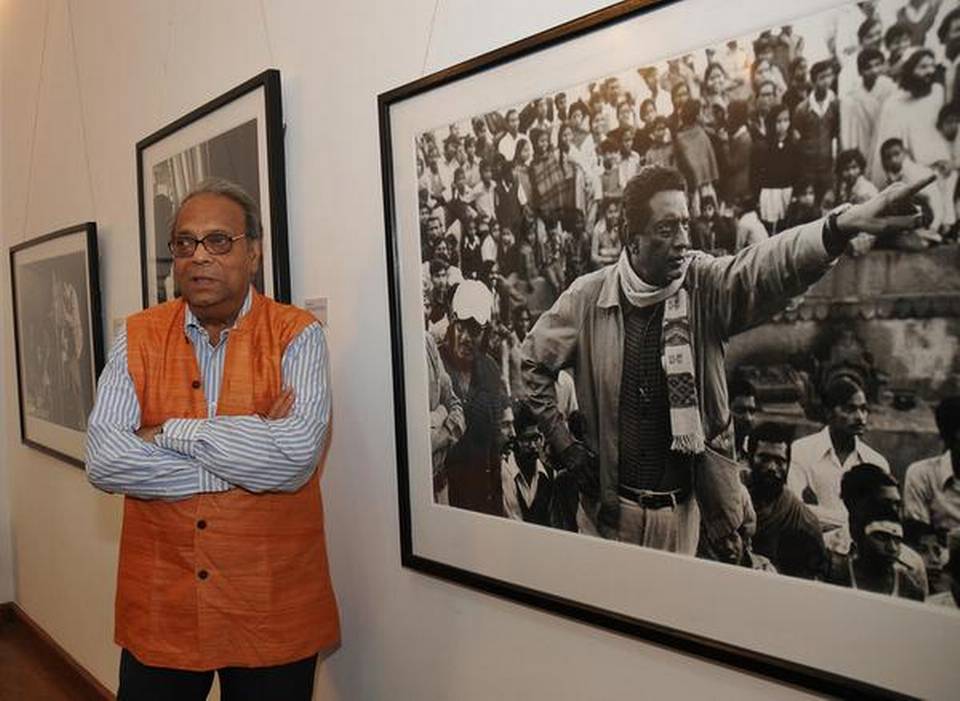
‘Goopi Gyne Bagha Byne’ (1969) onwards, he was the still photographer for all of Satyajit Ray’s works till his last film ‘Agantuk’ (1991)
For someone best remembered as the visual biographer of legendary filmmaker Satyajit Ray and a documentarian of the making of his astounding body of work, an interesting aspect about Nemai Ghosh was that he started off as an actor with actor-director Utpal Dutt’s Little Theatre Group in Kolkata.
Arts critic and publisher-editor Samik Bandopadhyay remembers one such play that he acted in: the landmark Angar (1959) about the exploitation of coal miners. It had music by Ravi Shankar and complex sets (Nirmal Guha Ray) and lighting design (Tapas Sen) with an entire sequence of a mine getting submerged under water. “He was an impressive and formidable figure on stage but was never so interested in photography then,” recalls Mr. Bandopadhyay.
Nemai Ghosh passed away in Kolkata on Wednesday. He was 85.
Ghosh’s interest in photography was kindled entirely by chance in 1966 when he found an abandoned camera and started tinkering and playing around with it. Being a great lover of cinema himself, he wanted to shoot the process of filmmaking which is when his path crossed with that of Ray. Initially just “tolerant” of his presence, as he once recalled, Ray discovered Ghosh’s talent by and by to have him become a part of his unit. Goopi Gyne Bagha Byne (1969) onwards, he was the still photographer for all of Ray’s works till his last film Agantuk (1991). “The only other parallel I can draw is Raghu Rai’s photographs of Indira Gandhi,” says photographer Chirodeep Chaudhuri of an imagemaker’s consistent collaboration and engagement with a personality.
Ray’s son and filmmaker Sandip Ray remembers meeting him on the sets of Goopi… “He was a part of the family. He was always there, not just on the shoot, but our home as well,” he says.
Black and white
The magic of his black and white images lay in the specific fleeting instants that they managed to capture, that too without flash, in natural light. “He never missed a moment, captured the right moment,” says Sandip Ray. “His work in theatre gave him a sense of the moment,” says Mr. Bandopadhyay.
Filmmaker Sujoy Ghosh compares his frames to videography. “Each of his photos tells a story to me. Like Jaya Bachchan in Kalighat, teeka on the forehead, prasad in hand, happy… I see many things in the process. It’s instructive and informative about the process of filmmaking itself,” he says.
Mr. Chaudhuri points out the candidness in his frames unlike the “manufactured PR images and ‘behind the scenes’, ‘making of’ balderdash” where the stars are perennially performing or posing.
“There was an endearing quality about his photos. You could see his love for theatre and cinema [reflected in them],” says Mr. Chaudhuri.
Apart from Ray, Ghosh also chronicled some of Mrinal Sen’s films and he was the still photographer on Mira Nair’s The Namesake. “His portraits of my father were absolutely brilliant,” says Mr. Ray. Sujoy Ghosh remembers him shooting on the sets of his own film Kahaani. “I fell at his feet. It was such an honour that he considered our film,” he says.
On theatre
Beyond Ray and films, a major part of his work was on the theatre in Bengal and about Kolkata itself. His work was a reference point for Sujoy Ghosh when he went shooting in Kolkata for Kahaani. “It was an amazing inspiration. Every photographer and painter has a [unique] way of looking at places, objects, people which is different from ours,” he says.
Mr. Chaudhuri remembers him showing rare colour photos of Ray when he visited Ghosh at his home couple of years back. “He was so excited going through the folders and files of his work on the computer,” he says. One of Ghosh’s disappointments, according to Mr. Chaudhuri, was not being given space by the State government to archive his work. Later, he gave away most of it to the Delhi Art Gallery.
In the latter half, he was passionately documenting painters at work and musicians in performance. According to Mr. Bandopadhyay, Ghosh had clicked some exclusive pictures of the ailing Italian maestro Michelangelo Antonioni, some of them in his hotel room, when the latter had come to Kolkata for the retrospective of his work at the International Film Festival of India in 1994. Impressed with his images, Mr Antonioni, who had taken to painting in his later years, had invited him for his exhibition to Italy. Ghosh took pictures of Antonioni moving around in the exhibition on a wheelchair. Having been witness to and documented the maestro’s painting phase, Ghosh wanted to preserve them in the form of a book. Sadly there were no takers for it in the commercial publishing world.
source: http://www.thehindu.com / The Hindu / Home> Entertainment / by Namrata Joshi / Mumbai – March 26th, 2020