All posts by wellnmed@gmail.com
30a
29 b
29 a
28
27
26
India’s first underwater Metro line in Kolkata: A look at newly opened station
- Union minister Piyush Goyal inaugurated the Phoolbagan metro station of Kolkata East-West Corridor earlier this month
- The Union Cabinet earlier approved the revised cost of East-West Metro Corridor Project for Kolkata

With “world-class passenger amenities and elegant interiors” the newly opened Phoolbagan Metro station is Durga Puja gift for commuters in Kolkata. Union minister Piyush Goyal unveiled the Phoolbagan metro station of Kolkata East-West Corridor earlier this month. The 16.6 km long Corridor will connect Howrah on the West bank of the river Hooghly with Salt Lake City on its east bank.
Phoolbagan is the first underground station to become operational in the East West Metro corridor, which travels both below the surface and on elevated tracks, and also through underwater tunnels below River Hooghly. MG Road in the north-south main line of Kolkata Metro was the last underground station to be commissioned back in September 1995. All metro stations to become functional after that are either elevated or at grade level.
The start of Metro services at Phoolbagan Station is a “Durga Puja gift by the Railways for Kolkatans”, the minister said. “The estimates are that this line (East West Metro corridor) will be used by nearly 10 lakh people by 2035. That itself will be a huge service to the people of Kolkata,” he added.

“The metro corridor will ease traffic congestion, enhance urban connectivity and provide a cleaner mobility solution to lakhs of daily commuters,” the minister said.
The new line is expected to take less than a minute to cross a 520-meter underwater tunnel. Depending on the time of day, it takes some 20 minutes to use the ferry and anywhere upward of an hour to cross the Howrah bridge.
“Since this corridor connects three most important parts of the Kolkata Metropolitan Area i.e. Howrah, Business area of Kolkata and New Settlements in Salt Lake it is going to revolutionise the mass rapid transport in Kolkata and adjoining Howrah and Bidhanangar. This will connect important landmarks like Howrah, Sealdah, Esplanade and Salt Lake Sector-V which is an IT hub,” the official statement mentioned.
The Union Cabinet earlier approved the revised cost of East-West Metro Corridor Project for Kolkata, Union minister Piyush Goyal said. The completion cost of the project estimated at ₹8,575 crore, Goyal added. The project is likely to be completed by December, 2021. “This will give a boost to mass transit system,” said Union minister Piyush Goyal.
source: http://www.livemint.com / Mint / Home> News> India / by Staff Writer / October 20th, 2020
Father Gaston Roberge Retained a Lifelong Love for and Commitment to Indian Cinema
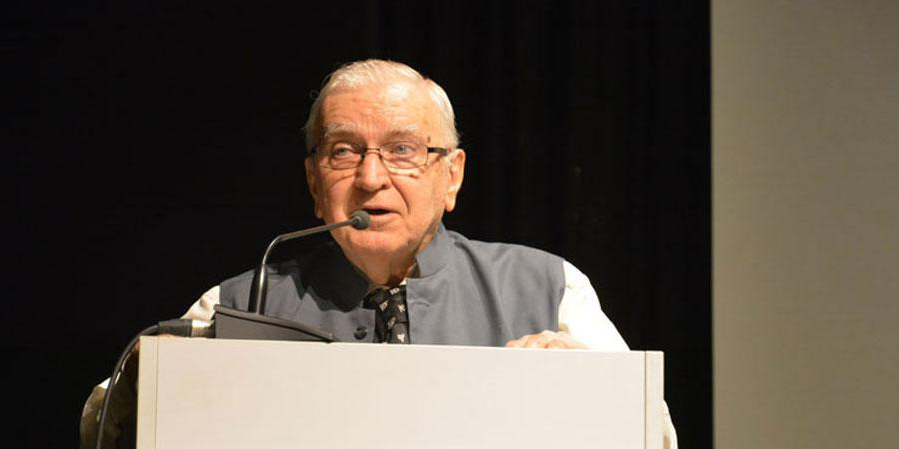
The Canadian-turned-Calcuttan did not share the disdain arty Indian filmmakers had for commercial cinema.
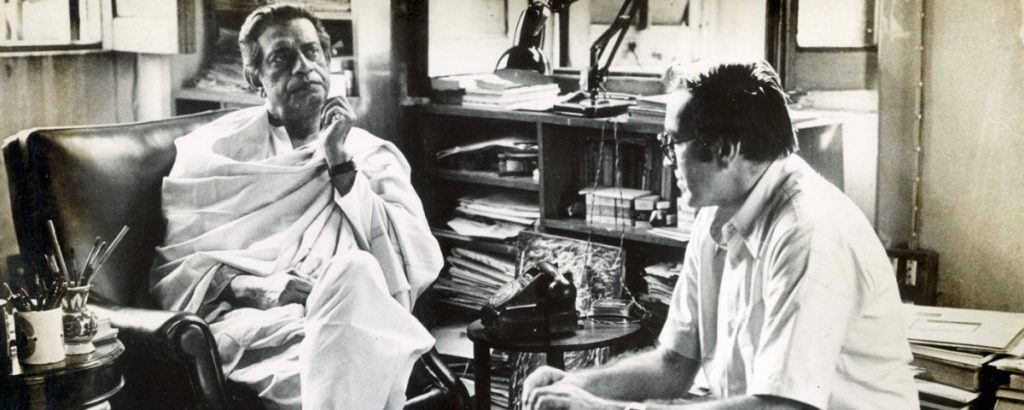
The exchange between the little prince and the fox from the classic 20th century post-war French fable, Antoine de Saint-Exupéry’s Le Petit Prince, holds the key to how two men – Satyajit Ray and Fr Gaston Roberge – met every Sunday at 9 am at the residence of Ray on the Bishops Lefroy Road in Calcutta. Like the fox and the prince, they kept their ritual and explored the world of ideas. Alas, now with the passing of Fr Gaston Roberge, we will never know who was the prince or the fox between the two. This rite of friendship lasted for 22 years, ever since their first meeting in 1969. They institutionalised their friendship in the form of Chitrabani, the first development communication institution in the eastern part of India, and thus the lore continues.
Unlike their rendezvous, I encountered Fr Gaston Roberge on three occasions, serendipitously – in Pune, Ahmedabad and Goa – in the early 1990s. The third time, at an International Canadian Studies conference, I decided to record the moment in the form of an interview which was then published in the Sunday Magazine of the Indian Express on November 13, 1994. Each time it was his Canadian cadence of directness, and unassuming presence, coupled with the mischievous smile and the phenomenal capacity to talk cinema that stood out.
Let’s take the case of the blockbuster hit Sholay. This year marks the 45th anniversary of its theatrical release in 1975, and I do not recollect anyone who has brought together the arrival of the train at the Ramgarh and the Lumière brothers’ 50-second shot of L’Arrivée d’un train en gare de La Ciotat in Paris (1896) together in a sentence: It is in such moment of equivalence that one is deschooled and taken on a parallel journey of Indian cinema.
For Fr Roberge, “a proud Calcuttan”, embedded in culture and ethos of the host society – becoming native was a natural process. “I am at a loss when I am asked, ‘Where are you from?’,” he confesses. “I have been called ‘Fadar Gautam Roberjee’,” he said, recounting an incident of his earlier days after his arrival in Kolkata while learning the Bengali language and doing missionary work in the schools. When asked how he felt about that name, an accident of accents, he smiled. “I like it! I still use ‘Fadar’, he said to me. Fadar speaks Bengali with a French accent among other languages like Italian. Through interacting with Bengali people, I have come to know myself further,” he had said.
Writing about his journey to India, he said it was an “urge” to come over to India, to dialogue with her people, and learn from them whatever he might discover that he did not know, especially about God. “In return, of course, I was keen to share whatever my own tradition had given me. But my journey was one of discovery, not of colonization, religious or political. I had joined the Society of Jesus at the age of 21 years. I already had five years of religious life when I volunteered to come to India, and my superiors decided I would join the Jesuits of Kolkata.”
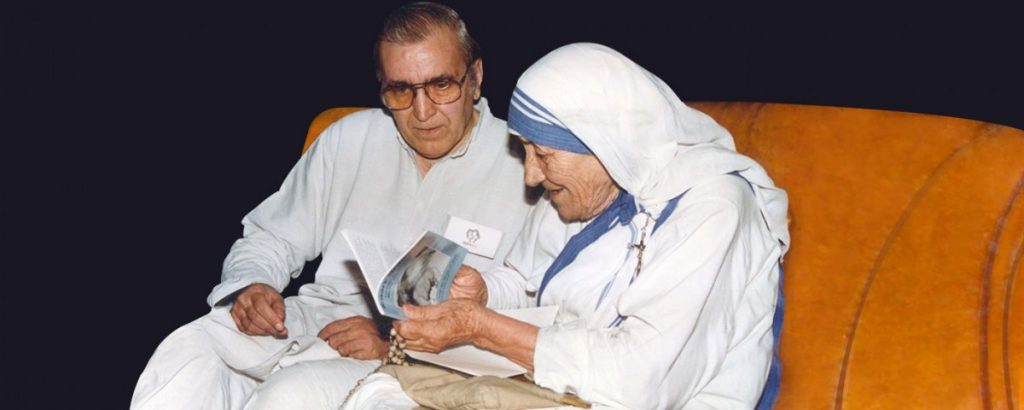
I recollect him telling me how the city was encoded in him in form of a tri-murti, an image with three faces: “the face of cineaste Satyajit Ray, Mother Teresa, the face of the rickshaw-puller in Dominique Lapierre’s The City of Joy—each representing the creativity of the intelligentsia, unconditional charity and the heroism of an ordinary citizen.” He had a very close relationship with both Mother Teresa and Dominique Lapierre.
In drawing attention to the imperative to think about cinema, he implores, “thinking allows the mind to progress in its search for plentitude and unity. When one is dissatisfied with a particular social order, one is tempted to reject the type of thinking that is associated with that order. This is indeed a mistake. For, if one cannot transcend the limitations of a social order with the help of the ideology of that order, one is not likely to be able to transcend the limitations of the alternative social order either, with whatever ideology.”
Writing was his mode of thinking – at the last count he had authored 31 books – especially after he discovered his inability to do much on the field during the violent times of the 70s in Calcutta during which many conspiracy theories flourished, making him, his work and the institution of Chitrabani the suspects of an international conspiracy, ranging from cold war rhetoric to missionary conversions.
The confluence of Derrida and his missionary invocation produces statements like:
“A text always already defies the authority of its author. What is true of films is generally true of all texts. The author of a text, filmic, literary or dramatic, is not the author—God.” (original stress)
In conversations, his pauses and the idea of silence were eloquent and an exercise in listening, an endangered practice as Nuruddin Farah would say. His witty deployment – “I am a priest” – as a strategic reminder of drawing the line in refraining to speculate in a discussion despite being tempted intellectually.
Woven into his discourse were emotion and theology and implicit in his teleological imbuement of Cinema was the providentialism. Once I asked him about Kalaignar Karunanidhi writing out god from the Tamil cinema. He paused and alluding to the 17th century tension between Blaise Pascal and Rene Descartes, who tried to dispense with God in philosophy, and quoting Pascal said, “the heart knows of reasons that reason cannot grasp”. Much like a Bernard Crick, he elaborated the treatise in defence of Indian cinema. “[P]opular films are collective dreams and song and dance is an integral part of it. Song and dance are sight and sound,” he wrote, invoking Bharat Muni’s Natyashastra. He was the Master Preacher of Film Theory, as the 2017 39-minute long documentary by K.S. Das encapsulates the remarkable Father Gaston Roberge.
Among the critical three decades of the 70s-90s, it was in the 80s that his work bore much meaning as filmwallahs, writers, academics, critics and even politicians were flailing in an effort to keep their feet on shifting ground, as everything was up for question.
At the beginning of the 80s, the film society movement, having spread across the nation fostering an orientation of an alternative film culture with an international outlook, found itself in a crisis as it embattled the state bureaucracy’s wrongful interpretation of its activities – sites of commercial entertainment. At the same time, as questions about Indian cinema became part of a milieu for the 800-odd graduates who had come out of the Pune Film Institute, brandishing “a consciousness of the social responsibility of the artist”, as Jagat Murari wrote about as the mandate of the institute. Fr Roberge countered the dismissive and patronising gaze of the film society-wallahs, as he sought answers in a fuller engagement with the popular Indian cinema. In response, Fr Gaston offered Another Cinema for Another Society, a militant manifesto of sorts: “A new cinema can only be born along with a nascent society and a new cinema can contribute to the growth of that society. ”
Similarly, the two key reports – the Patil Report of the Film Inquiry Committee (1951) and Karath Report of the Working Group of Film Policy (1980) – are like bookends to the bureaucratic rationalisation of the political economy of the Indian film industry. Often the disdain was visible, as the Karath report framed the film industry, “vulgar, trivial, reactionary, tasteless and exploitative”.
With his trademark clear-headedness, Fr. Roberge defined his position:
“Every effort should be made to salvage from total oblivion the report of the Working Group on National Film Policy (1980) for a new Indian Cinema. The report has ideological limitations but argues well for ‘another’ Indian cinema. This cinema would take on the social tasks which critics of the so-called commercial cinema want the latter to perform. In our socio-economic system, commercial cinema functions best when it is is spared the irritant of false expectations, and when the social value of the commodity it produces—entertainment—is recognised.”
He was a faithful witness to these turbulent times as Indian cinema was in the throes of its identity crisis – “good Indian cinema” vs “radical cinema” – as the questions of a ‘third cinema’ began floating around.
There were many endeavours in that decade in search of the quintessential Indian idiom.
Earlier, Satyajit Ray laid out the schema in Our films, Their films. As Chidananda Das Gupta was Talking About Films, we read that Kishore Valicha had pronounced Amitabh Bachchan as the urban machine. In the context of the Sikh pogrom, Nirmal Verma proclaimed at the Gandhi Peace Foundation the need to address “religion, the most prestigious thing in the life of every Indian. Why should we in the name of this faithless secularism try to deny the deepest, the noblest quality of Hindus, Sikhs, Muslims, every religion?”; K.S.Singh and Bapu Jayasinhji Jhala were trying to institutionalise visual anthropology in India; G.N. Devy was calling out the amnesia in literary criticism; Arundhati Roy scripted and acted in, In Which Annie Gives it Those Ones; and, Pankaj Mishra was still on his way to Ludhiana for his butter chicken!
Despite cinema as his apostolic calling, he resonated with Arturo Escobar in the critique of development: “Sustainable development is an oxymoron and is not some project but a quality of human mind”. In the same vein, he added, “Spirituality is not a part of any religion but a quality of humans.”
With his friend Apu and uncle Bharat Muni, he made his way through the cinematic maze, addressing the poverty of Indian cinema, enriching the Indian people through a mass literacy in the means and technologies of communication as tools of conviviality.
Displaying admirable epistemic fluency, patience, discernment and prescience, the way Verrier Elwin responded to the tribal question, Fr Roberge did on the question of communication, and for him, the modality of cinema became a point of entry into that communication—human communication. All his life, Fr Roberge argued and endeavoured to define the social contract of image making in India, which unfortunately is under duress once again.
Narendra Pachkhédé is a critic and writer who splits his time between Toronto, London and Geneva.
source: http://www.thewire.in / The Wire / Home> Film / by Narendra Pachkhede / September 01st, 2020
Jayantibhai Thakorlal Mehta: Trusted, and loyal to city
With his deep knowledge in stones and affable nature, he soon earned a nationwide reputation as an estate jeweller
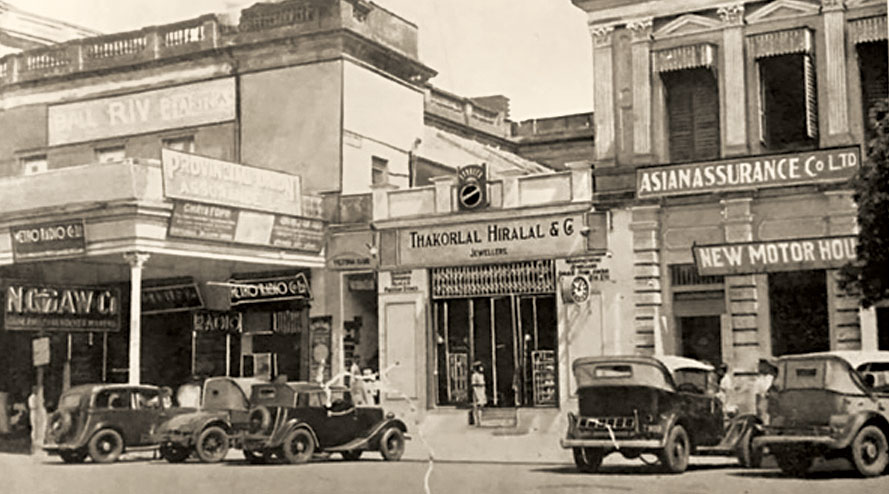
A trader dealing in precious stones saw a business opportunity soon after India’s Independence. The princely states were being merged into the republic of India and the zamindari system was being abolished.
Suddenly many of them were in market to sell a part of family jewels, for ostensible reasons. Simultaneously, a new class of rich was on the rise — businessmen mostly belonging to the Marwari community.
Jayantibhai Thakorlal Mehta was at the right time and at the right place in history. With his deep knowledge in stones and affable nature, he soon earned a nationwide reputation as an estate jeweller, buying from princely states and zamindars and selling it to the new moneyed class.
Mehta, who passed away in Calcutta earlier this week at the age of 103, moved to this city at an early age when his father Thakorlal settled down here. Jayantibhai’s uncle then ran a small diamond trading shop at Chorbagan. Being close to Rangoon also made sense as a part of the extended Mehta family was exporting rubies and emeralds from Burma to India.
When a part of that same extended family moved to Antwerp, the diamond capital of the world, Mehta’s trade and business received a further fillip as it straddled India, Burma and Belgium.
Hailing from Palanpur in Gujarat — the ancestral home to many of India’s top diamantaires — Mehta and his two brothers also saw an opportunity to up the game. There were not many jewellers dealing in diamonds apart from Hamilton & Co in Calcutta. Mehta saw a void which can be filled in the years after Independence.
The showroom at Stephen House in Dalhousie, set up in 1930, grew to become one of the top names in diamond post-Independence.
“I would say the way he handled the client, at a deeply personal level, and the trust he earned were behind the success of Thakorlal Hiralal,” Pranay Mehta, grandson of Jayantibhai and the force behind the TH brand today, said from Mumbai.
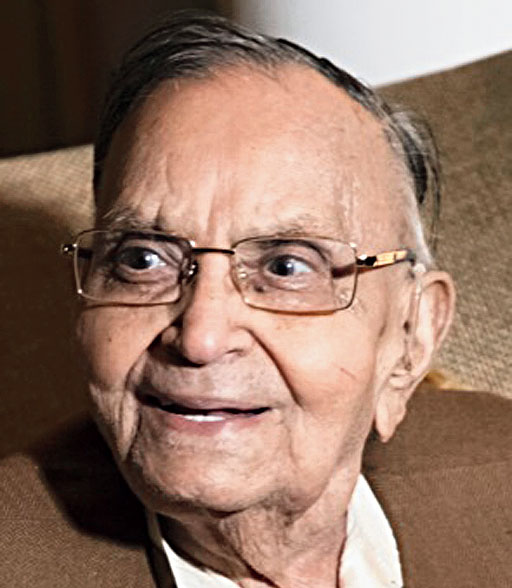
Jayantibhai, who used to love classical music and playing cards, stayed back in the city even after the business moved to Mumbai. After operating for 50 years, the Dalhousie showroom closed down in 1980 in the aftermath of a massive tax raid. The business was confined to a workshop and office on Elgin Road-SP Mukherjee Road crossing.
The office was shut down in 2010 when his son Satishbhai died and grandson Pranay decided to focus on Mumbai, the financial capital of the country, which is also close to Surat, the diamond cutting capital of the world.
“Even though he spent at least six months with us in Mumbai, after one or two months he would miss Calcutta and want to go back,” Pranay said from the Horniman Circle showroom at Fort, South Mumbai.
Pankaj Parekh, former vice-chairman of the Gem & Jewellery Export Promotion Council, recalled the splendour of the showroom at Stephen House. “In those times, trust was the biggest currency when one buys diamonds as there was no standardisation like today. When you bought diamond — and diamonds were usually bought by the HNIs and the ultra rich in those days — they had implicit trust in Jayantibhai and TH,” Parkeh, 76, said.
The rise of TH also in a way mirrored the rise of India as the destination for cutting and polishing diamonds. The Jews, who controlled the diamond trade, were not interested in dealing in small-sized stones as they thought it was not worth the effort, price wise. Indians, especially Palanpuri Gujaratis, saw an opportunity in cutting and polishing those stones, which were otherwise destined to be crushed and used to lay airport runway tarmac.
Several top industry families were loyal clients of TH and many of them continue to be today. Travelling abroad was not as frequent as it used to be today. “A wealthy patron may be often walking into Cartier, Tiffany or Harry Winston now but it was not that frequent in the 50s or 60s. For them, it used to be TH,” Raja Shah, whose father Viharilal Shah, was a friend of Jayantibhai, said.
“TH was a well known brand out of Calcutta. Jayantibhai was a respected figure in the business. We, at Satramdas Dhalamal, used to compete with them but also did business together at times,” recalled couture jeweller Raj Mahtani.
Although a diamantiere by passion, Jayantibhai worked closely with Laxmi Niwas Jhunjhunwala of Bhilwara Group and set up HEG Ltd and Rajasthan Spinning & Weaving Mills.
“My grandfather never left the city which gave him everything. Calcutta was very much a part of him,” Pranay signed off.
source: http://www.telegraphindia.com / The Telegraph Online / Home> West Bengal> Calcutta / by Sambit Saha / Calcutta – October 23rd, 2020