Kolkata, the City of Bongs that has stood the test of time, has much to offer to anyone who has been or lived there. Just when you enter the place you feel a kind of warmth that you may not have felt anywhere else. This applies to anyone and everyone irrespective of where they come from. If you have an open heart or are trying to open your heart, this is the city where you should be.
Despite the political unrest and slow pacing developments, the City of Joy still attracts almost everyone who visits Bengal or India at large.
One such person is Anubhav Mukherjee, founder of The Kolkata Buzz who came to the city from Chhattisgarh. Though he intended to learn filmmaking, the city’s charisma turned him into a wanderer who would try and capture the bursting streets on his camera and post it on Facebook. He had no idea that people will fall in love with his content and that he would create an entire platform based on Kolkata.
“When I came to Kolkata I was an outsider despite being a Bengali. So, to explore the city, I would often set out on foot and take pictures and videos. I found a lot of subjects to capture that looked ordinary but had a Bong connection. Then I started to post them on Facebook. To my surprise, it was received well by the audience and thus was born, ‘The Kolkata Buzz’ “, shares Anubhav.
In 2016 during Durga Pujo, the page was all over the place and this made Mukherjee pursue a full-time career in digital media. And all that he could do had only one USP – Kolkata and Bengali culture.
“Kolkata has been the soul of all our content. When I started the platform there was no one else who was so focused on Bengalis. So, I always made sure that my content was attractive and connected with what the public loved and I guess that is what has clicked,” explains Mukherjee.
Initially, the page had all original pictures taken by Anubhav but gradually he found and showcased pictures and quotes by several other Bengalis on his page.
“While I was working on my page, I started to spot others who were posting some great content on our theme. Although my growth mattered to me, I wanted to showcase what others tried to narrate in their posts and give them a shout-out,” says the platform’s founder.
Also, Anubhav felt the need to bring some changes to the work culture in Kolkata. Having studied the market, he knew the worth of digital and wished people to join him. So, he started pooling freelancers and professionals who now work under him to make the page even more amazing.
“I wish that Kolkata’s youth is directed towards the new age, shedding the traditional opportunities. There’s a lot to do out there other than what we are taught to aim as kids. Also, the city needs to build its startup culture and professionalism. I am doing my part and also trying to inspire my colleagues,” said Anubhav.
On today’s date, The Kolkata Buzz has 215k Followers on Instagram, and 1 Million + on Facebook. They are also into videos and are starting a website. The page’s success propelled Anubhav to start his agency – Buzzaffair ventures (OPC) Pvt. Ltd. The company is into brands, Influencer marketing, event promotions, and social media management. They have covered 1000+ brands till now.
One little Santhal girl was sent away to the city for a better life. Years later, she returned to her roots, astride air waves.
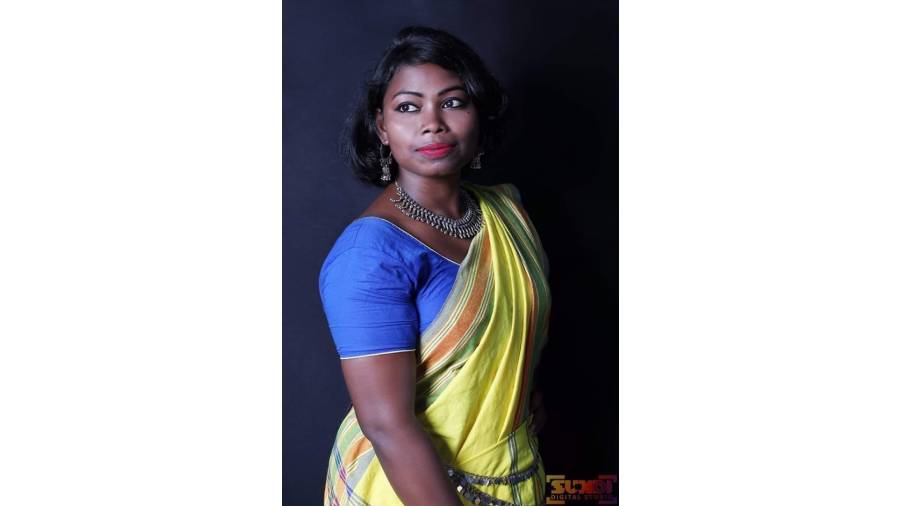
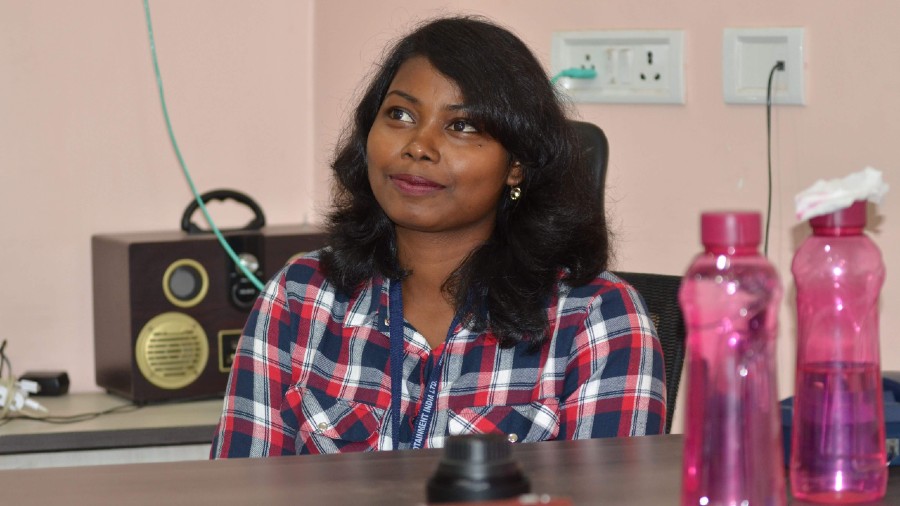
Shikha Mandi / Courtesy – Shikha Mandi
Shikha Mandi was barely four years old when she came to Calcutta from Jhargram’s Belpahari village. Her parents, both farmers, sent her to the city in the hope that she would get a better education, be safer than in a region routinely in the news for Maoist activity.
“My paternal uncle lived in north Calcutta’s Ariadaha with his family. I was told that my elder sister and I were going for a vacation. I was very eager to see a big city. The next thing I knew was that we would be living with them and not return to the village,” recalls Mandi.
Shifting from a village wasn’t easy, not in the least because of the language switch. Mandi, now 27, grew up in Calcutta among Bengalis but retained a love for her mother language, Santhali. Santhals are the largest tribal community in Bengal and Santhali is spoken by over 70 lakh people across Bengal, Jharkhand, Odisha, Bihar and Assam.
At the city school, Mandi had to speak in Bengali. She says, “In our village we barely knew Bengali. Even in Calcutta, we would speak Santhali at home. But to fit in with the rest I had to prioritise another language over my own.”
But bigger struggles lay ahead. Mandi changed school when she was in Class V. She says, “Nobody wanted to be friends with me at Ariadaha Sarbamangala Balika Vidyalaya. I looked different and I was from a different community. They didn’t know much about Santhals. But they would associate tribals with certain things. They would say, ‘Look at her, even a buffalo is more fair-complexioned in comparison’ or ask ‘Do your people wear clothes made of leaves and eat raw meat?’ I would feel hurt. I kept thinking if only I was like them, I wouldn’t have to face all this.”
In hindsight, she wishes she had made a clean breast of her feelings to someone. She says, “My chacha would tell me we are different from the rest but we should not pay attention to anyone who slanders us. He is a government schoolteacher and he too had his fair share of struggles as a Santhal. Now when I talk about my experiences, I hear others say that they too have gone through similar things in life, because of their tribal identity.”
College was comparatively better, but it was difficult to be comfortable in one’s own skin, especially when compounded with her gender, it became an othering factor. “In the city, people seemed to believe that girls should be pretty and fair only,” says Mandi, and for the first time I hear her soft voice break into a laugh.
When Mandi arrived in Calcutta for the first time, she found a friend in the radio. Over the years this friendship endured. Every evening, there would be a Santhali programme on Akashvani and Mandi listened devoutly. “It had Santhali songs and chat shows. Listening to them was my home away from home. It made me miss my village and parents less,” she says.
“I would wonder what it might be to become someone like those people inside the radio — as I imagined them to be. I didn’t even know how it worked, what one needs to do to be on air, but I knew that I wanted to grow up and talk on the radio,” Mandi says.
After school, while the other kids played ghar-ghar, Mandi would pretend to be a news reader and a radio jockey. She would sing Santhali songs too. Over a call, she hums a song she says was her favourite: Hane biti Ganga gada dak do biti nel me, bai bai bai te, bai bai bai te atu kana. She says the song is by Lal Susant Sorenji from Dumka in Jharkhand. “It is a very old song and I’ve grown up listening to it.”
But when she spoke to her parents about her ambition, it didn’t go well. Mandi continues, “My parents were clear they couldn’t afford to spend much on me and insisted I complete my education and get a government job.”
After her school-leaving exams, Mandi joined an Industrial Training Institute in south Calcutta and after training, started preparing for an apprenticeship exam for Garden Reach Shipbuilding and Engineers Ltd.
And then, the tide turned and her ship changed direction.
Mandi saw an advertisement for a radio jockey for an upcoming community radio station in her hometown, Jhargram. Radio Milan 90.4 was starting a Santhali programme and she put in an application. She says, “My parents were not pleased with my decision.” Yet she appeared for the interview, gave a voice test and finally took up the job in December 2017.
Shikha Mandi thus became one of India’s first tribal radio jockeys, commanding the attention of thousands of listeners through her evening talk show Johar Jhargram.
For Shikha, shifting from a village wasn’t east, not in the least because of the language switch / Courtesy : Shikha Mandi
The programme was all about making Santhals feel connected. Says Mandi, “Everyone wanted to listen to their language on radio and television, it doesn’t happen very often for us. So people were very excited.” But years of living in Calcutta had had its impact on her fluency in Santhali. She adds, “People complained that I used Bengali words.”
Mandi spent the next many months brushing up her Santhali. She learnt the Ol Chiki script, re-acquainted herself with tribal customs, culture, rituals, songs. She started reading up about ground realities of Santhals. She would scour around for socially relevant topics for her show. “Every day I’d choose a new topic that people could relate to. I would invite guests for expert opinions on these topics. I even got Santhali callers on my show from other cities. There were conversations about love, friendship, tragedy, everyday struggles of being a Santhal, it was all about us,” she says. Mandi is soft-spoken, but I sense a firmness in her tone.
Mandi wrote her own script and made playlists. Broad themes were festivals, religion and gender, but everything was in Santhali. There was no place for any other language. If someone called in with a request for a Santhali song but spoke in Bengali, Mandi urged the caller to speak in Santhali, assuring that it was okay not to be entirely fluent. Soon from being a daily hour-long show, her show became so popular that it became a three-hour show.
Says Mandi, “I didn’t just want to become a radio jockey to indulge some personal aspiration, I wanted to do something for my people, keep the Santhali language and culture alive among the youth. The pride for the language is fading among people of my generation and those younger to me. When they move to the city, they pretend they don’t know the language and don’t speak it even if they do know it. I wanted to change that.”
When Shikha arrived in Calcutta for the first time, she found a friend in the radio… After school, while the other kids played ghar-ghar, she would pretend to be a newsreader and radio jockey–
Sometime during the pandemic, Mandi quit her job of a radio jockey. She seems to think that the channel had strayed from its initial commitment. She says, “It wasn’t doing what actual community radio centres do — work with the locals.” These days, Mandi runs her own podcast on Tumdah, an app to discover, stream and share Santhali music.
But from the sound of it, radio continues to be the love of her life. She cannot stop talking about her radio jockey days. She tells me, “I used to love the fact that I could connect with so many people through this medium… I couldn’t reduce anyone’s pain in life but I could always say two words of hope.”
She is sure that this is not the end of RJ Shikha Mandi. She says, “I want to start my own community radio centre where we will involve more tribal people and I am working towards it.”
source: http://www.telegraphindia.com / The Telegraph Online / Home> Culture / by Manasi Shah / April 25th, 2021
He had tested positive for COVID-19 earlier in April
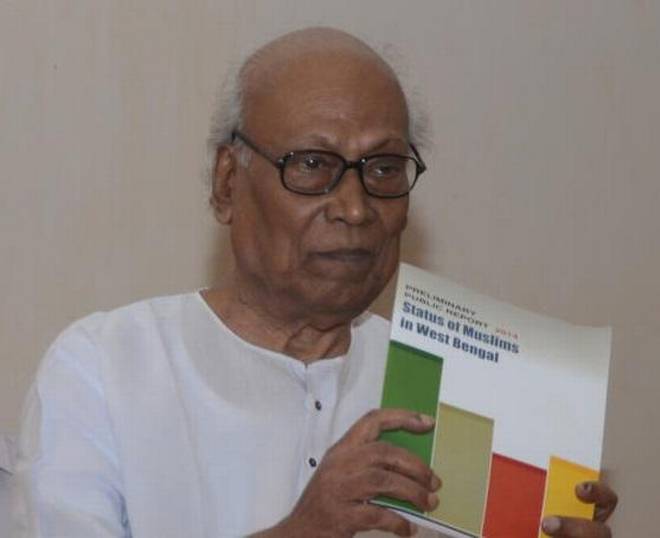
Eminent poet and critic Sankha Ghosh passed away in Kolkata on Wednesday. The Jnanpith awardee was 89 and had tested positive for COVID-19 earlier in April.
He was under home isolation for the past few days, but his condition deteriorated late on Tuesday. He is survived by wife and two daughters.
Ghosh was one of most important names in Bengali poetry and, together with Shakti Chattopadhyay, Alokeranjan Dasgupta and Sunil Gangopadhyay, was said to have carried on the baton from the poets of the early part of the 20th century, such as Jibanananda Das and Buddhadev Basu.
He was awarded the Jnanpith Award in 2016 and the Padma Bhushan in 2011. In the shadow of the Rabindranath Tagore era, poets such as Ghosh took the legacy forward.
Considered an authority on Tagore, Ghosh was awarded the Sahitya Akademi Award in 1977 for his poetry collection Babarer Prarthana.
He was born on February 6, 1932, in Chandpur, which is in present-day Bangladesh. The poet graduated in Bengali honours from Presidency College in 1951 and did his post-graduation at University of Calcutta.
He taught at a number of educational institutes, including Visva Bharati University, Delhi University and Jadavpur University. He retired from Jadavpur University in 1992.
Silent protester
Ghosh was a man of few words. Though he was considered one of the greatest of poets, he chose silence even when protesting against the violence and violation of human rights towards the end of the Left Front regime. At the most, he would issue written statements.
The poet had also expressed strong opposition to the Citizenship (Amendment) Act through a poem called Mati. His other well-known poems are Andolan, Mukh Dheke Jaye Biggapone, Chup Koro and Bohiragoto.
“Following the demise of Sankha Ghosh, we extend our deep condolences. I have directed the Chief Secretary and final rites will be performed with full State honours,” West Bengal Chief Minister Mamata Banerjee said.
Ms. Banerjee also added that since the poet was not in favour of a “gun salute,” it would not be part of the ceremony.
Noted Bengali poet Joy Goswami said Ghosh was the conscience of Bengali society. “The Bengali literary circle will feel a void created by his death more and more.”
Writer Sirshendu Mukhopadhyay, recalling his decades-long association with the poet, said that despite several awards and laurels “there was not even a hint of pride in him”.
source: http://www.thehindu.com / The Hindu / Home> News> Cities> Kolkata / by Shiv Sahay Singh / Kolkata – April 21st, 2021
At a time when politics of hate threatens to tear apart the inclusive social fabric of the state, such stories demand a telling.
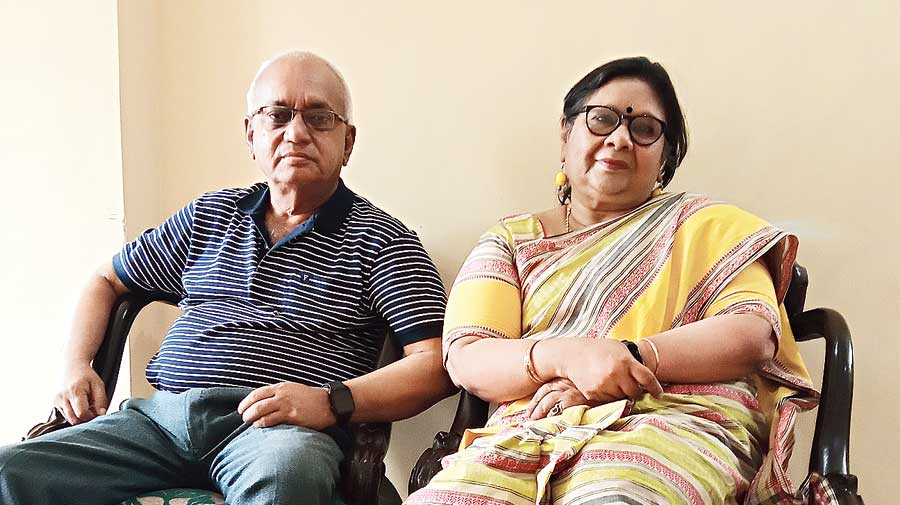
The couple at their ancestral home in Park Circus on Apirl 6 / Debraj Mitra
Gautam Sengupta is 69. Yasmeen Sengupta is 65. He is a Hindu. She is a Muslim. Married for 46 years, the two have lived through many ups and downs. Their families have always stood by them.
Till their health permitted, Yasmeen used to paint alpona during Saraswati Puja at her in-laws’ ancestral home in Park Circus every year and Sengupta broke bread with her during Ramazan.
There are many like the Senguptas of Park Circus around Bengal. But such stories demand a telling because of the politics of polarisation that threatens to tear apart the inclusive social fabric of Bengal.
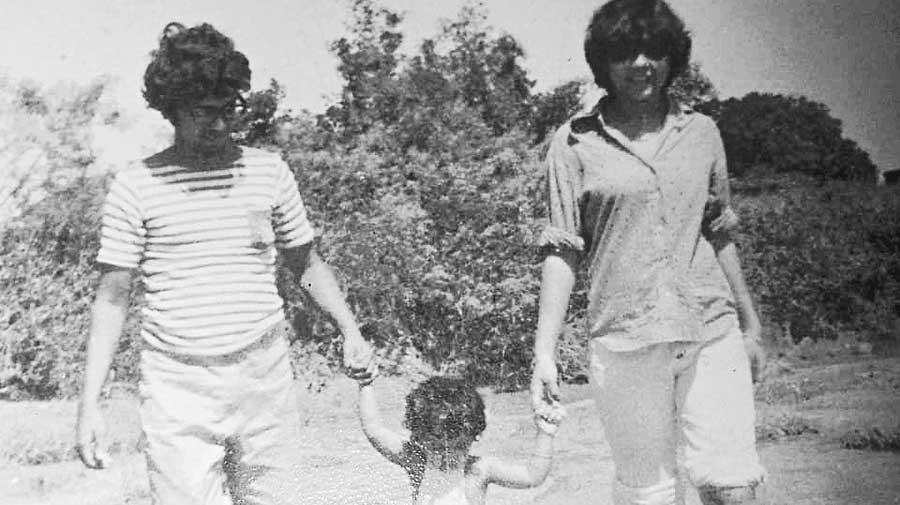
Gautam and Yasmeen Sengupta with daughter Rohini during a trip to Madhupur, now in Jharkhand, in 1979 / Sourced by Correspondent
Jesuit culture, Tagore
Yasmeen’s family shifted from Ballygunge Place to Circus Row when she was nine years old. Sengupta’s family home stood a stone’s throw from the Park Circus Seven-Point intersection. The two got introduced through a set of common friends and got married in 1975.
Sengupta, who did his school and college from St. Xavier’s, holds Jesuit principles close to his heart till this day.
Yasmeen did her school from South Point and graduated from Loreto College. Yasmeen’s grandfather, Rafiuddin Ahmed, is the founder of the R. Ahmed Dental College, the oldest such institute in Southeast Asia.
But her inspiration is her grandmother Ayesha Ahmed, an alumnus of Brahmo Balika Shikshalaya. Later, Ayesha was part of a group of women who started a school for girls from marginalised families in Beleghata, which is now called the A.I.W.C Buniadi Bidyapith Girls School.
She made Rabindranath Tagore a part of the lives of the Ahmed family.
Yasmeen and Sengupta got married in Brahmo tradition. “There was hardly any ritual. I remember my friends singing Tagore songs,” said Yasmeen.
“When we were growing up, inclusiveness was not just a textbook word. It was a part of our everyday lives. Every home had pictures of Tagore, Gandhi, Vivekananda and Netaji,” she said. Sengupta remembered growing up in a neighbourhood where the president of the local Durga Puja committee was a Muslim and the treasurer a Christian.
Sengupta, who runs a manpower consultancy firm, has turned a part of his ancestral home into a guesthouse. The couple also own a flat in the Hastings area and keep shuffling between Hastings and Park Circus.
‘Heroic’ acceptance
One of Sengupta’s grand-uncles (father’s uncle), a doctor, was killed during the 1947 riots. “A man disguised as a woman in a burqa entered his chamber as a patient and shot him point blank,” said Sengupta.
But the past never came in the way of the Sengupta family embracing their daughter-in-law. “My family members always considered the incident an act of terror, an aberration in a moment of madness,” he told this newspaper.
“Their acceptance of me has been absolutely heroic. We (her parents and in-laws) speak the same language, eat similar food. It is not like I was wedded into an alien culture. But the way they rose above petty human instincts was heroic,” said Yasmeen.
The couple have a daughter and a son. Their daughter, Rohini, is married to a Muslim man. The two are settled in Sydney. The bride and the groom’s family had known each other for three generations and the couple knew each other from childhood.
“The marriage happened in 2001. It was such a happy occasion,” Sengupta said. His no-fuss demeanour drove a point home. That some of the stereotypes associated with interfaith marriages are based more on myths than reality. That an interfaith marriage can still be a normal and spontaneous affair.
Yasmeen, a social worker, keeps reading newspaper reports and seeing television programmes around “love jihad” — a Right-wing narrative of Muslim men marrying Hindu girls with the alleged intention of converting and radicalising them.
At least two BJP-ruled states have introduced legislation criminalising interfaith marriages if conducted for the ostensible purpose of religious conversion.
“Where is the individual freedom, guaranteed by the Constitution? This is a blatant violation of constitutional values. Not only is this bad in principle, it is also bad in law,” said Yasmeen.
Fear of tomorrow
“I am terrified of the future,” Yasmeen told this reporter bluntly. She is worried because she has heard plenty of stories of Partition from her elders and she dreads a rerun.
“Politics now thrives on polarisation, more so in the run-up to the elections. Bengal and Punjab are two states scarred by Partition. Both places have seen how polarisation brings out the basest instincts in people. I have grown up around people who saw best friends baying for each other’s blood during Partition,” she said.
Sengupta has spotted a change in the social fabric of Bengal. “A section of people now asserts their religious identity more strongly than before. Wearing your religion on your sleeve is the norm,” he said.
The next second, he gave a caveat. “I have never been too religious. Perhaps that’s why I notice these things more than others.”
Sengupta remembers some “flare-ups” in his neighbourhood in the aftermath of the Babri Masjid demolition in 1992 and surrounding author Taslima Nasreen, who was eventually “expelled” from Bengal in 2007.
Sengupta stood up to a mob with sticks and flaming torches intent on setting a series of taxis on fire. “I managed to prevail on them. They were fuming but went back. Most of them were local boys,” he recounted.
Both the husband and wife said the ongoing polls are more than a battle for political power. “We don’t know if it is possible to get back the Bengal where we got married. But we still have a place where all kinds of people live together. We must try to preserve what we have,” Sengupta said.
source: http://www.telegraphindia.com / The Telegraph Online / Home> West Bengal / by Debraj Mitra, Calcutta / April 19th, 2021