Category Archives: World Opinion

CSM, Goethe Institut ready for twin treats

Kolkata :

The Calcutta School of Music and Max Mueller Bhavan have joined hands to continue the school’s centenary celebrations as well as commemorating iconic composer Richard Strauss, whose 150th birth anniversary fell this year.

CSM will host ‘Bach-A Benediction and Theatre as Music’ — a fundraiser to boost their orchestra facilities on Friday evening at The Oberoi Grand, with Max Mueller Bhavan flying in eminent pianist-scholar Siegfried Mauser and vocalist Amelle Sandmann-Mauser, who will perform with the CSM Chamber Orchestra. “Since this is a fundraiser, there are no tickets but donor cards priced at Rs 750 each. The cards can be picked up from the school till Friday afternoon and also at the venue in the evening,” said Dickoo Nowroji, CSM president.

On Monday, the venue will shift to the Victoria Memorial, where the German pair will perform Beethoven, Wolfgang Rihm and of course, Strauss, among others. “The event is titled ‘Towards Modernity’ as what will be reflected in the concert is that classical music has not only survived for centuries but it’s still dynamic and progressive,” said organizers from the Max Mueller Bhavan. This programme is open to public, they added.

Sanjib Mondal, the resident conductor of the CSM Chamber Orchestra, was busy on Thursday rehearsing for the first time with Mauser. “Despite the time crunch, we are very happy after practicing together. Normally, before major concerts like these, we have many rehearsals but somehow, this time, after only one rehearsal we have become comfortable to each other’s style and pattern. Two more rehearsals will follow on Friday before we hit the stage in the evening,” he said.

“A fun trivia about Strauss is that the opening bars of his composition ‘Thus Spake Zarathustra’, a tone poem inspired by Friedrich Nietzsche’s novel of the same name, was used in the famous movie ‘2001: A Space Odessey’,” said Nowroji. The Oscar-winning film was produced and directed by Stanley Kubrick in 1968.

Apart from being a pianist, Mauser is a professor of musicology, the president of the College of Music and Theatre in Munich and the designated rector of the University Mozarteum in Salzburg. He was also honoured with the German Federal Cross of Merit and the Bavarian Order of Maximilian. His wife Amelie was trained in Barcelona, Rome, London and Munich and she is also and actress in theatre and opera.

source: http://www.timesofindia.indiatimes.com / The Times of India / Home> City> Kolkata / TNN / October 31st, 2014
Kolkata girl bags Panda award

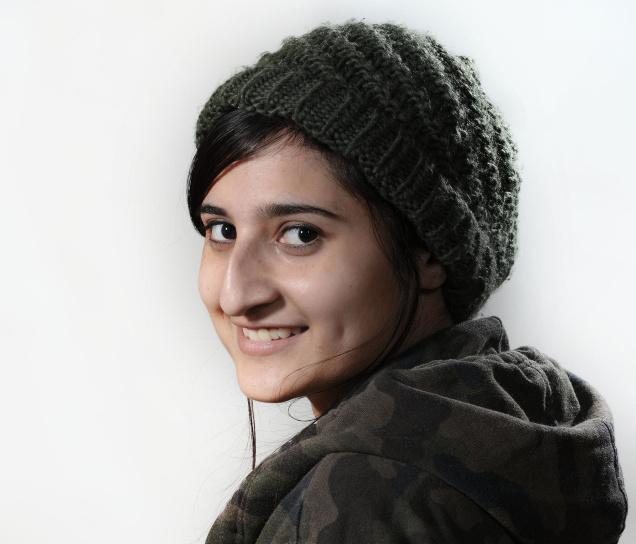
Ashwika Kapur / by Special Arrangement

Ashwika Kapur is the first Indian woman to win the wildlife photography prize

Ashwika Kapur of Kolkata on Friday won the prestigious Panda Award, aspart of the annual Wildscreen Film Festival held at Bristol, U.K. She is the first Indian woman to win the coveted wildlife photography award for her film on a Kakapo parrot.

The tale of a parrot
Ms. Kapur’s film “Sirocco — how a dud became a stud” is based on Sirocco, a Kakapo parrot, which is perhaps the only bird to have bagged a government job.

The male bird was appointed as the Official Spokesbird for Conservation in New Zealand and it helps in conservation advocacy on social media.

The film earned 26-year-old Ms. Kapur a nomination for the best Newcomer category, competing against two other nominees. This year, the Windscreen Film Festival received 488 entries from 42 countries.

In an email statement, Ms. Kapur said the film was a solo project and she single-handedly managed the film’s scientific research, scripting, camera work, editing and music direction. She is currently involved in the filming and production of two international television programmes in India.

After finishing her school and college education in Kolkata, Ms. Kapur graduated in Science and Natural History Filmmaking from the University of Otago, New Zealand.

The Kakapo parrot, a nocturnal and flightless species of the parrot, is classified as a critically endangered species since 2012 on the IUCN Red List.

The bird, found in New Zealand, is known to be one of the longest-living birds and its known population is 125. Over 14,000 people from 162 countries voted the Kakapo the world’s favourite species in 2013.

The tiger and the African elephant came second and third, respectively.

source: http://www.thehindu.com / The Hindu / Home> News> Cities> Kolkata / by Staff Reporter / Kolkata – October 25th, 2014

Curry King brings 14 new marinations

Kolkata :

Marination, that familiar method of flavouring and tenderizing food by coating them in a seasoned, and often acidic, liquid prior to cooking, lies at the core of a cuisine, lending character to the dish even as it provides a signature of the region. When Barbeque Nation, the casual dining chain which has an outlet at Sector V, decided to broaden the menu on their live on-the-table grill, not many could have fitted the bill better than Pat Chapman.

The Englishman, a chef, food writer, broadcaster and author, has a strong Indian connection and, perhaps more importantly, a passion for her cuisines. The Curry Club, which the London-born chef founded back home, has not just helped many a Brit take that bold leap from the bland to the spicy but has had them delve deeper into Indian cuisines.

“I’m not here to teach Indian marination to the chefs here; they know that better than me. But I do know the Indian palate,” said Chapman, who has brought 14 different marinations from round the world to add to what was being put on the table in the DIY (do-it-yourself) menu before the main buffet. “Putting the grill on the table is a fantastic concept and we don’t have it as yet in Britain,” added the 73-year-old, who had seven generations of his family living in India since 1715.

“My mother was born in Mhow and she was a terrific cook. She taught me and I have been cooking Indian food since I was eight,” said Chapman, who has earned sobriquets like ‘Ambassador of Indian food’ and ‘Curry King’ from British food reviewers. The man who has authored 36 recipe books with cumulative sales of over 1.5 million copies reminded that he has had no formal training as a chef. “But I’ve worked hard and learnt from so many of them. These chefs are my gurus,”
he added.

Giving a ‘demo’ of three of the marinations he has brought here — a Lebanese-Arabian coating of broccoli, a Thai preparation of Basa fish and Jamaican Jerk chicken — Chapman pointed out that the essence of marination is tenderizing for penetration of the flavours and that acid helps do that.

“Marination works particularly well for starters. Indian and Middle-East starters use it very cleverly,” he said. “In my view, Indian is the best food in the world. The curry is a wonderful thing, the food of a nation,” he added, and pointed to the phenomenal spread of Indian cuisine in the UK.

“I came to India for the first time in 1965 and have been here some 43-44 times since then; my wife Dominique has been here about 20 times. The visits have been more frequent since the 1980s, when I started The Curry Club. I bring groups and have them meet chefs here. Most members are British but we have Americans and people from other regions on board too,” he said. “Indian food is addictive. When I was a kid, garlic had to be bought from the chemist in the UK. Now you get it everywhere. Every region of India is represented in London through its restaurant and they are all doing well.”

Yorkshire Lamb, Spanish Valencia Prawns, English Mushrooms, Persian Veg Patties, New Orleans Corn, Mexican Veg Shashlik… As the skewers were laid on the table grills for the gastronomes to baste them in Vinegar Chili, Lemon Butter or Oriental Garlic to add that sheen of personal preferences, Chapman went around for the interactions. As the items disappeared quickly from the plates in the company of barbeque, tartar and mild mustard sauces, the beaming Englishman would have known he had connected well with the Indian palate.

source: http://www.timesofindia.indiatimes.com / The Times of India / Home> City> Kolkata / by Arup Chatterjee, TNN / October 18th, 2014

Oscars boy Avijit Halder scripts ‘inside’ story

Kolkata :

The day the makers of the documentary ‘Born Into Brothels’ thrust a camera in the hands of young Avijit Halder, little did he know it would change his life, propelling him to Oscars glory and land him on the sets of a Hollywood film. Ten years on, he is a green-card holder in the US, armed with a degree from New York University, with his name on the Donald Sutherland-starrer ‘Basmati Blues’ credit list.

Back in Kolkata on a ‘break’, he has just finished scripting a short film on life in the brothels while mentoring his younger co-actor in the art of photography. “I have no reason to shift from Sonagachhi. It’s my home,” he says.

Halder’s journey started when he caught public attention with the photographs he took for the documentary — snippets of life in Sonagachhi, his own house. The documentary-makers had set up a charity, ‘Kids With Cameras’, to help Halder and the other children pursue an education. Photography exhibitions were held in several locations including Kolkata, New York and Europe. “A fund was set up from the photos we sold in the exhibitions. I was told several prints of my photos were bought as souvenirs of the docu-film. That paid for my education as well as my trips to my home,” he told TOI.

On Monday, Halder revealed that he has just finished writing a script, which is an account of a Sonagachhi “insider”. He said: “Every film or documentation on the brothels depicts it as a place of doom, trafficking, political equations. But I have explored how the brothel residents see the society outside. Personally, I can say whenever I return to the place, there is visible negativity as some believe they are being exploited with the lens. So I first live there for a month, get myself accepted and then people don’t notice the camera.” Halder’s grandmom still lives there and when asked if he considered moving her elsewhere, he replied: “Why
would I? I see no reason. It’s my home.”

Halder is mentoring another boy from the documentary, Manik Das, who is in the final year of BCom, into the world of photography. Das, along with his siblings and some of the other children were adopted by a city NGO. “There were initially eight children and we were joined by one more. Barring a couple, we are all in touch with each other,” said Das.

What about his future plans? “I’d love to come to Kolkata and make films. The evolution of the red-light area fascinates me. Now there are much less crowd and lot more cellphones. Talks revolve around ‘miss calls’ and ringtones. But what is really striking is the brothel, one of the most liberal places in the world, is deeply conservative in its core.”

He is travelling back and forth two continents. This time he has brought his girlfriend Marcia along, but he says he’s not yet “there”. And he has no illusion of playing a saviour for children with his history. “I’m merely trying to be a role model so that the kids like me look at me and believe in themselves,” he said.

source: http://www.timesofindia.indiatimes.com / The Times of India / Home> City> Kolkata / by Shounak Ghosal, TNN / October 21st, 2014

A Doctor’s Quest

Since when did you want to become a doctor? Since I was a child in Chittagong. My father wanted my elder brother, whose schooling was being taken care of by a well-to-do family, to be a doctor but I too dreamed of becoming one.

But you weren’t even going to school… Yes, while my friends attended school, I used to sell fruit in the market but I made sure I progressed too. When they were back, I’d take their class notes and copy them. This went on till I was 13 or 14, when I became a tutor to some four- and five-year-olds and could pay the fees. So, I managed to go to school in classes IX and X and did well in matriculation. It got me a scholarship and took care of my Class XI and XII fees. I continued to be a tutor, and that was the time I began to believe that I could become a doctor. Though I had good results in the intermediate exams too and was eligible, I was told it wasn’t possible to get into medical studies in Chittagong, in what used to be East Pakistan.

And you decided to come to Kolkata… That the standard of education was much higher in India was motivation too. I arrived in 1955, all but penniless and armed with a letter from Mrs Nellie Sengupta and permission to stay at the zamindar’s Kolkata home for a few days. I discovered that Mrs Sengupta’s contact had fallen on bad times and was saddled with graver problems than mine. That’s when my struggles began. I went from one medical college to another but without any success. One day, overwhelmed by a sense of hopelessness, I was at College Square, when a man sitting on the same bench pulled me into a conversation. He literally dragged me to the famous Sarbadhikari house on Amherst Street and told me to seek an audience with Dr Kanak Chandra Sarbadhikari the next morning. I managed to meet the influential orthopaedic surgeon but he told me that I couldn’t get into a government college because I had no papers. He arranged for me to face the board at National Medical, which was then a private college. The interview went off well and I was in.

But you still had no money… I couldn’t afford hostel fees but managed somehow. Among things I did was carry the stretcher up and down buildings for St John’s Ambulance Brigade. It was hard work but it allowed me to stay at Netaji Bhavan. Later, when I started receiving refugee stipend, I moved to the hostel.

How did you end up in Newcastle? My life has been like a ship with a captain, dragging me from one place to another with the sole aim of making me a good surgeon. I had no resource to get into postgraduate education in Calcutta and the refugee stipend was also stopped. While I was contemplating all this, I fell in love and got married in secret. That was the best thing I did in my life. Leaving her behind at her parents’ place, I went to England in 1961 with very little money and without doing internship. After a month of going from one place to another, I finally landed a job at the Berry General Hospital in Manchester. The one year there got me the registration number, and after drifting from one speciality to another, circumstances had me landing up in the neurosurgery department. Gradually, I grew fascinated by what the neurosurgeons were doing — their fight between life and death, working on the pulsating brain to cure patients. I told myself I should be a surgeon for the most precious part of the body.

So, the struggle continued in England? Yes, it was hard. I had no holidays, working even on weekends to make ends meet for the growing family (son was born in 1963 and daughter in 1965).

How did you stay focused and pursue a high ambition despite poverty and other problems? Struggle has always spurred me to strive harder. I am sure it is largely because of my childhood moorings. In Chittagong, even as my mother somehow kept us alive, my father filled us with teachings of the great souls. They sounded hollow initially but became a source of great strength later. Swami Vivekananda’s words in particular provided the answer whenever I was confronted by doubt and dilemma. Soon, I knew nothing could stop me from achieving my goal.

When did you consider settling in India? The moment I passed FRCS from Edinburgh and England, my wife was keen to come back to India. I too wanted to serve here. It was 1971 by the time I could save enough for plane tickets. However, I couldn’t find a job here and we went back. A second attempt, in 1973, got me a job in Safdarjung Hospital in Delhi but they were only into head injuries. I was doing a much higher level of work. I failed to get a suitable placement and realized a job in India was not for me. I went back and worked harder to try to get a career in England. It was difficult for an Indian doctor to get a consultant’s job there at that time. During this period of despair, I got a call from Dr William Sweet, the famous neurosurgeon of Harvard University. I worked with him at the Mess General Hospital but I did not quite enjoy it and went back to the National Health Service in Newcastle.

You became a world famous surgeon… At that time, the success of aneurysm surgeries was very poor and I decided to take it as a challenge by making it my area of work. I travelled the world at my own expense to get better at it, meeting doctors, writing in publications.

You treated several VIPs. Can you tell us about it? On one occasion, in the mid-80s, I received a call from the PMO and later came to know it was Gopalkrishna Gandhi (who would later serve as governor of Bengal) at the other end. I had to rush to Delhi to attend to President Venkataraman’s wife, who had a brain haemorrhage. She insisted she be treated in Newcastle. After she had recovered sufficiently, she didn’t want stay in the hospital or move to a hotel. So, she came to stay at our house, and it became a fortress. They were charming people and strict vegetarians, so my wife and I became vegetarian chefs for a while! Soon, VIPs from different parts of the world wanted their loved ones to be treated by me. When I reached retiring age (65) in 2002, the Newcastle hospital named the OT ‘Robin Sengupta Theatre’ in a rare gesture. They wanted me to continue and I finally stopped in December 2012. I am now an emeritus consultant there.

You’ve had other honours as well… In 2003, the BBC did a programme ‘A Day in the Life of Dr Robin Sengupta’, which was a part of their ‘What is best in NHS’ series. Then, because I have trained so many Indian neurosurgeons in England, the Neurosurgery Society of India named me ‘Neurosurgeon of the Millennium’ in 2000. The National Academy of Science made me an honorary fellow. I was really moved when former President APJ Abdul Kalam gave me the Vivekananda Samman at the ‘World Confluence of Humanity, Power & Spirituality’ organized by SREI.

Why did you choose Kolkata for the Institute of Neurosciences Kolkata (I-NK)? Apart from an emotional connect with the city that made me a doctor, I also saw the urgent need for neurological services in eastern India. I had attained a great deal but I asked myself, ‘Should I now slip into a comfortable life in England, enjoying the fruits of my struggle and hard work, while people continued to suffer?’ Friends and relatives tried to dissuade me from such a task but Vivekananda’s words reminded me that it was better to wear out than rust away. My wife and I donated all our resources and so many others helped raise the funds, but I built I-NK with the support of the Kolkata Municipal Corporation and the government of West Bengal. I am looking for a bigger campus to set up facilities for top-level education and research and extend world-class services to more people. I-NK already has an association with the Newcastle hospital and more doctors from around the world will want to work here. There is no dearth of cases here. I am hoping the state government will join in this effort and we’ll do wonders.

What have you learnt and unlearnt in these 15 years of I-NK? I learnt that handling patients and their relatives here is a different art. In the West, they want to know the truth. Patients too want it, even if means asking ‘Doc, how long do I have?’ Here, not only will relatives insist that you not tell the patient, they often don’t want the truth themselves. All they want are false assurances.

What do you see when you look back? I see my struggle but also the sacrifices of people around me, particularly those of my family. The struggle may have been tasteless and painful at that time, but it’s like vintage wine now. That’s what time does. When I lost my only son, who too was studying medicine, in an accident in 1983, I was overcome by a sense of guilt at not having spent enough time with my family as I chased my goal. I still do surgery; it seems I’ll never be able to rest. There’s still so much left to do.

source: http://www.timesofindia.indiatimes.com / The Times of India / Home> City> Kolkata / by Arup Chatterjee & Debasish Konar, TNN / October 17th, 2014

City organization wins US ambassador grant to document folk music

Kolkata :

After seven years, a Kolkata-based organization—Banglanatak.com—has won a prestigious grant from the Ambassador’s Fund for Cultural Preservation (AFCP) 2014 for their project “Documentation of Bengal folk music genres Bhawaiya, Bhatiali, and Bangla Qawwali”. The city chapter of Indian National Trust for Art and Cultural Heritage (Intach) was the last to win the grant in 2007 for restoration of the Lalgola project in Murshidabad.

Announcing the grant award to Banglanatak.com at the American Centre on Friday, director Joanne Joria expressed hope that the documentation of three music genres would help preserve and popularise them again. Musicians of all three genres performed on the occasion.

According to Banglanatak.com founder director Amitabh Bhattacharya, the project will document and preserve folk music traditions—Bhawaiya songs of North Bengal, Bhatiali songs of Sunderbans in South Bengal and Bangla Qawwali of Kolkata, Nadia, and Murshidabad that are fast losing ground to other modern forms of entertainment and being pushed to the point of near extinction.

An initiative by the Bureau of Educational and Cultural Affairs of the US State Department, AFCP supports preservation of cultural sites, cultural objects, and forms of traditional cultural expression in more than 100 countries around the world. AFCP-supported projects include the restoration of ancient and historic buildings, assessment and conservation of rare manuscripts and museum collections, preservation and protection of important archaeological sites, and the documentation of vanishing traditional craft techniques and indigenous languages.

“By taking a leading role in efforts to preserve cultural heritage, the US shows its respect for other cultures,” Joria explained.

The last time a Kolkata organization won this grant was in 2007 when the Indian National Trust for Art and Cultural Heritage (INTACH) won the grant for restoration of the Lalgola project in Murshidabad.

source: http://www.timesofindia.indiatimes.com / The Times of India / Home> City> Kolkata / TNN / October 17th, 2014

For Malala, this West Bengal teenager is a true hero

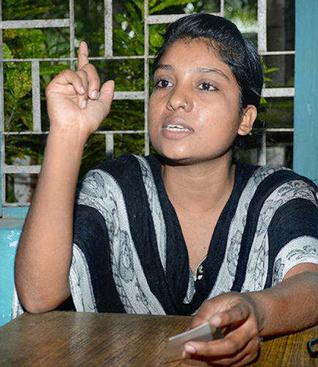
Anoyara Khatun.— Photo: Sushanta Patronobish / The Hindu

As the world celebrates Pakistani teenager Malala Yousafzai winning the Nobel Peace Prize, Malala herself is celebrating the courage of a little known young girl from West Bengal’s Sandeshkhali area who has been quietly working against the trafficking of young girls from the region.

Anoyara Khatun, 18, from North 24 Parganas, has, with the support of other children and non-governmental organisations, built a strong network to resist trafficking of young girls and prevent child marriages in the region.

“Malala and the Malala Fund celebrate Anoyara’s exemplary courage and leadership. She has helped reunite more than 180 trafficked children with their families, prevented 35 child marriages, rescued 85 children from the clutches of child labour and registered 200 out-of-schools (drop-outs) into schools,” says a Facebook post by the Malalafund, an initiative by Malala.

The post made on October 13, International Day of the Girl, only a few days after Ms. Malala was awarded the Nobel Prize, has described Anoyara as “a true girl hero.”

When The Hindu met Anoyara at Sandeshkhali on Wednesday, she was aware of the Facebook post and could not stop talking about Malala. The first year student of a local college has also collected a number of vernacular newspapers that published news of Ms. Malala’s award and shared it with her friends.

“Though I have not met Malala, I did meet her father Ziauddin Yousafzai at Brussels in June 2012,” she said. She made the trip to Belgium when she was nominated for The International Children’s Peace Prize.

“Trafficking of young girls and child marriages were rampant in the villages here. Poverty and lack of awareness and education provided the ideal conditions for traffickers to operate here,” Ms. Anoyara said.

In 2008, Save the Children, an international non-governmental organisation working for child rights, helped establish a number of multi activity centres in the Sandeshkhali area. These centres help create awareness among the children of the region about the dangers of trafficking and similar crimes. Anoyara recalls stories of how she and others chased away traffickers who came offering jobs and marriage to young girls in the region.

Jatin Mondar, the State Programme Manager of Save the Children, West Bengal said that through these centres, the organisation had managed to put in place a “committee-based child protection model” in Sandeshkhali since 2004.

“Now, if someone approaches the villagers with the proposal to take a girl to Delhi or anywhere else for work, that person is sure to be handed over to the police by us,” Anoyara said.

source: http://www.thehindu.com / The Hindu / Home / by Shiv Sahay Singh / Sandeshkhali (North 24 Parganas) / October 16th, 2014

UK minister’s city date with WW I, football & museum

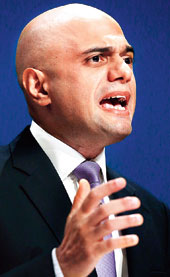
Sajid Javid, Britain’s culture minister and one of the rising stars of British politics, is to set foot in Calcutta on Monday.

Javid, 44, whose formal title is Secretary of State for Culture, Media and Sport and who is a full member of David Cameron’s cabinet, was the subject of a very positive profile last month in the Daily Mail.

The paper’s right-wing columnists normally make a living by putting the boot into immigrants but for Javid, the long headline read: “Could Sajid Javid be Britain’s first Asian Prime Minister? His parents arrived here with just £1, yet he’s now a minister. That’s why this man believes immigrants are natural Tories?”

JavidKOLKATA13oct2014

So who is Sajid Javid and what’s he doing in Calcutta?

Javid will have a busy day in Calcutta where he will host a reception. The day will begin early with a First World War Centenary Commemoration at the Commonwealth War Graves Cemetery. More than a million Indian soldiers fought for Britain in the First World War.

This will be followed with the launch of the community football development programme for girls under the Premier Skills Kolkata Goalz Project at Alipore Bodyguard Lines on Diamond Harbour Road.

He will then introduce the UK-India joint report at the Museums Round Table at the National Library.

For many years now, the British have been training staff in Indian museums. Privately, they say that Indian Museum is a wonderful place but it badly needs sorting out.

For the second part of his visit, Javid will go to Delhi where he will deliver a keynote speech at a UK-funded Cyber Governance Security conference; meet a number of ministers; and also attend a session at the British Council with young Indian creative entrepreneurs and Indians who have studied in the UK.

As culture secretary, he is chairman of the special advisory group supervising the erection of a statue of Mahatma Gandhi in Parliament Square, ready for unveiling on January 30, 2015.

A first-time member of parliament, elected in May 2010, Javid’s political rise has been swift.

After stints in the treasury as economic secretary and financial secretary, David Cameron brought him into the cabinet in April 2014.

He had previously been a banker for 18 years, working in senior positions in New York for Chase Manhattan, and later in Singapore for Deutsche Bank.

Javid’s father, Abdul-Ghani Javid, and mother, Zubaida, came to Rochdale in the north of England in the early 1960s from a village background in Punjab in Pakistan. The couple had five sons — Sajid is the third.

Abdul-Ghani initially worked in a cotton mill, then moved to the buses, first as a conductor and then a driver. By the time the family moved to Bristol, he had started a business in women’s clothes, with Zubaida doing the cutting and stitching at home.

Unlike P.G. Wodehouse’s creation, the bully Roderick Spode, 7th Earl of Sidcup, whose guilty secret (rumbled by Jeeves) was his ownership of a firm dealing in ladies’ lingerie, the culture secretary is quite happy to poke fun at himself: “I think it’s fair to say that I know more about ladies’ clothing than any other male MP!”

Abdul-Ghani, who died of cancer two years ago, planted the seeds of his son’s political thinking.

In the “winter of discontent” in 1978, when rubbish was not being cleared and even bodies were piling up in mortuaries because of trade union unrest, his father saw hope in Margaret Thatcher.

“She will be good for the country,” Abdul-Ghani told his son, then nine. “She’s got steel. She’s the one who is going to sort out the country.”

“And, of course, she did,” asserted Javid, who keeps a portrait of the late Lady Thatcher behind his office desk.

As culture secretary, his mission is to make enjoyment of cultural activities accessible to everyone in society — “I believe that culture is for everyone.”

Not just the ethnic minorities but the poorer sections of society, too, may feel they have now got a champion in Javid who added with quiet determination: “And when I say everyone – I really do mean everyone.”

Javid himself has a quality not always obvious among folk from the Indian sub-continent — he does self-deprecation.

“Self-deprecation is a good thing,” he grinned, looking completely relaxed in his 6th floor office on Parliament Street. “Don’t take yourself too seriously.”

When he addressed the most powerful and somewhat precious men and women in television at the Royal Television Society in September, he disarmed everyone by recalling his school days: “If life had taken a different turn I could have been part of the TV industry myself. My careers adviser at school told me I had a bright future working in television.”

He got the timing right with a little pause.

Then came the punch line: “Delivering them at Radio Rentals for repair.”

source: http://www.telegraphindia.com / The Telegraph, Calcutta / Front Page> Calcutta> Story / by Amit Roy in London / Monday – October 13th, 2014

British culture secretary Sajid Javid’s visit to focus on museum tie-up

Kolkata :

British culture secretary Sajid Javid will be in the city next week to discuss with representatives of three museums of Kolkata and several from the rest of the country on how to transform them from mere tourist spots to nerve centres of their respective cities.

Javid, who is coming to Kolkata on a two-day visit on Monday, is also likely to meet chief minister Mamata Banerjee and talk about possible areas of collaboration between Britain and Bengal in the sphere of museums and other cultural monuments and heritage structures. The British Deputy High Commission in Kolkata has reportedly sought an appointment with the chief minister on Tuesday for Javid’s visit, but they are yet to receive a confirmation from Nabanna.

The fact that Mamata has cancelled her Sandakphu trip, which had been scheduled around the same time, is significant. Javid is the first person of Asian origin to have entered the British cabinet. Hence, his visit is being considered to be of importance to this subcontinent.

For the past one year, representatives of the British Council have been visiting the best museums of the country to find out how they function. They have also written a report on what should be done to transform the museums to hang-out places of academic interest. The report will be placed at the round table discussion. The suggestions for change and assurance of help in bringing this transformation will also be discussed.

Officials of Indian Museum, Victoria Memorial, National Library and the National Council of Science Museums have been selected for this interaction as prime museums of the country based in Kolkata. The chosen others are Chhatrapati Shivaji Maharaj Vastu Sangrahalaya, Mumbai, Dr Bhau Daji Lad Museum, Mumbai, and Crafts Museum, Delhi.

The research is an opportunity to explore UK-India opportunities and partnerships looking at best practices in collections, policies, strategies, human resources, education programming and audience profiling in Indian and UK museums and galleries,” said a British Council press release.

source: http://www.timesofindia.indiatimes.com / The Times of India / Home> City> Kolkata / by Jhimli Mukherjee Pandey, TNN / Ocotber 11th, 2014

Victoria Memorial Hall collections to find place in Google’s digital storehouse of art

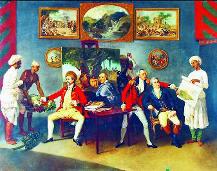
The painting titled 'General Claude Martin and his Friends' or 'Colonel Polier with his Friends' depicts Colonel Antoine Polier, Claude Martin, and John Wombwell with the painter himself, Johann Zoffany (1733-1810), in the background, being waited on by Indian servants, probably in Lucknow around 1786-87.
The painting titled ‘General Claude Martin and his Friends’ or ‘Colonel Polier with his Friends’ depicts Colonel Antoine Polier, Claude Martin, and John Wombwell with the painter himself, Johann Zoffany (1733-1810), in the background, being waited on by Indian servants, probably in Lucknow around 1786-87.

Kolkata :

The Victoria Memorial Hall’s collections will find a place in the largest-ever digital repository of exhibits and collections on a global platform created by Google. Apart from Victoria, some others on the list are Metropolitan Museum of Art and Museum of Modern Art in New York, British Museum, National Gallery and Tate Gallery in London, Musee d’Orsay in Paris, Acropolis Museum in Athens and Hiroshima Peace Memorial Museum.

Victoria Memorial curator Jayanta Sengupta told TOI that the museum and its finest collection of art and artifacts are expected to join the Google Cultural Institute, a cyber platform created by Google Art that enables users to view high resolution images from various museums and even compile their own digital collection. It is fast emerging as an invaluable resource for researchers as they can have access to objects from museums across the world and learn about art objects, their history and artists at the click of a mouse.

“A team from Google will reach Kolkata with sophisticated video and still cameras to film the museum and photograph the 120-odd highlights. Of these, they will select one item and photograph it with high-definition gigapixel camera so that it can be magnified online without distortion. Once the exercise is over in a couple of months, a virtual tour of the galleries at Victoria Memorial will be created and the images uploaded on Google Cultural Institute,” said Sengupta.

Victoria Memorial signed a memorandum of understanding with Google Art in February 2013 and has been communicating with the team since. The museum has sent the list of 120 items it considers the best among its collection of 33,000+ objects of art apart from the 10,000+ small objects like stamps.

Though the Google team is at liberty to select any one of the 120 objects listed by Sengupta’s team as the museum’s highlight for the gigapixel photography, the curator has suggested a painting titled ‘General Claude Martin & his Friends’. The painting that has an alternative title ‘Colonel Polier with his Friends’ depicts Colonel Antoine Polier, Claude Martin, and John Wombwell with the painter himself, Johann Zoffany (1733-1810), in the background, being waited on by Indian servants, probably in Lucknow around 1786-87.

“We have suggested the painting by 18th century German neoclassical painter because it is intricate. There are six paintings within the painting that can be enlarged and viewed in detail when photographed in a gigapixel image,” explained Sengupta. Other paintings that make the cut are ‘Bharat Mata’ and ‘Passing of Shah Jahan’.

Among the other objects in the highlights shortlist are oil paintings by Thomas and William Daniel, Abanindranath Tagore and Gaganendranath Tagore, a 1964 copy of the Ain-e-Akbari manuscript, Persian translation of Aristotle’s treatise Six Principles of Ethical Life and commentary by Dara Shukoh as well as his Persian translations of Gita and Upanishad, Aurungzeb’s personal Quran, Tipu Sultan’s dagger, Maharaja Ranjit Singh’s sword and Queen Victoria’s piano.

“Once Victoria Memorial Hall joins the others on the Google Cultural Institute website, all objects that comprise the museum highlights will be there for the world to see and experience online. We have been working on documenting each object, detailing the history, the artist and its relevance. We are currently in the final lap of that exercise and expect to be on the website by this yearend or early next year,” said Sengupta.

source: http://www.timesofindia.indiatimes.com / The Times of India / Home> City> Kolkata / by Subhro Niyogi, TNN / September 07th, 2014