Category Archives: World Opinion

Purney tea launched – Sale money to go to family and garden hospital

Margaret’s Hope :

The Purney Subba limited edition tea was launched by the Goodricke Group today to mark Margaret’s Hope garden’s 150th year and the brew fetched a maximum of Rs 7,000 a kg.

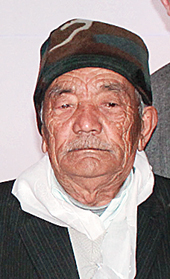
The management had decided to name a special edition autumn tea after the garden’s oldest surviving worker, Purney Subba, 98.

Today, Purney launched the tea in the presence of P.J. Field, chairman, Goodricke Group (UK), M.C. Perkins, chairman, Camellia PLC, UK (parent body of Goodricke) and A.N.Singh, managing director, Goodricke Group. “I wish all the luck to the garden,” Purney said after the launch.

The special edition tea is called FTGFOP1 PS Special. All Darjeeling tea is sold as FTGFOP (Fine Tippy Golden Flowery Orange Pekoe. PS stands for Purney Subba.

The packet has a photograph of Purney Subba and his year of birth, 1916.

Purney Subba at the tea launch. (Suman Tamang)

Of the 60kg tea launched today, 40kg was sold. “Marcus Wulf of Schroeder and Mamann from Germany and Leafull Corporation Limited from Tokyo, Japan, bought 20kg each,” said Vinod Gurung, manager (marketing), Goodricke.

The German buyer wanted to buy 20kg at Rs 6,500 a kg and later the Japanese buyer bought another 20kg for Rs 7,000.

Autumn tea is usually sold for less than Rs 500 a kg.

Jeevan Pande, the garden manager, said: “This is a small effort to recognise the hard work put in by the workers to make our tea world famous.”

Singh said the proceeds from the sale would go to Purney’s family and the 20-bed garden hospital. “Twenty percent will be given to Purney Subba and the rest of the money will be used to buy a ventilator for the hospital. If it is not enough, the company will chip in for the ventilator.”

He said the ventilator will cost around Rs 10 lakh.

Today, the management distributed school bags among 600 students and commemorative wall clocks among the 1,500 workers and gave five laptops to Margaret’s Hope High School and Rs 1.5 lakh to buy furniture for the school. “We will construct 150 toilets in the garden,” said Singh.

Margaret’s Hope spread over 586 hectare was established in 1864. Purney had worked in the garden for 40 years. Of his five sons and three daughters, one son and a daughter are garden workers. Deoraj, who is a chowkidar at Margaret’s Hope, said: “I am happy that a tea has been named after my family. This is an honour for the work force. I do not want my children to work in gardens. With a daily wage of Rs 90, it is difficult to survive.”

source: http://www.telegraphindia.com / The Telegraph, Calcutta / Front Page> North Bengal & Sikkim> Story / by Vivek Chhetri / Friday – November 21st, 2014

Kanyashree success finds place in US filmmaker’s lens

Kolkata :

A short film on a young girl’s fight to stave off marriage and help her family make ends meet drew appreciation at the film festival on Sunday.

Made by Oscar winning American short filmmaker Megan Mylan, the film is about a beneficiary of the state government’s Kanyashree and Sabala schemes that are aimed at empowering the women of rural Bengal. Mylan said she read about 16-year-old Monika Barman of Cooch Behar in an article and was stunned by her resolve.

Titled ‘After My Garden Grows’, the ten-minute film is more like a clip that conveys a strong message. It shows Monika working to develop her family’s own garden on a plot of land where she grows vegetables and helps her father earn by selling them at the local market. She is shown discussing the perils of an early marriage with peers and village elders and asking everyone around not to get their daughters married at an early age.

“I have just shot what was really happening. It was amazing to see Monika changing the lives of adolescents in her village and fighting a tradition. Through my film, I have tried to portray what adolescent girls in India are faced with,” said Mylan, while speaking to newspersons on Sunday.

She was accompanied by the state child and women’s development minister Shashi Panja, who felt the film showed that the government’s initiatives are bearing fruit. “Both Monika and her elder sister Kanika, who got married and had a child at the age of 17, are beneficiaries of our schemes. The Kanyashree and Sabala schemes have been helping hundreds like them. Girls have now been made aware that they shouldn’t be getting married before 18. I congratulate Megan for having handled this gender issue so sensitively,” said the minister.

Monika is now back in school and continues to tend to her garden which helps her family earn money. Monika, who was present at the event, said she would not get married in the near future. “Now, I have the courage and the support to refuse marriage proposals. My father has been very supportive and he wants me to be self-sufficient. I hope other girls of my village follows my example,” she said.

The film could be used by the state government to project its rural schemes, Panja said. “We are exploring the possibility. It is indeed a good advertisement for our schemes,” she said.

source: http://www.timesofindia.indiatimes.com / The Times of India / Home> City> Kolkata / TNN / November 17th, 2014

Indian farmers who fought WWI in France

Caleidoscope

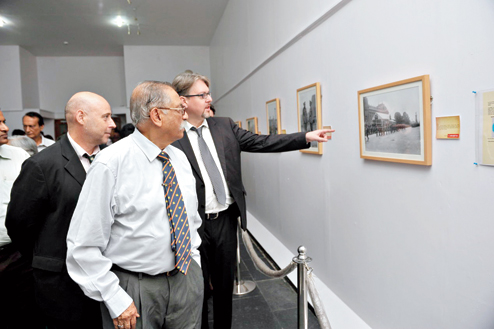
French consul-general Fabrice Etienne, director of Alliance Francaise du Bengale Stephane Amalir and General (retd) Shankar Roy Chowdhury at Victoria Memorial. (Anindya Shankar Ray)

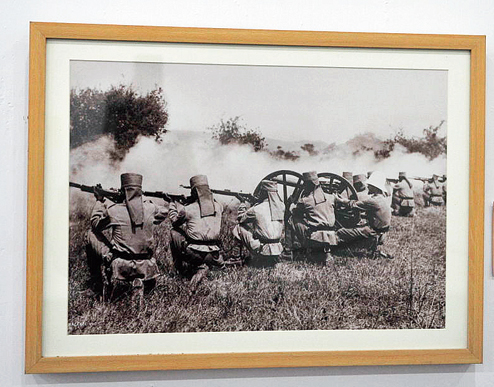
On a day when French President Francois Hollande was to pay a tribute to the 6,00,000 foreign soldiers who fell in World War I, Alliance Francaise du Bengale, in association with Victoria Memorial Hall, opened to the public a photography exhibition titled “War and the colonies”, presenting glimpses of soldiers at work on French soil from lands as varied as India, Ireland and Senegal, 100 years after the Great War.

“Around 28,500 Indian soldiers came to fight on French and Belgian soil as part of the British army by end-1914. They faced the severe winter of 1914-15 and the war in Neuve Chapelle in March, Ypres in April, Festubert in May and Los in September,” said French consul-general Fabrice Etienne at the inauguration of the exhibition at Victoria Memorial.

WW102KOLKATA17nov2014

“From 1914 to 1918, around 90,000 soldiers in various capacities fought for the freedom of France and Belgium. Of them, 8,500 died and 50,000 were injured. France will never forget the suffering and the heroism of these men,” he added.

General (retd) Shankar Roy Chowdhury pointed out that WWI was no concern of India. “It was not their war. But the Indian army was a professional one and part of the assets of the British Empire. What choice did they have?”

Two factors loaded the situation against them. “They were meant for imperial policing and not equipped for a full-blown battle. Within a week of arrival in Marseille, they were put in the assault zone. Also, their efficiency relied heavily on their personal bond with their British officers. But the 10-12 officers there were in each battalion died within the first week. Young officers, fresh from Britain, were sent in haste to lead the Indian troops.

“No wonder Indians did not fare well in France and Flanders, and were moved out to Asia Minor. Still they got nine Victoria Crosses for gallantry,” Roy Chowdhury said.

Without the colonies, the Allies could not have won, said Kaushik Roy, a professor of history at Jadavpur University. “Of a population of 235 million, 1.2 million Indians were serving in WWI. This is a significant percentage. Raised voluntarily, mainly from Meerut and Lahore, they were mostly illiterate farmers who did not write much except for some letters home. The poorest were not taken as they were thought to be malnourished. Punjabi Muslims, Sikhs, Garhwalis and Gorkhas were the dominant segments while Bengalis and Madrasis were under-represented,” Roy said.

WWI resulted in fragmented identity-building of each race, rather than evoke any pan-Indianness, he added.

The evening concluded with Theophilus Benjamin playing works of French composers on the guitar.

The exhibition is on till November 23, except Monday.

source: http://www.telegraphindia.com / The Telegraph, Calcutta / Front Page> Calcutta> Story> Caleidoscope / by Sudeshna Banerjee / Sunday – November 16th, 2014

Expo on lost Kalamkari textile in city

Kolkata :

They had originated and proliferated in India, possibly in Tanjore, in the late 16th or early 17th century under the patronage of the Mughal emperors. But, with the passage of time, Kalamkari paintings on textiles faded into oblivion.

Thousands of miles away, a museum in France on the Swiss border has preserved some of the oldest specimens of Kalamkari paintings on textiles. These are very rare to find even in museums within the country.

For a fortnight starting on Wednesday, the textile gallery of the Indian Museum will showcase the world famous ‘Tapis Moghol’ — some of the most elaborate designs replete with mysterious animals, birds, foliage and flowers — that hold the key to many stories of the times. The ‘Tapis Moghol’, that dates back to the late 16th or early 17th century, has been preserved for the world at the En Musea De L’Impression Sur Etoffes De Mulhouse or the Museum of Printed Textiles at Mulhouse, France.

Kalamkari paintings in its earliest form were motifs painted on large wall hangings that were used to decorate the altar behind the deity. Kalamkari, though, is not a lost art form in the sense that it is still practised in both the painted and block printed versions. But, we have lost most of the original designs that were popular when it was used as an altar backdrop in South Indian temples.

“A gentleman called Funffrock, who was an employee of the French East India Company, was posted in Tanjore. The Frenchman was immensely interested in the traditional art form and got a cotton cloth, measuring eight feet by eight feet, done up with rich intricate designs that showcased the best motifs of that time. With time, this became the focal exhibit, around which the other collections of the period grew. The exhibition will give the city a glimpse of the Funffrock collection,” explained Ruby Palchowdhury, spokesperson of the Crafts Council of West Bengal, which is a wing of the Crafts Council of India and is funded by the Centre.

Textile and culture ministries and the Alliance Francaise have funded the expo that will have 25 panels to show off design details and the stories underneath. The exhibition has been curated by ethnic historian Lotika Varadarajan.

source: http://www.timesofindia.indiatimes.com / The Times of India / Home> City> Kolkata / by Jhumli Mukherjee Pandey, TNN / November 16th, 2014

Japanese scholar traces history of Kolkata

Kolkata :

Once Okamoto Yoshiko starts speaking on the history of Bengal, jaws are bound to drop. Yoshiko, a history scholar of modern Japanese thought at Institute of Asian Cultural Studies of International Christian University, Tokyo, is tracing the untold history of Bengal and the city in connection with modern Japanese thought.

For last few days, she has been running from one house to another belonging to forgotten luminaries of Calcutta in search of documents, old photographs and books to track the vibrant bond Japan shared with Bengal more than 100 years ago.

Recently, Yoshiko was sifting through old books and documents at the house of Tapan Sen, great grandson of Narendranath Sen (1843-1911), the founder-editor of nationalist newspaper, Indian Mirror.

“He was a liberal Hindu, with a deep interest in other religions, particularly Buddhism. He was the founder of the Theosophical Society of Bengal,” Yoshiko said.

Yoshiko is working towards a book on an international religious conference that was to be held in Japan — a cancelled event at Kyoto in 1903. The key mover of the conference was Okakura Kakuzo (1863 -1913). This was after Kakuzo and art historian and Japanese monk Oda Tokuno came to Kolkata in 1902 and 1903 and met literary, cultural and spiritual luminaries like Rabindranath Tagore, Swami Vivekananda and Sister Nivedita. Narendranath Sen was elected chairman of the committee for the religious conference, Yoshiko said.

Why did the conference not shape up? “One of the reasons was the premature death of Swami Vivekananda. Without him the conference would have lost its sheen. There were other reasons as well. But the cancelled conference became a threshold of modern Japanese thought and forged an international intellectual network. With the idea of one-Asia, Kakuzo ceased to identify himself as Japanese but an Asian,” Yoshiko explained. The conference evoked world-wide response. Two Indian monks — Swami Rama Tirtha and Agamiya Parama Tattava — travelled to Tokyo for the conference.

Kakuzo had some wonderful intellectual exchanges with Narendranath Sen, who first interviewed Vivekananda after his return to India. In fact, Narendranath was the prime mover behind Vivekananda’s supposed participation at the Kyoto conference, the scholar explained. Yoshiko was sad that the original house of Narendranath Sen was razed.

Like Tagore, Kakuzo’s prophesy in his book, ‘The Ideas of the East’, proved true a century later, she said. “He noted that Japan’s rapid modernization was not universally applauded in Asia,” Yoshiko said.

source: http://www.timesofindia.indiatimes.com / The Times of India / Home> City> Kolkata / by Krishnendu Bandyopadhyay, TNN / November 13th, 2014

Healing touch for Bible society

Kolkata :

Over two centuries, Bible House on Jawaharlal Nehru Road has played a pivotal role in translating and publishing the best-selling book of all time — the Bible. Ravaged over time, the Romanesque building has received superficial attention but never undergone a thorough repair. Now, various churches have come together to fund the first major restoration and offer the heritage building a fresh lease of life.

“The Bible is the reason why churches exist. Hence the significance of the building where the Bible has been translated and published for two centuries. It has served as the cradle of Christianity in the country,” said Bishop Ashok Biswas, chairman of the Kolkata auxiliary or chapter of Bible Society.

The Bible Society movement in India started from the Bible House, which was built in 1811. It is the second oldest Bible House in the world, built barely seven years after the Bible House in London. Till the mid-20th century, its jurisdiction extended up to Sri Lanka and Myanmar. It was the Calcutta Auxiliary Bible Society that was established in 1811 and the Bible Society of India came into being 33 years later.

Conservation architect Manish Chakraborti, who has been appointed the project consultant, is finalizing the plan for the building’s authentic restoration.

“A cast iron column in the building appears to be buckling under pressure and needs to be immediately repaired. Thereafter, the flooring system has to be strengthened by repairing the supporting wooden beams and runners, and splicing steel joist where necessary. A leak in the roof also needs repair. Woodwork and joinery of doors and windows will also be restored and the Burma teak wooden staircase will be cleaned and polished,” said Chakraborti.

Beyond restoring the building, the architect has chalked out a detailed plan for its appropriate adaptive reuse after detailed discussions with Bible Society officials. “Three fourth of the ground floor is occupied by a tenant. The rest of the building is occupied by us. This section will be internally revamped. On the first floor, a full-fledged modern auditorium with a seating capacity of 180 persons will be set up.

There will also be an archive, reading room, library and a special room for the translation board to meet. On the second floor, we will have a guest house with four rooms,” said senior auxiliary secretary Sajal Kumar Sarkar.

Another important aspect is the development of a fire-retardant store-room at the rear of the building for storing Bibles and Biblical texts published by Bible Society. Chakraborti expects the KMC Heritage Committee to give the project its nod soon.

source: http://www.timesofindia.indiatimes.com / The Times of India / Home> City> Kolkata / by Subhro Niyogi, TNN / November 11th, 2014

Bengal’s Dutch link on Presi site

Kolkata :

Dutch history in India has been ‘e-mortalized’ by Presidency University and Netherlands Embassy, with the launch of a web portal documenting and geo-tagging the total area of the Dutch cemetery in Chinsurah. At the same time, ‘The Dutch East India Company in India’, a book by anthropologist Bauke van der Pol was released on Friday.

“This book looks at the larger picture of the Dutch in India, and Dutch trade relations with India have existed for far longer than those with say, America or Australia,” said van der Pol, who presented a comprehensive compendium of the Dutch East India Company heritage in India by guiding the reader through country houses, settlements, trading posts and cemeteries.

The website and the book was launched by Presidency University vice-chancellor Anuradha Lohia and the Honorary Consul of the Netherlands, Namit Shah. “The ‘Dutch Cemetery in Chinsurah’ database, that’s available online at www.dutchcemeterybengal.com, tells the story of a centuries-old colonial settlement that produced some of the key figures involved in the shaping of trade, polity and culture in the Indian subcontinent. Less well-known than its British namesake, the Dutch East India Company, Vereenigde Oostindische Compagnie (VOC), once managed the vast inter-continental trade from 17th to 19th century through its settlements in coastal India. As a hub between the western trade capital Amsterdam and its Eastern counterpart in Batavia, Chinsurah occupied a key position in VOC and indeed, in Dutch history as well,” said Souvik Mukherjee of the English department, who headed the digital humanities project.

Mukherjee outlined the objectives of the project. “We photographed the gravestones and tombs in detail, accessed and digitized the research matter from offline sources. We also transcribed headstone inscriptions and inserted architectural, biographical, geographical, demographic, literary and historical metadata,” he said.

The Dutch anthropologist also gave a sneak peek into his next book, ‘Dutch on the Ganges’, scheduled to be released next year.

While explaining how the Dutch settled at Baranagar, van der Pol said, “It was a small settlement where big ships would anchor before heading out. It was also known to have a widely-known brothel, with beautiful ladies from Malaysia.”

He also gave a brief description of Prince Hendrik van Oranje’s three-month stay in Bengal back in 1837.

source: http://www.timesofindia.indiatimes.com / The Times of India / Home> City> Kolkata / TNN / November 07th, 2014

French return to Park Mansion

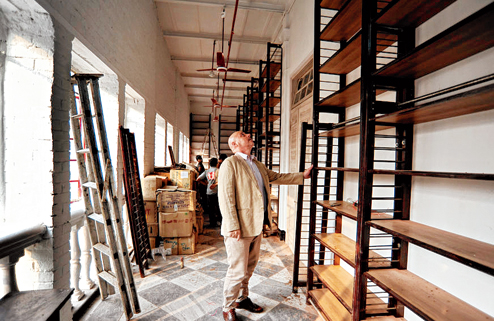
Director Stephane Amalir inspects the book racks at Park Mansion. (Amit Datta)

Alliance Francaise, the city’s cultural bridge with France, is returning to the address where it stood for 59 years till a fire ousted it in 1999. The shift to Park Mansion is slated to take place in mid-December.

“Khaleel Munzil (the current rented address on AJC Bose Road) is a nice building but it is up for sale. We want to move out before we are asked to,” says director of Alliance Francaise du Bengale (AFB) Stephane Amalir.

AFB operates out of Khaleel Munzil and Bimal Villa on West Range, a few buildings away. “We will retain Bimal Villa but the library and the administrative offices will shift to Park Mansion, where we have acquired a 3,500sq ft apartment on the second floor on a 10-year lease,” Amalir says.

The French culture hub, then called Alliance Francaise du Calcutta, was housed at Park Mansion ever since it opened in 1940. It is the second in India after the Pondicherry centre, which turned 125 this year. “Back then, Alliance Francaise had 8,000 sq ft over two apartments in the first and the third floor. The consulate too was there as was the Trade Commission in separate apartments. I would pick up a book from the Alliance library upstairs before going home,” recalls Fabrice Etienne, the consul-general, who was posted at the Trade Commission here for two years in 1995-96.

The fire broke out in the wee hours of April 18, 1999. “We were rendered homeless and moved around to Max Mueller Bhavan, Nehru Children’s Museum and Sukhsagar Building in Elgin Road till we settled at West Range,” says Kaushik Chakraborty, a teacher at Alliance since 1981. Veteran staff members, like him, Mirza Salim Baig and Amitabha Ghosh, are nostalgic about the return to the old address.

Of course, much has changed. The wooden staircase is gone, gutted completely by the fire. It has been replaced by marble steps. Amalir is busy supervising the renovations. “We were handed an empty shell. The idea is to accommodate modern needs while keeping the charm of the old building.” Fire-proofing gadgets are being installed. In the library, there will be tablets to access Culturetheque, the upcoming e-library platform. “Members will be given passwords to log in from home as well to magazines, books, films and reading material online.” An 800sq ft room will host film screenings and conferences while bigger cultural events will use outside venues. The 18ft high ceiling will be retained as also the wooden doors and windows.

source: http://www.telegraphindia.com / The Telegraph, Calcutta / Front Page> Calcutta> Story / by Sudeshna Banerjee / Tuesday – November 04th, 2014

Chaos to School in the Cloud

SugathaKOLKATA02nov2014

Calcutta-born education scientist Sugata Mitra grew up in a strict Jesuit-school environment in Delhi where life was all about discipline and order.

Little did he know that one day his life would be all about “theories of chaos”, the key to a series of self-organised learning environments that are transforming the way education is imparted.

Mitra, a physicist by training and a polymath by choice, is the winner of the 2013 TED prize that fetched one million dollars for his radical educational project School in the Cloud. Seven such experimental facilities have since been launched in the UK and India, three of them in Bengal.

Apart from giving shape to his vision, the 62-year-old scientist is making the most of his stay in Calcutta with “a daily visit to the bazaar to shop for fish and duck eggs”.

For Mitra, professor of educational technology at Newcastle University in the UK since 2006, each day is about implementing what he calls SOLE, or unsupervised self-organised learning environment. This theory forms the basis of his School in the Cloud concept, a term that he first used in a riveting speech after winning the TED award last year.

Mitra was the first recipient of the one-million-dollar purse since it was raised from $100,000. Past winners of the prize, awarded by the non-profit Sapling Foundation to foster the spread of “great ideas”, include Bill Clinton and Bono.

The journey to worldwide recognition of Mitra’s great ideas started with a winning experiment in 1999 called Hole in the Wall. The then Delhi-based scientist and educator embedded a computer within a wall in a Kalkaji slum and children were allowed to use it freely. The experiment proved that kids could quickly learn computers on their own without any formal training.

Mitra called it Minimally Invasive Education and the experiment caught on, even inspiring the novel Q&A by Vikas Swarup that Danny Boyle adapted into the Oscar-winning Slumdog Millionaire.

The unintended connection with Slumdog Millionaire is not something he is excited about. “I was quite startled at first because I couldn’t see the connection,” Mitra said of the film. “The fact that you can learn by yourself was put into a very different, rather sad context. I wish that one wouldn’t have to learn under the circumstances as we see in the movie.”

So would he have approved if the story didn’t feed on the rags-to-riches formula?

“I found Vikas Swarup on the Web after the film released in England and wrote to him. We were in correspondence and I still feel it would have been better if it were about a slumdog professor who did not win a million-dollar game show but went on to become a professor!” Mitra said.

School in the Cloud, which has brought Mitra back to Calcutta, started in the UK three months ago. “It’s a three-year research project and according to the budget, a maximum of seven locations is what I could afford (with the prize money). The challenge was to find those seven places,” Mitra said.

In England, he picked George Stephenson High School, “where the steam engine man George Stephenson lived”, and another in the rural hamlet of Durham. In India, he found a school each in Delhi and a town called Phaltan, near Pune, besides the three in Bengal. The first three are already operational.

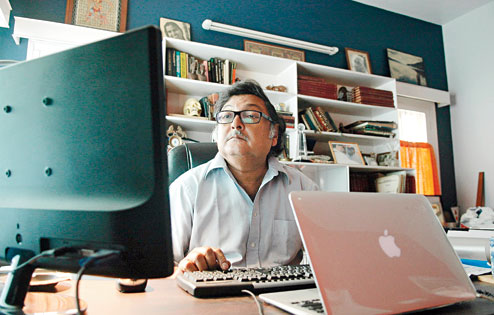
“I am here because the most remote of all the sites is a village called Korakati in the Sunderbans, where the facility will hopefully be operational from March 9, followed by one in the village of Chandrakona in West Midnapore on March 13. Third in line is a semi-urban school at Gocharan in Barasat,” said Mitra, working out of a well-appointed study in his Salt Lake home.

Since the project was launched here this February, help has come from “unexpected quarters”.

“People had read about my TED wish in the papers and I was getting calls. Then, one morning in February 2013 somebody landed up at my house early morning. He was a schoolteacher from Korakati who wanted to do something for his village and from the description, it was the kind of place I was looking for — no electricity, no health care, no primary education,” the education scientist recounted.

Midnapore appeared on his radar through an NGO and Gocharan was suggested by a doctor friend who works there.

Mitra’s confidence in his experiment with unsupervised self-organised learning challenges the basics, including the concept of a school.

If his Hole in the Wall experiments with slum children in India from 1999 to 2004 showed there is no limit to learning capacity “as long as children are left unsupervised and allowed to work in groups”, carrying the project to the UK entailed turning it “upside down”.

In the third phase, he chose south India for an experiment that made him realise how children stop being adventurous if there’s a teacher breathing down their necks. “Therefore, the process of unsupervised learning had to be done purposefully or replaced with a different kind of adult, maybe a grandparent.”

He found out that a grandmother’s presence helped step up a child’s academic performance. “That’s how I got the third piece of my puzzle. I realised I had to have children in unsupervised groups, along with the Internet and an admiring adult.”

In his pursuit of the “admiring adult”, Mitra put out a request for “British grannies”.

“We were looking for retired teachers who may not be grandmothers but were willing to come on Skype and talk to children for one hour every week for free. I got hundreds of calls,” Mitra recalled.

And when the TED prize happened, he thought: “Now is the opportunity to put these pieces together and see what we get.”

“It was TED that coined the term School in the Cloud, where cloud is the other word for the Internet and that is where grannies and children connect,” he explained.

Mitra today has 300 grannies on board, mostly from the UK and also the US, Canada, Australia and India. “At any point in time, we get 30 active grannies,” he said.

And what does a School in the Cloud look like? “Essentially like cyber cafes for children with a few important differences. The computers are big, publicly-visible screens within a glass-walled room, which is an effective control on what they are doing on the computers,” Mitra said.

The group size is determined by the number of computers he can afford. “So we have clusters of four or five children per computer. It has low-level seating and there’s a 52-inch screen on the wall where the granny comes on live over Skype, almost lifesize. It’s like being present there,” smiled Mitra, who keeps an eye on the proceedings through a surveillance camera along with his research team.

English is the most important part of the agenda, Mitra said, for the Indian leg of the School in the Cloud project. “While they want their children to learn many things, what the parents are most interested in is English because they feel that will change their lives more than anything else, which I feel is true. I hope native English-speaking grannies will be more easily able to transfer language skills to these children.”

A typical SOLE session, 40 to 60 minutes long, is open to topics that children might ask for or those initiated by the grannies.

A research team will soon be travelling to Korakati and Chandrakona for a baseline measurement of where the kids stand. “I am focusing on ages six to 14. They follow a very old-fashioned disciplined structure but I have managed to remove the adults,” said Mitra, who has arranged for a waiting room next to the schools for mothers to watch on a large screen what their children are up to.

Schools in the Cloud in Bengal will be kept shut during regular school hours so that children continue with their regular education and their teachers don’t feel threatened. “I am not replacing schools. I am supplementing them,” Mitra said.

Just as fish and duck eggs supplement the Bengali in him

What message do you have for Sugata Mitra? Tell ttmetro@abpmail.com

source: http://www.telegraphindia.com / The Telegraph, Calcutta / Full Page> Calcutta> Story / by Mohua Das / March 04th, 2014
Kolkata bids for 2017 World Chambers Congress

The WCC is an international forum for chamber leaders and professionals to exchange insights and address business issues.

The Indian Chamber of Commerce has bid for hosting the next World Chambers Congress in the city. The 2015 Congress is scheduled to be held in June next year in Italy and India would debut in case it is selected as a host for the next meet due to be held in 2017.

The WCC is an international forum for chamber leaders and professionals to exchange insights and address business issues. It attracts about 2000 business leaders from over 100 countries and can play a major role in placing Kolkata on the global investment map, a ICC statement said.

The ICC delegation is just back from making the bid presentation to the World Chamber Federation Governing Council in mid October in Tokyo. ICC is competing with the Zhejiang Provincial Committee of China, the Philippines Chamber of Commerce and Industry and the Sydney Business Chamber for the bid, whose results are expected in November end, the ICC said.

The event is organised by the International Chamber of Commerce. The ICC delegation also utilised the opportunity to invite Japanese investors to the Biswa Banga Sammelan a global investors meet which is being planned by the Mamata Banerjee in January 2015.

West Bengal science and technology secretary Hridyesh Mohan who also travelled with the ICC delegation, invited Japanese business houses and industry captains to attend the West Bengal meet for which preparations are under way.

source: http://www.thehindu.com / The Hindu / Home> Business> Industry / by Special Correspondent / Kolkata – October 23rd, 2014