Category Archives: World Opinion

Hazarduari gets ‘Adarsh’ tag from ASI

Kolkata :

Hazarduari Palace in Murshidabad has been declared an Adarsh Monument by the Archaeological Survey of India (ASI) along with three others in eastern India.

The other three monuments are Vaishali-Kolhua in Bihar, Rang Ghar in Assam’s Sibsagar and the Konark Sun Temple in Odisha. These
will be in the focus of international tourism promotion plan developed by the central government.

ASI has selected only 25 out of 3,680 protected monuments under the Adarsh Samarak Yojona. The list was made on the basis of the number of tourists these monuments attract annually. The list includes some of the biggest crowd-pullers like Taj Mahal, Khajuraho, Qutab complex and Red Fort.

All of them can be of great interest to international tourists, believes the ministry of culture. “Keeping that in mind, we are developing amenities of international standards, including washrooms, drinking water, signs, cafeterias, audio-visual centres, Wi-Fi connectivity, interpretation centres and encroachment-free areas,” said ASI regional director (eastern region) P K Mishra.

But more than anything else, security will be enhanced. The Centre is thinking of introducing the ‘tourism police’ force that is quite common across the world.

Hazarduari Palace, earlier known as Bara Kothi, is located on the campus of Kila Nizamat in Murshidabad, on the banks of the Bhagirathi. It was built in the early 19th century by Duncan MacLeod under the reign of Nawab Nazim Humayun Jah of Bengal, Bihar and Orissa (1824-1838). In 1985, the palace was handed over to ASI. Kila Nizamat or Nizamat Kila was the old fort of Murshidabad which was demolished to build this grand palace.

Built in the 13th century, the Konark Sun Temple is shaped like a chariot of the Sun God with 12 pairs of ornamented wheels dragged by seven horses.

Rong Ghor, meaning ‘House of Entertainment’, is a two-storied building that used to serve as the royal sports pavilion. Ahom kings and nobles used to watch buffalo fights and other sports at Rupahi Pathar in Rangpur, particularly during the Rangali Bihu. Said to be one of the oldest surviving amphitheaters in Asia, the building was constructed during the reign of Swargadeo Pramatta Singha in 1744-1750.

Kolhua in Vaishali is where the Buddha is said to have preached his last sermon. To commemorate the event, emperor Ashoka erected one of his famous lion pillars here in the third century BC. A hundred years after the Buddha’s death, Vaishali hosted the second great Buddhist council. Two stupas were erected to commemorate it.

Jainism, too, has its origins in Vaishali. In 527 BC, Lord Mahavir was born on the outskirts of the city and lived in Vaishali till he was 22. Vaishali remains an important pilgrimage centre for both Buddhists and Jains.

source: http://www.timesofindia.indiatimes.com / The Times of India / Home> City> Kolkata / by Krishnendu Bandyopadhyay, TNN / January 11th, 2015

School adopts US model to inspire kids in science

Kolkata :

Bengal is going to get its first STEM-based school in Barrackpore, some 25km from Kolkata, to encourage more children to take up science and arrest the decline in interest in engineering.

STEM — an acronym for ‘science, technology, engineering and mathematics’ — is a US-based teaching method that aims to inspire kids to become engineers rather than dreading the sciences and mathematics as many do now. STEM World School- the Barrackpore school, for instance, will have a STEM laboratory where attendance will be compulsory. The lab can accommodate 30 students at a time.

The STEM World School in Barrackpore will be affiliated to ICSE. Admissions for playgroup to Class VI will start from the 2015-2016 session, say officials.

The emphasis on science comes at a time when projections of a nationwide shortfall of technocrats threaten to hold back India’s progress.

“A recent study by Defence Research and Development Organisation revealed that just 4 out of 1,000 students in India opt for science, technology or research as their career. In contrast, this figure is 110 in Japan, 76 in Germany and 46 in Korea, indicating the dearth of young talent in these vital areas in our country. Because of this, India is at risk of a huge economic crisis, despite being the youngest country demographically,” said Paddy Sharma, a board member of the school. “The main objective in setting up a STEM school in Kolkata is to create critical thinkers, increase science literacy and give rise to the next generation of innovators,” said Hilda Peacock, former principal of La Martiniere for Girls, who is one of the advisors.

According to a survey, India will be facing a shortfall of 1.5 to 2.2 million engineers by 2020, Sharma added.

“Innovation leads to new products and processes that sustain economy. Innovation and science literacy depend on a solid knowledge base in STEM areas. We just need to remind kids that this kind of learning can be fun. We need to introduce children to the basic concepts of science, engineering, technology and mathematics in junior grades and continue with these programmes through high school,” she said. Michael Glanton, Democratic member of Georgia House of Representatives, USA, is one of the advisors.

source: http://www.timesofindia.indiatimes.com / The Times of India / Home> City> Kolkata / by Somdatta Basu, TNN / January 11th, 2015

Anthology on Jesuit Fathers’ contribution

The Goethals Indian Library and Research Centre of St. Xavier’s College has published a book on the lives of the Jesuits who lived and worked in India, especially in Bengal, since the early 19th century.

The anthology was released by Father P. Franck Janin, Jesuit Provincial, South Belgian Province and Luxembourg, at Dhyan Ashram in Joka on Sunday.

Edited by Father Albert Huart and Father J. Felix Raj, Discovery of Bengal: The Jesuit Design marks the 200th year of the Restoration of the Society of Jesus. The book records the academic, social, cultural and spiritual contributions of the Jesuit fathers in shaping the moral growth of the race and the country.

Among the Jesuits who feature in the book are Fathers Henry Depelchin, Achille Verstraeten, Paul Joris, Cardinal Lawrence Picachy, Camille Bouche and Andre Bruylants.

“They attracted heartsby the qualities they displayed and posterity retains them as lessons of life learnt forever. Even after 200 years, their words and works reach those for whom they were intended – the inhabitants of The Kingdom of God. These men of moral might were armed with supreme sense of sacrifice and were gifted with grace and the zeal to establish ‘Good News of God’ and the promise of justice for humanity,” said Felix Raj, the principal of St. Xavier’s College.

“Humility, fortitude, power of prayer and passion for performing God’s will on earth endowed these Samaritans with the benediction that brought the light of the Lord to the masses of Bengal. This collection scripts the eternal immortal lives of the Jesuits who are today and forever in fellowship with us and with God.”

Copies of the anthology are available from the Goethals library at the college.

source: http://www.telegraphindia.com / The Telegraph, Calcutta / Front Page> Calcutta> Story / by Staff Reporter / Monday – December 29th, 2014

Sky’s the limit for these girls

BirlaGirlsKOLKATA30dec2014

Lying on blankets at a height of 9,200ft, they gazed up at the sky and couldn’t believe what they saw. Khushi Goenka and two of her schoolmates from Modern High School for Girls were staring up at the Milky Way. With the naked eye.

In Hawaii to attend the second edition of the Pacific Astronomy & Engineering Summit at Imiloa Astronomy Center, the girls had seen the constellation through a telescope just the day before. “It was unbelievable because the previous day at the astronomy centre we had seen the constellation and other stars and there we were, seeing it again, this time with the naked eye,” said Khushi, a Class XII student.

Khushi, along with Class XI students Adwitiya Dawn and Shruti Keoliya, made up the only team from India invited to the five-day conference. Accompanied by their physics teacher Pamela Dutta, the girls worked in collaboration with Puragra (Raja) Guha Thakurta of the department of astronomy and astrophysics at University of California, Santa Cruz, and PhD student Emily Cunningham on the Halo 7D project.

The conference included presentations by scientists and astronomers from China, Japan, Canada and the US but the high point for the city girls was a meeting with five scientists who had spent four months in isolation in simulated Mars-like conditions.

“We met the HI-SEAS crew, a group of five scientists who had spent four months in isolation on a Mars-like surface on top of a mountain. We got hold of an aeronautical engineer and kept asking him absurd questions to satiate our curiosity and not letting him eat his plate of chicken that he hadn’t in the past months,” recalled Shruti.

After the girls returned to the city, Guha Thakurta visited their school and shared with Metro the importance of research and how the trip not only opened new avenues for the girls but also opened their minds to new ideas.

“It opens the eyes of students, especially those who are used to finding exact answers even to difficult problems, to the fact that there are problems that do not have a right answer. In research you have some idea of the question you are trying to answer but there is no guarantee you will find the answer,” explained Guha Thakurta, an astronomer for 30 years. “In most high schools, students are taught there is a correct answer and there is an incorrect answer. To know that there are many shades of grey in between is an eye-opener. The girls, on several occasions, were looking for answers but we would tell them we don’t know the answers or the answer is not known.”

Guha Thakurta said the girls understood the need for research and saw “some laws of physics, some of which they put in their presentation. Some of it they had learnt in class but what they had probably not seen is how someone who making a career as a researcher still uses the formula that they are learning in high schools”.

“In the initial document sent to us, the astronomy terms seemed alien and too technical. But as we started researching, the concepts became clear and we tried to make our presentation (calculating the mass and structure of Milky Way) as comprehensible as possible for the layman,” Adwitiya said.

The five-day trip included sessions by scientists and astronomers, visits to museums, trekking and cultural presentations and some bhangra and dandiya to get everyone at the conference on their feet.

“As far as education is concerned, travelling contributes hugely as does mixing with people and working together as a team on research. The girls had to Skype with California early in the morning before school and be there in time to attend school,” said Devi Kar, the director of Modern High School for Girls.

source: http://www.telegraphindia.com / The Telegraph, Calcutta / Front Page> Calcutta> Story / by Jhinuk Mazumdar / Tuesday – December 30th, 2014

Film with Kolkata touch in Oscar race

Kolkata :

When Bickram Ghosh and Sonu Nigam hit it off as collaborators four years ago, little did they know that a moment of creative spark will land them in the race for Oscar. The soundtrack of ‘Jal’, a film based in the Rann of Kutch, scored by the duo with a horde of Kolkata musicians on board, has been shortlisted for Oscar.

The soundtrack has several Kolkata musicians behind the scenes — such as keyboardist Indrajit Dey who has done the melody programming, and folk singer Dipannita Acharya, among others. This is also a first for Ghosh, who has featured in a Grammy-nominated album so far.

“The producer is excited as the movie has been shortlisted in the best feature film category as well. We have featured an international artist like Greg Ellis and the soundtrack has several Kolkata fingerprints on it. Shamik Guha Roy is the recordist along with Pramod Chandorkar in Mumbai. The sound is a marriage of Gujarati folk and voice music,” said Ghosh.

“Sonu is overjoyed. We collaborated first in 2010 and our album will be launched this week,” he added. The race is against masters like A R Rahman, who has two film scores on the list, and the legendary Hans Zimmer.

Dey, who has programmed the score for the melody, said: “It’s a marriage of desert folk and symphony and even oral percussion.” When asked about his chances, he replied: “It’s all about taste. There is folk raga music… I am more used to classical fusion and I find desert fusion closer to the heart and the grassroots. This could be an advantage in the race to the Oscars. Dipannita, who excels in various folk forms, has a god-gifted Gujarati folk texture and the effect is amazing.

source: http://www.timesofindia.indiatimes.com / The Times of India / Home> City> Kolkata / by Shounak Ghosal, TNN / December 13th, 2014

IIT-Kharagpur conclave a stepping stone for budding entrepreneurs

Kolkata :

Students of IIT-Kharagpur will get the opportunity of rubbing shoulders with renowned academics, new-age entrepreneurs, eminent business personalities and successful venture capitalists over three days in January when the premier B-school organizes the sixth edition of the Global Entrepreneurship Summit (GES 2015).

Companies like Microsoft, IBM, Intel, Flipkart, Amazon Web Services, BSE, Deloitte and other corporate giants will hold workshops between January 16 and 18, focusing on the entrepreneurial acumen of participants. IIT-Kharagpur’s entrepreneurship cell, which is organizing the event, has already undertaken various activities on the same lines, including the pan-India entrepreneurship awareness drive. Following the successful culmination of the drive, which saw close to 25,000 applicants participating from 24 cities last year, the e-cell is now moving on to the flagship event.

The previous edition of GES has seen people like India TV founder Rajat Sharma, Aakash tablet founder Suneet Singh, serial entrepreneur Dominique Trempont, Forbes columnist and Silicon Valley entrepreneur Srimana Mitra, renowned social entrepreneur Harish Hande, former ICICI Bank deputy manager Nachiket Mor and naukri.com founder Sanjeev Bhickchandani participating. Even this year, the organizers are trying to rope in a star-studded panel.

GES is the only such conference of entrepreneurship that will serve as a conclave for discussion of opportunities and programmes aimed towards promoting entrepreneurship in various universities across the world. It will host a global business model competition, Empresario, powered by Viligro, which saw entries from around the country at the preliminary round in October. The finals of the competition will be part of GES where the winners will get a direct entry into the semi-finals of the International Business Model Competition.

The other important event is the start-up camp that will involve interaction of entrepreneurs and students where start-ups will recruit the finest talent for internships or jobs while giving them an opportunity to meet to meet the CEOs in campus.

Unlike previous years, GES 2015 will be an invite-only summit where only specific colleges will be able to send their delegations.

“IIT’s entrepreneurship cell aims at supporting budding entrepreneurs. GES will prove to be the ultimate stage for propagating the cause,” said Deepak Kumar Jha, a member of the e-cell, IIT.

GES 2015 has Flipkart as its title sponsor along with sponsors like IBM, Villgro, VMware, Fedena, Haier, Air India and the WBIDC.

source: http://www.timesofindia.indiatimes.com / The Times of India / Home> City> Kolkata / TNN / December 12th, 2014

UK scholar on indigo trail

Kolkata :

UK museum officer Helen Bradley’s quest for truth has landed her not just in Kolkata, but given invaluable insight into the atrocities committed by her British forefathers on Indian peasants in the 18th century. What began as a causal interest in the founder of Bradley’s workplace and his birthplace could well turn out to be one of the most candid versions of the Indigo Revolt (1859-61).

Bradley is the development officer, Llandudno Museum, Wales. She is on a research assignment not only on early life of Francis Chardon, son of an indigo planter, or the momentous event in history but to especially explore the potential of the indigo dye. Bradley has got a British Council grant for coming to Kolkata, seeking collaborations between her museum and the Indian Museum and the Victoria Memorial Hall (VMH).

“We want to learn more about Francis Chardon and his family, and to understand our collections better with help from colleagues in India. We are carrying out some initial research into the Chardons in India and the plantations that they managed throughout Bengal,” Bradley said, ahead of her meeting with Jayanta Sengupta, curator, VMH, on bringing Welsh and Indian museums together. She has spent hours at the National Library, the Indian Museum, Neelhat House and the VMH, compiling records on the Indigo Revolt.

Llandudno Museum was established in 1926, and Chardon was born in (then) Calcutta in 1865, to Maria and Edouard. His father, Benjamin, cousins and uncles were all indigo planters in lower Bengal, Bihar and Bangladesh between 1830 and 1890.

Chardon was born at Gallis Hotel, Dharamtala, his mother, Maria, was born on Mangoe Lane, and his father, Eduoard, lived at 5 Dacres lane. Bradley, whose week-long trip (her first to India) ends on Thursday, has clicked photographs of all these places that will figure in an exhibition on indigo in 2016, as part of project “Indigo Trail”.

The exhibition will begin at Llandudno and travel to several locations. A landscape survey and research which will include the location and layout of indigo houses and plantations will complement the exhibition. “The idea is to tell the true story of indigo – with the tales of oppression and also its significance as a time when national consciousness was growing in Bengal. We want to examine the Indigo Revolt not just from the Chardon family’s perspective, but from the ryot’s point of view — to view the picture of exploitation,” Bradley said.

source: http://www.timesofindia.indiatimes.com / The Times of India / Home> City> Kolkata / by Ajanta Chakraborty, TNN / December 02nd, 2014

‘Kolkata deserves Unesco tag’

Kolkata :

The word “Bengali” is most used in Penang, Malaysia, to refer to anyone of North Indian origin because the headquarters of Penang Presidency were located in Kolkata during the British Raj.

Such unknown facts about the heritage of Kolkata was up for discussion at the Indian Museum where the two-day annual conference of the Indian National Trust for Art and Cultural Heritage (Intach) ended on Saturday to discuss the impact of urbanization on heritage.

Many heritage conservationists and art historians converged at the Indian Museum to attend the event on Friday. Experts felt that Kolkata should find a place among the Unesco sites but unfortunately the fact that Kolkata was the centre from where the British Empire proliferated, hasn’t quite been marketed well.

“The city should make a consistent effort in getting its pivotal place in history registered in the world’s mindscape,” said historian and conservation architect from Delhi AGK Menon.

“There is a renewed interest in Malaysia in the contributions of this once capital of the British empire to the realm of art and architecture,” said Khoo Salma, a conservationist with the Penang Heritage Trust.

“Coming here almost feels like being where it all began, at least when it comes to colonial art and culture,” said Gwynn Jenkins, a cultural anthropologist working in Malaysia. Among others present were historian PT Nair, art historian Bhau Daji Lad Museum director Tasneem Mehta and art historian Saryu Doshi.

“There are heritage laws in place but they have no teeth. We are yet to see destroyers of heritage getting arrested. Promothesh Barua’s house got razed, the arch at the gateway of Bishop’s House was pulled down and nothing happened to the builder. This needs to be stopped,” said GM Kapur, Intach state convenor.

source: http://www.timesofindia.indiatimes.com / The Times of India / Home> City> Kolkata / TNN / November 23rd, 2014

French scientist wows students with ‘do-it-yourself’ science

Kolkata :

It’s a rare lecture that makes teachers feel like the taught and forces guardians to pull out chits of paper from their wallets to take down notes in a hurry. When renowned French scientist and author Nicole Ostrowsky speaks, the laws of magnetism take on a whole new meaning.

The acclaimed physicist was in Kolkata last week as the star attraction of the third edition of Apprentice Scientist competition at The Future Foundation School (TFFS). The contest, held in collaboration with its partner school Lycee Francais de Pondicherry, encourages some of the best young brains in the city to get out of their textbooks and test their scientific aptitude in creative ways.

The participating school teams get the same equipment — and questions that force them to think out of the box. This time, for instance, each team got two plastic glasses, a football, three bottles and other items that look like odds and ends. One of the questions was: can you transfer air using two cups and a container full of water?

The teams of Class VII students had to complete four experiments, at the end of which they came to realize, hands-on, that all sciences — physics, chemistry, biology — are linked.

The correlation between sciences was a key feature of Ostrowsky’s lecture. She added psychology to the group and pointed out how it would dominate research in the days to come.

Ostrowsky, author of ‘The Agenda of the Apprentice Scientist’, is on a worldwide mission to make science fun for children. A professor emeritus at University of Nice in France, she has taught at Harvard and founded the ‘Exploratoire’ in Paris, a hugely popular collection of interactive scientific experiments. This is her first visit to Kolkata. “I am fascinated by the colours here,” she said.

The packed hall at TFFS was completely under her spell as Ostrowsky put up one scientific riddle after another: If you put a pea and a banana in a bowl of water, which will sink? If all the icebergs in the world melted, would the sea level rise? She showed how the answer to these questions can be found in simple experiments at home. “Be curious. Ask questions. That is what a scientist does,” she advised students. Handing over her pointer stick to students, she asked if anyone could find its centre of gravity. One boy did, drawing applause.

The same spirit was seen in the contest where Cedric Le-Bescont, head of science teachers at Lycee Francais, was urging the competitors to “forget your books and write your own science”. “Forget what you learnt. Analyze what you see,” he kept telling students.

He wanted them to stop etting confined to any one branch of science and to allow them to look for down-the-lane answers. The winners were Heritage School, followed by South City International and Modern High for Girls.

source: http://www.timesofindia.indiatimes.com / The Times of India / Home> City> Kolkata / TNN / November 25th, 2014

Bengal honour for Baltic biker boy

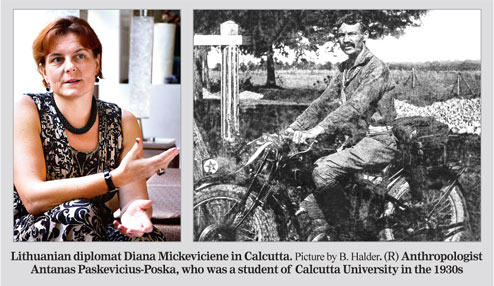
LithuanianKOLKATA23nov2014

In the autumn of 1929, 26-year-old Antanas Paskevicius-Poska set off on a rather long motorbike ride. The Lithuanian would travel down south to Egypt, through Central Asia, with India as his final destination. From Iran, he took a ship to Bombay. In early 1931 he joined the University of Bombay, where he received his Bachelor degree in 1933. Then he shifted to Calcutta to collect material for his Masters. The five years he spent in India, including three in Calcutta, resulted in an eight-volume travelogue titled From the Baltic Sea to Bengal, other than accounts in the Lithuanian press about India and sundry friendships he struck with the intellectual elite.

The story will come full circle on November 28, when President Pranab Mukherjee takes the stage at the convocation of Calcutta University, Poska’s alma mater, and a posthumous DLitt is handed over to Laimute Kisieliene, Poska’s daughter.

“The Lithuanian scholar was brought to our notice by Diana Mickeviciene, a diplomat who came to us on behalf of the country’s embassy in Delhi a year-and-a-half ago to look for material on Poska. We found that he had studied in our anthropology department and had even worked on his PhD. This made us think of recognising his contribution to Indological studies,” said the vice-chancellor of Calcutta University, Suranjan Das. Rimantas Vaitkus, Lithuania’s vice-minister of science and education, and ambassador Laimonas Talat-Kelpsa are flying down too.

Mickeviciene, who has just returned to Lithuania, had spoken to Metro when she was here. “Poska was Calcutta’s ambassador in Lithuania. It is because of him that Lithuanians know about the city. He also worked at the anthropology laboratory of the Indian Museum on racial anthropology and started translating the Gita. Lithuanian is the closest living sister language to Sanskrit,” she said.

Poska, she pointed out, had also spent some time in Santiniketan as a friend of Laxmiswar Sinha, who, like Poska, was a practitioner of Esperanto, a constructed international language. Here he came in touch with Tagore and translated some of his poems into Lithuanian.

Among his friends was the linguist Suniti Kumar Chatterji, who became interested in the Lithuanian and Baltic culture. The monograph of his comparative research of Indian Vedic and Baltic pagan rites, Balts and Aryans, was dedicated to Poska. Chatterji even travelled to Lithuania twice, Mickeviciene added.

Poska met Mahatma Gandhi twice, in Bombay and in Allahabad, and conveyed to him the support of the Lithuanian people for India’s Independence. “Gandhi had gifted him a tablecloth which he took with him even to Siberia, where he was sentenced in 1945 for refusing to comply with an order to destroy books published before the Soviet occupation,” she said. He was the head of the library department of the Lithuanian SSR commissariat then. Most of his archives were destroyed.

Poska’s doctoral research remains unfinished business, though. He did his PhD thesis in physical anthropology under professor Biraja Sankar Guha. It was sent to London for the measurements of skulls to be checked. Poska’s diary mentions that the paper was sent to the British Museum in 1936, and he was planning to go to London to defend his thesis but the delay in his return journey from India, financial difficulties and finally the outbreak of World War II came in the way.

When Chatterji visited Poska in Lithuania in 1966, he had volunteered to retrieve his dissertation from London and to accord the scientist a PhD from the university. However, though Poska’s diary mentions Chatterji’s letter informing him of granting him the degree, and Chatterji himself addressing him as “Dr. Antanas Poska” in the preface to Balts and Aryans, the university archive has no such record.

“Without the defence, his PhD could not have been completed. All we have is the title (‘Physical Affinities of Shina-speaking people of the Western Himalayas’). But we all agree that he deserves recognition,” said vice-chancellor Das.

source: http://www.telegraphindia.com / The Telegraph, Calcutta / Front Page> Calcutta> Story / by Sudeshna Banerjee / Sunday – November 23rd, 2014