Deepak Khaitan, the vice-chairman of Williamson Magor Group and the eldest son of B M Khaitan, passed away at his Kolkata residence on Monday morning. He was 60 and is survived by his wife Yashodhara, son Amritansu, daughter Nitya and grand daughters. Khaitan was suffering from cancer for over 8 years.
B M Khaitan Group includes companies like Eveready Industries, Mcleod Russel and Mcnally Bharat Engineering among others. Khaitan was the vice-chairman of Eveready and chairman of Mcnally Bharat. An MBA from Geneva, Khaitan served as the managing director of Eveready Industries until August 10, 2011. He had over 30 years of experience in business enterprises in India.
Khaitan had in-depth knowledge of tea, batteries and engineering industries. He became the chairman of McNally Sayaji Engineering Ltd on June 11, 2009 and was also the non-executive chairman of Kilburn Engineering Limited. He was the executive chairman at McNally Bharat Engineering Co Ltd and also served as chairman of its board till August 12, 2011.
Khaitan was involved in developmental matters of Eveready and Mcnally till 2012. A close associate of Khaitan said that he was instrumental in making Williamson Magor Group the largest bulk tea producer in the country.
Between 2004 and 2007, the group had three to four major acquisitions where he played an active role. The acquisitions include Williamson Tea Assam from its owners in UK, Doomdooma Tea from Unilever (then Hindustan Lever) and Moran Tea. In July 2005, McLeod Russel acquired Borelli Tea Holdings from the Magor family based in England and took over the 17 tea estates of its Indian subsidiary Williamson Tea Assam Ltd. McLeod Russel also acquired two more quality tea companies in Assam — Doomdooma Tea Company and Moran Tea Company India Limited. All three were then merged with McLeod Russel India Limited, making the group the largest tea producing company in the world. Khaitan also had a role in the acquisition of Eveready from Union Carbide in 1994.
Indian Chamber of Commerce, where Khaitan was president in 1992, condoled his death. “During his tenure, ICC achieved new heights of excellence through a process of interaction and consultation with international and Indian experts on economy, business and management,” said ICC director general Rajeev Singh.
Nazeeb Arif, who worked with Khaitan as ICC secretary-general, said, “I will always remember him for his courage of conviction, his extremely forthright and honest views, thorough professionalism and deep commitment.”
MCC Chamber released a statement after Khaitan’s death. “We at the MCC Chamber of Commerce & Industry are shocked at his sudden demise and pay our respectful homage to his immortal soul,” the statement said. .
“The death of such an industrial doyen from Bengal is really sad,” said P Roy, director general of Bengal Chamber of Commerce.
source: http://www.timesofindia.indiatimes.com / The Times of India / Home> City> Kolkata / TNN / March 10th, 2015
He was born in Woodstock and became a raga exponent in Kolkata, his bansuri featuring in a Grammy-winning album and Oscar-winning film along the way.
Flautist Steve Gorn is in town to perform at a concert presented by Calcutta Classical Guitar Society in association with Flute Lover’s Association on Wednesday.
Gorn had first come to India in 1970. He visited Kolkata a year later. “I had a Western music background. My father was a pianist and I played jazz saxophone and Western flute. During the late 1960s, though, many in our generation got influenced by Ustad Bismillah Khan’s shehnai. I came to Varanasi to explore Indian classical music and even tried the the shehnai. But since I was already playing the flute, I shifted to bansuri,” he said.
Gorn next travelled to Kolkata and began learning bansuri from Gaur Goswami, a disciple of the legendary Pandit Pannalal Ghosh. “I stayed around Gariahat and would take a tram to Shyambazar. That year, 1971, was a troubled time because of the Bangladesh war. Bombs were going off, curfews were imposed and thousands of refugees strea- med in. But I was young and couldn’t gauge the political situation. Now of course I know things better,” he told TOI.
“But back then, the music used to be a lot different from what it is now. Kolkata had an old-world charm and the music I love comes from that era — the music of stalwarts such as sitar maestro Pandit Nikhil Banerjee. For me, it is the ‘bhav’ or ‘ras’ of Indian classical music that is more important than anything else,” he said.
By 1972, Gorn and his wife had spent about 16 months in India. Then came a long gap and he returned again in 1986. “But Indian classical music continued to influence my compositions for films, dance shows and theaters,” he said. It also took him around the globe. Last year, he performed in China, Japan, Bulgaria, Czech Republic and Holland. “That’s why I speak only smattering of Hindi and Bengali,” he says apologetically.
Pandit Hariprasad Chaurasia heaps praises on Gorn. “He is a very good musician and a nice human being. We are very good friends and I have visited his home many times,” the flute maestro told TOI on Tuesday.
In 2004, Gorn played the flute for “Born Into Brothels” which was shot in Sonagachi and bagged an Oscar. “One scene is very close to my heart — a boy flies a kite and the flute melody also rises with its flight,” he said.
In 2011, he featured in the Grammy-winning album “Miho – Journey to the Mountain”. “Dhruba, the nephew of Pannalal Ghosh, played sarangi in the album. Miho is a museum in Japan and the music director was invited to visit and create music reflect the Asian artworks that were on display,” he told TOI.
Gorn has also been a part of several Grammy-nominated albums, including two this year.
source: http://www.timesofindia.indiatimes.com / The Times of India / Home> City> Kolkata / by Shounak Ghosal, TNN / March 11th, 2015
WITH the retirement of Madhumita Bisht, a long and illustrious chapter in the history of Indian badminton has come to a close. In a career spanning nearly three decades, Madhumita grew from a small-town girl to a big-hearted champion. By stringing together will, courage and determination to succeed, Madhumita set an example for all those who followed.
Madhumita Bisht announcing her retirement in New Delhi. The queen of Indian badminton is an eight-time National singles champion, nine-time doubles winner and a 12-time mixed doubles winner
V.V. Krishnan
“If you believe you can do it, you will do it. After all, we human beings are blessed with amazing abilities. It is for us to make the most of these abilities.” These words from the 38-year-old Madhumita reflect the tremendous self-belief she developed over the years.
No wonder, Madhumita, who became the National sub-junior champion in 1977, went on to collect National titles at will. An eight-time National singles champion, nine-time doubles winner and a 12-time mixed doubles winner! That, in short, tells the tale of Madhumita’s all-round success at home.
Madhumita broke Meena Shah’s record of six successive National singles titles by winning seven between 1985 and 1991. She also had the unique distinction of emerging winner in all her eight appearances in the singles final of the National championship.
A fitness fanatic, fiercely competitive and a firm disciplinarian, Madhumita was greatly inspired by Ami Ghia, who won the Nationals seven times. She acknowledges the contribution made by Ami and says, “till date, we are best friends.”
Even before Madhumita arrived on the National scene, Ami was already a four-time National singles champion. “I remember watching her play for the first time. I thought she was just too good,” recalls Madhumita, now a Sports Officer with Northern Railway.
It was at Panjim in 1978 that Madhumita first saw Ami play and went on to lose to her. “I used to be very scared of the senior players like Ami and Kanwal Thakur Singh. Then I joined Railways and Ami was with me. I remember, we had a camp in Delhi’s Karnail Singh Stadium. We were roommates. Dipu Ghosh was our coach and he was of the opinion that I stood to gain a lot from Ami. He was right.”
Madhumita recalled a tournament in Bangalore, before joining the Railways, in 1978. “I was to play Ami in the final. But when I watched her warm-up, I forgot all about the fact that even I had to warm-up. Believe me, I did not warm up at all. Needless to say, I lost. But after watching her before the match, I realised the importance of warming up before every match. Perhaps, her meticulous ways rubbed off on me.”
It was not until 1980 that Madhumita began to believe that she could actually beat Ami. “I had beaten Kanwal Thakur Singh (who won two National titles by beating Ami in the finals) in the Lucknow International. So my confidence was growing.”
One Saturday afternoon, in the Uber Cup camp at Patiala, Madhumita lost 11-12 to Ami in the deciding game. “After the match I was wondering if I could run her so close, it was possible to beat her, too. Sunday was a day of rest. On Monday, the trials to select the team were to start. When the lots where drawn, I faced Ami in the first match of the round-robin trials. I beat her 11-7, 11-8,” recalls Madhumita with a glint of pride in her eyes.
“I beat her in August 1980 and again in January 1981. But around a fortnight later, in the Vijayawada Nationals, I lost to her in the semifinals. But thereafter, things became a little more comfortable for me. I beat her six times in the National finals. I’ve enjoyed playing with Ami. I played with her and many more opponents since then, but I can tell you, that in my opinion, Ami was the most difficult player to beat,” declares Madhumita, whose game revolved around her speed, fine anticipation, power and deception.
Hailing from Jalpaiguri and getting her early lessons in badminton from her father at Siliguri, young Madhumita worked hard to overcome the constraints. From playing on an outdoor mud-court to a make-shift indoor hall with the roof only 15 feet high, Madhumita progressed. “One could neither serve deep, nor go back since there was a danger of banging your racquet against the back-wall. But this helped my speed as I had to get adjusted to the shuttle travelling at such a quick pace,” says Madhumita on those challenging days.
An appearance in the National junior final and a sub-junior title kept her on the course. “In 1978, my dad (an artist with the Information and Cultural Affairs Department) shifted to Calcutta. This helped my badminton a lot. I must tell you that my dad was my biggest support. When I was 10, he accompanied me everywhere. He forgot everything else as he helped me pursue my dreams. He would give me an oil massage, tie my shoe-laces and even hand over the racquet to me before my match. Would you believe that? He would never scold me even when I lost. He would say, ‘unless you lose, you’ll not know what it takes to win.’ Till date, he is equally concerned,” says Madhumita about her “baba,” who used to personally repair the cemented floor of the badminton court at Siliguri to ensure that there was no break in his daughter’s practice-session.
Employed with the South Eastern Railways at the tender age of 13 years and seven months and married at 18 to Delhi-based shuttler Vikram Singh, Madhumita benefited a great deal from the environment which encouraged her to go on.
Madhumita went on to bag a bronze in the Asian Games in 1982 and received the Arjuna award in the same year. In 1992, Madhumita became the first lady to represent the country in the Olympic Games, in Barcelona. In fact, right through the 1980s and the 1990s, Madhumita was a regular feature of the Indian teams for the World Cup and Uber Cup competitions. Again in the 1998 Asian Games in Kuala Lumpur, Madhumita was part of the bronze-winning team.
Looking back on Madhumita career, success in the major international championships is absent. She won a triple-crown at Toulouse and finished runner-up in the USSR International in Moscow. But to see things in perspective, it must be remembered that during her best years as a singles player, lack of international exposure was the biggest hindrance facing the Indian players. Barring Prakash Padukone, no other player in the country could break these home-grown shackles. But surely, Madhumita deserved more in the international arena.
Among her big victories, the one against World number two Kusuma Sarwanta in 1992 stands out. Kusuma had won the Malaysian Open and the following week, Madhumita beat her in the second round in Indonesia.
Madhumita wanted to take a break from the game soon after the Nationals in 1991. “But Vikram and my in-laws asked me to concentrate on making it to the Olympic Games the following year. They said, ‘since you are playing well, you should give it a shot,'” recalls Madhumita.
Madhumita was ranked 29th in the world in 1992. For three months she looked for a sponsor to play abroad but in vain. Non-participation brought down her ranking to the 60s. “Since only the top-40 get a direct seeding in the Olympic Games, I had no option but to play and do well enough to raise my ranking. I reached the quarterfinals of the Korean Open and the ABC Championships before making the pre-quarterfinals of the All-England Championships that year,” says Madhumita.
On her return from Barcelona, Madhumita chose to stay off the game. She returned when her son was three months old but was firm on playing only in the country. “I was very happy to have a son after 10 years of marriage. I knew that I had played enough and my time was now for him. So I made up my mind not to travel overseas,” says Madhumita.
Later, Madhumita became Sindhu Gulati’s doubles partner after Nancy Keith gave up the sport following her marriage. Madhumita and Sindhu not only won their inter-Railways matches but also went on to win all three selection tournaments leading to the selection of the Indian team for the World championship in Switzerland. “Though Sindhu was aware of my priorities, all others waited for me to report for the World Cup camp at Patiala. At that time, I was away in Kolkata to attend my brother’s wedding. Citing domestic reasons, I stayed away from the camp.”
The turning point in Madhumita’s career came when she lost the doubles match with Sindhu in the 1996 Nationals at Bharauch. “I had put on a lot of weight due to thyroid problems. But I told myself that I had to become completely fit before the next Nationals. Thereafter, I began training very hard.”
A string of consistent showings, up to the Pune Nationals in 1997, saw Madhumita make the National team for the SAARC Cup at Colombo. “I was not very keen but Dipu Ghosh and Ami Ghia persuaded me to travel with the team.” She made all the three finals and won the doubles in the company of P. V. V. Laxmi.
Thereafter, in a major tournament in Chennai, where Aparna Popat and Manjusha Kanwar did not play, Madhumita beat Neelima Choudhary in the semifinals and Laxmi in the final. This was also Madhumita’s last singles title.
Her amazing success-rate in the doubles is something that has not received the kind of accolades it deserves. Madhumita’s first doubles title came in the company of Ami in 1981. She regained the crown in 1986 with Mallika Barua and went on to retain the title for the next three years with Ami. After Ami left the scene, Madhumita partnered Sudha Padmanabhan and won twice in succession till 1991. In 1998, Madhumita was back on top with Sindhu and regained the title for the last time in 2000 alongside P. V. V. Laxmi.
In mixed doubles, Madhumita’s consistency will be hard to match. She has played the National mixed doubles finals a whopping 20 times!
Madhumita first won the mixed event in 1982 in the company of Sanat Mishra. The duo came together in 1987 and recreated the magic over the next three years. For the following two years, it was with Harjeet Singh. After her comeback, beginning in 1995, Madhumita won four times in succession with Vinod Kumar. Last year, Vincent Lobo was Madhumita’s partner in prosperity, just as it was Markose Bristow this year. Interestingly, the only time Madhumita partnered Vikram, the duo ended as runner-up in 1986.
“I understand that doubles competition does not get its due. But that has not discouraged me from enjoying the doubles. I hope, with changing times, we’ll pay more attention to doubles. After all, in the World Team championship, you have three doubles. I’m glad the Badminton Association of India is working in this direction. Getting a specialist doubles coach like Rashid Sidek to India was a wonderful idea. We have talented doubles players and youngsters like Sanave Thomas and V. Diju are promising a lot. I am sure, it is a matter of time before we start getting results in doubles, too.”
Being involved in competitive badminton for 27 years, the only time an injury threatened to put an end to her career was in 1999. A leg-injury suffered in a camp in Bangalore necessitated an operation. And for once, Madhumita thought that it was not possible for her to resume playing. But help was at hand.
“Dr. Ashok Rajagopal told me that he’ll see to it that I’m back. He even told me that he cited my example to encourage others to fight their injuries and return to their respective discipline. It took eight months for me to get back. I again trained and found a place in the Uber Cup team in 2000,” recalls Madhumita.
Thereafter, she began contemplating retirement. Though there was no dearth of motivation, Madhumita thought it was time for her to spend more time with her growing son, Harshvardhan, besides fulfilling other family commitments.
“After the Cochin Nationals (in 2000), I decided to announce my retirement. But people around me prompted me to play on. The same happened even after the Jaipur Nationals, last year. But this time, before the Lucknow Nationals I had made up my mind that this would be it,” she says.
In fact, Madhumita all but made a formal announcement at Lucknow before changing her mind to do so on her return to Delhi. The mixed doubles title in the company of Markose Bristow was an indication of her form and this led to her selection in the Uber Cup team in Eindhoven.
And when Madhumita finally called it a day in New Delhi, it was in the presence of her employers, former Asian champion Dinesh Khanna and several badminton players.
“I am not feeling too sad since I had prepared myself mentally for this day long time back. May be, I’ll be attached to badminton and do everything that I can for the youngsters. Whatever I’ve learnt, I will try to give to the younger players,” said Madhumita who is also the chief coach for Railways.
“Whatever I am today, my job, name and fame, it is all due to badminton. There are several successful people in various professions and vocations but how many of them are well-known? So I’ll remain eternally grateful to the game and all those people who believed in me.”
Looking ahead, Madhumita is happy that a lot of foreign exposure is being given to today’s players. “It is good but not everyone is making the most of it. Since, they are getting it far more easily, they do not value it as much. I feel, there is not much accountability. The players should be made to feel that if they are being given the opportunity to represent the country, they should give their very best. I am not saying you win every time you go out and play, but try your best. I see that they lack dedication and discipline. This is where the role of parents comes in. Certain values need to be inculcated at home.”
Citing examples of her idol Prakash Padukone for his discipline and P. Gopi Chand for his commitment, Madhumita says, “I’ve watched Prakash work very hard. His discipline was simply amazing. Take a look at Gopi. He is so dedicated. Even after three knee operations, he is so committed on the court. If you don’t have the commitment, you cannot succeed,” says Madhumita. For years, Madhumita has carried on successfully mainly due her form and fitness. Her passion for the game and the appetite for success have kept her on the court. When looking at Madhumita’s glorious career, it is difficult to find a parallel. She is one of a kind.
“If you believe you can do it, you will do it. After all, we human beings are blessed with amazing abilities. It is for us to make the most of these abilities.” These words from the 38-year-old Madhumita reflect the tremendous self-belief she developed over the years.
No wonder, Madhumita, who became the National sub-junior champion in 1977, went on to collect National titles at will. An eight-time National singles champion, nine-time doubles winner and a 12-time mixed doubles winner! That, in short, tells the tale of Madhumita’s all-round success at home.
Madhumita broke Meena Shah’s record of six successive National singles titles by winning seven between 1985 and 1991. She also had the unique distinction of emerging winner in all her eight appearances in the singles final of the National championship.
A fitness fanatic, fiercely competitive and a firm disciplinarian, Madhumita was greatly inspired by Ami Ghia, who won the Nationals seven times. She acknowledges the contribution made by Ami and says, “till date, we are best friends.”
Even before Madhumita arrived on the National scene, Ami was already a four-time National singles champion. “I remember watching her play for the first time. I thought she was just too good,” recalls Madhumita, now a Sports Officer with Northern Railway.
It was at Panjim in 1978 that Madhumita first saw Ami play and went on to lose to her. “I used to be very scared of the senior players like Ami and Kanwal Thakur Singh. Then I joined Railways and Ami was with me. I remember, we had a camp in Delhi’s Karnail Singh Stadium. We were roommates. Dipu Ghosh was our coach and he was of the opinion that I stood to gain a lot from Ami. He was right.”
Madhumita recalled a tournament in Bangalore, before joining the Railways, in 1978. “I was to play Ami in the final. But when I watched her warm-up, I forgot all about the fact that even I had to warm-up. Believe me, I did not warm up at all. Needless to say, I lost. But after watching her before the match, I realised the importance of warming up before every match. Perhaps, her meticulous ways rubbed off on me.”
It was not until 1980 that Madhumita began to believe that she could actually beat Ami. “I had beaten Kanwal Thakur Singh (who won two National titles by beating Ami in the finals) in the Lucknow International. So my confidence was growing.”
One Saturday afternoon, in the Uber Cup camp at Patiala, Madhumita lost 11-12 to Ami in the deciding game. “After the match I was wondering if I could run her so close, it was possible to beat her, too. Sunday was a day of rest. On Monday, the trials to select the team were to start. When the lots where drawn, I faced Ami in the first match of the round-robin trials. I beat her 11-7, 11-8,” recalls Madhumita with a glint of pride in her eyes.
“I beat her in August 1980 and again in January 1981. But around a fortnight later, in the Vijayawada Nationals, I lost to her in the semifinals. But thereafter, things became a little more comfortable for me. I beat her six times in the National finals. I’ve enjoyed playing with Ami. I played with her and many more opponents since then, but I can tell you, that in my opinion, Ami was the most difficult player to beat,” declares Madhumita, whose game revolved around her speed, fine anticipation, power and deception.
Hailing from Jalpaiguri and getting her early lessons in badminton from her father at Siliguri, young Madhumita worked hard to overcome the constraints. From playing on an outdoor mud-court to a make-shift indoor hall with the roof only 15 feet high, Madhumita progressed. “One could neither serve deep, nor go back since there was a danger of banging your racquet against the back-wall. But this helped my speed as I had to get adjusted to the shuttle travelling at such a quick pace,” says Madhumita on those challenging days.
An appearance in the National junior final and a sub-junior title kept her on the course. “In 1978, my dad (an artist with the Information and Cultural Affairs Department) shifted to Calcutta. This helped my badminton a lot. I must tell you that my dad was my biggest support. When I was 10, he accompanied me everywhere. He forgot everything else as he helped me pursue my dreams. He would give me an oil massage, tie my shoe-laces and even hand over the racquet to me before my match. Would you believe that? He would never scold me even when I lost. He would say, ‘unless you lose, you’ll not know what it takes to win.’ Till date, he is equally concerned,” says Madhumita about her “baba,” who used to personally repair the cemented floor of the badminton court at Siliguri to ensure that there was no break in his daughter’s practice-session.
Employed with the South Eastern Railways at the tender age of 13 years and seven months and married at 18 to Delhi-based shuttler Vikram Singh, Madhumita benefited a great deal from the environment which encouraged her to go on.
Madhumita went on to bag a bronze in the Asian Games in 1982 and received the Arjuna award in the same year. In 1992, Madhumita became the first lady to represent the country in the Olympic Games, in Barcelona. In fact, right through the 1980s and the 1990s, Madhumita was a regular feature of the Indian teams for the World Cup and Uber Cup competitions. Again in the 1998 Asian Games in Kuala Lumpur, Madhumita was part of the bronze-winning team.
Looking back on Madhumita career, success in the major international championships is absent. She won a triple-crown at Toulouse and finished runner-up in the USSR International in Moscow. But to see things in perspective, it must be remembered that during her best years as a singles player, lack of international exposure was the biggest hindrance facing the Indian players. Barring Prakash Padukone, no other player in the country could break these home-grown shackles. But surely, Madhumita deserved more in the international arena.
Among her big victories, the one against World number two Kusuma Sarwanta in 1992 stands out. Kusuma had won the Malaysian Open and the following week, Madhumita beat her in the second round in Indonesia.
Madhumita wanted to take a break from the game soon after the Nationals in 1991. “But Vikram and my in-laws asked me to concentrate on making it to the Olympic Games the following year. They said, ‘since you are playing well, you should give it a shot,'” recalls Madhumita.
Madhumita was ranked 29th in the world in 1992. For three months she looked for a sponsor to play abroad but in vain. Non-participation brought down her ranking to the 60s. “Since only the top-40 get a direct seeding in the Olympic Games, I had no option but to play and do well enough to raise my ranking. I reached the quarterfinals of the Korean Open and the ABC Championships before making the pre-quarterfinals of the All-England Championships that year,” says Madhumita.
On her return from Barcelona, Madhumita chose to stay off the game. She returned when her son was three months old but was firm on playing only in the country. “I was very happy to have a son after 10 years of marriage. I knew that I had played enough and my time was now for him. So I made up my mind not to travel overseas,” says Madhumita.
Later, Madhumita became Sindhu Gulati’s doubles partner after Nancy Keith gave up the sport following her marriage. Madhumita and Sindhu not only won their inter-Railways matches but also went on to win all three selection tournaments leading to the selection of the Indian team for the World championship in Switzerland. “Though Sindhu was aware of my priorities, all others waited for me to report for the World Cup camp at Patiala. At that time, I was away in Kolkata to attend my brother’s wedding. Citing domestic reasons, I stayed away from the camp.”
The turning point in Madhumita’s career came when she lost the doubles match with Sindhu in the 1996 Nationals at Bharauch. “I had put on a lot of weight due to thyroid problems. But I told myself that I had to become completely fit before the next Nationals. Thereafter, I began training very hard.”
A string of consistent showings, up to the Pune Nationals in 1997, saw Madhumita make the National team for the SAARC Cup at Colombo. “I was not very keen but Dipu Ghosh and Ami Ghia persuaded me to travel with the team.” She made all the three finals and won the doubles in the company of P. V. V. Laxmi.
Thereafter, in a major tournament in Chennai, where Aparna Popat and Manjusha Kanwar did not play, Madhumita beat Neelima Choudhary in the semifinals and Laxmi in the final. This was also Madhumita’s last singles title.
Her amazing success-rate in the doubles is something that has not received the kind of accolades it deserves. Madhumita’s first doubles title came in the company of Ami in 1981. She regained the crown in 1986 with Mallika Barua and went on to retain the title for the next three years with Ami. After Ami left the scene, Madhumita partnered Sudha Padmanabhan and won twice in succession till 1991. In 1998, Madhumita was back on top with Sindhu and regained the title for the last time in 2000 alongside P. V. V. Laxmi.
In mixed doubles, Madhumita’s consistency will be hard to match. She has played the National mixed doubles finals a whopping 20 times!
Madhumita first won the mixed event in 1982 in the company of Sanat Mishra. The duo came together in 1987 and recreated the magic over the next three years. For the following two years, it was with Harjeet Singh. After her comeback, beginning in 1995, Madhumita won four times in succession with Vinod Kumar. Last year, Vincent Lobo was Madhumita’s partner in prosperity, just as it was Markose Bristow this year. Interestingly, the only time Madhumita partnered Vikram, the duo ended as runner-up in 1986.
“I understand that doubles competition does not get its due. But that has not discouraged me from enjoying the doubles. I hope, with changing times, we’ll pay more attention to doubles. After all, in the World Team championship, you have three doubles. I’m glad the Badminton Association of India is working in this direction. Getting a specialist doubles coach like Rashid Sidek to India was a wonderful idea. We have talented doubles players and youngsters like Sanave Thomas and V. Diju are promising a lot. I am sure, it is a matter of time before we start getting results in doubles, too.”
Being involved in competitive badminton for 27 years, the only time an injury threatened to put an end to her career was in 1999. A leg-injury suffered in a camp in Bangalore necessitated an operation. And for once, Madhumita thought that it was not possible for her to resume playing. But help was at hand.
“Dr. Ashok Rajagopal told me that he’ll see to it that I’m back. He even told me that he cited my example to encourage others to fight their injuries and return to their respective discipline. It took eight months for me to get back. I again trained and found a place in the Uber Cup team in 2000,” recalls Madhumita.
Thereafter, she began contemplating retirement. Though there was no dearth of motivation, Madhumita thought it was time for her to spend more time with her growing son, Harshvardhan, besides fulfilling other family commitments.
“After the Cochin Nationals (in 2000), I decided to announce my retirement. But people around me prompted me to play on. The same happened even after the Jaipur Nationals, last year. But this time, before the Lucknow Nationals I had made up my mind that this would be it,” she says.
In fact, Madhumita all but made a formal announcement at Lucknow before changing her mind to do so on her return to Delhi. The mixed doubles title in the company of Markose Bristow was an indication of her form and this led to her selection in the Uber Cup team in Eindhoven.
And when Madhumita finally called it a day in New Delhi, it was in the presence of her employers, former Asian champion Dinesh Khanna and several badminton players.
“I am not feeling too sad since I had prepared myself mentally for this day long time back. May be, I’ll be attached to badminton and do everything that I can for the youngsters. Whatever I’ve learnt, I will try to give to the younger players,” said Madhumita who is also the chief coach for Railways.
“Whatever I am today, my job, name and fame, it is all due to badminton. There are several successful people in various professions and vocations but how many of them are well-known? So I’ll remain eternally grateful to the game and all those people who believed in me.”
Looking ahead, Madhumita is happy that a lot of foreign exposure is being given to today’s players. “It is good but not everyone is making the most of it. Since, they are getting it far more easily, they do not value it as much. I feel, there is not much accountability. The players should be made to feel that if they are being given the opportunity to represent the country, they should give their very best. I am not saying you win every time you go out and play, but try your best. I see that they lack dedication and discipline. This is where the role of parents comes in. Certain values need to be inculcated at home.”
Citing examples of her idol Prakash Padukone for his discipline and P. Gopi Chand for his commitment, Madhumita says, “I’ve watched Prakash work very hard. His discipline was simply amazing. Take a look at Gopi. He is so dedicated. Even after three knee operations, he is so committed on the court. If you don’t have the commitment, you cannot succeed,” says Madhumita. For years, Madhumita has carried on successfully mainly due her form and fitness. Her passion for the game and the appetite for success have kept her on the court. When looking at Madhumita’s glorious career, it is difficult to find a parallel. She is one of a kind.
Sarod exponent Joydeep Ghosh tells Meena Banerjee his musical education allowed him to take uncommon ragas in his stride.
One discovered an intriguing fact from versatile musician Joydeep Ghosh, the concluding artiste of the annual soiree organised recently by Kolkata’s Ballygunge Maitreyee Music Circle, dedicated to the late Sangeetacharya Radhika Mohan Moitra (Radhubabu). On this occasion his sarod etched a rare raga, Kedari-Marwa, with admirable clarity. In this both Kedar and Marwa remained intertwined; like in a braid; without giving up their identity. Such an interpretation, replete with unexpected bends, does not allow complacency, either to the player or to his listeners. This was definitely a show by a maestro for initiated listeners only. The latter is a dwindling community even in Kolkata nowadays; but going by Ghosh’s usual selection of ragas, one was inspired to ask:
What encourages you to choose rare ragas for concerts?
I was only five when I started learning at the feet of great masters Anil Roychoudhury and Radhubabu; and later from Buddhadev Dasgupta. They all belong to the famous Senia Shahajahanpur sarod gharana and they are revered for their enviable melodic treasures. I also learnt tabla and vocal music from venerable gurus. Subsequently, I came under the wings of the erudite and versatile master Bimalendu Mukherjee, a doyen of the famous Imdadkhani gharana of sitar and surbahar. Under their priceless guidance I assimilated vocalism, instrumentalism and the style of rhythmic play along with raga elaboration.
The simple fact is that my gurus did not tell me what were common and what ‘rare’ ragas were. They all came naturally as sister ragas, with their key phrases loud and clear, during the learning process of one major raga; even the jod-ragas (blend of more than one) were taught to me without much ado; just as they did not categorise any instrument and made me learn to play sarod, surshringar and mohanveena.
Isn’t the mohanveena a newly invented instrument?
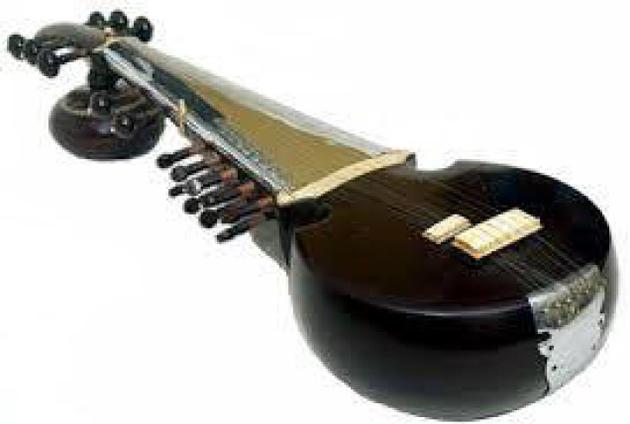
Radhubabu’s mohanveena.
Unfortunately, very few remember the history of the original mohanveena, conceived and invented by Radhubabu in early 1948! Once, around 1944, he played the surshringar in a jugalbandi (duet) with the famous beenkar (Rudra veena player) Ustad Sadiq Ali Khan in Lucknow. The concert inspired him to design a unique instrument in which the playable materials of both the sitar and the sarod could be appropriately exploited and the tonal quality of the Rudra veena could be equally maintained. Since he was proficient in both, having had his training from Ustad Mohammad Ameer Khan of the Shahajahanpur gharana and Ustad Inayat Khan of the Etawah gharana in the sarod and the sitar respectively, Radhubabu’s experiment succeeded.
The instrument’s majestic tonality impressed Thakur Jaidev Singh, the renowned musicologist who was then Chief Producer, All India Radio, Delhi. In 1950, Thakur Saheb named the instrument ‘mohanveena’ and also arranged an archival recording for AIR, followed by an extensive interview of Radhubabu, its inventor. Radhubabu was invited in several music festivals all over India to play the mohanveena. Some of his rare recordings for AIR archives are available in compact discs as precious documents.
So, despite the emergence of another, Hawaiian guitar-based instrument of the same name almost fifty years later, the original mohanveena exists along with its own unique excellence till date, through some of the devoted torchbearers of Radhubabu’s legacy. I am also a humble exponent of the mohanveena.
source:http://www.thehindu.com / The Hindu / Home> Features. Friday Review / by Meena Banerjee / February 27th, 2015
Satyajit Ray astonished me at our first meeting. I had trotted out various Santiniketan connections I expected him to know. He looked at me for a moment while I felt his brain darting through the lanes and bylanes of the genealogical network. Then he said, “You must be related to Bussa Susheila Das!” It was the last name I expected to hear from the Maestro. Bussamami – whose death last week, three years short of a century, must be counted a merciful release – was the most fashionable, Anglicized and probably richest of my relatives. In georgette and furs, sporting a long cigarette-holder, she was a vision of elegant grandeur, the Last Burra Memsahib. When I told her about Ray, she said, “It must be because of Keshub Sen!”
If so, the Brahmo Samaj meant more to Ray than anyone imagined. Although neither Bussamami nor her husband, Mohie R. Das, had set foot in a Brahmo temple for many years, she was Brahmananda Keshub Chunder Sen’s great granddaughter. She was also the great granddaughter of General Sir Edward Barnes, India’s commander-in-chief and governor of Ceylon. That connection was embarrassingly highlighted when Bussamami stayed with us in Singapore. On the day she arrived, the afternoon tabloid, New Paper, which normally confined itself to sensational local tidbits, went to town with an unexpected cover story on Barnes and his Ceylonese mistress. As governor, he lived in what is today Colombo’s Mount Lavinia Hotel from which a secret underground tunnel snaked away to his inamorata’s dwelling. Bussamami wasn’t disconcerted.
She had flown in wearing a saree. It was her habitual garb when travelling abroad she explained. “I get better service.” At one time people laughingly called her “Susheila please!” because of her strenuous but unsuccessful efforts to banish the Bussa nickname. She was indignant when a British Indian woman in Singapore asked why she didn’t have a British passport. “Why should I?” she retorted. “India is my home. I’m Indian. I have property there.” The patrial clause in British immigration law would at once have granted her British citizenship. But people like her didn’t need to emigrate to raise their living standards or become Westernized. They easily did both in India. Her sister, Moneesha Chaudhuri, whose husband was the first Indian head of Andrew Yule, the biggest British managing agency in India, and an army chief’s brother, was also like that. She once refused the then whites-only Saturday Club’s invitation to play the piano in a concert under her English mother’s maiden name. “After all, you could pass for English,” they pleaded. She didn’t take it as a compliment.
Singaporeans found it intriguing that Bussamami and I were related twice over. She and my mother were second cousins, great granddaughters of Annada Charan Khastagir, who presided over an All-India National Conference session in 1883, preparatory to the Indian National Congress being launched two years later. Her husband, Mohiemama, and my mother were first cousins, grandchildren of Bihari Lal Gupta, who was responsible for the Ilbert Bill, which led to the AINC and INC. She and her husband being related, the marriage presented difficulties: one version for which I can’t vouch was they went to French Chandernagore for the registration.
Mohiemama’s father, S.R. Das, founded Doon School. He himself was the first Indian head of Mackinnon Mackenzie, the Inchcape shipping giant. When he joined Mackinnon’s exalted band of covenanted hands (UK-based officers who had signed a contract with the company) in England, the Numbers One, Two and Three were known in inverse order as Three, Two and One. Those figures indicated their monthly salary in lakhs of rupees. Mohiemama’s ways were upper-class English, the legacy of public school in Britain and Cambridge. My son, Deep, quoted Bussamami in this newspaper (“Learning To Speak Like The Masters”, October 13, 2004) as saying when asked if her husband went to Mill Hill or Millfield school, “Mill Hill of course. Millfield was only for the post-war nouveau riche!” Being dark and heavily built, he borrowed a turban from Maharaja Sawai Man Singh II of Jaipur – husband of the beautiful Gayatri Devi, who was Bussamami’s cousin – to visit America in the Fifties. He enjoyed describing how he clamped the turban on his head before entering restaurants in the American Deep South.
They settled down in a gracious villa called Faraway in remote Coonoor. But their world straddled Calcutta, Darjeeling, Hong Kong, London and the south of France. Or rather, small gilded niches in all these places, with extensions to Simla, Colombo and Singapore. World War II and the 300 Club had lent zest to their cosmopolitan set. Not everyone could come to grips with this dizzy diversity. Raj Thapar, wife of Seminar magazine’s Romesh Thapar, betrayed her own provincialism by dismissing Bussamami in All These Years as “an erstwhile crooner”. Yes, she, Moneeshamashi and their only brother K.C. (Bhaiya or Kacy) Sen were all gifted musicians. In her youth, Bussamami had indeed given music lessons in Calcutta, and Moneeshamashi continued to do so for free at St Paul’s School, Darjeeling. But the sleaziness that Thapar’s comment sought to convey just didn’t go with the Ingabanga (Satyendranath Tagore’s term for Anglicized Bengalis) elite.
Kacy called his delightful memoirs The Absolute Anglo-Indian. He wasn’t “a person whose father or any of whose other male progenitors in the male line is or was of European descent, but who is a native of India”, which is how the Government of India Act, 1935, defines Anglo-Indian. Nevertheless, his was the culture of the Rangers Club, Grail Club and the club of which he says “if ever there was a place that separated the men from the boys, and no angels feared to tread, it was the good old Golden Slipper”. I was struck as a child by his imaginative wedding invitation, “Bridgette and I are going to be married at the Golden Slipper Club.” His Cavaliers was a popular band. He frequently compered at the Oberoi Grand Hotel’s open-air Scherezade night club, which occupied the space now taken up by the swimming pool.
He provided Ray with Devika Halder aka Vicky Redwood for Mahanagar “over a cup of tea on the verandah” of his flat. The voice off-screen in Mahanagar was Devika’s, but the song was a ballad, Time Gave Me No Chance, he had composed in his rowing days. Major Sharat Kumar Roy of the American army was an unusual wartime buddy and surely the only Indian to be commemorated by a mountain in Greenland: he discovered Mount Sharat. Laced into the light-hearted banter of Sen’s memoirs was the fear that the “Absolute Anglo-Indian” would become the “Obsolete Anglo-Indian”.
Bussamami built personal bridges to very different milieus. Cooch Behar, Mayurbhanj, Jaipur, Nandgaon and other royals, some also descendants of Keshub Sen, were relatives and intimates. When I mentioned the novelist, Maurice Dekobra, she told me she had known him as the Paris-born, Maurice Tessier. Axel Khan, whom I met as India’s ambassador in pre-unification Berlin, was another old friend. Rumer Godden produced a flood of memories, which were borne out by Ann Chisholm’s biography, Rumer Godden: A Storyteller’s Life. Her apology for arriving late for dinner with my wife and I in our Calcutta flat was that she had got lost in the suburban lanes to Kanan’s house. Kanan who? She meant the legendary star, Kanan Devi, whom the young Bussamami had taught her dancing steps in the Thirties. They had remained friends ever since.
The real burra memsahib didn’t need to keep up appearances. Neither did she have to try to be stylish. To adapt the Comte de Buffon, the style was the woman herself. There won’t be another like her.
source: http://www.telegraphindia.com / The Telegraph, Calcutta / Front Page> Story / by Sunanda K. Datta-Ray / Saturday – February 28th, 2015
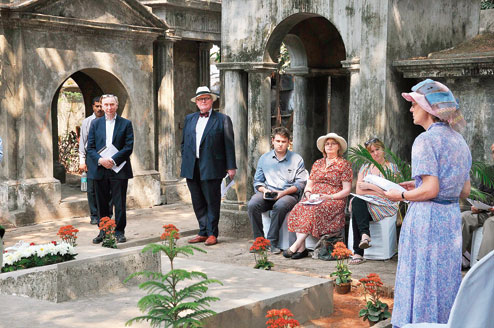
Lady Emma addresses the small gathering at the ceremony to dedicate the gravestone of her ancestor, Lady Anne Monson, at South Park Street Cemetery on Thursday morning. With her are Michael Dorrien Smith, Lady Emma Windsor-Clive, Isabella Monson (seated) and JM Robinson and James Miller (wearing panama). Picture by Anup Bhattacharya
Calcutta :
Sleepy, leafy South Park Street Cemetery could have turned into a scene from the TV series Downton Abbey on Thursday morning as a small group of Englishmen and women gathered at the twin graves of Lady Anne Monson and her second husband, Colonel George Monson, for a quiet and solemn ceremony as a chorus of koels sang incessantly.
The frail, behatted Lady Emma Monson was with her granddaughter Isabella, her friend, the youthful Michael Dorrien Smith, a descendant of Lord Clive – Lady Emma Windsor-Clive – and two friends, architectural historian J.M. Robinson and art historian James Miller.
Lord Clive was a British officer who defeated Siraj-ud-Doula in the Battle of Plassey in 1757 and consolidated the East India Company’s rule.
Lady Emma was there to dedicate a tombstone inscription to her ancestor, Lady Anne Monson, who was a botanist, an exceptional figure in the 18th century, and great granddaughter of King Charles II.
Charles II, king of Great Britain and Ireland (1660-85), was restored to the throne after years of exile during the Puritan Commonwealth, according to Encyclopaedia Britannica. The years of his reign are known in English history as the Restoration period.
The genus Mansonia was named by Swedish botanist Carl Linnaeus in honour of Lady Anne. Colonel Monson was a member of the Supreme Council of Calcutta and an enemy of Warren Hastings. He died six months after his wife in September 1776. An inscription above his tomb was erected in 1908 by the Calcutta Historical Society. But Lady Anne’s tomb remained without an inscription. Both graves are quite nondescript by the monumental standards of this cemetery.
A wreath was laid on the spruced-up grave and newly inscribed tombstone by Ranajoy Bose, executive member, Christian Burial Board, with Ash Kapur, president of the Association for the Preservation of Historical Cemeteries in India, Bertie Da Silva, vice-principal of St. Xavier’s College, and Christina Mirza, who heads the English department of the college. Lady Emma said in her address that when she first visited Calcutta in 2012, both graves were in ruins and she wished to restore them. So she got in touch with the British Association for Cemeteries in South Asia (BACSA).
She thanked all concerned for refurbishing them. Both graves have been restored by an accredited architect and its surroundings have been cleared and neatly marked with brick dust. The service was conducted by Reverend Nigel Pope, vicar of St. Paul’s Cathedral.
source: http://www.telegraphindia.com / The Telegraph, Calcutta / Front Page> North Bengal> Story / A Staff Reporter / Saturday – February 14th, 2015
When a 73-year-old woman stepped into Mayer Bari — Maa Sarada’s house at Bagbazar — everybody was busy with their daily chores. Sight of tourists is nothing unusual for them. But when they came to know that the lady was actually the grand-niece of Sister Nivedita, there was no leaving her alone. For rest of the day, a strong crowd milled around Selenda Margot Giardin, who came all the way from Newbury at Vermont in the US. By evening, it was a day well-spent for Saradha Math monks, students of Nivedita School and Selenda as well.
“I am fascinated. I feel like a celebrity,” beamed Selenda, who was the centre of attraction at Sarada Sarani on Monday. The pangs of Parkinson’s and acute arthritis could not dissuade Selenda from embarking upon the long journey in quest of “truth, love and God”.
Selenda didn’t know how to react when people touched her feet. Anushuya, a student at Nivedita School where Selenda led a prayer, said: “For us, it’s like being with Bhagini Nivedita herself.”
Some found the same eyes in Selenda, who shares her middle name (Margot) with her Irish grand-aunt Margaret Elizabeth Noble, whom Swami Vivekananda christened Nivedita. “My middle name is ‘curiosity’. From the age of seven, when I first read at the church that ‘God is Love’, I have been curious about God. The search continues…and now I am here, searching…” reminisced Selenda, who runs her choir at the United Church of Christ at Vermont.
The septuagenarian will be attending a host of programmes over the week. She will spend two days at Belur Math before flying back to the US on Saturday. Her son John Grow is accompanying her.
Selenda let out more about herself and the Nobles as she spoke to TOI: “Ever since I was a child, I remember my mother, Isabel Noble, telling me stories of her aunt who pursued her quest for truth and worked for the people living in this faraway land.”
She gifted the monks of Sarada Math the handwritten notes by Sister Nivedita circa 1909 and a replica of Michaelangelo’s Pieta, which Sister Nivedita had gifted Selenda’s mother Isabela. These items will be on display at the upcoming Nivedita Museum inside Nivedita House.
Mayer Bari head Swami Viswanathananda said: “Selenda’s amazing. We never imagined that a descendent of Sister Nivedita would come here after all these years.” Another monk Prabuddhaprana shared the euphoria: “We are glad to discover the Sister’s family at last.”
source: http://www.timesofindia.indiatimes.com / The Times of India / Home> City> Kolkata / by Ajanta Chakraborty, TNN / February 17th, 2015
Barshan Seal bagged the best actor’s prize end-January at North Carolina State’s Global Film Festival 2015 for his performance in ‘Nabalok’ (The Innocent). A couple of days ago, the production team of ‘Bodhon’ got an official notification that it has got the ‘best film’ and lead actor Arpita Chatterjee has bagged the ‘best actress’ award. With this, all three top awards at the American festival has come to Bengal.
“It was an official selection in Indian Panorama at IFFI, too, and that was prestigious as well. But this double award is a big boost too,” said debutant filmmaker Ayananshu Banerjee, who got top ranks in both Madhyamik and Higher Secondary before graduating from IIT-Kharagpur.
For Arpita, it’s welcome news. “An award doesn’t define an artist. It’s a nice feeling and it will help me strive for perfection. It will be a driving force,” she said. Asked if the limited number of films she works in is a conscious decision, she responded: “I don’t do films out of financial compulsion. So this acts as an elimination process. Also my priority is my son, so I keep my schedule tuned to him.” ‘Bodhon’ is a film about a woman on her journey to rediscovering motherhood.
Arpita said her long-term plans include returning to the theatre stage. “I’ll wait for a good film script. And, in the next five years, I will be able to devote a good portion of my time to theatre. There are several young theatre groups coming up which are doing good work. It’s a very good time to be in the theatre world and theatre has always been an integral part of Bengal. It’s where any actor gets the best ground to hone his or her skills. It is equivalent to what ‘riyaz’ is to a vocalist,” she told TOI.
Asked about the state of affairs in Tollywood, she exclaimed: “A large number of films are releasing now, but the market space hasn’t increased. Some halls have shut down. This is a terrifying situation. We have to increase the number of halls, be it single-screen or multiplex. Because of lack of space, there is no breathing space for films releasing in quick succession.”
source: http://www.timesofindia.indiatimes.com / The Times of India / Home> City> Kolkata / by Shounak Ghosal, TNN / February 12th, 2015
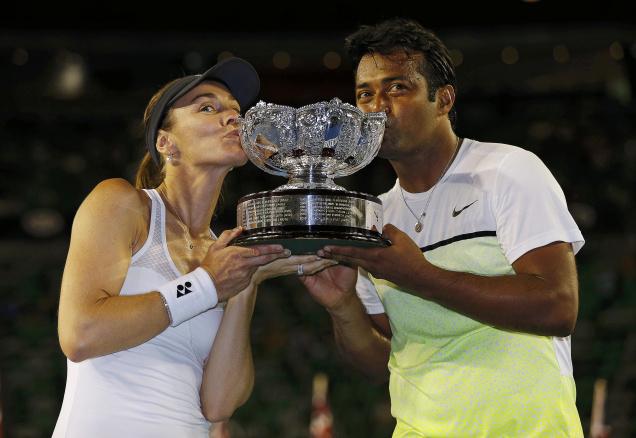
Leander Paes in his long and illustrious career has played with nearly 100 different partners in doubles and recently with Martina Hingis
There seems to be no expiry date on Leander Paes career. At 41, he is going as strong as ever, picking Grand Slam titles almost at will stunning the game’s pundits, few whom were willing to write him off as a potent force in the doubles. The Indian ace enthralled, legion of his supporters and proved his detractors wrong when he won his record 15th Grand Slam doubles title at the recent Australian Open, partnering game’s another great, Martina Hingis in the mixed doubles event.
It took all the persuasive charm of Leander to get the Swiss ace and former Women’s World No.1 Martina Hingis, who came out of retirement in 2013, to team up with him and as he says, “it took almost two years.” And when it happened, it was sheer magic. The two champions produced vintage tennis to win the mixed doubles crown.
Incidentally, Hingis had won a mixed doubles title at the Australian Open in 2006 pairing with Mahesh Bhupathi, Leander’s former men’s doubles partner. But winning with Leander Paes indeed has been a special moment for Martina Hingis, who had won three singles (from 1997 to 99), four doubles and two mixed doubles titles at the Melbourne Park. It was Leander Paes’ third Australian Open mixed doubles title and he had earlier won it in 2003 with Martina Navratilova of the United States and with Cara Black in 2010. In a career tally of seven mixed doubles titles, he has won three with Cara Black of Zimbabwe, two with Martina Navratilova one with Lisa Raymond of the US and now with Martina Hingis. In men’s doubles, he has won Grand Slam titles and maximum of three with Mahesh Bhupathi.
A delighted Martina Hingis, called him as a ‘perfect patner’ while Leander, acknowledged her role saying “we had a great chemistry and understanding”.
Leander Paes in his long and illustrious career has played with nearly 100 different partners in doubles, ranging from legend like Martina Navratilova (in mixed doubles) to a relatively unsung Vishnu Vardhan (men’s doubles). With whomsoever he plays, Leander has the ability to transfer his kinetic energy and positive attitude to his partner and that’s one of the main ingredient of his success in doubles. Leander also makes sure that his weakness, such as lack of a very powerful serve, is compensated by a strong partner, who serves strongly and a great hitter, such as Mahesh Bhupathi and Radek Stepanek
There is lot more to it in doubles, than finding a good partner. The well-known tennis coach, M. Krishna Kumar of Kinesis, who is a USPTR certified Professional and an avid admirer of Leander’s game, lists Leander’s lightning fast reflexes and good court craft as his big asset. Krishna Kumar also picks up Leander’s uncanny court craft as big plus point. “He has an exquisite court craft and Leander has the ability to pick the ball and find the right gap and angle to put it away for a winner. For that you need speed and timing and he has that ability to do that with an amazing ease,” says the coach.
Leander is a great team man, adds Krishna Kumar. “In doubles you need to complement each other well and communication is very important and Leander does that very effectively with all his partners.” Tennis fans in Bengaluru had a great time during the Davis Cup match against Serbia few months ago, watching Leander turn a losing doubles tie into a winning one with Rohan Bopanna. Two sets down, the Indians came back from cold to win that tie, with Leander taking charge of the show from the third set. Though Leander and Rohan won the doubles tie, India lost the rubber 2-3. But Leander made that doubles contest a memorable one. That never-say-die and taking charge in crunch situations makes Leander arguably the best doubles player in the World.
As years roll by, Leander’s magical show goes on and on.
source: http://www.thehindu.com / The Hindu / Home> Features> MetroPlus / by Kalyan Ashok / February 08th, 2015
Leading physicists from around the world will analyze CERN experiments and theories over the next three days at a conference — ‘India’s International Collaborations In Physical Science’ — to be held in the city.
Sessions will review and dissect CERN experiments and chart out a future course of action. They will also discuss theories thrown up at CERN, according to scientist Bikash Sinha, a former director of the Saha Institute of Nuclear Physics (SINP), which played a key role in getting India involved with the CERN experiment.
“CERN has thrown up hundreds of theories that will dictate particle physics in years to come. Scientists who will be here have been directly associated with CERN from its inception and it will be a good opportunity to listen to them. Indian scientists will have a rare opportunity to collaborate with them,” said Sinha.
Among those who will join the conference are Horst Stoecker, the director general of GSI Darmstadt, Johanna Satchel, a recipient of the Lise Meitner Prize, CERN director Rolf Heuer and CERN spokesperson Jurgen Schukraft. Larry McLerran, professor of theoretical physics, Brookhaven National Laboratory and a recipient of the Herman Feshbach Prize, will also attend the conference.
Heuer is arguably the biggest name on the guest list. An outstanding experimental physicist, he has been the architect of the leadership of CERN’s experiments with LHC, which led to the discovery of the Higgs Boson.
Several renowned Indian scientists will also share the dais. Notable among them are Siraj Hasan, a former director of the Indian Institute of Astrophysics, Rakesh Bhandari, a former director of the Variable Energy Cyclotron Centre and Dinesh Kumar Srivastava, an outstanding theoretical physicist and Sibaji Raha, director of the Bose Institute and S N Bose Centre, Kolkata.
Though the science community in the country is upbeat about the conference, India’s status at CERN remains unclear, according to Sinha. While the community has been trying hard to elevate India to the grade of an associate member at CERN, the government clearance is yet to come through. “Even Pakistan is an associate member now. We deserve to play a greater role now,” said Sinha.
source: http://www.timesofindia.indiatimes.com / The Times of India / Home> City> Kolkata / TNN / February 03rd, 2015