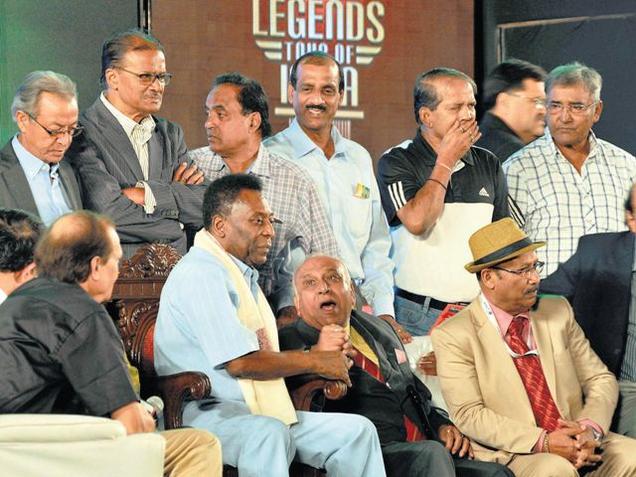
DOWN MEMORY LANE: Players from the Mohun Bagan team that hosted Pele way back in 1977 had a great time getting reacquainted with the Brazilian legend in Kolkata on Monday. Photo: Ashoke Chakrabarty / The Hindu
Felicitates the 1977 Mohun Bagan team, shares special moment with Rahman
Football legend Pele had an evening to remember as he renewed his acquaintance with the players of the Mohun Bagan team which hosted him in 1977.
Pele feted all the 13 players and coach P.K. Banerjee who were present to receive the honour from the greatest footballer on earth at the Netaji Indoor Stadium on Monday evening. Subrata Bhattacharya, the captain of the Bagan side then, called in his players to be felicitated by the owner of three World Cup crowns. The others players included the likes of Shibaji Banerjee, Prasoon Banerjee, Gautam Sarkar, Bidesh Bose, Shyam Thapa, and Pradip Choudhury.
Prasoon, the younger brother of P.K. Banerjee, asked Pele who he thought was better: Diego Maradona or Lionel Messi? “Both have the same style and are great players, but Maradona was a more complete player than Messi. For the last 10 years, Messi is the best player the world has seen,” said Pele.
Machine closed!
Asked whether the world would see another Pele, the legend quipped, “My mother and father have closed the machine.”
Pele also had a special moment with internationally-acclaimed music composer A.R. Rahman, who has scored the music for a biopic on the Brazilian great which is yet to be released.
“I am zero on sport, and know only names like Kapil Dev and Sachin Tendulkar. I have composed the music for Pele’s biopic without even knowing him. But, when I saw the ‘rushes’ of the movie, I cried thrice,” said Rahman, after meeting the legend.
“I wanted to see the real Pele. He is such an amazing personality, a great inspiration. All my musician friends were envious when they came to know that I was doing the music for Pele’s biopic,” said Rahman.
Rahman sang ‘happy birthday’ for Pele, who turns 75 on October 23. The Brazilian also cut a cake, shaped like the Jules Rimet Trophy, which he helped Brazil retain forever after becoming the world champion for the third time in 1970.
West Bengal Chief Minister Mamata Banerjee and former India cricket captain Sourav Ganguly were present on the occasion.
source: http://www.thehindu.com / The Hindu / Home> Sport> Football / by Amitabha Das Sharma / Kolkata – October 13th, 2015
Among the stories of torture, loot and oppression that the British left behind for us, one of the most common is that of how the thumbs of muslin weavers from Bengal were chopped off to wipe out the ancient art form from the face of the country. Muslin has since then been an item only to be seen in museums across the world.
A fine cotton textile making art that originated in India in the ancient times, with the maximum concentration in Bengal, and proliferated under Mughal patronage since the 17th century, muslin died an unnatural death when the British decided to smother it so that they can bring in their own mill-made textiles from Manchester to India.
Recently, the West Bengal chapter of Crafts Council of India has taken up a project to revive the art of muslin making. It started in 2010 and now weavers who were being re-skilled for producing muslin, have finally been able to reach an enviable thread count of 500.
After the Mamata Banerjee government came into power, the state micro, small and medium enterprises department also started thinking on how the fine textile making art can be revived in Bengal. The MSME department scouted for experts in villages across five districts of the state where muslin used to be produced traditionally. In this manner, some 793 weavers’ families were chosen from Birbhum, Murshidabad, Nadia, Bankura, West Misnapur and Burdwan, who had all been connected with muslin making some generations ago. The state government encouraged them to take to the art once again.
When the thread count reached 300 last year, muslin made by weavers under MSME made its way to the government’s Biswa Bangla Haat. MSME department is trying its best to increase the count further because the higher the count, the better is the quality of muslin.
During the time of the Mughals, muslin weavers from Dhaka were able to reach a count of 1500. Samples of these are available in museums across the world. A 500 count means that the two threads crisscross each other to create a mesh 500 times in the span of a square inch. “It all started quite by an accident. An American advertising honcho, Anne Johnson, had visited us with inquiries about muslin and whether any efforts were being made to revive it. She was fascinated with muslin and was even prepared to fund it if we took up a revival project, which we eventually did at a cost of Rs 70 lakh,” said Ruby Pal Chowdhury, who heads the Crafts Council of India here.
The Crafts Council project took place in Kalna, where master weavers, who are otherwise associated with the production of khadi yards under the aegis of the Khadi and Village Industries Commission (KVIC) of the central government and West Bengal Khadi Board (WBKB), kept experimenting with spinning of the yarn with the right thickness out of cotton sourced from Gujarat.
“Once the yarn is spun, it has to be soaked in starch made of kolma or dohor nagra varieties of rice. The water used is essentially rain water to keep the solution soft. There is no formula for this, these are part of family knowledge that are being gradually recalled through re-skilling,” said Pal Chowdhury.
The weavers of the council have not only been able to weave muslin yards but also entwine antique jamdani motifs in it. These have been christened as muslin jamdani and a pure saree woven thus costs nothing less than Rs 20,000. These creations are now available for viewing at Artisana, the council’s outfit at Chowringhee Terrace, while a mega debut is also being planned.
Considering the huge expense that such revival incurs, the council is also trying to tie up with Biswa Bangla to take the revival issue a step forward.
“We would welcome this because the final aim is to bring back muslin to its original glory. That will be possible only if we are able to keep giving incentives to weavers to sacrifice other commercial interests and concentrate on spinning finer yarns and then weaving finer counts,” said Sinha.
source: http://www.timesofindia.indiatimes.com / The Times of India / News Home> City> Kolkata / by Jhimli Mukherjee Pandey , TNN / October 11th, 2015
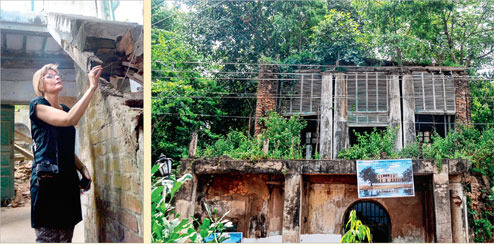
Bente Wolff, curator of the National Museum of Denmark, on Tuesday morning inspects the staircase of what was once the Denmark Tavern; (right) the Hooghly-facing facade of the tavern which will restored soon. Pictures by Pradip Sanyal
As our car tried to wriggle through vehicle-clogged Rishi Bankim Sarani of Serampore on Tuesday morning, I noticed that somebody has tried to prettify the miserable Subsidiary Correctional Home opened in 1803 by the rulers of this former Danish colony (1755 to 1845).
It was a modern institution based on humanitarian ideals and the then administration had taken into account the health problems, religions and caste system prevailing in India while planning it. And now its high walls are painted a blinding cobalt blue. A model park will soon be opened on the pavement in front of this jailhouse, and replicas of Chhota Bheem and other such cuties have been installed there.
In a few minutes we arrived at the ruins of what was once the double-storeyed Denmark Tavern & Hotel, where a ground-breaking puja was to be performed as the National Museum of Denmark will take it up for restoration. It is on the banks of the Hooghly, and Nishan ghat in front of it lies on the main axis connecting the main landing place near the ghat with the Government House, the seat of the former Danish government.
The museum had launched the Serampore Initiative in 2012 and took up the restoration of St. Olav’s Church (1806), whose steeple can be seen from Barrackpore on the opposite bank of the Hooghly; the south gate, once the guard house and used as a police lock-up as well facing Tin bazaar, then the main market; the main gate of the compound that houses the sub-divisional court.
It has acted in an advisory role in the restoration of what was once the old single-storeyed, colonnaded Danish Government House (1771) or Governor’s House. This compound dates back to 1755, when the Danish Asiatic Society Company established a trading post in Serampore.
The West Bengal Heritage Commission, which had taken up restoration of the Governor’s House, now exists only in name – most restoration work has come to a standstill. And the state government has made it clear built heritage is not uppermost on its mind.
However, Bente Wolff, curator, National Museum of Denmark, who is here to inspect the work being done by conservation architect Manish Chakraborti under the supervision of Intach, has good news.
Wolff has visited this town several times since the Serampore Initiative was launched and spends much of her time in the corridors of power to keep the dialogue with the government going. She has been in and out of Nabanna and the Chinsurah district magistrate’s office, and she has been informed that a tender will be floated soon for the last phase of the restoration work on the Governor’s House.
The cost of the ongoing projects: St. Olav’s Church and the South gate will be around Rs 3.5 crore when they are completed early 2016; the Denmark Tavern will be Rs 2.5 crore at least. The cost of restoring the main gate and some upgrading of the square in front of St. Olav’s Church and the court compound has not been estimated yet.
Wolff said the final phase of the Government House was kept in abeyance for a long time and its plinth will have to be constructed. An effort will be made to free the natural ventilation system. The government election building between the Government House and the South gate had to be demolished, which was not an easy task.
About Denmark Tavern & Hotel, Wolff said a painting of the establishment dating back to 1790 exists. The tavern found a mention in the March 1786 issue of Calcutta Gazette. According to the news item, Mr Parr, former owner of London Tavern, opened the Denmark Tavern & Hotel in the upper-roomed house near the flagstaff in Serampore.
It had a billiard table and coffee room, drinks were served and it did catering for wealthy people. The exact location of the hostelry was not known, but after examining archival sources, historian Simon Rasten came to the conclusion that it was adjacent to the SDO’s residence.
The rear section of this pile of bricks was used by the police, and a sign on the gateway reads Serampore Emergency Force Line, West Bengal Police. Once restoration work is done it will be handed over to the tourism department of the West Bengal government, which is expected to turn it into a coffee shop.
Chakraborti says it will take one-and-a-half months to clean the debris, and work will start in December. The central space will be an atrium for light and air, and accommodation for five to six guests will be provided. The Danish architect, Flemming Aalund, will be here in November to fine tune the work done.
G.M. Kapur, state convener of Intach, says he hopes this will become a nodal point and catalyst for such restoration projects and give a fillip to tourism in West Bengal.
The dilapidated main gate of the sub-divisional court dates from the late 18th century and has a high historic significance as part of the shared Indian-Danish heritage. Early drawings and photographs exist of the gate. These are being used for the restoration project. The cost will be defrayed by the National Museum of Denmark, and it will be reconstructed complete with a pediment and rustication to the original appearance based on verified evidence in 1851.
Restoration of St. Olav’s Church is in the last stages. The timber of the roofs in the ceiling has been replaced with steel beams and it will be opened for service next February. This is the historic core of the town, and the bus terminus is being relocated. Ideally, the square in front of the church should be cleared of the heart-shaped enclosure. The trees that obstruct the view should be transplanted elsewhere for a clear view of the magnificent church.
source: http://www.telegraphindia.com / The Telegraph, Calcutta,India / Front Page> Calcutta> Story / by Soumitra Das / Thursday – October 08th, 2015
The 28th Japanese language speech contest of eastern India will be held at Kalakunj Auditorium in Kolkata on October 10. Forty one students from various institutes will be participating in the contest which will be organised by Consulate General of Japan in Kolkata in collaboration with Indo-Japan Welfare & Cultural Association.
Winners from the eastern zone will get a chance to participate in the all-India speech contest to be held in New Delhi. Students winning at the national level may get a grand opportunity to go to Japan.
MOSAI, an initiative of the Japanese consulate, started the all India speech contest in 1985. The first round of contests (Zonal Contests) is held in North, South, East and West Zones and the finals will happen in Delhi. Students can participate either in junior or senior category depending upon the level of training in the language. Candidates are nominated by the organisation where he/she is learning Japanese language.
The speech contest is meant to encourage students to express spontaneously their own thoughts in Japanese language. It is not merely a memory test of a written speech. This is followed by a round of questions from the judges.
Mr Kazumi Endo, Consul General of Japan in Kolkata, will address the occasion and will hand over the awards and certificates to the successful contestants Gouri Bakshi, General Secretary, Indo-Japan Welfare & Cultural Association will also grace the occasion.
source: http://www.timesofindia.indiatimes.com / The Times of India / News Home> City> Kolkata / by Jhimli Mukherjee Pandey, TNN / October 09th, 2015
The Hooghly isn’t just an Indian river but belongs to the world, historian and international authority on heritage conservation Philip Davies said at a seminar on heritage based urban development for the Hooghly riverfront held in the city on Wednesday.
Referring to the former European colonial posts—the Portuguese settlement in Bandel, Dutch in Chinsurah, French in Chandannagore, Danish in Serampore and Engligh in Barrackpore—along an 80-km stretch of the river’s western bank, Davies said the West Bengal government could source funds from the European Union as well as the World Monument Fund to revitalize these heritage precincts.
“The built heritage of West Bengal is greater than the entire United States and can be a powerful economic driver for the state,” Davies said while pointing out that much of it was crumbling and needed immediate repairs.
Conservation architect Manish Chakraborti agreed that the Hooghly riverfront heritage had an outstanding universal value and felt the way forward was to put it on the Unesco tentative list for world heritage sites. “Once it is on the list, the goal will be set. We can all then strive to achieve it,” he reasoned.
But stitching together a site that extends nearly 80 km along the river bank and covers Dalhousie Square, the central business district of a bustling metropolis like Kolkata, isn’t easy. This is particularly so about Kolkata and Bengal where things move at a snail’s pace.
Davies and architect Partha Ranjan Das have had a taste of it in the past. While it took Moe Chiba, the section chief and programme specialist (culture) Unesco, nine years to bring all stakeholders, including Kolkata Port Trust, Railways and PWD, on a single platform, Davies had prepared a blueprint for restoration and development of the Strand Warehouses in Kolkata 12 years ago but it is yet to take off. Das, too, had prepared a land use development plan for the entire heritage stretch along Hooghly but it has been gathering dust as well.
“There has been enough talk. It is time for decisive action,” Davies said at the seminar organized jointly by Unesco, the state government and non-government organization Indian Heritage Cities Network. “The inertia here is frustrating when compared to what is happening elsewhere. Kolkata has been extremely slow in taking advantage of its heritage resources. The delay could lead to destruction of what is unique. Already, one of the warehouses has been lost. Letting the warehouses rot is a dreadful waste of opportunity. In the past 50 years, they could have fetched crores of rupees in income and generated many jobs. Political will is needed to drive such an initiative. The involvement of chief minister and mayor is crucial,” he said.
While the heritage precincts in the erstwhile colonies have been identified and some restoration work funded by Dutch and Danish governments has already begun, Davies suggested that one of the options to fund the initiative could be to use cross-subsidy.
“There are areas along the riverbank that can be developed by private parties. The development will be in sync with the overall master plan. The funds generated from these projects can go into restoring the heritage zones and bringing them back to life,” he said.
source: http://www.timesofindia.indiatimes.com / The Times of India / News Home> City> Kolkata / TNN / October 04th, 2015
Mathematicians all over the world have been trying to solve a 150-year-old problem, popularly called the Holy Grail of maths, and a city mathematician has just been able to give a major insight into it. Ritabrata Munshi has stunned the world and no wonder, he has bagged the Shanti Swarup Bhatnagar award.
A number theorist, Munshi, who has taken lien from TIFR, Mumbai, to join his alma mater Indian Statistical Institute as faculty, seemed unfazed by all this adulation. In fact, one could sense an urgency in his voice, an urge to carry on with the third degree of the Lindelof hypothesis, which is the route that he is taking along with his co-researchers abroad to finally progress on the line of the ever elusive Reimann hypothesis that was formulated in 1859 by Bernhard Riemann.
It took 60 years to solve the first degree of the L theory and progress on to the second degree that again took 35 years to be resolved. Finally, Munshi has been able to make a global start on the third degree and make a considerable progress.
“The properties of prime numbers, their distribution pattern in the realm of the abstract simply bowled me over and I made up my mind to study maths after plus two despite ranking 25th in the WBJEE and under 400 in IITJEE,” said Munshi. He studied B Stat and M Stat at ISI and then enrolled for Phd at the Princeton University under legendary mathematician Andrew Wiles. He enrolled at Rutgers University, US, for his post doctoral degree.
source: http://www.timesofindia.indiatimes.com / Times of India / News Home> City> Kolkata / by Jhimli Mukherjee Pandey, TNN / September 30th, 2015
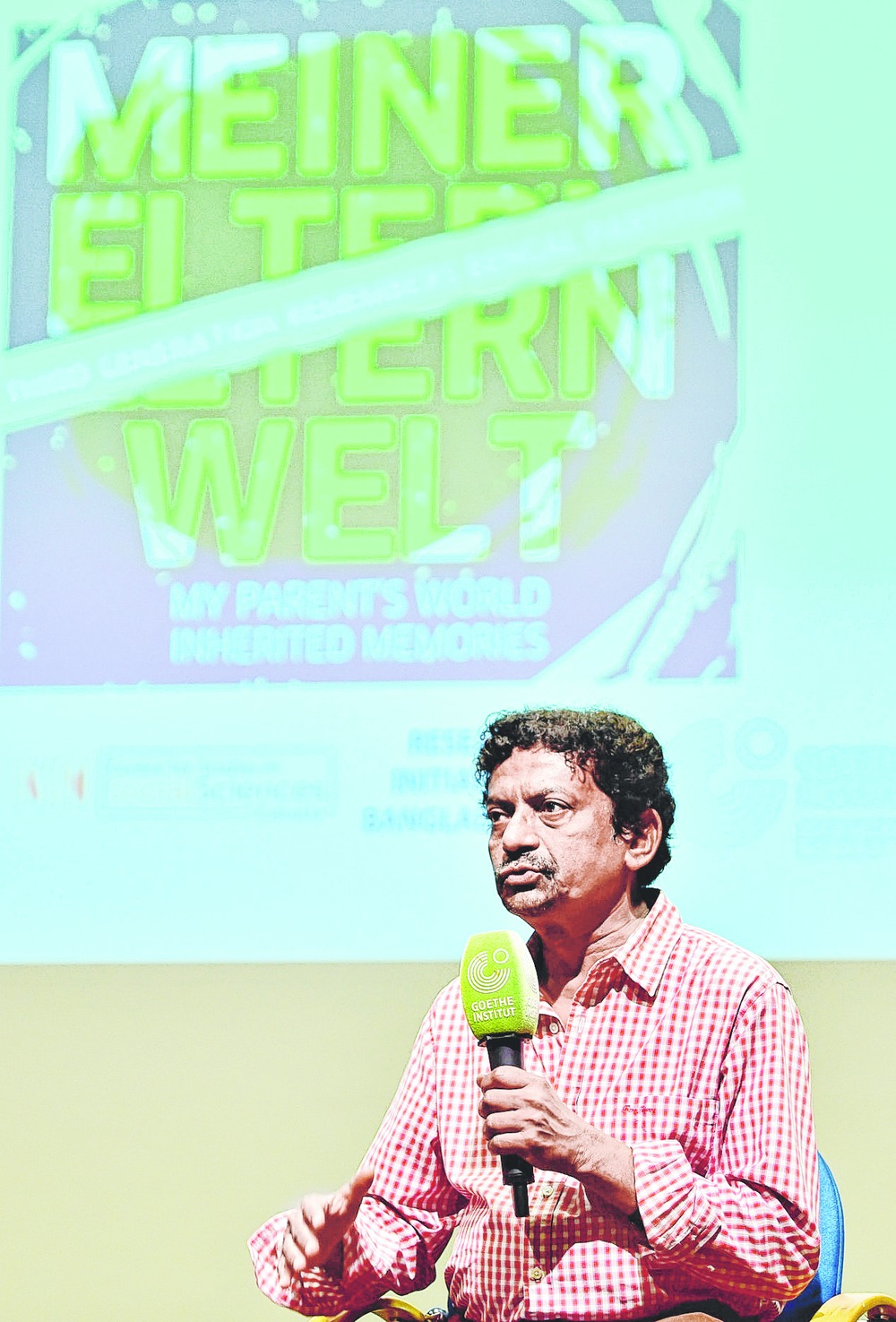
Goutam Ghose at the conference in Max Mueller Bhavan. (Anindya Shankar Ray)
Director Goutam Ghose often wondered as a 10-year-old why his friends could visit their desher bari during vacations while he could not.
“I remember asking my mother if we have a gramer bari. She would say, ‘achhe, but it is in East Pakistan and we don’t have easy access’,” Ghose said during a recent conference at Max Mueller Bhavan.
The conference kicked off a five-month Indo-Bangladesh project titled My Parent’s World – Inherited Memories, organised by Calcutta and Dhaka’s Goethe Institut.
Ghose narrated how he used to accompany his grandmother to refugee colonies in the Jadavpur and Bijoygarh areas to meet relatives. “I remember my grandmother telling me stories…. When I became a filmmaker, I thought let’s connect. Two races had been divided for a wrong reason. I wanted to go back to my ancestral home and make a film. So I made Padma Nadir Majhi and my father was really happy. He said he was happy that I had chosen the subject as I could go and shoot near the Padma.”
The conference saw speakers like Andrea Zemskov-Zuge from the Berghoff Foundation, Berlin; Manas Ray of the Centre for Studies in Social Sciences, Calcutta; Meghna Guhathakurta, executive director, Research Initiatives, Bangladesh, which works with the marginalised community; and former BBC journalist Nazes Afroz.
Ghose spoke about a village (Chakpanital) where he shot for his upcoming Indo-Bangla film – Shonkhochil. It is a village where there are houses of both sides and people live together.
“I find this two-nation theory absurd… that too on the basis of religion. While making the film, I was studying the Radcliffe Line. It is so strange… how on a huge water body you find a zigzag line separating two nations. Same people, same language, same culture divided by an absurd border. Why did Gandhi not launch a ‘Stop Partition Movement’ like the Quit India Movement?”
As part of the project, eight students from Calcutta travelled to Goethe Institut, Bangladesh, to meet eight students there. Together they will attend conferences and workshops on commemorative culture. “Once both sets of students are trained in interviewing techniques, they will interview third generation families of Partition on both sides of the border. People would be selected to travel to the country of their ancestors,” said Judith Mirschberger, director, Goethe Institut, Bangladesh. “So, someone living in Calcutta would travel to Bangladesh and vice versa to trace his/her family roots with these students.”
The project will end with the launch of a web platform where all interviews and background information will be put up.
From Shahid Minar in Dhaka to a memorial in Bhopal by a Dutch sculptor for victims of the Bhopal gas tragedy, Nazes Afroz, who is also the coordinator of the project, presented a slide show of pictures, while talking on the topic “Visual tool is very important in culture of memory”.
It was after a visit to Dhaka in February 2014 for an exhibition that Friso Maecker, the director of Goethe-Institut, Calcutta, started thinking about the possibility of working together. “I remember we were shooting a documentary film, which was about moving from one place to another…. There’s not been much research on the influence of Partition on third generation people in India as well as in Bangladesh…. Also from the viewpoint of an outsider… it is quite astounding that there is no memorial or place to remember the migration of more than eight million people… Which is why we started the project.”
source: http://www.telegraphindia.com / The Telegraph, Calcutta,India / Front Page> Calcutta> Story / by Malancha Dasgupta / Tuesday – September 15th, 2015
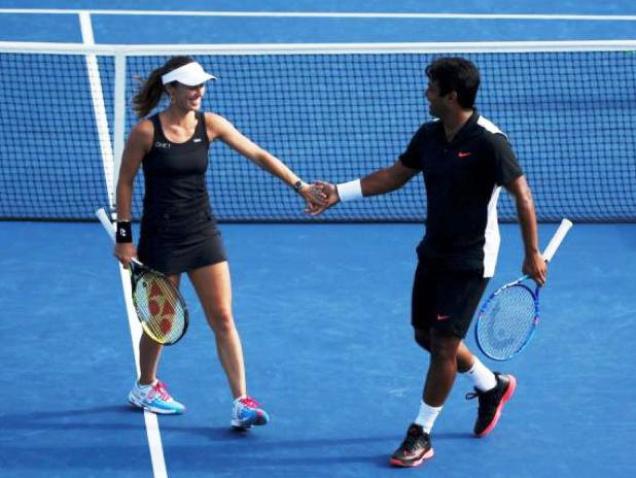
Martina Hingis celebrates a point with mixed doubles partner Leander Paes during their finals match against Bethanie Mattek-Sands and Sam Querrey at the U.S. Open tennis tournament in New York on Friday / Reuters / The Hindu
Paes now has nine Grand Slam mixed doubles titles, surpassing compatriot and former partner Mahesh Bhupathi’s record of eight.
Leander Paes created history by winning the U.S. Open mixed doubles title with Swiss partner Martina Hingis and surpassed compatriot and former partner Mahesh Bhupathi’s record.
The 42-year-old Paes now has won nine Grand Slam mixed doubles titles, against Bhupathi’s eight.
The fourth seeded India-Swiss pair, edged past unseeded Americans Bethanie Mattek-Sands and Sam Querrey 6-4 3-6 10-7 in a tricky final to win their third Major title together this season.
Paes is now only behind legendary Martina Navratilova, who won 10 mixed doubles trophies. Of those 10, two came with Paes, when they won Australian Open and Wimbledon in 2003.
With this win, Paes and Hingis, who also won Australian Open and Wimbledon titles early this season, have become the first mixed doubles team since 1969 to win three Grand Slam mixed doubles titles in the same year.
It was Paes’ 17th Grand Slam title overall and Hingis’ 19th. Hingis has won four Grand Slam titles and all of them have come with Indians. She won her first mixed doubles trophy with Bhupathi when they won 2006 Australian Open.
Hingis is also in the contention in the Women’s Doubles with Sania Mirza with whom she won the Wimbledon this year. They are up against Yaroslava Shvedova of Kazakhstan and Casey Dellacqua of Australia.
Paes and Hingis broke Mattek-Sands at love to take a 2-1 lead in the opening set as the Swiss miss hit a forehand passing shot to secure the break. That bit of momentum was all they needed, as Paes easily closed the set out at 5-4 when Hingis hit a volley winner.
A lone break of serve also decided the second set, as Mattek-Sands hit two straight winners to break Hingis’ serve as the Americans led 3-1. Hingis saved three set points on her serve at 2-5, but Querrey easily held in the next game to send the contest into a deciding super tiebreak.
The unseeded Americans were cruising as they created a 4-1 cushion when they won both points on Hingis’ serve to grab the first mini-break. But Hingis and Paes took the mini-break back on Mattek-Sands’ serve at the next opportunity.
The crucial point of the match came at 7-7, when Paes blocked Querrey’s serve for a clean passing-shot winner. He then won both points on his serve to close out the match, hitting an overhead winner on their first match point and then lifting Hingis in celebration.
source: http://www.thehindu.com / The Hindu / Home> Sport> Tennis / PTI / New York – September 12th, 2015
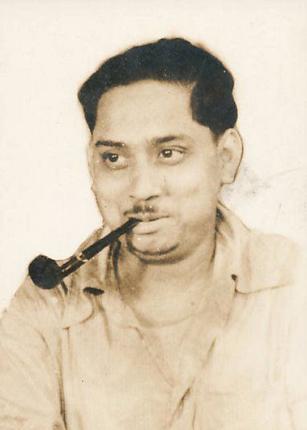
Nirmal Chandra Kumar / Special Arrangement / The Hindu
Nirmal Kumar was probably the first Indian bookseller to publish a rare books catalogue in the best tradition of bespoke antiquarians around the world.
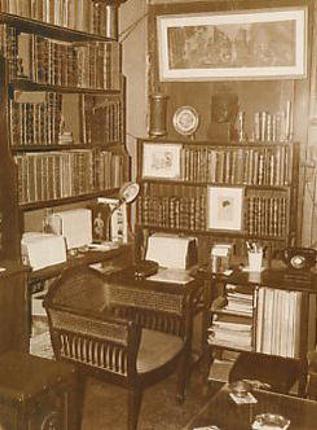
One can only imagine it today: a set of cosy rooms in an ancestral home on a busy street in Calcutta in the 1950s resembling a finely appointed private library with a complex of bookcases and furniture that was actually an antiquarian bookshop one could walk into for a browse and for long conversations with its bohemian-bibliophile owner. His name was Nirmal Chandra Kumar, and his bookshop was called, simply, Kumars. From 1945 until his death in 76, Kumar ran a rare bookshop from his home. It took up several rooms and the stock ranged widely, from fine bindings to prints to maps.
Kumar’s bookshop / Special arrangement / The Hindu
I first learnt about Kumar and his bookshop when I stumbled upon a blog by his son, Aloke Kumar, on his father’s bookshop and its influence on the life and work of many Bengali artists and intellectuals of that time who were all regulars at Kumars. I was delighted to discover there had once been such a marvellous bookshop in India — a genuine antiquarian bookshop in a country where antiquarian bookselling and buying is not an ingrained tradition. In this sense, Kumar was no doubt a maverick and thank God for that. Eager to know more, I managed to contact his son, Professor Aloke Kumar, for a brief chat on the phone.
In one of his writings, Kumar describes his father: “a stocky Bengali… he wore a white collared shirt, half-sleeved, and a lungi; his formal dress was a dhoti and kurta with pump shoes. Can you imagine somebody wearing this dress and smoking a pipe or a Davidus cigar sitting in his library surrounded by books?” Kumar was probably the first Indian bookseller to publish a rare books catalogue in the long tradition of all bespoke antiquarian booksellers around the world, especially the legends Kumar had done business with, Quaritch and Maggs. The city’s bibliophiles, artists, luminaries, antiquarians and bohemians all frequented Kumars. Satyajit Ray, a regular browser here, consulted Kumar when he was making The Chess Players: in a London book auction, Kumar had bid for and won a priceless scrapbook on the Mutiny.
Ray went on to pay his own little tribute to Kumar in the character of the encyclopaedic Sidhujata in the Feluda stories. Well-known antiquarian Sir Ashutosh Mukherjee was also a customer. When he donated thousands of rare books to the National Library, several books in the collection had once come from Kumars. “In the early 1940s,” writes Aloke Kumar, “rare book collection was in a dismal, class-bound rut. The famous rare book shop Cambray… was already fading, Thacker and Spink was alive, but there were hardly any rare books… Kumar helped to change all that. His enthusiasms included the then unheralded British painters, Thomas and William Daniel, to be re-introduced to Calcutta once more. He bought the rare elephantine folio of 144 Views of T&W Daniell from Sotheby’s to ship it to Calcutta.”
What was just as remarkable about Kumar — reading his son’s reflections — was how generously and freely he gave to his customers, friends and family even though the bookshop wasn’t a profitable business and . It just broke even most of the time, but Kumar, right in the middle of his struggles to keep the bookshop afloat and provide care for the needs of his own family, invited his parents (who had faced a financial loss) to come live with him. He was also apparently a gourmet and “organized the very best of fine cooking to be presented to his friends. Sometimes such delicacies that you would only find in the pages of some rare Mughal document.”
Aloke recalls a regular errand for his father: being sent off with books in hand to be delivered to Satyajit Ray; he also remembers how cautious everyone in the house was about handling the books, tiptoeing around the shelves, careful not to disturb them. One of the things that broke Kumar’s heart was the sharp practice in the antiquarian trade in the late 1970s of breaking up rare books, atlases and maps to make a bigger profit. Some of his fellow booksellers had begun to buy books with rare prints and maps and tear them up in order to sell each print or map individually. You made more money this way than when you sold the set or the atlas as a whole.
“Kumar did not want to be a part of this and lost out,” says Aloke. “And it was with a sense of bowing to the inevitable that Kumars mentally gave up. Nirmal Kumar died in 1976 and with his death, the literary world lost a sweet and genuinely unselfish man who freely gave of his vast knowledge and delighted in the achievements of those he influenced so profoundly.”
My interest in this impassioned, unsung bookman and his cherished antiquarian bookshop is not so much for the luminaries who once buzzed around it as much as for imagining the regular traffic of ordinary bibliophiles, scholars, and collectors for whom Kumars must have been a Mecca of fine and rare books.
Pradeep Sebastian is a bibliophile, columnist and critic.
source: http://www.thehindu.com / The Hindu / Home> Opinion> Columns> Pradeep Sebastian / September 05th, 2015
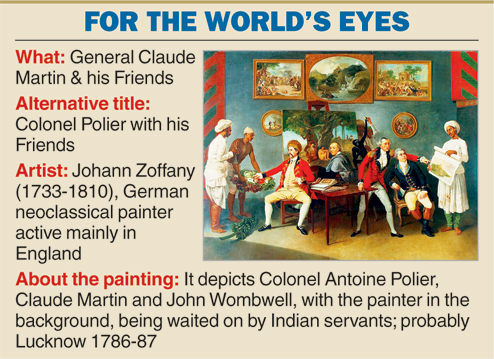
More than a hundred treasures from Victoria Memorial Hall, among them a painting by Johann Zoffany, will be showcased in a global online archive by Google featuring many well-known museums.
A team from Google was in the city last week, shooting at Victoria Memorial. A panoramic view of the inside as well as the outside area of the museum will also be available on the online platform.
Zoffany’s oil on canvas depicting General Claude Martin, the founder of the La Martiniere Schools, and his friends, will share space with paintings by European artists from 1770-1850-60, also known as Company Paintings, works of Thomas and William Daniell, Abanindranath Tagore, Jamini Roy, historic documents and Tipu Sultan’s handwritten and illustrated diary on the art of war and other treasures from Victoria Memorial on Google Cultural Institute, earlier Google Art.
Started by the tech giant in 2011, the institute is a not-for-profit initiative that partners with cultural organisations to make the world’s cultural heritage available online.
Victoria Memorial signed an MoU with Google Cultural Institute in 2013 and as part of the project 150 highlights of the museum would be found on the online platform. Fifty of these images will be available in ultra high-resolution images known as gigapixels.
“We are still deliberating on which 50 to choose. We are also planning to do a digital walkthrough of the museum,” said Jayanta Sengupta, the secretary and curator of Victoria Memorial Hall and Indian Museum. “The selection has to be balanced. We are choosing objects that are historically as well as visually attractive. The transformation into gigapixels of certain paintings, especially of the impressionist painters, will be extremely useful for art enthusiasts. Each and every brush stroke and intricacies of the paintings will be visible.”
The technology used by Google is expensive and patented. “Footfall at museums has been known to increase after digitisation. People are keen to check out the actual objects,” Sengupta said, adding that the Indian Museum would soon join Victoria for the project.
Courtesy the association with Google, Victoria Memorial can now put up exhibitions it is hosting on Google Cultural Institute. “We can select an exhibition, curate it and post on Google. Also, we can put up previews for our upcoming exhibitions,” Sengupta said. “Google is the most popular search engine. The project is not only beneficial for us but it also gives people a chance to go through our collection.”
Three museums from India – Crafts Museum, National Gallery of Modern Art and National Museum, all in Delhi – are already part of the association. Victoria and Google are aiming for a November launch, when a few more Indian museums will come on board.
The choice of German neoclassical painter Zoffany’s painting of General Claude Martin has made the La Martiniere family proud too. “This is a matter of pride and pleasure for us. We are delighted and it is a great honour for us,” said Supriyo Dhar, the secretary of La Martiniere Schools.
source: http://www.telegraphindia.com / The Telegraph, Calcutta,India / Front Page> Calcutta> Story / by Samabrita Sen / Saturday – September 05th, 2015