Category Archives: World Opinion

Kolkata girl creates underwater drone

Sampriti Bhattacharya

Kolkata :

At 28, she has created an underwater drone that can map ocean floors and explore the deep sea, where even GPS doesn’t work. Kolkata girl Sampriti Bhattacharya’s invention — the Hydroswarm — has been patented and is quite a rage with the defence sector and oil giants.

What’s more, Forbes has featured her among the top 30 most powerful young change agents of the world. Sampriti, who left the city about seven years back for her masters, is now a PhD scholar at Massachusetts Institute of Technology (MIT).

Hydroswarm was created as part of her research thesis. “Underwater navigation has been a reality for many years but for advanced searches you need maps that are as refined as, say, the Google map. This is where my drone comes in. It can map the ocean, sitting on its bed, and you can zero in on the minutest objects, living or non-living.

You can even map underwater pollution with the help of this drone,” said Sampriti, who was in Kolkata for a short while and returned to the US on Thursday. A South Point alumnus, she studied engineering at St Thomas College and did her masters in aerospace engineering at Ohio State University before switching to robotics at MIT.

She told TOI that she always wanted to create an underwater robot because there was no easy way to study the ocean floor. The only option was the very expensive remotely operated underwater vehicles generally used to track warships.

source: http://www.timesofindia.indiatimes.com / The Times of India / News Home> City> Kolkata / TNN / January 29th, 2016

Bengal school with Slovenia heart – Couple united by a calling

SloveniaKOLKATA01FEB2016

• Name of school: Piali Ashar Alo
• Where: In Piali village, around 27km from Calcutta
• Students: Underprivileged children
• Founders: Anup and Mojca Gayen
• Sponsors: Slovenian schoolchildren and various other individuals and families; two German NGOs

A bright village boy who might have been grazing cattle had a German lady not funded his education is giving many others a shot at education through a school he and his Slovenian wife have set up with donations from Europe.

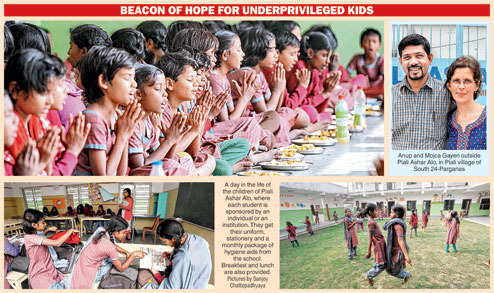
Anup and Mojca Gayen’s Piali Ashar Alo, in Piali village of South 24-Parganas, isn’t just an extraordinary act of charity. It is a mission spanning continents and small contributions – from Mojca digging into her personal savings to provide Rs 12,000 as seed money to students of 30 schools in Slovenia collecting newspapers over two years to sell them in bulk and raise Rs 4.5 lakh for a plot of land.

The school, which had started out from a rented space in February 2008, has since gone from a class of 12 students to a roll call of 140, mostly children of daily-wage earners, van rickshaw-pullers, fisherfolk and brick kiln workers. Most of the students are girls.

The genesis

Anup, 45, had always wanted to do something for the underprivileged, a feeling that found an echo in wife Mojca, 38. She was on a six-month internship in India in 2006 when she decided to leave her job as a psychologist in Slovenia and stay back.

“If there is no education, children of the poor will continue to remain poor. I believe that if not all, at least 50 per cent of our students will grow up and stand by another poor child,” says Anup.

In the early days, Anup and Mojca would go from door to door to convince parents to send their children to Ashar Alo. The school still sends teachers to homes in the village, but only to ensure that the seats are filled by children who wish to study.

Each student, from kindergarten to Class VII, is sponsored by an individual or an institution, most of them based abroad. They get their uniform, stationery and a monthly package of hygiene aids from the school. Breakfast and lunch are provided too.

The school has two floors with open-plan classrooms and a playground spread across a bigha and two cottahs of land. The building was designed by a Slovenian who was then studying architecture and had spent a year in Piali observing the place, its people and climate.

“He took note of how most villagers spend a lot of time on the verandas of their home and felt that his design should reflect that. So we have open classrooms,” explains Mojca.

The playground bustles with energy during a break between classes, badminton and skipping being the students’ favourite activities. This they are allowed to do only after they have finished their meal and cleaned up, for etiquette and discipline are as important at Ashar Alo as learning to read and write.

The school also teaches its students to dream. Twelve-year-old Sanchita Mondal’s father earns a living as a hawker on local trains, but she aspires to be a doctor. She is one of three students from Ashar Alo who now go to a CBSE-affiliated English-medium school in Sonarpur, about 5km away.

“We are not from rich backgrounds but the importance of education was obvious to our families when we were young. But the importance of education is not obvious to many in Piali,” says Mojca.

Ashar Alo’s focus is on educating girls, although the school remains a co-ed institute. “Women must learn to read and write. Even at home, they should not have to listen quietly to everyone who has an opinion. They should be able to speak and go to the bank or the post office,” says Mojca.

According to Anup, “80 per cent of the girls in the area” wouldn’t go to school until the start of the previous decade.

Momina Bibi, who works in the school’s kitchen, is one of them. Her daughter Jasmina Khatoon is a Class VI student, though. “I couldn’t study but I want my daughter to earn a decent living,” says the 29-year-old.

Many girls leave their education midway to get married. A six-year-old who studies in the school also accompanies her grandmother to beg.

A couple of years ago, the school started charging between Rs 30 and Rs 50 a month from the parents of some children who can afford to pay the fees. “Otherwise, they tend to take everything for granted,” explains Anup.

Flashback

Anup remembers carrying hay on his head and helping his grandfather graze cattle. It was a life he would have probably continued to lead in Champahati, the village next to Piali, had his mother not sent him off “with a pair of clothes, a plate and a glass in an aluminium box” to catch a train to Sealdah and from there to Behrampur.

He was eight then and headed for the Children’s Home run by the Christian Mission Service. He next moved to Azimganj, then Bhadrakali and again to Konnagar College to complete his education. In 1993, Anup enrolled for a mechanical and motor vehicles training course at the Industrial Training Institute near Kanyakumari. He topped his batch.

His first job was with a courier service in Calcutta that earned him Rs 700 a month. A succession of jobs later, he found his calling in educating needy children. “I owe my education to a German lady. We would write to each other but I never got a chance to meet her then, because it was meant to be confidential,” says Anup.

But he finally did manage to meet her in the middle of 2008 when his wife helped track Haide Marie Schneider in Germany through a friend who had searched the “telephone dictionary and managed to locate her despite Schneider being a common name”.

“I travelled to Germany to meet her,” he recalls.

Wife Mojca first came to India in 2006. “I had always wanted to serve poor children…and I went to Africa and then came to India…not to travel but to serve. But my work was for a limited period and I didn’t intend to stay,” she recalls.

That was, of course, until she met Anup. “I had a wish and he had more experience in the field and we decided to do it together,” says Mojca.

Funding

After Ashar Alo started, Mojca wrote to people she knew in Slovenia for help. One of them, Romana Jordan, mobilised schoolchildren to collect newspapers and sell them to raise the money that helped buy a plot.

Christlicher Entwicklungsdienst, a German NGO, came into the picture after one of its members visited the “empty plot with a gate” and offered to help. “Given our resources, we would have maybe built 10 rooms in 10 years!” says Mojca.

Another German organisation called FAMI helped the couple build the boundary wall. “Before them, there were only individuals and families sponsoring us,” says Mojca.

Today, she and Anup can look back at a job well done, altgough far from complete. “Not many might know about us in Bengal, but not less than a million people know us in Slovenia,” smiles Anup.

What message do you have for Anup and Mojca? Tell ttmetro@abpmail.com

source: http://www.telegraphindia.com / The Telegraph,Calcutta,India / Front Page> Calcutta> Story / by Jhinuk Mazumdar / Monday – February 01st, 2016

IIT Kharagpur students win prestigious award

Team ‘Aces’ comprising of four 4th year undergraduate students, Anubhav Goyal, Anush Gupta, Lakshya Kalra and Shreshtha Mundra of IIT Kharagpur secured 1st place in the finals of the PAN India HULT Prize competition held at IIM Ahmedabad on January 9.

Top 30 teams from all over India had pitched their ideas to a panel of 13 eminent judges.

They will be competing against 50 other teams from across the globe at the Regional Finals of HULT Prize Competition 2016 being held at Boston, for a prize money of $1 million. The other finalists include teams from other prestigious colleges and universities like Harvard, MIT, and Yale.

The teams were asked to suggest ideas to double the income of people living in crowded urban areas within 5 years. The winning team ‘Aces’ had come up with a mobile application along the lines of Mechanical Turk to provide these people with a means of stable income by utilizing their non-productive broken time.

The app basically has simple questions based on image categorization and text verification. The team will provide this data to research groups and companies that require this preliminary data processing and transfer the monetary benefits to the people in crowded slums. Yes we are planning to initiate these ideas. Firstly the team will conduct a pilot in the month of Feb and this pilot will be the integral part of our pitch at Boston. The development of the mobile app is in the beta stage and is being handled by one of our team members.

The entrepreneurial spirit of Kharagpur can be estimated from the fact that 5 of the 30 teams at IIM Ahmedabad and 2 of the top 3 teams were from IIT Kharagpur.

Team Sanyojan comprising of Ayush Garg, Kartik Pal, Pradeep Kumar Mittapally and Pradyumna Mishra bagged the 3rd prize and will be competing at the Shanghai Regional Finals.

The idea of Team ‘Sanyojan’ was to provide B2B Services and promote local entrepreneurship along a Co-operative Society Model Supported by an Extensive Tech Platform and Micro-financing Schemes. Sanyojan’ works on a cooperative society model to provide a holistic solution. Our enterprise focuses on providing B2B services by connecting people, both skilled and unskilled, with businesses like Contractors, Security Agencies etc. Workers, employed through our enterprise, give back to the community by training other people for similar jobs.

The HULT Prize is organized by HULT International Business School in partnership with the Clinton Global Initiative and is largest student competition globally to solve the world’s toughest social challenges.

The Hult Prize Foundation is a start-up accelerator for budding young social entrepreneurs emerging from the world’s universities. Named as one of the top five ideas changing the world by Former US President Bill Clinton and TIME Magazine, the annual competition for the Hult Prize aims to create and launch the most compelling social business ideas—start-up enterprises that tackle grave issues faced by billions of people.

Winners receive USD1 Million in seed capital, as well as mentorship and advice from the international business.

source: http://www.timesofindia.indiatimes.com / The Times of India / News Home> City> Kolkata / by Jhimli Mukherjee Pandey / TNN / January 20th, 2016

Moghalmari fest to bring ‘buried’ Buddhist vihara under limelight

Kolkata:

Buddhist monks from different corners of the country are set to converge on Buddhist monks from different corners of the country are set to converge on Moghalmari near Dantan in West Midnapur on January 24 to stake their claim on a newly excavated site, believed to be one of the oldest Buddhist viharas in India.near Dantan in West Midnapur on January 24 to stake their claim on a newly excavated site, believed to be one of the oldest Buddhist viharas in India.

What was written off as just a mound, which residents of the area believed to hide an ancient lore, has turned out to be a 5th century Buddhist site. The state archaeological department’s excavation has pushed the Raktamrittika Vihara at Karna Subarna in Murshidabad, dated 7th century, to the second position on the Buddhist religious map and calendar.

The Bauddha Dharmankur Sabha, headquartered in the city, has organised the two-day Moghalmari Buddhist Festival, which will see a rare congregation of monks at the site that dates back to the era of Raja Samachar Dev. This was the time when the Gupta dynasty had waned and local satraps had managed to shake off its suzerainty to declare their independence, Raja Samachar Dev being one of them. Most details of the pre-Pala age of Bengal is shrouded in mystery owing to lack of any historical evidence but now, scholars believe that the Moghalmari vihara excavation would help them piece together this past.

The excavation of the site, which had been put on a hold for nearly two years, will be taken up again from Monday. The state archaeology directorate had stopped the digging after archaeologists found coins and seals that had to be analysed to verify the site’s antiquity.

With the inscriptions on the seals finally ascertaining the fact that the vihara was founded and fucntioned during the 5th-6th centuries, if not earlier, the state government has decided to release funds for the new phase of excavation. Already, more than Rs 3 crore has been spent.

“A total of 6,400 square-feet area has to be dug up. So far, we have been able to work our way through less than 2,000 square feet. There is a lot of work to be done. Apart from the stucco figurines, gold, silver and mixed metal coins, pendants, votifs and seals, we have also been able to unearth a seal that describes the vihara as the Sribandaka Vihara Aryabhikkhu Sangha. The vihara did not grow in one phase. So far, we have come across evidence that pinted at the fact that the establishment flourished over second and third phases. We will not stop till we get to see traces of the first phase of the vihara’s development which might put the dates back even further,” said Prakash Maiti, director of the Moghalmari excavation site and a senior archaeologist of the directorate.

During the festival, the Bauddha Dharmankur Sabha will organize special prayers and meditation sessions to spread the message of Buddhism. Visitors will be taken on tours through the excavated courtyard, pradakshin path, the cells in which the monks lived. Seminars have also been organised on Tagore’s writings on Buddha and how his teachings had inspired Vivekananda.

While on one hand, the festival would write a new page in Buddhist religious history, it would also help catapult Moghalmari from obscurity to an important position on the map of ancient Indian history.

“This phase is especially important to us because we will look for more seals to finally establish the name of the vihara. Also, we might stumble upon the first phase of the vihara’s growth while excavating further. We have not yet reached the Garba Griha,” Maiti said.

District magistrate of West Midnapur J P Meena said a lot of interest has already been generated around the forthcoming festival.

source: http://www.timesofindia.indiatimes.com / The Times of India / News Home> City> Kolkata / by Jhimli Mukherjee Pandey & Sujay KhanraJan / January 10th, 2016

Entrepreneur meet at IIT

The entrepreneurship cell at IIT Kharagpur has organised the Global Entrepreneurship Summit 2016, partnered by The Telegraph, to promote the spirit of entrepreneurship and start-ups among students. Metro provides a lowdown on the ninth edition of the conclave

When: January 8 to 10.

Time: 6pm to 9.30pm on January 8, 10am to 8.30pm on January 9 and 10am to 6pm on January 10.

Where:
IIT Kharagpur. Empresario, the Global Business Competition, will be held at Nasscom Warehouse in Salt Lake on January 9.

Participants: Apart from students of IIT Kharagpur, students from institutions across the country have registered. Around 3,000 students are likely to attend it.

Key events:
Workshops on currency and commodity markets, and accelerating growth of start-ups with cloud computing; sessions on Definitive Guide to Growth Hacking by NASSCOM; and Biz Quiz.

Main attraction: Finals of Empresario. It will take place on January 9, from 10.30am, at Nasscom Warehouse in Salt Lake. Venture capitalists and investors engaged by the entrepreneurship cell have shortlisted finalists based on the business models submitted between September and December 15. The finalists will pitch in with their business models in front of the judges.

Key speakers: Asha Saxena from Columbia University, Shailendra Vyakarmanam from Cornfield University and Sashi Reddy from Wharton School. The trio will speak on “Is Silicon Valley the Right Model for Indian Start-ups”, through Skype in the CET studio 1 at the CIC lab of the IIT from 7.30pm to 8.30pm on January 9.

source: http://www.telegraphindia.com / The Telegraph, Calcutta,India / Front Page> Calcutta> Story / January 08th, 2015

‘An Indian singer with an international tone’

Kolkata :

When the news of the demise of singer Subir Sen broke out on Tuesday morning, many echoed that it was the end of an era, an era where an Indian musician mastered an international tonal quality and impressed not just with his singing and compositional skill but also his large-hearted nature.

Sen was 82 when he succumbed to cancer on Tuesday at a private nursing home in the city . He is survived by his daughter.

Known for his work in Chhoti Bahen’ and ‘Katputli’ in Bollywood, Sen is popular for his songs like `Dheere chalao zara’ with Lata Mangeshkar and `Humein un rahon par’, besides his hits in Bengali like `Oi ujjawalo dwip’ and Eto sur aar eto gaan’.

Chief minister Mamata Banerjee condoled his death.In her tweet, she wrote: “Saddened at the passing away of legendary singer Subir Sen. He is our Banga Bibhushan. He will always be in our hearts.”

Music director Abhijit Banerjee, who had composed Monalisa tumi ki bolona’ for Sen, described the singer as a king with a big heart and a wide perspective’. While the initial stage of his career saw him singing Hemant Kumar’s songs, Sen had soon graduated to carve a niche for himself. “From Jim Reeves, he picked up the tonal quality .From Nat King Cole, it was the drama that appealed to him.He punched the two style to create an international tone.He even learnt ghazal during his stint in Mumbai,” Banerjee said. Going back in time, he recalled how Sen had made him listen to Jim Reeves’ `I hear the sound of distant drums’ and `Snow Flakes’.”The first song inspired me to compose `Saradin tomae bhebe’. The first line of `Snow Flakes’ song inspired me to compose `E jeno shei chokh’. Nat King Cole’s `Mona Lisa’ helped us to create our own `Monalisa’ in a different form,” he recalled.

Few know that Sen was a good composer too. Sen had composed for an international film called `Midnight’ that had Geeta Dutta, Mohammad Rafi and himself singing in the soundtrack. It was an endearing relationship that Nirmala Mishra shared with him.”One day , I was speaking to him in a certain tone and he told me: `You are talking like a pishima!’ That’s how I got my name `pishima’. In return, I said that I should have the liberty of calling him `pishemoshai’,” Mishra said.

Sabita Chowdhury , wife of music director Salil Chowdhury , said, “Subir-da was very close to our family . My husband used to like his style of singing. He specially composed `Dhoronir pothe pothe’ and `Pagol hawa’ for him.” On being asked the similarity between Sen and Hemant Kumar, Chowdhury said, “His voice has a softness to it and a texture that was different from that of Hemanta-da.”

Singer Banasree Sengupta was impressed with Sen’s acting skills too. “I remember going to watch him film `Momer Putul’ where he had acted opposite Sabitri Chatterjee,” she pointed out, adding, “Composer Sudhin Dasgupta and he were friends. I was a favourite student of Sudhin Dasgupta.When Subir Sen came over to discuss Puja songs with my guru. I would also tag along to be a part of those musical sessions. I regret my luck that I could never sing a duet with him,” she said.

While in Bollywood, Shankar Jaikishan seemed to have kar Jaikishan seemed to have a special liking for Sen. The composer duo account for Sen most well-known songs. “Who can forget his `Manzil wohi hai’ from `Kathputli’?” Sengupta wondered aloud. No one is sure why Sen returned to Kolkata despite a successful stint in Mumbai. Mishra claimed that it was because of “internal politics that prevented his rise in Mumbai”.

But Sen never cribbed publicly and was happy to be singing in Bengali. “He deserved much more recognition than what he got. While remakes are common at reality shows these days, nobody dares to sing his songs,” Sengupta said. The reason, Banerjee pointed out, is his “international sound”. In unison, music industry believe that there will never be another Subir Sen who has so much of `sur’ and `gaan’ in him.

source: http://www.timesofindia.indiatimes.com / The Times of India / News Home> City> Kolkata / Priyanka Dasgupta, TNN / December 30th, 2015

For the love of German – INTER-SCHOOL FESTIVAL TO CELEBRATE LANGUAGE

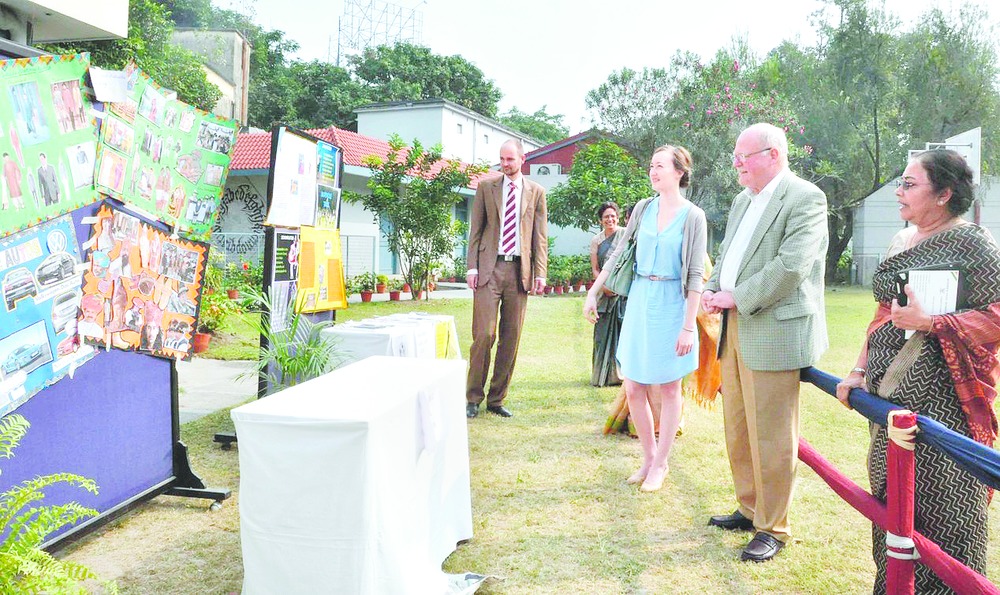
(From left) Friso Maecker, director of the Goethe-Institut/Max Mueller Bhavan, German vice-consul in Calcutta Angela Grossmann and German consul general Olaf Iversen at an exhibition as part of the German fest, organised by Modern High School for Girls. Picture by Anup Bhattacharya

Herzlich willkommen (Hearty welcome)

Mit Liebe aus Deutschland (With love from Germany)

These were some of the phrases that could be heard at Treffpunkt (meeting point) – a German fest organised by Modern High School for Girls recently.

The fest had quiz shows, skits, talent-hunt and an exhibition – events that are part of any fest – but one needed to be specially trained to understand what was being said. Because the spoken language was German.

Modern High had invited nine other city schools, which offer German as a second or third language, and a school each from Nepal and Bangladesh to be part of the festival.

It was a celebration of a language that is still not common in city schools though several schools offer German, French and Mandarin as second or third language.

Modern High started offering German as a foreign language in 2011. The same year, the school hosted the first German inter-school fest and “provided a platform for students learning German to come together and explore the language”.

“I am honoured to be at a meeting of students who have chosen German voluntarily as an additional language to learn,” German consul-general Olaf Iversen said. “More people speaking German will also help create a bond between our two countries. By learning a foreign language you automatically learn about the culture of the country from where the language comes.”

In one of the events, Licht, Kamera, Aktion! (Lights, Camera, Action!), students had to prepare a skit after being told about a person, a situation and a product.

Delhi Public School New Town got Beethoven as the person and students had to sell “popcorn” at cinemas. A couple of students would sell popcorn when “Beethoven comes and tell them that he ate jelly candy, and that’s what made him so popular”.

“All the children thought if candy made him so famous they, too, would have it,” said DPS Class VI student Yuvika Dwivedi.

The first Treffpunkt had four PaSch schools (Partner Schools of Goethe Institut) of Calcutta.

“The students are excited about the fest because they can apply the language outside their curriculum,” Anita Mitra, education cooperation officer of Goethe Institut/Max Mueller Bhavan, said. “They make posters and jingles based on real life experiences… it makes them feel part of something that is unique.”

The excitement was palpable as students rehearsed and conversed with each other in German.

Modern High director Devi Kar said: “We find a population in school comfortable in German.”

The school’s German club meets every Monday to watch German films and discuss their songs and culture to help improve students’ vocabulary.

The school believes in celebrating the language in totality and not just by tucking in a German song or dance in the annual programme. “Students try to use German as a natural language… using extensively what they learn in class,” Modern High principal Damayanti Mukherjee said.

source: http://www.telegraphindia.com / The Telegraph, Calcutta,India / Front Page> Calcutta> Story / by Jhinuk Mazumdar / Thursday – December 31st, 2015

India’s sepia-tinted U.S. connections

USKolkata09dec2015

A unique photograph of the elephant (1797), archived by the New York Historical Society, is now exhibited in the city.

“It will be a great thing to carry the first elephant to America,” wrote Jacob Crowninshield, the captain of the ship America. The first living elephant, which was ferried all the way from Kolkata to the US, was later exhibited in Boston, New York and Philadelphia.

A unique photograph of the elephant (1797), archived by the New York Historical Society, is now exhibited in the city. Alongside The Elephant, 41 rare photos, collected over the last 150 years, form part of the exhibition titled ‘Kindred Nations: The United States and India: 1783-1947’at The Indian Museum here that opened during this weekend.

The exhibition tells the story of association between the two countries long before the latest thrust to step up diplomatic and trade ties were initiated.

One compelling example is the photograph of the Indian immigrant workforce in the US. It is perhaps a less-known fact that a significant share of the workforce involved in building modern America migrated from northern India.

At least two of the photographs taken around World War II underscore the role of Sikh immigrants in the construction of rail roads or them joining various other trades. The exhibits also narrate how Americans engaged in building ties with Indians.

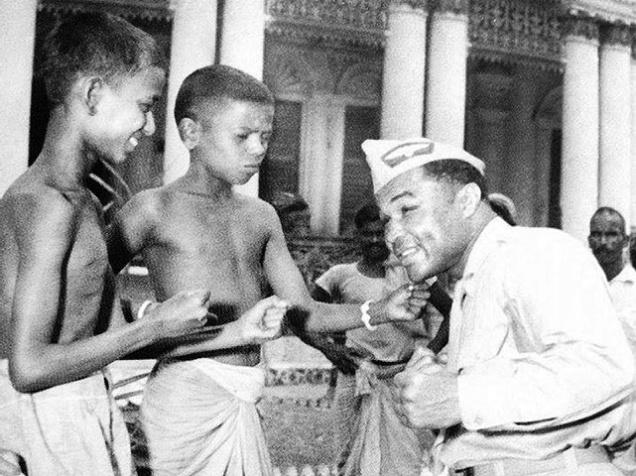
Henry Armstrong, one of the greatest American boxers of all times, visited India during World War II and graced an amateur boxing tournament in Kolkata. A candid picture of the pugilist giving spontaneous boxing lessons to local youth (1945) also forms a part of this exclusive exhibit.

Photographs of celebrated Anglo-Indian actor Merle Oberon, who shot in West Bengal for a film, and Charlotte Wiser, an American anthropologist, teaching childcare techniques to local villagers at Allenganj (1919), provide the viewers with an insight about the ever-evolving ties between the two countries.

It all started with bilateral trade relations. From education, cultural and religious values, cinema, jazz music, Kashmiri shawls, books on navigation — India and the U.S have shared them all. There was also a rare shot of Anandibhai Joshi (1880), the first Indian woman to earn a medical degree in the U.S.

Shots of Singer Manufacturing Company’s office (1897), the famous Atkinson house (1860), Swami Vivekananda with his American counterparts at Green Acre School (1894) and Rabindranath Tagore holding the delicate hands of the blind and deaf American activist and author Helen Keller are the other notable ones.

However, some these exhibits are widely circulated on the Internet.

Curated by the Meridian International Center in Washington D.C. and supported by the U.S. Department of State, the photographs and letters speak of what is described as ‘shared prosperity and peace’. Dr. Jayanta Sengupta, Director of Indian Museum, said it was “an honour” to host the exhibition.

“As a museum, we always explore the interstices of cultures and the connections between them, and what better way to do this than by celebrating the two centuries of historical connections between the world’s two largest democracies?” he asked.

Acting U.S. Consul General Cory Wilcox, on his part, complemented Dr Sengupta. “Through the medium of art, we begin a dialogue about our perspectives and values. We hope this exhibit of the past engagement sparks our imagination for the future, seeing how we can take steps to improve the lives of the next generations in both our countries,” Mr Wilcox told The Hindu.

The exhibit was earlier on display in New Delhi, Chennai, Hyderabad, Mumbai with Kolkata being the last stop, where it will continue till the last day of the year.

source: http://www.thehindu.com / The Hindu / Home> National / by Ayshika Mitra / Kolkata – December 07th, 2015

Writers with Kolkata link in line for DSC award

Kolkata:

It is surely a proud moment for the city, which lays its claims to three of the six authors shortlisted for the DSC award for South Asian Literature 2016. While Neel Mukherjee and Raj Kamal Jha spent their childhood and youth in south Kolkata, Anuradha Roy had a brief stint with this city when she studied at Presidency College.

“Calcutta will always enter whatever I write because that’s the city I have walked the most, got lost the most in. ‘She Will Build Him A City’ is about the imagined cities inside our head, the magic that we need to live with reality,” said Jha, editor-in-chief of a national English daily. Jha, who was born in Bihar and had his schooling at St Joseph’s, put the city in his first novel ‘The Blue Bed Spread’ where the former IITian went beyond the cordons of the concrete city. Similar seemd to be the case with his fourth novel, where humans, under strain or facing irrevocable loss, find themselves deprived even of their names. Their narratives, fragmented and with a constantly shifting relationship to any recognisable version of events, are interspersed with characters allowed to keep their nominal identities.

Neel Mukherjee studied at Don Bosco School, Park Circus and then took up English at Jadavpur University before proceeding to University College, Oxford on a Rhodes Scholarship where he graduated in 1992. He completed his PhD at Pembroke College, Cambridge. In his second novel, ‘The Lives of Others’, Mukherjee gives us finely-grained descriptions of daily life. It is a complete world, where political unrest is always visible on the fringes, casting ever-darker shadows over the domestic. The fragmented versions of families particularly in north Kolkata is carefully penned in his novel.

Anuradha Roy, novelist, journalist and editor, has been shortlisted for her ‘Sleeping on Jupiter’. Born in Uttarakhand and brought up in Sikkim and Hyderabad, she came to Kolkata to study English at Presidency College before moving to Cambridge University. The co-founder of publishing house Permanent Black said, “I did college in Kolkata, where I made lifelong friends, and became aware of a whole cultural universe. I have wonderful memories of wandering in the second-hand bookstores and films at Lighthouse and phuchkas and rolls in New Market.”

source: http://www.timesofindia.indiatimes.com / The Times of India / News Home> City> Kolkata / by Saibal Gupta, TNN / November 29th, 2015

Nadia royal family bears Puja torch since Akbar era

Krishnanagar :

Illuminated by earthen lamps and torches (mashals), the idol of Ma Raj Rajeshwari looks resplendent in the Akbar-era Natmandir at the Krishnagar Maharaja’s palace.

The serenity is suddenly shattered by the town crier’s shrill call: “Attention! Agnihotri Bajpeyi Raj Rajendro Maharajadhiraj Nabadwipadhipati Mahashaya Krishno Chandro Roy Bahadur is arriving.”

On cue, 108 dhakis beat drums to frenzy.

The Maharaj arrives in an elaborately carved silver palanquin that was gifted to one of his forefathers by Emperor Jahangir. He approaches the pulpit. Shortly thereafter, the palace cannon booms, a signal for the beginning of sandhi puja. A hundred and eight buffaloes are assembled before the Goddess. At shandhikshan, the heads are severed and placed before the Goddess as offering to cleanse the human spirit of its evils. “As a child, I grew up watching these rituals being performed while sitting on my grandmother Maharani Jyotirmoyee Debi’s lap. Growing up, I always held a grudge against Ma Raj Rajeshwari. How could the divine mother, the supreme protector of good and the destroyer of evil, devour so many harmless, helpless lives? I would often bring this up with my father. Being a God-fearing man, he would stick to tradition till the resistance melted away when he saw my infant son Manish crying on witnessing the sacrifice.The practice was stopped in 1987,” said Saumish Chandra Roy , the 39th descendant of Nadia royal family .

Nadia Rajbari’s Durga Puja remains the oldest puja in what was then Anga-Banga-Kalinga or undivided eastern India region. Started in 1603 by Maharaj Rudra Rai, the great grandfather of Krishno Chandro, it has continued uninterrupted till date. “The puja began two years before the death of Emperor Akbar. Since it all happened at the height of the Mughal era, the influence is very strong in the architecture of the natmandir,” said Saumish’s son Manish. However, though the gran deur of celebrations have shrunk over the centuries, the rituals have remained intact.

Ma Raj Rajeshwari has seen Nadia during the most tumultuous of times.In medieval India, persecution and heinous tyranny on the grounds of religion was common.

Blood was spilt for the protection and defense of Nadia’s “honour”, for the protection of the freedom to choose and profess the religion of our choice.”Jato dharma Stato jayo” (Stay in the path of good dharma and victory will be yours) is embedded in the Krishna gar royal family’s coat of arms.

Ma Raj Rajeshwari’s power was tested during Partition. Nadia had initially been ceded to what was then East Pakistan on grounds of religion. “For three nightmarish days, we were Pakistanis. My father Saurish Chandra Roy , the last officially recognized maharaja, had told Sir Cyril Radcliffe (the chairman of the Boundary Commission in British India) that if Nabadwip was lost to Pakistan, then what would remain of the great Hindu faith in the Anga-Banga-Kalinga region?

After three days of rioting, rape and arson, a significant portion of Nadia was returned back to India. The entire population went wild with joy when the news was broadcast over All India Radio. People arrived in trucks from far and wide and assembled in front of the palace gates, shouting ecstatically “Ma Raj Rajeshwari’r Jai!” Though the princely order was abolished by former Prime Minister Indira Gandhi, some royal customs are still followed. The Maharaj was believed to be the protector of his people.Accordingly a clay model of a “shatru”, symbolizing evil, is created which is slain by the Maharaj every year during the Durga Puja. Saumish does the slaying now.

source: http://www.timesofindia.indiatimes.com / The Times of India / News Home> City> Kolkata / by Subhro Niyogi, TNN / October 19th, 2015