Category Archives: World Opinion

Indo-Danish collaboration revives St Olav’s from ruins

Serampore:

The bells will again chime, the ancient clock tick and hymns resonate through the air as the 210-year-old St Olav’s Church is Serampore rises like a phoenix from the ruins.

St Olav’s Church of Fredricksnagore, as the Danes called Serampore, is being restored back to its former glory, with the first service being slated for April 16.

After decades, people will pray inside the 210-year-old church that has risen like phyoenix, not from ashes, but from ruins. St Olav’s of Fredricksnagore (as the Danes called Serampore) has been restored back to its former glory.

If the former Danish colony, which administered Serampore from 1755 to 1845, boasted of a landmark, it was St Olav’s, which was built from 1800 and opened to the public in 1806. Now, it is an example of one of the most successful conservation projects in the country.

A part of the “Serampore Initiative”-launched by the National Museum of Denmark (NMD) in 2008 with the revival plans for the former Danish colony monuments-the restoration of the church began in January 2015.

The Danes started building the church in 1800 and finally opened it in 1806., as a relic of the time when the Danish ruled Serampore.

From a distance, the church’s magnificence is not quite visible. But as one walks into the narrow alley, the majestic steeple of St Olav’s church which would be the identity of the Danish settlement on the banks of the Hooghly centuries ago-towers over. The clock in the tower is getting the finishing touches, symbolic of the eras gone by, and the ones to come.

But the grandeur of the project-now touted as a major collaboration India-Denmark collaboration-can be truly perceived only after entering the compound.

Bente Wolff, curator of NMD, to attend the historic moment of reviving the church, sounded excited: “The church looks new, not in the flashy sense, but in its authenticity. Very high standards of international restoration protocol are maintained. We are proud of the fruits of our hard labour.”

She recalled how Danish historian Simon Rasting and architect Flemming Aalund had meticulously conducted the pre-project social survey, hunting through archives in India and Denmark for original designs and photographs as part of the scientific analysis.

“Doing this in our own country would have been easier, but we loved the challenge and how all the stakeholders, especially the locals, helped us achieve this,” said Rastin, adding the project would not have been possible without the craftsmanship of Aalund and conservation architect Manish Chakraborti, chief conservation architect for the project and director of historic buildings conservation firm Continuity.

“St Olav’s can serve as a model for conservation projects,” said Chakraborti. “The restoration was carried out after thorough research.” for adopting an appropriate strategy executed with utmost care.”

Ashis Mukherjee, proprietor of Mascon, who is executing the project, said, “The greatness of the project lay in the filigree work, strictly carried out with lime and mortar.” Everything, from piecing together the almost-shattered marble tablet of J S Hohlenberg to recreating the timber of the roof-it collapsed in 2003 -that has been replaced with steel beams, polishing the church bells with ‘Frederiksvaerk 1802’ inscribed on them to restoring the original Burma teak furniture, is noteworthy.

History of St.Olav’s Church

‘Governor’ Ole Bie – born in Norway, buried in Serampore , Between 1755 and 1845 Serampore was administered by Denmark under the name Frederiksnagore. Until 1814 Denmark and Norway formed one kingdom

The longest sitting head of Serampore’s Danish government was the Norwegian Ole (Olav) Bie. During his service from 1776 to 1805 Serampore grew nto a prosperous town. In 1800 Ole Bie began the construction of a Lutheran church for Serampore’s Protestant citizens.

Originally planned as a simple three-aisle building with a flat roof, the church was later enlarged with an open portico in front, and a vestry and a spiral staircase behind the altar.

The church was completed in 1806, but Bie died in 1805 and never saw the final result.

An epitaph honouring his achievements can be seen in the Church together with five other commemorative tablets. Olav was a Norwegian saint, but it is not known when the name St. Olav’s Church came into use.

source: http://www.timesofindia.indiatimes.com / The Times of India / News Home> City> Kolkata / by Ajanta Chakraborty / TNN / April 07th, 2016

Six Bengali shorts make it to Cannes Short Film Corner

Kolkata:

As many as six Bengali films have been shortlisted for the Cannes short film corner that will be held between May 11 and 22. They are among the 40 films from India to have been selected for the same section.

The selected short films are Anirban Guha’s ‘Elixir’, Abhiroop Basu’s ‘Afternoon With Julia’ (‘Cum Iulia Meridiem’), Aniket Chattopadhyay’s ‘Saubala’, Lubdhak Chatterjee’s ‘In A Free State’, Charles Kinnane’s ‘Generation Hope’ and Moumita Mondal’s ‘Adieu’.

Guha’s 35-minute film is about a journey that begins in a cafe. Basu’s film, starring Neha Panda and Samadrashi Dutta, is about a casual conversation between a young couple, while ‘Saubala’ is a fantasy drama that comes with the tagline – Rebirth of Shakuni. Mondal’s 12-minute ‘Adieu’ looks at a hospital ward through the eyes of a young boy admitted there. ‘In a Free State’ deals with the story of an aspiring filmmaker and an artist who paints amputated figures. They embark on a journey to explore the true essence of freedom when their choices are antagonistic to popular social norms.

While all these films are in Bengali, Kinnane’s 34-minute ‘Generation Hope’ has been made in Bengali, Creole and English. It was filmed at Mary’s Meals projects in Malawi, Haiti and India and shows what difference receiving a daily meal in school can make to children growing up in some of the world’s poorest communities.

An Economics masters from Kolkata’s Indian Statistical Institute, Guha works in a multinational bank. “I used to do theatre in school and college. Post that, I also did stage productions in Bangalore and Delhi. Eventually, I wanted to tell my story to more people and wanted to experiment further. That pulled me into filmmaking,” he said. His film stars Daminee Basu, Arindom Ghosh, Mahul Brahma and Dr Koushik Dutta.

Guha will be off to Cannes for the screening. Accompanying him will be wife Sinjini Sengupta, who wrote the story on which ‘Elixir’ is based. “When my husband decided to make a short film based on my story, the first question was finance. Some fixed deposits were dissolved. Good friends had volunteered to do their bit, too. Cast, crew, searches and many calls later, we found ourselves in Kolkata. Mine is basically a story of magic realism and a journey of the soul,” said Sinjini.

Basu claims he made ‘Afternoon With Julia’ keeping Cannes short film corner in mind. Samadarshi, who has already started receiving congratulatory messages, said, “Abhiroop is a young director, but I can say he is someone to watch out for. This film was part of his student project. I have watched some of his earlier works and they have a lot of promise.””After completing my schooling from South Point, I had studied commerce at St Xavier’s College. But I always wanted to make movies. My earlier films had gone to some festivals and won accolades there too. But none of that was in the league of Cannes,” Abhiroop said.

However, he won’t be making it to the French Festival. “For a middle class family, it isn’t easy to go to Cannes without any financial assistance. I am happy that my film is going. May be, some years later, I too will be able to make it to Cannes too,” he said.

But before that happens, Abhiroop will be off to Prague in September to study cinema at the Prague Film School.

source: http://www.timesofindia.indiatimes.com / The Times of India / News Home> City> Kolkata / Priyanka DasGupta / March 31st, 2016

Century Ply expands global footprint

Kolkata:

Century Plyboards, one of the leading plywood manufacturers in India and a growing mid-cap company in the bourses, is expanding its global footprint in an attempt to become an Indian multinational. The city-based plywood maker has set a target of $50 million (Rs 340 crore) turnover from its overseas operations in the next two years. Currently, the company has a turnover of close to Rs 1,600 crore.

Sajjan Bhajanka, chairman of Century Ply, told TOI that it is expecting $35 million turnover from its Singapore subsidiary and another $15 million would come from its Myanmar operations. Century Myanmar is a wholly owned subsidiary of Century Ply while the company has 51% stake in Century Singapore. Bhajanka said that the remaining 49% of Century Singapore is with a company called Viet Dutch, promoted by an NRI. “We shall cater to Laos, Vietnam and Indonesia through this Singapore firm. We are entering all these markets where Ajay Bhagat, an NRI, will be our partner,” he added.

Bhajanka pointed out that Century would initially invest $5 million for entering into these markets. “We shall use these companies to source raw materials for our Indian and global operations. This will help reduce cost,” he added.

According to the Century Ply chairman, the group is also firming up plans to set up a plywood factory in Laos. The investment in the project would be over $12 million. The group already has an overseas facility in Myanmar. “We have a big factory in Myanmar. This is the second highest exporting unit in that country,” he added.

Elaborating on the Indian operations, Bhajanka said it is setting up a medium density fibreboard (MDF) plant in Punjab with an investment of over Rs 400 crore. “This plant will be ready by mid-2017. We are also setting up a particle board unit near Chennai with an investment of Rs 60 crore. It will be ready in the next few months,” he added.

Besides MDF and particle board, Century is entering into new product lines like wood cement and wood plastic. “As far as wood cement is concerned, we shall initially import it from China and Thailand but we will take a call on manufacturing facility by next year,” he added. On BSE, the Century Ply scrip was hovering at Rs 160-165 range for the last few days.

source: http://www.timesofindia.indiatimes.com / The Times of India / News Home> City> Kolkata / by Udit Prasanna Mukherji / March 31st, 2016

Indian-American Named President, CEO of Bank of The West

Photo Credits: Nandita Bakshi via Linkedin

Houston :

Indian-American Nandita Bakshi has been appointed the President and Chief Executive Officer of Bank of the West, a unit of French banking giant BNP Paribas.

Bakshi, 57, will replace Michael Shepherd as Bank of the West’s next President and Chief Executive Officer (CEO) and is expected to join the bank as a CEO-in-training on April 1 and will take the helm officially on June 1.

She earned a bachelor’s degree in History at the University of Calcutta and a masters in International Relations and Affairs at Jadavpur University.

A New England News ‘Woman of the Year’ award recipient in 2002, Bakhshi also serves on the board of the Consumer Bankers Association.
“I am excited to join Bank of the West, one of America’s most reputable banks. Bank of the West is well positioned in the US market, and I am thrilled at the prospect of leading an organisation with such a strong focus on customer service,” Bakhshi said in a statement.

“We are pleased to welcome Nandita Bakhshi to Bank of the West. Her extensive experience in product and distribution, coupled with her visionary thinking, relentless customer focus and values-driven philosophy will serve us well in taking Bank of the West to greater heights,” head of international retail banking for BNP Paribas Stefaan Decraene said.

Bank of the West’s parent company BNP Paribas is revamping its US operations to meet new regulations.

“I am very pleased that Nandita Bakhshi is joining Bank of the West. Her energy, innovative ideas and proven record of accomplishments are a great combination with our strong franchise and corporate culture,” Shepherd said.

Bakhshi previously held several leadership roles at TD Bank, the most recent being executive vice president and head of North American direct channels where she was responsible for driving innovation in direct and electronic channels to improve digital adoption and provide customers a unified banking experience.

She also held executive positions at Washington Mutual in Seattle which is now JP Morgan Chase; FleetBoston, which is now Bank of America; First Data Corp, Home Savings of America and Banc One Corp.

source: http://www.newindianexpress.com / The New Indian Express / Home> Business> News / by PTI / March 28th, 2016

Baroness bats for Bengali books – Life peer on digitisation drive

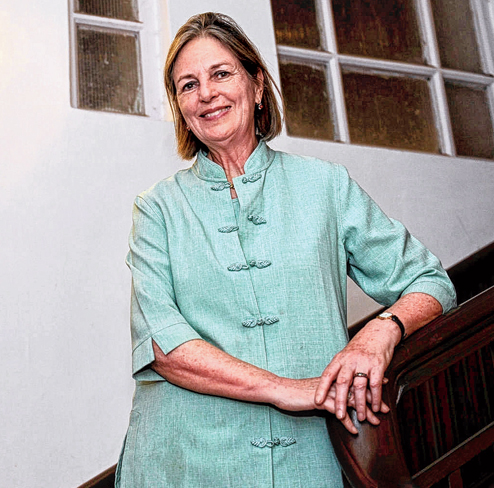
Baroness Tessa Blackstone at Bengal Club on Thursday evening. (Sanjoy Chattopadhyaya)

Baroness Tessa Blackstone, the chairman of the British Library, is in Calcutta to speak with various stakeholders in a massive British Library project to digitise its collections of South-Asian language printed books dating from 1714 to 1914.

Digitisation will not only preserve the rare and priceless — and often brittle — books for posterity but also make them available to people across the world, transforming the scope of research in these languages.
Titled Two Centuries of Indian Print, the project is expected to encompass 22 South Asian languages and some 11 million pages.

The first phase involves the British Library’s collection of early printed Bengali books as well as the cataloguing of these resources, for which the library is collaborating with the School of Cultural Texts and Records at Jadavpur University, Srishti Institute of Art, Design and Technology, Bangalore, National Library of India, the National Mission on Libraries and other institutions in India as well as the library of SOAS, University of London.

On Thursday, the 73-year-old Baroness visited Jadavpur University and met with the university registrar and some senior professors to discuss how this project would take shape and move forward.

“This was an official meeting regarding the pilot project for Two Centuries of Indian Print that we have been talking to the British Library about. Among other things the baroness spoke about the importance of digitisation as well as funding avenues in future,” said Abhijit Gupta, an associate professor at Jadavpur University, who is one of the co-investigators in the project.

On Friday, Baroness Blackwell will meet with Arun Kumar Chakraborty, the director-general of the National Library to discuss digitisation and collaboration between the national libraries of the UK and India.

Name: Tessa Blackstone
Title : The Rt Hon. the Baroness Blackstone of Stoke Newington
Politics: Labour MP, House of Lords. Former minister for education (1997-2001) and former minister for the arts (2001-2003)
Current posts: Chair, British Library board, and chair, Great Ormond Street Hospital Trust, among others
Former posts: Vice-chancellor of Greenwich University, Master at Birkbeck College and lecturer at London School of Economics, among others
Family: The baroness was born in 1942. According to The Guardian, “her father was the chief fire officer for Hertfordshire, her mother an actress and model for the House of Worth in Paris.” House of Worth is a French house of high fashion that specialised in haute couture and perfumes

source: http://www.telegraphindia.com / The Telegraph,Calcutta,India / Front Page> Calcutta> Story / by Staff Reporter / Friday – March 25th, 2016

An indigo planters’ journals

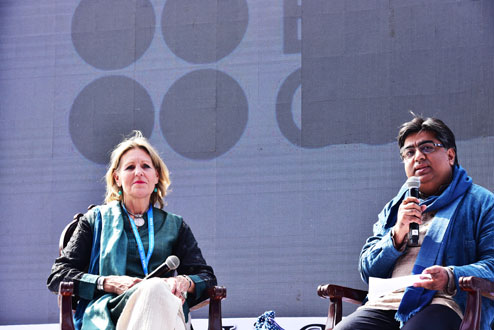
Jenny Balfour-Paul with Bappaditya Biswas at Kolkata Literary Meet on January 24. Picture by Anindya Shankar Ray

“It was serendipity,” said Jenny Balfour-Paul about how he chanced upon Thomas Machell’s journals in the British Library. She was speaking at the Tata Steel Kolkata Literary Meet, in association with the Victoria Memorial and The Telegraph on January 24.

Balfour-Paul’s book, Deeper than Indigo, based on these journals, seemed to her like a natural progression from her earlier works. For, it was indigo that lured her to Machell and shaped the 15 years of her life that she spent pursuing his trail.

Machell was a midshipman in the merchant navy and an indigo planter. He had travelled on an Arab ship dressed as an Arab and read the Bible to strict Muslims. He was taken aback at how much they had in common. Machell’s plea for religious tolerance is much more relevant now than it was in his times, said Balfour-Paul.

Balfour-Paul objects to her obsession with Machell being called a love affair across time. Yet, she seemed quite taken when it was pointed out that the Bengali translation of her book’s title, Ghana Shyam, not only means the darkest blue but is also another name for Krishna, bringing to mind an image of Radha and the themes of separation and union.

“It was a compulsion to know more about Machell and his spiritual search” that led Balfour-Paul to follow his path. Machell would love the way the world is connected at present, said Balfour-Paul, adding that had he been around he would probably have been quite active on Twitter.

Machell was ahead of his time in his empathy for the “natives” and his “criticism of colonialism”. His journals bear witness to him repeatedly “grappling with his conscience”. Machell, when he wrote the journals, only wanted to be heard. Balfour-Paul recalled how when she came across the first draft of the book, she shouted to the sea: “I’ve got you out there now.”

source: http://www.telegraphindia.com / The Telegraph,Calcutta,India / Front Page> Calcutta> Story / by Srimoyee Bogchi / Tuesday – March 08th, 2016

Bengal village teen bags top Nasa scholarship

Eighteen-year-old Sataparna is among only five scholars from the world chosen for the programme
Eighteen-year-old Sataparna is among only five scholars from the world chosen for
the programme

Kolkata :

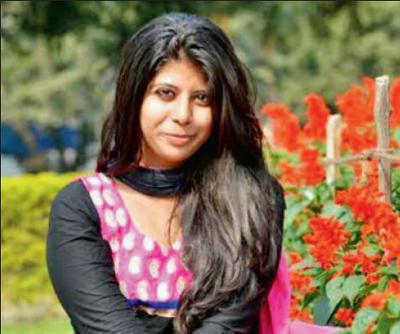
Eighteen-year-old Sataparna Mukherjee, a Class 12 student from a village around 30km from Kolkata, has been selected by the National Aeronautics and Space Administration (Nasa) for its prestigious Goddard Internship Programme under the Goddard Institute for Space Studies (GISS). She is among five scholars chosen from across the world for this programme.

Nasa’s GIP selects five exceptional individuals from across the world every year and funds their entire education after school.

Sataparna, who will appear for her school-leaving exams this year from St Judes School, Madhyamgram, in Kamduni – it gained notoriety for a brutal gangrape in 2013 – will be at Oxford University, where she she will pursue graduation, post-graduation and PhD (as Nasa faculty) in aerospace engineering at its London Astrobiology Centre.

Sataparna told TOI, “It all started in May last year when I was a member of a group on a social networking site where there were many members, including some scientists. One day I shared some of my thoughts on ‘Black Hole Theory’, and one of the members of this group gave me Nasa’s official website and told me to post my findings, which I did.” Sataparna’s paper on Black Hole Theory, and how this could be used to create a ‘Time Machine’, was hugely appreciated. “I am very happy to get this opportunity where I will also work as a researcher at the Nasa centre in London,” she said.

Under the Goddard Internship Programme, Sataparna will work as an “employee and researcher”, where she will be part of its earth science and technology development programme. Nasa is paying her a generous sum as honorarium, apart from bearing all her expenses.

Her father Pradip Mukheree, a headmaster of a primary school who led a people’s movement against goons and political pressure to drop the infamous June 2013 Kamduni gang-rape case, said, “She has made us, and the entire country, proud.”

Pulak Chakraborty, a professor of English at the Nabagram Hiralapal College, who’s acting as Sataparna’s referee at Oxford, said, “She is a very good student and her ability should not be judged through her marks alone. She is original, and that has made her attain so much.”

“She is going on August 17,” said Pradip. “Though every cost is borne by the university and Nasa, we will arrange for the passage money, which is quite high. I am thinking of taking a loan because I don’t want to let this opportunity go,” he said.

source: http://www.timesofindia.indiatimes.com / The Times of India / News Home> City> Kolkata / by Saibal Gupta / TNN / February 29th, 2016

Back where the music started

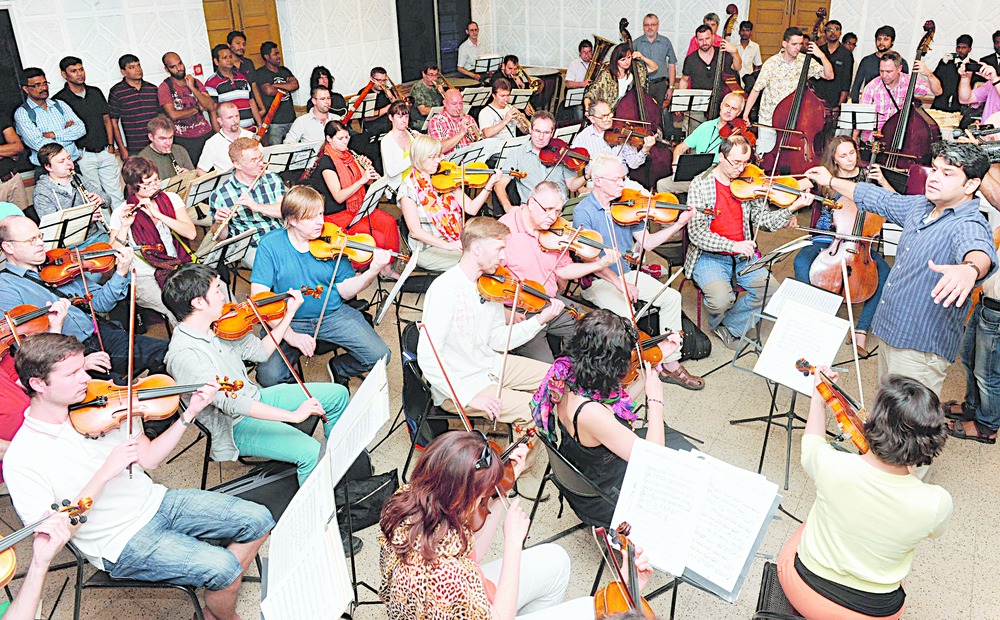
Members of Bohuslav Martinu Philharmonic Orchestra under Debashish Chaudhuri's baton at Calcutta School of Music on Friday. (Sanjoy Chattopadhyaya)
Members of Bohuslav Martinu Philharmonic Orchestra under Debashish Chaudhuri’s baton at Calcutta School of Music on Friday. (Sanjoy Chattopadhyaya)

A Ballygunge boy whose first tryst with French horns, bassoons and trumpets was at the Calcutta School of Music is back home as conductor of a premier European orchestra that would perform at his alma mater’s centenary celebrations.

Debashish Chaudhuri, 40, will wield the baton for the Bohuslav Martinu Philharmonic Orchestra from Zlin in the Czech Republic, which will perform along with members of the Calcutta Chamber Orchestra on Sunday evening. The concert at Kala Mandir will mark the end of the centenary celebrations.

Chaudhuri, an alumnus of St. James’ School who has performed at some of the best-known concert venues in the world, is thrilled at the prospect of entertaining his home audience. “My parents still live in Calcutta. It has always been the home I come back to from Prague. I am thrilled to be performing here at the conclusion of the centenary celebrations of the school where my musical journey started,” he said.

Chaudhuri recalled how, as a student in the music school in the 1990s, he had discovered instruments like trumpets and bassoons in packing boxes in a room near the library and taught himself how to play them.

After completing school, Chaudhuri joined a night college to concentrate on music before moving to the Czech Republic to study a conductor’s course. Chaudhuri’s wife Jana, a pianist, is also part of the orchestra and would perform solo on Sunday.

“I don’t remember the last time such a big orchestra played in Calcutta. Generally chamber orchestras, which comprise mostly string sections, perform here. But Sunday’s performance would have an equal spread of strings, woodwinds, brass and percussion,” said Prodipto Banerjea, secretary of the Calcutta School of Music.

source: http://www.telegraphindia.com / The Telegraph,Calcutta,India / Front Page> Calcutta> Story / by Rith Basu / Saturday – February 27th, 2016

In Calcutta, from trick to truth

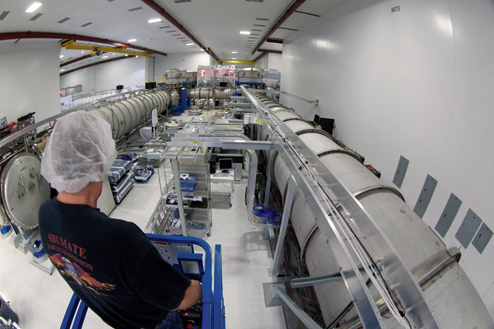
A bird’s eye view of a Ligo laboratory’s laser and vacuum equipment area near Hanford, Washington. (Reuters)

New Delhi :

Anuradha Samajdar, a research scholar in Calcutta, initially thought the first email alert she received about a possible gravitational wave signal was a “blind injection”, the community jargon for a simulation, a trick to test the integrity of the data analysis process.

The email was from Marco Drago, a scientist at the Max Planck Institute for Gravitational Physics, Hannover, Germany, telling a global consortium of physicists that two giant instruments on Earth had sensed (for just a fleeting one-fifth of a second) a signal.

The arrays of lasers, mirrors and control electronics that make up the detectors of the Laser Interferometer Gravitational Wave Observatory (Ligo), located 3,000km apart in the US, had recorded what appeared to be ripples in space-time – possibly the first direct observation of gravitational waves.

It would be up to the data analysis groups scattered across the world, including in Bangalore, Calcutta, Gandhinagar, Pune and Thiruvananthapuram, to determine that they were genuine effects of gravitational waves – and not just noise from the cosmos masquerading as gravitational waves.

“I had heard about blind injections – where a very select few senior scientists release signals and data analysis teams work on them only to be told later that this was a test,” said Samajdar, a scholar working towards her PhD at the Indian Institute of Science Education and Research, Calcutta.

Drago, an Italian and a member of the Ligo consortium, was among the first scientists to be alerted that something interesting had been turned up by an automatic “pipeline” that scans and filters the signals picked up by the detectors.

Shortly before noon on September 14, Drago received the automated pipeline alert. “The signal was so nice, so perfect, it looked like it was coming from a binary (a pair of objects),” Drago told The Telegraph .

After telephone consultations with colleagues, he sent out the alert to the 900-odd consortium members.

Samajdar and physicist Rajesh Nayak at IISER were among scientists in India analysing the signals, trying to determine whether the patterns of ripples observed indeed matched theoretical predictions of what patterns would look like, depending on the source of the gravitational waves.

Nayak, a faculty member at the IISER department of physical sciences, said: “We first match the detected signal pattern with the theoretical predicted pattern, if there is a match, we try and use the signal to estimate various parameters of the source event.”

Supervised by Nayak, Samajdar, who graduated in physics from the Lady Brabourne College, Calcutta, before joining IISER’s integrated PhD programme, while still a bit sceptical about the nature of the signal, began the process of extracting information about the source.

“We began to calculate the masses of the (merging) black holes, their distance – and our estimates were similar to what others in the consortium were reporting,” Samajdar said. “We told ourselves noise wouldn’t give us such nice outputs – that’s when I wondered ‘is this really the big thing’?”

Scientists at the Inter-University Centre for Astronomy and Astrophysics, Pune, the Indian Institute of Technology, Gandhinagar, IISER, Thiruvananthapuram, and the International Centre for Theoretical Sciences, Bangalore, also played key roles in the data analysis.

The multiple efforts across the consortium converged on the same results – the signal had emerged from (the merger of two black holes) a distant part of the universe, perhaps a galaxy.

Physicists are celebrating the discovery for multiple reasons.

“This is an example of big science supported by big engineering,” said Dibyendu Nandi, a physicist at IISER, Calcutta, and head of the Centre for Excellence in Space Sciences, India, a facility supported by the Union human resources development ministry.

The Ligo detectors are marvels of engineering precision, designed to detect ripples or displacements in space billionths of the width of an atom using laser beams that are bounced off mirrors after travelling along two arms of the instrument, each 4km long.

“Gravitational waves was the one prediction of Einstein’s general relativity theory that had not been directly detected – until now,” said Nayak. “This discovery is important for another reason – it will open a new branch of astronomy, we can observe and study things we have never seen or observed before.”

Some physicists also point out that the signal represents the first direct evidence of black holes merging.

“There is no other way we could have detected such exotic events,” said Nandi, who is not associated with the search for gravitational waves. “This observation tells us that such events are not just theorists’ dreams, that the universe is as exotic as we have imagined it to be.”

source: http://www.telegraphindia.com / The Telegraph,Calcutta,India / Front Page> Story / by G.S. Mudur / Friday – February 12th, 2016

Web home for Chandernagore

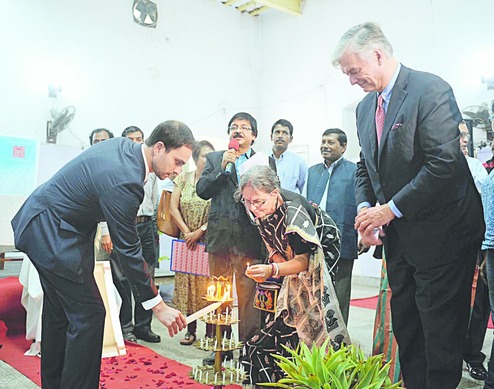
French consul-general Damien Syed lights a lamp to start the foundation celebrations at the Institut de Chandernagor as Vieilles Maisons Francaises president Philippe Toussaint (right) looks on. (Sanjoy Chattopadhyaya)

Five years ago, a project that took off as an inventory of the heritage buildings of Chandernagore has blossomed into an interactive website that acts as a repository of memories, a tool for heritage consciousness and a global platform for the former French colony.

The website www.heritagechandernagore.com will be unveiled on Wednesday at Alliance Francaise du Bengale. “The website enables people to see the magnificent built heritage of Chandernagore. Once one knows what is there to protect, there is no excuse not to do it,” Philippe Toussaint, president of Vieilles Maisons Francaises, the NGO which has provided most of the funds for the website, told Metro.

“The inventory was necessary to protect the buildings which would otherwise disappear,” said French consul general Damien Syed.

Syed and Toussaint had travelled to Chandernagore to be a part of the foundation day celebrations at the Institut de Chandernagor (IdC), marking the signing of the treaty of cession of Chandernagore in 1951.

“The website will evolve as it is not static like the one we built for Chinsurah,” said architect and conservation planner Aishwarya Tipnis, who led the project and has also built www.dutchinchinsurah.com on the history of neighbouring Chinsurah. “A blog will be part of the website where people will continue to contribute. There will be a continual crowd-sourcing of history.”

While the inventory of 99 buildings was ready by 2012, a host of community engagement activities was held in May 2015. “Contests were organised for schoolchildren alongside various workshops and a citizens’ forum. Local youths went door to door collecting memories which form a part of the website. They are now trained to take tourists on guided walks,” Tipnis said.

Toussaint is ready with another gift for Chandernagore. “We want to fund the digitisation of the important documents at IdC.” IdC curator Arup Ganguly has drawn up the list of documents. “Some, like our single copy of Le Petit Bengali, need immediate attention before crumbling to dust,” he says. The project awaits government approval.

source: http://www.telegraphindia.com / The Telegraph,Calcutta,India / Front Page> Calcutta> Story / by Sudeshna Banerjee / Wednesday – February 03rd, 2016