Category Archives: World Opinion

Bristol will always remember Rammohan Roy, says mayor

Continuing along city tradition, the Lord Mayor of Bristol on Sunday led the annual service at the sylvan Arnos Vale Cemetery to pay tributes to Indian social reformer Rammohan Roy, who died here on 27 September 1833 of meningitis.

The service at the tomb built to an Indian temple style, was attended by many people from across Britain, including representatives of the Indian high commission, Brahmo Samaj and the Unitarian church.

Lord mayor Alastair Watson recalled Roy’s many contributions, and said Bristol would always remember and cherish his memory. The annual service at Roy’s tomb has been held for nearly a century.

A new documentary, titled ‘Relics of the Raja’ by academic Suman Ghosh, was shown at the event, which included new research on Roy’s contribution to the anti-slavery movement in early nineteenth century.

It also showed the newly-discovered replica in back of Roy’s original death mask.

Carla Contractor, local historian, who has led several initiatives to preserve, cherish and celebrate Roy’s life and work, recalled his accomplishments. Her latest research is focussed on Roy’s last days in England.

“The Raja was a remarkable man in his day.

He fought for women’s rights and for the reform of legal and fiscal services in India. All Indians can take pride in what the city of Bristol has done in memory of the Raja and be proud too of their own roots in the Indian subcontinent,” Contractor said.

source: http://www.hindustantimes.com / Hindustan Times / Home / by Prasun Sonwalkar, Hindustan Times,Bristol / September 29th, 2014

Brand Bengal to steal the show in London, Edinburgh and Glasgow

Kolkata :

Two-fifty-nine years after East India Company brought business to Bengal, the roles have reversed. Brand Bengal, aka Biswa Bangla, has travelled the British Isles, and it means business.

Starting Tuesday, shows are being organized in London, Edinburgh and Glasgow to hard-sell the exotic arts and crafts of Bengal. The exhibitions will be a prologue to the grand Biswa Bangla showroom coming up in London three months later, as announced by chief minister Mamata Banerjee during her London visit in July, last year.

Titled “Gods and Demons”, the event will include live demonstrations and workshops on the making and rich history of the masks of Bengal. There will be visual storytelling from Patachitra, which was used originally as ways of spreading ancient mythology. The integration of modern social themes and issues in the artwork makes patachitra and mask-making inspiring tools for today’s artists.

Talking to TOI about UK’s exposure to “Bengal summer” at the Nehru Centre (till Friday), the Scots in the Museum of Edinburgh on May 12 and 13, Rajiva Sinha, secretary, micro and small and medium scale enterprises (MSME) and textiles, said, “The Biswa Bangla tagline ‘where the world meets Bengal’ says it all. The most exciting part of the event are the live shows by artisans Suman Chitrakar and Sankar Das. They have blended the traditional art-forms into the modern-day usage.”

In Glasgow, the location for the grand event is the Art Village Scotland which will be held on May 14 and 15, as part of the Southside Fringe festival.

“Biswa Bangla believes there is a keen appreciation for Bengal arts and crafts in the modern global community and we want the British to be a part of it, keep these art forms alive by bringing the magic of Bengal’s temples into the UK living rooms,” said London-based designer Neishaa Gharat, who represents Biswa Bangla in the UK.

Das, who hails from Sabdalpur village in South Dinajpur, will tell the British audience how “there was no rain in Kushmundi 200 years ago and people started praying to the gods for rain and to restrict the evil powers. Many characters became part of the dance, Kali, Rakshasa, Hanuman and Dakini – these are the faces we still carve today.”

Chitrakar, a villager from Naya who has applied patachitra to modern-day products like painted bags, apparels and crockery said, “Patachitra painting started many years ago. Patuas were mostly Muslims but painted Hindu gods. They moved house-to-house, singing for grains and money. Gradually, this took the shape of the art form we see today. In 2004, there were only 18 patuas in Naya, now there are 300.”

Gharat, who has been working with traditional Indian arts, crafts and textiles promoting artisans and creating designs for a global audience, sounded exited “because this is a government initiative to revive the art and craft of Bengal, which is one the most culturally diverse states in India. The art forms are fascinating because they give away such a stark dichotomy between tradition and modernity. There’s a tremendous legacy of skilled work out there and the willingness to take it forward.”

John Bell, former chairmen of the British Guild of Travel Writers and a consultant for the United Nations World Tourism Organisation, delivered the key note speech. Bell, who started his career with the BBC in London, producing and reporting for its travel and transport programmes on radio and television, said, “The work is not just a question of design, its jobs and poverty … this beautiful art is not just beautiful art, its beautiful art for good … the more we trade, the more we work, the more work we give to our friends Shankar Das and Suman Chitraker here, the more we are doing for the people of West Bengal and doing good for ourselves.”

– Aimed at rejuvenating the state’s handloom and handicraft products, Biswa Bangla was conceptualized in 2013
– The first store to sell products under the brand opened in 2014
– With 7 stores, the venture clocked a Rs 15 crore in 2014
– In the next two years, revenue is expected to increase six-fold to about Rs 100 crore.
– Among the arts being revived at Biswa Bangla are:
– Indo-Portuguese shawls (takes six months to embroider)
– Muslin
– Darjeeling tea
– Masks
– Attar perfumes
– Kalimpong cheese
– Mustard sauce
– Sundarbans honey
– Bonolokkhi ghee
– States like Rajasthan and UP are adopting the Biswa Bangla model
– Biswa Bangla markets 5,000 products, including 24 kinds of dolls from various parts of the state

source: http://www.timesofindia.indiatimes.com / The Times of India / News Home> City> Kolkata / by Ajanta Chakraborty / May 04th, 2016

From Hooghly to the Nile

All set to represent India at a festival in Egypt, dancer Dona Ganguly says the classical arts should get as much promotion as Bollywood and cricket

DonaGangulyKOLKATA02may2016

Long before she married former Indian cricketer Sourav Ganguly, Odissi dancer Dona Ganguly had been making news for her prowess in the art form. Having trained since age three under the likes of Amala Shankar and Guru Kelucharan Mohapatra, the dancer has come a long way. With several successful performances under her belt and a thriving dance school called Diksha Manjari, Dona is a force to reckon with when it comes to Odissi.

Now, the dancer, along with her troupe, is all set to take her art form from the banks of the Hooghly River to the Nile. She is to perform at the India by the Nile festival in Egypt. Dona talks about how arts play a role in diplomatic relations.

Excerpts from an interview.

Tell us about your journey as a dancer.

Just like kids in South India are expected to learn some classical art form, in West Bengal too we are supposed to join art, dance or music classes. My parents had first enrolled me for dance classes with renowned dancer Amala Shankar. From there on, I gradually gravitated towards Odissi. Not before long, Guru Kelucharan Mohapatra took me under his wing. I would either train under him at his house in Cuttack, or he would come to Kolkata and stay with us to teach me.

I never consciously decided to become a professional dancer, but after a steady stream of performances with Guruji and then as a soloist, I was a professional; without even realising it.

What are your views on events like India by the Nile?

Indian classical dance forms have a certain aesthetic value. They cannot and should not be presented anywhere and everywhere. More than politicians, who just want a cultural skit either before or after a major event, artists know the true elegance with which their art can be presented. An occasion like this festival gives one a chance to represent the nation at an international level with realistic and tasteful art.

What are you presenting at this festival?

I am planning to present traditional choreographies of Kelu baba such as ‘Saveri pallavi’ and ‘Shankarabharnam’, and abhinaya items like ‘Ardhanareshwar’ and ‘Naba Durga’. It will be traditional, because I wish to promote Odissi in its purest form.

What is Sourav’s take on your career?

Well, he’s often a silent spectator. Sourav never holds me back, but he also does not go out of his way to promote me. This is a blessing, since it lets me express my artistic sensibilities. It is a boon that I have a loving husband and a co-operative mother-in-law, who looks after my daughter when I’m practising or touring.

What is your opinion on the current situation of Indian classical arts?

I strongly believe that Indian classical arts should get as much promotion as Bollywood and cricket. Their popularity, to a large extent, is due to the glamour associated with their professions and the kind of promotion that is done. I often wonder what would happen if we were given just as much publicity. How easily we would have become celebrities and spread our art!

Sourav never holds me back, but he also does not go out of his way to promote me

source: http://www.thehindu.com / The Hindu / Home> MetroPlus / by Madhur Gupta / April 30th, 2016

Flower power pushes Kolkata Jewish population up by 1

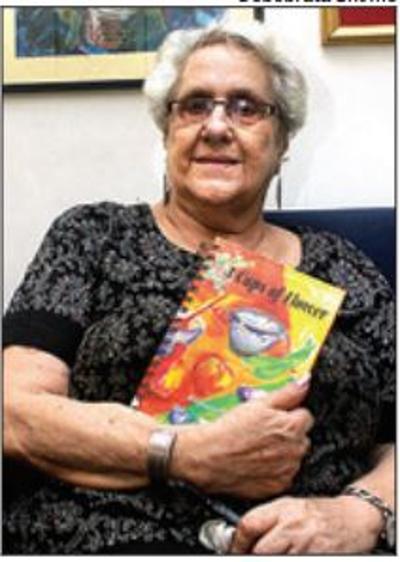
CHRONICLER OF TASTE : Flower Silliman

Kolkata :

For 30 years, Flower Silliman lived abroad, keenly observing and recording Jewish life in the Middle East, Europe and the US.

Now, the 86-year-old is back in the city she was born taking the community count up by one. And, she has taken upon herself the onerous task of keeping the authentic Jewish flavours alive for her nine-member strong community. Yes, you read it right: nine.

Demographers put the strength of the Jewish community in the city at less than 20, but the members are rather strict about who they call “pure”. Those that have married “outside” the community are strictly not “pure” Jews.

“I have come back to the city because this is where the Jews have lived most safe and free, but unfortunately , this is where our numbers have dwindled the most…but I am keeping the flame alive,” she says.

Silliman also happens to be among the last keepers of the community’s ancient recipes and has decided to chronicle the unique tastes for posterity.

“Even the food that Jews here have today is not what we are permitted by our religion. There’s so much of mix and match that most of the authentic cuisine that is over 5,000 years old and has its roots in the Middle East, is lost. I am trying to keep the tradition alive by documenting the recipes and rustling up dishes for feasts,” says Silliman.

Jewish food is special because Jews just can’t eat cause Jews just can’t eat anything and everything, Silliman says.

Their food -kosher -has to abide by strict dietary laws which not only lay down what is forbidden but also the process of cooking, the ingredients and the kitchen specifications. Kosher, for example, does not permit meat to be mixed with milk or milk products.So, neither can you mix the two while cooking, nor can you consume milk or milk products after having meat.

Flower Silliman says: “Judaism has a great similarity with Hinduism so far as its antiquity and dietary specifications go.

It’s another matter that most followers of both religions have drifted away from these guidelines… perhaps because they have often found it difficult to cope with such restrictions. I am not saying this by way of criticism, but the fact is that cuisines, and even cultures, become extinct because of such interpolation.”

A traditional sit-down Jewish feast on Friday night can ideally start with beet khatta with koobah (beet soup with chicken or vegetable balls), followed by Jewish roast chicken, which is different from the European roast in the kind of marinades and spices used. “The authentic Jewish roast will be far milder, both in flavour and sharpness, compared to the European roast,” Silliman says.

Kosher allows Jews to only have fish that have scales, and not those with shells (prawns, crabs or lobsters). “So you have items like fish shoofta, which is minced fish skewers. Vegetable lovers have choices like vegetable mahashas, which is stuffed tomatoes and capsicum.But the magic is in the recipe for the stuffing. The authenticity of the dish is heightened when served with aloo makalla (a special potato fry), hulba (a sort of fenugreek, mint and coriander chutney) and cucum ber zalata. Another speciality is mutton or vegetable ingree -a layered meat dish baked with brinjals, tomatoes and potatoes -not unlike the Greek moussaka, but without dairy to keep within kosher limits,” Silliman explains with the lucidity of an expert.

And why not? While abroad, Silliman served as a souschef at the Plaza in Jerusalem and launched the world’s only kosher Jewish restaurant, Maharaja.

She taught cooking and ran masterchef shows in US and London and authored two books. “I have come back to Kolkata because this is where the Jews have lived most safe and free, but unfortunately , this is where our numbers have dwindled the most… but I am keeping the flame alive.”

source: http://www.timesofindia.indiatimes.com / The Times of India / News Home> City> Kolkata / by Jhimli Mukherjee Pandey / TNN / April 29th, 2016

Armenia still lives in the heart of Kolkata

City’s 195-year-old Armenian school had a near-death experience when its student body shrank to one. But it has now returned to life, thanks to immigrant students.

What Parsis were to Mumbai, Armenians were to Kolkata -a refugee race that washed up on Indian shores before the British, and proceeded to establish iconic businesses and institutions that live to this day.One such in Kolkata is the Armenian College and Philanthropic Academy (ACPA), nearly two centuries old.

Built in 1821 as a residential school for children of Armenian descent, ACPA was founded by two Armenian merchants, Astvatsatur Muradkhanian and Manatsakan Vardanian who hailed from Julfa (now in Iran). The school was founded to impart an `Armenian’ education to its students, in their language, and about their culture.

In the early 19th century, the Armenians were a prominent business community in Kolkata that ran coal mines, indigo and shellac businesses, and built some of the city’s famous landmarks, including Stephen Court on Park Street and Grand Hotel (today Oberoi Grand).

But after the British quit India, so did most of the Armenians, who migrated abroad. Half a century ago, Kolkata’s Armenian population dwindled to just 2,000, vanishing still further to leave behind only around 150. Two of these Indo-Armenians are counted among the 68 students currently studying at the school; the rest are immigrant Armenians from Iraq, Iran, Russia and Armenia.

The school -in whose original building novelist William Makepeace Thackeray was born -has had its ups and downs. Its student body shrank and expanded -going from 138 in 1932, to 149 in 2003, and even plummeting to a solitary student in 1990, perhaps marking the most trying year in the school’s long history.

In February 1999, a Calcutta high court ruling transferred the school’s administration to Armenia’s Mother See of Holy Etch miadzin, the administrative headquarters of the Armenian Apostolic Church. It is now the Pope of Armenia who appoints the school manager.

“Since the institution’s guardianship was vested with the church, the school has maintained its standards and a minimum number of students,” said Rev. Zaven Ya zichyan, manager of Armenian College and pastor of the Indian-Armenian Spiritual Pastorate.

Following the transfer of power, the first batch of 34 immigrant students reached Kolkata from Iraq, Iran, Russia and Armenia -sent here for the free education and boarding provided by the school. Often, Armenian families in places like Iraq and Iran send their children here even as they plan to migrate to the West, the school be coming an interim harbour for their children. ACPA now routinely invites the diaspora abroad to enroll their children here.

In the run-up to their 200th year celebrations in 2021, Rev. Yazichyan has been at tempting to revive the institution. Among the ambitious projects is the preservation and digitization of the Araratian library, set up in 1828 and named after Mount Ara rat, the place where Noah’s Ark landed after the Flood. Other efforts include the creation of a databank of all Armenians from Kolkata (the last was created in 1956) and for malassociations with other international educational organizations.

To retain a cultural identity , ACPA teaches Armenian history , language and religion.

On visiting the campus on Free School Street (some say it got its name from the free Armenian school), the students seem content. Hovhannes Saringulyar, who teach es Armenian history, says, “If they miss their parents, they talk to them on Skype.”

Incidentally , the school also provides boarders with a free passage back home once every three years.

source: http://www.timesofindia.indiatimes.com / The Times of India / News Home> City> Kolkata / Ajanta Chakraborty / TNN / April 24th, 2016

Gravitational waves ‘sixth sense’ to understand universe: US-based Indian researchers

Kolkata (IANS):

Thrilled at the detection of the elusive gravitational waves a century after Albert Einstein’s prediction and the first observation of collision of two black holes at the Interferometer Gravitational-wave Observatory (LIGO), two young US-based Indian researchers working on the project say the waves act as a sixth sense for humans to comprehend the universe.

In fact, these “ripples in the curvature of space and time” will provide information on the cosmos that wouldn’t have been possible by peering through any kind of telescope, say Karan P. Jani and Nancy Aggarwal, who are elated at the prospect of India getting a third LIGO (observatory) and being at the forefront of new-age astrophysics.

Last month, India and the US signed an agreement for a new LIGO project in India during Prime Minister Narendra Modi’s visit to Washington. The agreement was signed between India’s Department of Atomic Energy and the US’ National Science Foundation (NSF).

The prime minister also met Indian student scientists, including Aggarwal and Jani, associated with the LIGO project.

“Gravitational waves are a completely new way of seeing the universe. It’s like humans can now perceive the sixth sense beyond the five, to comprehend the universe,” Jani, a fourth year PhD researcher in astrophysics at the Georgia Institute of Technology, told IANS via email.

The gravitational waves were detected on September 14, 2015, by both of the twin LIGO detectors, located in Livingston, Louisiana, and Hanford, Washington. The LIGO Observatories are funded by the NSF and were conceived, built, and are operated by Caltech and the Massachusetts Institute of Technology (MIT).

Physicists have concluded that the detected gravitational waves were produced during the final fraction of a second of the merger of two black holes to produce a single, more massive spinning black hole. This collision of two black holes had been predicted but never observed.

Jani and Aggarwal explained the detectors led to “direct observation of existence of black holes as also a direct observation of mergers of two black holes into a bigger black hole.”

“The energy released during collision was 50 times more than all the stars in the universe combined at that instance,” added Jani, whose work involves simulating black holes on supercomputers and searching for massive black hole collisions in LIGO data.

The breakthrough was made by the LIGO Scientific Collaboration (LSC) (which includes the GEO Collaboration and the Australian Consortium for Interferometric Gravitational Astronomy) and the Virgo Collaboration using data from the two LIGO detectors.

The LSC currently includes over 1,000 members from 90 institutes and 16 countries. India is the third highest right now in terms of membership.

At the heart of the mammoth hunting game to catch the unicorn are tools called interferometers which work by merging two or more sources of light to create an interference pattern that can be measured and analyzed.

“It is a four km light interferometer… in fact LIGO is the most precise measurement ever done. This means a lot of technology research has to be done to make LIGO,” Aggarwal, a fourth year Ph D student at MIT LIGO Lab, told IANS via email.

Aggarwal is studying quantum mechanics to improve the precision of gravitational wave detectors and is glad that the starting of the LIGO India project opens up a new opportunity for her to work in her native country.

“A lot of technological developments that were made for LIGO have found independent applications in science as well as industry and LIGO India will create a lot of opportunities for Indian scientists and engineers and improve the general scientific and technological environment,” Aggarwal emphasised.

They hope to “share the discovery with a larger audience”, a request put in by Modi during their meeting.

“During our meeting, the prime minister said he would like the LIGO scientists to make frequent India trips to popularize the science in colleges in India. We also talked about physics outreach in India for school children, the importance of hands-on demos and the importance of learning material in languages other than English,” Aggarwal informed.

“Also, due to the participation, the travelling of Indian scientists abroad and international scientists to India will definitely strengthen the international relations for India,” she said.

(Sahana Ghosh can be contacted at sahana.g@ians.in)

source: http://www.timesofindia.indiatimes.com / The Times of India / News Home> City> Kolkata / IANS / april 22nd, 2016
Bangladesh government observes Mujib Nagar day in Kolkata

Kolkata:

Bangladesh deputy high commission in Kolkata this week observed the setting up of first Bangladesh government in Meherpur in 1971. They held the programme at Aurobindo Bhawan as it was the place where for the first time outside Bangladesh their national flag was hoisted, as the new government had its base in Kolkata.

The priovisional government of Bangladesh was established on 10 April 1971 in the town on Baidyanathtala in Meherpur, Kusthia, while Mujibur Rehman, Bangabandhu was not in Bangladesh. The day is celebrated as Mujib Nagar, when the first government of Bangladesh started functioning.

A seminar was organsied at Aurobindo Bhawan and journalists Manas Ghosh and Bhabesh Das who had witnessed the Liberation war narrated their experiences.

Zokey Ahad, deputy high commissioner of Bangaldesh also spoke on the event. SM Ali, high commissioner of Bangaldesh also narrated how important was Aurobindo Bhawan during the independence of Bangladesh.

Even a photo-exhibition was also held at ICCR where 180 plus pictures of the Liberation War and that of Mujibur Rehman were also displayed.

source: http://www.timesofindia.indiatimes.com / The Times of India / News Home> City> Kolkata / Debashish Konar / TNN / April 19th, 2016

Bengal: Now, a wax statue of Michael Jackson in Rajarhat

Visitors to Mother’s Wax Museum in New Town will be able to see a statue of pop icon Michael Jackson. (EPA/Representative Photo)

After seeing statues of Mahatma Gandhi, Rabindranath Tagore, Maradona, Ramkrishna Paramhansa, Mother Teresa, Amitabh Bachchan and many others, visitors to Mother’s Wax Museum in New Town will be able to see a statue of pop icon Michael Jackson.

In addition, they will also be able to see statues of various Hollywood stars like Angelina Jolie, who is a familiar face in India. These would become possible after the museum undergoes an expansion.

Hidco authorities have decided to add 12,000 square feet to the existing museum. The tender process is over and work has already begun. If things go as per planned, then the phase II of the museum will be completed and commissioned in six months from now.

The existing wax museum is also spread across 12,000 square feet and is located on the sixth floor of the Finance Centre building which is located opposite Eco Park.

The phase 2 of the museum will be located a floor below the existing museum. After expansion, the museum will have a total area of 24,000 square feet. Besides Hollywood stars, the expanded museum will have a place dedicated to statues of well-known personalities of the West.

In addition, the new museum will also have a children’s zone, a fun area, Limca Book of Records and light zones.

“The construction work began on Monday. We will have a lot of surprises for children in the zone,” Debashis Sen, chairman of Hidco, said.

“Not everything in the children zone will be made of wax,” he said. The chairman did not want to disclose names of other Hollywood stars whose statues would feature in the Limca Book of records zone.

The museum was inaugurated by chief minister Mamata Banerjee on November 10, 2014. Since then, the museum has recorded a two lakh footfall till date.

The country’s first wax museum, it has statues of famous personalities on the lines of Madame Tussauds wax museum in London. The museum gained immense popularity along with the Eco Park.

source: http://www.hindustantimes.com / Hindustan Times / Home> Kolkata / by Saptarshi Banerjee, Hindustan Times,Kolkata / March 25th, 2016

US scholar on tea trail to dig up treasure trove

RomitaKOLKATA13apr2016

Kolkata:

A research on the treasure trove of tea in India has earned an associate professor of art history at Syracuse University, with roots in Kolkata, the prestigious National Endowment for the Humanities Fellowship 2016.

Romita Ray is not oblivious to the crisis ailing the tea industry, but she is working to strike a balance between the desolation associated with the sector and the shining aspect of the golden brew. “These (starvation deaths at tea estates) are a reality of the industry, but one needs to balance the bleakness with identifying tea as a botanic exotic. After all, it’s a living history that continues to connect Kolkata and Britain even after so many years,” said the Loreto House alumna who migrated to the US many years ago.

Her unique research is set to culminate in a book, tentatively titled ‘From Two Leaves and a Bud: The Visual Cultures of Tea Consumption in Colonial and Modern India’.

This will be the second literary attempt by the Yale University scholar, who specializes in art and architecture of the British empire in India, her earlier work being ‘Under the Banyan Tree: Relocating the picturesque in British India’.

Her passion for the evergreen shrub seems to run in the family, her great grandfather, Tarini Prosad, being the founder chairman of the Indian Tea Planters’ Association in Jalpaiguri.

Her current project, funded by the exalting and year-long National Endowment for the Humanities Fellowship (NEH) 2016, will be her second literary attempt. NEH is one of the largest funders of humanities programs in the United States, and highly competetive.

WhatsBrewingKOLKATA12apr2016

Ray now is set to deliver her first “tea talk” in Kolkata on Monday at Victoria Memorial Hall, when she is going to deliver a lecture on ‘Botanical treasure, ornamental wonder: Aestheticizing tea in Britain and Colonial Calcutta’.

She will focus on how Chinese tea, once a botanical novelty in the 18th-century Britain, crystalized into a paradigm of the “tea time”, a fashionable culinary ritual in the 21st century Britain.

“Calcutta’s (‘Kolkata’ doesn’t roll off Ray’s tongue so easily) connection with tea goes back to the 18th century when East India Company started the Canton tea trade,” said Ray, explaining why she had to be in Kolkata, away from her classes in the US, for her research.

“My book is about the visual cultures and landscapes… it is about consumption of tea in colonial and post-colonial India. It looks at the tea plant as an ornamental curiosity, the tea planter (British and Indian) as a pioneer figure whose portraits are rarely discussed, and the tea plantation as a multi-layered landscape of cultivation and leisure.”

The book will not be launched soon. “Academic books take a long time to research and write,” Ray said. The task involved extensive research at museums, archives, private collections, tea estates and libraries in the UK, India and Sri Lanka.

Being the epicentre of the Indian tea industry, Kolkata houses the Tea Research Association, Indian Tea Association and the Tea Board, along with auction house J Thomas, and even tea companies McLeod Russell and Goodricke are headquartered here.

This is where she will find the East India Company records.

“The Shibpur botanic garden is a mine of information,” said Ray, who has visited Assam, Darjeeling and the Dooars and intends to travel to south India as well as Sri Lanka.

She also intends to dig out family records with the help of multi-generations of tea families.

source: http://www.timesofindia.indiatimes.com / The Times of India / News Home> City> Kolkata / April 10th, 2016

Rare oil art by Tagore, other masters restored

Kolkata:

Seventy-two rare oil paintings by Rabindranath Tagore and other masters of the Bengal School that were lying in the strongroom of Rabindra Bharati University have been restored. The university authorities are also planning a public display of these paintings.

Most of these paintings by Tagore, his relatives, students and other legendary painters of the Santiniketan Kala Bhavan were in possession of the Jorasanko Thakurbari and were handed over to RBU when the house was converted into a state university in 1956. Some of these belonged to the Tagore family at Pathuriaghata.

After the Rabindra Bharati Museum was set up on the Jorasanko campus of RBU, several paintings by Tagore and his nephews, Abanindranath and Gaganendranath, and other family members were put up for display. But most of these were pencil sketches, water colour, crayons and pastels.

The Tagores were not known to have a great penchant for oil paintings, except when they were painting portraits or self portraits, feel scholars.

This makes ‘The Three Witches’ particularly so important. This is one of those rarest Tagore oil paintings, which has always generated a lot of interest among the scholars. However, it was never made available for public viewing. This, scholars say, is the most valuable painting in the collection, not only because it is a Tagore original but also because it was influenced by Shakespeare’s Macbeth. It is a dark painting showing three hooded women stirring the potion inside the cauldron. The three women are seen in moonlight and the suggestion of magic comes from a spark near the cauldron, deftly created by the light and shade used by the artist.

A portrait of Tagore by his grandnephew Subhogendranath Tagore was also restored. It’s a mammoth oil on canvas, that has been done by putting together geometric shapes. You have to move away from the painting to understand the pattern. “Today you have the concept of pixels in your camera. This painting, made more than 100 years ago, gives a perfect idea of pixel,” explained Indrani Ghosh, curator of the museum.

There are also some rare oil paintings by JP Ganguly, who also belonged to the Tagore family (he was Tagore’s elder brother’s daughter’s son) and Ramendranath Chakraborty, one of the most accomplished students of Kala Bhavan, Santiniketan.

It took two years for painting conservationists at the National Research Laboratory for Conservation of Cultural Properties (Lucknow) under the ministry of Culture to complete the job.

There were layers of dust all over the paintings, which were also torn in many places; in some the canvases had come out of the frames.

RBU is planning to hold a public viewing of all the 72 paintings at the ICCR.

source: http://www.timesofindia.indiatimes.com / The Times of India / News Home> City> Kolkata / by Jhimli Mukherjee Pandey, TNN / April 08th, 2016