Category Archives: World Opinion

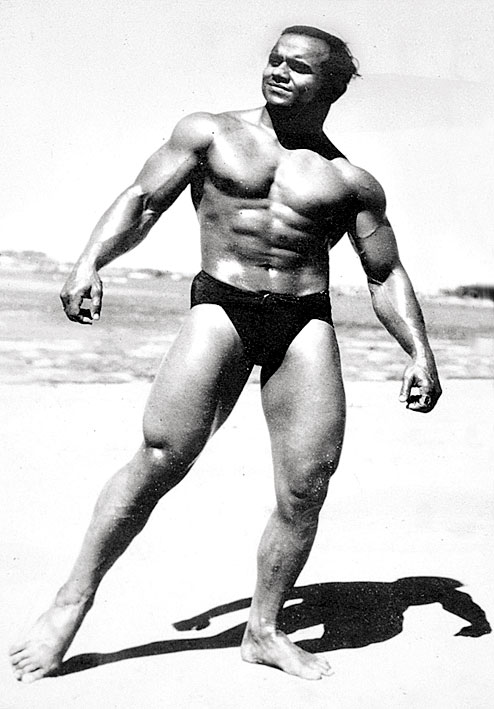
The world of Mr Universe

Manohar Aich (1912-2016)
Manohar Aich
(1912-2016)

♦ Born March 17, 1912 in Putia village of Comilla district in present-day Bangladesh.

♦ At 12, he survived a near-fatal attack of leishmaniasis, a disease caused by the bite of a sandflies but it left him fragile and sickly.

♦ The teenaged Aich got into bodybuilding. His father had ill health and so to support his family he started performing at fairs and other public events in his native village as well as those in the neighbourhood.

♦ Aich met magician P.C. Sorcar at Jubilee School in Dhaka. Sorcar instantly recognised Aich’s capabilities and asked him to join him. While the magician’s feats drew applause from the crowd Aich silenced them by bending steel rods, balancing on his stomach on the tip of a sword, tearing 1,500-page books and doing squats with very heavy loads. But a trick with a spear went wrong and resulted in a life-long scar on his neck.

♦ In the 1940s, Aich joined the Royal Air Force (RAF) as airman and met an officer, Reub Martin, who introduced him to proper weight training equipment.

♦ In 1942, at the peak of the Quit India movement, Aich slapped a British officer for making an offensive comment about India. He was court martialled and jailed.

♦ In jail, he would practise bending the steel rods in his cell. He would also practise daily for up to 12 hours with the little equipment he could find in jail. Aich was released from jail in 1947 after India gained Independence.

♦ In 1950, at the age of 38, Aich won the Mr Hercules contest. In 1951 he stood second in the Mr Universe contest in London. The first position went to fellow Bengali bodybuilder Monotosh Roy, who became the first Asian to be crowned Mr Universe.

♦ Aich trained in London for a year, funding his stay by working with British Railways and bagged the Mr Universe title on March 17, 1952, which was coincidentally his 40th birthday. At that time, his measurements were— biceps 46cm, chest 1.2m, forearm 36cm and wrist 16.5cm. His height was 4ft 11” and he won in the Pro-Short division.

♦ He got a hero’s welcome upon his return to India with both Prime Minister Jawaharlal Nehru and President Rajendra Prasad congratulating him personally.

♦ Aich tried to repeat his feat thereafter but could only secure the third position in 1955 and the fourth position in 1960. He also won gold medals for body building in the Asian Games of 1951 (New Delhi), 1954 (Manila) and 1958 (Tokyo).

♦ Aich performed in a circus, entertaining the spectators with his amazing muscle dancing in the 1960s.

♦ Aich time and again said that the secret for his strength was that he was a teetotaller. He never smoked, ate a simple diet of fish, fruit, lentils, milk, rice and vegetables.

♦ He was a fan of Hollywood actor and multiple Mr Universe title-winner Arnold Schwarzenegger and had watched all his films. He regretted having never met him in person.

♦ Aich passed away on June 5, 2016 at the age of 104 years.

Had you met Manohar Aich? Write to The Telegraph Salt Lake, 6, Prafulla Sarkar Street, Calcutta – 700001 or e-mail to saltlake@abpmail.com

source: http://www.telegraphindia.com / The Telegraph,Calcutta,India / Front Page> Salt Lake> Story / Friday – June 17th, 2016

Halmari CTC tea pips own feat, breaks Rs 500 barrier

Kolkata:

Halmari, the first among Assam varieties to find a place at the Harrods Top Tier Tea Gift Box, may soon be called the Sergey Bubka of CTC tea. The former Ukrainian pole-vault icon broke his own world record 16 times. The CTC (crush, tear and curl) tea produced on the plush plains of this Upper Assam estate has already surpassed its own feat four times in just two years. Late on Tuesday, it created history by vaulting past the Rs 500/kg barrier.

Nine sacks of Broken Pekoe (BP) CTC tea belonging to Halmari Tea Estate fetched a price of Rs 501/kg at an auction brokered by J Thomas & Co. The buyer was Prasad Tea , a tea-buying house in Siliguri. Last July, another Broken Pekoe variety of Halmari estate had fetched a record price of Rs 441/kg. The buyer then was Kolkata’s Sealdah Tea House . Only eight days before that, Halmari, owned by Kolkata-based Amarawati Tea Company , had grabbed eyeballs when another batch of its Broken Pekoe went for Rs 426 a kg.

“Of the nine or 10 CTC varieties that have gone for over Rs 400 a kg so far, seven are from Halmari,” owner Amit Daga told TOI.

Dissecting the character of the record-breaking tea, Krishan Katiyal, CMD of city-based J Thomas & Co, the world’s largest tea auctioneer, said: “This tea is of surprisingly excellent quality for an early second flush variety. The liquor is smooth, full, sweet, malty and mellow.”

Katiyal added that he expects more such good quality tea from Halmari as “the garden’s quality is on an upward curve”.

Daga feels he is lucky to be the owner of one of the “best-placed gardens on earth”. Located 28km from Dibrugarh town, the 374-hectare estate boasts a rich loamy soil suited to produce high quality tea from pedigree clones.

“I also congratulate my whole team for the feat. The courage of the buyer is also commendable to say the least. Preparing such a clientele is not an easy job. It seems the Indian consumers are graduating to the next level for quality tea,” he said.

Stressing on the need to maintain quality, the Halmari owner said: “We are 100% EU-compliant as we export to European clients. But I have no idea why the brand is getting so much value for the past 20-25 years.”
Over 1,000 people work at the Halmari estate to produce around 9.5 lakh kg tea a year.

Bharat Arya , director & CEO of J V Gokal & Co, one of the largest exporters of tea in India, lauded the efforts put in by Halmari, saying the owner must be treating his tea leaves like his baby. “They handle it very well. Thus the tea forms a nice thick cup. It is brisk, strong with a gutty liquor. Basically the garden’s raw material is good.”

Speaking from Siliguri, Raju Prasad, owner of Prasad Tea, said the CTC tea that he bought was better than most Darjeeling varieties although one should not compare between the two. “I paid a good price for an excellent batch of tea. This particular tea is mild and bright bodied. It strikes the taste buds as and when one sips it,” he said.

Prasad has already found buyers for his latest batch. “It will be divided into two parts. One will travel to a Maharashtra seller. The other lot will be sold in the Siliguri market. It is all set to fetch Rs 650-700 a kg in the market,” he said

If you think this is not a big price to pay, think again. Unlike Darjeeling, which goes for thousands per kg and has a select clientele, the CTC caters to the mass market and India is the world’s largest consumer in the category, running through 1,080 million kg of CTC tea in 2015-16. Of the country’s total tea production of around 1,200 million kg last year, CTC accounts for almost 90%.

Asked whether Indian consumers are prepared to pay good price for quality tea, Prasad said, “Today’s tea aficionados are confident about quality. So, they don’t mind paying for it.”

source: http://www.timesofindia.indiatimes.com / The Times of India / News Home> City> Kolkota / by Sovon Manna / June 09th, 2016

When my right fist was on Ali’s jaw – CLOSE ENCOUNTER WITH TRULY THE GREATEST

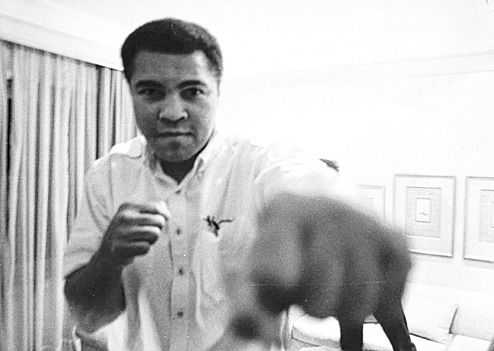
Muhammad Ali in his Taj Bengal room in December, 1990

I chased 100m drug cheat Ben Johnson from the 1988 Seoul Olympics and caught him… for an interview at his home in Toronto. I bit my nails during the football World Cup final in Rome in 1990 when Germany’s Andreas Brehme scored against Maradona’s Argentina in a penalty shootout to win the trophy. I joined Carnivale-style Brazilian fans in downtown Los Angeles after they won the World Cup of football in 1994. I was with Sunil Gavaskar when he presented Kapil Dev with a bottle of champagne at the WACA in Perth in 1992 after the Indian all-round legend got his 300th wicket. I saw Kapil dance on the bed of his Ahmedabad hotel room after becoming the highest wicket taker in the world in 1994. I had goosebumps when the Indian national anthem played to announce P.T. Usha as the sprint queen of Asia in South Korea in 1986. I’ve seen Boris Becker ‘boom boom’ his way to a Wimbledon title.

You could say that I’ve been there and done numerous international sporting events as a sports journalist in the 1980s and 1990s. But whenever I am asked about the highlight of my life, my answer is always the same: my encounter with Muhammad Ali at Taj Bengal, Calcutta, in 1990.

It went down like this. Word got around that The Greatest was visiting Calcutta for a community event, unrelated to sport. We at Sportsworld magazine (from the ABP Group of publications) were desperate to get an interview, and needed to identify the organisers of the community event. Having done so, we sought to find a ‘connection’ to the organisers. The link was a man named Dada Osman, a leading figure in Calcutta’s rugby scene and an old family friend of my parents.

Osman organised for me to meet Ali in his hotel room for 15 minutes! The arrangements included permission for us to take a photographer and one other person. This made for plenty of problems because everyone I knew wanted to be my chaperone. You would expect enthusiasm from a bunch of young journalist colleagues. But the demand to accompany me to meet Ali went far beyond my colleagues and friends. My father, Neil O’Brien, known to be an avid boxing fan, put in a request as well. How could I turn him down, when it was part of folklore that the quiz legend Neil O’Brien could rattle off every world heavyweight boxing champion in chronological order since the titles began!

So off we went, father, son and another legend, Calcutta’s best-know sports photographer, Nikhil Bhattacharya, to see the ultimate Legend. To set the scene, it must be pointed out that by this time Ali’s Parkinson’s was well publicised, and we were warned that it would not be a smooth-sailing question-and-answer session.

I knocked on the hotel room door a couple of times and after a little while, it opened. I stood there looking at this big white bath robe right in front of my face. My eyes travelled upwards, and there IT was: the Louisville Lip. From the photographs I had seen, Ali didn’t seem as big a man in comparison to some other boxers of his generation. But I was astounded to see this large frame standing in front of me. It was later that I realised it was not only his physical stature; it was also his awesome presence and aura which made him look bigger than he actually was. There is only one word which comes to mind every time I tell this story.

MAJESTIC! That’s what he was. And mind you this was way past his glory days. He still floated gently like the butterfly he claimed to be. The raving and ranting had been replaced by slow and soft speech. But there was no denying that there was something special about this man. He radiated greatness by his mere presence. I honestly don’t remember what questions I asked, but I recall he wasn’t able to provide long answers. Just a simple ‘yes’ or ‘no’. As an interview it wasn’t very informative.

All I remember is that he sat back on the large sofa, white bathrobe wrapped around as if he had just come out of the boxing ring. I sat at the other end of the sofa… on the edge of it really. My dad sat on the single sofa at the side. Nikhil da went about his business, click, click, click.

There are two other things which are etched in my memory. At the end of our 15 minutes, my dad, unannounced to me, pulled out an enlarged black-and-white print of a photograph of Ali in the famous pose after he had knocked out Sonny Liston to win his first of three world titles. I recall feeling a bit embarrassed, because as a journalist I always refrained from asking sportspersons for autographs, and posing for photos with them. I remember thinking; I had never witnessed my father pay such reverence to any other person. Such was dad’s passion for this legend that he stooped to break my unwritten rule of no autograph/photograph.

Dad’s request gave me courage to ask my last question; and I couldn’t help but ask it. “Ali sir, may I take a photo with you?”

He stood up very slowly, I jumped to my feet. Nikhil da set himself up to take the shot. Just when Nikhilda said “ready?” something got into me. I raised my right fist and placed it on Ali’s jaw to pose for the photo. Perhaps at the back of my mind I was aware that his Parkinson’s would not allow him to ‘sting like a bee’ in reaction to this bold step of mine. I was right. He merely looked at me, leaned forward and the man, known for his classic one-liners, whispered in my ear, “BE COOL, FOOL!”

The champion, his body ravaged by something beyond his control, had not lost his wit, his class and his dignity.

Over many years, when I came across media reports that he was ill, I always told myself that one day I would write again about our meeting to relive the Legend of Ali to the current generation. Sadly, that day has arrived today, when my teenage son, born 20 years after Ali retired, burst into the room to announce, “Dad, sad news: Muhammad Ali has died.” My son knew it would be sad news for his dad, because he has heard on numerous occasions his dad tell the story of the encounter with Muhammad Ali. The time had come for me to write the story, as a eulogy and tribute to the great man. I’m glad I passed on the Ali legacy to my children. I had to, because I have never been so in awe of a person ever in my life as I was with Muhammad Ali that day in the hotel room in Calcutta.

Truly the Greatest! RIP.

Andy O’Brien, always a sports fan and always a Calcuttan, worked for 13 years with Sportsworld magazine. He migrated to Australia in 1996.

source: http://www.telegraphindia.com / The Telegraph,Calcutta,India / Front Page> Caclutta> Story / by Andy O’Brien / Sunday – June 05th, 2016

A window on history – Remains of Portuguese days

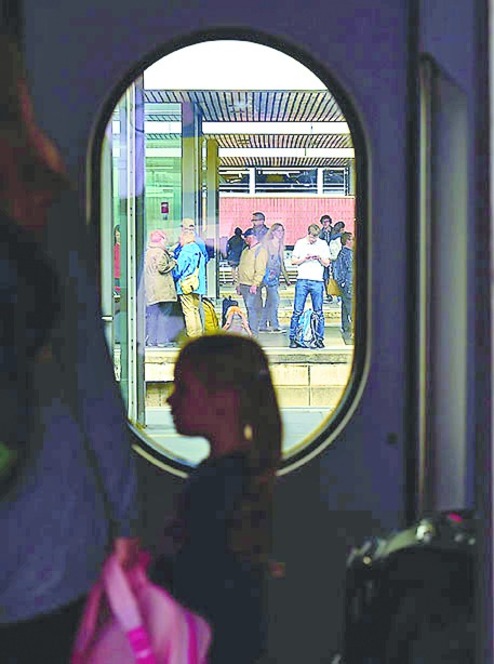
WindowKOLKATA04jun2016

Memory can be extraordinarily flexible. As the Portuguese coast recedes and our ship edges into Spanish waters, Évora’s reticence about the communist upsurge in the surrounding region called Alentejo reminds me of the stonewall I encountered in Hyderabad trying to talk of the Telangana revolt. Most people assumed I meant the agitation for a separate state. Few even remembered the earlier armed rising linked to the 1948 Calcutta Conference which also resulted in Malaya’s prolonged and bloody Emergency.

“In the Alentejo, you travel naturally with and to History,” writes a local chronicler. It didn’t know a revolution that never was like West Bengal where revolution means speeches, and revolutionaries fatten in office for decade after decade. Alentejo’s was a revolution that failed like Telangana’s. But without the violence. It also suffered from a confusion of aims. Both mixed the local with the global. The immediate impetus in Telangana was opposition to the Nizam of Hyderabad’s regime. However, the Calcutta Conference spoke of a wider ideological purpose. In fact, many believe the insurrection petered out because Moscow’s rapprochement with New Delhi prompted the Comintern to abandon the conference’s ostensible hosts, the World Federation of Democratic Youth and the International Union of Students.

The peasantry around Évora where we spent several delightful days also felt betrayed. Évora is a charming medieval walled town whose university students in black medallion-studded cloaks over their frock coats sing and dance in the cobbled central square, the Praça do Giraldo, chasing away horrible memories of the burnings that took place there during the Inquisition. Founded in 1559, the university closed down in 1759, when the authoritarian prime minister of the day turned out the Jesuits. It didn’t reopen until 1973. Évora was under Muslim rule for 400 years. They came to help a local contender for power and stayed to consolidate their own rule.

The real contradiction was between radical young officers of the Movimento das Forças Armadas and peasant and student protesters clamouring for reform in 1974. The officers overthrew Portugal’s long dictatorship in a last-ditch attempt to pre-empt more drastic change. The protesters in the streets who gave them carnations which they put into the barrels of their guns – hence the name Carnation Revolution – hoped for a drastic social and political transformation. The organizations of workers and young people that sprouted all over the Alentejo resembled the proletarian councils (soviets) associated with Russia’s October Revolution.

Ordinary soldiers weary of war also set up their own committees to demand democratic rights and an end to Lisbon’s imperialist wars. If national liberation movements could rock the foundations of colonial rule in the so-called “overseas provinces” of Angola, Cape Verde, Guinea-Bissau, Mozambique, and São Tomé, they asked, why should the metropole remain under the corporatist yoke? Landless labourers who toiled on the great estates called latifundio seized the fields they farmed. According to government estimates, about 2,200,000 acres were occupied. Some 1,000 estates were collectivized.

Something like the Spanish Civil War seems to have been fought out in miniature but with roles reversed. Claiming that fascism had to be defeated, Portugal’s reformist Socialist Party and Stalinist Communist Party sprang to support the MFA and the junta it had installed. Social historians believe they destroyed the chance of a socialist revolution. Lisbon promulgated the Land Reform Review Law in 1977. The collectives were dissolved. The original owners repossessed the latifundio. Portugal’s aristocracy has retained its wealth through centuries of upheavals. Some of the mansions and manor houses have been in the same family for generations. Hoardings in the vineyards along the road from Évora to Lisbon proudly proclaim the ownership of families like the Fonsecas. No lingering memory of the 1974 uprising disturbs Évora’s tranquillity.

The official justification is that the Alentejo collective farms could not be modernized. In the mid-1980s, agricultural productivity was half that of the levels in Greece and Spain and a quarter of the European average. Land holdings were polarized between small and fragmented family farms in the north and inefficiently large collectives in the south. Even Bangladeshi immigrants who had managed to acquire Portuguese work permits fled to more prosperous economies. Decollectivization was said to be the only hope.

I learnt more about Évora and its unexpected links with Bengal from Trilokesh Mukherjee, my graphic artist friend who lived in the Dordogne in France for many years. Now he seems to spend more time in Oxford and South Wales but remains a storehouse of the minutiae of Indo-European culture. Trilokesh told me Évora was the birthplace of Manuel da Assumpção, an Augustinian monk who spent many years near Dhaka and is credited with writing and printing the first dictionary and grammar of the Bengali language, Vocabulario em idioma bengalla e portugueza. “The Portuguese even cast some Tamil and Malayalam types. But they never could cast Bengali types.” It’s a matter of everlasting regret to Trilokesh that this final triumph eluded the Portuguese. “The first book to be printed in Bengali was printed in Lisbon though the writer, translator and the compiler came from Évora,” he wrote. Alas, it was set in Latin type.

Évora’s state library treasures another historic document, the manuscript of Brahman-Roman-Kyathalik-Samvada: an argument on Law between a Roman Catholic and a Brahmin by the Bengali Dom Antonio de Rozario. Dom Antonio’s life is shrouded in mystery. No one knows his Bengali name. He was apparently a princeling of Bhusana, which some place near Dhaka and others near Jessore. According to one version, Mug pirates took him to Arakan as their prisoner. Another has it he was sold into slavery in Goa. Both agree that another Portuguese Augustinian priest was his saviour and that he converted to Christianity.

The reinvented Dom Antonio is believed to have converted 30,000 Hindus in and around his estate, thereby arousing the wrath of the Jesuits in Goa who sent a senior priest to investigate. He confirmed Dom Antonio’s proselytizing success but added the converts had little knowledge of Christianity and had been paid to be baptized. It must be added before ghar wapsi fanatics reach for their purifying water that this was the competing camp’s verdict. No rivalry is more relentlessly bitter than that between the pious who are convinced of their monopoly of the truth.

Religion and language are the two main links. Vasco da Gama wasn’t quite the pirate in priest’s clothing that Bharatiya Janata Party loyalists made out on the 400th anniversary of his landing at Calicut, but he did have a strong religious motivation. Another Portuguese sailor, Luís de Camões, called Portugal’s Shakespeare, immortalized his achievement in the epic poem, The Lusiads. If Calcutta had Anthony Feringhee (Hensman Anthony), Dhaka’s Christians revere Sadhu Antoni (St Anthony of Padua). Some credit the Portuguese with creating Bengal’s first modern city in Hooghly. Others hold their imports of tobacco, potato and guava changed Bengali taste for all time.

With so many connections, it was exciting to stumble upon a Bengali gift to Portuguese (or so I imagined) when my wife was allotted the janela seat on the train to Sintra. I emailed a friend in Calcutta who passed it on to Aditi Roy Ghatak who messaged me from Macau, where she was holidaying, to say the former Portuguese colony had given her a janela on Portugal. I now learn that far from being Bengali, janla is an import like potato, guavas or tobacco. Derived from the vulgar Latin januella, the Portuguese janela travelled east with those first Europeans to inspire the Sinhalese janelaya and Tamil cannal. Our own janla is like almirah or kameez. Borrowing within reason is all right providing it doesn’t prompt Mamata Banerjee to follow the late P.N. Oak and claim that Big Ben and the Eiffel Tower are really Bengali creations.

source: http://www.telegraphindia.com / The Telegraph,Calcutta,India / Front Page> Opinion> Story / by Sunanda K. Datta-Ray / Saturday – June 04th, 2016

Restaurant school with French help

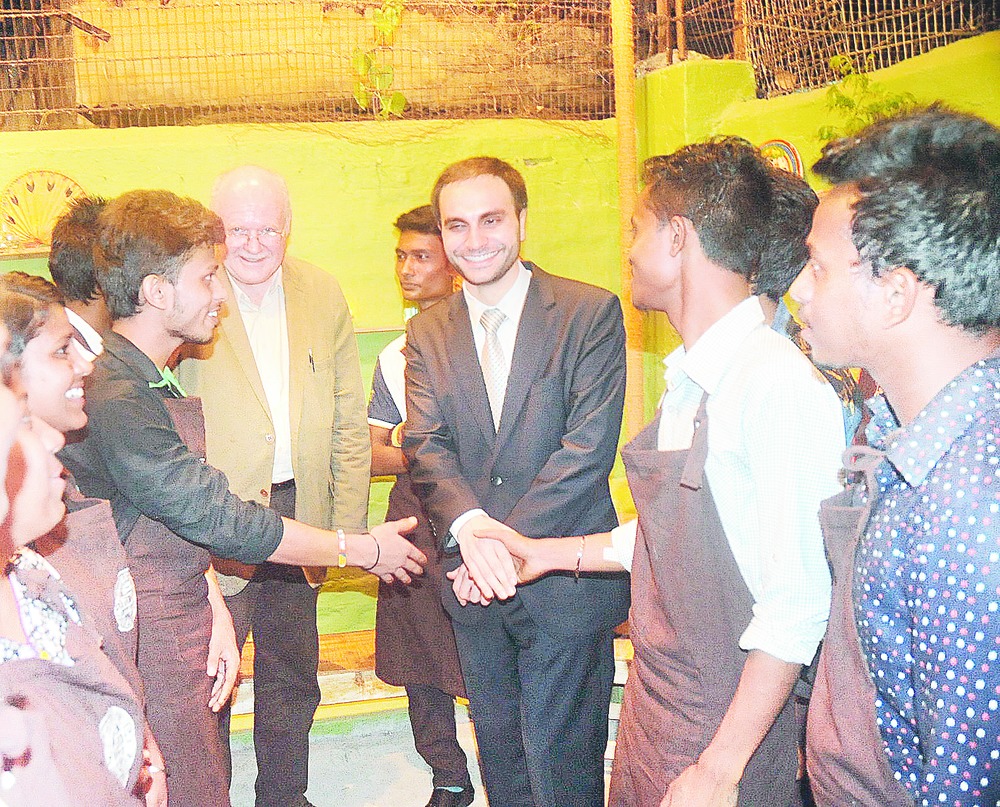
French consul general Damien Syed and German consul general Olaf Iversen meet the underprivileged youths being trained at Toto in Chetla. Picture by Bishwarup Dutta

Falafel served with pita bread. Chocolate cake. Apple pie.

These dishes were part of the food served by underprivileged youths from colonies in Kalighat and Tollygunge. The occasion was the inauguration of French restaurant school Toto in Chetla.

The school, which will also run a café, is a joint initiative of the local NGO Tomorrow’s Foundation and the French NGO Life Project 4 Youth (LP4Y), and is being supported by the French consulate in Calcutta.

“Our objective is education to employability. This is an entrepreneurship development project and we are looking at it as a business school,” said Arup Ghosh, founder of Tomorrow’s Foundation. Four volunteers of LP4Y have come from France to start the Calcutta project. “They are providing the knowhow, we are providing local help.”

In a two-storeyed house in Chetla which is housing both the school and the eatery, 15 youths are being trained to run a business when they are not busy picking up European recipes in the kitchen. “We had started off in October by recruiting five girls. When we started to think of the kind of business activities we should focus on, they suggested baking. It was important to take the idea from them based on their interest,” said Constance Delawstre, one of the volunteers.

That is how the seed of Café Toto germinated. The management is intent on serving only vegetarian fare. “We want to serve fresh and healthy food. We do not want to take a chance with meat in this heat,” says Delawstre.

The French volunteers are taking recipes of chosen Western dishes off the internet, preparing the dishes themselves for the students to taste and teaching them how to cook them. And if the reactions at the opening of guests like Marc Salesse, head of the consulate’s visa section, are anything to go by, their apple pie and chocolate cake are already tasting “just like back home”.

Not just cooking, the youths are also being trained in soft skills, like greeting a guest and taking orders, and management. “The youths have too much fire in the belly to not succeed. Once they complete the 12-month course, they should get entry-level jobs or set up their own place,” said Ranadeb Banerjee, a food and beverage industry veteran who is one of the coaches. The school offers them the option to continue beyond the course duration till they become self-sufficient.

Rama Rao and Gobindo Das, both orphans brought up in a Tollygunge NGO, are the biggest instances of the will to succeed. Rama had dropped out of school after Class VI but has taught himself spoken English. After a six-year gap, he has enrolled in an open school to appear in Madhyamik. Gobindo, too, picked up English on his own and took the Higher Secondary exams last year.

Other students stay with their families in slums. “I have to support my mother and two sisters. I am learning how to run a business,” said Sonu Kamti, who aims to deal in garments. Others like Laltu Singh and Gobindo Das are in it to learn computers. Such is their involvement that they have even sawed the café’s furniture themselves.

The guests left with a promise to return. “There was a need for such a café in our neighbourhood. The food is authentic and simple and the atmosphere convivial,” said Damien Syed, the French consul general. “It is a wonderful idea to create jobs through vocational training. Perhaps they can cook some German dishes too,” said Olaf Iversen, Syed’s German counterpart.

For now, the café will deliver food home on order and stay open only on advance booking. “Once the youths get trained, we will open thrice a week,” said Daniella, another volunteer.

source: http://www.telegraphindia.com / The Telegraph,Calcutta,India / Front Page> Calcutta> Story / byu Sudeshna Banerjee / Wednesday – June 01st, 2016

Indian-American scientist wins Springer Theses Award

Mr. De has dedicated his PhD thesis to cricketing legend Sachin Tendulkar and his alma mater, Kolkata’s Presidency University.

An Indian-American scientist has received the prestigious Springer Theses Award in recognition for his outstanding research in which he developed transgenic mice to study a critical tumour-suppressor called A20.

Arnab De’s thesis was nominated by New York’s Columbia University. Before this, Mr. De, who has also developed peptide-based prodrugs as therapeutics for diabetes, had received the Young Investigator Award at the American Peptide Symposium.

The thesis prize is awarded by Springer, a leading global publisher of renowned scientific journals and books, to recognise outstanding PhD research.

Internationally top-ranked research institutes select their best thesis annually for publication in the book series: “Springer Theses: Recognising Outstanding PhD research”.

Additionally, winners also get a cash prize of 500 euros.

The research work was highlighted by the European Molecular Biology Organization (EMBO) Reports.

Only research considered to be of ‘fundamental relevance to a general readership’ is chosen to be highlighted by EMBO.

Mr. De has dedicated his PhD thesis to cricketing legend Sachin Tendulkar and his alma mater, Kolkata’s Presidency University.

Mr. De said: “Two things that have influenced me the most is sports and education. This thesis is dedicated to Sachin Tendulkar not only for the cricketing joy he provided me, but also for being a constant source of inspiration to all Indian youth.”

Ole John Nielsen (University of Copenhagen), who shared the 2007 Nobel peace Prize as a member of the Intergovernmental Panel on Climate Change along with US vice president Al Gore, had in 2012 described the Springer award as an “insanely great honour”.

source: http://www.thehindu.com / The Hindu / Home> International / PTI / Singapore – May 28th, 2016

German ambassador revives Dresden-Kolkata creative tie

Kolkata :

Two years after Germany reunited, four artists from Dresden had come to Calcutta and casually met with painters, sculptures and poets here, not knowing they were sowing seeds for this creative collaboration a quarter century later.

The Dresden-Calcutta initiative was formally launched by German ambassador Martin Ney at ArtsAcre, Museum of Bengal Modern Art, last Tuesday, 24 years after artists Michael Freudenberg, Eberhand Goschel, Max Uhlig and Sonia Zimmermann, facilitated by the Goethe Institut, had the most meaningful interface with members of ArtsAcre in Kolkata. The German artists had been briefed about Pandit Ravi Shankar laying the foundation of ArtsAcre, a nest for budding artists in north Kolkata, and Nobel laureate Gunter Grass inaugurating it in 1986, with an exhibition of his own drawings. Subsequently, Shuvaprasanna, director of ArtsAcre visited Dresden and conceived the idea of “Dresden-Calcutta/Calcutta-Dresden”.

The project promises regular exchange of ideas and workshops between Dresden and Kolkata, with its nucleus at ArtsAcre, the grand 4.5 acre arts hive for artists, enthusiasts and creative communities in Kolkata that chief minister Mamata Banerjee inaugurate two years ago.

The project kicked off with a portfolio of graphics and lyrics, titled “Shuttle”., comprising intaglio, etchings and poetry of seven mainstream artists and seven poets from Dresden and Kolkata, displayed at the permanent Dresden gallery inside ArtsAcre. The participating artists from Desden are Lutz Fleischer, Eberhand Goschel, Peter Herrmann, Reinhard Sandner, Claus Weidensdorfer and Uhig and Zimmermann, who came to Kolkata 24 years ago.

Lothar Barth, Andreas Hegewald, Uwe Hubner, Lothar Koch, Gregor Kunz, Bernhard Theilmann and Michael Wustefeld are the participating poets from the German city.

From Kolkata, Dip Banerjee, Shipra Bhattacharya, Kinkar Ghosh, Shakti Karmakar, Somenath Maity, Munindra Rajbongshi and Shuvaprasanna were those who contributed in the art section. Lending their creative expertise with words were the late Shakti Chattopadhyay, Sunil Gangopadhyay and Mallika Sengupta, Sankha Ghosh, Joy Goswami, Alokeranjan Dasgupta and Dibyendu Palit — Shashi Despande, Subodh Sarkar, Kalyan Ray and Dipak Rudra are the translators.

Shuvaprasanna, executive trustee of ArtsAcre Foundation, said, “The aim of Dresden-Kolkata initiative is providing space for the young and experienced artists, allowing them to express their message and present their creations in all kinds of arts – from painting, to photography and installations.” He said the artists speak of globalization, intolerance and openness through their works.

Grass remains the pivot of the project. Nay watched Gautaim Ghose’s “Shuva & I”, a film on Grass and Shuvaprasanna at Grass’ home in Germany in August 2013.

Pointing at “Shuttle”, the ambassador said, “These works by the poets and artists were created when Germany was passing through the most difficult circumstances – through a totalitarian regime. They will show how important this kind of creative exchange is for countries.”

source: http://www.timesofindia.indiatimes.com / The Times of India / News Home> City> Kolkata / Ajanta Chakraborty / TNN / May 21st, 2016

Young student from Bengal chosen for Boston Math Workshop

Kolkata :

Soumen Ghosh, a meritorious student from Narendrapur Ramkrishna Mission, has been selected for prestigious Promys, a challenging mathematical summer programme at Boston University. Soumen is one of five students in India selected for Mehta Fellowship that facilitate participation of students in this pogramme.

A resident of Katwa in Burdwan district, Ghosh was also ranked 8th in this year’s Higher Secondary examination. His teachers said that he is a math-champ, who scored 100 out of 100 in every math examination in his career. The Fellowship posed 10 complex mathematical problems. Soumen solved them and mailed. Soumen was one of seven students selected from India. It was followed by online interview in which Soumen was selected.

Approximately 80 mathematically talented pre-university students and 20 undergraduate counselors are carefully selected from around the world. Under graduate students focus primarily on a series of very challenging problem sets, a daily lecture, and exploration labs in Number Theory. There are dozens of additional seminars, mini-courses, and guest lectures on a wide range of mathematical topics, advanced seminars and mentored research are offered.

His father Nani Ghosh is a teacher. He said that his son got excited if he confronted any complex mathematical problems. His schools syllabus hardly appealed him. He looked for mathematics of higher classes. Soumen is also very excited about joining the workshop which will expose him to best of the mathematicians.

Apart from development of mathematical habits of mind that support independence and creativity in facing unfamiliar mathematical challenges, it will also train them in asking good questions, precision of thought and depth of understanding. The workshop is of six-week duration with a collaborative and supportive community. There will be rigorous student discovery of fundamental mathematical truths. Students receive daily feedback from their counselors on their Number Theory problem sets.

source: http://www.timesofindia.indiatimes.com / The Times of India / News Home> City> Kolkata / by Krishnendu Bandyopadhyay / TNN / May 18th, 2016

Barcelos comes to Kolkata

Kolkata :

Costa Mazzis-owned Barcelos has brought Afro-Portugese cuisine to the city. Rohit Malhotra, India Business Head of Barcelos, told Business Line that the franchised 100-seater casual dining restaurant was result of a tie-up with MP Jewellers family outfit Trivia Food & Beverages Pvt Ltd.

Indranil Roychowdhury, Director of Trivia, said that collaboration was likely to be replicated in the near future for a few more in West Bengal.

For Barcelos, it is the fourth outlet after setting up two in New Delhi and one in Gurgaon. “By July we would be present in Jaipur and Mumbai through the franchisee route”, Malhotra said. Apart from one company owned outlet in the Capital, Barcelos is following the franchise model for expansion in the country.

Portuguese restaurateur Mazzis, who first set up his shop in South Africa, linked his brand to a village in Portugal – Barcelos – with legends attached to cockerel or rooster.

Though its low-oil flame grilled chicken along with “peri-peri” or a number of table sauces made of African chili are the menu drivers, for India, Barcelos has created a range of vegetarian dishes.

Barcelos official said that the chain now popularising a typical flavour and taste of the fiery African peri-peri in the country where Portuguese traders centuries ago introduced chili. Variants peri-peri sauce is also used by Barcelos chefs as a secret marinade for meat or seafood before they are roasted or grilled, Malhotra said.

source: http://www.thehindubusinessline.com / Business Line / The Hindu, Bureau / Kolkata – May 16th, 2016

LMG two blaze Harvard trail

– Two bright young minds with shared roots in La Martiniere for Girls, Calcutta, are lighting up an Ivy League campus with their brilliance.

Jhinuk Mazumdar spoke to Vedika Khemani, Junior Fellow designate at Harvard University, and Tarang Kumar, Teaching Fellow at Harvard College, to chart their inspiring journeys
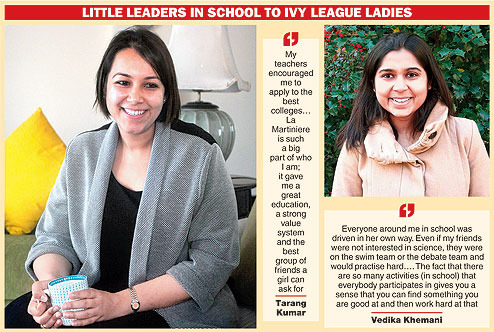
VedikaKOLKATA16may2016

VEDIKA KHEMANI

As a toddler, she was fascinated by science museums. As a student of Class IV, she had already made up her mind to specialise in either physics or mathematics. As a teenager, she would hunt for answers to her inquisitiveness in the pages of books by Richard Feynman and Stephen Hawking.

Vedika Khemani, “science geek” from the Class of 2006 at La Martiniere for Girls, will now get to dine and discuss physics with Nobel laureates.

The 27-year-old has been designated Junior Fellow at Harvard University with effect from August, a position she earned by clearing an interview by a panel of distinguished academicians that included Nobel laureate Amartya Sen. She is the 94th and only the ninth woman physicist to be admitted to this elite group. No other Indian woman physicist has gone where she has.

The Harvard Society of Fellows, founded in 1933, is the most prestigious postdoctoral research fellowship in the US. Only 12 fellowships are awarded each year across fields ranging from physics to literature to law. The list of Junior Fellows in physics since the inception of the society includes top scientists and Nobel laureates like David Gross, John Bardeen and Kenneth Wilson.

Vedika’s extraordinary journey started at La Martiniere, where the school topper would help her friends with their math problems the day before an exam. After completing her ISC in 2006, she went to Harvey Mudd College and is currently finishing her PhD in theoretical condensed matter physics at Princeton University.

So, how did a girl of barely 10 decide in Class IV that she would study physics or math? “Those were the subjects I really enjoyed, and everything else I kind of did because I had to,” she told Metro.

Vedika describes her favourite subjects the way a poet would give voice to feelings. To her, math is “beautiful, pristine, neatly tied with a bow” while physics is “messy, chaotic, but then you discover patterns in that mess”.

She also finds it fascinating that “this really complicated system of so many trillions of electrons actually follows this one very simple and beautiful equation”.

A teacher in school remembers Vedika as “effortlessly brilliant, with an amazing memory”. But the able – and humble – student feels there is no alternative to hard work, discipline and drive.

“Everyone around me in school was driven in her own way. Even if my friends were not interested in science, they were on the swim team or the debate team and would practise hard…. The fact that there are so many activities (in school) that everybody participates in gives you a sense that you can find something you are good at and then work hard at that,” she said.

Her history teacher Behula Chowdhury, who Vedika remembers fondly, said the most striking thing about the precocious girl in class was the ease with which she could assimilate knowledge. “She was not one of those students who would jot down every note in class. Everything was inside her head,” recalled Chowdhury.

Vedika owes her love of physics and math to her father Navneet and maternal uncle Rajesh Kanoria, who she remembers would “willingly spend hours discussing esoteric math and physics problems that were well outside my course of study at school”.

Even when he returned home late from work, Navneet would not turn away from discussing any math problem his daughter came up with. “A message for all dads everywhere to invest time in their children instead of just paying the bills!” quipped Vedika.

To her mother Rashmi, Vedika gives credit for giving her “the courage to dream without thinking about any misgivings or limitations”.

Vedika had received fellowships from Berkeley, Stanford and Caltech, and a position from Microsoft, but she chose Harvard over everything else.

Last December, when she was to be interviewed at Harvard for the position of Junior Fellow, Vedika was struck by nerves just like any other young person on the cusp of a great career opportunity. The nervousness, which she says helps her prepare for such big occasions, disappeared the moment she stepped into the room filled with brilliant minds.

For half an hour, Vedika took questions and presented her work on “Many-body localisation” with the confidence of someone who knew her subject. “I had spent a lot of time on this project and the fact that all these people were interested in it and asking questions was really exciting,” she recalled.

But for all her achievements, Vedika compares her entry into Harvard as “that of one electron among those trillions” and refuses to dwell on it. “This position is only based on my potential to do something. In the grand scheme of things, what have I really discovered about physics yet? There is the prestige of a position, but that is nothing compared to actually figuring something out,” she said.

Vedika is still the same Wood Street girl who loves to have chaat near Vardaan market, Chinese at Flavours of China and rolls on Park Street. Whenever she is in town, which is at least once a year, she visits College Street to buy textbooks on physics and misses the stores that once dotted Free School Street.

And to all those who aspire to be the next Vedika, she is never far away for some friendly advice. “I always try to write back to students who email me asking how and where to apply,” smiled the 27-year-old.

TARANG KUMAR

Tarang Kumar, 31, had cited her experience of taking two classes in her alma mater, La Martiniere for Girls, in her application for the post of Teaching Fellow at Harvard College. “You have never learnt something until you are made to teach it,” she wrote in the application.

Tarang, who passed out of La Martiniere in 2003, is doing her MBA at Harvard Business School and the opportunity to be a Teaching Fellow is something she hadn’t planned for. The last time she had taught was 12 years ago – she was then a student of economics at Delhi’s St. Stephen’s College – and Tarang was drawn to the information session primarily because it was to be addressed by Gregory Mankiw, whose books she had read in college and wanted to “put a face to the name”.

“He was on the campus and it was super convenient,” she said of the session, attended by 600-odd students.

The experience encouraged Tarang to take “a shot” at becoming a Teaching Fellow and she was soon on board as part of “an army of 25-30” selected to teach economic theory to undergraduates. But Tarang refuses to make a big deal out of it even though “there are many who apply for the job but don’t get it”.

“The undergraduate college has developed a system where they recruit teachers from Harvard Kennedy School, Harvard Law School, Harvard Business School, PhD students and also full-time teachers,” she explained.

Although Tarang didn’t have any long-term career goal when she was in school, she always knew that she would study economics. “And my teachers encouraged me to apply to the best colleges…La Martiniere is such a big part of who I am; it gave me a great education, a strong value system and the best group of friends a girl can ask for,” she recalled.

Whenever she makes a trip home, Tarang’s to-do list includes time with her school friends and trips to Kookie Jar and Tolly Club.

At La Martiniere, Tarang had been the president of the Drishti Club that organises cultural events. Being involved in these activities gave her the opportunity to learn about teamwork and leadership, skills essential to success in any workplace. “All the activities we had, whether it was sports, debate or elocution, gave us a lot of opportunities to step up and take leadership positions even at the school level,” she reminisced.

Sharmila Mazumdar, her economics teacher in school, said of Tarang: “There is not much growth in our profession and the maximum reward we get is when our students do well across the country and the world.”

According to Tarang, what makes La Martiniere different from a lot of other institutes is that “even if academics is not your strong suit, you still could find a place”.

At Harvard, Tarang teaches for three hours a week and “prepares for two hours for every class that I take”. Preparation is something she can’t do without because students “are smart and ambitious and some of the questions stump you”.

The hours that she puts in mean “giving up on other things such as great speaker events, opportunities to travel, socialise, take certain courses and sleep”. Two to three classes a week is a “huge time commitment” also because there are occasions when her students need her help to prepare for an exam in the middle of her own tests.

But Tarang won’t have it any other way. “This has given me an opportunity to relearn economics; to stand up in front of the class and teach. I have had the benefit of having some good teachers and to share the experience with someone is a great opportunity,” she signed off.

What message do you have for Vedika and Tarang? Tell ttmetro@abpmail.com

source: http://www.telegraphindia.com / The Telegraph,Calcutta,India / Front Page> Calcutta> Story / by Jhinuk Mazumdar / Monday – May 16th, 2016