On International Day of World Indigenous People, observed on August 9, Indian Museum brought to the fore an anthropological treasure it has had in its store since 1929. Physical anthropologist Biraja Shankar Guha, former director of Anthropological Survey of India, had brought in a model of the Khalash community of Afghanistan after his study on them. Khalash community. It’s accession no is 11813.
In Afghanistan, at the extremities of Hindukush are some isolated mountain valleys of Khyber-Pakhtunkhwa, known to rest of Afghanistan and Pakistan as Kafiristan.
The word ‘Kafiristan’ underlines that the Khalash community follows its own religion. They have liberal customs, rituals and beliefs – for instance, elopement is as common as married women choosing their new husbands, said Indian Museum education officer Sayan Bhattacharyya.
The Khalash religion is similar to the religion that was practised by Rigvedic Aryans and the community has retained most of the Indo-Iranian traits as well.
A wooden statue put on display shows the pagan origin of the community. Some of the Khalash people claimed to be descendants of Alexander the Great and a recent genetic analysis has substantiated this belief.
During the 1970s, local Muslims and militants tormented the Khalash because of the difference in their religions and multiple Taliban attacks on the tribe lead to its numbers shrinking to just 2,000.
However, protection from the government has ensured decrease in violence by locals and Taliban. It has also brought about a great reduction in the child mortality rate. The last two decades has seen a rise in their numbers.
source: http://www.timesofindia.indiatimes.com / The Times of India / News Home> City> Kolkata / TNN / August 11th, 2016
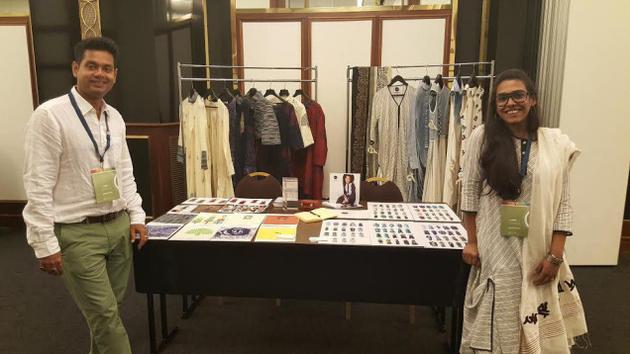
Designers Sayantan Sarkar and Rimi Nayak in Italy.
Two Kolkata designers represent the country in Italy
Last month, designers Sayantan Sarkar and Rimi Nayak — both Lakme Fashion Week veterans — were among a group of 18 delegates from various industries who represented India at a four-day trade conference, courtesy the Bengal Chamber of Commerce. The meet was organised in association with the Indian Embassy as a part of the government’s ‘Make in India’ project. Staged across three Italian cities — Milan, San Marino and Rome — the meet was graced by Italian fashion houses, buyers and industry experts, who were duly impressed by Indian craftsmanship, textile heritage and attention to detail.
Saying it in Bengali
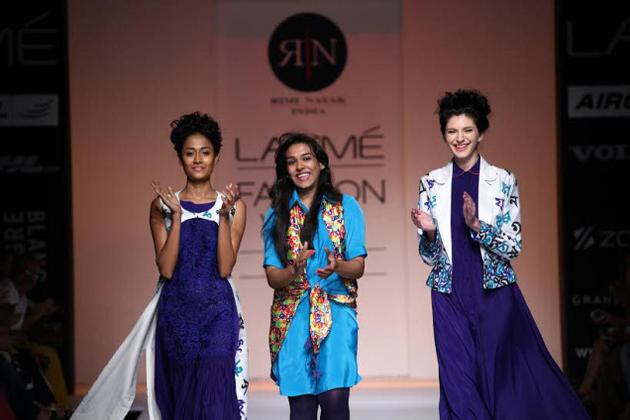
Nayak has been working with prints inspired by Bengali fonts since 2013. Her signature Bengali typography prints have earned her rave reviews at the Lakme Fashion Week and celebrity clients such as Vidya Balan, Amrita Rao, Esha Gupta, Sayani Gupta and Yami Gautam. Nayak. The curvaceous look of the Bengali font piqued the curiosity in Italian buyers. “Bengali fonts are visually appealing and have been hugely appreciated in the past.” says the designer.
Nayak’s collection inspired by Bengali typography.
“I had iconic lines from Tagore’s literature printed on beautiful dresses with my signature drapes. Also, every line in Bengali also had its corresponding English translation. For instance, ‘Pothik tumi ki poth haraiyacho?’ was accompanied by ‘Wayfarer have you lost your way?’ printed beside it.” The ‘world map’ items from her 10-piece capsule collection were also a huge hit with buyers in Milan. “The entire world map was printed on the ensemble in a graphical manner, with names of the countries and oceans written in Bengali and English.”
Nayak, who works extensively with khadi, said that Europeans acknowledged and appreciate the rich heritage of the handloom fabric.
As for the typographical print, she said, “When it comes to typography prints in fashion, you mostly see English, Chinese and Arabic scripts. I am born and brought up in Bengal, although I am Oriya by birth. So I wanted to popularise the Bengali typography as it never got the kind of exposure it deserved.”
Nayak is now expecting potential collaborations through Milan Fashion Week with those who are keen to work with her label. She is looking forward to working on commissions for developing indigenous fabrics for them.
Europeran sensibilities, Indian fabric Sarkar feels Indian designers ought to harness the craze Europeans have for our fabrics. “You can expect to sell a simple Khadi ensemble for 3000 Euros. That’s the kind of price they are willing to pay.” He has also been approached to develop weaves by ‘mesmerised buyers’ from Italy.
He is amongst the handful of Indian designers who develop their own textiles. He works with craftsmen in the Phulia district of Bengal to create fabrics for his western outfits. “The Chamber of Commerce was seeking someone who would cater to European sensibilities promoting Indian fabric. That’s how they zeroed in on me.”
Sarkar travelled with two collections, featuring trousers, shirts and jackets for women. The former used the khesh technie (a technique which recycles fabric) on the denim. “We have applied it on denim strips, washed them and developed fabric out of them. These fabrics were manufactured in Shantiniketan.” His Mayuraka collection. “had dancing peacock motifs used on shift dresses, tunics and shirts.” The other, more bohemian collection, called Vagabondage, was inspired by “the nomadic gypsy lifestyle” and used the Jamdani weave. The feathers of a dream catcher were used as a recurring motif. It featured shibori with kantha stitchwork and South American Aztec motifs inspired by the traditional Bengali Jamdani textile.
Sarkar concedes that the European market is of the opinion that our silhouettes are not trendy or global yet. “They think we are still very conservative. They demanded a new silhouette range, which we have taken up as our most recent project.” Sarkar is optimistic that his designs will display soon at multi-designer outlets in Rome.
The author is a freelance writer
source: http://www.thehindu.com / The Hindu / Home> News> Cities> Mumbai / by Piali Dasgupta / August 09th, 2016
Atanu Das in action at the Rio Olympics on Tuesday
Atanu Das, the Baranagar boy who made the round of 16 in Rio on Tuesday, had taken his first aim with a bamboo bow. “It was made of Manipuri bamboo and cost Rs 1,200,” mother Aditi recalled.
When the Olympian-in-waiting started falling short of desired results in sub-junior contests, Atanu wept his eyes out, pleading with his parents for a fibreglass bow. “We are middle-class people. There was no way we could afford one. But seeing his determination, I closed some of my monthly income scheme accounts at the post office though the interest used to form a necessary part of our earnings,” said Aditi, a homemaker.
They then bought him a second-hand fibreglass bow for Rs 45,000. “It was so full of scratches that it looked more like a third- or fourth-hand one,” she said.
And on Tuesday evening, 24-year-old Atanu made good his parents’ sacrifices by scoring one perfect 10 after another – he got full points in seven of his nine shots in the first match – on the world’s biggest stage.
The bow with which Atanu shot down Nepal’s Jitbahadur Muktan and staved off Cuba’s Adrian Andres Puentes Perez costs close to Rs 2 lakh. “He has two-three top-class bows now,” father Amit said.
Late on Tuesday, the proud parents received a call from their Olympian son. “The wind, he said, was bothering him in the second match,” said Amit, who could not follow his dream of a career in football.
Atanu, now an assistant manager with Bharat Petroleum Corporation, was exposed to sports early. “I wanted him to take a different path. It could have been any sport. The Kolkata Archery Club in Sinthee happened to be near our home,” said Amit, who has taken VRS from the private company he worked for.
Atanu’s first coach Santanu Nandy remembers him well. “He was so serious that he would come straight from school for practice. When he won the sub-junior national championship on debut I knew he was special,” he said.
Baranagar Narendranath Vidyamandir used to let him off early and Aditi would take the 14-year-old straight to the archery club. “The school even excused him from appearing for his Madhyamik selection test.” He travelled to Jabalpur for the junior national meet instead, but only after his mother made him promise that he would do well in Madhyamik.
The call from Tata Archery Academy had come by then. But the boy did keep his word, getting a first division in his Board finals. Atanu is a boy of few words, said his parents who now live with him in the office flat in Bansdroni. Apart from the bullesye, he has his sights set on stamps. “He brings back stamps from wherever he goes,” said Amit.
And on Friday, Atanu has the chance to leave a permanent stamp on Indian sport with bow in hand in Rio.
source: http://www.telegraphindia.com / The Telegraph,Calcutta,India / Front Page> Calcutta> Story / Sudeshna Banerjee / Wednesday – August 10th, 2016
Shakespeare’s Hamlet has inspired award-winning director Anjan Dutta to recreate the intense drama on celluloid, though with a contemporary spin.
Anjan’s ‘Hamlet’, which is the second adaptation of the age-defying drama in recent times after ‘Haider’ by Vishal Bhardwaj, deals with socio-political crisis and violence against humanity.
“Shakespeare’s Hamlet suffered from a basic crisis and I wanted to define and interpret that crisis in my own way,” the director told .
Actor Parambrata Chatterjee will portray Hamlet’s character ‘Hemanta’. Anjan said he himself would play the character if he were a little younger.
“Had I been a little younger, I would have done the role and my wish to portray Hamlet got shape through Param,” he said.
Anjan said that his Hemanta couldn’t care less about the situation around him, unlike his contemporaries who were largely insouciant about violence next door and busy with personal affairs.
“I had long been thinking I should not confine myself to Byomkesh exploits and urban relationship and musicals. I thought there is an imperative need to have a hard look at the present time through my protagonist’s eyes,” he said.
“Hamlet’s character has many layers. Some put his crisis at sexual level, some talk about his anguish and hatred towards the stinking political situation in Denmark about 500 years back. But for me it is more of his angst towards the situation prevailing all over the world,” Anjan said.
Parambrata said he had to cut himself off all other projects for one and a half months to study the character over and over again.
“Though I had read Hamlet during college days as a student of English literature, I needed time to grasp the contemporariness of his character,” the ace actor said adding “it is an actor’s dream to work in projects inspired by Chekov, Tagore and Shakespeare”.
Jisshu Sengupta is playing Horatio’s role while Saswata Chatterjee plays Cladius.
Hemanta after graduating from New York Film School returns to his home in Kolkata and gets the news that his film producer father has commited suicide because his mother Gayatri is set to marry uncle Kalyan (Cladius), which triggers a series of murders and mysterious deaths.
SUS MD MM JCH
source: http://www.timesofindia.indiatimes.com / The Times of India / News Home> City> Kolkata / PTI / August 08th, 2016
Journalist: “Ambassador, Madam Ambassador, is India walking out of the talks?”
Ambassador: “India is going to the loo.”
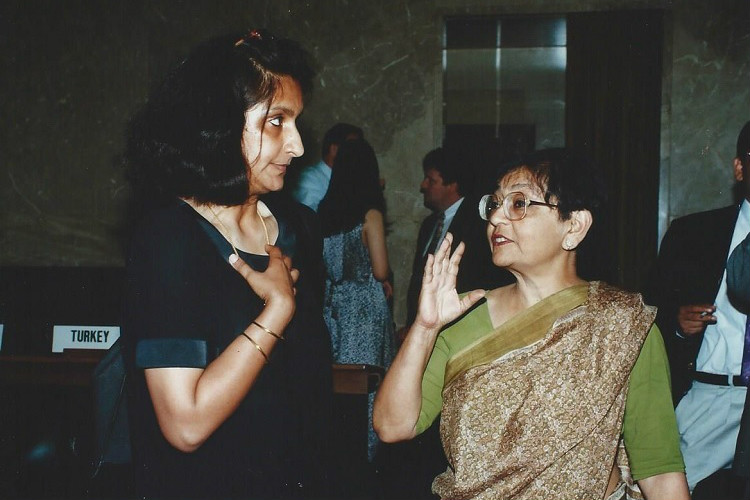
The journalist was a correspondent for a Japanese news agency. The Ambassador was Arundhati Ghose who passed away this week (1940-2016). She was the Indian Ambassador to United Nations (UN) in Geneva. The year was 1996 – she was negotiating the Comprehensive Test Ban Treaty (CTBT) on behalf of 900 million Indians. The diminutive lady with a cigarette in one hand, papers in the other and India in her heart single-handedly wreaked havoc on the Conference on Disarmament (CD). She did this for India.
Leading from the front and all guns blazing, she defended India’s decision to oppose the treaty. The talks hinged on India’s decision and pressure on New Delhi to sign the skewed and dishonest CTBT was multi-pronged and fierce. She didn’t blink – diplomats will tell you what blinking in such negotiations can mean. No she didn’t blink and ensured no one in India did either. That is an even more difficult task for an Indian diplomat to achieve.
I covered the talks. Staking out with hundreds of journalists at the UN became normal life if not at GATT-WTO, then at the UN. Has Ms. Ghose spoken to India, has Washington spoken to India, will India sign, do you know anything, what is she going to do next went the drift. I felt good – this was a great story.
More importantly, in all my years of reporting from abroad including from the UN, I had never seen an Indian diplomat defending India’s interests with such force, grit, grace and determination. At the GATT-WTO, down the road from the UN, India was conceding paragraph by clause on trade and market access to the demands of the very same P5 who were being dismantled by Ms. Ghose for their double-speak and hypocrisy at the CD.
Didn’t national interest include protecting trade interests? For a journalist, the contrast was stark and which each passing day, I admired Ms. Ghose. If she could do it, why not the other guys down the road? The answer was and continues to be simple – she was a committed Indian, India’s defence interests were not just a treaty, it was her soul and her substance. She walked and talked national security, especially South Asian security.
Picture this. Press conferences during the negotiations were held throughout the day with all of us chasing the P5 (United States, United Kingdom, France, China and Russia), sharing notes, placing each others’ tape recorders in strategic places – laptops and mobile telephones had just debuted. The more important CTBT press conferences were held in a large room, always jam-packed. What will India do or what do you think India will do was almost always the first question.
One such presser was called as the endgame neared. Sitting on the stage with the P5 manel, Ms. Ghose was unperturbed, taking notes, as Ambassador after Ambassador said New Delhi would be held responsible for the CTBT’s collapse. At one point a western P5 Ambassador said “…the people of the world want this treaty.” Ms. Ghose jumped in. Hello, she said. “Which people…I represent 900 million people and you will not ignore the wishes of my people. We are not signing the CTBT text on the table.” In a spontaneous gesture journalists were on their feet applauding Ms. Ghose. The logic was on India’s side – the world had failed its CTBT mandate. The air was electric.
In 1993 the UN gave the then 38-nation Geneva-based CD its first comprehensive mandate to negotiate a test ban treaty at the earliest. The scope of the proposed treaty quickly emerged as the most important and contentious aspect of the negotiations. Linked to the scope were verification and compliance protocols which obviously meant on-site inspections. An international monitoring system would check cheaters but fears grew that this was a fishing expedition in disguise.
Just ahead of the CTBT, India said that the indefinite extension of the nuclear non-proliferation treaty (NPT) – a gift the then nuclear weapons states had given to each other to blow the world apart – was an act of bad faith. Given that reality, New Delhi said any meaningful CTBT could not be a standalone piece and must be part of a time-bound global disarmament process. That set the cat among the pigeons, then.
How did Ms. Ghose handle it? How many phone calls did the Indian Prime Minister take? It was a long way from Arkansas to Haradhanahalli – maybe the Indian Prime Minister was resting when the phone rang, maybe the two men just didn’t understand each other. All we knew was that Ms. Ghose had a mandate and she was going to work it for her people. Ambassadors are supposed to do just that. Serve their countries.
Ms. Ghose did all the heavy lifting and then there were moments that tugged at your heartstrings. She told me about a visit to a bank during one of her trips to New Delhi. The clerk looked at her name, jumped up, told her the entire nation was behind her as she negotiated the ‘NTPC’ in Geneva – such was the groundswell of support for her. There were other anecdotes, of people stopping her on the streets of India, Ms. Ghose and the journalists hanging out in Geneva over peels of laughter even as she scolded us for following her to the loo or not allowing her a peaceful moment for a puff at 3 a.m.
As I write this, I wonder if Ms. Ghose is not telling god what she thinks of the man with the yellow hair trying to make his way to the White House. There will never be another like you Ms. Ghose. This is but a goodbye.
source: http://www.thenewsminute.com / The News Minute / Home / by Chitra Subramanian / Wednesday – July 27th, 2016
Indian Institute of Technology Kharagpur will confer the Distinguished Alumnus Award on the occasion of the 62nd convocation of the Institute which will be organized on July 30 and 31.
Seven eminent alumni have been selected for the award for their exceptional professional achievements in the industry, in the academia or as entrepreneur. The awardees are – Dr Anurag Acharya, Ajit Jain, Asoke Deyasarkar, professor Gautam Biswas, professor Indranil Manna, professor Supriyo Bandopadhyay and Professor Venkatesan Thirumalai.
Dr. Anurag Acharya (IIT KGP B.Tech./Computer Science and Engineering/1987 batch), Distinguished Engineer at Google USA. Dr. Acharya is key founder of Google Scholar which since its inception has become an indispensable service for the global academic and research community.
Ajit Jain (IIT KGP B.Tech./Mechanical Engineering/1972 batch), President of Reinsurance Division, Berkshire Hathaway Insurance Group, USA. Shri Jain is a visionary in the global investment sector, having led Berkshire Hathaway to great heights. He is a well-known philanthropist as well funding the Jain Foundation with the mission is to cure muscular dystrophies.
Dr. Asoke Deysarkar (IIT KGP B.Tech./Chemical Engineering/1971 batch), CEO and Chairman, PfP Industries, USA. Dr. Deysarkar has blended his research with entrepreneurship in Chemical Engineering forming a billion dollar conglomerate of companies. The Deysarkar Family has helped establish the Trans-disciplinary Program in Petroleum Engineering at IIT KGP. Dr. Deysarkar is also known for his philanthropy activities.
Professor Gautam Biswas (IIT KGP Ph.D./Mechanical Engineering / 1985 batch), Director, Indian Institute of Technology Guwahati. Prof. Biswas has an illustrious academic career of 25 years having taught at IIT Kharagpur, IIT Kanpur and in various international universities and known for his leadership at IIT Kanpur, Central Mechanical Engineering Research Institute, Durgapur and IIT Guwahati. His fundamental research on heat transfer phenomena is well recognised in the international academic community. He was the Founder Director of Academy of Scientific and Innovative Research (AcSIR), New Delhi.
Professor Indranil Manna (IIT KGP Ph.D./Metallurgical and Materials Engineering/ 1990 batch), Director, Indian Institute of Technology Kanpur. He has been an exceptional academician and researcher having a long-standing association with IIT Kharagpur as faculty and thereafter leading the Central Glass and Ceramic Research Institute, Kolkata and IIT Kanpur. His significant contributions in advanced material science and engineering have been well recognised by national and international bodies.
Professor Supriyo Bandopadhyay (IIT KGP B.Tech./Electronics and Electrical Communications Engineering/1980 batch), Commonwealth Professor, Department of Electrical and Computer Engineering, Virginia Commonwealth University, USA. Recently he was named Virginia’s Outstanding Scientist and is known globally for his interdisciplinary research. He directs the Quantum Device Laboratory in the Department of Electrical and Computer Engineering which has been frequently featured in national and international media for exemplary research in nanotechnology.
Professor Venkatesan Thirumalai (B.Sc./Physics /1969 batch), Director, NUSNNI-NanoCore, National University of Singapore. He is known for his pioneering research in laser technology. Prof. Venkatesan was Founder of the PhD/MBA program in NUS and the Surface Center at Rutgers University.
The Distinguished Alumnus Award is one of the highest recognition given of accomplishment and contribution of an alumnus/alumna from the Institute.
The awardees will be given a gold medal and a certificate.
source: http://www.timesofindia.indiatimes.com / The Times of India / News Home> City> Kolkata / Somdatta Basu / TNN / July 12tj, 2016
Bengali film star Jeet’s Grassroot Entertainment Private Limited on Wednesday announced that they have signed a long-term agreement with Premier Futsal to acquire the Kolkata franchise of the league.
The agreement, for an undisclosed sum, makes Kolkata the second franchise to be sold after the promoters of football club Chennai City FC — among the oldest in the city — picked up the league’s Chennai team.
“Football has a huge, fervent following in Kolkata, where love for the sport is passed on from one generation to the next. It is therefore a matter of great pride for me to introduce the faster, shorter version, of the beautiful game to Kolkatans,” Grassroot Entertainment Pvt. Ltd director Jeet said in a release.
“Through futsal, the young generation can hone their skills and talent, which will uplift their quality and eventually benefit in long-term development of footballers. I’m certain it will capture people’s imaginations and thrive and I urge people to come forward and support our initiative to lead the Kolkata franchise of Premier Futsal to glory.”
The Kolkata franchise will be called Kolkata 5s. In the inaugural season, each team will be similarly named. The franchise-owners will then be allowed to rebrand their respective teams from the second season onward.
Premier Futsal managing director Dinesh Raj said, “It gives me immense pride to announce Jeet and Grassroot Entertainment Pvt. Ltd. Asowners of our Kolkata franchise. We are delighted to have a superstar of Jeet’s stature backing Premier Futsal and playing his part to grow it in what is football’s Indian heartland.”
“The response we have received from prospective owners across all cities validates our decision to get behind Futsal as sport. We will unveil owners of the other franchises very soon.”
Each franchise will be assigned a marquee international football player, seven international and five Indian Futsallers for their squad to participate in the inaugural season through a player draft scheduled later this month.
The league, which has roped in international stars like Alessandro Rosa Vieira, fondly known as ‘Falcao’, Deco, Paul Scholes and Michel Salgado will kick start from July 15.
Portuguese legend Luis Figo is the president of the tournament.
–IANS
dd/ajb/dg
source: http://www.timesofindia.indiatimes.com / The Times of India / News Home> City> Kolkata / IANS / July 06th, 2016
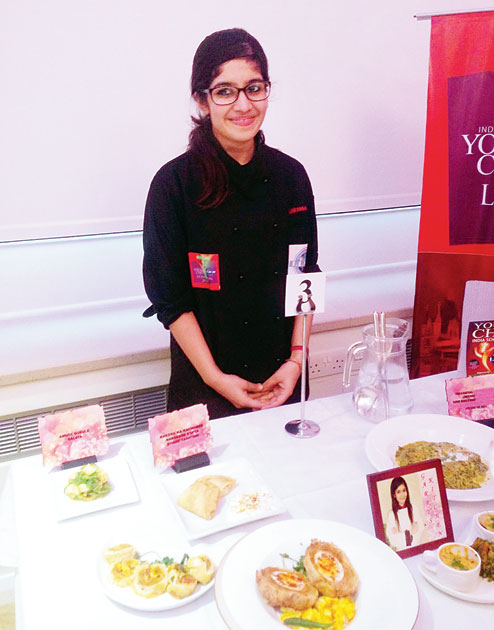
Garima Poddar plates her dishes at IIHM Young Chef India Schools 2014 at the University of West London
Garima Poddar likes her friends calling her Garry after Gary Mehigan, her favourite judge on Masterchef Australia.
And true to the Masterchef nickname, the Calcutta Girls High School Class XII student won the IIHM Young Chef India Schools 2014 contest at the University of West London on Saturday and retained the crown that Simran Kapur had won for Calcutta last year.
The finals of the inter-school cooking competition — held by the International Institute of Hotel Management (IIHM), in association with t2 — saw six finalists from six Indian cities (Calcutta, Delhi, Hyderabad, Bangalore, Pune and Ahmedabad) battle it out with their plates and pans to serve up meals to some of the best-known Indian chefs in London.
Wearing the judges’ hat at the London finale were Andy Verma, who owns restaurants Vama and Chakra in the UK, Dipna Anand whose family owns and runs Brilliant restaurant in London’s Southall area largely inhabited by Indians, Romy Gill of Romy’s Kitchen in South Gloucestershire, and closer home t2 columnist Shaun Kenworthy and Sector V IIHM’s chef Sanjay Kak.
How apt it was for the IIHM Young Chef India Schools contest to culminate in London was underlined by Virendra Sharma, MP, Ealing Southall, the chief guest at the evening prize distribution, who pegged the number of Indian restaurants in the UK at 60,000.
But what did Calcutta girl Garima do that the others didn’t? For one, she churned out 10 dishes in a three-hour-long cookout, a number unmatched by any other contestant. “Her biggest challenge was getting all her dishes right because she made so many,” agreed the judges, all of who gave Garima the highest score.
The Southern Avenue resident pinned her win down to two factors — confidence and practice. “I know it sounds cliched but practice does make perfect. I strived to make at least three dishes a day to prepare for the finals. One day, I did a 100 roti challenge just to get that perfect roti shape and all the rotis were given to the needy,” said Garima.
Like Garima, her other five competitors made it past 8,000 students who participated in the Young Chef competition over six months. Two got their visas in the nick of time and reached two hours before the contest kicked off while the Jaipur girl had to give it a miss, cutting down the number of finalists to six from seven.
In the two days they all spent in London before the finals, food was the only thing on Garima’s mind. Ask the Lebanese hairdresser at Eli’s Hair & Beauty on Kew Bridge Road who was unexpectedly pulled into a casual conversation on tahini, babaganoush and shawarma as she settled down for a wash-and-blow dry! Or the Kadai Chicken that was sampled at a local restaurant down the road from the hotel.
“In fact, it was for this competition that I started having non-veg,” said the spunky Marwari girl. “Non-veg is not cooked at home but we eat it outside. Initially, I would nibble on chicken; now I can eat a whole chicken meal!”
Which is why chicken featured on what the judges called her “buffet”. There was Chicken Garam Masala Roast, Nageese Kofta (egg wrapped in chicken keema) “learnt from my mom’s friend”, Kheera Ka Kachoree “learnt from dadi”, Bhaap Tashtari, Fish-E-Hariyaali, Lemon Rice, Gobi Dahi Ki Sabji and a fusion dessert Gajar Ka Halwa with Lemon Cheesecake. She also made an Amuse Gueule called Salata (frozen salad) and an Assamese dish called Narasingha Paator Maas “inspired by a YouTube video of Gordon Ramsay cooking Assamese food in Assam”.
The commerce student who loves economics also made all the right calculations and moves. Like when she used micro-greens to garnish her dishes, an idea picked up from Shaun’s cooking demonstration the previous day. Or when “I decided not to make rotis because they would have to be made last and would eat into my plating time”, she said.
Her future plans? “It’s either economics or cooking and after this contest, the scales are tilting more in favour of the latter,” she signed off, clutching in her hands the winning trophy, a cheque for Rs 5 lakh and a placard that read ‘Garry’s Kitchen’, which she had proudly displayed on her table.
What is your message for Garima? Tell ttmetro@abpmail.com
source: http://www.telegraphindia.com / The Telegraph,Calcutta,India / Front Page> Calcutta> Story / by Karo Christine Kumar in London / Monday – October 20th, 2014
The little-known Amrapali mango grown in Bankura district of West Bengal has now found buyers in Dubai, Hong Kong and Malaysia.
Horticulture Department officials said mango producers in Bankura have received orders of exporting 8 metric tonnes of Amrapali to Dubai this season.
“They have started sending it after a quality test report from the Agricultural and Processed Food Products Export Development Authority (Apeda) cleared the product,” department official Sanjoy Sengupta said.
He said the delectable taste of the mouth-watering variety has been gaining popularity gradually over the years.
Producers have been sending it to all over the country but this is the first time that any variety of mango from Bankura is getting export orders.
So far, mangoes from Malda and Murshidabad only were the famous ones in the state.
“Now we are trying to create Bankura as a brand in the world of mangoes. Our red laterite soil produces an unmatchable taste,” officials said.
Sengupta said that they were already receiving queries about the fruit from Hong Kong and Malaysia where Amrapali would be exported next year.
This year the district produced around 130 tonnes of Amrapalis in around 730 mango orchards.
The largest orchard of 84 bigha is in Damadorpur where the highest number of Amrapalis are produced.
Last year, Bankura’s Amrapali had bagged the first prize in the agri-horticulture fair in Kolkata.
At an ongoing mango festival in Delhi, where state horticulture department officials are present, Bankura is beating other districts.
“Bankura is getting more attention than any other district. The demand is so high that all our stocks are getting exhausted,” Sengupta said.
NIK MD MM DV
source: http://www.timesofindia.indiatimes.com / The Times of India / News Home> City> Kolkata / PTI / June 28th, 2016
Neil Taylor’s mother, Shibani Chakraborty , is a Bengali from Kolkata. The half-Welsh, halfIndian footballer is the closest to Indian involvement in Euro.
Neil had scored the second goal in a 3-0 thumping of Russia that enabled Wales top Group B and earn the debutant nation a place in the last 16 of Euro.
The comments on Neil Taylor’s official Facebook page are both euphoric and cheeky . One says, “Huw….if Ronaldo asks you to swap shirts, tell him to get stuffed…you only swap with goal scorers.” Another comment teases the 27-year-old left full-back on his first ever goal for Wales.”Neil. You scored. How.”
But for any Indian reading the 150 plus comments to Neil’s Monday night post, this one really catches the eye. “Well played lad! Proud of your Bengali origin! Lots of love & well wishes from Bangladesh.”
Neil had scored the second goal in a 3-0 thumping of Russia that enabled Wales top Group B and earn the debutant nation a place in the last 16 of Euro. He never scored for Swansea, the EPL side he plays for.
Not many know that Neil Taylor’s mother, Shibani Chakraborty , is a Bengali from Kolkata. The half-Welsh, halfIndian footballer is the closest to Indian involvement in Euro. As a child, Neil played cricket for his village side in north Wales though football is what he was always devoted to. “Sachin Tendulkar is a huge character and sportsman to me,” he once told The Independent newspaper.
In interviews to British newspa pers, Neil comes across as someone proud of his Indian roots. In 2013, he had visited Kolkata as part of a charity project, Kolkata Goalz, to promote the game among under privileged kids.Earlier as a nine-year-old he had visited the city -a trip to Eden Garden and playing with colours in Holi -being two indelible images of that visit. “What I remembered of the country was that it is just cricketmad. But when I went out this time I saw the change. It was monsoon and you couldn’t even take your feet out of the grass. Sopping! But all the young people were playing football,” he told the newspaper.
Late Monday night, Neil had posted, “What a feeling.. What a night in Toulouse!! The Wales fans were unbelievable, thank you for your support. A night to remember at Euro 2016!!” Neil began his career as a junior at Manchester City . But at 15, he joined the 152-year-old Wrexham, the oldest Welsh club and the third oldest in the world. He made his international debut against Croatia in 2010.
In an interview to BBC earlier this month, his mother said, “Ever since he was a child that’s all he’s wanted to do, play football. He mis sed all his school discos and friends’ birthday parties because, at that time, he was playing for Manchester City (junior team).We’d drive him three times a week to Manchester and back when he was about nine or 10 and not once did he say, ‘Mum, do I have to go?’ He used to sit in the back of the car and do his homework.”
A November 2015 BBC reports says that as people of Indian, Pakistani and Bangladeshi origin form 5.3% of the 56 million population in England and Wales as per 2011 census. Yet Neil is just one of the seven Asian players with a professional contract in the top four English leagues.”Wolves centre-back Danny Batth and Mansfield left-back Malvind Benning are the only others from the group who play regular first-team football,” the report says.
source: http://www.timesofindia.indiatimes.com / The Times of India / News Home> City> Delhi / TNN / June 22nd, 2016