Category Archives: World Opinion

Kolkata set with world class facilities for U17 World Cup

Kolkata:

The stage is set for the 66,000-capacity Vivekananda Yuva Bharati Krirangan in Salt Lake to host 10 matches of the Fifa Under 17 World Cup in the city. The event kicks off in Kolkata with two matches on Sunday— the first between England and Chile and the second between Iraq and Mexico.

DGP Surajit Kar Purkayastha visited the stadium on Saturday afternoon along with senior officials to take a stock of the security, parking and other arrangements to ensure a hassle-free experience for spectators, including the foreigners who will turn up to witness the matches. Tickets for the matches on Sunday have already been sold out.

“The security inside and outside the stadium is perfectly in place and everything has been done in close coordination with Kolkata Police. There will be directional signs and a good number of police assistance booths for the spectators. All the departments under the state government have worked hand in hand to ensure the best of facilities inside and outside the stadium for the spectators,” Kar Purkayastha said.

Commissioner of Bidhannagar City Police Gyanwant Singh had said a few days back that the police have chalked out a detailed evacuation plan through which the entire stadium full to its capacity can be evacuated in eight minutes in case of any emergency. “We don’t want to take any risk in view of the global situation. So we have prepared for all crisis situations. The emergency evacuation plan we have formulated will ensure there is no stampede.”

Spectators would not be allowed to carry anything apart from their mobile phones while women could additionally carry a purse, but after it is checked.Water bottles, newspapers, bags, helmets or containers of any kind, including aerosol cans and spray, will not be allowed.

A total of 3,000 cops — including 35 officers of SP and ASP rank and 60 lower ranked officers — would be on duty. No goods vehicles will be allowed to ply from 7 am to 11.30 pm in the roads, lanes and areas under Kolkata airport, Baguihati, Lake Town, New Town, Rajarhat and the entire Bidhannagar area.

The doors of the stadium would be opened two hours prior to the start of the day’s first match and all spectators will be frisked. Tickets would also be scanned. There will be 110 door frame metal detectors as checking points, with 260 closed circuit TVs deployed at all nook and corner of the stadium to keep vigil.

There will be adequate parking arrangements and everybody is requested to park at the designated parking area. Bidhannagar City Police has provided a link in its website putting the details of the parking & traffic circulation plan along with do’s and don’t’s for facilitating the spectators.

source: http://www.millenniumpost.in / Millennium Post / Home> Kolkata / by Soumitra Nandi / October 07th, 2017

The touch of civility – Jeremy Raisman’s career in India

Peterhoff, in Simla, where Jeremy Raisman stayed in India

Jeremy Raisman is not a name many recognize in India or Britain. But while a few British Jews might take pride in his achievements in the Indian Civil Service, the few Indians who know he presented five wartime budgets as finance member of the viceroy’s council may not remember him with affection.

He comes to mind because the Royal Borough of Kensington and Chelsea library has mounted a display of Indian books to commemorate what the British now call “Partition”. A leading Queen’s Counsel who wonders if India’s judiciary maintains the same high standard as when Soli Sorabjee was attorney-general asks what I think of Partition. So does a benign peer who campaigns against caste discrimination among subcontinental immigrants in Britain. Also a revered academic who has authored erudite tomes on India and Pakistan. I stress the commemoration is of Independence, but Partition is what the avalanche of television talks and discussions calls it. TV imposes its thinking and terminology even on the learned and discerning. It prefers Partition. Why?

A journalist I first encountered during the staged drama of “Mujibnagar” offered a typically English explanation. “‘Partition’ makes us feel guilty,” he said. “We love that!” He finds the endless televised interviews with Hindus and Muslims who had lost all, especially their closest relatives, in the great upheavals of 1947 tiresome. “The one question they never ask is ‘So many of your relatives were killed but did you kill anyone?'” He says Saudi Arabia promised the infant Bangladesh a billion dollars or more to call itself an “Islamic republic”. Mujib refused. Now he fears India is on the brink of betraying the dream of its founding fathers and turning into a rabid Hindusthan.

The books displayed – Nehru’s letters, Gandhi’s thoughts, Mountbatten, Jinnah and even a tattered biography of Maulana Abul Kalam Azad – celebrate the empire’s guilty conscience. It would have been too much to expect The Undark Sky, subtitled “A Story of Four Poor Brothers”, by Jeremy’s nephew, Geoffrey Raisman, among them. India isn’t its main theme. Geoffrey was – I have just discovered he died in January – a distinguished neuroscientist who made it his mission to find a cure for paralysis caused by spinal chord injury. We met many years ago at a formal dinner at Corpus Christi College, Oxford. He was then working on The Undark Sky and later sent me a copy. He told me how his grandparents had fled Lithuania and settled down in a Leeds slum called Leylands. They were tailors with 11 children. Jeremy, born in 1892, was the third and most successful. John came fifth. Harry, Geoffrey’s father, was the sixth.

The family had never seen chocolate biscuits or butter and jam on bread until Jeremy won a scholarship to Oxford. Visiting Blenheim, the Duke of Marlborough’s grand palace that was Churchill’s ancestral home, Harry Raisman echoed another more famous Jew. “The history of England,” he declared, “the history of any country, is nothing more than an account of the bitter, continuous struggle of the common people against their rulers, the kings and queens, the dukes, barons, earls…” It isn’t for that radical explosion that The Undark Sky came to mind at the Kensington library’s exhibition but because of Jeremy Raisman’s Indian career. The boy who had once pointed to an elegant country house in Yorkshire and said “One day I’ll have a house like that” lived in Peterhoff, a Simla mansion burned down in 1981, whose ballroom could take two hundred dancing couples. It’s a house I went to see once for my mother had spent holidays there as a child when her uncle, S.R. Das, lived in it as law member.

J.R.D. Tata visited Peterhoff and beat everyone at ping-pong. Raisman backed Tata’s steel production. He also helped to conserve India’s sterling reserves. They amounted to a handsome £1,300 million or Rs 1,733 crore at the prevailing exchange rate, being mostly money an impoverished Britain, which had “to spend vast sums buying equipment from America… to sustain the war”, owed India. Churchill’s government expected India to pay even more for the war effort than the Indo-British agreement on sharing expenses stipulated. Some in London, including Maynard Keynes, wanted Britain’s debt reduced or cancelled. As India’s effective finance minister, Raisman objected to both. He wanted the agreement adhered to, and told the war cabinet in London on August 6, 1942 that being a belligerent “had already caused a heavy increase in India’s own expenditure”. It could not accept a larger defence liability. But his testimony was kept secret because it might set a precedent. Churchill didn’t want any Indian who succeeded Raisman “to claim the right to attend the war cabinet”.

Perhaps not so surprisingly in that pre-Islamist age when the Jew in question had cast himself in an imperial English mould, Sir Jeremy’s sympathies, personal and political, were with Muslim potentates like the Nizam, and the Nawabs of Bhopal and Chhatari. He didn’t like Gandhi. When he offered not to jail Gandhi in return for tacit cooperation and Gandhi replied he had to stick to his principles, Raisman grunted “Principles! With the bodyguards we provide to protect him, it costs the government of India millions to keep one man in poverty.” The Aga Khan’s palace wasn’t much of a prison!

Gandhi cropped up many years later when Mountbatten told Jeremy at a lunch in London, “In my opinion you were responsible for the death of Gandhi.” Asked why he thought that, Mountbatten replied Nehru had told him so. Raisman explained to Geoffrey, Harry and John, “After independence and the partition of the country, there was a financial crisis. The Reserve Bank of India was holding all the gold and currency reserves. The new Reserve Bank of Pakistan appealed to the British Government to intercede for them. I was asked to go out and advise. I refused, but in the end they insisted, and I agreed to go out, but only on the condition that I would give advice, but I would not enter into any discussion. I would give my opinion and that was that.” He advised that the gold reserves should be shared between India and Pakistan. “It was only fair. Both countries had paid taxes. They were entitled to it. Without reserves, the national banks couldn’t function. It was only common justice.”

According to Mountbatten, Nehru refused. “What!” he exclaimed “Give them the money! They’ll only use it to buy arms to murder our people with.” Hence the appeal to Gandhi. “Gandhi’s influence was tremendous. People worshiped him like a god. Well, Gandhi at once backed my decision. He agreed it was only natural justice, and with that, of course, it was agreed to transfer the gold and currency reserves. They included the sterling balances I had fought so hard for at the war cabinet…”

Jeremy had called on Nehru on the morning of Gandhi’s assassination. Nehru told him, “You know the old man’s being very difficult and causing me a lot of worry because there’s a lot of opposition building up to him.” Raisman went on, “That very afternoon, Gandhi went out as usual, to pray in public… One of his fanatical followers just walked right up to him with a revolver and shot him dead at point blank range.”

Sir Jeremy sat back. John, fumbling with his pipe, remained silent. “Let’s have tea,” said Harry, playing the host. The Jewish refugees from Lithuania had become almost English. Almost but not quite. Unlike the English, they rejected any share of the blame. “Of course I told Mountbatten that I didn’t agree I was responsible” was Sir Jeremy Raisman’s disclaimer. He probably remembered 1947 as the year of Partition more than Independence, but with none of the English sense of guilt for the bloodshed.

source: http://www.telegraphindia.com / The Telegraph,Calcutta,India / Front Page> Opinion> Story / by Sunanda K Datta-Ray / Saturday, October 07th, 2017

Newly-discovered maps from 1887 tell Kolkata’s municipal story

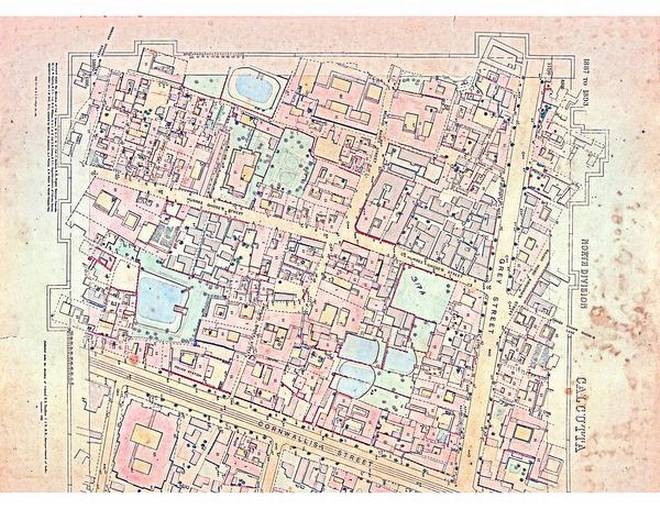
Painstaking effort: In this British-era map of Kolkata, water bodies are shown in blue and concrete structures are marked in pink.

The newly-discovered Kolkata maps, created over a seven-year period, plot buildings, trees, lakes and even dustbins

Almost a hundred years before satellite-based mapping made information available to people at their fingertips, a municipal survey done in Kolkata by British surveyors documented not only streets, houses, landmarks and water bodies but also trees, telegraph and telephone posts, urinals, wells, hackney carriage stands, and dustbins, among others.

The maps of the first major municipal survey of the city carried out over a span of seven years from 1887 are so precise that they follow a scale of 50 feet to an inch. The survey was conducted by Lt. Colonel W.H. Wilkins, who had surveyed Bassein in British Burma. The exercise involved ₹2.38 lakh.

The West Bengal State Archives is now ready with a publication comprising 38 such maps detailing the city’s north division, from Mahratta Ditch in the north, the Hooghly river in the west, the Circular Road, Panchanna Gram in the east and Jorasanko and Kasaripara area in the South.

Titled ‘Calcutta Municipal Maps 1887-1893,’ the publication provides a rare glimpse into the urban history and landscape of Kolkata with the minutest details.

Simonti Sen, the director of State Archives said the painstaking detail in the maps was impressive.

“These maps will not only serve as a milestone to those interested in urban history of the city but can be of immense use to environmentalists who can look up information on water bodies and clusters of trees that existed between 1887 and 1893,” Ms. Sen told The Hindu.

The maps were discovered rolled up in a corner of the State Archives when the renovation of its premises was taken up in 2015. Archivists came across 20 inch x 18 inch sheets with alphanumeric markings that did not make much sense in the beginning.

After a thorough search, scores of such maps were found and it was ascertained that the alphanumeric markings were the order of the maps. The maps were marked on the basis of street names and names of landmarks. Consultations with experts showed that they were part of the survey done by W.H. Wilkins. Each map sheet bears the names of nine or ten surveyors, mostly British, including that of Col. Wilkins.

First effort

“The Calcutta Municipal Corporation was set up in 1876, and this may be the first major survey after that. We believe that the aim of the survey was to increase the tax base of the corporation. One can see the pucca houses and katcha houses being marked differently. Moreover they take into account all municipal infrastructure from sewage lines and drains to telegraph and telephone posts,” Sarmistha De, archivist who has worked extensively on the publication said.

Both Ms. Sen and Ms. De are convinced that the maps, which are being brought to the public domain for the first time, served as the basis of the survey conducted by Major R.B. Smart between 1903 and 1914, which historians call the most “noteworthy of all surveys made on the city till date”.

A changed city

One important thing that the maps point to is the significant change in Kolkata’s green cover and water bodies. They have distinct symbols for different kind of trees, while water bodies are shown as blue spaces, concrete structures are marked pink, and katcha houses, grey.

Almost all 38 maps indicate large open spaces and green. These areas have turned into the most congested parts now.

The maps highlight important educational and cultural institutions of 19th century Kolkata. For instance Bethun College and School, one of the first educational institutions exclusively for girls has been marked as Bethune Female School.

The historic Scottish Church College set up by Alexander Duff in the beginning of 19th century is described as The General Assembly’s Institution in map sheet no. S9. More landmarks such as Duff’s Hindu Girl’s School (sheet no. Q7) and Free Church Institution (sheet no. O3, O4) are also mentioned.

The Star Theatre which conducted its first show on 21 July, 1883 can also be seen at the crossing of Cornwallis Street and Grey Street. (map sheet no S7).

Historians can also find details about the Bengal Music School founded by Rabindranath Tagore, in 1881, referred to in map sheet numbers P4 and P5.

These map sheets also provide a glimpse of the transformation of urban geography.

The name change of some old city streets becomes immediately evident: European names have yielded to Indian ones.

For instance Cornwallis Street changed to Bidhan Sarani, Schalch’s Street to Durgacharan Banerjee Street and Grey Street is now Shree Aurobindo Sarani.

After the current publication, the State Archives plans to reveal 68 other maps.

source: http://www.thehindu.com / The Hindu / Home> News> Cities> Kolkata / by Shiv Sahay Singh / Kolkata – September 30th, 2017

3 Kolkata directors to be part of Oscar panel

Kolkata:

The Academy of Motion Picture, Arts and Sciences has invited 14 popular personalities associated with Indian cinema to be a part of its Oscar committee. Three eminent directors from Kolkata — Mrinal Sen, Buddhadeb Dasgupta and Goutam Ghose — are also in this list.

Incidentally, all three directors have never been in awe of the Oscars. Their names have been often associated with awards at Berlin, Venice and Cannes film festivals. Though highly respected in the art-house circuit of international cinema, none of them have ever won an Oscar or sent their films for consideration at the awards.

Dasgupta has never been known to have rated Oscars as the highest film event. “I have never been inspired by Hollywood. For me, Oscars has never been a benchmark for great cinema. I don’t remember aspiring for an Oscar either. Having said that, I must also mention that being invited to be a part of the committee is definitely a kind of honour for me. I have accepted the offer,” the director said.

Ghose shared that he was once the chairperson of the board that decided on which Indian film must be sent as the Oscar entry. “India produces a lot of films. Thus, we had sent a request asking if more than one film can be sent from here,” he said. Though Ghose insists that he has never been crazy for Oscars, he doesn’t have any conflict with this award ceremony. “Why just Oscars? I haven’t even craved for a Palme d’Or at Cannes. Oscar is basically an award for English language films released in the US. It is also true that some masterpieces have never got an Oscar. Even Alfred Hitchcock didn’t get an Oscar. Yet it is important to see that the academy is expanding and constituting a large committee,” Ghose said.

At 94, Sen is just a year younger than the oldest invitee (American actress Betty White). When TOI asked the director’s son Kunal about his father’s reaction to the invitation, he said, “I have mentioned it to him. He didn’t show any interest or curiosity. It makes little difference as he doesn’t watch films any more. Even when he was active, he showed no interest in the Oscars or the type of the films that compete for it. He didn’t even watch a lot of Hollywood productions. Therefore, I doubt he would have been too involved even if it happened years ago.”

Incidentally, Sen has once famously said, “Oscars didn’t make ‘Slumdog Millionaire’ a great film.”

“He preferred more serious films, not the crowd-pleasing ones that Oscars generally lean towards,” Kunal said. On being asked if Sen’s films were ever sent to the Oscars, Kunal said, “He preferred the European festivals. So, I don’t think he would have considered it, and I am not aware of any of his producers who did it either.”

source: http://www.timesofindia.indiatimes.com / The Times of India / News> City News> Kolkata News / by Priyanka Dasgupta / TNN / July 12th, 2017

Midmark (India) sets up experience centre in Kolkata

Kolkata :

Midmark (India), a provider of medical, dental and veterinary equipment and solutions, has set up its first experience centre in Kolkata.

This incidentally will be the company’s first “state-of-the-art” experience centre in the eastern part of the country.

The display centre will showcase a “Barrier Free” OPD room, advance hospital beds and allied medical furniture. Customers will be taken on an interactive journey through the product and solution offerings and will be able to discuss about efficient clinical spaces with the experts, the company said in a press release.

The company operates in four main business areas: medical furniture, including hospitals beds and OPD spaces, diagnostics, homecare and skill development.

According to Sumeet Aggarwal, MD, Midmark (India), the new national health policy plans to add 1.8 million beds in the next ten years.

“In line with this vision, we have an ambitious expansion plan for eastern India which includes launching three more experience centres in eastern India and another 12 in other regions of the country over the next 2 months,” he said.

source: http://www.thehindubusinessline.com / Business Line / Home> News / by The Hindu Bureau / Kolkata – April 11th, 2017

Kolkata-based oil & gas co set to buy LSE-listed firm

Kolkata :

City-based PFH Oil and Gas, promoted by Harsh V Poddar of Poddar group, is in talks with London Stock Exchange (LSE)-listed companies for acquisition to expand its energy business. The Poddar-led firm has won three gas blocks from ministry of petroleum and natural gas last week. It is one of the youngest firms in India and the only firm from east to be allotted these oil and gas blocks by the Cabinet Committee on Economic Affairs (CCEA) in this round of auction held on February 16.

Out of these three fields, two are in KG basin (Andhra Pradesh) and one in Cambay basin in Gujarat. During the latest auction round, CCEA awarded contracts for 44 fields, mostly smaller fields of ONGC and OIL India. A total of 47 companies submitted their bids for these blocks, out of which four were foreign companies.

Poddar, a 29 year MBA from Yale and a graduate of Duke University who came back to Kolkata after over an eight-year stint in the US, told TOI that his plan is to acquire the LSE-listed company and merge it with PFH through which its hydrocarbon firm, too, would be listed on LSE. “We are in advance talks with two-three firms. I am going to the UK later this week to finalize a deal,” he added.

However, Poddar didn’t disclose the names of the UK firms citing LSE restrictions

According to Poddar, the three gas fields awarded to PFH have adequate reserve. “There are four drilled wells, and the company plans to drill at least 11 additional wells in the near future. Our portfolio currently consists of three fields in India, which we expect to bring into production by the end of the year. By 2020, we aim to have a portfolio of at least 10 producing blocks in India,” he added. Over the next 20 years, PFH has set a target to become one of the largest global exploration and production companies with a focus on gas.

A young serial entrepreneur, Poddar has acquired or started companies in IT, semiconductors, shipping and environment engineering across India, the US, China and Israel over the last eight years. According to him, Yogeshwar Sharma, based in France, has recently been appointed as a director on the board of PFH. He is the co-founder of Hardy Oil and Gas plc, a London-listed company and served as its CEO until May 2012. PFH Oil and Gas is advised by Manuel Pinho, who had served as economy minister of Portugal from 2005-2009.

Apart from upstream business of exploration and production (E&P), it is also planning to focus on building mid-stream business like infrastructure such as pipelines in the KG basin to make it easier for independent and smaller E&P companies to enter the industry in the future. “Since transportation infrastructure in India is predominantly government-owned, often capacity constraints and lack of competition make it difficult for smaller private companies to negotiate a deal and efficiently transport and market their production. We aim to contribute towards building the necessary ecosystem to make India a vibrant domestic oil and gas market,” he added.

source: http://www.timesofindia.indiatimes.com / The Times of India / News> City News> Kolkata News / by Udit Prasanna Mukherji / February 22nd, 2017

Doctor far-off, care close by – Satellite health unit set up at remote Rimbick

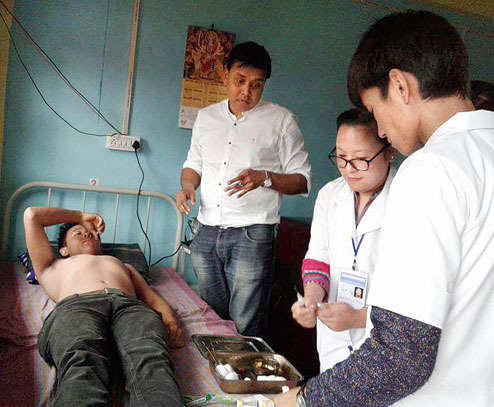
A patient being treated at the medical unit at Rimbick. Telegraph picture

Darjeeling :

An idea that bagged an award from the Acadèmia de Ciències Mèdiques, a forum of healthcare professionals in Barcelona, Spain, has blossomed into a fruitful project that is saving human lives in one of the farthest corners of Darjeeling district in Rimbick.

Plaban Das, a medical director of Planter’s Hospital in Darjeeling, during his advanced medical studies at La Santpau hospital in Barcelona, had through his Spanish friends proposed an idea in 2009 to create a satellite healthcare unit in remote areas.

The idea we bagged the Beques de Cooperacio Academia del Mon award that carried a prize money of 200 Euros in 2009.

“Anna Goma, a Spanish doctor, has presented the idea to the academy and it bagged the first prize. It was just an idea then and wanted to replicate the same in Rimbick, where I had conducted a medical camp in 2007,” said Das.

He mulled over the idea for long and once social media, more particularly WhatsApp, became common among people, he started working on the project.

“The basic idea was to ensure the people of Rimbick and its surrounding areas quick medical intervention during emergencies so that lives could be saved,” said Das.

Rimbick is about 90km from Darjeeling and one has to trek 6-7km further to reach the villages of Srikhola and Daragoan.

“With the help of local people, we formed a 12-member committee and set up the Rimbick Singalila Health Care Centre, a no-loss-no-profit venture which was inaugurated on September 13, 2015,” said Das.

Das made a personal contribution of Rs 2.5 lakh, along with the prize money of 100 Euros (the remaining 100 Euros was used in a project in Nigeria), while local people contributed around Rs 1 lakh. “Dr Hem Gosai, who practices in London but is from Darjeeling, later contributed Rs 1 lakh when he heard about the project,” said Das.

Two nurses, one para-medic and two technicians run the two-bedded centre at Rimbick with ECG, X-ray machine, nebuliser, oxygen cylinder and lab equipment.

“Whenever there is an emergency, the nurses contact me through WhatsApp. Primary tests are done there and they send the report on Whatsapp to me. Then I prescribe preliminary treatment right away, which is important in cases like brain stroke and heart attacks,” said Das.

Prakash Gurung, GTA Sabha member of the area, has also donated an ambulance to the centre.

In fact, this year, the centre observed a Stroke Survival Day, where five patient who had become paralytic and fully recovered because of immediate medical intervention were felicitated.

Shiva Rai, a hotelier, said: “I would not have been speaking to you had the centre not been there. I had gone to bed normally but in the morning, I found that my hands were paralytic and my face slanted. I could recover fully because of immediate medical intervention.

Binod Kumar Rai, a teacher of Rimbick Higher Secondary School, said: “I had a bee sting followed by fever and diarrhea. I recovered immediately. Importantly, my relative who had a stroke also recovered well.”

The centre needs Rs 30,000 on an average a month to function. “They charge a minimum amount. If we were to go and meet Dr Das in Darjeeling we need to spend anything between Rs 2000 to Rs 3000. But treatment is much cheaper and efficient at the Rimbick centre,” said Binod.

Das, along with other doctors visit the centre, once a month. A group of doctors from Zion Hospital in Nagaland held a free medical camp on February 15 there.

“People from Nepal also visit the centre now,” said Das.

Apart from the Spanish doctor, Anna, Martha Gallego, a nurse, Pau Casan Bonet, a pianist, and Begonya Crespo Bosque held a musical event in Barcelona to support the centre.

A similar project is being worked out for Badamtam tea garden, about 20km from Darjeeling.

source: http://www.telegraphindia.com / The Telegraph,Calcutta,India / Front Page> North Bengal> Story / by Vivek Chhetri / Monday- February 20th, 2017

Film on messiah of pavements to hit Kolkata screen tomorrow

Kolkata :

At 87, this doctor bends over to listen to heartbeats. He bends slightly more these days, but there is otherwise no sign of fatigue on his weather-beaten face. You may have not been lucky to come across Jack Preger — the healer on Kolkata pavements as, he is popularly called — at work, but here’s a film that captures the journey of the British farmer-turned-doctor who has been serving destitutes on Kolkata streets since the 70s.

The film, ‘Doctor Jack’, directed by French filmmaker Benoit Lange, is an 83-minute film that has already won a coveted international award and is likely to enter some more competitions this year.

It will be screened by Alliance Francaise for a select audience on Thursday and will open for public screening at a popular south Kolkata movie hall the next day.

The French/Swiss film released in those two countries in 2016 and won in the documentary section of the prestigious Solothurn Film Festival, Switzerland. Camerawork by renowned European cinematographer Camille Cottagnoud has received critical acclaim worldwide. The filmmaker has donated the entire amount of 20,000 Swiss Franc to Preger’s organization, Calcutta Rescue.

Born in 1930 in Manchester, Preger’s life has been extraordinary. After graduating from Oxford University with economics and political science, he took up a career in hill farming. It was during this time that he realised that he had a different call in life and that he should spend the rest of his life trying to take medical benefit to the poor who cannot afford structured treatment.

After training as a surgeon at the Royal College of Surgeons in Dublin, Preger decided to leave the first world for good and go to Bangladesh to treat war refugees.

Thereafter, he reached Kolkata and started his clinic on the pavements of Middleton Row. For years, he ran this clinic before Calcutta Rescue spread its wings crisscrossing pavements of the city.

“It took me four years to make the film, such is the mystery of the man. Where does he get so much strength from? I call him the Don Quixote of modern times — a farmer metamorphosing into a messiah. What an exceptional destiny,” said Lange.

Preger, however, in his characteristic humour explained, “Sometimes you don’t choose life…life chooses you.”

source: http://www.timesofindia.indiatimes.com / The Times of India / News> City News> Kolkata News / by Jhimli Mukherjee Pandey / TNN / February 16th, 2017

The accidental zamindar – The East India Company did not learn its lessons well

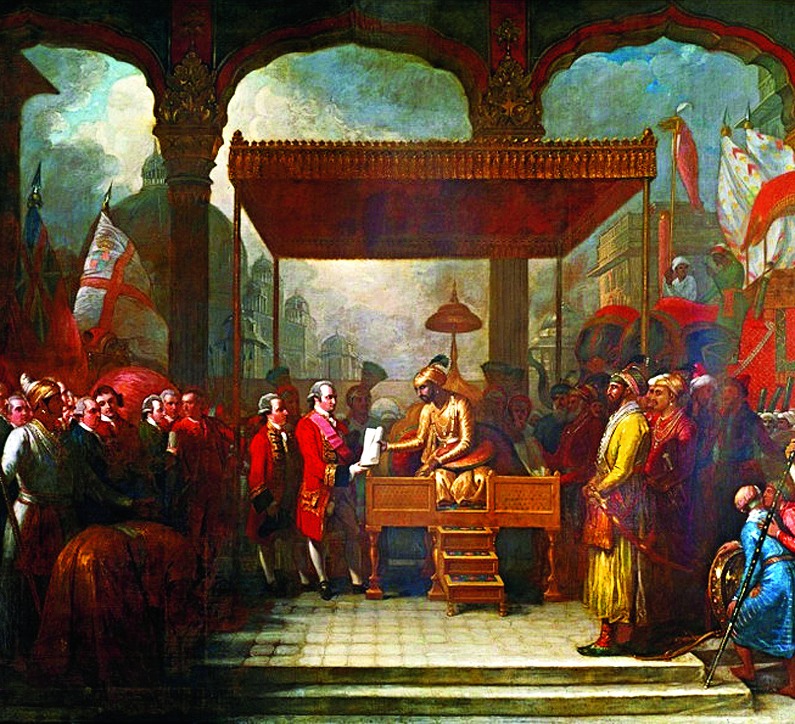
A painting by Benjamin West, 1765, of the Mughal emperor, Shah Alam, transferring the right of tax collection to Lord Clive

East India Company was basically a commercial enterprise; till the end it continued to make good money by exporting Indian goods. In the 19th century, its monopoly was corroded by the entry of other British traders; but trade continued to be a major activity till its demise in 1858.

But it was an odd bird from its birth. The Spanish and Portuguese adventurers who preceded it were an explicit extension of their home governments; the British crown, on the contrary, kept out of the Company’s affairs abroad. Charles II gave the Company power to judge and punish people in its territory abroad according to the laws of his kingdom in 1661; the power to make locally applicable laws followed.

The injunction assumed that the Company would occupy and own territory. But its territory in India was not virgin territory; it had its own administrative structure, of which the Company became one pillar. So it had two masters; and in so far as the two never talked to each other, it had considerable freedom of manoeuvre. But legislation and administration were not its main business; it tried to minimize the effort it put into them. One way it did so was to use local law where it existed, and import British law where there was no local law.

The two differed greatly in respect of landed property. In 1660, King Charles II abolished personal service due from noblemen and converted it into a monetary obligation; that is how land revenue became the dominant tax in Britain. In India, too, land revenue was the major tax; it was reckoned as a third of agricultural produce under Akbar. But it was not always in cash. And it did not necessarily go to the king; the nobleman delivered his dues in cash or in military service. The feudal structure applied to the Mogul empire, but not necessarily to other, smaller kingdoms. So when Lord Clive defeated the Mogul army in 1765 and took the Diwani of Bengal, the Company had to learn the ins and outs of zamindari.

The lessons it learnt are the main part of Law and the Economy in Colonial India, a new book by Tirthankar Roy and Anand V. Swamy. They are an odd pair. Tirthankar is a first-class economic historian. But he is not a leftist; so he faced discrimination from the academic powers-that-be in India. Finally he got fed up and left India; now he teaches in the London School of Economics. Anand Swamy teaches economics in Williams College. They have been running into each other in conferences, and working together on books once in a while.

Their conclusion is that the Company did not learn the lessons well. Its laws led to thousands of cases in Bengal relating to property, tenancy and rent; the system remained overloaded throughout British rule, and cases took decades. As if property law was not obscure enough, legal proceedings were complicated by succession law, which differed according to religion. They do not say so, but the mess was sorted out after Independence, first by legislation abolishing zamindari, and more slowly by population growth, which reduced the size of holdings.

It is difficult to imagine today that Indians could own slaves till 1843; and once slavery was abolished by law, all they had to do was to give a loan to the slave and turn him into a bonded labourer. That is not surprising, since Britain itself outlawed slavery only in 1811. But slavery served a purpose under conditions of labour shortage, which was commonly faced by plantations in the north-east. There were not enough workers in the area; they had to be brought from far away, most often tribals from Chhota Nagpur, which is now Jharkhand. Loading them into bullock carts and transporting them hundreds of miles cost money; a planter could not afford to bring them and then let them walk over to a neighbouring planter for a higher wage. So planters asked for and got laws which empowered them to jail their workers for not repaying a loan. But maltreating workers also earned a planter a bad reputation that he would rather avoid; so planters who could get and retain workers more easily avoided using penalties. Roy and Swamy deal with these labour market adjustments in some detail.

I found their discussion of contract law fascinating. Before the statification of the Company, Indian governments did not legislate or enforce laws. But commerce had existed for millennia; and where there was trade, there was always scope for cheating and breach of promise. Traders used social networks to deal with these risks; loss of reputation and standing was the punishment for breach of contract. But this could work only with those who had reputation to lose; it could not work with Santhal labourers or indigo farmers. When it came to workers, the Company gave penal powers to their employers. That could not be done with indigo farmers; they were not housed by indigo buyers, and could not be jailed or beaten up. So indigo buyers collected chits documenting debt against various farmers, and when an opportunity arose, sold them off to someone who had greater influence on the debtors. Partly under their influence, a contract act was passed in the 1860s; but few cases were filed under it.

Such are the narratives collected by Roy and Swamy. Their book is neither a treatise on law nor a history book: it does not systematically align legislation and case law, and it does not tell a story. The topics it has chosen are broad; a systematic treatment would take more space. Making a history out of it would require a larger role for the personalities involved; a legal treatise would require links with both legislative and case law. So there is a case for expanding the book.

Roy and Swamy should also try their hand at pathology of Indian law. The Indian judicial system is hugely overloaded, and extremely slow; the two aspects are connected, but slowness is not just due to overload. It is a good deal due to antiquated procedure; for instance, judges let lawyers drone on and on, briefs cite piles of cases unnecessary to make the point, and courts give postponements and adjournments for the asking. There are too many briefless lawyers, and too few judges. High courts reverse a high proportion of lower court judgments, generally on the ground of poor police investigation. Other systems have faced these problems and overcome them.

No one in India has looked critically at the judicial system except Arun Shourie; anyone who thinks of doing so is bound to consider the possibility that he may face judicial bias if he is hauled to court. Roy and Swamy do not have to worry about that. At worst, a book of theirs would be banned in India. But that would not be much of a loss; hardly any book sells more than a thousand or two copies in India, and the publicity would increase the book’s sales outside. If the judicial system is to be repaired, someone has to start somewhere, and no one is better placed to do so than Roy and Swamy.

source: http://www.telegraphindia.com / The Telegraph,Calcutta,India / Front Page> Opinion> Story / Writing On The Wall: Ashok V. Desai / Tuesday – February 14th, 2017

Kolkata girl bridges Bengal-Costa Rica gap

Kolkata :

This saree-clad, Spanish-speaking woman had stood out in the Costa Rica pavilion of the Kolkata Book Fair. Nothing about her looks and demeanour was Central American and yet she seemed so much at home, spreading native Costa Rican cheer. But speaking to a visitor at the pavilion, her Spanish changed into pure Bengali within seconds. Kolkata girl Baishakhi Saha has made it big in Costa Rica to gain permanent residency from the government there.

Saha used to live in Salt Lake and studied at Bharatiya Vidya Bhavan before settling down with her parents in Chennai. Her ties to the city, however, remained strong as the family often returned to visit relatives. Always a brilliant student, Saha bagged a scholarship from the Singapore department of education to major in computer science and minor in German from University of Singapore. It was during her stay there that she realised being part of university exchange programmes would help her see the world.

However, she soon realised that with a partial scholarship, it was quite an expensive proposition for an Indian girl with a middle-class background. Around this time, she participated in a global essay-writing competition hosted by the government of Switzerland, on how Europe still inspires imaginations. This won her a limited period stay in Switzerland, which was a turning point in her life. “I yearned see the whole of Europe.

There were many like me and I soon found that by becoming a member of Aiesec, a global students’ body, I could get placed in jobs and get internships that could help me with that. Luckily, I managed to clear the necessary tests and was called for an interview to Malayasia, after which I was awarded a management internship with Model United Nations in Nigeria. It was a two-month job and I made $200 a month — quite a hand-to-mouth situation, but I enjoyed every moment of it,” Baisakhi recalls.

For the next one-and-a-half years she travelled the length and breadth of the west coast of Africa for the TV show Goge Africa. Aiesec acknowledged her work and her next assignment was that of an English teacher in Venezuela, after which she got a similar assignment in Costa Rica. By then, she had started writing her book, ‘magicNine’. The book was a success and Baisakhi was soon giving inspirational talks and teaching business communications at institutes. Her popularity made the Costa Rican government acknowledge her contribution and offer her permanent residency.

“Life has been a dream since then. Costa Rica is more or less like Kerala or Goa if you want to compare Indian situations. I come to Kolkata once in a while, but I have plans to take slices of Bengali culture there now,” Baisakhi said. She is a dancer too and has performed Indian dances in Costa Rica, which have been instant hits. As one of the few Bengalis in a distant land, she has much to do to bridge the two cultures, she explained.

source: http://www.timesofindia.indiatimes.com / The Times of India / News> City News> Kolkata News / by Jhimli Mukherjee Pandey / TNN / February 13th, 2017