In Chandannagar, time flows as languorously as the Ganga beside it
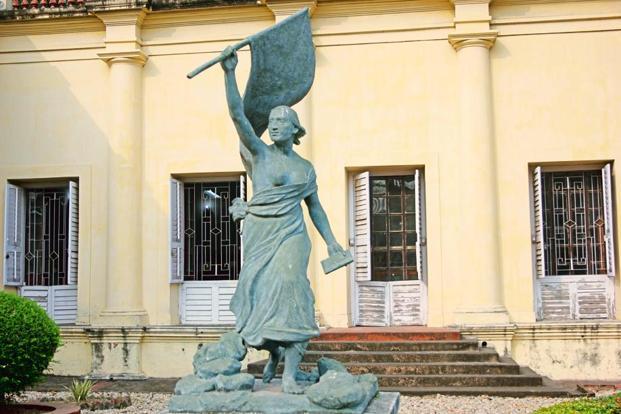
The statue of Marianne, a national symbol of France, outside the Dupleix mansion. Photos: Ganesh Vancheeswaran
The rains had left the fields lush green, a vivid contrast to the dark brown soil at the base. This dual-colour canvas kept a tight grip on the sides of the road through most of the trip. Bustling villages and near skirmishes with traffic ensured there was never a dull moment on the drive from Kolkata to Chandannagar.
My decision to go to Chandannagar for the weekend had been an impromptu one, taken the night before. The fact that it was the only French colony in Bengal in the 17th century, at a time when the British were making determined inroads into the region, made me curious. And so, late one Saturday morning, I hopped into a taxi for the 53km ride. It was a swift and mildly disorienting transition from the crush of humanity in Kolkata. As we entered Chandannagar, my driver pointed to two pillars topped with urns. He said these were all that remained of the grand gate built by the French in 1937.
I asked him to take me to the Dupleix Museum, located in a large yellow mansion. It is one of the few in India that houses a collection of artefacts from French rule, which lasted more than 250 years. Chandannagar was a major trading and military hub for the French during the 18th and 19th centuries. And this mansion used to be the official residence of French governor generals. Apart from French memorabilia, the museum houses rare collections of statues, letters exchanged between freedom fighters, and news clips on the freedom movement in Bengal. With its colonnaded courtyard, broad slatted windows and high ceilings, it is a throwback to period architecture. Even today, French is taught at an institute that operates from the same premises.
Leaving the museum, I headed to a stall nearby for a leisurely mutka (earthen cup) of tea. I was in no mood to rush from place to place. Already, I could feel my heartbeat settling into a slower rhythm. Chandannagar has that effect on you.
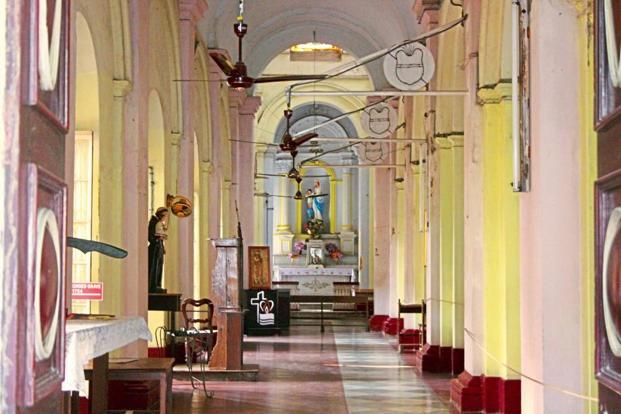
The interior of the Sacred Heart Church.
Continuing my journey into the past, I walked up to the lovely Sacred Heart Church, close to the Dupleix Museum. This church, designed by French architect Jacques Duchatz, was inaugurated in 1884. Stepping into its cool portals, I was transported back to the 19th century. The stained glass, old furniture and colourful murals along the nave are largely intact. Later, I walked through the restored graves and tombstones in the cemetery adjoining the church. Buried here along with other nobles is the long-forgotten French commander Duplessis, one of the town’s founding fathers.
Exploring the streets that evening, I saw a number of rambling bungalows from the French period. The structures, still intact, exuded an air of genteel neglect. There was an abundance of greenery. Traffic was sparse and slow-moving. Passing through the local market, I was struck by the absence of the hoarse cries one normally finds in Indian markets. Even the haggling was absent. It seemed as if the entire town loathed anything loud or frenetic.
Wending my way to the strand, I sat on a bench. A few others had colonized benches to read the newspaper or chat. In front of me, the Ganga, known in these parts as the Hooghly, flowed gently, with barely a murmur. Boats ferrying locals were the only traffic. And quiet descended as soon as the day’s activity wound up with the setting sun.
Fortified by some luchi-aloo dum the next morning, I sallied forth again. This time, to the stunning Nanda Dulal temple with its cream-and-vermillion exterior. This temple is built in the do chala (double sloping roof) style native to Bengal, but is, surprisingly, devoid of the terracotta work that is typical of buildings in this district. I learnt from the priest that this temple, which houses a deity of Lord Krishna as a child, was first built in 1740, destroyed and then rebuilt.
I was tempted to join the boys playing volleyball in front of the temple. In keeping with the mood, however, I decided to return to my room to curl up and read.
Weekend Vacations offers suggestions on getaways that allow for short breaks from metros. The author tweets from @theholehog.
source: http://www.livemint.com / Live Mint / Home> Leisure / Ganesh Vancheeswaran / November 09th, 2017
The journey started way back in 1784 and on Monday, the oldest archive of the country, located inside Asiatic Society, started a new journey as it shifted to the digital mode.
For long, the Centre had been prodding the Society to get its valuable archive digitized but the authorities were unable to comply because of the unionized staff that often put spanners into the process. In 2006, when Pranab Mukherjee was the Union finance minister and chairman of the planning board of the Society, he urged the authorities to fast-track digitization so that the wealth could be made available in the digital domain. At the moment, only members of the Society have access to the archive.
The process could start much later and even on Monday, when the public announcement was made, only the first phase of the digitization was over. The rest will follow in phases.
In the first phase, all publications of the Society, right from 1788, when the first edition of an Asiatic Society publication came out, have been digitally reproduced and linked to the Society’s website. The formal inauguration was done by Jawhar Sircar, former Union culture secretary, who had prodded the Society in his previous capacity, to enter the digital platform.
“This place is steeped in history and is of singular importance but it doesn’t have a complete inventory yet. I am happy that the first step in digitization has happened here but in the 21st century, this is not enough. I urge the Society to accelerate the process, which can also become an income generator when non-members try to access the archive,” Sircar said.
The archive has 50,000 manuscripts in 26 languages, made in varied mediums like palm, palmyra leaves, barks of trees and paper (often handmade, not chemically treated). There are original paintings of Hodges, Daniells, Baille, D’Oyly, Solvins, Rubens and Reynolds, and are among the most valuable in the world of paintings. “In the next phase, we will digitize the paintings. There are some extremely rare views. There are 90 paintings of European masters and 125 masters of the Bengal School in our archives,” said Satyabrata Chakraborty, general secretary of the Asiatic Society. This will be followed by digitization of manuscripts.
source: http://www.timesofindia.indiatimes.com / The Times of India / Home> News> City News> Kolkata News / by Jhimli Mukherjee Pandey / TNN / November 07th, 2017
In the recently concluded international workshop jointly held by UNESCO and the National Digital Library of India (NDLI) under the leadership of IIT Kharagpur, NDLI announced to go global through international collaborations with the world’s top digital libraries keeping up to its motto of ‘Open and Inclusive’.
The Workshop deliberated on the state-of- the-art technology, practices, and policies as internationally accepted and available for digital library design. About 200 domain experts from India and abroad participated in the Workshop including representatives from Microsoft Research, Google and Taylor & Francis.
UNESCO, the event co-organizer collaborated with NDLI to promote the digital libraries as a very effective avenue to realize universal open access of the learning contents. It has promised to co-ordinate digital library development, resource sharing activities of the SAARC countries. Integration of UNESCO South Asia publications has been taken up as the first step towards that.
“While getting international content is one aspect of NDLI, the other focus for NDLI is being inclusive and open. Inclusive will be in terms of education, languages and disciplines. It is open in every respect whether data, technology or content,” said P P Das who is the in-charge of NDLI.
NDLI is mulling over possibilities of collaborations with Trove and DigitalNZ in terms of sharing of resources and software components. NDLI is already collaborating with Europeana Foundation. Individual experts in user data analytics, knowledge graph mining, linked data have shown keen interest in imbing best research practices into NDLI development. Some of the other digital libraries which expressed interest in collaboration with NDLI are Tainacan Project (Brazil), National Library of The Netherlands, National Library of South Africa, and National Library of Nepal.
Under the NDLI project, IIT Kharagpur has also initiated discussion with Microsoft Academic on sharing scholarly publishing knowledge graph.
“NDLI research and development team will soon focus on implementing technical outcomes of the workshop in terms of data aggregation framework, indexing infrastructure and service based models for data sharing. The developments in academic search engines like Google Scholar and Microsoft Academic also provide cues to efficiently organize scholarly publication in NDLI,” said Plaban Kumar Bhowmick, Program Co-Chair of the workshop.
K K Sharma, secretary, MHRD and R. Subrahmanyam, additional secretary, MHRD who were present on the occasion opined that by 2030 the union ministry is targeting to increase the Gross Enrolment Ratio (GER) in higher education to 30 per cent from the present 24 per cent. To achieve this goal, a combination of digital technology with the educational resources is the ideal pathway to ensure that all of India can learn, share and grow.
source: http://www.timesofindia.indiatimes.com / The Times of India / News> City News> Kolkata News> Schools & Colleges / by Somdatta Bose / TNN / November 07th, 2017
FIFA president Gianni Infantino has thanked West Bengal Chief Minister Mamata Banerjee for successfully organising the matches at various stages and the final of the Under-17 World Cup last month.
FIFA President Gianni Infantino. (Getty Images)
Kolkata:
FIFA president Gianni Infantino has thanked West Bengal Chief Minister Mamata Banerjee for successfully organising the matches at various stages and the final of the Under-17 World Cup last month.
In a letter from FIFA headquarters in Zurich, Infantino also praised Banerjee for the way the tournament was hosted at the Salt Lake Stadium including the final.
“I would like to congratulate your government on its role in your country’s successful hosting of the FIFA Under-17 World Cup. I would also like to thank you on behalf of the entire FIFA delegation for affording us such a cordial welcome and warm hospitality,” he wrote to Banerjee.
The FIFA president also praised Banerjee’s vision about the game in breaking down the cultural and social barriers and making the game accessible to all.
He also thanked the West Bengal government for the development of football and promoting the values of the game in India.
Promising all assistance from FIFA in developing the game in the region, Infantino lauded Banerjee for deciding on providing 15-acre of land to the AIFF for the National Centre of Excellence for Football near here.
The Salt Lake Stadium here had hosted 11 matches of the FIFA U-17 World Cup, including the final. Kolkata co-hosted the mega event along with New Delhi, Guwahati, Navi Mumbai, Kochi and Margao.
source: http://www.news18.com / News18.com / Home> Football / PTI / November 04th, 2017
For the world she is Priyanka Yoshikawa -Miss World Japan 2016.
But those close to her know her as Priyanka Yoshikawa Ghosh.
Born to a Bengali father and Japanese mother, she is the first woman from a multi-racial background to have won the pageant in Japan. But Priyanka’s journey was far from easy .
When she broke the glass ceiling, there were some who questioned why the title was not bestowed upon a `pure’ Japanese, but Priyanka found support in her nation and also in India, where she has her roots.
On a whirlwind tour to Kolkata where she attended a dinner hosted in her honour by Masayuki Taga, Consul General of Japan in Kolkata, Priyanka spoke to us about the backlash and support, tracing back her roots and why her family doesn’t discuss Prafulla Chandra Ghosh, her greatgrandfather and Bengal’s first chief minister, over dinner.
Excerpts:
Is this your first trip to Kolkata since you won Miss World Japan in 2016?
Yes. But I have been to the city quite a few times before that. I lived here when I was nine years old. That was for a year. I also studied in a school here. Even before that, I have been to the city when I was two or three, but I don’t have memories of those visits. Another long visit was five years ago, when I was 18. That time, I stayed here for a month. My father is Bengali and our extended family lives here. My connection with Bengal was established with my birth though I was not born here.During the one year I was here, I explored my father’s country and got to understand my roots.
On this visit for a day, did you get to meet your relatives living in Kolkata?
My father comes from a big family and he has many siblings. My uncle and aunt live in Kolkata.Some of my cousins are still here, but many got married and live abroad. Whenever I am in Kolkata, I visit them. I came on Sunday midnight and on Monday , I visited Mother House and later, went to a doctors’ meet. Though I was not in Kolkata on work, I am the brand ambassador of a charitable foundation, and ended up doing some meaningful work. I wanted to visit Kolkata ever since my win, but it was hard to get a vacation. Then, I got a few days off and came here on my way to Guwahati.
After you became Miss World Japan 2016, the first contestant from a multi-racial background to do so, you spoke about drawing inspiration from Ariana Miyamoto, born to a Japanese mother and African-American father, who won the Miss Universe Japan 2015. She had to endure racial backlash for being a hafu (a person with a non-Japanese parent), but since she set a precedent just the previous year, was it easier for you?
To be honest, Ariana was not exactly my inspiration. We participated in different pageants. I followed my own dreams, but I have tremendous respect for her.I didn’t know her before I won, but we became good friends after winning the title. I didn’t hear stories about her trials and tribulations, but she made it big as the first hafu to win a pageant in Japan. She had to face racial backlash as she was the first and people were not used to it. For me, I was the first for Miss World in the nation. Nothing has been easy even though Ariana won the previous year. I got good media coverage and though some people questioned my win, it never affected me. I was confident and was concen trating on the international pag eant where I made a mark after 60 years. During the pageant, there was no social media back lash, but after the win, some questioned why the title was not awarded to a `pure’ Japanese. I got a lot of support too. Messages came trickling in from hafus living in Japan, and also from Indian citizens. When you get such strong support, it gives you more confidence. I am proud to have an Indian in me, but that doesn’t mean I am not Japanese.
What were the celebrations like in India?
My relatives messaged me. My first cousins are very close to me. I call them didi. One of my didis lives in the US and she was a great support during the inter national pageant. She is eight nine years older than me and she and everyone else was happy about the win.
What was the homecoming like this time around?
I was excited as I was meeting everybody after five years.Visiting home and meeting my aunt, uncle, nephews was quite something. Though they are all in touch with me, talking to them on social media is different from meeting them. I got to eat Bengali food. I was looking forward to tasting some homecooked Indian food. I often crave for white chicken, which is perhaps called doi chicken. And I love phuchkas though I missed it this time. I was in Mumbai and had panipuris there, but it’s different from having phuchkas in Kolkata.
How did you learn to speak so fluently in Bangla?
I studied Bengali in school, but I picked it up naturally as everyone speaks Bengali around me in my family .
Your great-grandfather Prafulla Chandra Ghosh was the first chief minister of Bengal. You must have heard many stories about him from your father?
He was my great-grandfather, but I didn’t meet him. My father did tell me stories about him but only at times. I never really asked questions about him.Everybody in our family knows about him, but we don’t discuss him over dinner.
An elephant trainer, are you visiting Guwahati for a purpose?
My Guwahati trip is all about wild elephant conservation and nature conservation.
You have keen interest in Bengali movies…
I remember having seen The Japanese Wife and some others that I watched on flights. I can’t read or write in Bengali though I can speak the language. It’s sad that not many Bengali films can be found in Japan, though Bollywood movies -sometimes three years old -travel to the country . I love to watch them. I have grown up watching Shah Rukh Khan, Hrithik Roshan and Kajol. Kajol is one of my favourite actresses.
Should you foray into Bengali films if an offer comes your way?
Yes, why not! I would also love to do something with films in India, maybe bring them to Japan… There are many takers for Indian films in Japan and I am sure a lot of people here are waiting to watching Japanese films. If I can bridge the gap, I will be the happiest.
source: http://www.timesofindia.indiatimes.com / The Times of India / Home> News> City News> Kolkata News / by Zinia Sen / TN / November 02nd, 2017
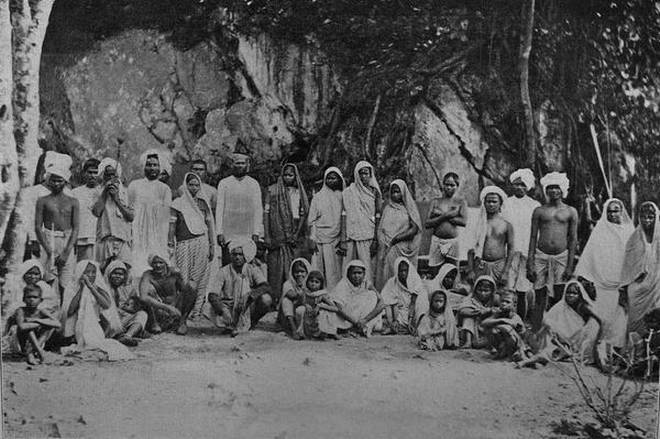
Newly arrived indentured labourers from India in Trinidad. | Photo Credit: Wiki Commons
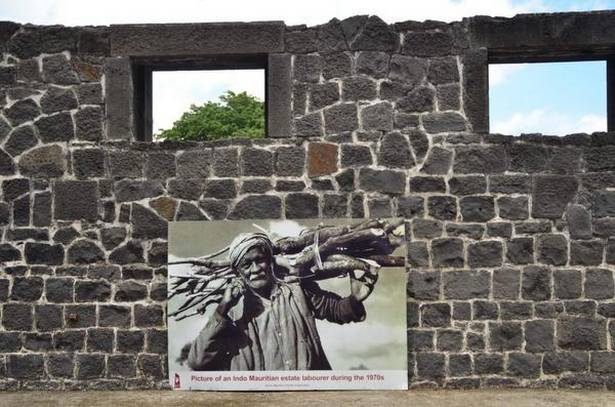
In 1834, 36 impoverished men from Bihar and Bengal set sail for Mauritius to work as indentured labour. Over the next 80 years, more than two million people would travel to some 20 European colonies, the first of a global Indian diaspora, before indentured labour was abolished 100 years ago
When the British abolished slavery in 1834, they populated their plantations with indentured labour from India, launching the biggest international movement of workers after the notorious ‘middle passage’. In 80 years, more than two million Indian labourers were transported to about 20 British colonies before it was stopped in 1917 under intense pressure from Indian abolitionists. This year marks the centenary of the abolition of indentured labour.
Kalachand was on the verge of collapse when Champa, a fellow tribesman from the hills of Hazaribagh, came looking for him that fateful September evening in 1834. Champa too looked starved, but his eyes held a glint of excitement.
“Where have you been? I’ve been looking for you since noon. Didn’t I tell you god is great? We are going to escape this wretched life,” he said.
Kalachand didn’t say a word in response. All he wanted was to eat something. He hadn’t had a proper meal for three days now.
Champa too, and many others, had not eaten the past few days, but he suddenly seemed to have found some energy. Standing on the slushy banks of the Hooghly, he pointed to the Kidderpore depot and said, “This will save us.”
All Kalachand could see was a long shed and some small sail-ships at a distance. “Are we going somewhere,” he asked. “Tapu,” said Champa.
“Come, let’s eat something, I am starving,” he said. “Money?” Kalachand asked. “Don’t worry, I have some,” he said. He didn’t tell Kalachand it was the same Ghulam Ali, who had promised road work in Calcutta for ₹5 a month, who was now promising a brighter future.
Back in his shanty in Howrah, Kalachand found Bachu, Chuniram, Budhu, Bhola, Chota Bandhu and other friends from Bihar, Burdwan and Bankura, preparing to leave. Champa had sold them the hope of a better life on a faraway island working in British-owned sugarcane plantations. They would have legal contracts, medical help, and plenty of money to save for the future. In five years, they could come back and start a new life.
New lives, new names
The next day, September 10, Kalachand and 35 others put their thumbprints on a paper for a contract with George Charles Arbuthnot of Hunter Arbuthnot & Company. It was read out to them by a magistrate at the Calcutta police headquarters. On the contract, their names were written in English exactly the way the white men pronounced them.
Kalachand became Callachand, Champa became Champah, Bachu became Bachoo, Chuniram became Chooneeram, and Chota Bandhu became Chota Bundhoo. Most of their names had “ee”, “oo” and “ah”. It would be repeated a few million times in the next 100 years, changing Indian names to strange-sounding new variations.
After a medical examination and a five-day wait in a barrack in Bhowanipore, the men were finally herded onto a boat on the Hooghly that took them to a medium-sized sail-ship called Atlas. They were led to the lower deck while the dock workers loaded a big cargo of rice. In a few hours, the ship was heading towards the Indian Ocean. Its destination: Mauritius, the once uninhabited island off the southeast coast of Africa, discovered by the Portuguese in the 14th century and colonised by the Dutch, the French, and finally the British.
The tiny land of forests and hills, originally occupied only by dodos, rats and locusts, now had a flourishing plantocracy that desperately needed cheap labour. The abolition of slavery that year was threatening the survival of the sugarcane plantations. The planters needed workers by the thousands or faced bankruptcy. The only source of cheap labour they could think of was India, poor, overpopulated, and with millions from oppressed castes.
For the 36 men cooped up in the Atlas, it was a desperate, uncertain voyage to escape poverty and oppression. What they didn’t realise was that they were making history by launching the biggest movement of labourers in the world after the ‘middle passage’, laying the foundation for a global Indian diaspora.
50 days later
Over the next eight decades, more than two million Indians would travel to about 20 European colonies. A large number would die in transit, many would return to India, but the majority would remain, building vibrant Indian communities and sometimes even changing forever the demographies and socio-cultural and political histories of the colonies.
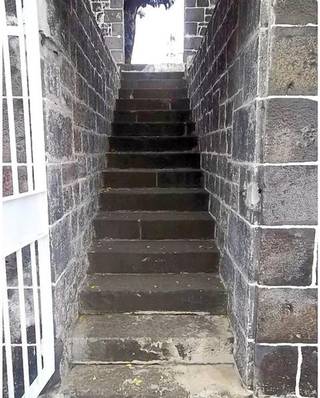
After 48 arduous days at sea and two days aboard the ship just off the shore, Kalachand and the other men set foot in Port Louis and walked up 16 stone steps carved at the harbour before they were processed and sent to the sugarcane estates. In the following years, till the turn of the next century, about half a million more Indians would climb up this flight.
Those steps, like those at Ellis Island near Manhattan that millions of immigrants to America passed through, would go on to become an iconic symbol of the history of Mauritius, and the incredible story of indentured Indian labourers across the world.
Kalachand and the others were the uninformed first participants of a ‘Great Experiment’ that the British had come up with to substitute slave labour and safeguard their commercial interests. If slaves had been hunted down and sold to the British and other Europeans, the new scheme used a method called indenture, which in simple terms meant a written contract signed by a person to work for another person or company for a fixed tenure and sum of money.
Compared to “slave” labour, indenture was projected as “free” labour, even though the workers were bonded by contract for five years under harsh conditions. ‘Double-cut’, for instance, would dock two days’ pay for a day’s absence from work.
The workers could not easily move outside their estates. If caught without their ‘immigration ticket’, they were jailed for ‘vagrancy’. The colonisers wanted to appear morally right without losing profits, but what they had surreptitiously laid out was “a new system of slavery”, as Hugh Tinker would call it in his seminal book in 1974. (A New System of Slavery, Hugh Tinker, Oxford University Press, 1974)
They chose to stay
Although their contracts promised the workers a return passage to India after five years, a majority of them chose to stay back by obtaining a new indenture. Some did return to India, mostly empty-handed, but many went back with wives and children.
Following the Mauritian experiment, which in the next four years saw more than 24,000 Indians arriving in Port Louis (an average 500 people per month), ships carrying Indian ‘coolies’ from the ports of Calcutta, Madras and Bombay became a common maritime activity for the British.
Between 1838 and 1920, another half a million would go to the Caribbean islands and the Dutch-controlled Suriname (based on a convention on emigration signed between the governments of Netherlands and England in 1870.) By the turn of the 20th century, almost all the British colonies, from Sri Lanka to St. Kitts, had tens of thousands of Indian indentured labourers. A few thousand Indian men had been transported as slaves, lascars, artisans and labourers by European colonies during the slave-trade era, even before the ‘Great Experiment’. However, what makes the 1834 Atlas voyage historic and pioneering is that it was the first-ever lawful movement of indentured labourers in the world.
Although Kalachand and his 35 companions survived, many who arrived in subsequent trips, which had more people packed into small ships, didn’t. Infectious diseases, unsuitable food, and the stress of the journey killed them. Mortality often touched double figures.
But in the later years, with the introduction of faster ships, the mortality rates decreased even as the numbers of workers rose rapidly.
The early recruits endured slave-like working and living conditions, and many perished. The Mauritius Truth and Justice Commission in its 2011 report said: “The treatment meted out to the flow of Indian workers who came to Mauritius between 1834 and 1842 was very harsh. Their recruitment, transportation, housing and conditions of work left much to be desired. The condition of work was so appalling that the authorities decided to suspend further recruitment.”
Most of the early ones were tribal people (collectively called Dhangars) and from lower castes — they were the desperate ones who could be easily duped or even kidnapped. The same report shows the attitude of the planters towards the Dhangars: “They have no religion, no education, and, in their present state, no wants, beyond eating, drinking and sleeping; and to procure which, they are willing to labour.”
Tracing their footprints
Did Kalachand or any of the men who came with him die young? Probably yes, but they left no traceable footprints, melting into the sugarcane fields that seemed to have filled the entire island. With no women partners, they probably didn’t even leave any descendants. But some of the early ones did survive and lived long lives. Some, such as Harran, a Bihari from Calcutta, left a record of their life, including photographs, purely by chance. (Angaje, Volume 1, Aapravasi Ghat Trust Fund, 2012.)
Harran reached Mauritius in December 1836, and did multiple indentures without ever going home. He rose through the ranks, finally becoming an overseer. He was booked for ‘vagrancy’ twice and was photographed by the Immigration Depot for the first time aged 76. His photo, available in the Indian Immigration Archives of Mahatma Gandhi Institute in Mauritius, shows a nattily dressed labour-hardened man with a white beard who looks to have done well for himself.
The stories of Harran and some others, available in the archives, throw light on the early migrants who survived the neo-slavery. The details of the later migrants, particularly those who came in the late 19th century, are well documented.
In the Caribbean islands, migrants fared better because they started travelling late. Munshi Rahman Khan, who became a sort of legend in Indian indenture history for his unique autobiography, was one such. (Autobiography of An Indian Indentured Labourer, Shipra Publications, India, 2005.) Hailing from a village in Hamirpur in the United Provinces, he was a schoolteacher. On a visit to watch the Ramlila in Kanpur, he was lured by the “sugary talk” of two agents into a job in Suriname as a sardar or supervisor at a salary of 12 annas or ₹24 a month, unheard of in India at the time.
He left Calcutta in 1898, finished his five-year indenture, but chose to stay on as an agriculturist while also working as a sardar in railroad construction. He got married and bought a plot near the capital of Paramaribo. By the time he migrated, the reforms in indenture laws and land ownership and the falling sugar prices gave him a different life experience. His memoir is a rich source of history.
Workers to owners
In 1870, the planters were forced by falling prices and labour shortage into land parcelling or grand morcellement — selling small plots on the fringes of their estates to labourers. Many labourers thus became small planters. By the 20th century, there were 40,000 Indian planters who accounted for about 30% of the estates. Their descendants went on to become prime ministers and presidents, ministers, writers, academicians, artists, and businessmen. Nearly 70% of Mauritians are of Indian origin, and they dominate the island’s politics. In Trinidad, Guyana and Suriname, Indians constitute 40%, 51% and 35%, respectively, of the population.
Where are the women?
Indenture history and literature is dominated by the stories of men. But the Mauritius Immigration Office records (1853) [New System of Slavery, Hug Tinker, p-70] show that a handful of women too travelled in the early years like Deeti in Amitav Ghosh’s Sea of Poppies. The very first woman immigrant to Mauritius, and possibly in indenture history, to be issued a number by the Mauritius immigration authorities was Rimoney from North Bihar in 1845. (Satyendra Peerthum, Le Mauricien, 3 November 2016) And what a story it is!
Rimoney, 30, was a widow with a 12-year-old son when she was recruited by an agent in Calcutta where she was struggling to make ends meet. She was literate and so got a job as shopkeeper in an estate while her son was enrolled as labourer. She worked for several years, and with her savings, bought some land to become a vegetable farmer who employed other immigrants and later expanded the business.
There were other women too who migrated under extraordinary situations despite the prevailing patriarchy in India. Gauitra Bahadur, an American journalist of Indian origin, explored the 1903 journey of her great-grandmother Sujaria from Majhi district in Bihar to Guiana, in the book Coolie Woman. Sujaria’s story is fascinating because she was single, pregnant and, above all, a Brahmin for whom crossing the seas was taboo.
By 1910, about 23% of the indentured Indians in Mauritius were women — sifting sugar, stirring the juice, maintaining the mills.
An imagined India
The most remarkable feature of the indenture phenomenon is the creation of a “coolie diaspora” more than a century before the present diaspora India prides itself on. Recruited mostly from the Bengal and Madras presidencies, and to some extent from the Bombay presidency, the labourers and their descendants preserved their culture and heritage in its original form and created an India of their imagination, from handed-down memories and later, from satellite TV and cinema. A poor Tamil woman selling flowers on a Durban street dreams of meeting Rajinikanth in his Chennai home. Women, including young urban girls, who’ve never seen India, wear salwar-kameez and bindis and perform Bharatanatyam.
Temples are prominent in the diaspora’s cultural heritage, whether in Mauritius, South Africa, Fiji or the Caribbean, and Shiva and Kali temples, and Amman, Subramanya and Venkateshwara temples dominate. Shivratri, Diwali, Thaipoosam and Kavadi are gala events, with some rituals likely to surprise even Indians for their adherence to detail.
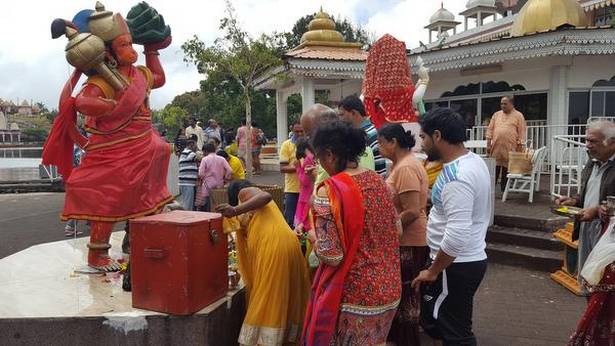
In Mauritius, for instance, a huge crater-lake atop a secluded mountain has been made into their Ganga Talo, where they celebrate Shivratri with bells and incense and rituals, an astonishing recreation of a heritage that travelled with them when they left their homeland more than 100 years ago.
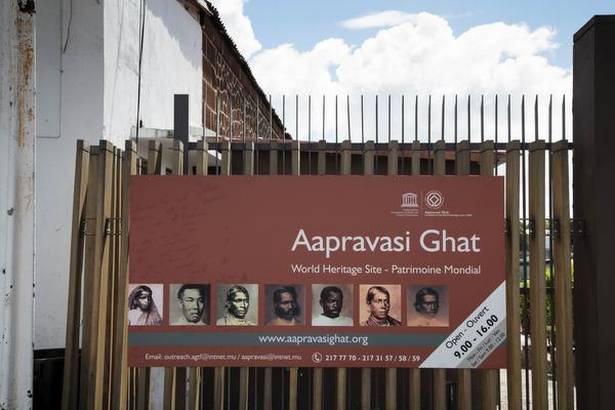
The 16 steps the emigrants climbed are now immortalised as the centrepiece of a Unesco World Heritage site called Aapravasi Ghat. The Ghat, the barracks and the immigration depot have been restored and converted into a living museum. In its cool interiors, exhibits and faces tell the story of the odyssey of generations of bonded labourers from a country more than 3,000 miles away, how they built a nation with their sweat and blood, and finally, how they owned it.
As Kalachand stood at the steps, Champa probably whispered to him that the tapu they had reached was Marich tapu, Mauritius, the centre of a new India they would soon build.
@pramodsarang is a journalist-turned-UN official-turned-online columnist who lives a semi-hermit life in Travancore and adores Sanjay Subrahmanyan.
source: http://www.thehindu.com / The Hindu / Home> Society / by G. Pramod Kumar / October 28th, 2017
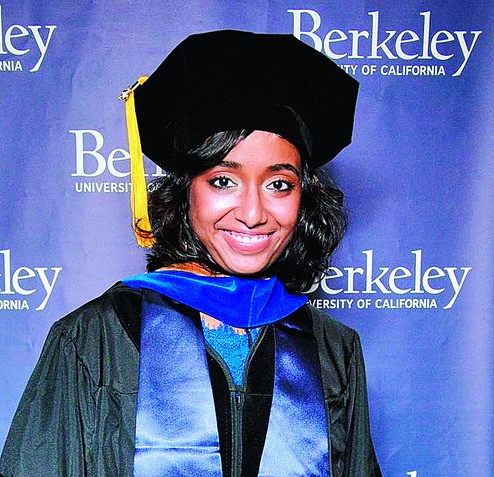
Cancer biologist Aishwarya Kundu has chemically tweaked a natural compound found in broccoli, cabbages and cauliflowers to design a novel molecule that shows promise as a treatment for skin cancer resistant to standard therapy.
The California-based researcher and her colleagues have shown through laboratory studies that their designer compound is about 20 times more potent in killing skin cancer cells than the parent compound extracted from the vegetables: indole-3 carbinol (I3C).
Scientists have known for nearly 30 years that broccoli and the other so-called cruciferous vegetables contain I3C, which has anti-cancer properties. Several research teams working independently have since the late 1980s shown that I3C suppresses breast cancer, prostate cancer, colon cancer and leukaemia cells grown in laboratory petri dishes.
The compound, packaged into tablets, has even been sold as a “health supplement”.
“But the exact way it works in different kinds of cancers is not known. Nor are its direct targets known, without which a compound cannot be given the status of a drug,” said Kundu, who was born in Calcutta and studied at Calcutta Girls’ High School before moving to Manipal and then to the US for higher studies.
Kundu’s research at the University of California, Berkeley, is the first to establish that I3C can block two specific biological pathways -BRAF and PTEN – that drive the growth of skin cancer. While the current drugs against skin cancer target the BRAF pathway, I3C promises a second alternative route of attack.
The researchers have added a chemical structure to the I3C compound to create a novel molecule that shows the same anti-cancer effect at a concentration 20 times lower than the parent compound.
“This is a specially valuable aspect that the drug industry looks for – compounds that are effective at very low concentrations,” Kundu told The Telegraph over the phone. The novel molecule also blocks a third biological pathway: Wnt.
Skin cancer cells use the Wnt pathway as an “escape route” to develop resistance to the standard drugs. Most of these drugs target the BRAF pathway, which is the primary “driver” in 70 per cent of skin cancer patients.
“Since our novel compound blocks the Wnt escape route, we hope it will be more effective than BRAF blockers alone. It can be used in combination with BRAF blockers to curb the risk of resistance,” Kundu said.
“It may also hold out hope for the 30 per cent of patients who don’t carry the BRAF mutation in their tumours and, currently, have limited treatment options. This market alone runs into billions of dollars.”
The California researchers’ studies show that both I3C and the new compound can independently shrink skin tumours in mice. Kundu and her colleagues are now hoping to conduct the required animal studies before the new molecule can be assessed in human clinical trials.
If all goes well, Kundu speculates, human trials could start within two years.
source: http://www.telegraphindia.com / The Telegraph,Calcutta,India / Home> India / by G.S.Mudur / October 27th, 2017
‘During my trip to Kolkata, I could only think of one word.’
https://www.youtube.com/watch?v=hYg2dmJO4Lg
Ever since City of Joy, Kolkata has been a foreign filmmaker’s joy, its dizzying roll of sights, faces, sounds, and activities offering exciting possibilities to documentary-makers in particular.
Cuban-born, Netherlands-based filmmaker Yuribert Capetillo Hardy aptly summed up the feel of Kolkata in the title of his short film – Roller Coaster. “During my trip to Kolkata, India, I could only think of one word: rollercoaster,” he wrote in the film description. “This film rollercoaster is the visualisation of my feelings, fears and emotions.”
Hardy’s film moves just like a rollercoaster, swooping low and soaring high to create an exhilarating collage of scenes from the city. He shot his film in just one week, while on assignment for a Dutch non-profit organisation, 1000Children. “The one thing that stays on my mind was a little baby sleeping alone in the streets, which made me think of my own daughter who grows up protected and loved,” Hardy noted.
We welcome your comments at letters@scroll.in.
source: http://www.video.scroll.in / Scroll.in / Home> Around The Web / by Scroll Staff / October 14th, 2017
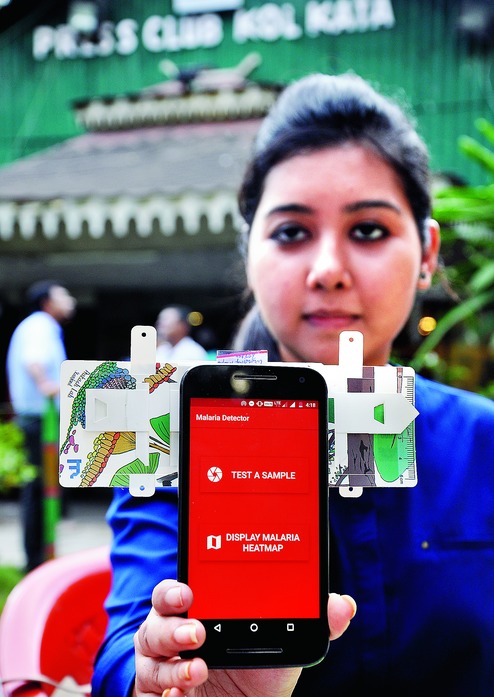
Two aspiring engineers have developed an app-based system to detect malaria in a blood sample in less than a minute.
The detection involves a multi-step process that starts with the collection of a person’s blood sample. The slide containing the blood sample has to be inserted into a foldscope – a small microscope made of folded paper and a microlens.
The foldscope was developed by Manu Prakash, who teaches bioengineering at Stanford University.
Prakash’s lab sent two prototypes to the Calcutta researchers. The foldscope then has to be fitted to a smartphone, whose camera helps magnify the sample. The magnified image is then transported to a server, where using an algorithm, malaria parasites, if any, are detected in less than a minute. The diagnosis is relayed back to the phone user and the findings archived.
Nilanjan Daw and Debapriya Paul, BTech final-year students of computer science and engineering at the Institute of Engineering and Management (IEM), Salt Lake, developed the system with the help of their teacher Nilanjana Dutta Roy and IIEST professor Arindam Biswas.
Picture by Anup Bhattacharya
source: http://www.telegraphindia.com / The Telegraph,Calcutta,India / Home> Calcutta / Thursday – October 19th, 2017
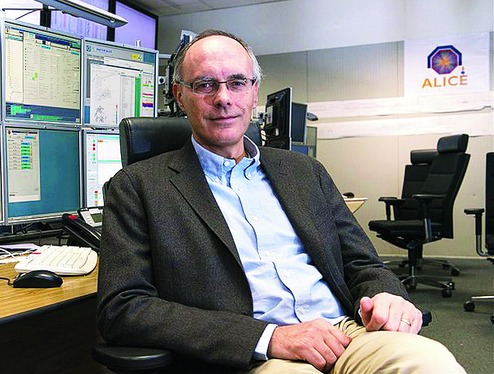
Paolo Giubellino, scientific managing director, FAIR.
Calcutta:
Science institutes in the city got a thumbs up recently from the chief of one of the world’s mega science projects, Facility for Antiproton and Ion Research (FAIR) in Germany.
“Why do students from here go abroad to study when you have such fantastic institutes like the Variable Electron Cyclotron Centre (VECC) and the Bose Institute doing excellent work? They are in the same league as MIT and Oxford, doing cutting edge work in science and are at the frontiers of technology,” said Paolo Giubellino, scientific managing director, FAIR. Giubellino was in the city to update all participating institutes – VECC, Bose Institute, Calcutta University among others – on the status and progress of work at FAIR. FAIR is the newest accelerator facility for research with antiprotons and ions and boasts a large number of contributors from India.
Much like the Large Hadron Collider at CERN, FAIR is being built with international collaboration near Darmstadt in Hesse, Germany, as part of the GSI Helmholtz Centre for Heavy Ion Research. While 70 per cent of the project is funded by Germany, India is the largest contributor after Germany and Russia.
“Unlike CERN, the contribution here is in kind, through building components of the accelerator and conducting experiments. The VECC is shipping us super conducting magnets for the accelerator. There are 25 Indian institutions from India participating at FAIR with the core effort in Calcutta,” said Giubellino. The new facility, which has Bose Institute former director Sibaji Raha as the founding chairman of the Joint Scientific Council of both the GSI and the FAIR, is expected to reveal consolidated findings about unknown states of matter and missing information about the evolution of the universe 13.8 billion years ago. The accelerator is in the process of being built though experiments will start as early as next year.
Stressing the role of the scientists in the city, Giubellino said: “Calcutta is a key partner in our project, the largest science project in the world. Scientists from here and the industry are working hand in hand to produce equipment of the highest standards. There is fierce competition that they have to overcome in building MUON detectors and the CBM equipment and it is based only on meritocracy.”
The Italian scientist, while addressing a group of girls from Calcutta over Skype, was impressed with the huge turnout. “I was in Germany travelling when I was asked to address a group of students from here. I had expected not more than 10 or 15 students but when I opened Skype, I was surprised to see about a thousand waiting,” said the science chief.
Calling all young students to FAIR, he said: “We welcome scientists from institutes like Bose Institute and VECC because we know they will be of international standards. I have been working with scientists from here and am aware of their calibre and do recognise that their students will have the capability to work in an international mega science project as ours.”
source: http://www.telegraphindia.com / The Telegraph,Calcutta,India / Home> Calcutta / by Anasuya Basu / Tuesday – October 17th, 2017