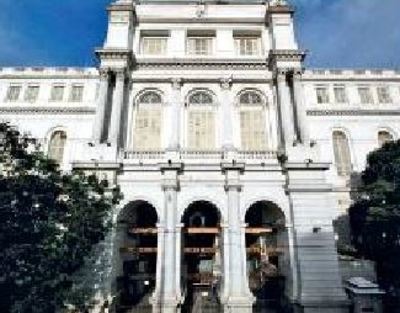
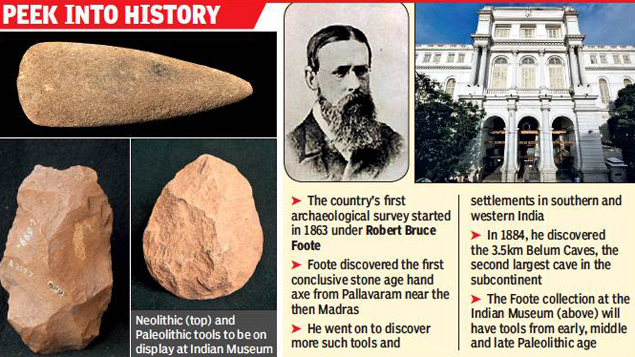
Indian Museum is pushing back the history it has been narrating thus far. It has ‘excavated’ Paleolithic stone age tools, some of which are up to 1.5 million year old, from its own sub-terranian store and will put them on display at a new pre-historic gallery that will open next month
Kolkata :
Indian Museum is pushing back the history it has been narrating thus far. It has ‘excavated’ Paleolithic stone age tools, some of which are up to 1.5-million year old, from its own sub-terranian store and will put them on display at a new pre-historic gallery that will open next month.
The collection, handed over to the museum in the 19th century by geologist-cum-archeologist Robert Bruce Foote, had been gathering dust in the underground store till they was re-discovered recently. Foote is considered the father of Indian pre-history and was the director general of Geological Survey of India.
Museum officials stumbled upon the collection of 100-plus tools that were discovered by Foote in south India. The oldest among them were unearthed in Atiram Pakkam, an area in Pallavaram, Chennai. These finds were named Atiram Pakkam tools.
“The Bruce Foote Collection is indeed the oldest collection of human tools anywhere in India. This treasure trove has never been viewed since it was brought to the museum. The inventory has swelled for 200 years without proper cataloguing. We are now sorting and classifying the collections scientifically,” said Indian Museum director Rajesh Purohit.
About 40 stone tools comprising of hand axes, scrappers, cleavers and arrow heads, mostly made of quartzite, will be brought out from that collection and displayed in the new gallery that will replace the Harappa gallery which had been till now the starting point of history at Indian Museum. The Harappa gallery has remained shut to public for nearly 15 years. Handpicked items from the Indus Valley Civilisation will also be exhibited at the new gallery.
The focus though will no longer be on Harappa and Mohenjo Daro, because these are both in Pakistan today and a large number of excavations on the Indian side around a circumference of 1.22 lakh sq km have revealed footprints of contemporary civilisations. “We can build our own history around these sites that have been unearthed in Haryana, Gujarat and Rajasthan. While in the earlier case, the civilisation developed along the Indus, on the Indian side the civilisations sprung up along Ravi, Chenab, Beas, Sutlej, Jhelum, Saraswati, Hakra and Ghaggar,” Purohit explained.
While Lothal (Gujarat) and Kalibangan (Rajasthan) excavations are well-known, other explorations in Rakhigarhi, Krunal, Birhana, Banawali and Firmana that have happened later and have led to discovery of thousands of archaeological remains like pottery, figurines and seals will now be part of the new gallery.
source: http://www.timesofindia.indiatimes.com / The Times of India / Home> News> City News> Kolkata News / by Jhimli Mukherjee Pandey / TNN / April 15th, 2018
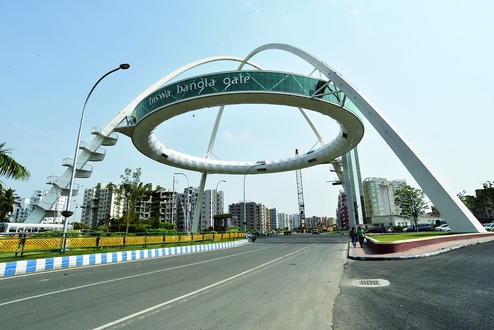
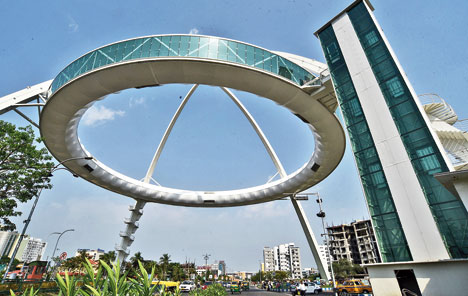
Kolkata Gate, a steel-and-glass structure with giant arches at the Rabindra Tirtha crossing of New Town, is almost ready. The two steel arches that criss-cross each other 55m above the ground can be spotted from several kilometres away.
A circular viewing gallery made of steel and toughened glass has been set up at 25m above the ground level. The 10ft-wide and 60m-long gallery has been constructed by interlinking four prefabricated structures that resemble aerobridges. These structures in turn are welded and attached to the steel arches at designated points. The facade is made of toughened glass with laminated silicone sheets that can withstand gale-force winds, hailstorms and extreme heat.
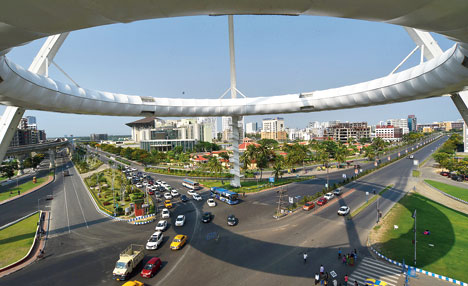
A bird’s-eye view of New Town clicked from a landing a few feet below the viewing gallery of the Kolkata Gate. The view from the gallery will be unhindered as nothing taller than the gate will come up in the area, New Town being a planned city and with pre-determined floor levels for every plot.
Programmable LED lights and flashers have been placed along the length of the steel arches to give it a snazzy look at night. The viewing gallery will have a snacks counter during the day and a fine-dining restaurant after 7pm. At night, only diners will be allowed inside the gallery that will offer a panoramic view of the township. The walls of the gallery have been painted with murals with an entire wall dedicated to the schemes and achievements of the state government.
“The restaurant will offer a one-of-a-kind experience. It will be unlike any other in the city and will offer cuisines from across the world,” said Debashis Sen, the chairman of Hidco. It is likely to open doors in June, officials said.
Two lifts with a glass facade made of toughened glass similar to that used in the viewing gallery will take visitors up to the gallery. The lifts are equipped with telephones at every level so that the operators can get in touch with visitors in case of an emergency. Hidco is mulling a Rs 30 fee per person for a visit to the gallery. Diners at the restaurant won’t need to pay the fee.
source: http://www.telegraphindia.com / The Telegraph,Calcutta,India / Home> Calcutta / by Snehal Sengupta / Photos by Sanjoy Chattopadhyaya / April 30th, 2018
Did you know that the City of Joy is also a city of museums? We’re not talking about the most obvious ones, but several that are tucked in forgotten corners, waiting for the elusive visitor to drop in. In fact, many of these museums provide a wealth of material for those who are interested, but lose out because few people know they exist. Utsav Basu does the rounds of a few of Kolkata’s lesser-known museums
Sabarna Sangrahashala
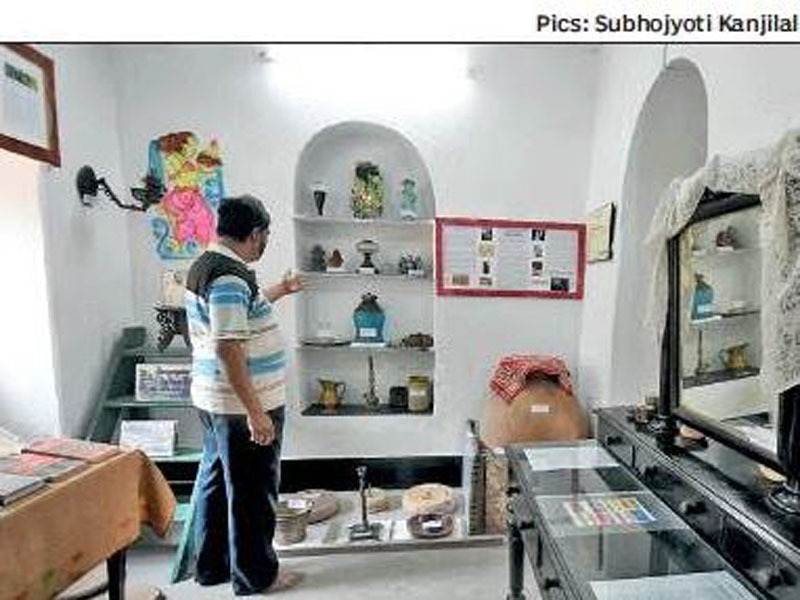
Located in Barisha, Sabarna Sangrahashala is a museum on the Sabarna Roy Choudhury family and the city of Kolkata. Developed by the Sabarna Roy Choudhury Paribar Parishad in 2005, the museum mainly caters to young students and researchers who wish to learn more about the history of the City of Joy. The museum – or rather a collection by the family trust – possesses rare documents and articles, including ‘kabilatipatras’ dating back to the 18th and 19th centuries. Among them is an important artefact which bears the signature of Kavi Rama Prasad Sen dated 1794. The highlight of the museum is the historic judgment of the Calcutta High Court in the Kolkata birthday case and the expert committee report on the matter, which states that Job Charnock was not the founder of Calcutta (Kolkata), nor is August 24 the city’s birthday.
Other articles include a huge earthen rice pot dating to 1840 with can carry 240kg of grain, a metal hookah from 1878, a metal candelabra from 1795, grinding wheels from 1845 and a wooden table used by Antony Firingee’s grandfather, John Firingee, from 1680.
Timings 10am-12pm and 5pm-7pm every day except Thursday
Entry free
Gurusaday Museum
Tucked away in a corner of Joka, Gurusaday Museum, run by Bengal Bratachari Society, is a house of folk art forms conceptualised by civil servant, folklorist, and writer Gurusaday Dutt. A deep interest in Bengal’s folk art led Dutt to collect around 2,325 specimens of various art forms of Bengal. These artefacts were later housed in a museum, which was thrown open to the public in 1963 by Humayun Kabir, the then Union minister of education. The museum now reels under financial crunch, after the Centre, in a notification, asked it to run on its own. The museum authorities claim this is a breach of agreement between the President of India and the Bengal Bratachari Society of May 23, 1984. Before the recent turn of events, it was funded by the Ministry of Textiles.
From specimens of Bengal’s ‘kanthas’ to ‘patachitras’, the museum is a paradise of eclectic artefacts that range from clay dolls to sandesh chhach (sweet moulds) and Dutt’s personal belongings. A few interesting things include ornaments made of paddy, archaeological specimens from the 1st and 2nd centuries BC, dokra crafts and manuscripts of undivided Bengal.
Located on Raja Rammohun Roy Sarani near the Amherst Street crossing, the nearly 200-year-old house owned by Raja Rammohun’s family houses a history that talks about his life and work. Through various documentations, the museum talks about his ideological battles with his father, compatriots and with a few British officials.
Though the museum does not have any of the real documents or objects used by Roy, a beautiful recreation of the period talks about his life. There are, however, a few original documents such as the original cover of the ‘Tuhfatu’l-Muwahhidin’ (A Gift to Deists), which was a frontal attack launched by Roy against idolatry and superstition plaguing Hinduism in the 18th and 19th centuries, the cover page of the first sermon of the Brahmo Samaj, and photocopies of a few letters written by Roy to various luminaries of the day.
Started in 2000 as a permanent exhibition, the museum slowly took shape through donations from many quarters and the tireless efforts of teachers and professors of Raja Rammohun Roy College. The museum, like any other lesser-known museums of the city, reels under a financial crunch and is thus not being able to expand and house many other artefacts related to the reformer.
Timings: 11am to 4.30pm, all days except Mondays Entry 10;50 for photography
State Archaeological Museum
Located near the Behala tram depot, the State Archaeological Museum, under the state government, is divided into six departments – Site and Sights, Early Historic Period, Sculptures of Bengal, Paintings of Bengal, Metal Sculptures gallery and the Nandadirghi Vihara: Jagjivanpur.
Inaugurated in 1980 by then chief minister Jyoti Basu, the museum has a collection of rare tools of the Early, Middle and Late Stone Ages from Susunia (Bankura) and other sites, proto-historic antiquities from Pandu Rajar Dhibi (Burdwan), sculptures, stone and stucco from the Gupta, Maurya, Shunga, Kushana, Pala and Medieval times.
The painting section of the museum boasts Mughal miniatures, paintings on wooden planks, Kalighat patachitras and watercolours. Primarily painted by court painters of different rulers, the section also has paintings that tell stories.
The main attraction of the museum, however, is the Nandadirghi Vihara: Jagjivanpur section, which documents the 1992 excavation activities at the site in Malda. The section doesn’t have all the real artefacts found in the excavation, but has flawless replicas, apart from a few real exhibits. It also has a model of the excavation site in Malda.
Timings 11am-4.30pm (Wednesday to Sunday) Entry Rs 5
Cultural Research Institute
Barely a two-minute walk from the Kankurgachi crossing, beside the Bureau of Indian Standards building is the Ambedkar Bhawan Cultural Research Institute, which houses a museum divided into four sections. Run by the state government, the museum was earlier at the New Secretariat building. In 1980, it was shifted to Ambedkar Bhawan.
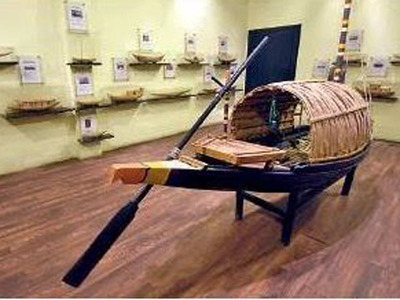
The cultural institute, through the four sections – Ethnographic, Puppet, Kantha and Boat – has an interesting collection that talks about Bengal and its varied cultural background.
The ethnographic section displays baskets of several tribes, tribal musical instruments, Birbhum paintings, masks and other artefacts that talk about Bengal’s ethnic milieu at length. The puppet section breaks the popular belief that Rajasthan is the only land from where puppetry originated. This section has a collection of puppets that were used to tell stories of Dakshin Rai and Bon Bibi and that of other kings who ruled Bengal and their valour. The Kantha section is also quite interesting. This section displays some of the finest examples of kantha.
The main attraction is the boat museum, which boasts a collection of around 40 models of several boats of Bengal, used for various purposes. This section is a virtual boat-ride through a wave of stories. Through detailed descriptions about the type of boats used for specific reasons, the narratives also throw light on the areas of Bengal where the boats were used or made.
Timings 10am-5.30pm (Monday to Friday)
Entry Free
Acharya Bhawan
The museum on Acharya Jagadish Chandra Bose at his house built in 1902, beside the Bose Institute on APC Road, houses furniture used by Bose and his wife, the original instruments used by him for his various scientific experiments and his personal belongings. A request to the trustees can also take you to the attic room where Bose used to carry out his experiments.
Restored by INTACH and looked after by the Sir J C Bose Trust, Acharya Bhawan has not been changed a bit from its original glory. The trust has arduously taken the task of keeping intact the feel of the house as it was more than 100 years ago.
A section of the museum has the original chairs and the table which Bose exclusively used while interacting with his friend, Rabindranath Tagore. The museum also has the dark room and the observatory used by Bose for his experiments.
Timings 2pm-4pm (Wednesday and Friday) Entry | Free
source: http://www.timesofindia.indiatimes.com / The Times of India / Home> City News> Kolkata News / Utsav Basu / TNN / April 28th, 2018
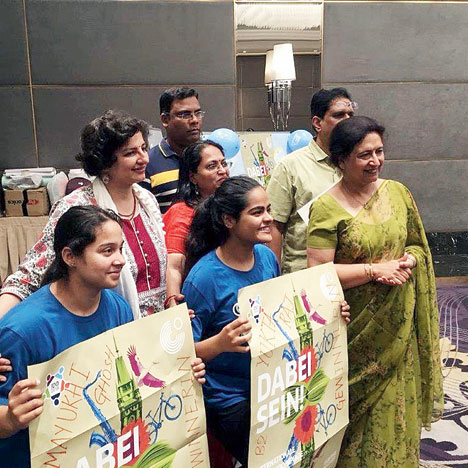
Modern High girls to represent India in contest with learners from 72 countries Mayukhi Ghosh and (right) Yukta Raj, who will represent India at the International German Olympiad this July
Ballygunge:
Two students from Modern High School for Girls have German television soaps and pop music to thank for topping a national-level language competition and earning the opportunity to represent India at the International German Olympiad in Freiburg this July.
Yukta Raj, a student of Class XII, and Mayukhi Ghosh, who is in Class X, have been learning German for many years. But the fluency they needed to compete with other learners in a language Olympiad came as much from following popular culture as from classroom lessons.
“I started watching German TV shows like Jojo sucht das Gluck and Tyrkisch fur Anfanger to prepare for the competition. It was basically learning while enjoying oneself,” said Yukta, who is the president of her school’s Deutschind club.
For Mayukhi, who inherited her love of German from her mother, pop music has been an unlikely learning tool. Her favourites include the rapper Cro and fellow artiste Namika.
Mayukhi was in Class I when she heard her mother speak a smattering of German and tried to emulate her. A decade later, it is the teenager who insists that her mother converse with her in the language and “keeps correcting her”.
“My mother is not fluent now for lack of practice. I ask her to randomly have a conversation with me in German,” Mayukhi said.
She and Yukta see the chance to compete with learners from 72 countries in the IDO – Internationale Deutscholympiade as an extension of their future plans. Both girls are looking at Germany as an option for their undergraduate studies. Yukta is fascinated by German “discipline” while Mayukhi loves the concept of artists’ colonies, of which that country has several.
For now, Yukta and her junior teammate are focused on enhancing their ability to not just speak and write German but also think in that language. “It’s started happening a lot. Since I started practising for the Olympiad, thinking in German has become a habit,” said Yukta.
Bina Ghosh, who teaches German at Modern High, said inter-school events and an exchange programme with a school in Germany had helped increase her students’ proficiency. “Even communicating over WhatsApp and Skype helps,” she said.
source: http://www.telegraphindia.com / The Telegraph,Calcutta,India / Home> Calcutta / by Jhinak Mazumdar / April 25th, 2018
“The logic system can be recycled for three cycles by adding a heat deactivation step,” says Jyotirmayee Dash (sitting).
Sixteen combinations of different enzymes were used to make up the desired outputs
Scientists at the Indian Association for the Cultivation of Science (IACS), Kolkata, have been successful in designing DNA-based logic devices that would find application in DNA-based computation. They have designed reusable YES and INHIBIT logic systems by using a small molecule that serves as a fluorescent probe and binds to both a four-stranded DNA structure (G-quadruplex) present in human telomeres and nucleic acid cleaving enzymes (nucleases).
Fluorescence
The fluorescent probe — carbazole ligand — selectively binds to the G-quadruplex over other DNA structures present in the human genome. Once it binds to the DNA (G-quadruplex), the small molecule inhibits certain enzymes (nuclease S1 and exonucleases) from degrading the DNA. However, certain other enzymes (DNase I and T7 endonuclease I) can degrade the DNA even when bound by the small molecule.
While the small molecule by itself shows weak emission at 373 nm and 530 nm, the fluorescence intensity gets enhanced 14-fold at 530 nm once it binds to the DNA. Similarly, the small molecule bound to the DNA exhibits different fluorescence behaviour in the presence of different enzymes and this has been taken advantage of by the team led by Prof. Jyotirmayee Dash from the Department of Organic Chemistry to design conceptually novel logic devices. The results were published in the journal ACS Synthetic Biology.
Computation
For instance, DNase I enzyme degrades the DNA-bound small molecule and so when both the DNA the DNase I enzyme are used as inputs the fluorescence at 530 nm weakens. The output is therefore taken as zero. On the other hand, nuclease S1 enzyme does not degrade the DNA bound by the small molecule and so when both DNA and nuclease S1 enzyme are used as inputs the fluorescence at 530 nm does not get affected. The output is taken as one.
“So the INHIBIT logic gate is constructed using DNA and DNase I as inputs while the inputs of DNA and nuclease S1 form a YES logic gate,” says Prof. Dash.
Once the DNA is degraded by the DNase I enzyme, the logic system can be reused by supplying heat to deactivate the enzyme. “The logic system can be recycled for three cycles by adding a heat deactivation step. After three consecutive cycles, the efficiency of the system decreases by only 33%,” says Prof. Dash.
The team went a step further to design combinatorial logic systems (individual logic gates integrated into one another such as INHIBIT−INHIBIT and NOR−OR) by using different combinations of four nucleases (enzymes) as inputs.
16 combinations
The researchers were able to get 16 different combinations by adding one, two, three or four enzymes (nuclease S1, Exo I, T7 Endo I and DNase I) to the DNA-bound small molecule. The different combinations of the four enzymes are taken as inputs and the fluorescence response at 530 nm is taken as the output.
Of the 16 combinations, only four combinations are fluorescent (output taken as 1) and 12 are non-fluorescent (output taken as zero). The square numbers (1, 4, 9, 16) are assigned as fluorescent combinations, whereas the rest are assigned as non-fluorescent combinations. “So by suitable programming we can modulate the system to carry out complex calculations (for example, identification of square numbers up to 16) by varying the inputs,” she says.
“We hope that these DNA logic gates will provide the ability to not only create more complicated, sequential DNA computations but also create interfaces between silicon and DNA-based computers. The DNA-based nanodevice could be useful for diagnostic sensors and other biomolecular machines,” Prof. Dash says.
source: http://www.thehindu.com / The Hindu / Home> Science / by R. Prasad / April 21st, 2018
Cargo shipped from other countries to Calcutta and then sent by road to Nepal is now being tracked by the customs authorities with GPS to ensure the containers do not go missing on the way.
As part of a pilot project which started on Wednesday, the customs authorities are using the GPS-enabled electronic cargo tracking system to lock Nepal-bound containers at the Calcutta ports.
“Cargo containers from India cross over to Nepal from Raxaul, Jogbani and Sanauli. While Raxaul and Jogbani are in Bihar, Sanauli is in Uttar Pradesh. Now, we can track a container’s journey to any of the three border points from a port. The tracker will help us know whether a container has deviated from the route or stopped midway and for how long,” a customs official said on Friday.
At the border points, Indian customs officials remove the device. A report is immediately generated containing all details of the trip.
“Importers and exporters can track the movement, too, with this system. This will increase transparency as well as make documentation less complicated,” the official said.
Three containers bound for Nepal were sealed with the new tracking system at Kidderpore and Garden Reach ports on Wednesday.
India and Nepal had signed a memorandum of intent in 2017 to introduce the tracking system.
Surrounded by land on all sides, Nepal’s import cargo from across the world are shipped to Calcutta, Haldia or Visakhapatnam.
However, because of its proximity to Nepal, bulk of Nepal’s cargo is shipped to the ports in Bengal.
Nepal imports items from pulses to helicopters, most of which are shipped to Kidderpore, Garden Reach and Haldia. Other items it imports include electronic goods, plastic granules, machineries, coal, urea and food products such as black pepper and noodles.
Customs officials said around 1,500 containers carried cargo from Kidderpore and Garden Reach on an average every week.
Officials said there had been a few occasions when the containers went missing on the way to the border.
source: http://www.telegraphindia.com / The Telegraph,Calcutta,India / Home> Calcutta / by Special Correspondent / April 21st, 2018
Conservation experts from the United Kingdom are voicing concern over the loss of Calcutta’s architectural heritage.
Conservation architect Philip Davies, who campaigns for the “shared heritage of Calcutta and Britain” and James Simpson, OBE, architect and vice-president of ICOMOS, UK, a heritage and cultural organisation, have lent their support to the protest march that Calcutta Architectural Legacies (CAL) is organising on April 18, the World Conservation Day.
Simpson believes Calcutta is facing a situation that Edinburgh faced 50 years ago. when development had threatened to rob the Scottish capital of its architectural heritage.
“Calcutta is… eminently worthy of recognition by Unesco as a World Heritage City. When chief minister Mamata Banerjee came to the Scottish capital last November, she saw in Edinburgh a beautiful city, whose heritage has made it one of the best places in the world in which to live and to do business, and to whose economy tourism makes a significant contribution,” Simpson wrote in an email sent to Metro on Sunday.
The Calcutta Municipal Corporation had last year downgraded the heritage status of the building that housed the old Kenilworth Hotel near the Middleton Street-Little Russel Street crossing, enabling its demolition by the present owners. Conservation activists have alleged that a builder-authorities nexus was behind the downgrading and the subsequent demolition.
The civic body had said the heritage downgrade of the building happened in accordance with law.
Amar Nath Shroff, the chairman of Alcove Realty, has said his company has not done anything outside the law. Alcove Realty is part of the consortium that owns the plot where the hotel stood and is promoting The 42, Calcutta’s tallest building.
Simpson said Calcutta’s heritage is its greatest asset, on which its future should be built. “Amit Chaudhuri and his supporters in CAL and PUBLIC are fighting for the very survival of the city. Without the architecture and the culture which makes it uniquely special, Calcutta will, in global terms, sink into mediocrity,” said Simpson.
London-based architect Philip Davies, who believes citizen’s movement is important to force governments into action, said: “Amit Chaudhuri, CAL and PUBLIC are to be applauded for taking to the streets to protest against the de-listing of buildings and the refusal of repeated administrations to designate conservation areas to protect its historic centres. Kolkata is one of the world’s great historic cities. Its remarkable heritage is enshrined in the very fabric of its buildings, neighbourhoods and public places. They desperately need strong statutory protection.”
Lamenting the loss of many such buildings, like the Strand Road warehouses, Davies said: “What is happening is a scandal. The Strand Road warehouses have stood vacant and decaying on a prime central riverside site for over 50 years losing crores and crores of potential revenue. The Botanic Gardens are of world significance and the oldest in Asia, but they are appallingly neglected with no coherent strategy for their future.”
He also lists the Silver Mint and Mint Master’s House, among the finest neoclassical buildings in India, that have been lying dilapidated for decades. The buildings that made Calcutta “a city of palaces” are threatened with development, he said.
Historic buildings and neighbourhoods are a huge economic and cultural asset, feels Davies. “A successful city can, and must, have both. Conservation is not an optional extra luxury, but crucial for sustainable urban regeneration and change. Heritage-led regeneration works,” he said.
Experience across the world – from London to Cape Town – demonstrates that waterfront cities can, and do, reinvent themselves. Calcutta can do the same and reap huge economic benefits for all, but it needs vision and leadership, felt the architects.
Grateful for the support from the UK, Chaudhuri said: “They have long been interested and invested in conservation in Calcutta.”
Talking of the UK experience in conservation, he said: “We can learn from Edinburgh, which never lost any of its architectural heritage, unlike Glasgow. We can learn from Scotland and London. But we can also learn from our own Mumbai, which has its own heritage precincts like the Churchgate and Oval Maidan, and the art deco of Marine Drive.
All these places are not museum-like but lived spaces shared by the affluent and the ordinary people. Calcutta too has the same mix of livelihoods and buildings that would form an attractive part of the city.”
source: http://www.telegraphindia.com / The Telegraph,Calcutta,India / Home> Calcutta / by Anasuya Basu / April 16th, 2018
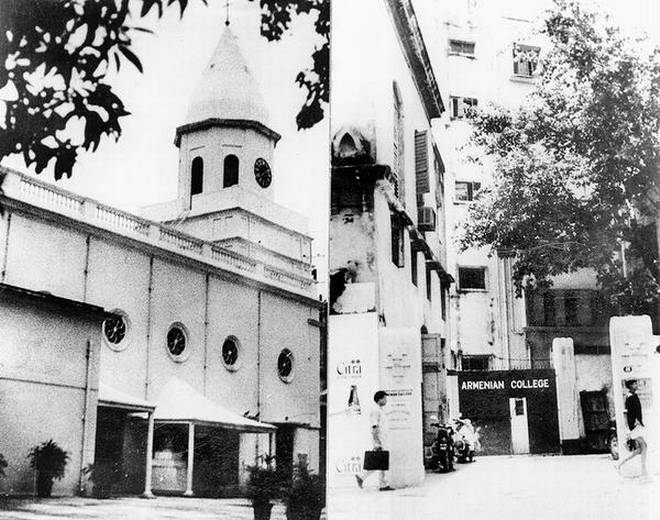
The Armenian Church of Nazareth, the oldest church in Kolkata; and (right) The Armenian College. | Photo Credit: PTI
For 197 years, the Armenian College and Philanthropic Academy has offered not just education but a sanctuary for children torn by conflict.
It was a birthday party of a different kind.
Brought together often by conflict and exile and nurtured in a regime of tough love, the dozen alumni and 70 present students of the Armenian College and Philanthropic Academy (ACPA) of Kolkata were celebrating 197 years of the institution on April 2.
Amid the animated discussions on the crisis in West Asia, Razmik Hakobyan, a 24-year-old Iraqi, an alumnus of the school, said he was dispatched to the ACPA in 2007 for “safety and education,” after a bomb exploded close to his house in Baghdad’s upmarket Kembel Gilani area. Mr. Hakobyan’s father, a retired soldier, decided distant Kolkata was safer.
“A friend who studied in Kolkata told us about the school and my parents got interested,” said Mr. Hakobyan, who left Baghdad when he was just 13. He would like to visit Baghdad, he said, but only on vacations.
“Baghdad is not getting better and nor is its education,” said the young man, whose family has since shifted to Kurdistan. Close to completing his graduation at the city’s St. Xavier’s college, Mr. Hakobyan says he is indebted to the Armenian College and its teachers.
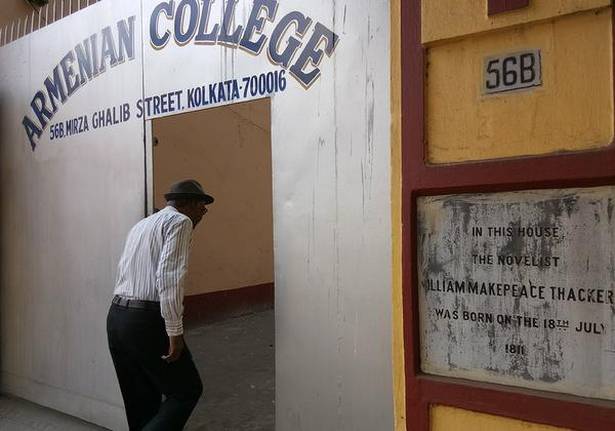
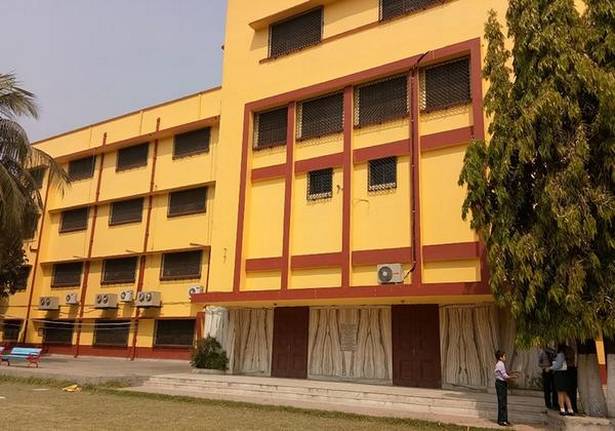
Set about 500 metres north of Park Street in the heart of the city, a plaque at the entrance of the imposing yellow building announces that “the novelist William Makepeace Thackeray was born on the 18th July, 1811” in the premises. Since 1821, it has housed the Armenian College and Philanthropic Academy — a school for Armenian students from all over the world up to Class X.
India as home
The Armenians adopted Christianity in 301 AD and were invited “to come and settle in his dominions” by emperor Akbar in the 17th century.
They arrived in Bengal in 1645 and settled along the Hooghly’s fertile western bank like most traders of the time. Anne Basil in her seminal book Armenian settlements in India writes that the community grew in size and influence and felt the need to have its own school. An informal school was set up in 1798, which was replaced by the present Armenian College and Philanthropic Academy on April 2, 1821, at 358, Old China Bazar Street near the Armenian Holy Church of Nazareth, Calcutta.
Following the genocide of more than a million Armenians in eastern Anatolia by Turkish forces in 1915, “hundreds of children of uprooted families…found shelter and a roof and received sufficient education…” at the Kolkata school, notes Basil.
Open to all Armenians
Armen Makarian, a former student and school’s coordinator, said the institution is the only Armenian school of its kind in the world.
According to Very Reverend Father Movses Sargsyan, head of the Davidian Girls’ School (DGS) — the girls’ wing — and Armenian College, the school is globally known among Armenians. “Internet, website and social pages informed the guardians,” Father Sargsyan said. While a majority of the students are from Armenia, the rest are from the Armenian disapora in Iran, Iraq and Russia and a handful of Indian-Armenians.
“We would like to have Armenian students from across the world — from Germany, Italy or France and even Syria,” Father Sargsyan said.
Like most boarding schools, the Armenian College has an intensely packed, exacting schedule. Mobile phones and laptops are a strict no-no, with the students allowed two hours out of the premises for shopping.
“But we like it,” said Vladimir Grigoryan, a ninth standard student, who was born in Russia but now stays in the Armenian capital, Yerevan.
“My parents were paying $2,500 annually for my education in Armenia. But the teachers never cared if we were learning — unlike here where teachers are constantly demanding,” said Vladimir, whose father runs a chain of hotels in Russia.
For Sevak Azarian Namagardi from Iran, who just appeared for his ICSE examinations, life is a “little boring” at times. Being a trained singer and a regular at choirs, he looks forward to weekly chats with his family over Skype.
“As the summer vacation approaches, I’m making arrangements to leave for Tehran,” he said. He has more reasons to cheer. “This time the family and I will visit Armenia, our motherland,” said Sevak. He, however, is equally keen to get back to friends at the school.
Academic challenge
Imparting education to students from such diverse backgrounds, however, is not easy. Soumitra Mallik, Principal at the Academy said the key problem was to match various levels of education.
“We do not know if the student who has studied up to Class V in her or his country is on par with what is taught here under the ICSE syllabus. So, this content mapping and matching is a problem,” he explained.
The other problem is communication as the students usually come from non-English speaking backgrounds. While Armenian teachers teach Armenian language, history, and culture, most of the around 25 faculty members at the Academy are Indian.
“So, we have six-month preparatory courses where we intensely teach English, some Mathematics and a bit of the Sciences to provide an outline of what the student will study and to hone their English language skills,” Mr. Mallik said. So far, it has worked well as many of the students are quickly able to leapfrog to reading Shakespeare’s Merchant of Venice within a few years!
Arindrajit Saha, the English teacher, said, “Studying Shakespeare within a brief period of time can be considered an important marker.”
Though the students indeed are grateful for the free and quality education they receive, there are regrets of a lost childhood back home.
“Saddam Hussein may have been a dictator but Iraq was not doing too badly and there was peace. With his departure, the country permanently collapsed and I had to leave my incomplete childhood behind,” said Mr. Hakobyan.
The different countries that the students hail from may not share friendly diplomatic ties, but the bond that Mr. Hakobyan or Sevak develop at the Kolkata school go beyond political compulsions or geographical boundaries.
“We are from the same tree, with same roots. The branches move in different directions, but the root remains,” says Arian Makarian of Iran, an alumnus.
source: http://www.thehindu.com / The Hindu / Home> News> Cities> Kolkata / by Suvojit Bagchi / Kolkata – April 14th, 2018
Residents of Raiganj have pinned hopes on Sonia Baishya, a local girl, to achieve medals at the Commonwealth Games on Saturday.
On Saturday, Sonia will participate at the finals of the 4 X 400 relay race at the international sports event. She is the sole member in the Indian squad from north Bengal.
“I have spoken with her over phone and have mentioned about the high hopes of Raiganj residents. We will organise a puja at home ahead of her event. But I will not join others to watch the live telecast. All of us are eagerly waiting for her success,” Baren, her father, a resident of Netajipally in the town, said.
In 2017, Sonia had bagged gold at the same event in the Open National Athletics Championship that was held in Chennai. Then she participated at 18th Asian Games Invitation Tournament held on February this year at Jakarta in Indonesia. There, she had also won the gold medal.
“Sonia’s consistent performance has helped her to secure a berth in the Indian squad that was sent for Commonwealth Games. India has already won a number of gold medals in the event but Saturday’s event is most important to us. We want to see her succeed,” said a sports enthusiast of the town.
Ahead of the event, residents, social organisations and even the North Dinajpur district administration have drawn up plans to pray for us as well as put giant screens to show the live telecast of Sonia’s event.
“A giant screen would be put at the stadium here where people can watch the event. Sonia Baishya has made North Dinajpur district proud and to encourage more children and youths to join the sports arena, we have made the arrangement,” said Ayesha Rani A, DM, North Dinajpur.
Sonia’s friends have planned a prayer meeting for her success. Also, organisers of Quiz Premiere League, a which will be held in the town from Saturday, have said that they would pray for her ahead of their programme.
“All eyes would be on Sonia on Saturday. People are planning celebrations if she succeeds,” said a representative of the District Sports Association.
source: http://www.telegraphindia.com / The Telegraph,Calcutta,India / Home> West Bengal / by Kousik Sen / April 14th, 2018
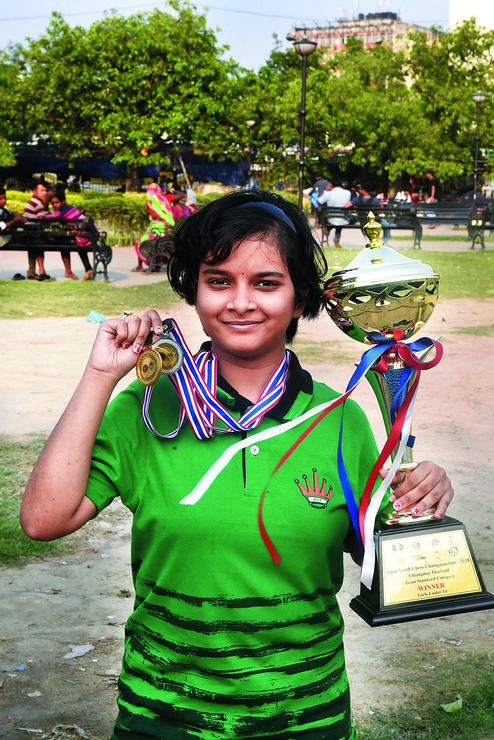
Thailand silver teaches chess teen how to finish first
Bristy Mukherjee outside the Maidan club. Picture by Sanjoy Chattopadhyaya
Calcutta:
If Bristy Mukherjee misses her 8.45pm train from Howrah after training at a Minto Park academy, she has to wait another 90 minutes to catch the next one and reach home past midnight.
The 14-year-old from Memari in East Burdwan has become used to the consequence of missing trains, but is having a hard time consoling herself about the gold medal she narrowly missed in Thailand this month.
Half a point was all that forced Bristy to settle for silver in the under-14 girls’ category of the Asian Youth Chess Championship at Chiang Mai between April 1 and 10.
Bristy had outplayed higher-ranked players in four consecutive rounds, but drew her last match against China’s Wan Quian to score 6.5 points in nine rounds. This was just half a point less than what Kazakhstan’s Kamalidenova Meruert had totalled to win the gold.
The visit to Thailand was the first time Bristy had travelled abroad. She has had to skip a couple of other international tournaments because her parents could not afford the expenditure.
Bristy’s mother had mortgaged her jewellery to arrange just over Rs 70,000 so that she could compete in the Asian Youth Chess Championship. Her father used to run a grocery shop that shut down two years ago because accompanying his daughter to tournaments left him with little time for business.
“I have to travel with Bristy within and outside the state. There is nobody else to sit at the shop,” Debasish Mukherjee told Metro at a Maidan club where Bristy and other players from Bengal were felicitated by the state chess association.
Mukherjee rents out a portion of his ancestral two-storey house for private ceremonies. The prize money that Bristy wins is kept aside to cover travel costs, although that is hardly enough.
Bristy trains at the Alekhine Chess Club at Gorky Sadan, near Minto Park, and spends six hours a day travelling. “The journey is especially taxing during the summer months,” she said.
Chess became Bristy’s life in 2010 when she was visiting a nursing home near Minto Park with her parents. “I noticed an advertisement for admission to Alekhine Chess Club. Nobody in our family was associated with chess but I liked the game,” she recalled.
That was July. In October the same year, Bristy won the first tournament she participated in – at the Khudiram Anushilan Kendra in the under-6 category. At the Asian School Championship in 2011, she won a bronze medal in the under-7 event.
Bristy, who studies at Memari Rasiklal Smriti Balika Vidyalaya, idolises Grandmaster Koneru Humpy and aspires to win laurels for the country. “She is from a place where there is hardly any chess infrastructure. She is promising but the pressure to perform sometimes hampers her game. Her performance in Thailand is encouraging. This is the break she needed,” said Atanu Lahiri, the general secretary of the Bengal Chess Association.
source: http://www.telegraphindia.com / The Telegraph,Calcutta,India / Home> Calcutta / by Debraj Mitra / April 15th, 2018