Deep within the suburbs of Unkal in the city lies a key relic of our rich architectural history — the Chandramouleshwar temple — forgotten by many and being usurped by the unscrupulous. The temple, which dates back to reign of the Badami Chalukyas in the 11-12th century, has been crying for attention for years now, but no concrete measures have been taken to protect the historical monument despite the Archeological Survey of India (ASI) designating it as a protected monument under the Ancient Monuments and Archaeological Sites and Remains Act,1958.
Over the years, the land on which it stands has also been allegedly encroached upon by villagers.
Unkal was a border area between the Hoysala and Chalukya empires. The Chandramouleshwar temple, therefore, bears resemblance to both Hoysala and Chalukya styles of architecture. Its unique plus-shaped plinth sets it apart from other temples in the state, claim experts.
A facade of promises
The temple has about 4-5 acres of land around it, but most of it has allegedly been encroached upon by villagers. ASI had woken up to such encroachments five to six decades ago, had conducted a survey and planned a renovation of the temple. But, it then placed all plans on the back burner.
C B Marigoudra, a retired teacher and historian, recalls that the temple was declared a historical monument by ASI around 50 years ago. “But, no steps for development have been completed to date.”
Around five years ago, ASI again took a shot at reining in encroachments by constructing a wall around the site. But work on redevelopment came to a grinding halt a few years ago, alleges Marigoudra.
P S Parvati, a retired officer of information and broadcasting department, says the district administration had sent a proposal to the state government around two years on developing the temple, improving road connectivity to it and providing other facilities to visitors. That file has been gathering dust. “Citizens are forgetting the importance of the temple. Many people don’t known that such a historical monument is located right in our city. There is a need to renovate the temple and create awareness about its importance among the people,” suggests Parvati.
M S Koravi, a former corporator, says ASI had served notices to residents who had encroached upon the land a few years ago. But that zest fizzled out soon. “No action was taken by the department against the encroachers. If ASI wants to clear the encroachments, it should provide alternative rehabilitation to the residents. Only then should it develop the city’s only historical temple,” recommends Koravi.
J Ranganath, assistant superintending archaeologist engineer, ASI, Dharwad division, points at half-hearted measures taken: construction of a compound wall and a watchman to keep an eye on the temple. “The ASI division will soon get funds, with which we will take up renovation in two to three months. There is a technical problem with removing encroachments and that will looked into as well,” he claims.
source: http://www.timesofindia.indiatimes.com / The Times of India / Home> City> Hubli / TNN / August 07th, 2014
All India Radio, Kolkata has been awarded as the most ‘effective’ regional news unit in India.
This decision was recently conveyed to the regional head of the Kolkata AIR unit by News Services Division, a unit of AIR in Delhi. AIR Guwahati has also been given the award along with its Kolkata counterpart. According to a AIR Kolkata spokesperson, the award was prestigious for the city regional unit as Kolkata unit of AIR has bagged such an award among 44 regional news unit in past five decades.
The award was given to the AIR Kolkata for broadcasting as many as 13 news bulletins everyday in regional language. Of these, 13 bulletins, 12 are in Bengali language and one in Santhali. This Santhali news has been popular not only with areas such as Bankura, Purulia, Mindapore or other Santhali dominated areas in West Bengal, but in large areas of Odisha, Bihar and Jharkhand. The spokesperson said that AIR Kolkata henceforth will be more careful to choose issues in airing news or news related programmes to cater the needs of the millions of listeners based in West Bengal and its neighbouring states. “The award has given us a sense of confidence and also a sense of responsibility to reach to more listeners,” the AIR (Kolkata) spokesperson said.
source: http://www.timesofindia.indiatimes.com / The Times of India / Home> City> Kolkata / Saikat Ray, TNN / August 16th, 2014
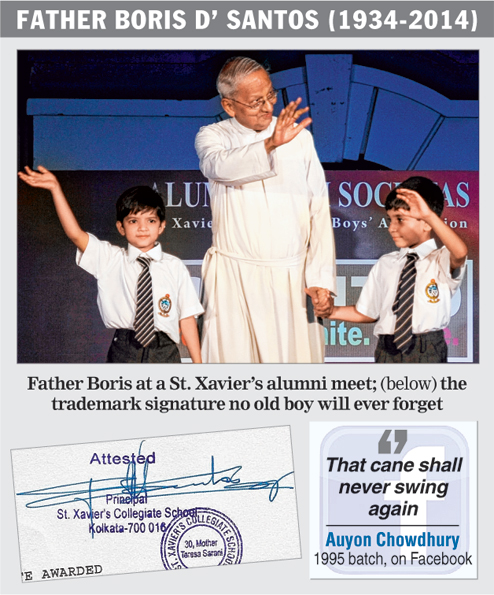
Few students of Father Boris D’ Santos would have got away without a caning or two and yet the loudest applause was for him at the last reunion of St. Xavier’s old boys in December 2013.
Father Boris, the long-serving former vice-principal of St. Xavier’s Collegiate School, Calcutta, passed away on Wednesday. He was 80.
He had been suffering from bone cancer for some time, the school said. “Fr. D’ Santos had been ailing for some time. He received the best treatment that medical science could offer…. The doctors who attended included some of his former students,” said a statement issued by the school. Along with other Jesuits, his sister and her husband were present in his last moments.
Born on April 19, 1934, Father Boris was himself a student of St. Xavier’s school. A few years ago, when he was asked about his association with the school that was celebrating 150 years, Father Boris’s eyes had glistened as he related a story: “My brother and I were almost turned away from St. Xavier’s school on the day of admission in 1943 for turning up late. But fortunately, a lady teacher of the school happened to enter the prefect’s room and recognised my mother. They were friends. She said she could find a seat each for us and so I joined Standard I Section B on February 1, 1943.”
His classmate of the 1951 Senior Cambridge batch, General Shankar Roy Chowdhury, remembered young Boris as being good in both studies and games and “second-to-none in sprints”.
It was while he was working at CESC (then Calcutta Electric Supply Corporation) that Father Boris found his vocation to be a Jesuit. He joined the Society of Jesus (The Jesuits) on September 14, 1965, and was ordained as a priest in 1974. The much-loved Jesuit was appointed prefect of St. Xavier’s school in 1984, a post he held till he gave it up a few months ago because of failing health.
The social media was flooded with messages saluting the master who juggled various roles, as English teacher, prefect, disciplinarian, counsellor, pastor and mentor. “Rest in Peace, Father. Thank you for everything that you inculcated in us. Will never forget you,” wrote Arpanarghya Saha.
“He shaped our young minds with his animated lectures. He cared more about us learning the language correctly than merely completing the syllabus,” said Ranjoy Chowdhury, 25, of the Class of 2005.
What endeared Father Boris to students was largeness of heart and a sense of humour. Dhruv Mookerji, theatre actor and a former student, remembered the last time he was pulled up by Father Boris. “It was in 1995. I was to give a speech at a school event. When he heard it the day before, he took me aside and angrily asked me to make it shorter. I pleaded it was less than one-and-a-half pages long. But he waved his finger and warned me that the event must be wrapped up before 4.30pm so that he could watch Small Wonder (the science fiction sitcom featuring Vicki the robot girl)!”
Former students recalled the complex signature that no one dared imitate.
The school described his death as the end of an era and iterated its belief that staff and students, their parents, and the old boys’ association would uphold the values and principles he held dear.
The funeral mass for Father Boris will be held at the St. Xavier’s chapel at 10am on Thursday, followed by internment at Dhyan Ashram, Joka.
source: http://www.telegraphindia.com / The Telegraph, Calcutta / Front Page> Calcutta> Story / Thursday – August 14th, 2014
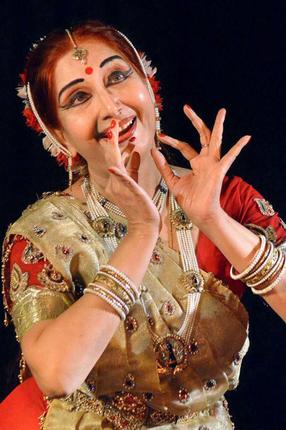
Amita Dutta in performance. Photo: Prashant Arora / The Hindu
Kathak dancer Amita Dutta, recently conferred the first Uday Shankar Award for Lifetime Achievement, talks about pursuing the art form and her endeavour to formalise a Bengal gharana. NITA VIDYARTHI
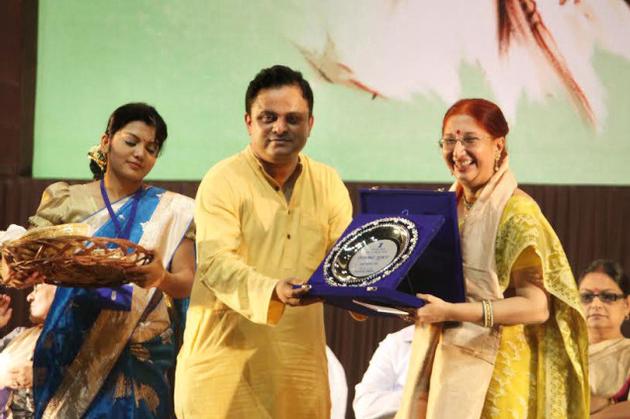
Acclaimed dancer, choreographer, scholar and professor Amita Dutt has recently been conferred the fist Uday Shankar Award for Lifetime Achievement in Dance by the West Bengal Government. Trained in Kathak under stalwarts like Pandit Birju Maharaj, Pandit Vijay Shankar and Bela Arnab, Dutt, the erstwhile Dean of Kolkata’s Rabindra Bharati University, has also been conferred the prestigious Uday Shankar Chair at the University after a gap of 17 years. Dutt, also Director of Performing Arts at the University, has performed and taught extensively at home and abroad and is striving to establish a Bengal gharana of Kathak. Excerpts from an interview:
You have been conferred the prestigious Uday Shankar Chair at Rabindra Bharti University after years. What edge do you think you have over others?
It is not for me ‘to reason why’. One external expert did ask me, how Uday Shankar was important to me as a classical dancer. I had answered that he taught us how to present our dance before a modern audience, on a proscenium stage. Earlier, dancers were engrossed with technicalities and grammar of dance. They did not view the presentation from the angle of the audience. The use of the stage space, lighting, costumes, patterns formed by various dancers and the attention span of the audience were all very important for Uday Shankar. And he was constantly seeking new avenues of expression through dance, never being satisfied with simply copying something that was learnt. In fact, Tagore had also advised Uday Shankar not to be confined within one geographical area or one historical period, but to thirst for new creative expressiveness. I have constantly endeavoured to adhere to these tenets and make my performances attractive and acceptable to a modern-day audience spread across the continents.
Recieving the Uday Shankar Award from the West Bengal Education Minister in Kolkata. Photo: Amrita Dutta / The Hindu
Do you feel any emotional identification with this position?
Yes, I do. My relationship with the great artist is not through blood but through thoughts and ideas. I always consciously carry with me his legacy. Incidentally, there have been many occasions when his name was associated with me. I am the professor in the Uday Shankar Chair, I performed in the first Uday Shankar Festival of the State Government and received the Lifetime Achievement Award in Dance from the Government this year.
How have you justified Uday Shankar’s creativity in your choreography?
I have choreographed many dances using different dance styles. In them, I have gone beyond Kathak. I have used my knowledge and with the inspiration coming from god, Tagore and Uday Shankar, I created many new presentations under the banner of my University. These have been presented in many important festivals across the country.
Your Kathak boundaries have not stretched beyond use of formations…
Yes. I have brought in many creative formations in my choreography. In my presentation on Ganga, I have tried to emulate the movement of the river — sometimes torrential, sometimes meandering, and also the ideas and images associated with the river: both natural and religious. I have also blended our traditional Kathak movements and rhythmic formations within my new creations. The sound of falling rain is shown through footwork and onomatopoeic rhythmic compositions.
How else would you suggest one should expand the boundaries of Kathak? At times, dancers have stretched the boundaries so far that the audience failed to identify the dance numbers as Kathak.
You began to choreograph with works of Tagore, Atul Prasad and Nazrul and then D.L. Roy. How was the creative (setting to music) process different from the classical form?
The creative process is similar. I have always worked on songs and music that have appealed to me, whether traditional or modern, classical or light, eastern or western. Actually, when you are creating a dance piece, you don’t calculate or think with your left brain. Ideas, images, rhythmic compositions and movements dawn on you. Of course, they usually emanate from your storehouse of knowledge, what you have learnt or seen or imbibed. But at times, ideas and images have come to me through my reverie or even my dreams.
Is the use of the celebrated literature a precursor to your establishing the Bengal gharana?
Yes, while working on the various literary works, the idea of an independent Bengal gharana dawned on me. Initially, I had started choreographing on these songs because I loved them. The fact that the audience responded with equal enthusiasm gave me an impetus. And one leading to the other, now the concept of our Bengal gharana has gradually started taking shape. The majority of my performances are for the Bengali audience who enjoy hearing well known Bengali songs. And songs of the last century are still very much alive in the popular Bengali consciousness. In fact, members of my audience participate in D.L. Roy’s patriotic and romantic thoughts more than in Awadhi thumris, chaitis and kaajris. The difference between the Lucknow and Jaipur gharanas was tangible at one time. Today, they are blending into each other as the repertoire is being borrowed or copied and the styles influencing each other. The present-day Benaras gharana artists have learnt from stalwarts of the Lucknow and Jaipur gharanas and there is more of an influence of these gharanas on their dance than an adherence to the precepts of their founder Janki Prasad. I, too, have learnt from stalwarts of the Lucknow and Jaipur gharanas. But what I perform today is not a mere copy of what I have learnt. I have evolved a style of my own which is more melodic than rhythmic, more interpretative than abstract, more lilting than staccato. And I have a large body of choreographic creations on Bengali songs: Tagore, Nazrul, D.L. Roy, Sachin Dev Barman, Salil Choudhury, as well as the traditional Baul songs and kirtans.
Will you be choreographing other poets’ work of that era?
Yes, I wish to. I am working on the lyrics of Vivekananda and Rajani Kanto.
source: http://www.thehindu.com / The Hindu / Home> Features> Friday Review> Dance / by Nita Vidyarthi / August 07th, 2014
British Baptist Missionary William Carey, who was the driving spirit behind the spread of modern English education in Kolkata, will once again be remembered on his 253rd birthday on August 17. The Bible Society has organised for a Carey Lecture to be delivered by Jawhar Sircar, the CEO of Prasar Bharati.
Sircar has been researching on old Kolkata for a long time and will focus his lecture on the Bengal Renaissance and the role of Carey behind it.
This will be followed by a dance drama, Dhrubojyoti Tumi directed by danseuse Alaknanda Roy. The performers are inmates of correctional homes.
source: http://www.timesofindia.indiatimes.com / The Times of India / Home> City> Kolkata / by Jhimli Mukherjee Pandey, TNN / August 07th, 2014
Justice Manjula Chellur. Photo: Thulasi Kakkat / The Hindu
After being administered the oath, Justice Chellur referred to her personal fondness for the rich heritage of the State.
Justice Manjula Chellur was sworn in as the first woman Chief Justice of Calcutta High Court here on Tuesday.
Governor Keshari Nath Tripathi administered the oath of office at Raj Bhavan during the day and Chief Minister Mamata Banerjee was present on the occasion.
37th Chief Justice
Justice Chellur is the 37th Chief Justice of Calcutta High Court replacing Justice Arun Mishra who was elevated as a Supreme Court Judge.
After being administered the oath, Justice Chellur referred to her personal fondness for the rich heritage of the State.
Gratitude
She expressed her gratitude to the Chief Justice of the Supreme Court of India for appointing her to the high office of the Chief Justice of Calcutta High Court.
Along with the Governor and Chief Minister, Law Minister Chandrima Bhattacharya and Speaker of the Assembly Biman Banerjee were present.
The event also witnessed participation of a large number of lawyers of Calcutta High Court.
Born on December 5, 1955, Justice Chellur started her career as an advocate in Bellary and became the first Judge of Karanataka High Court in 2000.
She was appointed Acting Chief Justice of Kerala High Court in November 2011 and had been functioning as the Chief Justice of the High Court since September, 2012.
source: http://www.thehindu.com / The Hindu / Home> Cities> Kolkata / Special Correspondent / Kolkata – August 06th, 2014
West Bengal has now secured first position in the field of micro, small and medium enterprises (MSME) sector, posted Bengal chief minister Mamata Banerjee on her Facebook page. “Our Micro, Small and Medium Enterprises (MSME) Sector is now No. 1 in the country with more than 35,000 new units having been set up with employment of nearly 3.20 lakh people and highest credit disbursement worth Rs.35,000 Crores over the last three years in the state,” the CM posted.
“We have been organizing SYNERGY since September, 2013 to provide more customized solutions to the MSME entrepreneurs t hrough hand holding support and personalized guidance. Nearly 40,000 entrepreneurs visited the clinics, help desks and technology pavilions and bank loan worth hundreds of crores were sanctioned to nearly 1800 enterprises in this first-ever state level conclave,” the CM posted.
“In 2014 we adopted the strategy of taking Synergy closer to the field level and accordingly we organized the first regional Synergy at Siliguri in February this year. The second regional Synergy was held at Howrah on 1-2 August, 2014. Loans worth Rs 1000 Crore were sanctioned and investment proposals close to Rs 5000 Crore were received in the Synergy at Howrah,” the chief minister further posted on her facebook page.
The state government is working on developing more and more MSME clusters in the state so that entrepreneurs, specially women and self help groups can come up with their handicrafts items.
Our Micro, Small and Medium Enterprises (MSME) Sector is now No. 1 in the country with more than 35,000 new units having been set up with employment of nearly 3 lakh 20 thousand people and highest credit disbursement worth Rs.35,000 Crores over the last three years in the state.
We have been organizing SYNERGY since September, 2013 to provide more customized solutions to the MSME entrepreneurs t hrough hand holding support and personalized guidance. Nearly 40,000 entrepreneurs visited the clinics, help desks and technology pavilions and bank loan worth hundreds of crores were sanctioned to nearly 1800 enterprises in this first-ever state level conclave.
In 2014 we adopted the strategy of taking Synergy closer to the field level and accordingly we organized the first regional Synergy at Siliguri in February this year. The second regional Synergy was held at Howrah on 1-2 August, 2014. Loans worth Rs 1000 Crore were sanctioned and investment proposals close to Rs 5000 Crore were received in the Synergy at Howrah.
source: http://www.timesofindia.indiatimes.com / The Times of India / Home> City> Kolkota / Suman Chakraborti, TNN / August 05th, 2014
Sakina khatun with the bronze medal she won at the Commonwealth Games in Glasgow. / The Hindu
Her success is all down to her hard work: coach
Life has not been kind to Sakina Khatun, who won a bronze medal at the Commonwealth Games on Saturday.
In Glasgow’s Clyde Auditorium, the 25-year-old Bangalore-based para-athlete lifted a weight of 88.2 kg to finish third in the women’s powerlifting event (Lightweight Group A). It was a success that came after prolonged hardship.
“My parents cried when I broke the news to them on the phone,” she told The Hindu from Glasgow.
Her coach and mentor Farman Basha, who also competed at the Games, faltered in his event on account of an injury, but his delight was enormous. “She has been through a lot. So I’m very happy for her,” he said.
Sakina hails from Basirhat in West Bengal’s North 24 Parganas district. Her mother is a farm labourer while her father, ailing with a serious back condition, is unable to work. “He can’t even walk,” Sakina said. “We don’t have the money for his treatment.”
Afflicted with polio at a young age, she took up swimming on her doctor’s suggestion, learning in ponds in her village before a teacher in school noticed she had an aptitude for it. “Despite steady success at the national level, I was ignored for the 2010 Commonwealth Games team. It left me disheartened and I quit the sport,” she said.
Sakina switched over to powerlifting on the advice of one of her swimming coaches, and in 2010 was directed to Basha. “She wanted to come over to Bangalore to be trained by me,” he said. “She had no money and I couldn’t afford to spend a rupee on her.”
But Sakina found a benefactor in Dilip Majumdar, a businessman who volunteered to support her training. “I’m a girl and my parents were against my leaving home,” she recalled. “But my sponsor managed to convince them.”
“At first, she could only lift around 25 kg,” recalled Basha. “But gradually she improved. Her success is all down to her hard work.”
source: http://www.thehindu.com / The Hindu / Home> News> Citis> Bangalore / by Shreedutta Chidananda / Bangalore – August 04th, 2014
Originally based on the Morris Oxford, the Ambassador has been manufactured by Hindustan Motors in India since 1948.
The car manufactuer has announced that it will suspend production at its plant in West Bengal. Few see it returning to Indian roads, as more efficient, modern cars have taken over the market.
This car ruled Indian roads for the first 40 years, becoming a symbol of power and influence. By the end of the 1970s, it had a market share of 75 percent.
The entry of Suzuki though a local joint venture with Maruti, changed all that and by 1992, Ambassador’s share dropped to 20 percent.
Lack of investment, a militant workforce, an ageing plant and lack of interest and vision by the owners are cited as resons for the demise of this car.
In teh 1990s, Hindustan Modors enterd into a joint venture withGeneral Motors to manufacture and sell Opel vehicles. There was also a collaboration with Mitsubishi Motors to manufacture the Lancer. But none of these ventures took hold.
In a statement, Hindustan Motors blamed the shutdown on “worsening conditions at its Uttarpara plant which include very low productivity, growing indiscipline, critical shortage of funds, lack of demand for its core product the Ambassador and large accumulation of liabilities”.
Only 2,200 Ambassadors were sold in 2013-14; a small fraction of the 1.8 million passenger cars sold in India.
In a show, which was aired on the BBC last year, Top Gear organized a world taxi shootout in which Ambassador emerged a winner, beating competitors from all over the globe.
The Top Gear team’s verdict? “If performance is getting to your destination at some point of time, yeah, this is quite a performer.”
As reported in The Economic Times, Nida Najar notes: “Drivers complain that pedals break off after a few thousand miles, that the air-conditioners malfunction. Some use turmeric to stop up holes in the radiator; anything to avoid servicing with expensive and increasingly rare parts. Many carry water bottles to cool off radiators that frequently overheat.”
source: http://www.ferret.com.au / Ferret / Home / by Kevin Gomez / July 03rd, 2014