Category Archives: Records, All

Lost and found: Seven fascinating stories of Calcutta’s Jewish past

The story of the Jews of Calcutta tends to always be a story about disappearance. There are only about two dozen Jews left in the city where once they were thousands and that makes it a poignant story of loss – of shuttered synagogues without services, a Jewish Girls School without a single Jewish girl, and buildings with names like Ezra Mansion but no Ezras in them. Nahoum’s Bakery and its plum cakes are about the only real memory most Calcuttans have of their city’s Jewish history. It makes for a melancholic nostalgic story both about the vanishing Jews of Calcutta and the city’s fading cosmopolitan charm.

But Jael Silliman says when she started archiving the city’s Jewish history she did not want it to be a lament about how few Jews were left in the city. She wanted to make a different point– “it is that the time we were here was full, was good and both we and the city benefited.”

JewishCalcutta.in is less a stuffy museum of that 230-year old history and more of a digital album that tells the story through snapshots and film clips and even recipes, through marriage contracts found in auction houses and wedding dresses stored away in attics in America. Silliman conceived of the idea, secured a Fulbright-Nehru fellowship and Jadavpur University’s School of Cultural Texts and Records came on board to help create the digital archive.

“My notion of the Jewish community was from my granny and my great-grandma and they were very conservative women, very inward-looking, not politically inclined. Fuddy-duddy kind of people,” she laughs. “I thought their worlds were very limited.”

But she found to her astonishment, her community was anything but limited. She encountered the first person in India to do magic on the radio. Silent movie stars. The first mother and daughter Miss India pair. The first woman to cut a record on disc in India.

Communists and Congressis. A woman asking to be a plaintiff in court long before even Britain had female lawyers. A woman lawyer fighting for the rights of Muslim women in purdah. The “Patton” of the Indian Army. And Jewish patrons of the Bengali Star Theatre in North Kolkata. “They loved what they called ‘gaana bajana’” chuckles Jael.

The Jews of Calcutta were mostly Arab Jews from Iraq, Syria and Yemen who came to India as traders. They prospered under the Raj in that grey area between “whites” and “blacks” and left behind grand edifices recalling that prosperity. But Jael says it’s worth remembering that because so many were new immigrants, over 40 percent of the community was poor and started at the bottom of the ladder.

In a way, she says the story of her community’s success is a story about India as well. “I think only a country like India would enable a community like this, which came for such a short time, to have the kind of impact they did,” she says. And her mother Flower Silliman says even though most of the Jews of Calcutta left in the decades after Independence — unsure of their position in the new country — there’s one thing worth remembering: “At least we didn’t vanish because of anti-Semitism. India can be proud and say that the Jews left because they wanted to leave and no one told them to go.”

The Jews of Calcutta are mostly gone but here are seven of the most intriguing stories they left behind, now saved on JewishCalcutta.in.
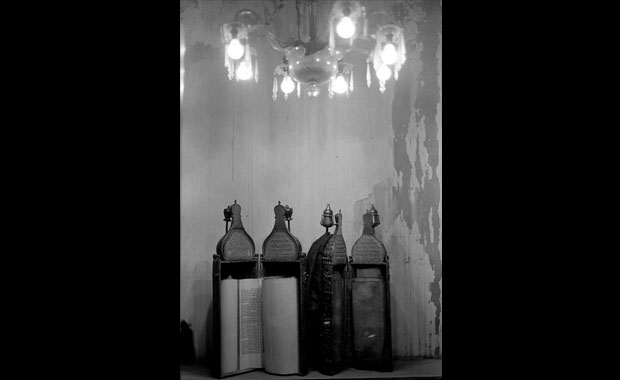
The Sefer Torah. Photo courtesy: www.sanjitchowdhury.com

The Sefer Torah is a handwritten copy of the holiest book of the Jews usually stored in the Holy Ark of a synagogue. “We used to have 80-100 sefer torahs in the synagogue. Now we only have two. At least we have two” says Jael Silliman.
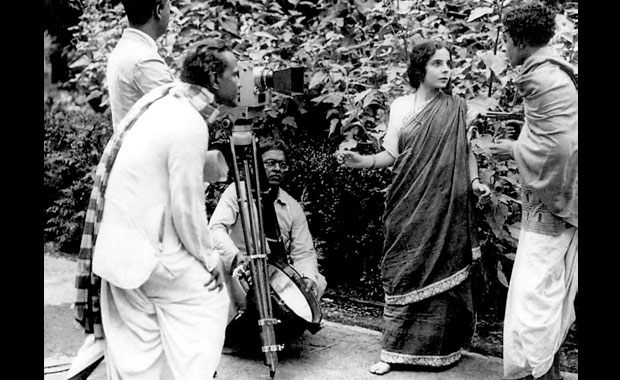
Arati Devi. Photo courtesy: Edmund Jonah

Arati Devi, a star of the silent film era was actually born Rachael Sofaer. She made three films including Punarianma: A Life Divine and A Man Condemned. She died in childbirth at the age of 35. Her cousin Abraham became a Hollywood actor alongside stars like Charlton Heston, Ava Gardner and Elizabeth Taylor.
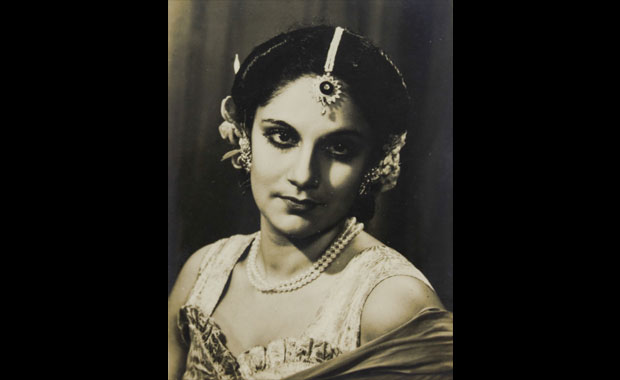
Pramila. Photo courtesy: JewishCalcutta.in

Esther Victoria Abraham was voted as Miss India in 1947. But she became more famous as Pramila, the westernized vamp with Anglicized Hindi in films like Bhikaran, Ulti Ganga and Bijli. She married the film star Syed Hassan Ali Zaidi, a Shia Muslim and converted to Islam, yet remained Jewish to the end and her children observed Passover. Their daughter Naqui became Miss India in 1967, the first mother-and-daughter pair to do so. Naqui became Hindu. One son became Wahabi. Another son Haider remained Muslim but married a Tamilian Brahmin and wrote the screenplay for Jodhaa Akbar. When Esther died at 90, her sons, Jewish and Muslim, carried her to the Jewish cemetery while prayers from both scriptures were recited.

Aloo makallah has no ingredients except potatos and oil and salt but it’s a taste of Jewish Calcutta oldtimers remember nostalgically. Flower Silliman says the keepers of the kosher rules in Jewish kitchens were often Muslim cooks. “My cook would tell me its shabbat today. You have not made such and such dish. I was not at all religious but he was,” says Flower Silliman.
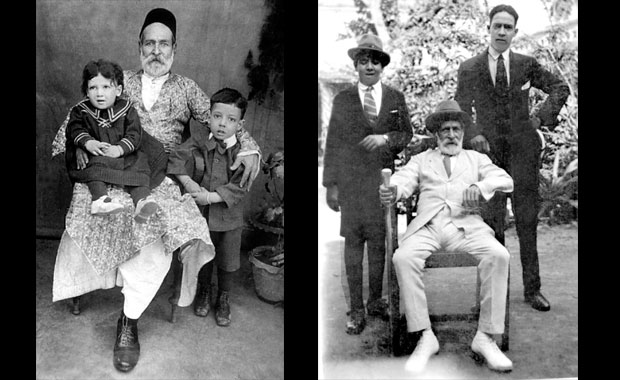
The Jonah family turns sahib. Photo Courtesy: Edmund Jonah

Mr Jonah and his sons show how the Baghdadi Jews quickly picked up British customs as they did business in India. “But he still sits like a Middle Easterner with his legs apart. So I think the transition for some of them was not so smooth,” says Jael Silliman.
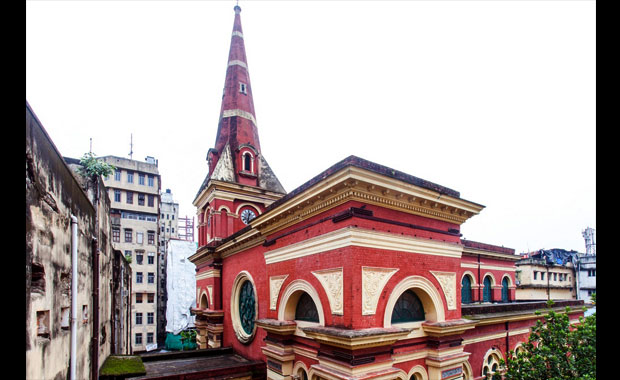
Magen David Synagogue. Photo Courtesy: Ashok Sinha

There were three synagogues in Calcutta within walking distance of each other. “We used to roam from one synagogue to another. You told your father I am going to this synagogue this time. Not because you wanted to. But your girlfriend was there. Or you wanted to check out the new girl in town,” says Flower Silliman.
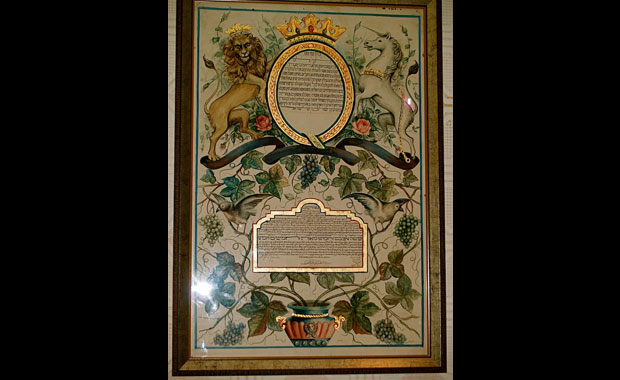
Ketuba or Marriage Contract. Photo Courtesy: JewishCalcutta.in

The elaborate Ketubas are now collector’s items. Jael Silliman was puzzled to be shown a ketuba from Faizabad which was not known to have Jews. But the project put her in touch with the family who owned that ketuba. Their forefather had gone to Faizabad to recruit railway workers for East Africa for the British in 1914. “It was like pieces of a puzzle which came together very neatly,” says Jael Silliman.

source: http://www.firstpost.com / FirstPost.com / Home> F.India> Latest News> India News / by Sandip Roy / September 13th, 2014
Nazrulgeeti legend passes away

Kolkata :

Nazrulgeeti exponent Firoza Begum, who was to be honoured with ‘Banga Bibhushan’ by the state government later this month, passed away in Dhaka on Tuesday evening. The 84-year-old was suffering from heart and kidney disease.

“She breathed her last around 8.15pm,” Bangladeshi media reports said. She had been undergoing treatment at the ICU of a private hospital. She was fitted with a pacemaker on Monday.

Mamata Banerjee grieved on social media as the news reached her on Tuesday night. “I am very sad to learn that the legendary Firoza Begum has just breathed her last. Her passing away will certainly create a huge void in the world of music and culture,” she posted.

The CM said her government had planned to confer the state’s highest civilian honour on her. “We had decided to honour her with ‘Banga Bibhusan’. She had also agreed to come to Kolkata to receive the award. But, now it’s all over,” she mourned.

Mamata recounted her last interaction with the legend by saying: “Hardly 10 days ago, we talked to each other. To me, her passing away is indeed a great personal loss. She used to treat me as a member of her family. On the last occasion of our meeting, she told me: ‘Ar ki dekha hobe? (Will we meet again?)’ Today, these words keep ringing in my ears,” the chief minister said.

source: http://www.timesofindia.indiatimes.com / The Times of India / Home> City> Kolkata / TNN / September 10th, 2014

Jewish past, digital present

A digital museum on the Jews of Calcutta is ready to go online on Monday after two years in the making.

“The archive documents the Jewish community’s contributions to Calcutta and celebrates the city where they thrived. It has taken me more than two years to curate this archive. I’m still fine-tuning it before the launch at Victoria Memorial on September 1 and have got wonderful feedback from community members across the world,” said Jael Silliman, a former women’s studies teacher at the University of Iowa and one of the members of the dwindling community in the city.

The website is a storehouse of information about Jews in Calcutta.

The community has dwindled from 6,000-plus members in its heyday to barely 20 people — mostly elderly — at present.

There hasn’t been a Jewish girl in the Jewish Girls School for about 40 years.

The Telegraph had reported last September how the community needed to include Israeli ambassador to India, Alon Ushpiz, who was visiting the city along with five other Jews, to achieve the “minyan” or quorum of 10 men needed for a formal service to celebrate Simhat Torah at Magen David Synagogue in Calcutta. It could not be held for 25 years because the community was not able to line up 10 men needed for the service.

Jews in India have branched into three main streams after the first batch arrived from West Asia in the late 18th century: the Bene-Israel (meaning Children of Israel), the Cochin Jews who prospered along the Malabar coast and Baghdadi Jews, who settled mostly in Calcutta and Mumbai.

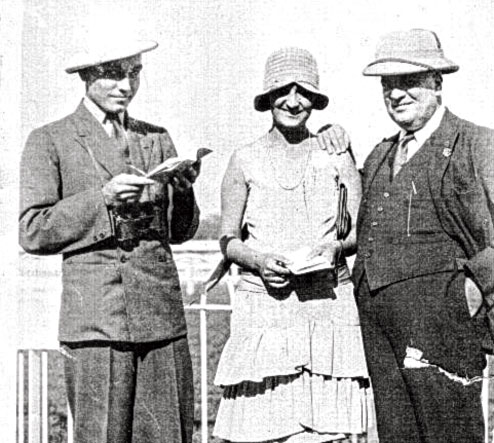
Calcutta’s Jewish community members at the Viceroy’s Cup racing derby in 1937
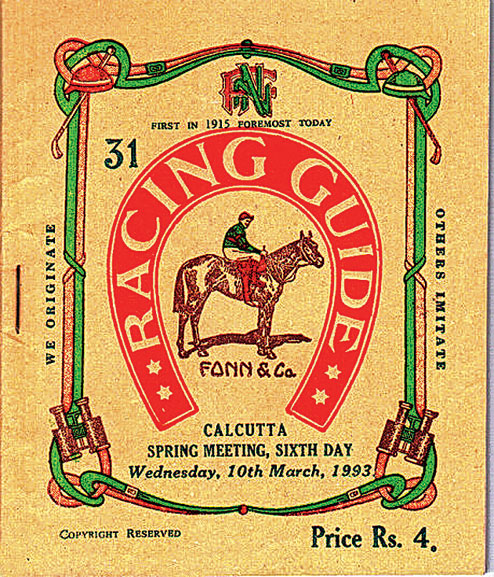
A guide to the races

The archive’s film section includes an audio-visual documentary of Jewish elders Cyril Cohen and Aaron Harazi, who passed away recently, speaking at length about their schooldays and work in Calcutta. The section offers a virtual tour of the Magen David on Canning Street and Beth El on Pollock Street — two synagogues no longer in use.

In a clip from the racecourse, Elijah Twena, an avid racer, gives an insight into the favourite pastime of Calcutta Jews.

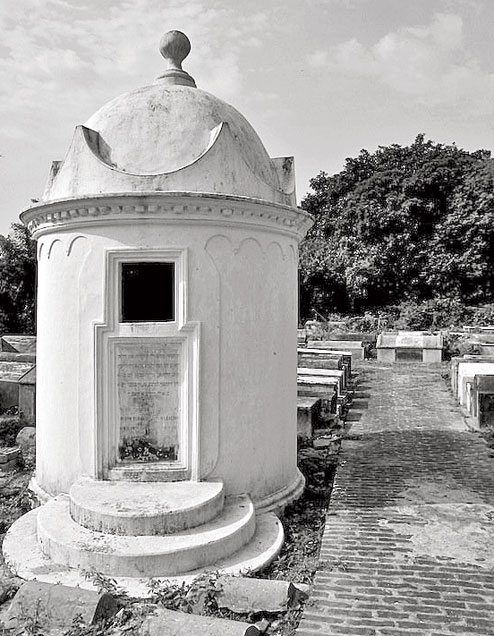
A geniza at the Narkeldanga cemetery

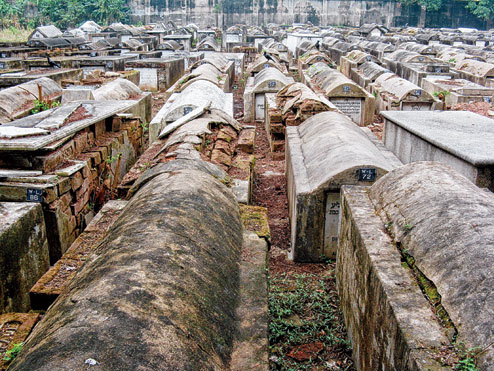
Another section talks about Jewish cemeteries in Calcutta, especially the ones at Narkeldanga.

Legend has it that the first Jewish burial ground — at 45, Narkeldanga Main Road — was “born” when Shalome Cohen, the first settler, decided to buy a plot of land for a cemetery and went about asking his friends and business associates for a suitable place. A Bengali business associate took him to a paddy field on the outskirts of Calcutta and asked if that would do.

Graves of Jewish people at 45, Narkeldanga Main Road

Shalome was delighted and told him to quote a price. The gentleman declined and offered to give the plot for free. But Shalome insisted that he must pay because the site would be used for religious purposes. The gentleman reluctantly agreed to accept “whatever Shalome wishes to give”. The settler pulled a gold ring out of a finger, gave it to the landowner and sealed the transaction.

It is assumed that Moses de Pas, an emissary from Safad, now in Israel, was the first Jew to be buried in Calcutta cemetery for the community in 1812. His grave is no longer traceable. The cemetery has a geniza too for storing worn-out Hebrew-language religious books and papers. A small private cemetery was opened in the 1870s, and closed after 20 years or so, half a mile from the main cemetery.

Other sections include maps of Jewish Calcutta, a film gallery, community portraits, music of the community recorded from Rivers of Babylon, war years and military service and their impact on the community.

The museum project is led by Jael Silliman, a former women’s studies teacher at the University of Iowa, and assisted by Amlan Dasgupta, professor at Jadavpur University. “Some of the speakers at the launch will be Amlan Dasgupta, Adam Grotsky of USIEF and Jo Cohen, who will talk about the life Jews made for themselves in the city,” said Silliman, an author of two books, The Man with Many Hats (2013) and Jewish Portraits, Indian Frames: Women’s Narratives from a Diaspora of Hope (2001).

“We’re happy to be associated with the project. It has been quite a journey and a very fruitful one. Our students have worked untiringly for the project. We’re also considering housing the material at the School of Cultural Texts and Records, Jadavpur University,” said Dasgupta.

source: http://www.telegraphindia.com / The Telegraph, Calcutta / Front Page> Calcutta> Story / by Showli Chakraborty / Monday – September 01sr, 2014

Astor revives its British heritage

Kolkata:

Gallops of horses then, dollops of history now.

Another feather will shortly be added to the city’s heritage hospitality industry as Astor Hotel opens its doors for guests.

Housed in a building that was a British barracks about a century ago, the hotel has retained the rooms of mismatching size and shape, and ironed out the colonial wrinkles with the precision of 21st Century.

“In its 120-odd years of existence, the interiors of the building never complemented its grand facade. Be it the electrical or plumbing system, it was a completely unplanned structure. A thumb-rule in construction is that a poorly-maintained building must be brought down and built over every 70-80 years,” said the hotel’s proprietor Vikram Puri.

“But with the help of the members of the heritage commission and a team from Delhi that specializes in restoring old havelis of Rajasthan, we managed to preserve the heritage elements of the building.”

Puri said the building used to be a British boarding house where soldiers would come riding on their horses and walk up the stairs to take rest in their rooms.

“What used to be the stable is now a lounge bar called Plush. We restored the same teak staircase the armymen walked up, instead of turning it into an elevator shaft. We retained the rooms with their mismatched dimensions, which gave us perfect material for a boutique hotel. A modern hotel resembles a block diagram, but here every room has a different character,” Puri said.

The guests here will use the same rooms that were once occupied by the army personnel of the imperialists, but the rooms have been fitted with modern facilities such as a big-screen television and air-conditioning.

“The main corridor of the hotel has a distinct Victorian look. But, we will adorn the walls with paintings and photographs of a century-old Kolkata,” Puri added.

To bring down carbon footprint, the hotel has done away with split air-conditioners and geysers and installed central systems. The corridor is not chilled but cool.

“This is not air-conditioned but filled with treated fresh air,” said a member of the hotel’s staff.

High ceiling, a four-poster bed and sepia-tainted lights give the suites the ambience of an era gone by. But water sprinklers, smoke detectors and Wi-Fi devices are a constant reminder of 2014.

source: http://www.timesofindia.indiatimes.com / The Times of India / Home> City> Kolkata / by Shounak Ghosal / September 12th, 2014

Neel Mukherjee shortlisted for 2014 Man Booker prize

Mukherjee was the only Indian-origin author to be longlisted earlier this year.

London:

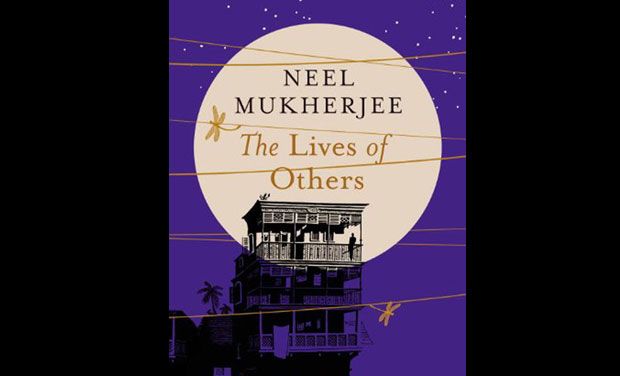
Kolkata-born British author Neel Mukherjee’s latest novel The Lives of Others, set in troubled Bengal of the 1960s and centres around a dysfunctional family, has been shortlisted for the prestigious Booker Prize 2014, in its debut as a global literary award.

Mukherjee, who studied at Oxford and Cambridge, was also the only Indian-origin author to be longlisted earlier this year, the first time the prestigious literary award opened up for anyone writing in English regardless of nationality.

“We are delighted to announce our international shortlist. As the Man Booker Prize expands its borders, these six exceptional books take the reader on journeys around the world, between the UK, New York, Thailand, Italy, Calcutta and times past, present and future,” said A C Grayling, chair of the 2014 judging panel.

“We had a lengthy and intensive debate to whittle the list down to these six. It is a strong, thought-provoking shortlist which we believe demonstrates the wonderful depth and range of contemporary fiction in English,” he added.

Mukherjee, now a British citizen, has been selected for his second novel published in May this year. The book is based in Kolkata and centres around a dysfunctional Ghosh family in the 1960s.

Mukherjee reviews fiction for the Times and the Sunday Telegraph and his first novel, A Life Apart was a joint winner of the Vodafone-Crossword Award in India.

The others on the shortlist include American authors Joshua Ferris for To Rise Again at a Decent Hour and Karen Joy Fowler for We Are All Completely Beside Ourselves; Australian Richard Flanagan for The Narrow Road to the Deep North; and British authors Howard Jacobson for J and Ali Smith for How to be Both.

Previously, the prize was open only to authors from the UK and Commonwealth, Republic of Ireland and Zimbabwe. For the first time in its 46-year history, the 50,000-pound prize has been opened up to writers of any nationality, writing originally in English and published in the UK.

source: http://www.deccanchronicle.com / Deccan Chronicle / Home Lifestyle> Books-Art / PTI / September 09th, 2014

Darjeeling’s Makaibari Becomes Most Expensive Tea in India

Kolkata :

After being sold at a record price of USD 1,850 (around Rs 1.12 lakh) per kg, Darjeeling’s Makaibari tea estate has become one of the most expensive tea producers in India.

“It is a matter of great pleasure and pride that Indian Tea, Makaibari, has booked orders at a record price of USD 1,850 per kg. That the orders have come from Japan, the UK and the US is also noteworthy,” Tea Board Chairman Siddharth said.

He said at a time when the Tea Board and the tea industry are grappling with the issues of value addition and brand building, this news has come as a shot in the arm.

“Makaibari has been an iconic tea garden and we are very pleased to note that even after its ownership has recently changed hands, the high standard of its quality and recognition has grown further,” Siddharth said.

Darjeeling Tea Association secretary Kaushik Basu said this is the highest ever price he has ever heard of for Indian tea.

“But this is a one off case. We have heard that it was a small sale of around 5 kg. I don’t think it was a commercial sale or auction. It may have been sold on charity,” he said.

Located in Kurseong, Makaibari is the ancestral property of Raja Banerjee who had recently sold off 90 per cent of his stake to Luxmi group.

source: http://www.newindianexpress.com / The New Indian Express / Home> Business> News / by PTI / September 06th, 2014

300 Rare Gramophone Recordings Digitised

Kolkata :

A rich collection of over 300 rare recordings, including speeches by Mahatma Gandhi, Jawaharlal Nehru and Netaji Subhas Chandra Bose and old classical music have been given a new lease of life through digitisation.

They can now be heard at a new digital sound archive centre at Weavers Studio here, which was thrown open to the public today.

Weavers Studio founder Darshan Shah said “Our primary objective is to preserve these voices of our ancestors and make them easily and electronically available for researchers, musicians, students of music and the public at large. It is unfortunate that many of our rare records are on the verge of destruction and without timely action, these would be lost forever.”

The oeuvre include Nehru’s speech after the Mahatma’s assassination and the original version of the national anthem sung by Gurudev and his students at Shantiniketan.

Other gems which have been digitised include the songs by Gauhar Jan, the country’s first classical singer to record in 1902, besides Hindustani and Carnatic classical music, music by Bengal artists and folk music.

There are also many versions of ‘Vande Mataram’, ‘Ram Dhun’ by Bismillah Khan and voices of Bal Gangadhar Tilak, Tagore, Rajendra Prasad, Vijayalakshmi Pandit, Aga Khan and Sarojini Naidu, among others.

Anyone visiting the studio can listen to the gems of the bygone era through kiosks and guided listening sessions and acquaint themselves through thematic exhibitions.

Shah said the collection would be taken to the youth in schools and colleges, museums and libraries to provide them a new perspective of looking at Indian history through sound and visuals.

Interested visitors to Weavers Studio are given android phones to listen to the records at the click of a button.

Also on display are the original gramophone records and gramophone players.

Some of the old and rare records collected and restored by the studio, which was set up in 1993, include Nicole and Pathe records dating back to 1900-1910 and the arare Beka grand records.

“We sourced the records from collectors and flea markets. This is an ongoing project and so we are still looking for old records,” Shah said.

In the second phase of the project, Weavers Studio would create an online archive where all these recordings would be uploaded on the web.

During 1902 to 1985, over 300,000 records were issued in India and were released under more than 75 different labels and in various formats, said Suresh Chandvankar of the Society of Indian Record Collectors in Mumbai.

They too are working for the preservation, documentation and dissemination of India’s rich cultural heritage in the field of audio and video recordings.

source: http://www.newindianexpress.com / The New Indian Express / Home> Nation / by PTI / September 05th, 2014

Bengal girl joins Malala in Dutch book

RekhaKOLKATA02sept2014

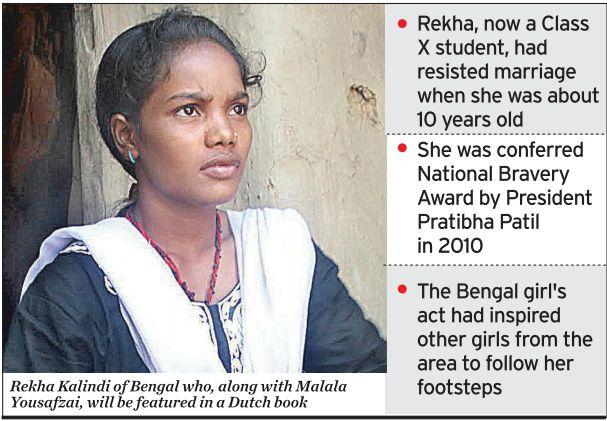
What is common among Malala Yousafzai, Anne Frank, Hellen Keller and 16-year-old Rekha Kalindi from Purulia in West Bengal?

The braveheart from the State will feature along with Malala and Anne Frank in the book Children who changed the world to be released in November in Amsterdam marking the 25th anniversary of the UN Declaration of the Rights of the Child.

Rekha, now a student of Class X, resisted marriage when she was about 10 years old. Her resistance led to other girls in the area following in her footsteps. She, along with two other girls from the district, was conferred the National Bravery Award by then President Pratibha Devisingh Patil in 2010.

The book is written by Dutch Newspaper NRC Handelsblad’scorrespondents who live and work in the countries of the children featured in the book.

It profiles 20 children and the chapter on Rekha is written by journalist Aletta Andre.

Girls inspired
“Rekha’s story fits very well in this theme (the book’s theme), as she resisted a very common but not so great practice in her area, when she was about 10 years old and has with her act inspired other girls to do the same. It shows that very young children, even very young girls in a patriarchal society, have the power to make a difference,” she said in an email response.

Speaking to The Hindu, Rekha said she was very happy that the story about her is being published in other countries. Since the time she and other girls from Purulia had resisted child marriage, many girls came forward to oppose the practice, she said, adding that poverty and lack of education are still resulting in such marriages.

She also pointed out that a Class V textbook of the State Board has a chapter on child marriage where her and another girl’s names feature.

“Such stories (like Rekha’s) encourage adolescents to protest and raise their voice against child marriage,” Asadur Rahaman, chief of field office UNICEF in West Bengal, said. Pointing out that child marriage and trafficking of girls continue to be a concern in States like West Bengal, Mr. Rahaman said that a scheme like Kanyasree providing scholarship to school-going girls is a significant
initiative.

source: http://www.thehindu.com / The Hindu / Home> News> Cities> Kolkata / by Shiv Sahay Singh / Kolkata – August 28th, 2014

Bengal ranked top in cut flowers’ production across India: Study

Kolkata :

West Bengal is ranked on top with production of over 250 crore cut flowers across India thereby clocking highest compounded annual growth rate (CAGR) of over 597 per cent during five-year period of 2007-08 and 2011-12, noted a recently concluded study by apex industry body ASSOCHAM.

“West Bengal has also emerged numero uno with highest share of about 34 per cent in production of over 740 crore cut flowers throughout the country as of financial year 2011-12, production of cut flowers in India is growing at a CAGR of over 14 per cent,” according to a study titled ‘Value addition to rural economy: The promise of floriculture,’ conducted by The Associated Chambers of Commerce and Industry of India (ASSOCHAM).

“Festivals, weddings, large scale political functions and other special occasions are driving demand for cut flowers as they are mostly used for decorative purposes, as gifts/bouquets for formal events,” said D.S. Rawat, national secretary general of ASSOCHAM while releasing the findings of the chamber’s study.

“Though the initial investment is very high, flower production gives much higher returns compared to traditional crops, however, one has to wait for four to five years for breakeven,” said Mr Rawat.

West Bengal is ranked eighth in terms of production of loose flowers. The state produces about 64,000 tonne loose flowers clocking a CAGR of over seven per cent during the aforesaid period. While loose flower production in India is growing at a CAGR of over 17 per cent as India produces over 16.5 lakh tonne loose flowers annually.

However, area under flower production in West Bengal has shrinked from about 27,000 hectares in 2007-08 to about 24,000 hectares in 2011-12 thereby registering fall at a CAGR of over three per cent, pointed out the study prepared by the ASSOCHAM Economic Research Bureau (AERB).

Apart from this, share of West Bengal in area under flower production across India also plummeted by seven per cent during the aforesaid period i.e. from about 16.5 per cent share in 2007-08 it came down to 9.4 per cent in 2011-12, highlighted the study.

It is estimated that about two lakh people are involved cut flower production in West Bengal which is blessed with diverse agro-climatic conditions suitable for flower production.

Dedicated cold storage facilities for flowers near to the main production centres would give a boost to exports of flowers from West Bengal, besides promotion of bio-technology especially tissue culture and genetic engineering would only further help the in realising its potential in floriculture industry in the state, noted the ASSOCHAM study.

Ensuring availability of quality seeds and improved varieties of planting materials, domestic development of capabilities for establishing poly-houses/shade-houses, providing loans at attractive interest rates to farmers willing to produce flowers, luring private sector participation for investments by offering tax rebates and incentives, conducting buyer-seller meets across India and even abroad are certain key policy recommendations listed in the ASSOCHAM study to further promote floriculture industry in West Bengal and other parts of India.

source: http://www.timesofindia.indiatimes.com / The Times of India / Home> City> Kolkata / by Udit Prasanna Mukherji, TNN / September 01st, 2014

INDIA ON WAX – Record discs that helped defeat the British empire: Tagore sings ‘Bande Mataram’

During the freedom struggle, recordings of patriotic speeches and songs helped rally support.
PhonographKOLKATA01sept2014
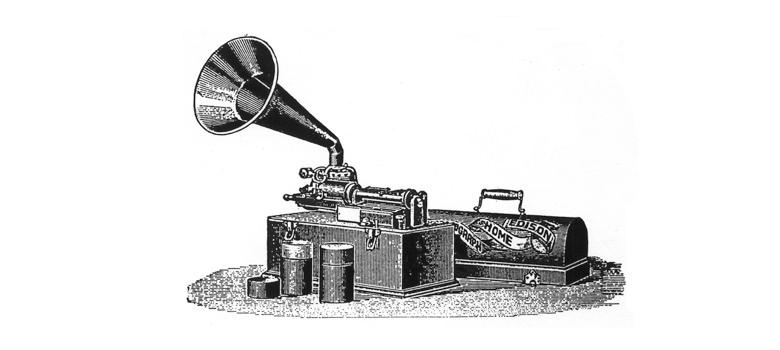
Between 1877 and 1878, Thomas Alva Edison submitted patent applications for the phonograph in many countries, including British India. It is not known when these patents were granted, but it is known that in December 1878, the first phonograph recording was demonstrated in Kolkata.

For the next 30 years, recordings on the phonograph cylinder became quite popular, remaining so even in the early years of disc records.

Many members of royal families and wealthy people bought cylinder phonograph machines and recorded musicians and religious personalities. The Maharajah of Khetri recorded Swami Vivekananad’s speeches and discourses much before he went to America and gave his famous talks on religion. The internet is full of versions of his celebrated speeches.

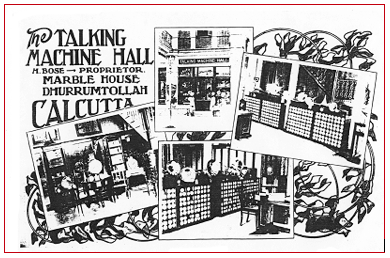
Hemendra Mohan Bose (1864-1916) opened the Talking Machine Hall in Kolkata, a shop where one could get one’s voice recorded. Bose was a sound recording expert and also had an agency to sell Edison and Pathe brand phonograph machines. Many great writers, poets and political leaders would visit him and he would record their recitations and speeches.

A 1906 catalogue lists several cylinder recordings of Rabindranath Tagore. Unlike disc records, cylinders could not be reproduced for sale. Most of these cylinders have been lost. Some museums have broken or damaged copies of cylinders as artefacts but no audible sound can be extracted from them.

TagoreAdsKOLKATA01sept2014
During agitations against the partition of Bengal in 1905, H Bose recorded many political speeches and songs, such as Bande Mataram, both on phonographs and disc records, and they became very popular. But his factory and shops were sealed, machines and discs destroyed ruthlessly by police. As a result, nothing has survived today except a very short piece from Bande Mataram, sung by Tagore.

Recording experts from Beka, a German company, were in Kolkata in November 1907. The British government went about destroying all nationalistic material, whereas the German company was the first to record a political speech right under the nose of the British.

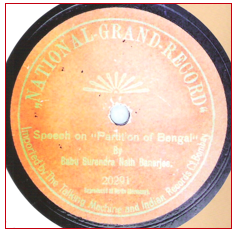
The National Grand Record label had a saffron disc with a rising sun as the logo. On it was recorded a speech by Babu Surendranath Banerjee, on the partition of Bengal. The flipside of this unusual 78-rpm disc has a speech on Bande Mataram.
DiskKOLKATA01sept2014

The man responsible for producing this disc was Sir Abdul Halim Guznavi, a political leader and agent for the Beka record company in Kolkata. Only few copies have survived. We have the image of the label only but no access to the audio file of this historically important recording.

We welcome your comments at letters@scroll.in.

source: http://www.scroll.in / Scroll.in / Home> All News / by Suresh Chandvankar / August 15th, 2014