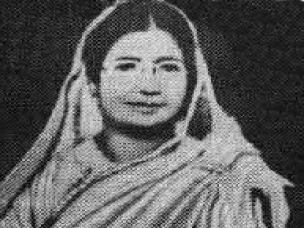
One of the rare rebellions of her time, Roquia Sakhawat Hussain is a name that echoes ceaseless struggle to bring women under the ambit of social respect and admiration. Born in 1880, this gritty and composed lady from a small village of Pairabondh in the then undivided Bengal gave her all towards cementing a respectable position of women during her epoch.
A livid exponent of feminist movement in eastern India, Begum Rokeya conceived and implemented the idea of establishing the first school mainly aimed at Muslim girls. Issues like gender equality and women’s emancipation found a new dimension under her prudent leadership. Being the precursor of future feminist movement in India and Bangladesh, Rokeya did her bit to bolster the position of the so called ‘second sex’ in a puritanical society stuffed with orthodox ideologies.
Married off at an early age, hers was in no way a beginning worth remembering. However, the indomitable urge to stand out for a cause and be the guiding star for he contemporaries and the ages to come drove her forward.
Begum Rokeya had the funny bone as well as the tinge of sarcasm that helped her euphemism narrate real-life incidents of injustice forced upon Bengali-speaking Muslim women. She displayed enough valiance to tell it on the face of the oppressors that they are adopting immoral ways distorting version of Islam.
Oborodhbashini (“The woman in captivity”), Paddorag (“Essence of the Lotus”) and Narir Adhikar (“The Rights of Women”) are among her widely read books that openly defied restrictions on women.
source: http://www.headlinesindia.mapsofindia.com / Headlines India / Home> Social Interest News> Women / Friday – March 04th, 2011
Sakina Khatum talks about her weightlifting career and her route to success at the Commonwealth Games
Such a long journey Sakina Khatum courted success after many trials including being struck by polio / The Hindu
Sakina Khatum hit the headlines with a bronze-winning effort at the Glasgow Commonwealth Games, last month. But the 25-year-old promises to do even better at the Incheon Asian Games, come October.
An irony, or call it fate, as polio struck Sakina, one of the four siblings when she was just a year and half old, and since then, it has been a story of determination and fighting all odds.
Four operations below the knee on the right leg helped her to walk, rather than crawl on fours. A doctor advised Sakina to take up swimming to strengthen the leg, and thus began her tryst with sports.
“I was national champion a year after taking up swimming, and for the next four years, ruled the pool in my category. I did not get any recognition or an international call up,” says the girl, who comes from a poor family. “My father is ailing. My brother does not stay with my family.”
She adds, “I came to Bangalore for the selection camp, ahead of the 2010 Commonwealth Games.
After three months away from home, I was not picked despite impressing coach Dabas, who referred me to ace para power-lifter Farman Basha. And the rest is history.” Farman, himself restricted to a wheelchair says, “She was lifting only 25 to 26 kgs. To turn her into an international star was a challenge, but with coach Dabas insisting, I agreed. I had no money to spare but asked her to train under me. I found her a small accommodation near K.R. Puram.. Four years down and she has won two international medals (both bronze) for her country,” says Farman.
The journey has not been easy.
“One Mr. Majumdar, from Kolkata used to send Rs. 5000 initially and then increased it to Rs. 10,000 per month for her basic expenses (though that has now stopped after her Commonwealth Games success). He supported her financially, till last month. He even procured her tickets to the Hungary Open, early this year where she won her first international medal. We don’t spend our money (on international tours) and save up to buy supplements – a must for every lifter. When I am short of money, we fall back on local produce,” adds Farman.
“I asked Sakina to move into my place to save up on rent and travel time for training. We train for about four-five days a week,” says the gritty lifter.
For more successes, it is important that the state government and the numerous corporates that endorses sports step forward and make it easy for them to travel and perform at the highest level. Is anyone listening?
source: http://www.thehindu.com / The Hindu / Home> Features> MetroPlus / by Avinash Nair / September 29th, 2014
As people in the city started opening their sleepy eyes on Friday morning, many early train catchers halted for a while seeing a group of white sari-clad elderly women coming out of Howrah station chanting “Radhe, Radhe, Radhe, Radhe”.
About 70 widows reached Kolkata from various ashrams in Vrindavan on Friday to visit the city and witness the spirit of festivity here.
Kanaklata Devi (105), who left the city 70 years ago, pointed at an advertising hoarding with a Hema Malini photograph and shot a humorous comment: “Tumi to asechho amader sahore, amra gele dosh ki?” (You have come to our city, so what is our fault if we stay at Vrindavan?”
BJP’s Mathura MP Hema Malini’s recent comment on the presence of many widows from Bengal in Vrindavan created a furore among various people and activists. The actor-turned-MP later clarified that these widows should not be thrown out of their native state by their relatives after their husband’s death. They should rather be treated with care and affection by their own people in their own state.
Kanaklata had a point to counter Hema Malini. “I am coming to this city after 70 years. Because I did not want to miss the chance of attaining ‘moksha’ by not passing away in that divine land of Vrindavan. According to myth, a person attains ‘moksha’ if he dies in Vrindavan. But this year, I could not refuse Pathak babaji’s requests to visit my hometown.”
Sunitra Devi (79) was nostalgic as she got down from the bus in which they were brought to Raj Bhavan to meet the governor. The lady, who lost her husband at the age of 26, used to live at Maniktala. “After our marriage, he brought me here to show Raj Bhavan. But at that time, we could see Raj Bhavan only from a distance,” she said.
The widows of Vrindavan will be in the city for two more days, during which they plan to visit the artisan’s hub at Kumartuli, hop some Puja pandals and enjoy a tram ride. “Getting an opportunity to see their favourite spots in and around the city after so long, the elderly women were behaving like teenagers,” said Bindheswar Pathak, founder of Sulabh Foundation, which is looking after about 1000 widows in Vrindavan.
source: http://www.timesofindia.indiatimes.com / Th Times of India / Home> City> Kolkata / by Kamalendu Bhadra, TNN / September 27th, 2014
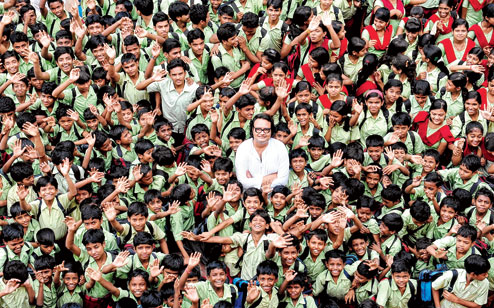
Vinayak Lohani basks in the love of his 900-strong Parivaar comprising destitute children whom he feeds, clothes and educates in Thakurpukur. Picture by Sanjoy Chattopadhyaya
His sartorial style is a crisp, white kurta-pyjama teamed with thick, black-rimmed glasses. He idolises Sri Ramakrishna and Swami Vivekananda and quotes Sunil Gangopadhyay. He worships Satyajit Ray and Ritwik Ghatak and unwinds with Anjan Dutt’s songs. He loves eating fish and roaming the old lanes and bylanes of Calcutta at night.
If 37-year-old Vinayak Lohani is catholic in his tastes, he is single-minded when it comes to his cause: providing home, hearth and education to the poorest and most vulnerable of children through the largest free residential school in eastern India.
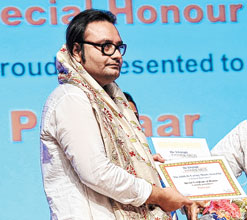
Vinayak receives a special certificate of honour on behalf of Parivaar in the ‘A School that Cares’ category of The Addlife Caring Minds Awards, along with a special honour from The Telegraph Education Foundation at The Telegraph School Awards for Excellence 2014, presented by Peerless in association with Parle-G and powered by Adamas University. The awards were given away at the Science City auditorium on Saturday
Vinayak, winner of The Telegraph Education Foundation’s certificate of honour at The Telegraph School Awards for Excellence 2014 on Saturday, was born in Bhopal but has made Bengal his home.
Vinayak had come to Bengal as a student, first to earn a degree in mining engineering from IIT Kharagpur and later an MBA from IIM Calcutta. It was while studying for his MBA that the then 20-something engineer sprang the first surprise of his career. He opted out of campus placements.
“I was the only one in IIM Calcutta’s history to do so!” he says with a laugh. “I wanted to do something in the social space. I wasn’t interested in a corporate career.”
By then, Vinayak had started skipping classes, writing journalistic pieces on social initiatives and volunteering with NGOs. He had worked with Infosys for a year in between his stints at IIT and IIM and realised that his calling lay elsewhere. Calcutta, with its “rich history of leaders and reformers”, fuelled his desire to be different.
“Being a good student from a middle-class family, engineering and MBA happened by default. But soon I found myself losing interest in a mainstream job and the corporate environment,” recalls Vinayak.
Vision & Vivekananda
For inspiration, Vinayak had Vivekananda. “I have always been inspired by the agents of change in society and the sense of sacrifice, service and devotion, especially Swami Vivekananda’s. I took diksha from the Ramakrishna Mission…spent time with monks. Mother Teresa’s influence was strong, as was the legacy of our freedom movement. I found no momentum to return to my hometown. All my thoughts became very Calcutta-centric.”
At 25, Vinayak became quite the non-conformist, determined to establish a reformatory institution of his own rather than be in the so-called rat race. “Doing what everybody else was doing didn’t excite me. My notion of success was different. I had been to the best of educational institutions, so I didn’t need to prove my abilities to anyone. I knew that if I put in my best I might be able to make it happen.”
Vinayak’s plans did irk his civil servant father, though. “My folks were worried whether I had the kind of maturity needed to carry out the responsibility of running an organisation, dealing with different domains and steering it safely and successfully.”
After moving out of IIM, he rented a small house in Sakherbazar in Behala. His plan was to start a free residential school for deprived children — the kind he had seen loitering on railway platforms and in red light areas. A few friends, researchers and professors from IIM were Vinayak’s “sounding board”.
Parivaar was born in 2003 but bringing up the child proved far from easy. “I prepared proposals, met people here and there, but all in vain because no one wanted to support something that was the wishful thinking of one individual,” says Vinayak.
With his efforts to raise funds leading nowhere, he rented a building near Thakurpukur with his earnings from lectures and tuitions to MBA aspirants. Vinayak started his mission with three kids, often not knowing where the next meal would come from. “It was a hand-to-mouth existence. I was spending whatever I was earning. My mother was my first donor,” he recounts.
In another six months, Vinayak had 55 children under his small roof, thanks to the support of “well-placed” IIM alumni who responded to his emailed appeal.
By the end of 2004, he had purchased a two-acre plot in Thakurpukur to build his dream brick by brick. Parivaar is currently spread across 20 acres. “Surely this is eastern India’s largest free residential institution for children today but not too many people know about it,” says Vinayak.
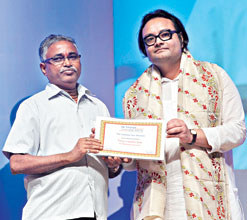
Vinayak presents The Shining Star Honour to Purna Chandra Rout, a non-teaching employee of La Martiniere for Girls for 37 years, at the Science City auditorium on Saturday. Pictures by Rashbehari Das
Parivaar path
Parivaar is today an institution that houses 672 boys and 298 girls whose lives have changed because of education and Vinayak’s encouragement. Some have gone on to get university degrees. “We have had a significant number of very inspired volunteers. They were mostly our donors who became our campaigners and spread the word actively,” says Vinayak.
Parivaar has two campuses that take in children between the ages of four and 10. The one for boys is called Parivaar Ashram. Located a few blocks away is the girls’ campus, called Parivaar Sarada Teertha. Each campus has dorm-like housing, a library, computer room, dining area, a soccer field and a volleyball court.
Parivaar also has its own co-educational school till Class X called Amar Bharat Vidyapeeth, located on the boys’ campus. “It’s not as if the kids’ stay is over once they are through with their education here. Would a parent ask a child to leave home? The older ones tutor the younger kids, earn pocket money and can move out of their own free will once they feel they are ready,” says Vinayak.
There are a few rules that set Vinayak’s initiative apart from others of its kind. “We don’t accept institutional support from any foreign agency. Ninety per cent of our donors are individuals of Indian origin, whether they are living in India or abroad. No government support. That’s how I could build it my own way because foreign or government agencies have their own parameters. I wanted to design my school my way, just like an artist would create his own piece of art,” he reveals.
Target 5,000
While his field teams are scouting for destitute children to bring home, Vinayak’s mind is preoccupied with the future challenges of the mission. “I hope to touch 1,200 by December. Since we have limited capacity at the moment, we admit children based on their neediness. Primarily orphans and the homeless are picked up from railway platforms and pavements, or those with one parent and incapable of taking care of the child.”
Apart from the city, Parivaar reaches out to rural areas, including the tribal belts of Midnapore, Bankura, Purulia and Jharkhand. The emphasis is on giving girls vulnerable to exploitation an opportunity to build their lives.
Vinayak’s IIT and IIM education hasn’t gone waste either. Parivaar is an example for institutions on how to “scale up” operations using entrepreneurial skills.
Unlike many social welfare organisations that are cagey talking about finances, Vinayak is upfront about money. “We raise around Rs 14 crore every year. I can raise Rs 100 crore over the next 10 years but I am not satisfied with that. For me, sky is the limit. I am taking Parivaar to 5,000 children in the next seven years. My aim is to convert Parivaar into the largest free residential school in the country.”
Model mission
The Parivaar model is already a case study at business schools. “A lot of people want to do things but don’t know how to get started. There’s a huge possibility of social enterprise and since I understand how it works, I want to help those who want to be agents of change — be it in education, health or livelihood,” says Vinayak.
His personal turning point was the decision to take the road less travelled, away from home and family. “When I took up the responsibility of these children I decided that I was not going to marry and raise a family. Otherwise, it wouldn’t have been possible for me to give myself completely, emotionally. I would have become nervous, I would have collapsed. So a strong focus was the emotional focus. I closed the door on any thoughts or feelings that might be distracting. And see what I have today, a family of 900!” he smiles.
Vinayak is now comfortable letting the institution run on “auto-pilot”. The faculty and his 179-strong office team take care of everything, his role being limited to “reviewing, mentoring and monitoring”. That is when he isn’t busy giving lectures at youth forums or in his new role as member of a special taskforce under the Union ministries of finance and women and child welfare. He also makes time for helping, mentoring and handholding young social entrepreneurs.
If there is one thing Vinayak is touchy about, it is about not being identified as “a Bengali”. His Bengali look, he says, has been “acquired through effort”. The dhuti was his choice of everyday attire until two years ago, when he switched to his trademark white kurta-pyjama.
“I would get offended when people wouldn’t take me as a Bengali. I have always identified with the Calcutta of the 1960s and ‘70s — the shilpis, buddhijibis and their simple-living-high-thinking philosophy that defined the city’s cultural aristocracy. Emotionally, I see myself as that and I have really tried to become one for all these years,” smiles Vinayak.
What message do you have for Vinayak Lohani? Tell ttmetro@abpmail.com
source: http://www.telegraphindia.com / The Telegraph, Calcutta / Front Page> Calcutta> Story / by Mohua Das / Monday – September 01st, 2014
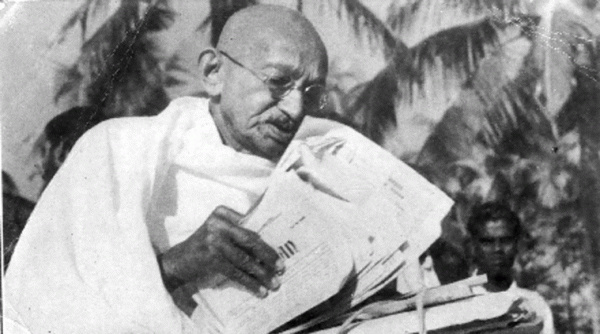
Mahatma Gandhi wrote seven letters to the then Viceroy of India after wife of revolutionary Haridas Mitra approached him. Haridas Mitra is the father of West Bengal Finance Minister Amit Mitra. (archive)
Mahatma Gandhi wrote seven letters to the then Viceroy of India, Lord Wavell, to commute the death sentence, and subsequently get released four young revolutionaries who were held guilty by the British of supplying information to Netaji Subhas Chandra Bose’s Indian National Army (INA).
The startling historical fact is just on of the many mentioned in the jail diary of freedom fighter Jyotish Basu who died in 2000. The diary has been compiled by renowned researcher Pallab Mitra in the form of a book —- ‘Phansi Theke Phire’ (Back from the Gallows) – and details the last few days of Basu at Presidency Jail where he was brought back from the gallows, just a minute before he was to be hanged.
The four revolutionaries for whom Gandhi sought clemency were Jyotish Basu, Amar Singh Gill, Pabitra Roy and Haridas Mitra. Haridas Mitra is the father of West Bengal Finance Minister Amit Mitra, and his wife Bela was the niece of Netaji.
All four were released in July-Agust 1946. While not much is known about the later life of Gill and Roy, Mitra joined Congress and later became the deputy Speaker of West Bengal Assembly. Basu spent his life in various social and cultural activities and died in 2000, at the age of 92.
As per the historians, the only known case when Mahatma Gandhi urged the British to commute the death sentence was for Bhagat Singh. The freedom fighter was ultimately hanged on March 23, 1931. “As far as we know it was in the case of Bhagat Singh that Gandhiji intervened,” says Sabyasachi Bhattacharya, historian and former chairman of Indian Council for Historical Research.
It was Jyotish Basu’s residence at 6A, Bipin Paul Road in Kolkata that the revolutionaries, then part of INA’s Secret Service, set up a communication centre. It was from this house that Basu was arrested on December 31, 1944 while other three were taken into custody some time later.
After a trial that lasted a few months, all four, lodged in Presidency Jail in Kolkata, were sentenced to death.
The book details the fearlessness of the revolutionaries. Asked if they had any last wish before they were hanged, Gill said he wanted to watched a dance recital by Sadhana Bose, while Basu said he wanted to hear Kanan Devi’s songs.
Bela Mitra, then 22, wife of Haridas Mitra, meanwhile, went to Poona and pleaded with Gandhiji to write to the Viceroy requesting for the release, or if that was not possible, commuting of sentence of all the four. A few days later, Basu’s father Ranjan Bilas Bose too met Gandhiji with the same request.
Gandhiji wrote seven letters requesting for release of first Haridas, and then the three others. All these letters have been kept at National Library, Kolkata.
In his first letter, dated September 14, 1945 and sent from Poona, Gandhiji wrote: “Shri Haridas Mitra, an MA of the Calcutta University, and the husband of Shri Subhas Chandra Bose’s young niece, age 22 years, is under sentence of death over what appears to be on untenable ground. I have perused the petition for mercy by the uncle of the condemned as also Advocate Carden Noad. I suggest that they furnish cogent grounds for exercise of mercy. In any event, the case for mercy becomes irresistible in that the war with Japan is over. It will be political error of the first magnitude if this sentence of death is carried into effect”.
“…My attention was drawn to the case by the prisoner’s wife as she has often sung at my prayer meetings when I had the honour of being a guest of advocate Sarat Chandra Bose (elder brother of Subhas Bose) who I am happy to learn from the government of India has ordered to be released”.
It was about five years ago that Jyotish Basu’s daughter told Pallab Mitra about the diary. “I consulted historians Amalendu Dey and Basudeb Chattopadhyay and then I got to know about Gandhiji’s letters. It was a wonderful revelation that because of his intervention four precious lives were saved from the gallows,” says Pallab Mitra.
Repeated calls and text messages to minister Amit Mitra failed to elicit any response.
source: http://www.indianexpress.com / The Indian Express / Home> Cities> Kolkata / by Sabyasachi Bandopadhyay, Kolkata / September 15th, 2014
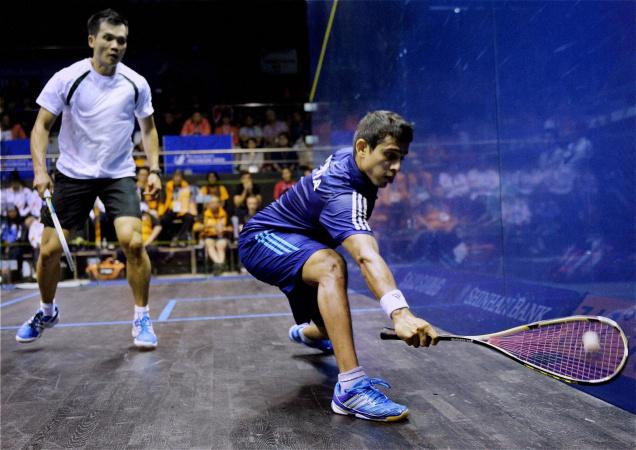
Saurav Ghosal on Monday outplayed 35th-ranked Beng Hee of Malaysia to enter the finals of men’s squash event. / PTI
Loses title clash to Kuwait’s Abdullah Almezayen, narrowly misses out on becoming the first Indian squash gold winner in Asian Games.
Saurav Ghosal on Tuesday squandered a two-game advantage to narrowly miss out on becoming the first Indian squash player to win the gold medal at the Asian Games.
Ghosal was leading after the first two games of the gold-medal match but his opponent, Kuwait’s Abdullah Almezayen, staged a dramatic fightback winning the next three games to clinch the top prize.
Almezayen won the title clash 10-12 2-11 14-12 11-8 11-9 at the Yeorumul Squash Courts. The Indian missed out on a gold-medal point with the scoreline reading 12-11 in the third game, which eventually proved to be the decisive game.
Ghosal took 21 minutes to take the first game before consolidating his position by clinching the second in merely six minutes of play. The Kuwaiti squash player then made a grand fightback as he took 19, 12 and 17 minutes respectively to win the next three games.
Prior to this, the 28-year-old Ghosal had three Asian Games medals to his name – singles bronze in 2006 Doha Games and two more, including one in doubles, in the 2010 edition in Guangzhou.
source: http://www.thehindu.com / The Hindu / Home> Sport> Other Sports / PTI / Incheon – September 23rd, 2014
The morning durbars under the portico of the delightfully eccentric Fairlawn Hotel on Sudder Street have just become history. The ‘Duchess of Sudder Street’, as Vi (Violet) Smith was popularly called, will not be holding ‘court’ there anymore. And legions of her fans, as well as the galaxy of loyal customers of her hotel, will no longer be regaled by her stories about the Kolkata of yore. Smith passed away at her first-floor quarters of Fairlawn Hotel on Saturday at an age of 93.
The stories she narrated were as eclectic as her personality, and the hotel itself. One of her favourites was how Shashi Kapoor (“drop-dead gorgeous he was,” recalled Vi) met and fell in love with Jennifer Kendall. In the spring of 1965, the Kendals, who used to own a mobile theatre company called ‘Shakespeareana’, were putting up at Fairlawn and Prithvi Theatre (owned by Shashi’s father Prithviraj Kapoor) also happened to staging shows at New Empire at the same time. Jennifer had gone to watch a show there and it was “love at first sight” for Shashi, who courted Jennifer, joined ‘Shakespeareana’ and eloped with her to Bombay to get married after her father Geoffrey refused permission for marriage. The couple spent their honeymoon in Room No 17 of Fairlawn, and Vi named it ‘The Shashi Kapoor Room’.
Vi was also very fond of telling visitors about Patrick Swayze who stayed at the Fairlawn while shooting for ‘The City Of Joy’ in 1991. “He was very nice and soft-spoken. He had told me about the ranches he owned in California and New Mexico, about his wife Lisa and his childhood,” the coiffed and elaborately made-up Vi told this correspondent a couple of years ago. She was also an encyclopedia on the Calcutta of the glorious past.
Violet Smith was an Armenian whose grandfather escaped the genocide of the Armenians by the Ottomans in Turkey in 1915 and reached India through Iran and Afghanistan. Violet married Edward Frederick Smith, a British army officer, in 1944 and moved to England later, but returned in 1962 to take over the affairs of Fairlawn. Violet’s mother Rosie Sarkies had bought the property from two British ladies in 1936. The sprawling structure that houses the hotel is 231 years old now, having been constructed by one William Ford in 1783.
Vi lent her personality to the hotel she dearly loved. Stepping in through the iron gates of the hotel is like entering a green oasis set amidst the bustle of the city. A profusion of plants, mostly palms, provides an immediate soothing experience and leads to the portico where, every morning, the redoubtable Violet used to hold court. Not just the abundance of potted plants, the colour of the walls, linen, wicker and cane chairs, settees and stools, many of the draperies and even some of the crockery are green or have splashes of it. It’s Violet’s favourite colour. “Green symbolizes freshness, vibrancy and reminds one of nature,” she used to say.
Other regular guests at Fairlawn that Vi would often talk about were filmmakers Ismail Merchant and James Ivory, actors Melvyn Douglas, Penelope Cruz, Julie Christie, Felicity Kendal (Jennifer Kapoor’s sister) and Om Puri, writers Gunter Grass, Eric Newby, Dominique Lapierre, Ian Hislop and Glen Balfour-Paul, British playwright Tom Stoppard, TV presenters Dan Cruikshank and Clive Anderson, and even Gordon Matthew Thomas Sumner (Sting, for the uninformed)!
And all have paid glowing tributes to the hotel and its wonderfully charming owner Violet Smith. Lapierre went to the extent of wishing he loses his passport when he stays at Fairlawn the next time so that he can stay on at the hotel forever. Newby calls Fairlawn his “most favourite hotel”. Vi would often say her motto was to “receive tourists as guests and send them away as friends”. For her innumerable friends all over the world, Fairlawn, and Kolkata, will never be the same without Vi.
source: http://www.timesofindia.indiatimes.com / The Times of India / Home> Cities> Kolkata / by Jaideep Mazumdar, TNN / September 22nd, 2014
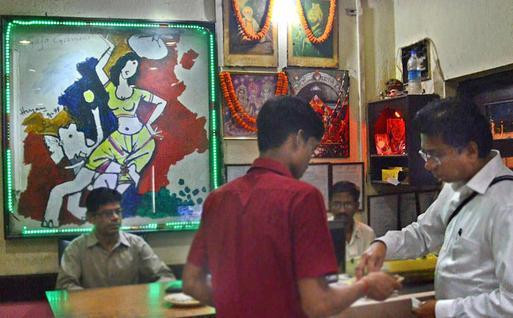
The wall of the Azad Hind Dhaba in Kolkata adorned with M.F. Husain’s Gaja Gamini. Photo: SUSHANTA PATRONOBISH
The now-famous painting, titled Gaja Gamini (one with a walk like an elephant), depicts a dancing woman, in a bright red background, while a white elephant looks on with its trunk held aloft
The memory of seeing M.F. Husain colouring one of his sketches back in 1999 is still fresh in the mind of Madan Sharma, one of the owners of Azad Hind Dhaba, a popular eatery in south Kolkata.
One fine afternoon years back, Mr. Husain walked into the dhaba, which he frequented during his visits here, and all of a sudden started adding colour to the black and white sketch on the wall that he had drawn three years before.
“The experience made me speechless,” Mr. Sharma said, on the eve of the 99th birth anniversary of the iconic painter.
The now-famous painting, titled Gaja Gamini (one with a walk like an elephant), depicts a dancing woman, in a bright red background, while a white elephant looks on with its trunk held aloft. Mr. Husain arranged a private show of his film Gaja Gamini at Azad Hind in 1999.
Sitting at the cash counter with the painting behind him, Mr. Sharma fondly recalled his memories of the famous artist. He remembers Mr. Husain as a “moody and humble person” who would come to the restaurant and sit quietly in one corner sipping his favourite “kadak chai [strong tea].”
“He did not talk much. But sometimes told me what kind of food he wants,” Mr. Sharma said. He was initially apprehensive of talking to an artist of Mr. Husain’s calibre, but eventually they became friends. “Mr. Husain could mingle with adults and children with equal ease. He was totally devoid of arrogance.” Whenever schoolchildren spotted him at the eatery, they flocked to him and asked for autographs. The world-famous painter complied with their demands with a smile and even drew them impromptu sketches.
When asked about the controversy that erupted in 2006 over Mr. Husain’s depiction of Hindu gods and goddesses, Mr. Sharma said the thought of removing the painting never entered his mind. “Nobody asked me to remove the painting even when the controversy erupted.”
Mr. Husain eventually had to leave the country under pressure from Hindu nationalist forces. He passed away in London in August 2011.
Meanwhile, the dancing woman with an elephant walk lives on happily on the central wall of Azad Hind Dhaba, in the company of numerous Hindu gods and goddesses.
source: http://www.thehindu.com / The Hindu / Home> Features> Friday Review> Art / by Soumya Das / Kolkata – September 17th, 2014
The ‘toy train’ chugging up a serpentine track through the Darjeeling hills is almost an image out of a fairy tale. But for Adrian Shooter the first look at the scene triggered a life-long love story that made him buy an entire locomotive to run in his London garden.
The world’s oldest surviving Darjeeling-Himalayan Railway (DHR) locomotive is back on track, thanks to Shooter. Smitten by the magic of a ride on the DHR (now an Unesco world heritage property) a decade and a half ago, Shooter, who retired as chairman of Chiltern Railways, bought the DHR locomotive — model number 778 — built in 1889 by Sharp Stewart and Company, Manchester, to restore it to perfect
condition.
The Indian government had sold the locomotive to Hesston Steam Museum in 1960, not realizing what its worth would be 50 years later when it was declared a world heritage by Unesco.
Shooter has also bought an Ambassador that runs by the train when it chugs through his garden to give it a feel of being in Darjeeling. He shipped the locomotive in a container from US to the steam rail workshop in Tyseley, Birmingham, where he restored it. The tracks laid in his garden over 1.5km is in the form of a loop just like in Darjeeling.
He has also built a station that looks exactly like the original Sukna station, besides laying a pathway that crosses over the tracks, exactly the way it is in Darjeeling.
In an exclusive interview to TOI, Shooter said “I bought the locomotive from the museum in Indiana, US, in 2002. It had been bought by a private individual, Mr Donnelley in 1960. He died in 1975 and it passed on to the museum after that. He was the boss and major shareholder in R R Donnelley Co, which is a very large printer and publisher in Chicago.”
He added, “I have several volunteers who help me operate the loco and we give rides to invited guests. We usually have 100-150 and do this three or four times a year. The loco is fully functional and is in excellent condition. Last winter it had a 10-year overhaul when, by law, the boiler has to be taken off the chassis, carefully examined and repaired as necessary.”
“The loco still has the original 1889 boiler and is, by at least 50 years, the oldest loco boiler in use in the UK. There are a couple of older ones in India. The reason that it has lasted so long is that it is made of wrought iron, which is much more corrosion-resistant than steel. It was obviously very well looked after during its 70-year use in India,” Shooter said.
Shooter will be in Delhi in February at the invitation of Mark Tully to speak at the Indian Steam Conference. He said, “Darjeeling Railway is very special because it climbs so high (over 7000 feet) through fantastic countryside with wonderful people. Many Britons had ancestors who lived, worked or visited Darjeeling. I still regularly come across people who went to school in Kurseong or Darjeeling. The engines themselves are of a sound design that have shown themselves to be more than capable on very steep and curvaceous railway tracks.”
Shooter, however, said he has no plans to return the locomotive to India. Britons will get a chance to ride on the train as it makes a special appearance at the North Pennines on September 26-28.
South Tynedale Railway at Alston is hosting Shooter’s train — Locomotive No. 19 — for an Indian-themed weekend of food, music and films. People will be able to ride on the train, dress like a local from Darjeeling and enjoy eastern Himalayan cuisine.
Locomotive No. 19 was withdrawn from the Darjeeling-Himalayan railway service in 1960 and, privately purchased, made its way to Indiana. In 2003, it was taken across the Atlantic to be restored by Tyseley Locomotive Works, Birmingham, for Shooter. At the same time, two replicas of DHR carriages were constructed at the Boston Lodge Works of the Ffestiniog Railway. These and the locomotive run in Adrian Shooter’s private garden railway.
India at present has 14 original DHR locomotives in working condition and 10 others on display at museums. Shooter’s train is the oldest of all DHR trains. Currently, only five DHR locomotives are privately owned, four of which are in Assam. The 778 is the only model outside India.
Indian railway expert Rajesh Agrawal said, “In the 1960s, India was getting rid of a large number of locomotives as we had more than we required. One such model was the 778. Nobody knew then that the DHR would become such a prized object. People also thought the 778 was not in working condition as it was 71 years old. A locomotive generally retires after 45 years.”
source: http://www.timesofindia.indiatimes.com / The Times of India / Home> City> Kolkata / by Kounteya Sinha, TNN / September 19th, 2014
This new contribution to diaspora studies maps a woman’s tumultuous passage from India to West Indies
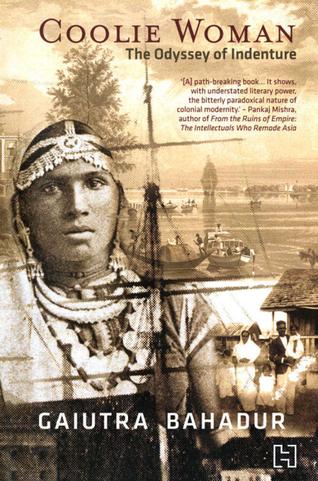
COOLIE WOMAN — The Odyssey of Indenture: Gaiutra Bahadur; Hachette Book Publishing India Pvt. Ltd., 4th & 5th Floors, Corporate Centre, Sector 44, Gurgaon-122003. Rs. 599.
Usha V.T
Gaiutra Bahadur’s Coolie Woman is an attempt to recreate the journey of an indentured woman labourer — a woman from India —who travelled to the West Indies and eventually to the United States. Diaspora studies have often pointed out that a wide array of social and economic deprivations drove villagers from their homes to travel to faraway lands. And as this author reiterates, the practice of imperial capitalism destroyed traditional livelihoods, while at the same time colonialism created new routes for moving across the subcontinent, in several guises.
The author justifies the use of the term coolie , despite its derogatory connotations, at the very outset. In fact, she devotes a whole chapter to a discussion of the term and its use in the current context. “As it turns out, mystery darkened the lives of many women who left India as coolies. The hind of scandal was communal. Some historians have called indenture “ a new form of slavery,”
In many ways it was: once in the sugar colonies, coolies suffered under a repressive legal system that regularly convicted more than a fifth of them as criminals, subject to prison for mere labor violations, which were often the unjust allegations of exploitative overseers.”
What makes the work interesting is the autobiographical nature of the narrative. The protagonist is the author’s great grandmother Sujaria, whose life and adventures are the occasion to map the tumultuous journey of the woman from her home in India to the West Indies. With the help of historical records, legal documents and tales of indenture, Gaiutra Bahadur attempts to recreate her grandmother’s historic journey. She says: “What I found was a revelation. I once thought that my great grandmother must have been an exception .” And a little later we read: “In which category of recruit did my great grandmother fall? Who was she? Displaced peasant, run away wife, kidnap victim, Vaishnavite pilgrim or widow? Was she prostitute…”
The sexuality of the women and her exploitation in terms of her body both during the journey to the new land as well as in her survival in the land of her slavery through sexual negotiation takes prime place in some of the seminal chapters of the book. They were exploited physically and their reputations were then “dismembered”. This was done systematically both by the men who exploited them as well as by the men who had no sexual stake in the women. Though it was seen that gender imbalance caused sexual chaos in the colonies among the indentured labourers and their functionaries, the women were made to suffer not merely physical agony but mental torture through character assassination. Some of the comments and statements that Gaiutra cites are from public figures held usually in high regard: Even men without a sexual stake in the women cut them to pieces. The Reverend C.F Andrews, indenture’s greatest critic, rued the women he met in Fiji. “The Hindu woman in this country” he reported, “is like a rudderless vessel with its masts broken being whirled down the rapids of a great river without any controlling hand. She passes from one man to another and has lost even the sense of shame in doing so ”.
Of course none of the opinionated colonisers bother to talk to the women or ask for their version of the reality they face on an everyday basis for survival. Yet they make their judgements on the character of the women vocal and the woman as always is silenced and humbled for circumstances beyond her control.
In 1906, the author’s great grandmother and her new born arrived at Rose Hall Plantation, on Canje Creek. She did no field work there as the narrator informs us… “Dey send her, and she cyaan make it in the field, because her feet was soft …” Instead Sujaria was assigned to be a child minder. This was the job that Jamni, the woman at the edges of the Nonpareil uprising, either as kept woman or rape victim, reportedly had. And this was the job that my great grandmother was given. Perhaps this was because she had a baby to support alone and her caste background had made her useless in the fields. Or perhaps, she possessed a pretty woman’s advantage. (p 148)
Gaiutra explains how caste class and gender are factors that develop new meaning as the woman moves from her own land through along, perilous journey into a new world where her survival depends on her capacity to negotiate with the multiple forces that are decisive to her existence. Her sex, though her weakness, now becomes a major factor that she can utilise for negotiating her survival. In a way of life, that is exploitative, survival become the centre of the labourer’s existence and the author explains how it is achieved in individual cases.
The narrative is supported with documents such as legal references, captains’ or doctor’s logbooks from the ships, police records, administrative reports, photographs etc.
These neglected narratives are footnotes to colonial history and women’s history in particular. It becomes her middle passage:
middle-passaged
passing
beneath the coloring of
desire
in the enemy’s eye
a scatter of worlds and bro
ken wishes
in shiva’s unending dance
(Arnold Itwaru, “We Have
Survived”)
With an astute eye for detail Gaiutra Bahadur, trained as a journalist, unearths sumptuous information buried in documents and records hitherto less-explored areas pertaining to women in indentured labour amounting to sexual slavery, and the odyssey of indenture is presented in a nonchalant manner. However having said that, the documentary nature of the work makes it a little tedious and uninteresting at times over several pages.
The author’s self-conscious struggle to motivate the reader to share individual experiences — albeit factual, in places slipping into a fictional style — is sometimes a bit laborious and too obvious. Gaiutra Bahadur’s Coolie Woman traces the story of how one woman’s experience represents an entire spectrum of woman’s experience: the book is a veritable source book for further research in diaspora studies.
source: http://www.thehindu.com / The Hindu / Home> Features> Book Review / by Usha V.T / September 16th, 2014