Category Archives: Records, All

The big fat biryani battle

AlooBiriyaniMPOs23nov2014

The A in the B

Shahanshah Mirza cannot imagine his biryani without the aloo. Fatima Mirza could not imagine her biryani with the aloo. Till the girl from Lucknow was married into the Mirza family of Park Circus. “I remember finding the aloo in the biryani quite funny at first,” says Fatima, who friends insist serves up some of the best biryani in town. And yes, with the aloo.

Why are we so bothered about the biryani being cooked in the Mirza kitchen? Simple, that’s where the great “to aloo or not to aloo” debate was born for the Calcutta biryani.

Yes, Shahanshah Mirza is the great-great-grandson of Wajid Ali Shah, the last nawab of Awadh. Foodlore has it that the nawab came to Calcutta after losing his throne and to cut costs, his cooks replaced the meat with the potato. And, foodlore number two: Wajid Ali Shah’s cooks added the aloo but only after falling on hard times following the death of the nawab. Either way, thus was born the Calcutta biryani the city now gorges on.

The nawab’s family line dismisses all this as, well, lore. “The nawab was a connoisseur of food and had given a free hand to his chefs to experiment with dishes. Once his chefs played around with the biryani and put potatoes in it. The nawab liked it so much that he ordered that the aloo be a constant in the biryani henceforth,” says Shahanshah.

And that is how it is cooked to this day in the Mirza kitchen — and in the kitchens of almost every biryani-serving restaurant around town.

With the royal exception of… Royal Indian Hotel.

What started as a humble rented shop in Chitpur to sell culinary creations by Ahmed Hussain, a migrant from Lucknow, is now a two-storeyed restaurant that seats 65 in its AC hall, 75 in the non-AC hall and 40 in the ground-floor dining hall and “remains full at meal times”.

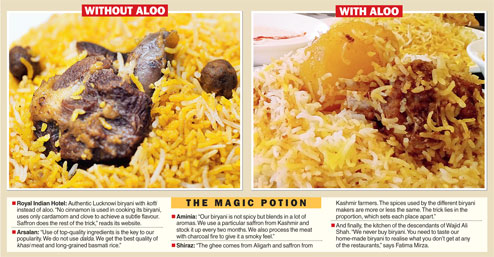
But don’t dare mention the A (aloo) word here. “We only make authentic Lucknowi biryani and our patrons love that. Our biryani does not have aloo, it has kofti (meat balls),” declares Md Irfan, one of the directors of Royal Indian Hotel, stirring up biryani since 1905, the year Lord Curzon divided Bengal.

More than a century on, Calcutta still stands divided. Along the thick potato line when it comes to the biryani.

How tough it is to serve biryani without the potato in a city weaned on that is evident from what Luknow, an Awadhi food restaurant that opened in Park Circus and Ballygunge this year, had to face. With diners insisting that “aloo chhara biryani hoy na (there can be no biryani without aloo)”, Shalini and Vinay Arora, the couple behind Luknow, were in a pickle. The cooks from Lucknow at the helm said: “Awadhi biryani cannot be cooked with potatoes.” But on popular demand aloo was introduced in one of the 11 biryanis on the menu.

No wonder the most popular biryani places in Calcutta just pile on the potato. Arsalan, Shiraz, Aminia, New Aliah — you name it and all of them have it. Aminia of New Market that has been running since August 15, 1947, has three more outlets in Calcutta — at Gol Park, Jessore Road (Nagerbazar) and Rajarhat (Chinar Park). They have been serving aloo with their biryani since inception.

Arsalan, a relatively recent dot on the biryani map of Calcutta (2002), has zoomed to the top of the bestseller chart and now runs five outlets — two in Park Circus, including the landmark one at 191 Park Street, and one each in Ripon Street, Taratala and Hatibagan. For them, there truly is no B (biryani) without A (aloo). “Some customers even look for a second piece of aloo on the plate!” says Arsalan director Akhtar Parwez.

The aloo is also an essential part of the biryani at Shiraz Golden Restaurant, which dates back to 1956. It has 10 outlets in the city stretching from Garia to Dum Dum.

A new kid on the biryani block, Oudh 1590, has tried to create a destination for Awadhi cuisine with the decor and menu at its Deshapriya Park address. But with one concession for the Calcutta palate: the option of the biryani with aloo. “Yes, the Awadhi Handi Biryani without aloo is less popular. People come and specifically ask for the aloo-wala biryani,” admits Debaditya Chaudhury, a partner of Oudh 1590.

Among foodies batting for the aloo in the biryani is musician-food writer Nondon Bagchi. “It is a part of our tradition. The aloo should not be taken out of the Calcutta biryani,” he says.

And slightly further away from home, we asked economist Abhijit Vinayak Banerjee, the celebrated co-author of Poor Economics and a fabled cook in his friends’ circle, where he stood on potatoes in biryani. “Potatoes can be very nice, especially if the biryani is sharp, like a Sindhi biryani,” said the man from MIT in the US. [Sindhi biryani is known to have mint, coriander and prunes in addition to the meat and rice. Originating from Sindh province in Pakistan, some of its variations have potatoes in it.]
BiriyaniFamilyMPOs23nov2014

The biryani boom

Enough of the potato, let’s get to the meat of the matter now.

To what lengths Calcutta can go for its fill of biryani is evident from the thousands who throng The Telegraph Biryani and Kebab festivals every year at City Centre (Salt Lake and New Town).

And it’s this passion for the rice-and-meat platter that has finally nudged Royal Indian Hotel to join the branching-out biryani brigade. Yes, Royal will have its first branch — “to be opened opposite Quest mall very soon”.

It took four generations and more than a century for this traditional biryani bastion to get a move on. So what prompted them to go south? “Our loyal customers from across Calcutta travel all the way to 147 Rabindra Sarani and often rue that we don’t have an outlet in their part of the city. We believe we are now ready to reach out and take our brand to all corners of Calcutta — north, south, east and west. We begin with south because it is a strategic location, where we can attract a wide clientele from the Ballygunge and Park Circus areas,” says Royal’s Irfan.

The restaurant that enjoys iconic status among loyalists says the popularity of the biryani here picked up after Independence. “Satyajit Ray to Uttam Kumar, Gunter Grass to Khushwant Singh, they all loved our biryani. Yesteryear actress Tabassum would get it packed and take it for Dilip Kumar. And now, Sourav Ganguly loves our Chicken Biryani,” smiles Irfan.

Royal may finally be stepping out of its crease, like Dada used to in his prime, but no one understands the biryani boom better than bestseller Arsalan. “If everything goes right, we intend to open three branches by June 2015,” says Arsalan director Akhtar Parwez. The locations on the radar are Barrackpore, Rajarhat and Jessore Road.

Simmering in the Arsalan handi is a target for “at least 50 outlets across Bengal” in the next 10 years. “If a Bengali loves and craves for Arsalan biryani, he should be able to get it near his home. That’s where we want to take our brand to,” says Parwez, reluctant to divulge the number of plates served per day in their blockbuster outlet at the Park Circus roundabout.

Multiplicity is the name of the game for Shiraz and Aminia as well. Aminia aims to open a branch in Behala, next to Ajanta cinema, and another near the Shyambazar tram depot. Shiraz has launched a chain of quick-service restaurants named Lazeez Express, which “does good business in Kasba”. For Zeeshan, which already has two outlets in the south (Deshapriya Park and Garia), another one near Lake Market is being planned. And then one in Kidderpore maybe.

Two new biryani players — Oudh 1590 and Luknow — are attracting a steady clientele in south Calcutta, enough for Oudh 1590 to eye a second serve near City Centre Salt Lake in January.

Multiplicity is married to makeover in the new-age biryani game, with words like decor and ambience coming into the dictionary. Take Oudh 1590. This Awadhi cuisine restaurant has created a “period dining experience” at its Deshapriya Park address.

The older players, too, are paying attention to the look and feel of their dining rooms. Aminia Rajarhat that opened earlier this year has been built on a Sufi theme.

“Today’s customers are hygiene-conscious and look for places that have a feel-good ambience. So we had to put in a lot of effort to make our Hatibagan address look chic and vibrant,” says Arsalan man Akhtar Parwez.

With the “need to reach out” becoming the mantra — from Royal to Lazeez — the biryani is taking the pizza route. Takeaways and home delivery are playing an important part. “You need to take special care as food items like biryani are best enjoyed fresh from the handi,” says Parwez.

“We depend largely on home-delivery orders, from domestic as well as corporate clients,” says Ishtiaque Ahmed of Shiraz’s Lazeez chain.

And then there’s Facebook, Zomato and Foodpanda for the smart(phone) set to book biryani on the go.

A foodnote: The great biryani debate doesn’t begin or end with the aloo. There’s a greater debate cooking, which questions the very standing of the biryani. But as with most things Calcutta, there is no place for the finer nuances or larger debates of life.

We turn the culinary pages to Abdul Halim Sharar (1860-1926), a courtier in nawab Wajid Ali Shah’s Lucknow durbar, who wrote in Lucknow: The Last Phase of an Oriental Culture that the real raeez of Lucknow preferred mutton pulao to biryani, which was bit of an aam aadmi food.

The last word is left, once again, to economist Abhijit Vinayak Banerjee from MIT. When asked to define the difference between pulao and biryani, he said: “Pulao is rice cooked in broth. Biryani is made with pre-cooked rice. Kachchi biryani is with marinated but not cooked meat. Normal biryani is with cooked meat. In both cases the meat cooks more and the vapours from that are used to flavour the rice.”

That, sadly, is too fine a flavour for the Calcuttan busy with a mouthful of biryani, aloo and all.

Do you like your biryani with or without the aloo? Tell ttmetro@abpmail.com

source: http://www.telegraphindia.com / The Telegraph, Calcutta / Front Page> Calcutta> Story / by Sibendu Das / Sunday – November 23rd, 2014
Indian farmers who fought WWI in France

Caleidoscope

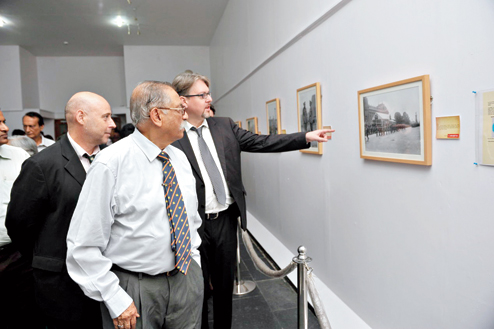
French consul-general Fabrice Etienne, director of Alliance Francaise du Bengale Stephane Amalir and General (retd) Shankar Roy Chowdhury at Victoria Memorial. (Anindya Shankar Ray)

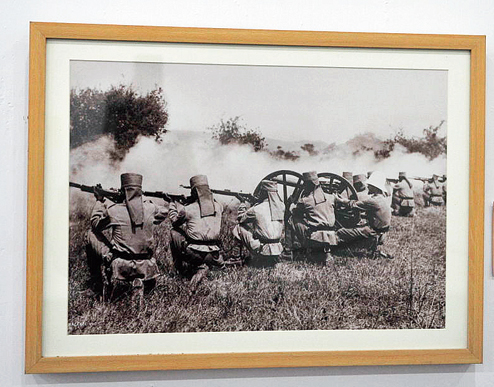
On a day when French President Francois Hollande was to pay a tribute to the 6,00,000 foreign soldiers who fell in World War I, Alliance Francaise du Bengale, in association with Victoria Memorial Hall, opened to the public a photography exhibition titled “War and the colonies”, presenting glimpses of soldiers at work on French soil from lands as varied as India, Ireland and Senegal, 100 years after the Great War.

“Around 28,500 Indian soldiers came to fight on French and Belgian soil as part of the British army by end-1914. They faced the severe winter of 1914-15 and the war in Neuve Chapelle in March, Ypres in April, Festubert in May and Los in September,” said French consul-general Fabrice Etienne at the inauguration of the exhibition at Victoria Memorial.

WW102KOLKATA17nov2014

“From 1914 to 1918, around 90,000 soldiers in various capacities fought for the freedom of France and Belgium. Of them, 8,500 died and 50,000 were injured. France will never forget the suffering and the heroism of these men,” he added.

General (retd) Shankar Roy Chowdhury pointed out that WWI was no concern of India. “It was not their war. But the Indian army was a professional one and part of the assets of the British Empire. What choice did they have?”

Two factors loaded the situation against them. “They were meant for imperial policing and not equipped for a full-blown battle. Within a week of arrival in Marseille, they were put in the assault zone. Also, their efficiency relied heavily on their personal bond with their British officers. But the 10-12 officers there were in each battalion died within the first week. Young officers, fresh from Britain, were sent in haste to lead the Indian troops.

“No wonder Indians did not fare well in France and Flanders, and were moved out to Asia Minor. Still they got nine Victoria Crosses for gallantry,” Roy Chowdhury said.

Without the colonies, the Allies could not have won, said Kaushik Roy, a professor of history at Jadavpur University. “Of a population of 235 million, 1.2 million Indians were serving in WWI. This is a significant percentage. Raised voluntarily, mainly from Meerut and Lahore, they were mostly illiterate farmers who did not write much except for some letters home. The poorest were not taken as they were thought to be malnourished. Punjabi Muslims, Sikhs, Garhwalis and Gorkhas were the dominant segments while Bengalis and Madrasis were under-represented,” Roy said.

WWI resulted in fragmented identity-building of each race, rather than evoke any pan-Indianness, he added.

The evening concluded with Theophilus Benjamin playing works of French composers on the guitar.

The exhibition is on till November 23, except Monday.

source: http://www.telegraphindia.com / The Telegraph, Calcutta / Front Page> Calcutta> Story> Caleidoscope / by Sudeshna Banerjee / Sunday – November 16th, 2014

Digi life for old records

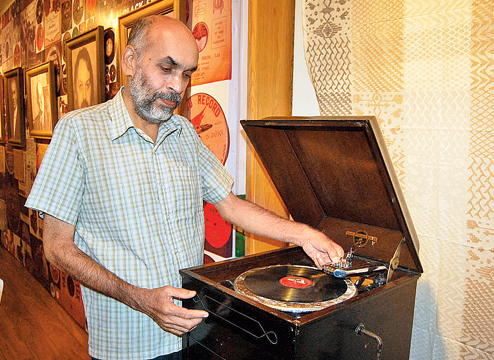
Suresh Chandvankar at the inauguration of the digitising centre at Weavers Studio. Picture by Bibhas Lodh

If you have inherited a collection of old gramophone records you have no idea how to preserve or perhaps even where to play, this is the address where to head. Weavers Studio Centre for the Arts has opened a digitising centre in its gallery space in Ballygunge Place where old and rare records are being digitised.

“We want collectors to come forward. We will digitise and archive their records and return the discs to them along with a CD of what we archived. We have started with 400 records and can digitise two records per day,” said founder Darshan Shah. Early 20th century single-sided cardboard Nicole, shellac Pathe, paper records and pre-World War I Beka-Grand records form part of their acquisition, sourced from flea markets. “We are working on a wide range of genres — Hindustani and Carnatic classical, folk, early film or theatre music, Bengali songs and speeches of leaders,” Shah added.

The centre wishes to disseminate the digitised content among music lovers and researchers through audio-visual exhibitions, listening kiosks and portals, guided listening sessions etc. It has set up a permanent listening facility for visitors to enjoy the digitised sound, on two computers with headphones and 10 Android phones gifted by Tata Docomo. On each phone, close to 150 audio clips have been uploaded, which are being changed depending on the theme of the exhibition organised most recently by the centre. “We can take the phones to schools or to other cities when we hold travelling exhibitions,” Shah said.

Schools are also being invited to send students over to experience India’s audio history. One can walk in and listen to any of the digitised material like the “Tryst with destiny” speech of Jawaharlal Nehru or Swami Vivekananda’s Chicago address, or voices of Subhas Chandra Bose and Mahatma Gandhi. There are also 70 versions of Vande Mataram. The listening facility is available on weekdays, 3pm to 7pm.

The centre was inaugurated by Suresh Chandvankar, the secretary of the Society of Indian Record Collectors in Mumbai. “In Calcutta, where India’s first commercial recording was done in 1902 by Gauhar Jaan for The Gramophone Company, there are people with knowledge in the field but not many are ready to come forward and share it. This is the first time that a digital archive is being set up and exhibitions on records being held by a private body unsupported by the government,” said Chandvankar, who has bought an apartment on the outskirts of Mumbai just to store his collection of records.

Even after a record has been digitised, Chandvankar argues for its preservation. “Digital can never replace the physical form. When a new technology comes, the physical recording will be needed again.”

The future of preservation, he believes, is a virtual archive. “Put all digital material on Cloud. And for outreach, the best channel is social media,” he advised. “But when it comes to sound quality, aficionados abroad are getting tired of the digital sound. So a revival of the disc is on the cards. In fact, many of my collector friends believe that the 78 rpm disc has the best sound quality.”

source: http://www.telegraphindia.com / The Telegraph, Calcutta / Front Page> Calcutta> Story / by Sudeshna Banerjee / Sunday – November 16th, 2014

Expo on lost Kalamkari textile in city

Kolkata :

They had originated and proliferated in India, possibly in Tanjore, in the late 16th or early 17th century under the patronage of the Mughal emperors. But, with the passage of time, Kalamkari paintings on textiles faded into oblivion.

Thousands of miles away, a museum in France on the Swiss border has preserved some of the oldest specimens of Kalamkari paintings on textiles. These are very rare to find even in museums within the country.

For a fortnight starting on Wednesday, the textile gallery of the Indian Museum will showcase the world famous ‘Tapis Moghol’ — some of the most elaborate designs replete with mysterious animals, birds, foliage and flowers — that hold the key to many stories of the times. The ‘Tapis Moghol’, that dates back to the late 16th or early 17th century, has been preserved for the world at the En Musea De L’Impression Sur Etoffes De Mulhouse or the Museum of Printed Textiles at Mulhouse, France.

Kalamkari paintings in its earliest form were motifs painted on large wall hangings that were used to decorate the altar behind the deity. Kalamkari, though, is not a lost art form in the sense that it is still practised in both the painted and block printed versions. But, we have lost most of the original designs that were popular when it was used as an altar backdrop in South Indian temples.

“A gentleman called Funffrock, who was an employee of the French East India Company, was posted in Tanjore. The Frenchman was immensely interested in the traditional art form and got a cotton cloth, measuring eight feet by eight feet, done up with rich intricate designs that showcased the best motifs of that time. With time, this became the focal exhibit, around which the other collections of the period grew. The exhibition will give the city a glimpse of the Funffrock collection,” explained Ruby Palchowdhury, spokesperson of the Crafts Council of West Bengal, which is a wing of the Crafts Council of India and is funded by the Centre.

Textile and culture ministries and the Alliance Francaise have funded the expo that will have 25 panels to show off design details and the stories underneath. The exhibition has been curated by ethnic historian Lotika Varadarajan.

source: http://www.timesofindia.indiatimes.com / The Times of India / Home> City> Kolkata / by Jhumli Mukherjee Pandey, TNN / November 16th, 2014

Japanese scholar traces history of Kolkata

Kolkata :

Once Okamoto Yoshiko starts speaking on the history of Bengal, jaws are bound to drop. Yoshiko, a history scholar of modern Japanese thought at Institute of Asian Cultural Studies of International Christian University, Tokyo, is tracing the untold history of Bengal and the city in connection with modern Japanese thought.

For last few days, she has been running from one house to another belonging to forgotten luminaries of Calcutta in search of documents, old photographs and books to track the vibrant bond Japan shared with Bengal more than 100 years ago.

Recently, Yoshiko was sifting through old books and documents at the house of Tapan Sen, great grandson of Narendranath Sen (1843-1911), the founder-editor of nationalist newspaper, Indian Mirror.

“He was a liberal Hindu, with a deep interest in other religions, particularly Buddhism. He was the founder of the Theosophical Society of Bengal,” Yoshiko said.

Yoshiko is working towards a book on an international religious conference that was to be held in Japan — a cancelled event at Kyoto in 1903. The key mover of the conference was Okakura Kakuzo (1863 -1913). This was after Kakuzo and art historian and Japanese monk Oda Tokuno came to Kolkata in 1902 and 1903 and met literary, cultural and spiritual luminaries like Rabindranath Tagore, Swami Vivekananda and Sister Nivedita. Narendranath Sen was elected chairman of the committee for the religious conference, Yoshiko said.

Why did the conference not shape up? “One of the reasons was the premature death of Swami Vivekananda. Without him the conference would have lost its sheen. There were other reasons as well. But the cancelled conference became a threshold of modern Japanese thought and forged an international intellectual network. With the idea of one-Asia, Kakuzo ceased to identify himself as Japanese but an Asian,” Yoshiko explained. The conference evoked world-wide response. Two Indian monks — Swami Rama Tirtha and Agamiya Parama Tattava — travelled to Tokyo for the conference.

Kakuzo had some wonderful intellectual exchanges with Narendranath Sen, who first interviewed Vivekananda after his return to India. In fact, Narendranath was the prime mover behind Vivekananda’s supposed participation at the Kyoto conference, the scholar explained. Yoshiko was sad that the original house of Narendranath Sen was razed.

Like Tagore, Kakuzo’s prophesy in his book, ‘The Ideas of the East’, proved true a century later, she said. “He noted that Japan’s rapid modernization was not universally applauded in Asia,” Yoshiko said.

source: http://www.timesofindia.indiatimes.com / The Times of India / Home> City> Kolkata / by Krishnendu Bandyopadhyay, TNN / November 13th, 2014

Spotlight on heritage assets

The Kathgola Palace, where the then chief of the British East India Company had met Mir Jafar after the Battle of Plassey in 1757, has regained some of its lost glory. The house of the Jagat Seth family, pre-eminent for its powerful moneylenders and bankers in the first half of the 18th century, has been restored, too.

Decrepit and prey to vandals till a couple of years back, both buildings are now popular tourist spots in Murshidabad, which was the capital of undivided Bengal during the Mughal era.

“They are now sustainable heritage properties and generate Rs 10 crore in tourism revenue,” said Pradip Chopra of the PS Group, who is also president of Murshidabad Heritage Development Society.

The Murshidabad model of conservation will be showcased along with other successful conservation projects in a seminar titled “Get the best out of your Heritage Property/Assets” at Palladian Lounge on November 22 and 23. The seminar will be part of “Resurgence — 3rd Murshidabad Heritage Festival 2014” to be held at Hazarduari palace and Kathgola palace in Murshidabad.

The Murshidabad Heritage Development Society is organising the festival, along with CREDAI Bengal, The Palladian-Asian Hotels North Limited, Hotels and Restaurants Association of Eastern India, The Calcutta Gastronomes, Intach and ASI.

“It will bring together stakeholders like property owners, developers, tour operators, hoteliers, restaurateurs and conservationists to develop a sustainable conservation effort,” said Anjan Mitra, architect and seminar coordinator.

The seminar will have an eclectic mix of speakers, including Debasish Nayak, the director of the Centre for Heritage Management, Ahmedabad University, civil engineer R.K. Anil, Aman Nath of Neemrana Fort Palace Hotel, Raj Basu of Help Tourism, Kasturi Gupta Menon, the chairperson of Crafts Council of India, and Sunil Rampuria, a heritage property owner in Bikaner.

Heritage is not just the building but also history, memories, lifestyles, craft, cuisine and a host of other things that need to be conserved holistically, said Mitra. So the inclusion of stakeholders like The Calcutta Gastronomes represented by chef Shaun Kenworthy.

The teaser launch of the seminar at Palladian Lounge on Tuesday showcased the royal vegetarian cuisine of Murshidabad, called Sheherwali cuisine.

source: http://www.telegraphindia.com / The Telegraph, Calcutta / Front Page> Calcutta> Story / Thursday – November 13th, 2014

Eden Gardens 150 years stamps released by CAB

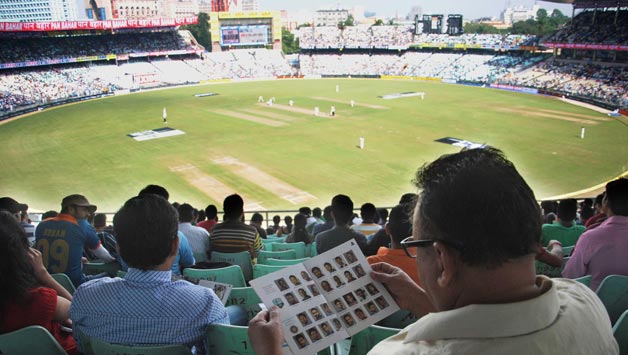
Bishan Singh Bedi made his Test debut at the Eden Gardens Dec 31, 1966 against the West Indies – a match infamous for a riot at the gallery © IANS (File Photo)

Kolkata:

The Cricket Association of Bengal (CAB) Tuesday released postage stamps to commemorate 150 years of the Eden Gardens, considered the home of cricket in this part of the world, as legends of the game nostalgically recalled their fond memories of the iconic ground.

The first day covers of the stamps, released under the India Post My Stamp venture, were brought out at a star-studded function on the historic ground, which hosted the World Cup final in 1987.

Postage stamps were also released to mark the contribution of CAB chief Jagmohan Dalmiya, former head of the world cricket governing body International Cricket Council (ICC) and its India affiliate, Board of Control for Cricket in India (BCCI).

The function was graced by the legendary spin trio – Bishan Singh Bedi, Erappali Prasanna and Bhagwat Chandrasekhar – as also former Indian skippers Ajit Wadekar and Dilip Vengsarkar, besides West Indies‘ fast bowling great Michael Holding. CAB joint secretary and ex-India captain Sourav Ganguly joined the celebrations midway into the programme.

Wadekar, who led India to historic series triumphs in England and West Indies in the early 1970s, said after Lords, the ground he relished more during his long cricketing career as player and coach was Eden.

“The facilities at Eden gardens was excellent, the people were very hospitable.”

Narrating a funny incident when he was India’s coach, Wadekar said he once offered England batsman Mike Gatting a prawn curry. “He liked it so much that he kept eating. As a result he could not go to the field the next day. His absence helped us win the match here.”

Bedi made his Test debut at the Eden Gardens Dec 31, 1966 against the West Indies – a match infamous for a riot at the gallery.

“I have fond memories of Eden Gardens. During my debut Test there was fire in the stands. There was a teargas charge. Players ran helter skelter. You can say that for me, it was baptism by fire,” he quipped.

Describing Eden as the most “electrifying stadium” in the world, Bedi said: “It is a proud momenta nostalgic moment for me to be here. Eden can give the Melbourne Cricket Ground [MCG] a lot to chase.”

Master legspinner Chandrasekhar, who had some great successes at the ground, said before making it to the Indian team, he had his first look at the Eden Gardens in 1962 during a visit to the city. “I was sitting in the gallery and thinking how I wish to play here!!”

Considered a lameduck batsman, Chandrasekhar said his most memorable moment in the Eden came in 1964, when he and Bapu Nadkarni put on 51 runs for the last wicket against England.

Prasanna, who prides himself as the son-in-law of Kolkata having married a Bengali, said the city and the CAB has never forgotten him. “Whenever I have come to the city, even for personal visits, the way I’m looked after is great.”

Comparing his hometown Bangalore to Kolkata, he said: “Banglalore’s hospitality is unbelievably low. The warmth and liking that Kolkata exudes has always floored me.”

Vengsarkar, who also went down memory lane, said ahead of his first Test experience at the Eden Gardens in 1978-79, he was told that one has to bat, bowl and field well at the ground. “As otherwise, the crowd will be after you.”

“I made sure I did well, I got my maiden Test hundred during the match against the West Indies. Later [in 1987-88] I scored another 100 on this ground.”

Holding said the 150 year association between cricket and Eden itself was commendable. “Not many associations, companionships or friendships last that long. But the fact that the association has lasted has given a fillip to the game here as also the CAB.”

Ganguly, for whom Eden was the home ground, said the stadium has through the years provided happiness, fun and satisfaction to the players, the crowd and sports administrators”.

source: http://www.cricketcountry.com / The Cricket Country / Home / Kolkata – November 11th, 2014

Murshidabad to get heritage hotels

Kolkata :

Murshidabad, 250 kilometres north of Kolkata and the erstwhile capital of undivided Bengal, offers an unparalleled treasure-trove of heritage to tourists, both domestic and international. But, thanks to years of neglect and indifference, the majestic buildings are falling apart and the art, crafts and cuisines of the past are fading into oblivion.

The Murshidabad Heritage Development Society (MHDS), which has launched the revival project for Murshidabad through conservation of buildings, running of museums of family heirlooms, exhibitions of lost arts and crafts, cuisines, handloom and textile, have now planned to initiate the next level of heritage campaigns — converting some of the palatial buildings into heritage hotels to attract tourists and generate a tourism-centric industry.

MHDS, along with the Archaeological Survey of India (ASI), on the occasion of World Heritage Week will hold a seminar at Palladian in Kolkata on November 22 to create awareness about the rich and vibrant heritage of Bengal encompassing architecture, arts and history and build a learning bridge between our past, present and future.

But, if you think that Murshidabad is only a hub of the Nawabi heritage, you should look beyond. Along with Nawabi culture, a powerful stream of rich traders and bankers, mostly from Rajasthan, had made its mark here. More than 400 years ago, they came, settled, prospered, built mansions, places of worships and even schools and colleges. They were known as ‘Sheherwali’. “We have identified 97 such heritage buildings with fascinating architecture and historical importance,” said Sandip Nowlakha, founder secretary of MHDS.

Murshidabad cuisine in general, or ‘Sheherwali’ cuisine in particular, is one such fascinating aspect of the heritage. “The love for food, especially all things sweet, is an apt description of any ‘Sheherwali’ cuisine. Food features prominently in the community, having evolved passionately through centuries of their existence in Bengal. ‘Sheherwali’ cuisine is possibly the finest vegetarian spread one can find, even in modern times,” said Siddharth Dudhoria, the founder president of MHDS.

The symposium aims at fine-tuning the heritage-tourism model being developed by the MHDS. It would put together experts across the country and bring forth some successful models. “Heritage can be a great revenue earner. Unless we drive this point home, we cannot make younger generation understand the value of our heritage. Several heritage buildings at places like Azimgunj, Ziagunj, Lalgola, Kathgola can be heritage hotels offering finest heritage experiences. Once heritage generates revenue and employment, the care for it would reach the zenith,” said Pradeep Chopra, president of MHDS.

source: http://www.timesofindia.indiatimes.com / The Times of India / Home> City> Kolkata / TNN / November 12th, 2014

Healing touch for Bible society

Kolkata :

Over two centuries, Bible House on Jawaharlal Nehru Road has played a pivotal role in translating and publishing the best-selling book of all time — the Bible. Ravaged over time, the Romanesque building has received superficial attention but never undergone a thorough repair. Now, various churches have come together to fund the first major restoration and offer the heritage building a fresh lease of life.

“The Bible is the reason why churches exist. Hence the significance of the building where the Bible has been translated and published for two centuries. It has served as the cradle of Christianity in the country,” said Bishop Ashok Biswas, chairman of the Kolkata auxiliary or chapter of Bible Society.

The Bible Society movement in India started from the Bible House, which was built in 1811. It is the second oldest Bible House in the world, built barely seven years after the Bible House in London. Till the mid-20th century, its jurisdiction extended up to Sri Lanka and Myanmar. It was the Calcutta Auxiliary Bible Society that was established in 1811 and the Bible Society of India came into being 33 years later.

Conservation architect Manish Chakraborti, who has been appointed the project consultant, is finalizing the plan for the building’s authentic restoration.

“A cast iron column in the building appears to be buckling under pressure and needs to be immediately repaired. Thereafter, the flooring system has to be strengthened by repairing the supporting wooden beams and runners, and splicing steel joist where necessary. A leak in the roof also needs repair. Woodwork and joinery of doors and windows will also be restored and the Burma teak wooden staircase will be cleaned and polished,” said Chakraborti.

Beyond restoring the building, the architect has chalked out a detailed plan for its appropriate adaptive reuse after detailed discussions with Bible Society officials. “Three fourth of the ground floor is occupied by a tenant. The rest of the building is occupied by us. This section will be internally revamped. On the first floor, a full-fledged modern auditorium with a seating capacity of 180 persons will be set up.

There will also be an archive, reading room, library and a special room for the translation board to meet. On the second floor, we will have a guest house with four rooms,” said senior auxiliary secretary Sajal Kumar Sarkar.

Another important aspect is the development of a fire-retardant store-room at the rear of the building for storing Bibles and Biblical texts published by Bible Society. Chakraborti expects the KMC Heritage Committee to give the project its nod soon.

source: http://www.timesofindia.indiatimes.com / The Times of India / Home> City> Kolkata / by Subhro Niyogi, TNN / November 11th, 2014

Raman memorial lies forgotten

Kolkata :

Few in Kolkata seem to remember Sir C V Raman on his 226th birth anniversary or the fact that he discovered the Nobel-winning Raman Effect at a small laboratory in this city.

The memorial on the campus of Goenka College of Commerce at BB Ganguly Street stood forlorn and deserted on Friday. A bust of the scientist had been garlanded and a bunch of agarbattis lay nearby. Nobody had bothered to relight them after they went out soon after being lit the first time.

“We haven’t seen any programme organized here. The college administration takes care of garlanding the bust and keeping the place clean. We sometimes use it as a shelter when it rain,” a student said.

When the ‘Hall of Scientific Fame’ was inaugurated in January 2013, it was announced that scientific discourse would be held there routinely. Replicas of Raman’s instruments were to be displayed. An enclosure exists but it is empty.

The original building of IACS, the first science research unit of India, was established during Bengal Renaissance where Goenka College now stands. It was here that Raman carried out his research between 1907 and 1933 that won him the Nobel Prize in 1930.

When Bidhan Chandra Roy was chief minister, he offered land to IACS at Jadavpur as the BB Ganguly Street plot had to be returned to the government so that Goenka College, which was in Presidency College, could become an independent institution. Raman was extremely unhappy on coming to know that the original campus of IACS hadn’t been preserved and resigned his membership.

In 2012, scientists from Kolkata appealed to then Prime Minister Manmohan Singh to build a memorial on the original site. This was inaugurated in 2013. “It’s just a memorial where no other activities are held. Little effort is made to preserve heritage in our country. We can’t carry out any activity at BB Ganguly Street as we are located quite far now. We can’t keep replicas there as the space is open,” said Prof Deb Shankar Ray, acting director, IACS.

source: http://www.timesofindia.indiatimes.com / The Times of India / Home> City> Kolkata / by Jayanta Gupta, TNN / November 08th, 2014