Category Archives: Records, All

Film with Kolkata touch in Oscar race

Kolkata :

When Bickram Ghosh and Sonu Nigam hit it off as collaborators four years ago, little did they know that a moment of creative spark will land them in the race for Oscar. The soundtrack of ‘Jal’, a film based in the Rann of Kutch, scored by the duo with a horde of Kolkata musicians on board, has been shortlisted for Oscar.

The soundtrack has several Kolkata musicians behind the scenes — such as keyboardist Indrajit Dey who has done the melody programming, and folk singer Dipannita Acharya, among others. This is also a first for Ghosh, who has featured in a Grammy-nominated album so far.

“The producer is excited as the movie has been shortlisted in the best feature film category as well. We have featured an international artist like Greg Ellis and the soundtrack has several Kolkata fingerprints on it. Shamik Guha Roy is the recordist along with Pramod Chandorkar in Mumbai. The sound is a marriage of Gujarati folk and voice music,” said Ghosh.

“Sonu is overjoyed. We collaborated first in 2010 and our album will be launched this week,” he added. The race is against masters like A R Rahman, who has two film scores on the list, and the legendary Hans Zimmer.

Dey, who has programmed the score for the melody, said: “It’s a marriage of desert folk and symphony and even oral percussion.” When asked about his chances, he replied: “It’s all about taste. There is folk raga music… I am more used to classical fusion and I find desert fusion closer to the heart and the grassroots. This could be an advantage in the race to the Oscars. Dipannita, who excels in various folk forms, has a god-gifted Gujarati folk texture and the effect is amazing.

source: http://www.timesofindia.indiatimes.com / The Times of India / Home> City> Kolkata / by Shounak Ghosal, TNN / December 13th, 2014

Sarat library without a librarian

Sarat01KOLKATA14dec2014

Factfile

Name:Sarat Smriti Granthagar
Estd: 1956
Address: Village and PO – Panitras, PS – Bagnan
No. of members: 1,029
Membership fees: Rs 2 per month for general members, free for children
Rare books: Collection of old volumes from Sarat Chandra Chattopadhyay’s personal library

Panitras in Bagnan is popularly known as Sarat Chandra Chattopadhyay’s home. Not only did Sarat Chandra live here, but his sister’s house was also in Gobindapur, in Bagnan. Sarat Chandra’s house in Panitras is now a tourist attraction and a heritage property. However, there are many other things in this village that are associated with the novelist. The local library is dedicated to him. It was named Sarat Smriti Granthagar by the local people, who started it in 1956. Sarat Mela is held on the ground adjoining the library.

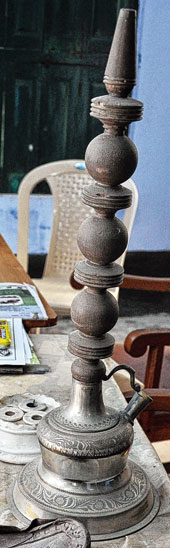
Some of Sarat Chandra’s belongings are also displayed at the library. An inkpot, a porcelain pen holder, an old pair of slippers, a torch, a hukkah and also a small wooden writing table. Although these have heritage value, the library authorities can only afford to keep these things stacked on top of an old cupboard. Interested people can take a look by bringing them down.

Sarat02KOLKATA14dec2014

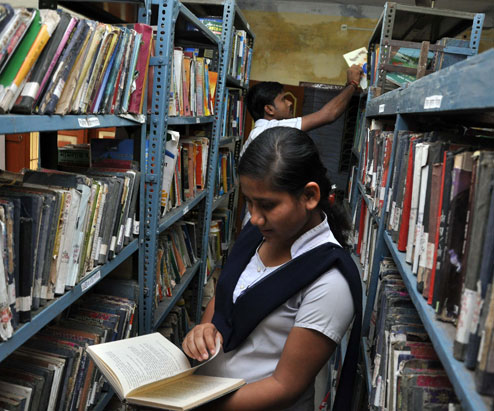
Sarat Smriti Granthagar was started by the local people who wanted to promote education in this area. Sarat Chandra being a popular figure at that time, they decided to name the library after him. It started functioning from a mud house in the locality. Some years later, in 1960, a permanent structure came up where the library now stands. In the same year, it became a government-sponsored library and in 1987 it was given the status of a town library. The total membership of the library now stands at 1,029 out of which only 235 are active members. The children’s section has 371 members, most of whom are students of the nearby schools, Panitras Boys’ School and Samta Sarat Chandra Uchha Balika Vidyalaya.

“Almost all students from the two schools come to this library for membership. Since we have a huge collection of reference books, they find it easier to study here,” said Gaurav Guria, a staff at the library. Students find this library useful since many old textbooks that have gone out of print, are available here. “Students studying in college or doing their post graduation in Bengali, often tell us that many of the texts here cannot be found in the market anymore,” said Guria. The library also has a career guidance section, which is useful to those studying for competitive exams.

Sarat03KOLKATA14dec2014

Although it is a popular library in this part of Howrah, Sarat Smriti Granthagar is operating without a librarian for more than two years. “The librarian and the assistant librarian retired some years back and both positions are lying vacant. A librarian was appointed for a year here in 2011, but after he left, no one has been appointed. The district library authorities are aware of the fact that there is no librarian at our library. However, they have not managed to appoint anyone in this position so far. So it is up to us to run the library on our own,” said Guria. The retired assistant librarian was asked to look into the running of the library, however, he could not continue due to illness.

The library has 11,245 titles. A collection of 133 encyclopaedias, gazettes and other books used by Sarat Chandra has been kept in this library. Copies of the Indian Quarterly Register and Indian Annual Register of 1920, 1925, 1929 and other years, are part of the novelist’s collection. Volumes of Nelson’s Encyclopaedia used by the author are also here. The books have been bound and preserved well. “The Howrah Municipal Corporation has taken initiative in 1999 to preserve these books,” said Guria.

Grants come regularly to the town library. It receives Rs 48,000 as annual grant. In 2010-11, the library received a computer from Raja Rammohun Roy Library Foundation (RRRLF).

source: http://www.telegraphindia.com / The Telegraph, Calcutta / Front Page> Howrah> Story / by Dalia Mukherjee / Friday – December 12th, 2014

The men of Bally Granthagar

Bally01KOLKATA14dec2014

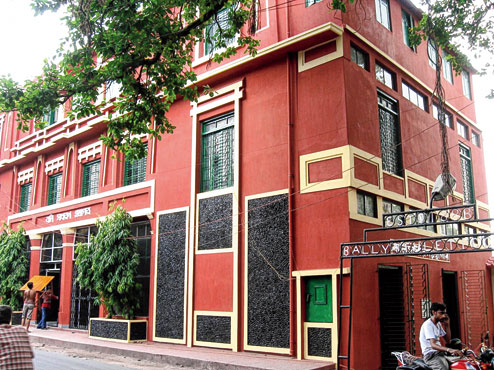
They are called ‘the men of the library’ because they are dedicated voluntary workers of the library. They help in cataloguing books, exchanging or issuing new books and even dusting the shelves — the members of Bally Sadharan Granthagar Karmisangha are as good as library staff, only they do it not for a salary but out of love for their local library.

Formed in Bengal in 1940, the group comprised dedicated library workers, who would help the library staff in all activities. The Karmisangha was formed under the leadership of Ratanmoni Chattopadhyay and the first director was Pravat Kumar Mukhopadhyay.

Over the years, Karmisangha has increased in size and activities. In 1981, when Bally Sadharan Granthagar became a government sponsored town library, Karmisangha was also registered as an association of library workers. Most of the library’s activities depend on the members of Karmisangha. The children’s section is entirely managed by these voluntary workers.

At present there are 88 members of Bally Sadharan Granthagar Karmisangha and any new entrant has to prove his or her dedication towards the library in order to be a member of the association. “Members are inducted on the basis of their dedication. Those who are regular visitors to the library and show interest in library activities are later inducted as members,” said Sumit Mukherjee, a member of the Karmisangha since 1975

Bally02KOLKATA14dec2014

“In our schooldays, our fathers or uncles would drag us to the library and make us remove the books and clean the shelves and also help in stock taking. We still do that once a year and also help the librarians and staff in indexing new books. The library is huge and the amount of work that accumulates is difficult for the staff to complete on their own,” added Mukherjee.

The traditional practice of inducting members includes taking an oath on Janmastami. “Janmastami is the foundation day of Karmisangha and new members are inducted on this day. A sloka from the Geeta on Karma is read out after which the new members take the oath,” said Utpal Kumar Mukhopadhyay, the secretary of Karmisangha.

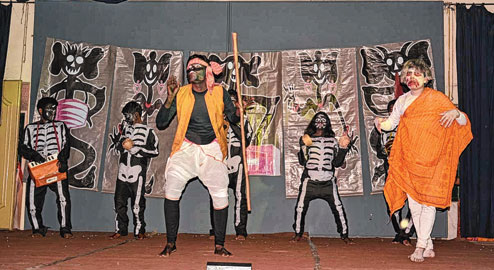
Karmisangha is celebrating its diamond jubilee this year with a variety of activities. A special screening of mountaineer trekker, Anindya Mukherjee’s cycling expedition from the Equator to the Tropic of Capricorn in Africa was done on one evening at the library seminar hall. The biggest event is the annual Soumen Charukala Utsav that continues for a month from November to December. A special workshop on masks will be held this year where school students will take part.

source: http://www.telegraphindia.com / The Telegraph, Calcutta / Front Page> Howrah> Story / by Dalia Mukherjee / Friday – December 12th, 2014

It’s time to celebrate for Calcutta Diocese

Kolkata :

The Diocese of Calcutta turns 200 this year and a year-long programme has been planned to celebrate the occasion, it was announced at the Bishop’s House on Wednesday. The Bishop, Diocese of Calcutta, Rt Reverend Ashoke
Biswas said a plot has been earmarked near St Thomas College, Kidderpore, for a human resource centre. A shelter
home will also be built.

“In past 200 years, through its 25 institutions, the Diocese has imparted education to millions of students in Kolkata and the suburbs. Our institutions boast of having Swami Vivekananda, Netaji Subhash Chandra Bose, Mrinal Sen and Manna Dey, along with many other luminaries, as our alumni,” Rt Revd Biswas said. “The Diocesan Board of Social Service covers 51 villages in South 24-Parganas and the primary focus is to mobilize women and youth by forming organizations to address food rights and livelihood issues. Youths are engaged in the entrepreneurship development and are also given vocational training,” he added while going on to list more programmes undertaken by the Diocese.

The announcement of the year-long celebrations came in presence of Revd Abir Adhikary, secretary and joint convener of the bicentenary celebrations, Revd Nigel Pope, the vicar of St Paul’s Cathedral church and celebrations convener and St James school principal T H Ireland.

The inaugural programme starts with worship service at St Paul’s in the afternoon, followed by a ceremony and cultural programme on Sunday. On February 7, a marathon for peace will be organized. March 7-8 will witness an inter-church cricket tournament. March 28 will see a women’s meet, where issues of empowerment and relevant topics will be discussed. Events will take place every month for exactly one year, when President Pranab Mukherjee is likely to be present for the closing ceremony.

Teachers and children will also enjoy their events, like an inter-school and pastorate basketball tournament in May, a children’s summer camp in June, inter-school football tournament in end-July, a Teacher’s Day celebration in September and a children’s fair on November 14.

source: http://www.timesofindia.indiatimes.com / The Times of India / Home> City> Kolkata / TNN / December 11th, 2014

Birla High teacher in Top 50 list for $1million education award

Kolkata :

Scared of Maths? Try synchronized dance and ludo, or even origami. Thanks to the idea, Hira Prasad, a city teacher, is in the fray for a mind-boggling $1 million global education award for marrying art and craft with mathematics.

Prasad, the assistant headmistress at Birla School for Boys junior section, is the only one from Kolkata and among three teachers in India to be shortlisted in the top 50 contenders for the big-ticket Varkey GEMS Foundation Global Teacher Prize. The final list was drawn from 5000-odd applicants from 120+ countries.

“Whenever I introduce a new concept, I’m tapping a weak part of the brain. Creative elements are of paramount importance when facing something that might seem difficult at first. So in Class IV, while learning factors and multiples, students — a group of six — are asked to dance to peppy music. They have to dance but maintain one line. So they learn that one is a factor of six and six is a multiple of one,” Prasad explained. Next, the students are asked to form two rows, then three, and they understand two and three too are factors of six.

Principal Mukta Nain said it’s not only a motivation for students but also for teachers. “She is a wonderful teacher, tech-savvy and full of innovation,” she said. “With the innovative methods, students are learning even while making a fruit salad,” added Loveleen Saigal, the headmistress of the junior section.

Prasad’s former students give full credit to her efforts. CA aspirant Nami Patni, 22, told TOI: “Initially, I wasn’t strong in Maths. But the novel method of teaching in our school was a turning point. In the CBSE Boards, I got 95 in Maths.”

Class VII student Naman Bhutoria said: “I used to be confused about addition-subtraction but when Ma’am used her unique teaching methods, it became clear. We were first introduced to lines and angles through yoga asanas. In my Class-VI annual exams I got 90%.”

source: http://www.timesofindia.indiatimes.com / The Times of India / Home> City> Kolkata / by Shounak Ghosal, TNN / December 10th, 2014

UK scholar on indigo trail

Kolkata :

UK museum officer Helen Bradley’s quest for truth has landed her not just in Kolkata, but given invaluable insight into the atrocities committed by her British forefathers on Indian peasants in the 18th century. What began as a causal interest in the founder of Bradley’s workplace and his birthplace could well turn out to be one of the most candid versions of the Indigo Revolt (1859-61).

Bradley is the development officer, Llandudno Museum, Wales. She is on a research assignment not only on early life of Francis Chardon, son of an indigo planter, or the momentous event in history but to especially explore the potential of the indigo dye. Bradley has got a British Council grant for coming to Kolkata, seeking collaborations between her museum and the Indian Museum and the Victoria Memorial Hall (VMH).

“We want to learn more about Francis Chardon and his family, and to understand our collections better with help from colleagues in India. We are carrying out some initial research into the Chardons in India and the plantations that they managed throughout Bengal,” Bradley said, ahead of her meeting with Jayanta Sengupta, curator, VMH, on bringing Welsh and Indian museums together. She has spent hours at the National Library, the Indian Museum, Neelhat House and the VMH, compiling records on the Indigo Revolt.

Llandudno Museum was established in 1926, and Chardon was born in (then) Calcutta in 1865, to Maria and Edouard. His father, Benjamin, cousins and uncles were all indigo planters in lower Bengal, Bihar and Bangladesh between 1830 and 1890.

Chardon was born at Gallis Hotel, Dharamtala, his mother, Maria, was born on Mangoe Lane, and his father, Eduoard, lived at 5 Dacres lane. Bradley, whose week-long trip (her first to India) ends on Thursday, has clicked photographs of all these places that will figure in an exhibition on indigo in 2016, as part of project “Indigo Trail”.

The exhibition will begin at Llandudno and travel to several locations. A landscape survey and research which will include the location and layout of indigo houses and plantations will complement the exhibition. “The idea is to tell the true story of indigo – with the tales of oppression and also its significance as a time when national consciousness was growing in Bengal. We want to examine the Indigo Revolt not just from the Chardon family’s perspective, but from the ryot’s point of view — to view the picture of exploitation,” Bradley said.

source: http://www.timesofindia.indiatimes.com / The Times of India / Home> City> Kolkata / by Ajanta Chakraborty, TNN / December 02nd, 2014

Tapan Raychaudhari, the renaissance man

Calcutta University V-C remembers the historian

Historians and students in Kolkata remembered Tapan Raychaudhari as a man who had all the qualities of a ‘Renaissance man’. The eminent economic and social historian Tapan Raychaudhari breathed his last on Wednesday in Oxford. He was 90 and had not fully recovered from a stroke he suffered last year.

Professor Raychaudhuri was a Reader in Modern South Asian History at St. Antony’s College, Oxford, from 1973 to 1992. An alumni of Presidency University, he completed his second D. Phil. in Oxford University in the late 1950s, and was the Emeritus Fellow of St. Antony’s College until his death. The winner of a Padma Bhushan in 2007 for his contribution to the study of history, Professor Raychaudhari authored several books on colonial India.

Among his many publications are Bengal Under Akbar and Jahangir, Jan Company in Coromandel, Europe Reconsidered: Perceptions of the West in Nineteenth Century Bengal, and The Cambridge Economic History of India (co-edited with Irfan Habib). He had also penned two autobiographies — Bangal Nama in Bengali and The World in Our Time in English.

Remembering his teacher at Oxford University, Vice-Chancellor of the Calcutta University Suranjan Das said Professor Raychaudhuri took equal interest in both academic as well as personal concerns of the student, a quality which is rarely found in a teacher.

Recalling an incident when his foodie professor personally accompanied him and another student to the dining hall to help shed their inhibitions in a new environment, Professor Das told The Hindu: “Professor Raychaudhuri never imposed his ideologies on us. Even if he differed with our arguments, he would think from our point of view and accordingly assist us to arrive at a logical decision. He treated criticism for his own work in an intellectual way.”

Although Professor Raychaudhuri migrated to the U.K. in 1970’s, he was passionate about research on Indian studies and helped establish the Centre for Indian Studies at Oxford University to encourage research on Indian studies to help dispel commonly-held stereotypes about India and Indian pluralism. Instead of focusing purely on research and analysis, the Centre would take a cultural approach on Indian studies to help understand Indian culture.

Professor Raychaudhuri was a strong critic of post-modernism and believed in empirical studies, the Vice-Chancellor said adding that his wife Pratima Raychaudhuri had played a critical role in supporting him in the domestic front.

source: http://www.thehindu.com / The Hindu / Home> News> Cities> Kolkata / by Staff Reporter / Kolkata – December 01st, 2014

Calcutta University confers Honoris Causa on President

Kolkata :

President Pranab Mukherjee was awarded Honoris Causa by Calcutta University on Friday.

After assuming office as the President of India, Mukherjee has received several offers of honorary doctorate from universities, all of which he has refused. He felt that as the President of India, he should not accept such offers. But, when it came from his own alma mater, his sentiments overwhelmed him, Mukherjee said.

“I thank the university for bestowing upon me the Asutosh Mookerjee Memorial Medal that was introduced a year ago to commemorate the 150th birth anniversary of the towering personality of Indian education,” he said at the CU convocation.

Recalling his ties with the varsity, Mukherjee said he studied at Suri Vidyasagar College. “I pursued law and two postgraduate degrees — modern history and political science — from CU. It is my good luck to have been associated with this esteemed institution,” he said. It might be mentioned that the President had also taught for sometime at Vidyanagar College in South 24-Parganas.

On the sidelines of the convocation, CU VC Suranjan Das shared an anecdote. “Much after he left the university as a student, a few years ago he requested us for duplicate copies of his registration card. I was amazed as he remembered his registration and roll numbers. We could immediately provide the copies,” Das said.

Governor Keshari Nath Tripathi, too, was present at the convocation where DSc was awarded to scientist Bikash Sinha and ENT surgeon L S Ojha. DLitt was awarded to former foreign secretary Muchkund Dubey. Among the eminent teachers awarded was historian Jayanta Kumar Roy for his substantial contribution to the university.

Later in the day, the President inaugurated the 150-bed facility of Institute of Neurosciences Kolkata at Mullickbazar — a PPP project in which the health department and KMC chipped in for the venture of three NRI doctors.

Mukherjee urged young doctors to embrace value-based principles while aspiring to be top professionals. “They have to remember that the nation invested in their education and they should never snap the sacred bond with the motherland while pursuing higher studies abroad.”

The President wanted a suitable rehab policy for patients with neurological problems, which is growing among the elderly populace with increased life span. “Elderly people are suffering from diseases like dementia, for which the need for medical aid and treatment cost are increasing. The dignity of patients is to be protected so that they are not isolated,” he said. He wanted campaigns highlighting treatment of neuro-psychiatric diseases.

source: http://www.timesofindia.indiatimes.com / The Times of India / Home> City> Kolkata / TNN / November 29th, 2014

‘Kolkata deserves Unesco tag’

Kolkata :

The word “Bengali” is most used in Penang, Malaysia, to refer to anyone of North Indian origin because the headquarters of Penang Presidency were located in Kolkata during the British Raj.

Such unknown facts about the heritage of Kolkata was up for discussion at the Indian Museum where the two-day annual conference of the Indian National Trust for Art and Cultural Heritage (Intach) ended on Saturday to discuss the impact of urbanization on heritage.

Many heritage conservationists and art historians converged at the Indian Museum to attend the event on Friday. Experts felt that Kolkata should find a place among the Unesco sites but unfortunately the fact that Kolkata was the centre from where the British Empire proliferated, hasn’t quite been marketed well.

“The city should make a consistent effort in getting its pivotal place in history registered in the world’s mindscape,” said historian and conservation architect from Delhi AGK Menon.

“There is a renewed interest in Malaysia in the contributions of this once capital of the British empire to the realm of art and architecture,” said Khoo Salma, a conservationist with the Penang Heritage Trust.

“Coming here almost feels like being where it all began, at least when it comes to colonial art and culture,” said Gwynn Jenkins, a cultural anthropologist working in Malaysia. Among others present were historian PT Nair, art historian Bhau Daji Lad Museum director Tasneem Mehta and art historian Saryu Doshi.

“There are heritage laws in place but they have no teeth. We are yet to see destroyers of heritage getting arrested. Promothesh Barua’s house got razed, the arch at the gateway of Bishop’s House was pulled down and nothing happened to the builder. This needs to be stopped,” said GM Kapur, Intach state convenor.

source: http://www.timesofindia.indiatimes.com / The Times of India / Home> City> Kolkata / TNN / November 23rd, 2014

Bengal honour for Baltic biker boy

LithuanianKOLKATA23nov2014

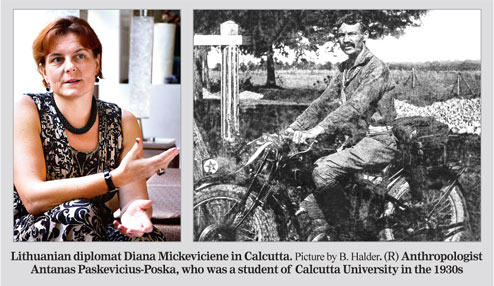
In the autumn of 1929, 26-year-old Antanas Paskevicius-Poska set off on a rather long motorbike ride. The Lithuanian would travel down south to Egypt, through Central Asia, with India as his final destination. From Iran, he took a ship to Bombay. In early 1931 he joined the University of Bombay, where he received his Bachelor degree in 1933. Then he shifted to Calcutta to collect material for his Masters. The five years he spent in India, including three in Calcutta, resulted in an eight-volume travelogue titled From the Baltic Sea to Bengal, other than accounts in the Lithuanian press about India and sundry friendships he struck with the intellectual elite.

The story will come full circle on November 28, when President Pranab Mukherjee takes the stage at the convocation of Calcutta University, Poska’s alma mater, and a posthumous DLitt is handed over to Laimute Kisieliene, Poska’s daughter.

“The Lithuanian scholar was brought to our notice by Diana Mickeviciene, a diplomat who came to us on behalf of the country’s embassy in Delhi a year-and-a-half ago to look for material on Poska. We found that he had studied in our anthropology department and had even worked on his PhD. This made us think of recognising his contribution to Indological studies,” said the vice-chancellor of Calcutta University, Suranjan Das. Rimantas Vaitkus, Lithuania’s vice-minister of science and education, and ambassador Laimonas Talat-Kelpsa are flying down too.

Mickeviciene, who has just returned to Lithuania, had spoken to Metro when she was here. “Poska was Calcutta’s ambassador in Lithuania. It is because of him that Lithuanians know about the city. He also worked at the anthropology laboratory of the Indian Museum on racial anthropology and started translating the Gita. Lithuanian is the closest living sister language to Sanskrit,” she said.

Poska, she pointed out, had also spent some time in Santiniketan as a friend of Laxmiswar Sinha, who, like Poska, was a practitioner of Esperanto, a constructed international language. Here he came in touch with Tagore and translated some of his poems into Lithuanian.

Among his friends was the linguist Suniti Kumar Chatterji, who became interested in the Lithuanian and Baltic culture. The monograph of his comparative research of Indian Vedic and Baltic pagan rites, Balts and Aryans, was dedicated to Poska. Chatterji even travelled to Lithuania twice, Mickeviciene added.

Poska met Mahatma Gandhi twice, in Bombay and in Allahabad, and conveyed to him the support of the Lithuanian people for India’s Independence. “Gandhi had gifted him a tablecloth which he took with him even to Siberia, where he was sentenced in 1945 for refusing to comply with an order to destroy books published before the Soviet occupation,” she said. He was the head of the library department of the Lithuanian SSR commissariat then. Most of his archives were destroyed.

Poska’s doctoral research remains unfinished business, though. He did his PhD thesis in physical anthropology under professor Biraja Sankar Guha. It was sent to London for the measurements of skulls to be checked. Poska’s diary mentions that the paper was sent to the British Museum in 1936, and he was planning to go to London to defend his thesis but the delay in his return journey from India, financial difficulties and finally the outbreak of World War II came in the way.

When Chatterji visited Poska in Lithuania in 1966, he had volunteered to retrieve his dissertation from London and to accord the scientist a PhD from the university. However, though Poska’s diary mentions Chatterji’s letter informing him of granting him the degree, and Chatterji himself addressing him as “Dr. Antanas Poska” in the preface to Balts and Aryans, the university archive has no such record.

“Without the defence, his PhD could not have been completed. All we have is the title (‘Physical Affinities of Shina-speaking people of the Western Himalayas’). But we all agree that he deserves recognition,” said vice-chancellor Das.

source: http://www.telegraphindia.com / The Telegraph, Calcutta / Front Page> Calcutta> Story / by Sudeshna Banerjee / Sunday – November 23rd, 2014