Category Archives: Records, All

A Classical Death

Once considered its mecca, classical music festivals are struggling to stray afloat in Kolkata. Tathagata Ray Chowdhury explores the reasons for the slow demise of the once thriving live music scene in the country’s ‘culture’ capital

Kolkata :

Not too long ago, Kolkata used to be steeped in the culture of live classical music. For the connoisseur, there was a plethora of fests to attend; for practitioners, a good show here, more than any where else, meant finally gaining acceptance among peers, perhaps even a chance to reserve a place in the pantheon of the greats. Cut to the last 10 years or so, and it’s clear that the once thriving culture is on the wane, with most classical music festivals staring at an uncertain future.

Even a couple of decades back, the city used to play host to a number of prestigious classical music gatherings. Now, only a few survive. Even fewer manage to do so with aplomb. Apart from a couple of names, most classical festivals are struggling to find sponsors, or are in the throes of a slow death.

But why this decay in the country’s “culture capital”? In a nutshell, it’s to do with the nature of classical music’s patronage. To start off with, it was the prerogative of the moneyed class, supported by zamindars and rajahs who truly valued it and understood its nuances. With the abolition of the feudal system, classical music finally travelled to the masses. Ironically, it was this that sounded its death knell.

In 1856, Lucknow’s exiled nawab, Wajid Ali Shah, had brought with him to the city the rich culture of classical music and established it in this part of the subcontinent. His court musicians — most notably Ustad Basat Khan and Ustad Sadiq Ali Khan — played a key role in establishing the genre in the city and its surroundings. By mid-20th century, Kolkata became a mecca for connoisseurs of this branch of the fine arts — so much so, that a number of stalwarts began to either settle down in the city or make it their second home.

Ustad Dabir Khan, the last khalifa of the Tansen family, made Kolkata his home, and other legends of the time — Ustad Allauddin Khan, Ustad Hafiz Ali Khan, Pandit Ravi Shankar, Ustad Vilayat Khan, Ustad Ali Akbar Khan and Ustad Amjad Ali Khan — all found a second home in this city. To all of them, this was the city where the real qadar daans (connoisseurs) lived. There were the music rooms — jalsaghars — of north Kolkata aristocrats, where both budding and prodigious musicians used to come for what then used to be called their “national audition”. And it was usual practice for the honorifics “Ustad” or “Pandit” to be bestowed on performers only after they gained enough acceptance in Kolkata’s aristocratic circles.

It is a matter of concern that a festival of the pedigree of All Bengal Music Conference is struggling to stay afloat nowadays. The first edition of the conference — on December 27, 1934, at Calcutta University’s Senate Hall — marked the day classical music breached the confines of north Kolkata’s aristocratic music rooms and reached the public. It was high time the lofty walls surrounding classical music were broken down: soon, the landed aristocracy would cease to exist, the country would become independent, and the zamindars would no longer be able to patronize the art form.

Sensing all this, Rabindranath Tagore, who was presiding over the event, had said: “We will have to keep in mind that Tansen and others were able to gift a certain form of music only because the royal opulence of the Mughal Empire could help them. That surrounding is no more there.”

Seventy-five years down the line, All Bengal Music Conference had to collaborate with another organization to hold this year’s event. “All Bengal Music Conference could not host any event because of lack of patronage and sponsorship for about 52 years,” says Robin Paul, general secretary of the conference and the founding secretary of Jalsaghar, an organization that promotes classical music. “It was Pandit Ravi Shankar who asked me to do whatever possible to revive the glorious organization. Pandit Asutosh Kanan also helped me revive it. When I associated myself with it in 2004, we could host events for a few years. But it is in very bad financial shape again. It is no longer in a position to host a soiree on its own. That is why it had to collaborate with ITC Sangeet Research Academy to host the music festival this year. Now that Babulal Ghosh, the last scion of the Pathuriaghata Ghosh family, who used to look after the once-famous music festival, also passed away a few weeks ago, I do not really know what the future holds.”

While the conference is staring at a possible extinction, many other music circles have either stopped functioning long ago or are counting their days. The reason is mainly to do with finances, particularly its lack.

Dipankar Sen, of the now defunct Calcutta Music Circle, has another take on the matter. “Organizers and sponsors often promoted a particular artist or gharana at the expense of others, and that also played spoilsport,” he feels. “Many organizations often used their platform to promote only a particular artist, or artists of one gharana. Naturally, connoisseurs started losing interest, as those concerts became repetitive.”

The lack of proper musical understanding by the sponsors — considered crucial in this genre — has also been a major issue. Tabla maestro Ustad Sabir Khan, who has been conducting an annual soiree under the banner of Ustad Keramatullah Khan Memorial Music Society for the past 28 years, has experienced this problem first-hand. “People who don’t know the first thing about music are directing organizers about which artist should perform, and who the accompanist should be on the tabla. It is not true that the money is not there. Corporate houses will happily spend crores to bring a Bollywood star on stage. But when it comes to classical music, the interest is just not there,” he rues.

Pandit Satish Vyas, of Gunidas Sangeet Sammelan, agrees. “Those who have money move toward sponsoring Bollywood events, as such events draw the crowds. But classical music traditionally catered to a niche crowd. It was never quite a mass thing. There was a time when corporate houses used to consider such kind of sponsorships a part of their corporate social responsibility. But the MBA guys who run corporate houses today first think about what they’ll get in return for sponsoring an event. This has diluted things. They take complimentary passes and give those to people who are not even interested in classical music. The front rows, thus, remain vacant these days, while the real music lovers wait outside for a pass to enter the venue.”

Vyas feels the media has a big role to play in introducing the masses to the stalwarts of classical music. “There is very little coverage for classical music events in most newspapers of the country,” he complains. “Today, there are also very few people in the media who can write with authority on classical music. So, it is natural that a five-year-old boy would know a Sachin Tendulkar, but not a legendary maestro. When Ustad Ali Akbar Khan passed away, there was no news in Mumbai. It was the same when Ustad Vilayat Khan died. Can you imagine that? They were like gods in the music industry. How would today’s sponsors come to know about great masters or budding talents if the media do not come forward to introduce them?”

Robin has a similar observation. “It’s difficult to get renowned artists on stage, as there is no one to sponsor us. We are running on donations. Some newspapers only write about some particular artists. There has been a fast and steady decline of general media coverage of classical music and musicians,” he says.

Indranath Pal, joint secretary of Uttarpara Sangeet Chakra, which completed its 59th annual soiree on the outskirts this year, said they were also struggling to make ends meet. “Our music festival was once as popular in the city and the suburbs as the Dover Lane Music Conference. But we are increasingly finding it difficult to sustain ourselves in the absence of sponsorship and media coverage — the two things that helped Dover Lane survive healthily. It is all the more difficult to find a sponsor in a mofussil town such as Uttarpara,” he says. Indranath also points to another very interesting aspect of the difficulty the organizers face in getting sponsors. “Most products available in the market are meant for young consumers. But most of those who come to attend a classical music concert are aged 50 and above. It is obvious that corporate houses are not interested in sponsoring events for this age group,” he says. An event manager, who did not want to be named, says: “Gone are the days of corporate social responsibility. In today’s corporate terminology, sponsorship of an event is termed as a ‘casual, soft advertisement’. The corporate houses are just not interested spending big money on it.”

Even the organizers of Dover Lane Music Conference — counted as one of the most prestigious in the country — admit that they face difficulties in promoting young but promising artists, primarily because of sponsorship issues. “The problem we face in getting sponsors is much less compared with what others face, because we have already established Dover Lane as a brand. Still, it is difficult for even us to present on stage an artist who is a very good performer but not famous, as sponsors prefer only some big names. A quantum leap in the remuneration of artists has also had an effect. Artists now charge about 300 to 500% more than what they used to charge even about two decades back,” says Bappa Sen, organizing secretary, Dover Lane Music Conference.

Vyas, who started the annual soiree of Gunidas Sangeet Sammelan in Mumbai in 1977, also feels that it would have been very difficult to keep the organization afloat, had he been settled in Kolkata. “It would have been impossible to look for a sponsor in Kolkata. So many external factors influence things in Kolkata, such as the political situation and so on. But this is not the case with other areas.”

These “external factors” have influenced the concert circuit in Kolkata — so much so that most music festivals that were once famous are now remembered only in the pages of old souvenirs or connoisseurs’ albums. Now, there are only a handful of concerts in Kolkata that have pockets deep enough to continue even in the face of losses. While the Shastriya Sangeet Sammelan, held at Rabindra Sadan every winter, is the only such event supported by the state government, in the private sector there are perhaps only the Ramakrishna Mission and ITC which have been running shows successfully without caring much for sponsorship. The spectre of financial losses looms large on almost all other concerts.

Sutanuti Parishad of north Kolkata, which was established in the early 1990s at the insistence of then mayor Kamal Basu, has also been conducting soirees every year despite incurring heavy losses. “We survive on donations. But we don’t know how long we will able to continue like this. The future of the about a century-and-a-half-old tradition of hosting classical music concerts in the city looks bleak if the government or private companies do not come forward to support us,” Subrata Dhar, the parishad’s secretary, signs off.

source: http://www.timesofindia.indiatimes.com / The Times of India / Home> City> Kolkata / by Tathagata Ray Chowdhury, TNN / February 21st, 2015
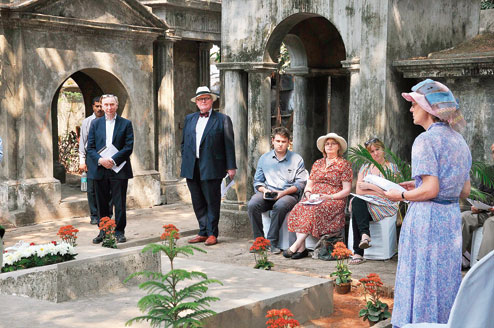
New start for grand lady – Descendants rededicate gravestone of botanist

Lady Emma addresses the small gathering at the ceremony to dedicate the gravestone of her ancestor, Lady Anne Monson, at South Park Street Cemetery on Thursday morning. With her are Michael Dorrien Smith, Lady Emma Windsor-Clive, Isabella Monson (seated) and JM Robinson and James Miller (wearing panama).  Picture by Anup Bhattacharya
Lady Emma addresses the small gathering at the ceremony to dedicate the gravestone of her ancestor, Lady Anne Monson, at South Park Street Cemetery on Thursday morning. With her are Michael Dorrien Smith, Lady Emma Windsor-Clive, Isabella Monson (seated) and JM Robinson and James Miller (wearing panama).
Picture by Anup Bhattacharya

Calcutta :

Sleepy, leafy South Park Street Cemetery could have turned into a scene from the TV series Downton Abbey on Thursday morning as a small group of Englishmen and women gathered at the twin graves of Lady Anne Monson and her second husband, Colonel George Monson, for a quiet and solemn ceremony as a chorus of koels sang incessantly.

The frail, behatted Lady Emma Monson was with her granddaughter Isabella, her friend, the youthful Michael Dorrien Smith, a descendant of Lord Clive – Lady Emma Windsor-Clive – and two friends, architectural historian J.M. Robinson and art historian James Miller.

Lord Clive was a British officer who defeated Siraj-ud-Doula in the Battle of Plassey in 1757 and consolidated the East India Company’s rule.

Lady Emma was there to dedicate a tombstone inscription to her ancestor, Lady Anne Monson, who was a botanist, an exceptional figure in the 18th century, and great granddaughter of King Charles II.

Charles II, king of Great Britain and Ireland (1660-85), was restored to the throne after years of exile during the Puritan Commonwealth, according to Encyclopaedia Britannica. The years of his reign are known in English history as the Restoration period.

The genus Mansonia was named by Swedish botanist Carl Linnaeus in honour of Lady Anne. Colonel Monson was a member of the Supreme Council of Calcutta and an enemy of Warren Hastings. He died six months after his wife in September 1776. An inscription above his tomb was erected in 1908 by the Calcutta Historical Society. But Lady Anne’s tomb remained without an inscription. Both graves are quite nondescript by the monumental standards of this cemetery.

A wreath was laid on the spruced-up grave and newly inscribed tombstone by Ranajoy Bose, executive member, Christian Burial Board, with Ash Kapur, president of the Association for the Preservation of Historical Cemeteries in India, Bertie Da Silva, vice-principal of St. Xavier’s College, and Christina Mirza, who heads the English department of the college. Lady Emma said in her address that when she first visited Calcutta in 2012, both graves were in ruins and she wished to restore them. So she got in touch with the British Association for Cemeteries in South Asia (BACSA).

She thanked all concerned for refurbishing them. Both graves have been restored by an accredited architect and its surroundings have been cleared and neatly marked with brick dust. The service was conducted by Reverend Nigel Pope, vicar of St. Paul’s Cathedral.

source: http://www.telegraphindia.com / The Telegraph, Calcutta / Front Page> North Bengal> Story / A Staff Reporter / Saturday – February 14th, 2015

Grandniece continues Nivedita’s quest for truth

Kolkata :

When a 73-year-old woman stepped into Mayer Bari — Maa Sarada’s house at Bagbazar — everybody was busy with their daily chores. Sight of tourists is nothing unusual for them. But when they came to know that the lady was actually the grand-niece of Sister Nivedita, there was no leaving her alone. For rest of the day, a strong crowd milled around Selenda Margot Giardin, who came all the way from Newbury at Vermont in the US. By evening, it was a day well-spent for Saradha Math monks, students of Nivedita School and Selenda as well.

“I am fascinated. I feel like a celebrity,” beamed Selenda, who was the centre of attraction at Sarada Sarani on Monday. The pangs of Parkinson’s and acute arthritis could not dissuade Selenda from embarking upon the long journey in quest of “truth, love and God”.

Selenda didn’t know how to react when people touched her feet. Anushuya, a student at Nivedita School where Selenda led a prayer, said: “For us, it’s like being with Bhagini Nivedita herself.”

Some found the same eyes in Selenda, who shares her middle name (Margot) with her Irish grand-aunt Margaret Elizabeth Noble, whom Swami Vivekananda christened Nivedita. “My middle name is ‘curiosity’. From the age of seven, when I first read at the church that ‘God is Love’, I have been curious about God. The search continues…and now I am here, searching…” reminisced Selenda, who runs her choir at the United Church of Christ at Vermont.

The septuagenarian will be attending a host of programmes over the week. She will spend two days at Belur Math before flying back to the US on Saturday. Her son John Grow is accompanying her.

Selenda let out more about herself and the Nobles as she spoke to TOI: “Ever since I was a child, I remember my mother, Isabel Noble, telling me stories of her aunt who pursued her quest for truth and worked for the people living in this faraway land.”

She gifted the monks of Sarada Math the handwritten notes by Sister Nivedita circa 1909 and a replica of Michaelangelo’s Pieta, which Sister Nivedita had gifted Selenda’s mother Isabela. These items will be on display at the upcoming Nivedita Museum inside Nivedita House.

Mayer Bari head Swami Viswanathananda said: “Selenda’s amazing. We never imagined that a descendent of Sister Nivedita would come here after all these years.” Another monk Prabuddhaprana shared the euphoria: “We are glad to discover the Sister’s family at last.”

source: http://www.timesofindia.indiatimes.com / The Times of India / Home> City> Kolkata / by Ajanta Chakraborty, TNN / February 17th, 2015

ZSI plans digitisation of specimens

A view of the Alipore Zoo in Kolkata / The Hindu

Launching its centenary celebrations, the Zoological Survey of India (ZSI), India’s premier taxonomic research institute, is aspiring for an ambitious project of digitisation of its millions of specimens, besides identifying the gap areas in taxonomy.

Started in 1916 with four scientists and seven other employees, the ZSI, in the past 99 years, has identified 96,000 species in India, considered a mega-diversity country possessing seven-eight per cent species of the world.

Speaking to The Hindu, ZSI Director K. Venkataraman said on Saturday that one of the primary future initiatives was networking with taxonomist and taxonomical research institutes in the country and identifying the gaps in taxonomy.

Scientists at the ZSI pointed out that despite the identification of 96,000 species, only 10 per cent of the country’s biodiversity and 50 per cent of the ecosystem had been explored. They also faced the challenge of a large number of species in the wild becoming endangered and even facing the threats of local extinction.

Commenting on the rich repository of biological specimens in collection with the ZSI, Mr. Venkatraman said the ZSI was the largest repository of fauna in Asia. “Over four million zoological specimens, including 17,000 type specimens, are maintained in the national zoological collections of the ZSI. This will the first set to be digitised,” he said. This would be followed by preparation of a database of temporal and spatial distribution of specimens over 100 years of the ZSI, he added.

source: http://www.thehindu.com / The Hindu / Home> News> Cities> Kolkata / by Special Correspondent / Kolkata – February 15th, 2015

‘Bodhon’ bags double US prize

Kolkata :

Barshan Seal bagged the best actor’s prize end-January at North Carolina State’s Global Film Festival 2015 for his performance in ‘Nabalok’ (The Innocent). A couple of days ago, the production team of ‘Bodhon’ got an official notification that it has got the ‘best film’ and lead actor Arpita Chatterjee has bagged the ‘best actress’ award. With this, all three top awards at the American festival has come to Bengal.

“It was an official selection in Indian Panorama at IFFI, too, and that was prestigious as well. But this double award is a big boost too,” said debutant filmmaker Ayananshu Banerjee, who got top ranks in both Madhyamik and Higher Secondary before graduating from IIT-Kharagpur.

For Arpita, it’s welcome news. “An award doesn’t define an artist. It’s a nice feeling and it will help me strive for perfection. It will be a driving force,” she said. Asked if the limited number of films she works in is a conscious decision, she responded: “I don’t do films out of financial compulsion. So this acts as an elimination process. Also my priority is my son, so I keep my schedule tuned to him.” ‘Bodhon’ is a film about a woman on her journey to rediscovering motherhood.

Arpita said her long-term plans include returning to the theatre stage. “I’ll wait for a good film script. And, in the next five years, I will be able to devote a good portion of my time to theatre. There are several young theatre groups coming up which are doing good work. It’s a very good time to be in the theatre world and theatre has always been an integral part of Bengal. It’s where any actor gets the best ground to hone his or her skills. It is equivalent to what ‘riyaz’ is to a vocalist,” she told TOI.

Asked about the state of affairs in Tollywood, she exclaimed: “A large number of films are releasing now, but the market space hasn’t increased. Some halls have shut down. This is a terrifying situation. We have to increase the number of halls, be it single-screen or multiplex. Because of lack of space, there is no breathing space for films releasing in quick succession.”

source: http://www.timesofindia.indiatimes.com / The Times of India / Home> City> Kolkata / by Shounak Ghosal, TNN / February 12th, 2015

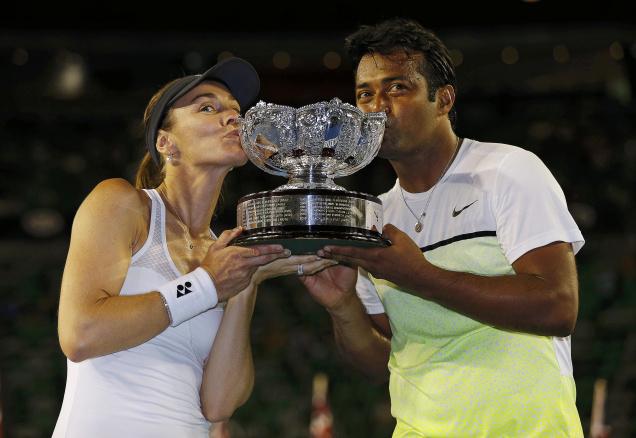
Sun never sets on Leander

Leander Paes, Martina Hingis / Reuters

Leander Paes in his long and illustrious career has played with nearly 100 different partners in doubles and recently with Martina Hingis

There seems to be no expiry date on Leander Paes career. At 41, he is going as strong as ever, picking Grand Slam titles almost at will stunning the game’s pundits, few whom were willing to write him off as a potent force in the doubles. The Indian ace enthralled, legion of his supporters and proved his detractors wrong when he won his record 15th Grand Slam doubles title at the recent Australian Open, partnering game’s another great, Martina Hingis in the mixed doubles event.

It took all the persuasive charm of Leander to get the Swiss ace and former Women’s World No.1 Martina Hingis, who came out of retirement in 2013, to team up with him and as he says, “it took almost two years.” And when it happened, it was sheer magic. The two champions produced vintage tennis to win the mixed doubles crown.

Incidentally, Hingis had won a mixed doubles title at the Australian Open in 2006 pairing with Mahesh Bhupathi, Leander’s former men’s doubles partner. But winning with Leander Paes indeed has been a special moment for Martina Hingis, who had won three singles (from 1997 to 99), four doubles and two mixed doubles titles at the Melbourne Park. It was Leander Paes’ third Australian Open mixed doubles title and he had earlier won it in 2003 with Martina Navratilova of the United States and with Cara Black in 2010. In a career tally of seven mixed doubles titles, he has won three with Cara Black of Zimbabwe, two with Martina Navratilova one with Lisa Raymond of the US and now with Martina Hingis. In men’s doubles, he has won Grand Slam titles and maximum of three with Mahesh Bhupathi.

A delighted Martina Hingis, called him as a ‘perfect patner’ while Leander, acknowledged her role saying “we had a great chemistry and understanding”.

Leander Paes in his long and illustrious career has played with nearly 100 different partners in doubles, ranging from legend like Martina Navratilova (in mixed doubles) to a relatively unsung Vishnu Vardhan (men’s doubles). With whomsoever he plays, Leander has the ability to transfer his kinetic energy and positive attitude to his partner and that’s one of the main ingredient of his success in doubles. Leander also makes sure that his weakness, such as lack of a very powerful serve, is compensated by a strong partner, who serves strongly and a great hitter, such as Mahesh Bhupathi and Radek Stepanek

There is lot more to it in doubles, than finding a good partner. The well-known tennis coach, M. Krishna Kumar of Kinesis, who is a USPTR certified Professional and an avid admirer of Leander’s game, lists Leander’s lightning fast reflexes and good court craft as his big asset. Krishna Kumar also picks up Leander’s uncanny court craft as big plus point. “He has an exquisite court craft and Leander has the ability to pick the ball and find the right gap and angle to put it away for a winner. For that you need speed and timing and he has that ability to do that with an amazing ease,” says the coach.

Leander is a great team man, adds Krishna Kumar. “In doubles you need to complement each other well and communication is very important and Leander does that very effectively with all his partners.” Tennis fans in Bengaluru had a great time during the Davis Cup match against Serbia few months ago, watching Leander turn a losing doubles tie into a winning one with Rohan Bopanna. Two sets down, the Indians came back from cold to win that tie, with Leander taking charge of the show from the third set. Though Leander and Rohan won the doubles tie, India lost the rubber 2-3. But Leander made that doubles contest a memorable one. That never-say-die and taking charge in crunch situations makes Leander arguably the best doubles player in the World.

As years roll by, Leander’s magical show goes on and on.

source: http://www.thehindu.com / The Hindu / Home> Features> MetroPlus / by Kalyan Ashok / February 08th, 2015

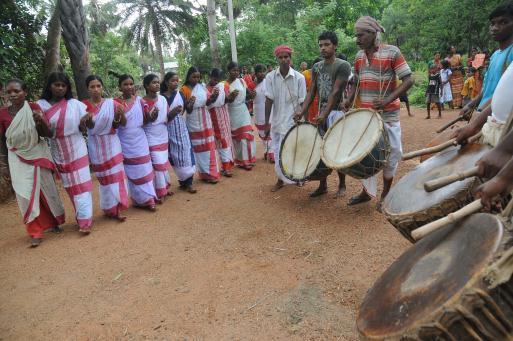
In six decades, Santhals have turned away from agriculture

The Santhal community is celebrating a festival at Bhalukshole village in Paschim Medinipur district of West Bengal. Photo: Arunangsu Roy Chowdhury


Study conducted by Anthropological Survey of India.

Research undertaken by the Anthropological Survey of India (AnSI) has pointed to a shift in the socio-economic and cultural life of tribal communities like the Santhals over the past few decades.

A recent study conducted by the AnSI at Kuotala village in West Bengal’s Birbhum district, has revealed that in six decades the economy of the village has shifted from agriculture to one of menial work. Most of the men from the village now work as daily labourers, rickshaw pullers, gardeners and caretakers at private residences. The women are engaged as maids in the various households in the region.

Interestingly, a seminal work on the Santhals of the village by Nabendu Datta Majumdar titled ‘The Santhal — A study in cultural change,’ based on the research he carried out in the 1950s, clearly states that the tribal society was primarily agrarian.

“The principal economic activities of the Santhals of Kuotala and adjoining villages are agriculture, hunting, fishing, rearing of domestic animals and day labour. Agriculture is the chief source of livelihood…” the book published in 1956 stated.

“However, now, the village economy has transformed with the rise in demand for cash in hand at the end of the day. Menial work in various developmental activities run by government or non-government organisations is being sought after by the villagers of Kuotala,” Shyamal Kumar Nandy, Research Associate, AnSI, Kolkata told The Hindu.

Along with the economic activities a change has also come about in the cultural and religious practices of the tribals. While Mr. Majumdar’s book clearly referred to a strict hierarchical order in the society, headed by a chief known as Manjhi, the latest research points to a weakening of the social structure among the Santhals.

“Some members of the community are not willing to hold the post of the Manjhi as they feel that they will have to devote a lot of time to community activities and not be able to make sufficient money,” Mr. Nandy said.

The researchers have come across an instance where the Jaherthan or the sacred grove of the Santhal community had to be shifted because of construction work carried out by the Visva Bharati, Kakuli Chakraborty, head of office, Eastern Regional Centre of (AnSI) told The Hindu.

Jaherthan — a cluster of trees — is considered by the Santhals to be the abode of their principal deities.

According to the publication of Mr. Majumdar, Kuotala dates back to 1865, long before the central university was set up, when a few immigrant Santhal families from the Santhal Parganas had settled there.

According to the book, in 1938, the land in and around Kuotala and the adjoining Santhal villages were purchased by Visva Bharati from the local zamindar of Surul and the Santhals automatically became the tenants of Visva Bharati.

source: http://www.thehindu.com / The Hindu / Home> News> National> Other States / by Shiv Sahay Singh / Kolkata – February 05th, 2015

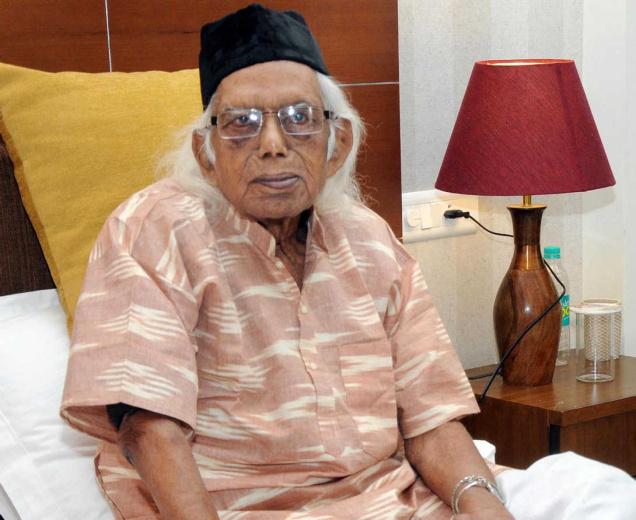
If you missed Tansen, listen to his descendant

Abdul Rashid Khan will perform at Sursagar’s ‘Living Legends and Budding Masters’ series at Alliance Francaise on January 30 at 6.30 p.m. — Photo: Sampath Kumar G.P.

Ustad Abdul Rashid Khan (107), based in Kolkata, was the oldest living legend to be bestowed Padma Bhushan

He is the direct descendant of Tansen and has been performing for 75 years. He has performed nearly 3,000 concerts and composed 2,000 bandish , which are being sung by leading Hindustani musicians. In 2013, when he was conferred the Padma Bhushan, he was the oldest living legend to be bestowed the honour.

“I am Ustad Abdul Rashid Khan, 107 years young,” declares the maestro jokingly. “Some members of my family have lived up to the age of 110 and beyond,” he says.

Born in 1908 at Salon near Rai Bareli in Uttar Pradesh, Rashid Khan is the son of Chote Usuf Khan of the Gwalior Gharana. He is the 23{+r}{+d}generation of Tansen’s family and traces his ancestry to Surat Sen, one of the maestro’s four sons.

“My father, and uncle Bade Usuf Khan, trained me in a 10-hour schedule that was followed by a four-hour riyaaz (practice) every day for 22 years.

“Only when I touched 30 did my gurus allow me to step on a stage. That was the kind of integrity we followed,” says the Ustad, who once had Zakir Hussain, then 16, playing the tabla.

After obtaining a degree from Allahabad University, Rashid Khan went to Rae Bareli. He performed a slew of concerts in every nook and corner of India. “I have performed at every maharaja’s court in pre-Independent India. Rae Bareli alone had 22 maharajas and each would demand a particular raag ,” he says recollecting the traditional four to five hour concerts that were in vogue then.

In 1991, he was specially invited by the ITC Sangeeth Research Academy in Kolkata to take over as the senior guru. He has been teaching there for the last 25 years. His traditional compositions have been recorded by the BBC and Iraq Radio.

The UP Sangeet Natak Academi and the ITC Sangeet Research Academy have more than 1500 compositions of the ustad in their collection.

And the secret of his longevity?

“All we know is that he prays five times a day,” says grandson Bilal Khan, who accompanies the ustad on the tabla.

source: http://www.thehindu.com / The Hindu / Home> News> Cities> Bengaluru / by Ranjani Govind / Bengaluru – January 29th, 2015

Treasures of Bengal Renaissance on display till Jan 28

Kolkata :

An exhibition of rare colour etchings, manuscripts, letters and documents at the Sadharan Brahmo Samaj Library at Bidhan Sarani has brought alive the Bengal Renaissance — the days of Raja Ram Mohan Roy and Rabindranath Tagore, the two doyens of Bengal’s socio-cultural resurgence.

The exhibition, which will continue till January 28, is part of the 185th Maghotsava celebration, an annual event of Sadharan Brahmo Samaj. Some of the artifacts being exhibited are rare etchings that capture early-19th century life and rituals in Kolkata. None of these etchings, done by European artists, were formerly available in India. Art restorer and archivist Ganesh Pratap Singh painstakingly bought these back from different international auctions.

“These are our treasures of our country, lying with personal collections mostly of Europeans and Americans. Once they are up for sale, I don’t lose a moment in buying them back,” said Singh, who for the first time is showcasing his treasure trove, which includes Tagore’s rare photographs. An original deed of a loan agreement of Tagore during the 1900s is also part of the exhibition. “Tagore probably took the loan for his family business,” Singh said.

The colour etchings are the most remarkable portrayals of socio-religious life of Kolkata and Bengal in the early-19th century. There are scenes of Charak Utsav, from markets and a series on the custom of ‘sati’, where a widow would be burnt alive on her husband’s pyre. Father of Bengal Renaissance, Ram Mohan Roy, took the lead in abolishing this custom. Several letters written by Ram Mohan and Keshav Chandra Sen are also on display.

“We have also brought some of the pieces from our own collection at Ram Mohan Library,” said Subrata Dutta, joint secretary of the Samaj. The Brahmo Samaj Library in itself is a historic place visited by the who’s who of Bengal Renaissance for intellectual exchanges.

“The formative years of people like Sukumar Ray were shaped here,” said Bijon Chanda, another joint secretary and key custodian of the 25,000 rare books, manuscripts and photographs. But January 26 is a special day when Brahmos from different corners of the country would meet at the majestic prayer hall to pray for peace.

Sudin Chattopadhyay, a former professor of history at the then Presidency College, was delighted to see the etchings and pointed out that their depiction of ‘sati’ was still relevant for the current generation. “The word ‘sati’ now does not bring the horrible picture of the custom to one’s mind. The current generation that only has textual knowledge of the custom will get a glimpse of how horrible the practice was after seeing these paintings,” he said.

source: http://www.timesofindia.indiatimes.com / The Times of India / Home> City> Kolkata / TNN /January 25th, 2015

Kaushiki forms first all-woman classical band

Kolkata :

Some of the country’s best-known young women performers have come forward to form the first ever ensemble of Indian classical music to “celebrate womanhood”.

Vocalist Kaushiki Chakraborty and her ensemble ‘Sakhi’ will make their debut at Kalamandir on January 20.

“Sakhi means friend. We will tell stories of womanhood through music and dance. It is our humble effort to pay tribute to the Indian women — Ganga, Saraswati, Durga, Lakshmi, Draupadi, Kunti, Sita, Radha and Meera — whose contribution to Indian music and dance remains as anonymous as their existence,” says Kaushiki, who is also the producer of the project.

But, is it really essential to form a women-only band to celebrate womanhood?

“Most of the legends in the classical music fraternity are male. We respect them. We are not trying to establish a counter platform. But, who else can portray womanhood better than women themselves?” insists a member of the group.

Shaoni Talwalkar, the daughter of tabla player Pandit Suresh Talwalkar and vocalist Bidushi Padma Talwalkar, will be on the tabla. Mahima Upadhyay, daughter of pakhwaj player Pandit Ravi Shankar Upadhyay, will play the pakhwaj. Debopriya Chatterjee, a disciple of Pandit Hariprasad Chaurasia, will play the flute. Bidushi N Rajam’s granddaughter Nandini Shankar will be on the violin, while Pandit Birju Maharaj’s disciple Bhakti Deshpande will perform Kathak.

Together, they will perform diverse genres of traditional repertoires of Hindustani and Carnatic music, such as khayal, thumri, dadra, chaiti, hori, kajari, tarana, tillana and bhajan, and kathak to explore the diverse spectrum of womanhood.

“Here we are together only for fusing various elements of Indian music, but nothing non-Indian,” says flautist Debopriya, who arrived in the city from Mumbai on Sunday.

“My challenge is to present a new interpretative form of classical music to the audience without diluting the standards by any means. I was never interested in forming a group just for its sake. But in this project, Kaushiki the girl and Kaushiki the singer will come together. We have programmes of our group lined up in Mumbai, Europe and America in the next few months. But I chose Kolkata to be the venue for our debut because of my emotional attachment with the city,” says Kaushiki.

“Kaushiki was actually inspired by Ustad Zakir Hussain in forming the musical group. Zakir bhai loves my daughter like her own daughter. She has formed the first women’s group of classical music in the country. On my part, I always wanted her to understand the real value of our music. I believe that the values that I and my wife have instilled in her will help her remain on track. She will not deviate from the core values of the purest forms of our music in whatever way she experiments,” assures Kaushiki’s father Pandit Ajoy Chakraborty.

source: http://www.timesofindia.indiatimes.com / The Times of India / Home> City> Kolkata / by Tathagata Ray Chowdhury, TNN /January 19th, 2015