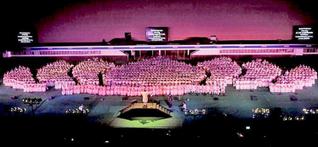
The Choir paid tribute to Tagore and his ‘Gitanjali.’
Thousand voices and one celebration… The Netaji Indoor Stadium in Kolkata, reverberated with poems of Nobel laureate Rabindranatha Tagore recently as Sangeet Bharati Muktadhara presented ‘Echoes of Gitanjali’ to commemorate 100 years of Rabindranath Tagore’s Nobel in Literature and Gitanjali.
For the 1000 singers from all over India – Chennai, Patna, Mumbai, Delhi, Gurgaon, Bengaluru, Baroda, IIT-Kanpur, Allahabad and Bhilai – the show, conceptualised, scripted and directed by Arundhati Deb, president, Sangeet Bharati Muktadhara, came after months of rigorous practice. The theme was the lotus, and sure enough, the singers on stage were positioned to represent the national flower.
For the group of 12 singers from Chennai group, it was a perfect opportunity to pay tribute to Gitanjali and its profoundly fresh beautiful verse.
Years ago, travelling abroad, Tagore witnessed western classical music concerts featuring musicians numbering 1000 to 2000. This left a lasting impression on him, observers had said. Nevertheless, Tagore had not voiced his latent desire – to give a similar treatment to his compositions.
“The programme titled ‘Echoes of Gitanjali’ commemorates 100 years of Tagore’s English Gitanjali,” said the 60-something-Arundhati Deb, who travelled from city to city to refine the performances of the different groups. She was in Chennai to help the team with singer Swati Bhattacharya taking the lead.
Hailing from a family deeply interested in music, Arundhati Deb grew up fascinated with Rabindra Sangeet. After a Master’s Degree in English and an editing stint, her desire to do some serious work with Tagore surfaced. The result? The first 1000 Voices Choir in 2007.
source: http://www.thehindu.com / The Hindu / Home> Friday Review / by Renuka Suryanarayan / July 10th, 2015
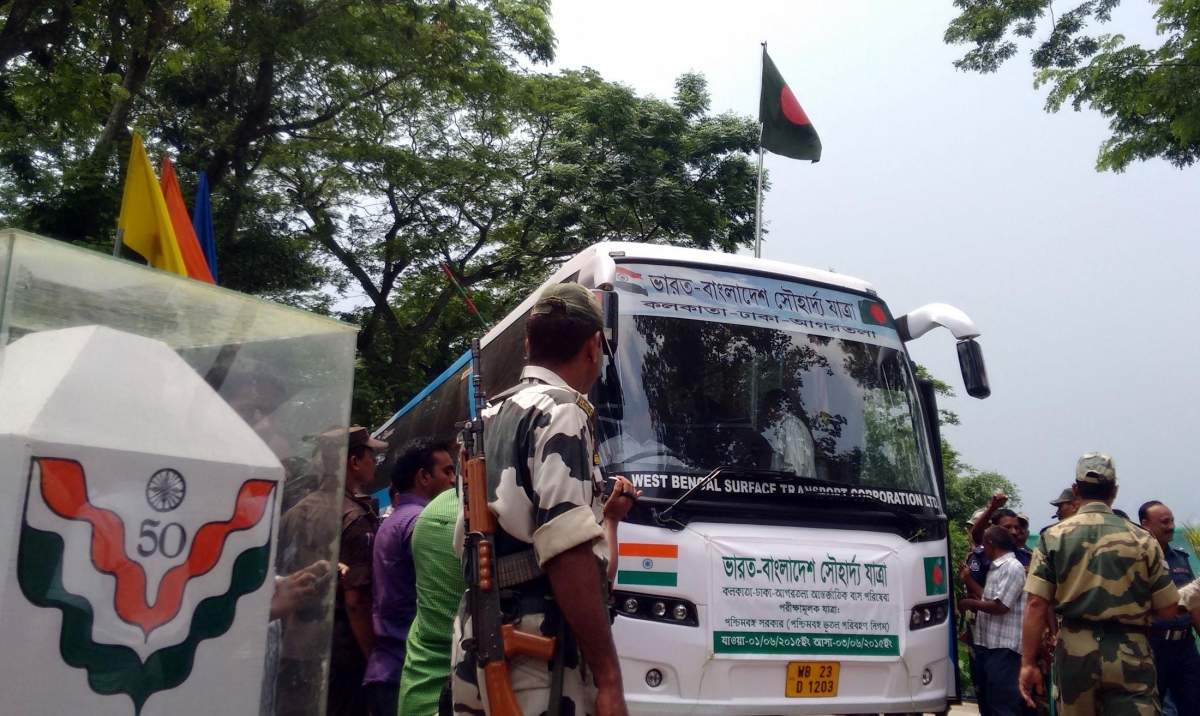
The first Kolkata-Dhaka-Agartala bus enters Agartala from Bangladesh through Akhaura integrated checkpost during a trial run on 2 June, 2015.IANS
Flagging off the Kolkata-Dhaka-Agartala bus service here on Thursday, West Bengal Chief Minister Mamata Banerjee said the initiative will turn the India-Bangladesh ties into an everlasting relationship.
“The launching of this service makes this day forever memorable and historically significant for both the countries,” Banerjee said at the flagging off event at the state secretariat, Nabanna, in Kolkata’s neighbouring Howrah district.
“This service will bring both India and Bangladesh closer and turn our cordial ties into an everlasting relationship,” she added.
The cross-border bus service was approved at a recent meeting between Bangladesh Road Transport Minister Obaidul Quader and his Indian counterpart Nitin Gadkari in New Delhi.
The bus service will facilitate visiting mainland Indian states for people of the mountainous northeastern region, reducing the distance by over 1,000 km.
Agartala via Guwahati is 1,650 km from Kolkata by road, but the distance between the tripura capital and the West Bengal capital via Bangladesh is only around 500 km.
Prime Minister Narendra Modi and his Bangladesh counterpart Sheikh Hasina are scheduled to flag off the Agartala-Kolkata direct bus service in Dhaka on June 6.
source: http://www.ibtimes.co.in / International Business Times / Home> News> Society / by IANS / June 04th, 2015
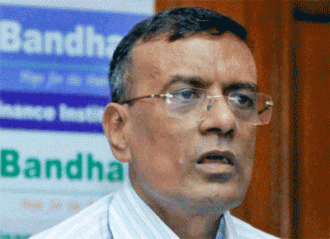
Micro-finance institution Bandhan Financial Services, which got the final license from Reserve Bank of India to start universal banking, would formally start operations as a banker from August 23.
“We will start banking operations under Bandhan Bank from August 23 with the inauguration of 600 branches in 27 states across the country along with 250 on-site ATMs,” Bandhan chairman Chandra Sekhar Ghosh told PTI.
He said 247 branches would be opened in West Bengal, while Bihar, Orissa and Assam would also have a good share in terms of the number of branches.
Ghosh said 65 per cent of the branches would be rural, while the rest 35 per cent would be opened in urban areas.
The logo for Bandhan Bank has been designed by advertising agency O&M, Ghosh said adding that all the branches would be on core banking platform.
Bandhan is also in the process of obtaining separate RBI licenses for RTGS, NEFT, payments gateways and CTS, he said.
Ghosh said all the necessary hardware and software are in place to start the operations.
The MFI had got the in-principle license from RBI to start universal banking in April 2014 within 18 months time.
Along with Bandhan, IDFC had also got the same in-principle approval from RBI for starting universal banking operations.
With IFC, GIC Singapore and SIDBI as equity investors, Bandhan Bank would start operations with a capital base of Rs 2,616 crore.
source: http://www.dailypioneer.com / The Pioneer / Home> Banking & Finance / PTI / Kolkata – Sunday, June 05th, 2015
It was a proud moment for Heritage Institute of Technology Kolkata when the students of the Rotaract Club of Heritage Institute received the Best Club Award in the Rotaract District out of 30 clubs on June 28, 2015 in the district award ceremony.
Rotaract Club of Heritage Institute won 16 awardsfor the term 2014-2015. Since 2009 the club has maintained the record of winning the Best Club award and this time it was no different from the previous years. The list of awards received included, best club, best president, secretary, best in community service, best in spreading community literacy and of course the best social media presence.
“It was a great moment for Heritage Institute as the students worked hard in organizing various projects for social welfare,” said P.K. Agarwal, CEO, Heritage Group of Institutions Kolkata. Both in Heritage School and its specialized higher education institutes, a great deal of stress is laid on social service. Children are taught to share their good fortunes with the underprivileged and spend time with them so that they realize that it is their responsibility to take up the cause of the less fortunate.
source: http://www.timesofindia.indiatimes.com / The Times of India / Home> City> Kolkata / by Jhimli Mukherjee Pandey, TNN / July 03rd, 2015
RIP Thomas Nelson Annandale, at the Scottish Cemetery.
Not many people know that the first director-general of Zoological Survey of India (ZSI), Thomas Nelson Annandale was buried at the Scottish Cemetery when he breathed his last on April, 1924. Or who he actually was. When ZSI kick-starts its centenary celebrations on Wednesday (the organization was founded on 1 July 2016), a plaque will be erected to pay homage to its Scottish founder at recently-discovered tomb.
Tracing the grave was far from easy for the premier institution on animal taxonomy that is adept at identifying species around the country. According to some records at ZSI, Annandale was buried inside the South Park Street cemetery. It took ZSI a while to fish out documents to prove that his remains had been shifted to the Scottish Cemetery where he has since been left to rest.
ZSI director Krishnamoorthy Venkataraman told TOI on Monday: “Now that we have found the grave, a plaque will be erected to honour Annandale’s contribution to ZSI and science at large.” Dhriti Banerjee, deputy director and head of office, ZSI, said, “It took us some time to find out that the ZSI founder was buried at the Scottish Cemetery and not at the Park Street Cemetery. But when we initiated the mission, we realized that the inscriptions were barely visible. We had a difficult time finding out Annandale’s tombstone.”
Most of the tombstones at the cemetery lie broken, defaced and forgotten. Weeds have obscured the gorgeous carvings. Annandale’s tombstone was unclean and the lead filling on the inscription had corroded. Established in 1820, the six-acre Scottish Cemetery was in use till 1940. Currently, it has around 4,300 graves. Apart from Scots, a few Bengalis who were converted to Christianity by Scottish priests were buried there.
After discovering the grave, ZSI officials had the tombstone spruced up and the inscription re-painted. On the occasion of ZSI’s centenary, new slabs will be installed on the grave and landscaping done around it.
An array of programmes have been planned to mark ZSI centenary. The authorities are organizing a run on July 1 to kick-start its centenary celebrations. The Centenary Run will begin from the Asiatic Society in Park Street, the place of ZSI’s origin, and end at Prani Vigyan Bhawan, the present headquarters in New Alipore.
Venkataraman said Prime Minister Narendra Modi will participate in the centenary celebrations in the third week of July at the ZSI headquarters and dedicate the “Digital ZSI” – the e-access to ZSI’s documents – to the country on 100 years of faunal inventory of India.
Going back to the organisation’s first founder, the director said: “We have learnt from a publication published by ZSI that the first director-general travelled across the country and also to China, Japan, Malaya and Morocco looking for different species of fauna in the beginning of 20th century.” The publication had described Annandale as a person of “slight physique, with high strung temperament and restless energy.” He was born in Edinburgh in June 1876 and died in Kolkata on April 10, 1924. During his short life of 48 years, Annandale had 528 scientific reports published.
Venkataraman said conducting authentic research on the country’s rich faunal diversity, undertaking studies on alien fauna, collecting samples of the country’s zoological wealth and setting up zoological museums in different parts of the country are some of the objectives of ZSI.
Annandale had founded the ZSI, which later started functioned under the ministry of environment, forests and climate change, to promote survey, exploration, research and documentation on animal taxonomy. It has identified more than 96,000 species of animals.
source: http://www.timesofindia.indiatimes.com / The Times of India / Home> City> Kolkata / TNN / by Ajanta Chakraborty / June 30th, 2015
Scientists at the Zoological Survey of India (ZSI) have discovered 176 new animal species in the run-up to their centenary year that kicked off on Wednesday.
Speaking to TOI, ZSI director K Venkataraman said 93 new species of insects were recorded by the team last year along with 24 species of amphibians, 23 species of fish and two species of reptiles. The other new finds were 12 species each of arachnida and crustacea, one type each of nematoda, trematoda and mollusca.
“It has been an exciting year with our scientists contributing to the inventory of animal species on the planet. Apart from the new finds, 61 species of animals that were found elsewhere in the world were also found and recorded in the country,” Venkataraman said.
Of the new insects discovered, several were found in Bengal. Agricnemis kalinga was found in Panchala, Howrah; Amemboa bifucrata in Kalikhola, Jalpaiguri; Amemboa mahananda in Mahananda Wildlife Sanctuary, Darjeeling; Onchotrechus dooarsicus in Buxa Tiger Reserve, Jalpaiguri; Pleciobates bengalensis in Alipurduar; Calvia explanata in Darjeeling and Forcipomyia parasecuris in Burdwan. In addition, several other species were found across the state.
ZSI deputy director Dhriti Banerjee said Bengal has one of the richest faunal diversities in the country due to its diverse climatic zones. “Of 96,000-odd recorded animal species in India, 11,042 species, or more than 10%, are found in the state. Different climate zones — alpine temperate forest in Darjeeling, tropical forest in north Bengal, desiduous forest in south Bengal, dry grassland in the middle and mangroves in Sunderbans — support the varied animal life,” she said.
In fact, north Bengal, particularly Darjeeling, is considered a animal diversity hotspot by zoologists as the Eastern Himalayas is the gateway for faunal elements coming to India. “Any experienced scientist can confidently set out on a trip to Darjeeling and find a new species. The insect and ambhibian population in Darjeeling is very high,” Banerjee said.
While new species are being discovered in the state, several species have become extinct, including Javan rhinoceros, Asiatic two-horned rhinoceros, musk deer, monal pheasant, mombin quail, pink headed duck, marbled cat, golden cat, three-banded palm civet, mock viper and gore’s bronze back viper.
While ZSI has traditionally focused on surveys, collection of specimens, identification, naming and preserving, it has now started working on a GIS platform so they can be spacially and temporally mapped for reference. An ambitious programme to digitize the specimens is underway.
“A databank of high resolution photographs of type specimens, along with their full profile — what it looks like, where it was discovered, where it is found now and its DNA bar code — will be created,” Banerjee said.
Banerjee is heading the Rs 3 crore project to digitize information on 7,286 species, most of which are 100-200 years old.
source: http://www.timesofindia.indiatimes.com / The Times of India / Home> City> Kolkata / TNN / July 02nd, 2015
The district Magistrate of Nadia along with chief of Nadia Zilla Parishad in West Bengal was on Saturday presented the United Nations Public Services Award 2015 for eliminating open defecation in the district.
Nadia district, located in south Bengal, had half of its population defecating in open till October 2013. The district administration, under a programme called Sabar Souchagar, built 3.56 lakh toilets in the district. As a result, the number of people continuing with the practice dropped to mere 0.2 per cent.
The award was presented by the acting Secretary-General of the U.N., Lenni Montiel, along with Head U.N. Women Stefani Senese, on conclusion of the U.N. Day celebrations 2015, on June 26 at Medellin in Colombia, District Magistrate P.B. Salim informed The Hindu over email.
Banikumar Roy, chief, Nadia ZP, was also present.
‘Unique model’
The U.N. has described Sabar Shouchagar (Toilets for All) as a “unique model developed to generate awareness, improve access to sanitary toilets, and bring substantial health improvement through improved sanitation.”
The U.N. added that the scheme has mobilised all stakeholders, “especially women and schoolchildren and saw involvement of faith-based organisations” and “if replicated, it has the potential to eliminate open defecation from across the world.”
West Bengal Chief Minister Mamata Banerjee had on April 30 held a programme in Nadia district highlighting the success of the scheme and announced that ‘Nirmal Bangla Divas’ will be observed across the State every year.
source: http://www.thehindu.com / The Hindu / Home> News> National / by Special Correspondent / Kolkata – June 28th, 2015
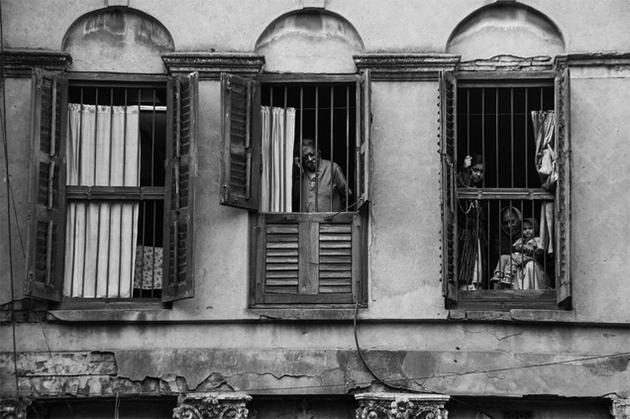
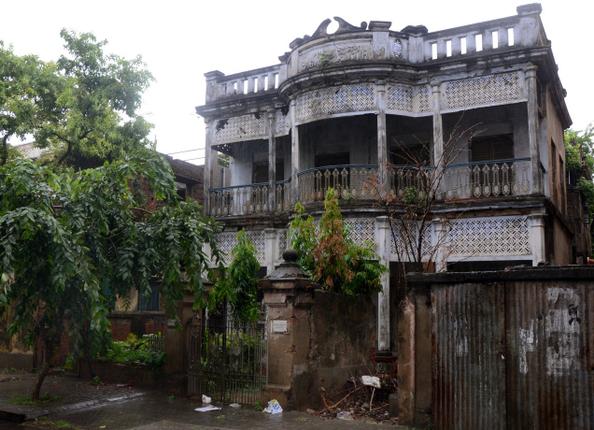
Thousands of Kolkata houses with red-oxide floors and sleepy green-shuttered windows, the spacious porches on the ground floor, with their intricate cornices, elaborate wrought-iron grills, and open terraces are being destroyed at an incredible pace. Photo: Akash Mondal
Kolkata’s heritage buildings are part of the city’s unique DNA, as distinct to its landscape as a fingerprint. The writers talk to novelist Amit Chaudhuri, who is spearheading the city’s brave fight to save its heritage.
In one of Kolkata’s most prosperous neighbourhoods stands a two-storey house. It has shuttered windows and large pillars, in the style typical of colonial Calcutta. The house belongs to Tapati Mukherjee, and was built by her grandfather in the 1930s, in an area called Hindustan Park. The house next to hers, built around the same time and in the same architectural style, is owned by a former chief of the Indian Football Association. It is being torn down. It will soon be replaced by an anonymous high-rise.
Mukherjee, however, is adamant that she will not let her house suffer a similar fate. The Director of Culture and Cultural Relations and the President of Rabindra Bhavan at Visva Bharati University in Santiniketan, she said, “I don’t want to live anywhere else. The house has a cultural ambience and feeling of old-world grandeur (that) I do not find elsewhere. I vow to protect this house till my death.”
Unfortunately, not everyone thinks like Mukherjee. Thousands of Kolkata houses with red-oxide floors and sleepy green-shuttered windows, the spacious porches on the ground floor, with their intricate cornices, elaborate wrought-iron grills, and open terraces are being destroyed at an incredible pace. These houses give Kolkata its unique old-world charm and reflect the amazing architectural ethos of the city, but they are being lost in the mad rush for multi-storey buildings and concrete chaos.
Thousands of heritage buildings in with red-oxide floors and green-shuttered windows, spacious porches with intricate cornices, elaborate wrought-iron grills, and open terraces are being destroyed at an incredible pace in Kolkata. / Photo: Sanjoy Ghosh / The Hindu
This loss of heritage is not unique to Kolkata. Several Indian cities today are battling this dilemma. In Jaipur, for instance, many of the privately-owned historical havelis, with their jaali windows, false fronts and pink facades — which gave the city its moniker of Pink City — are in danger of being lost forever. They have become dilapidated over time and are slowly beginning to be pulled down to make way for modern buildings. Some of these havelis date back over 100 years.
Mumbai has a splendid architectural history, with a mix of Art Deco, Indo-Saracenic and Victorian, all contributing to a rich variety of features that contribute to the city’s signature ‘look’. But many of these buildings are crumbling today and, in the absence of government incentives, owners prefer to let the heritage homes decay rather than spend their own money on upkeep, which is understandably an expensive task. Once the buildings reach a certain stage of disrepair, the owners are allowed to demolish them and sell the rights to redevelopers for a lucrative sum. This makes it much more difficult to persuade owners to look after them. Bangalore and Chennai, too, are fighting the same battle, as is the state of Goa, with its stunning built legacy in the Portuguese-Baroque style.
The only weak but bravely flickering touch of silver in this bleak skyline is the fact that informed citizens across India are taking up cudgels to try and save the country’s heritage structures. The newest episode to this saga of protest is being staged in Kolkata, where several people — both ordinary and prominent citizens — have written to Chief Minister Mamata Banerjee, pointing to the urgent need to stop the destruction of these historic buildings. Most of these houses were begun in the 19th century and continued to flourish over the next hundred years. In fact, even during the recession of the 1930s, the cement industry was flourishing as the middle-class was constructing these huge houses.
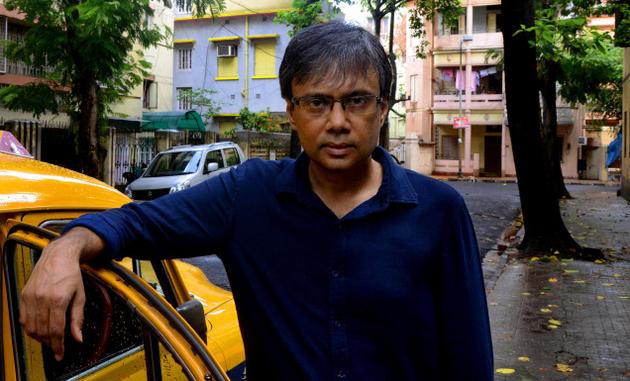
Author Amit Chaudhuri who is spearheading the protests to save the heritage buildings. / Photo: Sanjoy Ghosh / The Hindu
Eminent writer Amit Chaudhuri, who is leading the campaign, said, “Destroying these buildings is to destroy one of the chief characteristics of this city’s history of modernity. Kolkata is a modern city and these houses are emblems of the city’s modernity… they are as important as the painting, literature and music of Bengal.” For Chaudhuri, this is an old battle. He has been speaking and writing on the issue for many years now. He talks of how the architecture of many neighbourhoods in Kolkata is quite distinct from the Indo-Saracenic or neo-Gothic style of architecture that can be seen in other Indian cities. They represent a Bengali-European style that is not seen elsewhere.
The Kolkata heritage protest team includes architects, artists, film directors and academicians. And one common factor that everybody agrees upon is the fact that these old buildings are not important only because of the nostalgia that surrounds them but because they represent a certain time in history. If preserved well, these buildings can actually lead to very practical and modern benefits, such as increased tourism revenue and, in turn, a renewal of the city.
Take, for instance, the boutique hotel that opened in Kolkata a couple of years ago. Called Hotel 233 Park Street (based on the door number), it occupies the ground floor of an imposing Zamindari mansion located at the much less stylish but no less historical Park Circus end of the city’s famous restaurant street. Rather than tear the mansion down, with its classical pillars and high ceilings and wooden-slatted windows, the owner has recreated a piece of the city’s cultural history here. The rooms have antique mahogany or Burma teak furniture, and a potpourri of Zamindari and Colonial tapestries, lithographs, curios and floor lamps. The hotel’s revenues could be used to revamp the rest of the mansion over a period of time. It is testimony to how sensible restoration can go a long way.
As Nobel Laureate Amartya Sen has said, the rich history of early habitation in the Calcutta region has suffered not only from intellectual neglect but also from the destructive tendencies of the past. “We owe to future generations a preserved and unmutilated heritage of Calcutta’s eccentric but exciting old buildings,” Sen had said in response to the city’s petitioners.
Even as Kolkata’s mayor Sovon Chatterjee has claimed that it is “next to impossible” to preserve the old neighbourhoods and houses, the supporters of the campaign have agreed that a legislative intervention is required to preserve the buildings. Architect Partha Ranjan Das has also come up with another idea. He suggests that buyers must be incentivised by the introduction of a transfer of development rights. In other words, he says, “While the buyers (of heritage properties) will not be able to make changes to these old houses, they can transfer the floor area ratio to other projects that they are developing in other localities.” This is a unique solution that must be looked at seriously, not just in Kolkata but across cities.
Meanwhile, Sugata Bose, historian and MP from Trinamool Congress, has assured the petitioners that he will take up the matter with Chief Minister Mamata Banerjee. “During the Chief Minister’s upcoming visit to London, I will try to show her what the authorities have done there to preserve the neighbourhoods,” he said.
However, well-known artist Shuvaprasanna, who heads the West Bengal Heritage Commission, is very clear that the best of intentions cannot achieve anything unless there is a change in existing laws to prohibit the demolition of these houses. “The German author, Günter Grass, was awestruck by the city and had raised the issue of renovation with former Chief Minister Buddhadeb Bhattacharjee during the 1990s. However, the discussion was not taken forward and nothing much could be done.”
As he points out, most of the houses are owned by several members of a family and, in many of them, litigation is involved, so that most owners find it the easiest option to sell the houses to private builders. In fact, most owners don’t see any value in the structure itself, and sell it for the value of the land alone. Bose speaks of the need to change mindsets so that people can better understand the innate heritage value of the buildings.
But others say that none of this might work because rampant unemployment has resulted in real estate becoming one of the few growing sectors. In other words, the developers will not be stopped easily. “We have declared a number of these as heritage houses but we are failing to preserve them despite investing crores of rupees,” said the mayor, adding that the Kolkata Municipal Corporation has neither the resources nor adequate laws to deal with the issue.
A recent Bengali film, Bhooter Bhabishyat, (The Future of the Ghosts) was a huge hit. In the film, ghosts evict the greedy builders from a 19th century palace and settle down in it themselves. In real life, will the city’s heritage ever be able to evict the powerful builders and promoters?
source: http://www.thehindu.com / The Hindu / Home> Features> Magazine / by Shiv Sahay Singh & Suvojit Bagchi / June 27th, 2015
The introduction of fair price medicine shops and diagnostic centers in West Bengal has attracted international attention.
Chief minister Mamata Banerjee on Friday posted on her facebook page that a research study on the issue has been selected for discussion at the 11th World Congress of International Health Economics Association that will be held at Italy’s Milan during July 12 to July 15. “Our Fair Price Medicine Shops and Diagnostic Centres in Government Hospitals continue to receive more and more international attention and acclaim. A research study conducted on this innovative intervention of our Government to reduce out of pocket expenses of patient parties has been selected for presentation in the 11th World Congress of International Health Economics Association to be held at Milan, Italy during 12-15th July, 2015,” the CM posted on facebook.
“Already, 99 Fair Price Medicine Shops have been opened in just 4 years providing medicines at 48 to 77.2% discount. More than Rs.440 crore discount has been availed of by 157 lakh patients so far. It has been declared Model for the country. Moreover, 58 Fair Price Diagnostic Centres have been set up in just 4 years offering digital X-ray, dialysis, CT Scan and MRI at very affordable price,” the CM further posted on her facebook page.
source: http://www.timesofindia.indiatimes.com / The Times of India / Home> City> Kolkata / by Suman Chakraborti, TNN / June 26th, 2015
Crumbling buildings and filthy roads at Tiretta Bazar — or Old Chinatown — bear evidence to the depleting fortunes of the Chinese community in the city. But behind those closed doors lie a secret the community so proudly cherishes. The shabby buildings with a ‘falling-apart’ look and feel house some of the historic churches of Kolkata. Step inside and the regalia, incense sticks and intricate altars will give you a feel of the Chinese tradition.
The fact that KMC and the tourism department have joined hands with a Singapore-based organization to revive Old Chinatown has come as a shot in the arm for the community. They are happy that these churches, which were originally established in the 19th century and then rebuilt in the early part of the 20th century, will get restored.
The Indian Chinese Association has appealed to the project co-ordinators that the revival project should centre around the six churches (they were originally temples but later got converted to churches as most of the Chinese people embraced Christianity) that the community is guarding so dearly for so many years.
While the project so long centred around the Toong On Church and the famous Nanking restaurant that it houses, now five churches have also come into focus. A visit to the churches is an experience in itself. Take the case of the Namsoon Church, for example. It is the oldest of the six. It was established in 1820, almost immediately after the Chinese settlers abandoned Atchewpur near Budge Budge. Located at the far end of the snaky Damzen Lane, you will easily miss it. But the church, dedicated to Kwan Yin, the Chinese Goddess of War, has a magnificent altar complete with an intricately carved roof hanging.
There are three more churches on the same lane. Choong Hee Dong Thien, built in 1859, is in a sorry state but the deity, Kwan Kun, believed to be the God of Fortune, is still maintained and worshipped by the community. The Gee Hing Church was originally built in 1888 but it reached such a dilapidated state that the community rebuilt and relocated it in 1920 to its present location on 13, Blackburn Lane. Even that is in a sad state now, though the members of the community regularly visit for prayers and offerings there.
“Times are tough and you hardly find time to hang around as regularly as you did earlier. But we still try to meet up for our board games of Chinese Pair, after prayers as frequently as possible,” said Chang Yu Sen.
“Our tradition lives in these churches. It reminds us where we belong and the culture and tradition of that place. We cannot relate to the changes that have come over China today, so we guard these altars to remain close to our roots. Today many of us might have become Christians but we have not lost touch with Buddhism, Taoism and Confucianism that bind us,” explained Paul Chung, president of the Indian Chinese Association.
The other three churches — Sea Ip Church, Sea Voi Yune Leong Futh Church and Then Hane Miaw — too are crying for attention despite devotees’ best efforts at maintaining them.
source: http://www.timesofindia.indiatimes.com / The Times of India / Home> City> Kolkata / by Jhimli Mukherjee Pandey, TNN / June 23rd, 2015