Finally, the Mamata Banerjee government has initiated the process of bestowing heritage tag to the house where Vande Mataram creator Bankim Chandra Chattopadhyay lived during his stints as deputy magistrate and deputy collector. The house is in ruins and desperately needs restoration. Even as Howrah Municipal Corporation (HMC) has sanctioned Rs 5 crore for it, but work can’t be started unless the building is included in the heritage list.
Ten years ago, the house-owner, Pranab Mukherjee, sold the house to a developer. Just then, locals and an NGO, Howrah Citizen’s Forum, put up stiff resistance and stalled demolition of the property.
On Tuesday, at the behest of the chief minister, a Heritage Commission team visited the premises to start the tagging process. Basudeb Malik, OSD, heritage commission, told TOI, “Although the house doesn’t have much architectural significance, it is associated with a great man. It must be protected from falling apart, at any cost. We are looking for substantial records to prove that the creator of Anandamath had lived here.”
Chattopadhyay wrote the iconic novel became synonymous with the struggle for Independence and banned by the British. The song, Vande Mataram, originally a Sanskrit stotra personifying India as Mother Goddess, was first published in this novel. Bipin Chandra Pal named his patriotic journal after Vande Mataram in August 1906. Lala Lajpat Rai also published a journal of the same name. Chattopadhyay is also regarded as a proponent of Bengal’s literary renaissance for his versatile writing.
Efforts have been on to have Chattopadhyay’s stay in Howrah (between 1881 and 1886) officially recognized and commemorated. But confusion has been prevailing over his residences at 218 Panchnantala Road (about 2 km off Howrah Station) and 212 Panchanatala Road, in the same locality.
Pranab Mukherjee (63), who lives on the first floor of 218 Panchantala Road, that threatens to fall apart any day, said, “We had no idea that the building was associated with Bankim Chandra. If the state government wants to take it over, me and my brother and sister who co-own the house, should be compensated.” Chunks of concrete keep peeling off the house, forcing the other two Mukherjee siblings, Prodyut and Protima, to move out. In 1964, they had bought it from one Jaladhar Mitra, who, in turn, had bought it in 1936. Locals have turned the 17-cottah land in front of the house at 218 Panchanantala Road into a park and named after the litterateur. Mukherjee alleged, “The land was part of the same property, but the local club has encroached it.”
Howrah mayor Rathin Chakraborti said, “We have sanctioned Rs 5 crore for the restoration. Now we are waiting for the government to announce the heritage staus.”
Howrah Citizen’s Forum coordinator N Sarkar said, “During his first stint as an administrator in Howrah in 1881, Bankim Chandra would travel from Kolkata to his workplace. He later shifted to the rented house at 218 Panchanatala Road, and lived there during his second stint in Howrah in 1883. This tenure was his longest among the three.” For the third time, Bankim joined as first class deputy magistrate and deputy collector after being transferred from Bhadrak in Odisha on July 10, 1886. He travelled to Howrah every day but had not vacated the rented house at Panchanantala.
source: http://www.timesofindia.indiatimes.com / The Times of India / News Home> City> Kolkata / by Ajanta Chakraborty & Rupak Banerjee, TNN / August 15th, 2015
Midnight on July 31 had ushered in a new freedom in Cooch Behar’s 51 Bangladeshi enclaves. It took the wail of a newborn 12 days later to underline what it actually meant. Named Azad, he is the first baby born in free territory -with his parents’ real names, and calling what was no-man’s land his home.
When TOI had met the pregnant 18-year-old Jharna Biwi a fortnight ago, the Bangladeshi enclave of Poator Kuthi in Cooch Behar was excited because this baby would be special. At 6.30am on Wednesday , Azad was born at Bamonhat primary health centre. Never has the birth of a newborn -to a teenage mother -been the cause of such joy in any enclave.
Gone are the days when even quacks, what to speak of doctors, would refuse to deliver babies of enclave residents.Would-be-mothers would suffer the ignominy of lying about their husbands’ name.Azad’s elder brother, born four years ago, was named Saheed (martyr). Grandfather Mujibur Ali is ecstatic but cannot forget the shame and agony of half a century .”When Saheed was born in 2011, we had to send Jharna to her maternal home in Dinhata’s Picnicdhora, evading BSF patrols. We had to lie about her husband’s name and give a fake Indian address just to get her into hospital. Not any more,” Ali said. “Azad signals the new dawn,” he said, before hurrying off to offer sweets to visitors flocking to his home.
When Jharna felt pre-mature labour pains in the predawn hours, her brother-inlaw Meharul and mother-inlaw Jamina Biwi took her in a van rickshaw to the primary health care centre, half-anhour away . This in itself would be a huge task a fortnight ago. Being Bangladeshis, they couldn’t step out of their villages for fear of being hounded by BSF or police.And getting admission in a state-run health facility was out of the question.
As Poator Kuthi savoured the sweets of Azad’s birth, 70year-old Mansoor Ali recalled how Asima Biwi was denied treatment in 2010.
“Nearly 3,500 enclave residents braved a nine-hour stand-off with police and BSF to get her treated at Dinhata sub-divisional hospital. The administration relented only when they realized the protest could snowball into a huge agitation. Her baby was born that day and we named him Jehad (struggle),” said Mansoor, president of Poator Kuthi enclave exchange committee. Mansoor said, “Jehad’s birth may have brought our plight before the people but it didn’t change our way of life. Expectant mothers had to fudge their husbands’ name (give an Indian’s name) and address to get admitted to hospitals. Nothing can be a bigger insult to a married woman than to lie about the father of her child.” He added, “But this morning, I held Jharna’s hand and told her to go with her head held high and tell them that she belongs to Poator Kuthi, India, and her husband’s name is Jamidul Ali. She did.”
source: http://www.timesofindia.indiatimes.com / The Times of India / News Home> India / by Kamalendu Bhadra, TNN / August 13th, 2015
Time is money but some particular currency is timeless. On the eve of Independence Day, Kolkatans will get see some of the most ancient coins of Bengal at an exhibition by the Numismatic Society of Calcutta. On display will be 2nd Century BC coins from Chandraketugarh, along with those from Sasanka and Samudragupta era, among others.
“This is the first time we will hold an exhibition at any college in Kolkata. Elsewhere we had held shows at IITs, NITs,” said Samarjit Ghosal, the society’s secretary. The exhibition will be held at Jogesh Chandra Chaudhuri College on Friday.
“The Chandraketugarh coin is identified by some specific symbols like the sun and boat. A telltale symbol is that of a conch on the reverse side,” said Anup Mitra, the society’s president.
Explaining how collectors get hold of such ancient coins, he said: “In old times, the practice of storing valuables underground was quite common. In case they are abandoned, they are discovered long after, mostly by accident. Those who find them take them to jewellers. In England, museums buy back such coins. But here there is no such system here. Across the country, small teams of traders keep a track on movement of coins at jewellery shops. Once they acquired, they are sold to museums or collectors.”
“Till recently, it was believed ‘kouri’ was the medium of exchange in early Bengal. But after discoveries of the last few decades, it is now proved that ‘kouri’ was a parallel currency till early 19th century,” said Shankar Bose, an authority on coins who has penned 10 numismatic books.
Bose will present a powerpoint presentation on ancient Bengali coins at the exhibition.
source: http://www.timesofindia.indiatimes.com / The Times of India / News Home> City> Kolkata / by Shounak Ghosal, TNN / August 10th, 2015
Here’s a first from the world of Bengali sweets. Our very indigenous Joynagarer Moya, sweet roundels made of a special kind of puffed rice and bound with jaggery, has won the coveted G I (geographical indication) tag.
While the decision was firming up since April, the state government, which has been championing the cause of the moya, has just been intimated about the crown. Naturally, the moya makers of South 24 Parganas Joynagar, are rejoicing. This authentication tag attaches great prestige to the special sweet with a very short life that makes its annual appearance only in winter.
Joynagarer Moya had to go through a stringent test and documentation process for two and a half years before finally wresting the crown from the G I scientists in Chennai, who work as a wing of the ministry of commerce and industries. The state department of science and technology, which had applied for the G I tag is now enthused about winning the tag for its other two applications – Mihidana and Sitabhog of Burdwan, which are presently being evaluated for a final declaration towards the later part of the month. A GI tag is a name or sign used on certain products which corresponds to a specific geographical location or origin.
India as a member of the WTO enacted the GI Act in 1999, which came into effect in September 2003. The GI tag ensures that none other than those registered as authorised users (or at least those residing inside the geographic territory) are allowed to use the popular product name. Darjeeling tea became the first GI tagged product in India. The Joynagarer moya was invented in 1929 by two confectioners of Bahura and Charan near Joynagar – Purna Chandra Ghosh and Nitya Gopal Sarkar who sold their creation at their Sri Krishna Mistanna Bhandar. The secret lay in the use of kanakchur rice, which is a special variety of winter rice grown locally.
This rice has a distinct aroma that is heightened when this rice is puffed up. Special gawa ghee and nolen gur, also collected fresh locally, are then used to bind the khoi (puffed rice) into a moya. Kanakchur rice cannot withstand chemical fertilizers. “Initially the Joynagar moya makers, threatened by the plethora of fake and cheaper varieties that flood the market in winter, tried to apply for the G I status on their own but faced several hurdles. So they approached the state government for help.We documented the regional history, lore, ingredients, authentic recipe, the formulae used by the inventors and the list of makers at Joynagar who still follow the original process. The G I scientists inquired and tested random samples for consecutive years before agreeing to give the Joynagar er moya the coveted GI tag,””said Mahua Hom Chowdhury, scientist of the Patent Information Centre of the WB State Council of Science and Technology, which is a wing of the state’s department of science and technology.
A total of 150 moya shops have been included in the G I tag as the only authentic makers. It implies that the rest of the shops across the state who will still sell the moya are selling fake stuff. It was after submitting the application for Joynagarer Moya that the state government received appeals from the makers of sitabhog and mihidana of Burdwan too. “Our scientists actually camped in Burdwan for months and along with officials of the district administration, prepared separate dossiers for both mihidana and sitabhog. We were stunned by the details,” said an excited state minister for science and technology, Rabiranjan Chatterjee. He was found basking in the glory of the Joynagarer Moya. “This is our first sweet GI. We have also received GI for three Bengal varieties of mangoes – fazli, himsagar and lakshman bhog,” he said.
The document prepared for mihidana and Sitabhog and submitted to the GI office says that On February 10, 1904, Viceroy Lord Curzon visited Burdwan to confer the title of maharaja on then king of Burdwan Vijaychanda. Bhairav Chandra Nag, a local sweet-maker, had made the sitabhog and mihidana to mark the occasion. Mihidana is made from Kaminibhog, Gobindabhog or Basmati rice.
The rice is mixed with besan and saffron and blended. The mix is poured into hot ghee through a brass ladle with holes. The deep-fried saffron grains are then dunked in sugar syrup. Sitabhog on the other hand is, cottage cheese or chhana and powdered rice rolled into a dough. It is broken into tiny bits and fried in ghee, then soaked in sugar syrup.
source: http://www.timesofindia.indiatimes.com / The Times of India / News Home> City> Kolkata / by Jhimli Mukherjee Pandey, TNN / August 11th, 2015
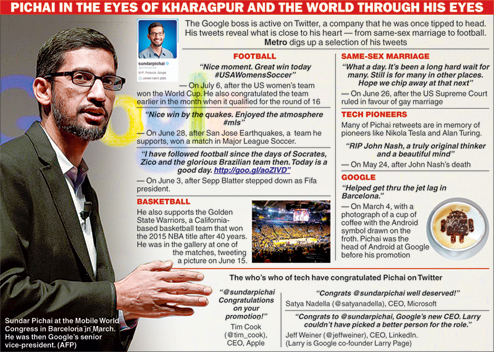
Sundar Pichai, the toast of the technology world, learnt his engineering 110km from Calcutta two decades ago.
In the records of IIT Kharagpur, P. Sundararajan was the topper in metallurgy and material science in the Class of 1993. Outside the classroom, he was known as the ” chhupa rustam” who had wooed and won his life partner from the chemical engineering class without any of his hostel mates getting a whiff of it.
Metro spoke to some of the new Google CEO’s old friends and teachers to get an insight into the man that holds that brilliant mind.
Sourav Mukherji, dean of academic programmes at IIM Bangalore; studied civil engineering at IIT-K and shared the Nehru Hall with Pichai
The world may be hailing Sundar Pichai but to us in Kharagpur, he was Sundi. And he would sing ” Anjali Anjali, pyari Anjali ” all the time.
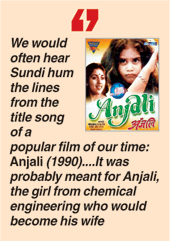
We would often hear Sundi hum the lines from the title song of a popular film of our time: Anjali (1990). He loved music and we all thought he sang the song because he liked it. It was much later, after we left Kharagpur, that we realised why he loved this particular song.
It was probably meant for Anjali, the girl from chemical engineering who would become his wife. We all knew Anjali and Sundi knew each other but we never came to know of their relationship in our four years on the campus. It was ‘surprise-surprise’ when we came to know that Sundi and Anjali were seeing each other.
He was a brilliant guy. In fact, a lot of people in the IITs are brilliant. But Sundi was absolutely brilliant. He was the topper in most exams when we were students at IIT. But nobody would call him bookish.
I feel that this (Pichai’s elevation at Google) is a moment of great joy and pride for us as Indians because two of the world’s most powerful IT companies now have Indians as their CEOs (Satya Nadella is the CEO of Microsoft). These gentlemen have truly been able to break the so-called glass ceiling. Twenty years ago, who would have thought that Indians would head powerful American companies, especially companies at the forefront of technology?
Sanat Kumar Roy, professor metallurgy and material science, who taught Pichai
At IIT Kharagpur, we all knew him as P. Sundararajan and it was only in 2012 that we came to know his new name: Sundar Pichai.
It was December 2012 when we got a call from the Wall Street Journal, informing us that Sundar Pichai, an alumnus of our institute, had been appointed vice-president of Google. The journalist wanted details about him.
We checked our records but couldn’t trace anyone by that name. Later, the journalist gave us a clue: that he had been a recipient of a silver medal. That helped us track P. Sundararajan. Later, we contacted our alumni office in the US to check whether P. Sundararajan and Sundar Pichai were the same person and finally it was they who confirmed it.
I had taught him in all the four years he studied metallurgy and material science here. I found him exceptionally bright.
The IIT selected him for its Distinguished Alumni award this year and he was supposed to receive the honour at the annual convocation that was held recently. He couldn’t attend the event this time but he has promised to visit the institute when he comes to India next.
Phani Bhushan, co-founder of Anant Computing and Pichai’s batchmate and co-boarder at Nehru Hall, where he had stayed at “CTM” (that’s section C, top floor, middle wing)
Sundararajan was a shy person who was more comfortable in small groups, and now he is making speeches and heading a global conglomerate like Google. It is like he has had a personality U-turn.
We are super excited that our batchmate and hall mate has achieved such a feat, although it isn’t as surprising as the news that he married a fellow KGPian, Anjali!
We hall mates and batch mates tend to spend a lot of time together and we thought he was shy about talking to girls. But he turned out to be a chhupa rustam! We wonder how he managed to have a girlfriend without us knowing about it.
Partha Pratim Chakrabarti, director, IIT-KGP
We are all delighted that a student from Kharagpur has achieved this. Sundar Pichai was always a very quiet and studious person. I never taught him but have interacted with him several times. He recently did a video chat with an auditorium full of students who talked to him about everything from life to technology and leadership.
He hasn’t made any public statement as yet. That’s the kind of person he is. He likes to do his work. Sundar has proved that technological leadership can lead to global leadership and has given aspiration to a new generation of IITKgpians that you can achieve global leadership through technological leadership.
He is a quiet worker, a technical wizard, a great thinker and visionary who is also an extremely humble person, quite in sync with his alma mater IIT Kharagpur. He is an Indian who is a global leader and epitomises future generations of Indians.
source: http://www.telegraphindia.com / The Telegraph, Calcutta,India / Front Page> Calcutta> Story / Wednesday – August 12th, 2015
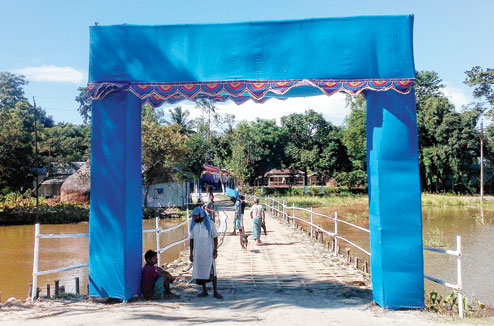
Preparations at Mashaldanga, the Bangladeshi enclave, for Friday’s transfer of territory. Picture by Main Uddin Chisti
Dinhata :
The people of Mashaldanga built the road themselves with mud and covered it with bamboo cane. A big gate draped in blue cloth stands at the start of the road which leads to a colourful canopy.
The road did not cost much but the pandal did – Rs 2 lakh. Yet the people of Mashaldanga, the biggest Bangladeshi enclave in India, paid for it out of their pockets because on Friday this is where they will celebrate their coming into being.
On July 31 midnight, as Bangladesh and India exchange territories, the borders of the enclaves will dissolve.
It will mean that Mashaldanga and 50 other Bangladeshi enclaves in India will become Indian territory. Similarly the 111 Indian enclaves in Bangladesh will become Bangladesh territory.
For the people of Mashaldanga it will mean having a country in the real sense for the first time in their lives.
For 67 years since Independence, the people in the enclaves have been overlooked by both the countries. They have been denied everything that a state can give its citizens, starting with identity.
From Saturday morning, for the first time 14,000 people on the Indian side and 41,000 people in Bangladesh will become citizens of the respective countries.
Enclave residents were given a chance to choose their country. No one from the Indian side – the Bangladeshi enclaves are mostly in Cooch Behar and a few in Jalpaiguri – is crossing over.
In total, 979 people are coming over from the four districts in Bangladesh with enclaves – Kurigram, Lalmanirhat, Nilkhamari and Panchagarh – said the superintendent of police of Kurigram, Mahammad Tabarukullah.
Mashaldanga illustrates perfectly what being denied a country is like.
Through the middle of the green fields of Madhya Mashaldanga, the part of the enclave where the celebrations are being held, run electricity lines.
Yet no house in Madhya Mashaldanga has electricity because it is in Bangladesh.
Through the middle of Mashaldanga runs a road, but not many step on it, because it leads into the outer world – India.
Only one house in Madhya Mashaldanga has electricity, because that house is in an Indian enclave within the Bangladeshi enclave.
This enclave, with its only house, since it is Indian territory, has electric lines reaching it, resting on a row of poles that cut through the green fields.
What applies to electricity also applies to jobs. No Mashaldanga resident has ever had one.
If the children go to school in Mashaldanga, they need to cook up the name of a father as no father here has identity proof.
Jainal Abdedin, a 23-year-old from Madhya Mashaldanga, who was at the forefront of the movement to exchange enclaves, is a third-year political science honours student at Deoanhat College in Dinhata. Even if he became a graduate, he would not be able to get a job, because he would need more identity proof than required so far.
He has been able to go through school and college using the name of another person, an Indian citizen, as his father. Because his father, like all other residents of Mashaldanga, has no papers.
“Mithye bolte bolte obhyesh hoye gechhe (I have got used to telling lies),” he says.
But may be that would change now. With him becoming an Indian citizen, he can think of having a job.
The enclave exchange has been achieved, says Diptiman Sengupta, the man behind the Bharat Bangladesh Enclave Exchange Coordination Committee, because of the will of the people. The organisation has led the movement for the exchange and Jainal is a member of this organisation. Jainal, with his friend Saddam Mian, also look after the social media presence of the movement.
Sengupta points out that the history of enclaves began in the displacement of people. From the 1880s, when land began to be organised in India by the British and be marked, the landowners of the areas in which the enclaves – chhitmahal in Bengali – lie, began to gift each other mauzas as stakes in card or chess games.
But that was undivided India, and the stakes got scattered over what would come up as borders between first, India and Pakistan, and then Bangladesh.
After Independence, depending on the ownership, these plots remained Indian land in Pakistan/Bangladesh or Pakistani/Bangladeshi land in India.
And all the countries forgot them, though there were agreements from time to time.
The first one was between Jawaharlal Nehru and Feroze Khan Noon, the Indian and Pakistani Prime Ministers in 1958. In 1947, the Land Boundary Agreement was signed by Indira Gandhi and Sheikh Mujibur Rahman. Many governments and working groups and decades later, Indian Prime Minister Narendra Modi ratified the agreement on June 6, 2015, during his visit to Bangladesh.
“The government moved aggressively when it felt the will of the people,” says Sengupta. He thinks the exchange is a triumphant example of a history-making event that political parties could not interrupt.
The Indian authorities are making arrangements to receive the people from Balngladesh, who are expected after November 30.
Tota Mian, a Mashaldanga resident in his seventies, said today: ” Akhon swadhinata pailam (We have got independence, finally).”
source: http://www.telegraphindia.com / The Telegraph, Calcutta,India / Front Page> North Bengal> Story / by Chandrima S. Bhattacharya and Main Uddin Chisti / Friday – July 31st, 2015
The green gate of 3 Peary Charan Sarkar Street has been leading thousands into the enchanting premises of the Eden Hindu Hostel for almost 130 years now. The lush green field, the wooden staircase, the kharkharis, the high-ceiling rooms, everything oozes an old-world charm that’s hard to ignore. And on Wednesday, the hostel closed down for renovations -its first overhaul since its establishment in 1886. CT celebrates the heritage and history of the colonial building and takes a trip down memory lane…
RICH HERITAGE
The hostel was initially built for the Hindu students of Presidency College, but later accommodated students from outside Kolkata. In 1988, the building was extended in order to accommodate postgraduate students and research scholars.Among its many famous boarders were the first President of India, Dr Rajendra Prasad, who studied in Presidency between 1902 and 1907, and professor Amartya Sen. Presidency University registrar Debajyoti Konar said, “Dr Rajendra Prasad was a student here and his room in the hostel is still not used.”
Divided into six wards, the hostel houses over 274 boarders, including undergraduate and postgraduate students.
HOME AWAY FROM HOME
With its seasonal tournaments, annual athletic meets, Saraswati Puja, reunions, freshers’ welcome, political meetings and farewell ceremonies, this hostel has been a second home for thousands of students.”It feels bad to leave this place. I’ve been here for over three years now and have spent some wonderful times with my friends and seniors,” third-year chemistry student Swarup Maji said. He added that they had been shifting to the new address in Rajarhat for the past three weeks. “We will be staying in Rajarhat for 11 months till the work gets done here. It’s going to be difficult, as we are used to staying in central Kolkata with so many facilities within reach,” Swarup said.
A NEW LOOK
Konar said an architect from the Heritage Commission will oversee the renovation. “As of now, Partha Das will supervise the work. This is a heritage structure and the plan has been made keeping that in mind,” he said. An amount of Rs 3 crore has been sanctioned for the first phase of renovation, while estimation is still under way for the second phase.
HELPING HAND
The University is more than happy to receive help from the government of West Bengal. “The renovation will span over 11 months and the higher education department has arranged for 80 flats in Rajarhat for the 150 students who have been shifted. A canteen, too, has been arranged. That’s not all. A subsidized bus will ferry the students from Rajarhat to Presidency,” Konar told us.
SAYING GOODBYE
For Sajan Dewan, a postgraduate political science student, it’s time to bid adieu to the hostel. “I’ve been here for the last four-and-a-half years. We’ve spent some of the best and worst days of our lives in this building. By the time the work gets done here, I’ll be out of college. But I’m taking back some fond memories with me, so we had a small party last night to say goodbye,” Sajan said.
HOSTEL HIGHLIGHTS
Eden Hindu Hostel was established in 1886 The hostel was built using funds raised by Ashley Eden, WB Gwyther was the architect The first president of India Dr Rajendra Prasad and Nobel laureate Amartya Sen are its alumni The hostel has eight guest rooms where parents of students and other guests are allowed to stay The six wards in the hostel include a kitchen, dining hall and staff-quarters, which occupy a total area of 26,000 sq ft.
source: http://www.timesofindia.indiatimes.com / The Times of India / News Home> City> Kolkata /by Kathakali Banerjee, TNN / August 03rd, 2015
The father of modern Bengali language, in which books are written now, seems to have been relegated to the a mere footnote.
Wednesday was the 201st birth anniversary of Peary Chand Mitra, which passed unnoticed in the blaze of celebrations that are forever being added to Bengal’s calendar. Though Mitra’s name or his pseudonym, Tekchand Thakur, would not ring a bell among the youth, his ‘Alaler Ghare Dulal’ is the first Bengali book written in the “novel” form, a tradition taken up by Bankim Chandra Chatterjee and others. The novel is said to be the first major experiment with the subaltern language.
A key member of Henry Vivian Derozio’s Young Bengal, that played a leading role in the Bengal Renaissance, Mitra was born on 22 July 1814, but the only people who remember the date are his successors. His bicentenary last year was observed without any fanfare. “A milestone that would have proponents of Bengali Asmita (pride) unfurling the flags on the streets has barely been acknowledged. Mitra’s achievement is all the more significant because he had strong public support,” said great great grandson Debabrata Mitra.
A year later, his family and the Kolkata Little Magazine Library and Research Centre have organized Mitra’s bicentenary celebration on Sunday at their ancestral property, “Madanmohan Jeu”, which was built at the behest of the writer’s aunt. Young Bengal members would meet at the historical venue to debate and thrash out ideas on how to usher in reforms in society.
His father, Ramnarayan, sent him to Hindu College where he was taught English by Derozio. David Hare, who was instrumental in spreading education in India, was also fond of him.
Despite his strong orientation in the English ways, it was Mitra’s role in vernacular that should be celebrated. In fact, Rev. James Long, who translated Dinabandhu Mitra’s Neeldarpan in English, had christened him the “Dickens of Bengal”. Mitra, indeed, had changed the course of the Bengali language, from the formal, pundit’s style (shadhubhasha) to the language of the masses (chalitbhasha).
Mitra’s family has drafted a charter of demands, including a research centre, a place where discussions on improving society and spreading education would be held, naming of College Street after him and an awareness campaign to spread Bengali language.
source: http://www.timesofindia.indiatimes.com / The Times of India / Home> City> Kolkata / by Ajanta Chakraborty, TNN / July 26th, 2015
A mighty fracas is raging between the descendants of Nawab Wajid Ali Shah in Calcutta and an Iranian woman who claims to be married to a scion of the Awadhi family. Hemchhaya De investigates the rumpus
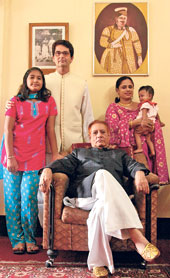
REGAL ROOTS: Shahebzade Wasif Mirza and his family pose before the portrait of Nawab Wajid Ali Shah;
A king-size portrait of Nawab Wajid Ali Shah will catch your eye the moment you step into the grand, old living room of Wasif Manzil on Talbagan Lane in Calcutta. “That’s my ancestor,” says Shahebzade Wasif Mirza, a dignified septuagenarian, pointing at the portrait — the pièce de resistance in a room bristling with Awadhi heirlooms.
“Satyajit Ray once asked me, ‘Why did the Nawab choose to move to Bengal after his kingdom was annexed?’ At that time, he had just made a film called Shatranj Ke Khiladi,” recalls the patriarch, a registered descendant of Wajid Ali Shah (1822-1887). “I told Ray that perhaps the Nawab felt he would get the respect he deserved only in Bengal.”
For Shahebzade Mirza, it’s a matter of family honour that he takes on what he calls “pretenders” to the Awadh legacy. In recent months, he has been fighting a fierce battle against Fay Ary, an Iranian woman who divides her time between Monaco, Paris and Dubai, and claims to have married a direct descendant of Nawab Wajid Ali Shah and his second wife Ronakara Begum.
Fay Ary
But she refuses to disclose her late husband’s name for “fear of being drawn into family feuds.” Ary also wishes to do something for the underprivileged in India through her charity organisation, Royal Awadh Cultural and Heritage Foundation (RACH).
“All this sounds very nice. But she calls herself Her Royal Highness Princess Jehan Ara Fay Ary. I have the complete family tree and she figures nowhere. I’d like to know where her imaginary kingdom is located,” says Mirza. In a recent letter to the French ambassador to India, Jerome Bonnafont, he complained against Ary and RACH. “Our objection is to the use of our family’s name …for large monetary gains,” wrote Mirza.
Fay held a charity auction in Paris this May where her “personal collection of jewellery” went under the hammer. “We don’t know what she auctioned as her Awadhi legacy. And we don’t know where the proceeds are going,” says Ibrahim Ali Khan, a descendant of a 19th century Awadhi vizier, who heads the Royal Family of Awadh Foundation in Lucknow.
It all began a couple of years ago when Nawab Jafar Mir Abdullah — who reportedly claimed to be the Awadh rulers’ “direct descendant” — came under media glare. Abdullah, who’s on the RACH advisory committee, was accused of faking his nawabi heritage and arranging Awadhi banquets for foreign tourists in collusion with “unscrupulous” travel operators in Lucknow. It was also alleged that he charged tourists hundreds of dollars for banquets and mujras (dances) at his Lucknow home. His partner in this enterprise is said to be Prateek Hira, who heads a tour operating agency called Tornos India and is also associated with RACH.
Hira maintains that Khan and others have launched a malicious campaign to defame Ary, Abdullah and his agency. “Abdullah is well respected in Lucknow,” says Hira.
d in Lucknow,” says Hira.
_______________________________________________________________________ Dramatis personae
■ Shahebzade Wasif Mirza, descendant of Nawab Wajid Ali Shah (1822-1887) of Awadh (Oudh).
■ Fay Ary, an Iranian who claims to have married a direct descendant of Wajid Ali Shah and his second wife Ronakara Begum. Ary runs a charity, Royal Awadh Cultural and Heritage Foundation (RACH).
■ Ibrahim Ali Khan, a descendant of a 19th century Awadhi vizier, who heads the Awadh Royal Family Foundation in Lucknow. Does not support Ary.
■ Jafar Mir Abdullah, who is described as Wajid Ali Shah’s direct descendant and is on the RACH advisory committee.
■ Prateek Hira, who heads a tour operating agency called Tornos India and is associated with RACH.
Fay Ary gained some publicity in Lucknow around this time after announcing her charity projects. “She wants to do something for the poor — like arranging cleanliness drives in various Indian cities and providing slum dwellers with clean drinking water. She sought my help to implement the projects,” says Hira.
Ibrahim Ali Khan and others tried to blow the lid off what they called a “nexus” between Abdullah, Hira and Ary last year. “The issue was almost dying down when a freelance journalist from Delhi wrote to Hira and threatened action against his activities. He wrote to me as well,” says Khan.
Fay didn’t take it lying down. In an email dated June 29 this year, she wrote to her friends in Lucknow, Dubai and Paris, “A very nasty activity is being undertaken …(by a journalist)… for want of some money to sustain himself …ignore this man who keeps changing his name to fool people.”
Speaking from Paris, Ary expresses her “anguish and disappointment” over the “concerted efforts to pull down RACH.” “I claim nothing from the Indian government or from the Awadh families. I auctioned my own jewellery in Paris. I am hankering after no title. All I wanted to say to these people was that I had the resources to do some good work in India,” says Ary.
She wants to start her “slum cleanliness drive projects” in early October. She will also host a gala event in Dubai this November to seek support for her charity work. “People who claim to be true nawabs in India should stop bickering and do something for their country.
There seems to be another point of clash between Ary and Shahebzade Mirza. Ary told the media last year that she would renovate Nawab Wajid Ali Shah’s mother’s grave in the Père Lachaise cemetery in Paris. The Nawab’s mother, Aliya Begum, went to England to plead with Queen Victoria for returning Awadh to her son. On her way back, she fell ill and died in Paris in 1856 and was buried in Père Lachaise. Ary wants to project her grave as a site of historical significance.
The Shahebzade Mirza family, on the other hand, wants to rectify an inscription near the grave which says that her son Wajid Ali Shah was killed by British forces in 1856. “The Nawab died of natural causes in 1887. We have written to the French consulate in Calcutta to do something about it,” says Mirza. A spokesperson from the French consulate, who prefers not to be identified, confirmed receiving the letter.
“I accompanied Fay to the Paris cemetery this year. She is planning a renovation,” says Abdullah, the controversial ‘nawab’ who refutes all allegations against himself. “She doesn’t lay any claim to the Awadh royalty. She is herself related to Farah Diba Pahalvi, the queen of the last Shah of Iran who ruled till 1979.”
Abdullah also goes on to say that he will go on hosting banquets for tourists in order to interact with people and entertain them. “I tour the world and get invited by top officials. I will also continue to be part of RACH and the commendable work it does,” says Abdullah. “I never claimed to be a descendant of Wajid Ali.”
Agrees Rosie Llewellyn-Jones, a British scholar who’s writing a biography of Wajid Ali Shah. “Abdullah does not really claim descent from Wajid Ali Shah, but from Nawab Mohammed Ali Shah, who ruled Awadh from 1837 to 1842,” she says. She adds that it’s important to remember that “Wajid Ali Shah’s descendants are not the only descendants of the royal family of Awadh.”
“Each Nawab, from the time of Asaf-ud-daula (1775 to 1797), had a number of wives, and inevitably, a large number of children and grandchildren. These people are also descendants of the Awadh royal family. On Wajid Ali Shah’s death he left about 45 sons, and a larger number of daughters, and the descendants of these sons and daughters can obviously claim direct descent from him.” On Ary, she says that unless she is prepared to reveal her husband’s name “we can’t really check out her claim.”
Indian historian Ravi Bhatt, who penned a book called The Life and Times of the Nawabs of Lucknow, begs to differ. “Just as Nagpur is famous for oranges and Benaras for silk, Lucknow is known for its nawabs,” says Bhatt. “Every Tom, Dick or Harry calls himself a nawab these days. But let me tell you there is no descendant of the Awadh royal family in Lucknow now,” says Bhatt.
Meanwhile, Shahebzade Mirza is gearing up for the next round of battle. “We hope the French government will act on our complaint against Ary. The war is far from over.”
source: http://www.telegraphindia.com / The Telegraph, Calcutta,India / Front Page> 7 Days> Story / Sunday – August 23rd, 2009
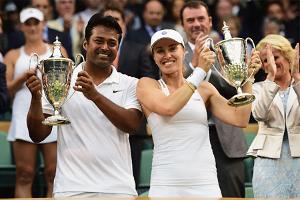
Leander Paes with his Swiss partner Martina Hingis won the mixed doubles title at Wimbledon. (Getty Image)
London :
A vintage Leander Paes clinched his 16th Grand Slam trophy, winning the mixed doubles event of the Wimbledon Championship with legendary Martina Hingis after a dominating win over Alexander Peya and Timea Babos, here today.
Seventh seed Indo-Swiss pair drubbed the fifth seed Austrian-Hungarian team 6-1 6-1 in the lop-sided summit clash which was over in just 40 minutes.
It was Paes’ eighth mixed doubles title and second with Hingis. They had won the Australian Open early this year.
42-year-old Paes has eight men’s doubles crowns in his Grand Slam collection.
Paes’ win capped an incredibly successful Wimbledon for India as the country took three titles this year. Sania Mirza won the women’s doubles and Saumit Nagal won the junior boys doubles trophy.
For Hingis, it was second title in as many days, having won the women’s doubles with Sania. Overall it was 18th Major title for the Swiss and third in mixed doubles.
Hingis was back on court less than 24 hours after that win with Sania but showed no sign of fatigue. She served well and was terrific at the net, complementing the Indian Pro.
Paes and Hingis literally toyed with Peya and Babos, who surprisingly failed to put any resistance.
In no time Paes and Hingis pocketed the first set as all they needed was 19 minutes to nose ahead. Two broke Babos in the fourth game and Peya in the sixth for a 5-1 cushion. Hingis served out the set when Paes smashed a volley winner.
Paes and Hingis kept the pressure on the Austrian- American combination right from the first game of the second set. Peya failed to negotiate a Paes return at deuce to hand the seventh seeds grabbed the opportunity to break them.
Babos’ could not handle a Hingis return and the Indo- Swiss pair got an early break. There was no stopping them from there as they raced to victory in less than one hour.
Babos failed to hold her serve even once and it was on her return that Paes hit a deft backhand volley winner to close the contest.
source: http://www.timesofindia.indiatimes.com / The Times of India / Home> Sports> Tennis> Wimbledon 2015 / by PTI / July 12th, 2015