Category Archives: Records, All

Calcuttan is kettlebell champ – 29-year-old gets top rank at Asian meet in Bangkok

SamratKOLKATA12oct2015

He is an expert in the long cycle category and he had 10 minutes to prove his strength. Beside him was a man ready to snatch. But the Calcutta boy came back with top billing and international prestige.

No, he is not a cyclist or a rugby player, nor was someone trying to grab something from him.

Meet 29-year-old MNC employee Samrat Sen who got the top ranking at the Thailand Kettlebell Meet (long cycle category) on October 10.

The annual event was held as part of Asia Fitness Convention at the Bangkok International Trade and Exhibition Centre.

Participants from nine countries tested their strength at the self-sponsored event, sanctioned by the International Kettlebell and Fitness Federation (IKFF).

The Indian contingent of six did the country proud by winning the team jerk relay against Malaysia. Sen was part of it.

“This is the first time India won a gold in kettlebell relay abroad. In a relay, the four best lifters of each country lift double kettlebells (2 x16kg) for three minutes each for a total of 12 minutes,” he said.

“India and Malaysia were head-to-head but towards the end we edged past them in a thrilling victory.”

A resident of east Calcutta, off the EM Bypass, Sen is happy to have gained international recognition for a sport that very few know of in the city, except those who are into fitness and weight training.

Kettlebell is a weight-training programme where you have to lift cannonball-like equipment as many times (repetitions) as possible in a minimum of 10 minutes.

Sen clocked 85 reps with double 16kg kettlebells. The feat secured him the top seed in the IKFF rankings.

“In Thailand, one could compete under the long cycle (clean and jerk), snatch (one bell), jerk (two bells) and biathlon (a combination of jerk and snatch) categories,” Sen told Metro over the phone from Bangkok.

“Lifters, of every category, stood side by side and put their strength and endurance to test for 10 minutes. But there is a catch – for those 10 minutes you cannot keep the kettlebells on the ground. You have to hold on to them and keep doing the reps. It is also a test of mental strength and focus.”

The Calcutta lifter, who has never compromised with his weight training despite work pressure, said the competition was not just about appearing on stage and lifting the kettlebells. “It is also about how you lift them. One needs to follow the right technique and pacing and have tremendous cardiovascular fitness to succeed in this sport,” he said.

What started as a fitness regimen in 2012 soon turned into a passion for Sen. “I took up kettlebell training to improve my fitness levels, not to compete. I found it difficult to lift them even a few times, leave alone holding on to them for 10 minutes,” he said.

“But I would keep surfing online about the discipline… I came across international lifters who would lift the heaviest of kettlebells with absolute ease and clocked ridiculous number of reps in 10 minutes, hardly breaking into a sweat. That motivated me… with my coach Arnav Sarkar egging me on, I soon took up the sport seriously.”

What followed was one gruelling session of practice after another to make Sen “competition ready” – a disciplined life and a strict diet with little leisure or fun time.

“I do not go to a gym, but I train every day after returning from work. It’s extremely challenging after a stressful day… but once I get started, I know I will complete the whole routine.”

Sen allows himself to cheat once a week with some ice cream, cold drinks, a plate of tandoori chicken or a Chinese meal.

A kettlebell is a traditional Russian training tool that is used to develop full body conditioning and fitness. The first-ever Kettlebell meet in India was held in Calcutta at the Calcutta Rowing Club in 2013. It had only 15 participants. By February 2015, the Calcutta meet saw a surge in lifters with 30 putting their strength to test.

“The kettlebell sport community is a small but extremely tight-knit one… with lot of support and encouragement for new lifters,” Sen said.

My message for Samrat Sen is…. Tellttmetro@abpmail.com

source: http://www.telegraphindia.com / The Telegraph, Calcutta,India / Front Page> Calcutta> Story / by Chandreyee Ghose / Monday – October 12th, 2015
Danish tavern to be restored

FRUITS OF SERAMPORE INITIATIVE

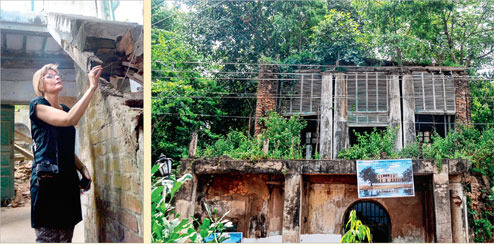
Bente Wolff, curator of the National Museum of Denmark, on Tuesday morning inspects the staircase of what was once the Denmark Tavern; (right) the Hooghly-facing facade of the tavern which will restored soon. Pictures by Pradip Sanyal

As our car tried to wriggle through vehicle-clogged Rishi Bankim Sarani of Serampore on Tuesday morning, I noticed that somebody has tried to prettify the miserable Subsidiary Correctional Home opened in 1803 by the rulers of this former Danish colony (1755 to 1845).

It was a modern institution based on humanitarian ideals and the then administration had taken into account the health problems, religions and caste system prevailing in India while planning it. And now its high walls are painted a blinding cobalt blue. A model park will soon be opened on the pavement in front of this jailhouse, and replicas of Chhota Bheem and other such cuties have been installed there.

In a few minutes we arrived at the ruins of what was once the double-storeyed Denmark Tavern & Hotel, where a ground-breaking puja was to be performed as the National Museum of Denmark will take it up for restoration. It is on the banks of the Hooghly, and Nishan ghat in front of it lies on the main axis connecting the main landing place near the ghat with the Government House, the seat of the former Danish government.

The museum had launched the Serampore Initiative in 2012 and took up the restoration of St. Olav’s Church (1806), whose steeple can be seen from Barrackpore on the opposite bank of the Hooghly; the south gate, once the guard house and used as a police lock-up as well facing Tin bazaar, then the main market; the main gate of the compound that houses the sub-divisional court.

It has acted in an advisory role in the restoration of what was once the old single-storeyed, colonnaded Danish Government House (1771) or Governor’s House. This compound dates back to 1755, when the Danish Asiatic Society Company established a trading post in Serampore.

The West Bengal Heritage Commission, which had taken up restoration of the Governor’s House, now exists only in name – most restoration work has come to a standstill. And the state government has made it clear built heritage is not uppermost on its mind.

However, Bente Wolff, curator, National Museum of Denmark, who is here to inspect the work being done by conservation architect Manish Chakraborti under the supervision of Intach, has good news.

Wolff has visited this town several times since the Serampore Initiative was launched and spends much of her time in the corridors of power to keep the dialogue with the government going. She has been in and out of Nabanna and the Chinsurah district magistrate’s office, and she has been informed that a tender will be floated soon for the last phase of the restoration work on the Governor’s House.

The cost of the ongoing projects: St. Olav’s Church and the South gate will be around Rs 3.5 crore when they are completed early 2016; the Denmark Tavern will be Rs 2.5 crore at least. The cost of restoring the main gate and some upgrading of the square in front of St. Olav’s Church and the court compound has not been estimated yet.

Wolff said the final phase of the Government House was kept in abeyance for a long time and its plinth will have to be constructed. An effort will be made to free the natural ventilation system. The government election building between the Government House and the South gate had to be demolished, which was not an easy task.

About Denmark Tavern & Hotel, Wolff said a painting of the establishment dating back to 1790 exists. The tavern found a mention in the March 1786 issue of Calcutta Gazette. According to the news item, Mr Parr, former owner of London Tavern, opened the Denmark Tavern & Hotel in the upper-roomed house near the flagstaff in Serampore.

It had a billiard table and coffee room, drinks were served and it did catering for wealthy people. The exact location of the hostelry was not known, but after examining archival sources, historian Simon Rasten came to the conclusion that it was adjacent to the SDO’s residence.

The rear section of this pile of bricks was used by the police, and a sign on the gateway reads Serampore Emergency Force Line, West Bengal Police. Once restoration work is done it will be handed over to the tourism department of the West Bengal government, which is expected to turn it into a coffee shop.

Chakraborti says it will take one-and-a-half months to clean the debris, and work will start in December. The central space will be an atrium for light and air, and accommodation for five to six guests will be provided. The Danish architect, Flemming Aalund, will be here in November to fine tune the work done.

G.M. Kapur, state convener of Intach, says he hopes this will become a nodal point and catalyst for such restoration projects and give a fillip to tourism in West Bengal.

The dilapidated main gate of the sub-divisional court dates from the late 18th century and has a high historic significance as part of the shared Indian-Danish heritage. Early drawings and photographs exist of the gate. These are being used for the restoration project. The cost will be defrayed by the National Museum of Denmark, and it will be reconstructed complete with a pediment and rustication to the original appearance based on verified evidence in 1851.

Restoration of St. Olav’s Church is in the last stages. The timber of the roofs in the ceiling has been replaced with steel beams and it will be opened for service next February. This is the historic core of the town, and the bus terminus is being relocated. Ideally, the square in front of the church should be cleared of the heart-shaped enclosure. The trees that obstruct the view should be transplanted elsewhere for a clear view of the magnificent church.

source: http://www.telegraphindia.com / The Telegraph, Calcutta,India / Front Page> Calcutta> Story / by Soumitra Das / Thursday – October 08th, 2015

Historian tips for Hooghly heritage

Kolkata :

The Hooghly isn’t just an Indian river but belongs to the world, historian and international authority on heritage conservation Philip Davies said at a seminar on heritage based urban development for the Hooghly riverfront held in the city on Wednesday.

Referring to the former European colonial posts—the Portuguese settlement in Bandel, Dutch in Chinsurah, French in Chandannagore, Danish in Serampore and Engligh in Barrackpore—along an 80-km stretch of the river’s western bank, Davies said the West Bengal government could source funds from the European Union as well as the World Monument Fund to revitalize these heritage precincts.

“The built heritage of West Bengal is greater than the entire United States and can be a powerful economic driver for the state,” Davies said while pointing out that much of it was crumbling and needed immediate repairs.

Conservation architect Manish Chakraborti agreed that the Hooghly riverfront heritage had an outstanding universal value and felt the way forward was to put it on the Unesco tentative list for world heritage sites. “Once it is on the list, the goal will be set. We can all then strive to achieve it,” he reasoned.

But stitching together a site that extends nearly 80 km along the river bank and covers Dalhousie Square, the central business district of a bustling metropolis like Kolkata, isn’t easy. This is particularly so about Kolkata and Bengal where things move at a snail’s pace.

Davies and architect Partha Ranjan Das have had a taste of it in the past. While it took Moe Chiba, the section chief and programme specialist (culture) Unesco, nine years to bring all stakeholders, including Kolkata Port Trust, Railways and PWD, on a single platform, Davies had prepared a blueprint for restoration and development of the Strand Warehouses in Kolkata 12 years ago but it is yet to take off. Das, too, had prepared a land use development plan for the entire heritage stretch along Hooghly but it has been gathering dust as well.

“There has been enough talk. It is time for decisive action,” Davies said at the seminar organized jointly by Unesco, the state government and non-government organization Indian Heritage Cities Network. “The inertia here is frustrating when compared to what is happening elsewhere. Kolkata has been extremely slow in taking advantage of its heritage resources. The delay could lead to destruction of what is unique. Already, one of the warehouses has been lost. Letting the warehouses rot is a dreadful waste of opportunity. In the past 50 years, they could have fetched crores of rupees in income and generated many jobs. Political will is needed to drive such an initiative. The involvement of chief minister and mayor is crucial,” he said.

While the heritage precincts in the erstwhile colonies have been identified and some restoration work funded by Dutch and Danish governments has already begun, Davies suggested that one of the options to fund the initiative could be to use cross-subsidy.

“There are areas along the riverbank that can be developed by private parties. The development will be in sync with the overall master plan. The funds generated from these projects can go into restoring the heritage zones and bringing them back to life,” he said.

source: http://www.timesofindia.indiatimes.com / The Times of India / News Home> City> Kolkata / TNN / October 04th, 2015

ISI faculty bags Bhatnagar award for maths breakthrough

Kolkata :

Mathematicians all over the world have been trying to solve a 150-year-old problem, popularly called the Holy Grail of maths, and a city mathematician has just been able to give a major insight into it. Ritabrata Munshi has stunned the world and no wonder, he has bagged the Shanti Swarup Bhatnagar award.

A number theorist, Munshi, who has taken lien from TIFR, Mumbai, to join his alma mater Indian Statistical Institute as faculty, seemed unfazed by all this adulation. In fact, one could sense an urgency in his voice, an urge to carry on with the third degree of the Lindelof hypothesis, which is the route that he is taking along with his co-researchers abroad to finally progress on the line of the ever elusive Reimann hypothesis that was formulated in 1859 by Bernhard Riemann.

It took 60 years to solve the first degree of the L theory and progress on to the second degree that again took 35 years to be resolved. Finally, Munshi has been able to make a global start on the third degree and make a considerable progress.

“The properties of prime numbers, their distribution pattern in the realm of the abstract simply bowled me over and I made up my mind to study maths after plus two despite ranking 25th in the WBJEE and under 400 in IITJEE,” said Munshi. He studied B Stat and M Stat at ISI and then enrolled for Phd at the Princeton University under legendary mathematician Andrew Wiles. He enrolled at Rutgers University, US, for his post doctoral degree.

source: http://www.timesofindia.indiatimes.com / Times of India / News Home> City> Kolkata / by Jhimli Mukherjee Pandey, TNN / September 30th, 2015

Indo-Bangla project on Partition

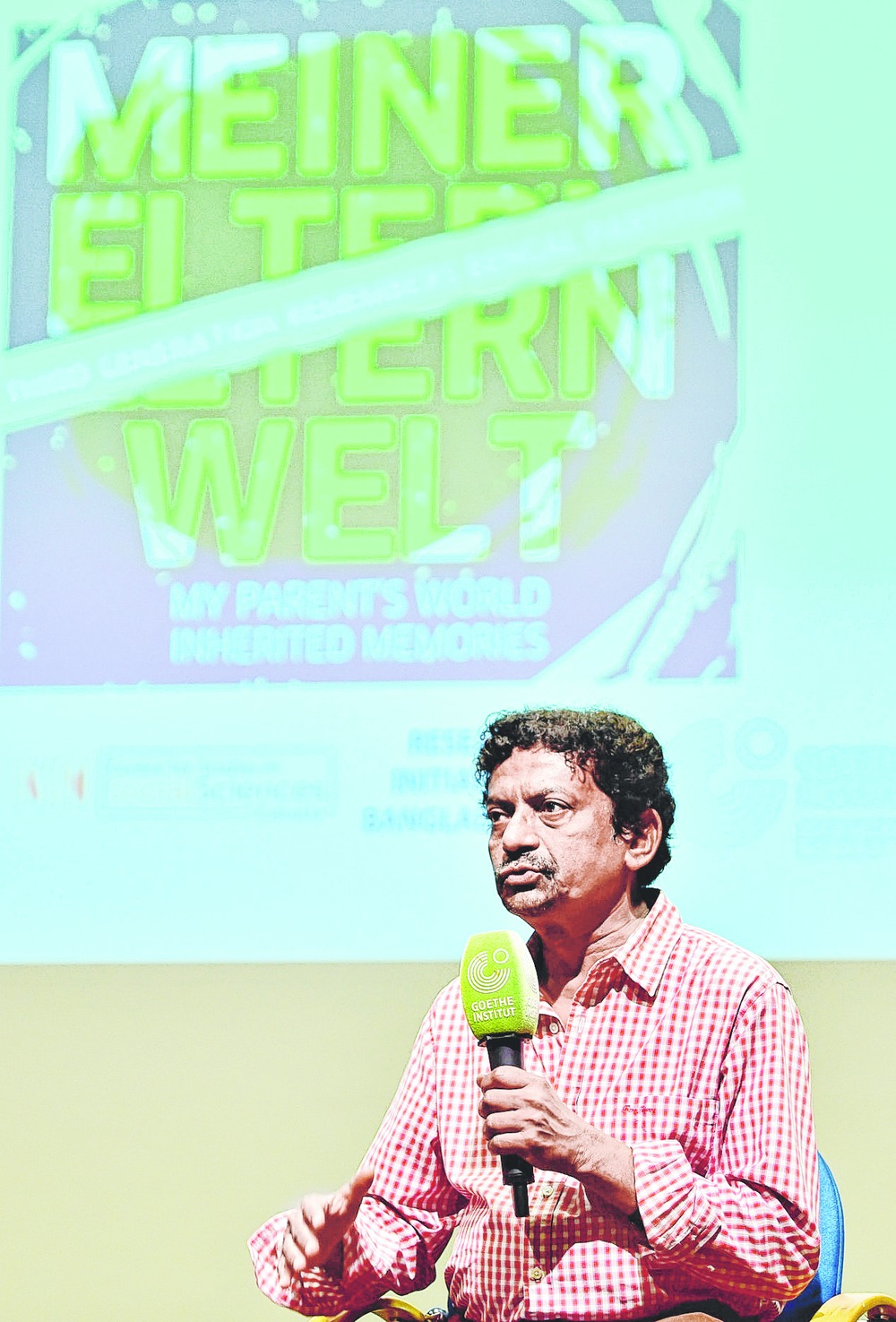
Goutam Ghose at the conference in Max Mueller Bhavan. (Anindya Shankar Ray)

Director Goutam Ghose often wondered as a 10-year-old why his friends could visit their desher bari during vacations while he could not.

“I remember asking my mother if we have a gramer bari. She would say, ‘achhe, but it is in East Pakistan and we don’t have easy access’,” Ghose said during a recent conference at Max Mueller Bhavan.

The conference kicked off a five-month Indo-Bangladesh project titled My Parent’s World – Inherited Memories, organised by Calcutta and Dhaka’s Goethe Institut.

Ghose narrated how he used to accompany his grandmother to refugee colonies in the Jadavpur and Bijoygarh areas to meet relatives. “I remember my grandmother telling me stories…. When I became a filmmaker, I thought let’s connect. Two races had been divided for a wrong reason. I wanted to go back to my ancestral home and make a film. So I made Padma Nadir Majhi and my father was really happy. He said he was happy that I had chosen the subject as I could go and shoot near the Padma.”

The conference saw speakers like Andrea Zemskov-Zuge from the Berghoff Foundation, Berlin; Manas Ray of the Centre for Studies in Social Sciences, Calcutta; Meghna Guhathakurta, executive director, Research Initiatives, Bangladesh, which works with the marginalised community; and former BBC journalist Nazes Afroz.

Ghose spoke about a village (Chakpanital) where he shot for his upcoming Indo-Bangla film – Shonkhochil. It is a village where there are houses of both sides and people live together.

“I find this two-nation theory absurd… that too on the basis of religion. While making the film, I was studying the Radcliffe Line. It is so strange… how on a huge water body you find a zigzag line separating two nations. Same people, same language, same culture divided by an absurd border. Why did Gandhi not launch a ‘Stop Partition Movement’ like the Quit India Movement?”

As part of the project, eight students from Calcutta travelled to Goethe Institut, Bangladesh, to meet eight students there. Together they will attend conferences and workshops on commemorative culture. “Once both sets of students are trained in interviewing techniques, they will interview third generation families of Partition on both sides of the border. People would be selected to travel to the country of their ancestors,” said Judith Mirschberger, director, Goethe Institut, Bangladesh. “So, someone living in Calcutta would travel to Bangladesh and vice versa to trace his/her family roots with these students.”

The project will end with the launch of a web platform where all interviews and background information will be put up.

From Shahid Minar in Dhaka to a memorial in Bhopal by a Dutch sculptor for victims of the Bhopal gas tragedy, Nazes Afroz, who is also the coordinator of the project, presented a slide show of pictures, while talking on the topic “Visual tool is very important in culture of memory”.

It was after a visit to Dhaka in February 2014 for an exhibition that Friso Maecker, the director of Goethe-Institut, Calcutta, started thinking about the possibility of working together. “I remember we were shooting a documentary film, which was about moving from one place to another…. There’s not been much research on the influence of Partition on third generation people in India as well as in Bangladesh…. Also from the viewpoint of an outsider… it is quite astounding that there is no memorial or place to remember the migration of more than eight million people… Which is why we started the project.”

source: http://www.telegraphindia.com / The Telegraph, Calcutta,India / Front Page> Calcutta> Story / by Malancha Dasgupta / Tuesday – September 15th, 2015

BSF organises exhibitions at schools in Kolkata as part of Golden Jubilee celebrations

BSFkolkata11sept2015

Kolkata :

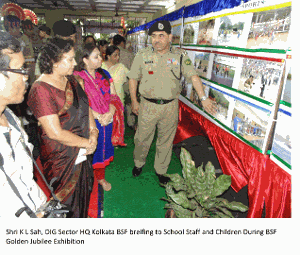
As part of the Border Security Force’s Golden Jubilee celebrations, the South Bengal Frontier is organizing exhibitions at schools across Kolkata and neighbouring districts to raise awareness on the activities of the border guarding force among students and teachers.

On Thursday, an exhibition was held at the St Joan’s School in Salt Lake where weapons and surveillance equipment were displayed. A photo exhibition also highlighted the force’s achievements over the last 50 years.

“The BSF’s history, participation in the Republic Day parades, training activities and roles played by the air, water and artillery wings were explained to hundreds of students at the school during the day. High-tech communications equipment systems were also displayed. BSF soliders and mahila constables briefed students about the functions of various weapons and equipment used by the BSF during war and peace. The exhibition was inaugurated by K L Sah, DIG, Sector HQ Kolkata, in the presence of Devyani Ghosh, principal and Lucia Ghosh, vice principal and over a thousand students,” a senior officer said.

Sah and S P Tiwari, DIG, Frontier HQ South Bengal briefed students about the genesis of the force, its role and task, duties and how effectively BSF sentinels guard the border from Kashmir to Kutch and Sundarbans to Mizoram with utmost professionalism. A short film on the role and task of the BSF, its functioning and parade at the Joint Retreat Ceremony of Indo-Bangladesh Border at Petrapole and Indo-Pakistan Border at Attari was also screened for students.

“The initiative has been taken to inculcate patriotic spirit in young school children and to make them aware about India’s borders and duties performed by the BSF. The patriotic tunes played by the BSF brass band were highly appreciated by the young children. The next programme will be organized by BSF on September 16 at The Heritage School,” the officer added.

source: http://www.timesofindia.indiatimes.com / The Times of India / News Home> City> Kolkata / by Jayanta Gupta, TNN / September 10th, 2015

Neglected Coolie Darwaza turns into pile of rubble

Kolkata :

St George’s Gate, once a prominent structure of the city after which even a road was named, was long lost. And now, even its remains are sinking into oblivion.

The southern gateway to Fort William near the northern slope of Kidderpore bridge, the gate, also known as Coolie Darwaza, was abandoned by military authorities when the passageway was converted into a civilian road — St George’s Gate Road. The new St George’s Gate of Fort William was built a little west, near Prinsep Ghat.

TOI on Thursday found only the pillar on the side of southern flank partly intact, overgrown weeds covering most part of it. The other part on the northern side has vanished. Only its broken pieces are strewn all over the place. Who razed it? When was it razed? No one ever bothered to know. It is not known whether it was razed when the elevated approach road of Vidyasagar Setu was constructed.

The pathetic condition of the gate was brought to the notice of Archaeological Survey of India (ASI) by Anthony Khatchaturian, a passionate heritage activist. ASI regional director (east) Dr P K Mishra immediately took note of it and inquired about it. He also wrote to GoC Bengal Area, requesting him to look into how this important heritage gate got destroyed.

“Historically, it is a very important architecture. It would be great if we could restore the structure,” said Mishra. There is a detailed reference of St George’s Gate in M L Augustine’s book ‘Fort William: Calcutta’s Crowning Glory’.

“I was surprised how such a beautiful structure is being damaged systematically. I was surprised to find the signs of destruction still intact across the road. There must be some serious attempt to restore the structure and rebuild the destroyed one,” said Anthony, a passionate save heritage campaigner with an Armenian origin.

source: http://www.timesofindia.indiatimes.com / The Times of India / News Home> City> Kolkata / by Krishnendu Bandyopahyay, TNN / September 11th, 2015

The Bengal paradox – Why the population growth rate in the state is low despite few noticeable advances on the economic and social fronts and what Mamata can learn from it

Sept. 6: Bengal has turned conventional economic wisdom on its head.

Data released by the Centre last month revealed that Bengal had one of the lowest population growth rates, 13.8 per cent, in the country for the 2001-11 decade. This is of a piece with the number thrown up earlier in 2013 for Bengal’s total fertility rate, which placed the state at the bottom of the table.

This development has taken place without being accompanied by the level of economic and social progress that has so far been seen to create conditions for low population growth.

Saswata Ghosh, economist and mathematical demographer at the Institute of Development Studies, Calcutta, said: “The basics in economics tell us that population growth rates tend to stabilise with rise in income and social well-being. We have seen such trends in the advanced economies of Europe around the 1960s and 1970s.”

Japan’s experience has been the same.

Bengal bucks that trend. The provisional socio-economic caste census (SECC) data of 2011 paints a dismal picture of rural Bengal: one-third of the population are illiterate and nearly three-fifths live in kuchcha houses and three-fifths earn their livelihood through manual labour. The breadwinner in 82 per cent of the households makes less than Rs 5,000 a month.

The situation of Odisha is somewhat similar. The state has witnessed a decadal population growth rate of 14 per cent but the socio-economic conditions of the rural population cannot be regarded as favourable for such a dip in the population growth rates.

“This is a demographic puzzle and I think it calls for more research,” said Anup Sinha, professor of economics at IIM Calcutta.

According to him, a proper social safety net can push down fertility rates – as it has been witnessed in various European countries – because people think that the government will take care of them in their old age. India is far from a situation like that.

Given the uncertainty about the future and the widespread misery, conventional wisdom expects the poor to have more children in the hope of augmenting future income. Besides, the lower probability of survival of all the kids also encourage the poor to procreate more.

But the finding from Bengal is different, as the total fertility rate has dipped. This rate is defined as the average number of children a woman would have over her reproductive life. Bengal’s fertility rate of 1.6 is not only below the national average but also lower than the replacement rate of 2.1 children per woman. This rate is taken to be 2.1 with the notion that a couple will be replaced by two children; 0.1 is added to factor in infertility among some women.

“The dip in the fertility rate in urban areas in Bengal is more to do with aspirations for their children, where parents are reducing fertility in search of social uplift. But in rural areas, the decline is distress-driven, as there are fears that the next child may starve to death,” said Ghosh, who has been tracking the trend for some time.

This sense of insecurity can be understood in the context of results from the census. Some 70 per cent of the rural households are landless, around 47 per cent of the rural population do not have primary education (national average of 50 per cent) and the percentage of graduates in the state is less than the national average and all the western and southern states.

The low decadal population growth might make Bengal’s current administrators happy as it means less strain on scarce public and private resources. As for the state’s poor social and economic scores, Mamata Banerjee can well blame her predecessor, the Left Front, as the survey related to the years to 2011, the year she took charge.

Several economists, however, said the trend of deprivation seen during Left rule doesn’t seem to have changed.

“Had there been a significant improvement in the situation after 2011, it would have been discernible to even non-expert eyes…. At least I haven’t seen any major changes in terms of job opportunities or education,” said Sinha.

Economists may wait for numbers, but till the next such survey results are out, Mamata can keep claiming that the Left destroyed both industry and agriculture, but the tables tucked in the voluminous report have several lessons for the chief minister.

Governments in Bengal have boasted about rapid industrialisation, never producing the numbers to support their claims. The provisional SECC data show that only 8.5 per cent of the rural population have salaried jobs -evidence of the lack of industrialisation. Agriculture offers a picture that is as gloomy: only 19 per cent of the rural population – against a national average of 30 per cent – earn their main livelihood from cultivation.

If more than 58 per cent of a state’s rural population earn their primary living through manual casual labour – which means they do not use skills and employment is irregular – there is little doubt that the state needs industrialisation for which availability of land is a precondition. But Mamata’s stated stand is against government acquisition of land.

“If the present government sticks to its stand on land, the next census will produce a more dismal picture of the state,” said an city-based economist who did not wish to be named.

Over the past few years, the Mamata government has been claiming that Bengal is ahead of the national average in terms of all the major indicators like the growth rate of the economy and the rate of growth in industry, agriculture and services.

“From a small base, one can achieve higher growth numbers. Besides, the national average includes other laggard states. So, clocking a higher than national average is no big deal. Instead of patting herself on the back for what she has achieved, she should take a lesson from these numbers and change her approach,” said the economist.

source: http://www.telegraphindia.com / The Telegraph, Calcutta,India / Front Page> Story / by Devadeep Purohit / Monday – September 07th, 2015

Mecca of rare books

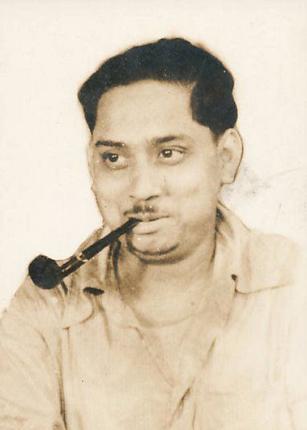
Nirmal Chandra Kumar / Special Arrangement / The Hindu

Nirmal Kumar was probably the first Indian bookseller to publish a rare books catalogue in the best tradition of bespoke antiquarians around the world.

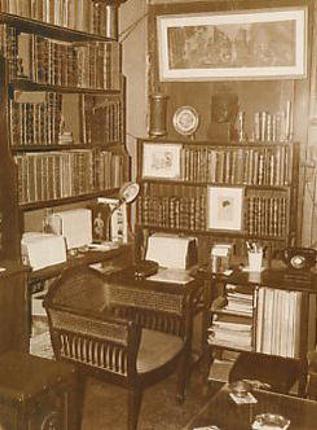
One can only imagine it today: a set of cosy rooms in an ancestral home on a busy street in Calcutta in the 1950s resembling a finely appointed private library with a complex of bookcases and furniture that was actually an antiquarian bookshop one could walk into for a browse and for long conversations with its bohemian-bibliophile owner. His name was Nirmal Chandra Kumar, and his bookshop was called, simply, Kumars. From 1945 until his death in 76, Kumar ran a rare bookshop from his home. It took up several rooms and the stock ranged widely, from fine bindings to prints to maps.

Kumar's bookshop / Special arrangement / The Hindu
Kumar’s bookshop / Special arrangement / The Hindu

I first learnt about Kumar and his bookshop when I stumbled upon a blog by his son, Aloke Kumar, on his father’s bookshop and its influence on the life and work of many Bengali artists and intellectuals of that time who were all regulars at Kumars. I was delighted to discover there had once been such a marvellous bookshop in India — a genuine antiquarian bookshop in a country where antiquarian bookselling and buying is not an ingrained tradition. In this sense, Kumar was no doubt a maverick and thank God for that. Eager to know more, I managed to contact his son, Professor Aloke Kumar, for a brief chat on the phone.

In one of his writings, Kumar describes his father: “a stocky Bengali… he wore a white collared shirt, half-sleeved, and a lungi; his formal dress was a dhoti and kurta with pump shoes. Can you imagine somebody wearing this dress and smoking a pipe or a Davidus cigar sitting in his library surrounded by books?” Kumar was probably the first Indian bookseller to publish a rare books catalogue in the long tradition of all bespoke antiquarian booksellers around the world, especially the legends Kumar had done business with, Quaritch and Maggs. The city’s bibliophiles, artists, luminaries, antiquarians and bohemians all frequented Kumars. Satyajit Ray, a regular browser here, consulted Kumar when he was making The Chess Players: in a London book auction, Kumar had bid for and won a priceless scrapbook on the Mutiny.

Ray went on to pay his own little tribute to Kumar in the character of the encyclopaedic Sidhujata in the Feluda stories. Well-known antiquarian Sir Ashutosh Mukherjee was also a customer. When he donated thousands of rare books to the National Library, several books in the collection had once come from Kumars. “In the early 1940s,” writes Aloke Kumar, “rare book collection was in a dismal, class-bound rut. The famous rare book shop Cambray… was already fading, Thacker and Spink was alive, but there were hardly any rare books… Kumar helped to change all that. His enthusiasms included the then unheralded British painters, Thomas and William Daniel, to be re-introduced to Calcutta once more. He bought the rare elephantine folio of 144 Views of T&W Daniell from Sotheby’s to ship it to Calcutta.”

What was just as remarkable about Kumar — reading his son’s reflections — was how generously and freely he gave to his customers, friends and family even though the bookshop wasn’t a profitable business and . It just broke even most of the time, but Kumar, right in the middle of his struggles to keep the bookshop afloat and provide care for the needs of his own family, invited his parents (who had faced a financial loss) to come live with him. He was also apparently a gourmet and “organized the very best of fine cooking to be presented to his friends. Sometimes such delicacies that you would only find in the pages of some rare Mughal document.”

Aloke recalls a regular errand for his father: being sent off with books in hand to be delivered to Satyajit Ray; he also remembers how cautious everyone in the house was about handling the books, tiptoeing around the shelves, careful not to disturb them. One of the things that broke Kumar’s heart was the sharp practice in the antiquarian trade in the late 1970s of breaking up rare books, atlases and maps to make a bigger profit. Some of his fellow booksellers had begun to buy books with rare prints and maps and tear them up in order to sell each print or map individually. You made more money this way than when you sold the set or the atlas as a whole.

“Kumar did not want to be a part of this and lost out,” says Aloke. “And it was with a sense of bowing to the inevitable that Kumars mentally gave up. Nirmal Kumar died in 1976 and with his death, the literary world lost a sweet and genuinely unselfish man who freely gave of his vast knowledge and delighted in the achievements of those he influenced so profoundly.”

My interest in this impassioned, unsung bookman and his cherished antiquarian bookshop is not so much for the luminaries who once buzzed around it as much as for imagining the regular traffic of ordinary bibliophiles, scholars, and collectors for whom Kumars must have been a Mecca of fine and rare books.

Pradeep Sebastian is a bibliophile, columnist and critic.

source: http://www.thehindu.com / The Hindu / Home> Opinion> Columns> Pradeep Sebastian / September 05th, 2015

Timely act saves heritage mansion

Kolkata :

A heritage building that had been granted the highest degree of protection to conserve its historical and architectural value was being systematically destroyed on the sly till locals alerted Kolkata Municipal Corporation (KMC) authorities. The latter has filed an FIR. Involvement of local politicians, musclemen and a section of police are suspected.

Located between Howrah bridge and Nimtala Ghat, Moribund House on 65/2 Strand Road is a 19th century single storey mansion with Roman Tuscan columns. It was once part of Rani Rashmoni Estate and was registered in the name of her husband Rajchandra Das. It was in this mansion that filmmaker Goutam Ghose shot a portion of the 1988 National Award winning film ‘Antarjali Jatra’.

Listed as Grade I heritage structure by KMC in 2009, no external change is permissible in the building. The grading also restricts the building’s use. But the building has fallen into disrepair following years of neglect. It would have been ground to dust had not KMC acted promptly following a tip-off. The compound had been shuttered by corrugated sheets to allow the demolition.

When TOI visited the building, it was in absolute ruins with evidence of fresh destruction everywhere. At least two columns lay in pieces on floor. Another was being hammered down when a visit by the police team following the KMC complaint forced a cease-work. Parts of the wall and roof have also been systematically pulled down to trigger a collapse of the entire structure.

The project management unit of KMC that oversees heritage buildings in the city filed a general diary (GD-PMU/108 15-16) with Jorabagan police station on August 25, 2015. In the complaint, the civic authority stated that the Grade I heritage building was being intentionally demolished.

“It is reported from local people that the house is being intentionally and systematically damaged by persons staying there which is illegal and unlawful. Please take necessary steps and keep strict vigil to prevent any sort of damage to the historical and heritage structure. This may be treated as FIR,” the complaint by the KMC PMU department stated.

The manner in which the demolition was being carried out pointed to the involvement of local politicians and musclemen. A few locals also hinted as much saying reputable builders would not have dared to act in that manner and get incriminated. The involvement of local cops is not ruled out wither. When TOI visited the police station, the cops initially feigned ignorance about the threat to any heritage building under its jurisdiction and acknowledged only when confronted with all details.

“I am totally disgusted at the state of affairs. We just had one Grade 1 building, the Ghoolam Rasul Mosque on Shamsul Huda Road, demolished without a murmur. No action was taken against anyone. Now, a second Grade I listed building is being demolished. At least some visible action should be taken,” said heritage activist GM Kapur.

Mayor Sovan Chatterjee has asked the KMC officials to keep a strict vigil on the building. “No one has the right to alter anything in a Grade-I heritage building, leave alone pulling it down. We have lodged a complaint. Let police investigate who are the culprits,” he said.

source: http://www.timesofindia.indiatimes.com / The Times of India / News Home> City> Kolkata / by Saikat Ray & Subhro Niyogi, TNN / September 04th, 2015